
 Mysteries
Mysteries
Mysteries  Weird Stuff
 10 Weirdly Specific Conspiracy Theories from the 1990s
 Movies and TV
 10 Characters Who Never Forgot a Grudge
 Technology
 10 Historical Inventions That Changed War Forever
 Humans
 10 Everyday Concepts That Are Shockingly Modern
 Animals
 10 Animals Everyone Gets Wrong
 Weird Stuff
 10 Bizarre Superstitions That Drive the Stock Market
 Movies and TV
 10 Films That Were Praised but Got History Wrong
 Our World
 10 Major Cities Being Swallowed by the Earth
 History
 10 Times Saying the Wrong Thing Became a Death Sentence
Mysteries 10 Fresh Clues That Might Crack Old Mysteries
Weird Stuff 10 Weirdly Specific Conspiracy Theories from the 1990s
Movies and TV 10 Characters Who Never Forgot a Grudge
Who's Behind Listverse?

Jamie Frater
Head Editor
Jamie founded Listverse due to an insatiable desire to share fascinating, obscure, and bizarre facts. He has been a guest speaker on numerous national radio and television stations and is a five time published author.
More About Us
Technology 10 Historical Inventions That Changed War Forever
Humans 10 Everyday Concepts That Are Shockingly Modern
Animals 10 Animals Everyone Gets Wrong
Weird Stuff 10 Bizarre Superstitions That Drive the Stock Market
Movies and TV 10 Films That Were Praised but Got History Wrong
Our World 10 Major Cities Being Swallowed by the Earth
History 10 Times Saying the Wrong Thing Became a Death Sentence
Top 10 Most Disgusting Parasites
I have not met many individuals who enjoy slimy and creepy crawly things. Amongst some of the nasty things that nature provides our planet with some are grouped into the category of parasites. We hate them, but they sure love us! We have to hand it to science and commend those who have chosen to study these types of organisms. So, out of respect for entomologists everywhere and to gross out those of you who fit into the category of “slimy and creepy crawly” haters I dedicate this list to you. This list is in no particular order of disgustingness and this list does not, in any way, cover all classes and categories of parasites nor does it cover all information available concerning the parasites mentioned. This list is merely a summary.
10
Bedbugs

Some of you may not know that bedbugs are actually more than just a cute little good night rhyme that your parents said to you before you went to sleep. They are as real as the other 9 entries. While they are not the worst or deadliest on the list they certainly have their share of difficulties.
Bedbugs have been on the rise lately and there are several theories as to why. Some point to increased international travel while others blame the lack of bedbug killing insecticides, most popularly DDT as well as the increasing use of gel-based insecticides. These gel-based insecticides are completely ineffective against bedbugs since bedbugs do not feed on anything other than blood. Control and elimination can only be achieved through repeated sprayings with an appropriate bug killer by a professional exterminator.
The bedbug is like a small tick that typically lives in and around the area of the mattress. They feed mostly during the night although they have been known to feed during any hour of the day. Due to their small size the bedbug can hide in mattresses, mattress seams, baseboards, headboards, screw holes, carpets, cracks in walls, bedroom clutter; practically anywhere in or around the bedroom. Bedbugs have been known to nest and walk as far as 100 feet in order to feed on their host.
The bites they leave are usually mistaken as mosquito or spider bite since the irritation and redness is very much the same. There is no scientific evidence that they spread disease although the bite sites may become infected due to scratching the bites. The misdiagnosis of the bites can also lead to a dramatic increase in infestation numbers before detection. The worst problems with bedbug infestations are not physical, but psychological. Once bedbugs are detected the host usually has heightened levels of anxiety, paranoia and fear.
Bedbugs are very difficult to detect and all too often a major infestation has occurred before detection. Their small size and elusive behavior only add to their difficult detection. Bedbugs are usually associated with lack of cleanliness and squalor, but this is not the case. Even the most posh and lavish hotels, apartments and homes have been infested with bedbugs. The bedbug can “hitch” a ride in clothes, luggage, purses, back packs and essentially anything that a small apple seed sized insect can work its way into. They are flat like a tick and can go over a year without feeding and still remain alive.
Another reason why bedbugs are a huge problem, aside from their detection difficulty and ability to live without sustenance for long periods of time, is their ability to breed rapidly. The female can lay over 500 eggs during a lifetime. Once the eggs hatch the bedbugs will immediately begin to feed. They usually feed once every several days and will pass through 5 molting stages, lasting 5 weeks before becoming a mature adult capable of breeding.
9
Lice
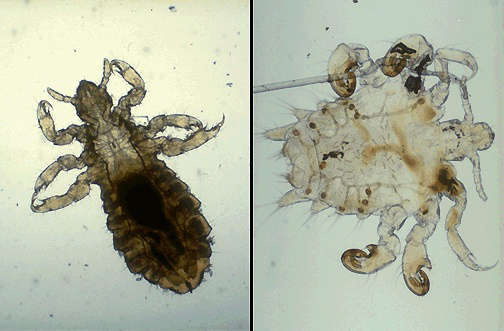
The human louse is an epidemic affecting both children and adults though children seem to be more susceptible to infestation. African Americans are less likely to get lice because of the characteristics of their hair. Other hair types seem to be more ideal and suitable to the louse.
There are many different types of lice. The most commonly known is the head louse though there is also the body louse and the pubic louse. These aforementioned lice species are the only ones that are solely reliant upon humans for blood. Other species exist, but are limited to other animals.
The life of the louse is somewhat short. The eggs will hatch within about 6-9 days after which the nymph will molt 3 times over a 7 day period before becoming an adult. The molted shells and egg shells remain attached to the hair near the scalp. The adults are very fast moving and will usually live for about a month while feeding on blood and continuing to breed and produce eggs. The female louse is able to produce between 7-12 eggs per day.
Lice are very little yet easily detectable. Noticeable itching and redness occurs around the infested area as well as the occasional pustule. A fine toothed comb or a louse comb can be used to capture eggs and the lice themselves. Over the counter and prescription medications can be used to rid the host of the lice. It is also advised that everyone within the household be checked for lice as well as recurrence is common.
8
Leeches
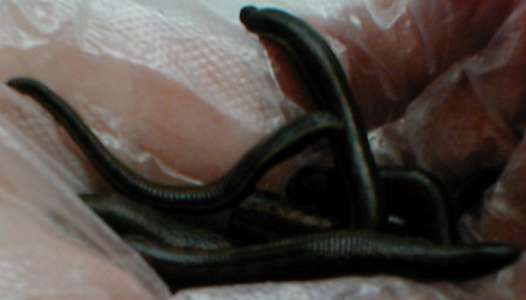
A common misconception surrounding leeches is that all of them are completely reliant on blood from animals and humans. Blood-seeking leeches are only one type of leech. Some species of leeches feed on invertebrates and do not live in the water, but on the moist earthen floor and, under more dry circumstances, underground. Leeches are segmented worms closely related to the common earthworm.
The sanguivorous, or blood-sucking, leech is most often found in still or slowly moving water, but can also be found on land. The usual method of attachment to a host is by waiting on the ground or at the bottom of the floor of a body of water. Here they spend their time sensing movement or changes in light patterns. Upon sensing a potential host the leech will waver its body to and fro attempting to “fish” for the host.
The leech will use the sucker part of its mouth and the jawed leech will use its many toothed jaw to create an incision on the host. Afterwards the leech will secrete mucus like substances in order to remain attached to the host. The leech then relaxes its body after using anti-coagulants and a histamine to prevent clotting of blood and also to prevent the blood from turning indigestible. This is the amazing attribute of leeches that aids in using them for medicinal purposes.
The wound is not as bad as you might think. It may become irritated and ooze blood and fluid for several hours, but loss of blood is minimal. Infections are rare and although allergic reactions do happen they are usually nothing to concern one’s self about.
7
Ticks
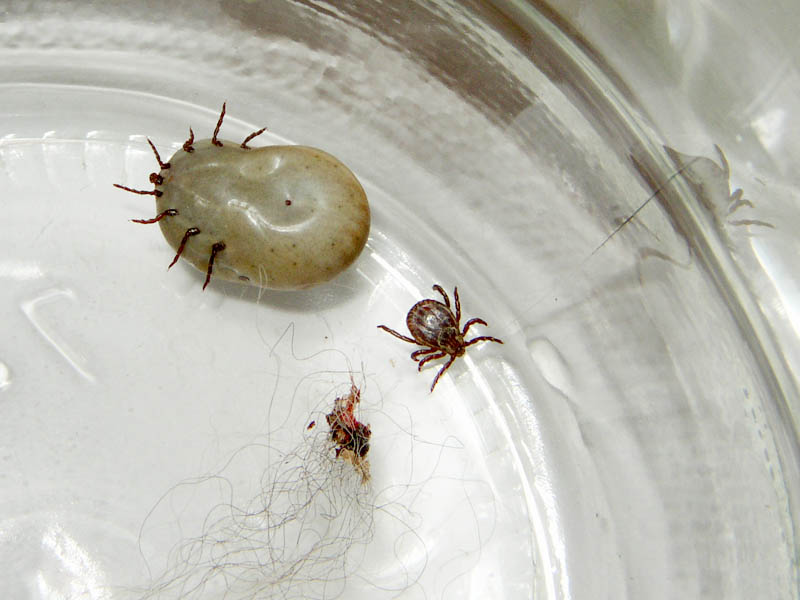
Ticks are classified as arachnids and there are many, many different varieties both hard and soft. The most commonly known are the black-legged tick, the lone star tick, the deer tick and the dog tick. The tick is capable of carrying diseases as well. The most well known are Rocky Mountain spotted fever and Lyme disease.
Ticks are usually found in areas with heavy underbrush and high weeds and grass as well as areas commonly traversed by deer and horses. The tick will wait in this type of environment as its host walks by where it will grab a hold and work its way toward a suitable area of the body, most often where an abundance of hair is present. On humans this is usually the scalp, but on other mammals this could be anywhere. This allows the tick to remain virtually undetected for several weeks as if gorges on the blood of the host.
Ticks have a fascinating lifecycle. There are three different types of ticks so far as the lifecycle is concerned. The one host female tick lives off of one single host for its entire life before dropping off and laying its eggs. Then there are the two host and three host ticks which live off of either two or three hosts in its lifecycle.
Many people have had ticks and many people have had to remove one. There are common misconceptions on how to remove ticks. Some people say to use the hot end of a match on the tick or spread a salve or petroleum jelly on the tick so that it will be unable to breathe and remove itself. These methods are both ineffective and unsafe as the tick could become agitated and regurgitate into the area in which it is attached thus increasing the possibility of disease or infection.
The best method of tick removal is to take a pair of tweezers and pinch as close as possible to the mouth of the tick, the point at which its head meets the area where the tick is lodged. Slowly and steadily pull the tick out. Avoid twisting or wrenching. After removal it is advised to either flush the tick down the toilet or put it in a container full of isopropyl alcohol to both kill it and preserve it just in case an illness befalls the host shortly after. This way it can be taken to a doctor and identified so that proper treatment can be administered.
6
Fleas

The flea is another common parasite. These things easily reproduce and can become a very big problem in only a short amount of time. Have you ever heard of The Black Plague? You can thank the flea for that.
Like the mosquito, fleas need blood from mammalian hosts in order to reproduce. Fleas will lay their eggs on the host which usually leads to an infestation of fleas originating around where the host most often resides, such as a pet’s sleeping area. Once the eggs hatch, typically within a few days to a few weeks, the larvae will spend their time in the larval stage consuming any available organic material such as dead skin cells and fecal remnants. The larval stage will last anywhere from 1 week to 2 weeks.
After three separate larval stages, the flea will create a silk-like cocoon and emerge after an additional 1-2 weeks. It is now time for the flea to find a host and begin providing blood for a new generation of offspring. In the small life of the flea, usually a few weeks, the female can lay several hundred eggs. This can lead to a severe infestation in almost no time at all.
The fleas are very versatile. Their bodies are flattened laterally to allow them to move easily on their host and also avoid being crushed. Their ability to jump is also a marvel. They have been known to jump over 100 times their body length. The fleas that typically bite humans are often cat fleas.
5
Mosquitoes
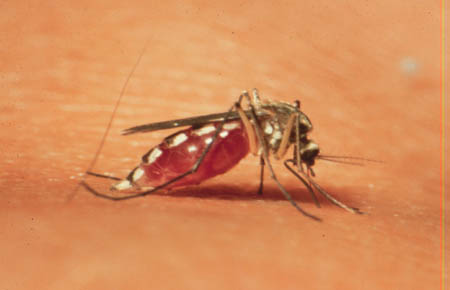
I am sure that most of us have been bitten by a mosquito before. These pesky flying insects are not only a nuisance but also a deadly health threat. They can carry many different types of parasites and diseases which cause conditions such as West Nile Virus, malaria, yellow fever and can even inject a parasite which causes elephantiasis. Mosquitoes are responsible for millions of deaths due to their ability to carry disease from host to host.
The mosquito needs blood in order to reproduce. Thus, it is the female of the species that is responsible for biting mammals. Interestingly enough, both the male and female mosquitoes regularly feed on nectar from flowers and fruits. However, the female requires the necessary proteins from blood to reproduce.
The mosquito’s life begins with the already mature female laying her eggs on fresh and stagnant water in groups of up to fifty. With enough blood she can produce these groups of eggs every three days for her entire lifetime. The female must lay her eggs in still standing water which is why it is recommended that you eliminate any free standing water around your property to minimize the possibility of a mosquito infestation.
Once the eggs have been laid they hatch in a mere 48 hour period. The larvae will live near the surface of the water anywhere from 1-2 weeks depending upon the temperature of the water in which they live. After this period they become pupa and will pupate in only a few days afterwards becoming adult mosquitoes.
The mosquito is attracted to a person’s body heat and also their scent, if you will. It is advised that you avoid heavy perfumes and colognes since they are attracted to sweet smells. However this is not a complete deterrent.
The female mosquito uses a complex proboscis coupled with an anti-coagulant within its saliva to draw blood from its host. Most often the host has no idea that it has been bitten until it is too late and the trademark itchy bump appears. These lesions are extremely itchy and easily irritated. Scratching can lead to infection so an anti-itch ointment should be applied to minimize the itch.
4
Mites
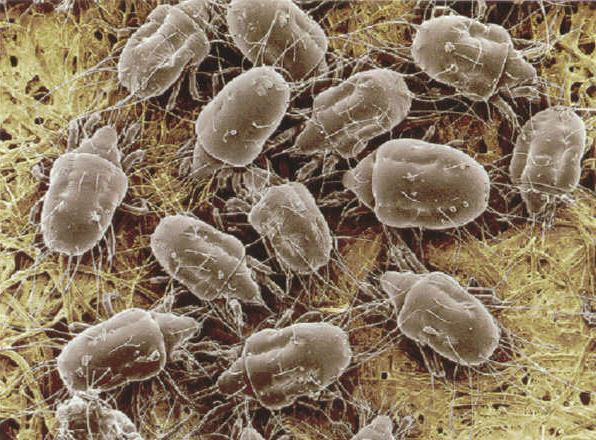
Mites are a very common type of organism. There are many classifications of mites including, but not limited to, dust mites, fowl mites, dog mites, deer mites, chigger mites and scabies mites just to name a few. There are even mites living on you right now called hair follicle mites that are feeding on the oily secretions from your hair and scalp, but don’t worry. These mites are a normal part of the living process for us humans and those of us with good hygiene will never even notice that they exist since they are microscopic and completely harmless. Most of the time mites do not pose any type of threat or problem for humans, but the mites will feed on the blood of humans if its usual host is unavailable.
The most common mites that cause problems for humans are scabies. These microscopic parasites can cause extreme itching and red lesions on infected areas as they live their lives in and on the skin. Often times the infection is diagnosed as parasitic dermatitis and can be easily treated with prescription topical ointments.
3
Human Botflies
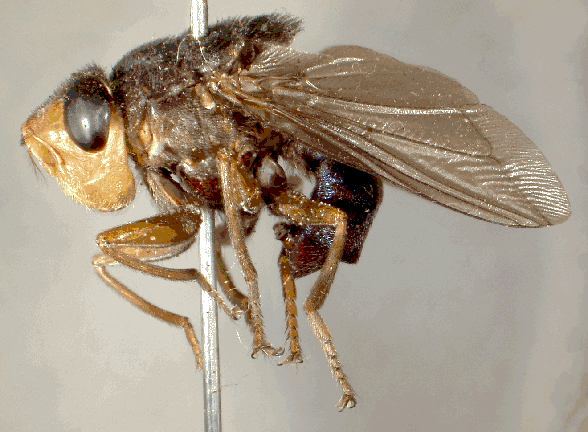
Botfly is a rather broad term given to any species of fly whose larvae live as parasites within the body of mammals. This can include anything from horses to sheep and deer and, as the title indicates, humans.
The human botfly maggot is contracted by mosquitoes and is most often found in Central and South America. The fly will capture the mosquito and lay several eggs on its body. Eventually, the mosquito will find a human and, during feeding, the eggs will fall onto the person and hatch. The botfly maggot will then chew its way into the host’s body. There it remains for approximately 5-6 weeks until it becomes engorged with flesh, all the while carving a hole in its hungering wake. At this stage, if left undetected, the maggot will pop its way out of the small hole that it has eaten inside of the host and fall to the ground where they pupate into an adult botfly in about 20 days time. Thus, the life cycle begins all over again.
The symptoms of a botfly maggot are not very difficult to detect. As the maggot begins to feed on the flesh of its host it will become bigger and bigger as the days pass often becoming red and swollen. The hole in which the botfly maggot has carved itself in the host’s tissue serves as a breathing passage for the larva. Every few minutes the larva will have to quickly and partially emerge from the hole to breathe.
Extraction of the botfly maggot is difficult and care must be taken when removal is being attempted. This process should be undertaken by a doctor or surgeon since trying to remove the larva without professional help can result in the maggot bursting, subsequently leading to serious infection.
2
Tapeworms
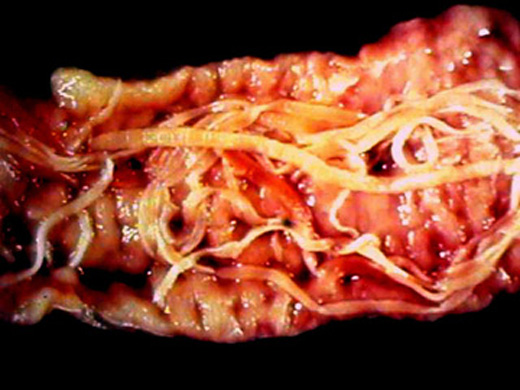
Tapeworms are similar to hookworms. They are intestinal parasites that can be transmitted through soil and fecal matter, but most often are ingested by humans through undercooked meats that have not been adequately cooked to kill the tapeworm eggs. The tapeworms set up shop in the muscles of the host animal after being ingested through the feeding of grass or contaminated vegetables. The animal is eventually slaughtered and becomes food for us as humans.
The human host will ingest the tapeworm egg and as digestion of the food occurs the egg will eventually hatch and grow from a larva to an adult while feeding on blood and nutrients via the intestinal wall. The adults, being hermaphrodites, can then produce more eggs which will be released from the body through the stool. The eggs can linger around the toilet bowl or can even be flushed down the commode where they can infest the soil through sewage and irrigation water, thus, beginning the cycle all over again.
The symptoms of a tapeworm infection are very difficult to spot as there are often no outward symptoms to indicate an infection for a very long period of time. This can lead to the tapeworm growing up to 30 feet in small, segmented lengths resulting in a bloated stomach and malnutrition, amongst other conditions. These parasites have been known to live for a few decades if left untreated.
1
Hookworms

The hookworm is transmitted through fecal matter. The eggs will hatch within about a week and grow into larvae which can live for close to a month within the soil of the earth or the feces which bore them. Upon contact with humans, usually through the foot, the worm will work its way through the host’s veins, into the heart and eventually the lungs. After entering the lungs they are sometimes expelled through mucus during a cough or simply swallowed by themselves. This gives the worm a one way ticket into the small intestine.
After setting up residence in the intestine the worm will attach itself to the intestinal wall and begin feeding on the host’s blood. If left undetected and untreated the hookworm can reproduce resulting in a serious intestinal infestation. This can lead to anemia, extreme abdominal pain, diarrhea, constipation, fatigue and even a bizarre hunger for inedible things like dirt and mud. The life cycle of the worm begins anew when the host releases more eggs through bowel movements.
Contributor: BrotherMan
More Great Lists
 10 Parasites And Pathogens That Control The Minds Of…
![Top 10 Disgusting Foods The Chinese Eat [DISTURBING]](https://listverse.com/wp-content/uploads/2020/03/23773182-0-image-a-46_1580303417295-150x150.jpg "Top 10 Disgusting Foods The Chinese Eat [DISTURBING]") Top 10 Disgusting Foods The Chinese Eat [DISTURBING]
Top 10 Disgusting Foods The Chinese Eat [DISTURBING] Top 10 Bizarre Ways To Make Money From Disgusting Habits
 Top 10 Disgusting Foods Westerners Eat
 10 Disgusting Facts About Historical Dentistry
 10 Disgusting Facts About Cockroaches
 10 Truly Disgusting Facts About Animal Culling
 Top 10 Most Notorious Metal Bands Ever
 Top 10 Most Fascinating Mummified Bodies Found Outside Egypt
fact checked by
dickensgirl
More Great Lists