Having written a list on the ten most evil children in the world, I am very pleased to have received this submission of 7 children who are far from evil; they are children who have changed the world by their actions or examples.
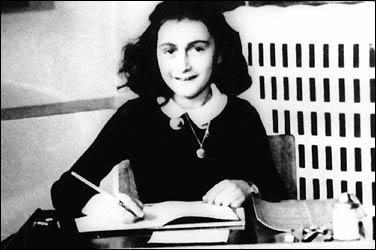
Annelies Marie “Anne” Frank was a German-born Jewish girl from the city of Frankfurt. She gained international fame posthumously following the publication of her diary which documents her experiences hiding during the German occupation of the Netherlands in World War II.
Anne and her family moved to Amsterdam in 1933 after the Nazis gained power in Germany, and were trapped by the occupation of the Netherlands, which began in 1940. As persecutions against the Jewish population increased, the family went into hiding in July 1942 in hidden rooms in her father Otto Frank’s office building. After two years, the group was betrayed and transported to concentration camps. Seven months after her arrest, Anne Frank died of typhus in the Bergen-Belsen concentration camp, within days of the death of her sister, Margot Frank. Her father Otto, the only survivor of the group, returned to Amsterdam after the war to find that her diary had been saved, and his efforts led to its publication in 1947. It was translated from its original Dutch and first published in English in 1952 as The Diary of a Young Girl. Anne Frank has been acknowledged for the quality of her writing, and has become one of the most renowned and discussed of Holocaust victims.
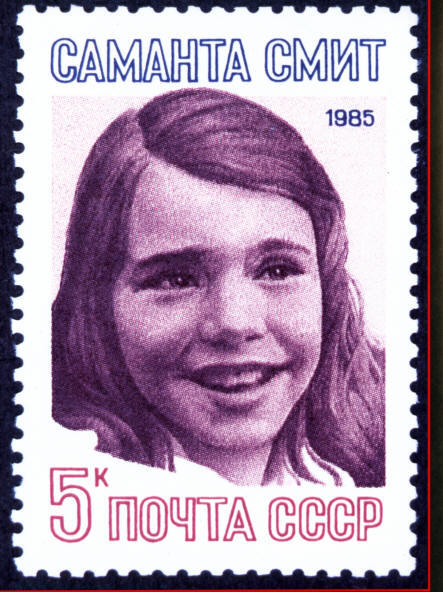
Image: 1985 USSR Stamp with “Samantha Smith” in Cyrillic.
Samantha Reed Smith was an American schoolgirl from Manchester, Maine who became famous in the Cold War-era United States and Soviet Union. In November 1982, when Smith was 10 years old, she wrote to Soviet leader Yuri Andropov, seeking to understand why the relations between the Soviet Union and the United States were so tense. Her letter was published in the Soviet newspaper Pravda. Samantha was happy to discover that her letter had been published, however, she had not received a reply. She then sent a letter to the Soviet Union’s Ambassador to the United States asking if Mr. Andropov intended to respond. On April 26, 1983, she received a response from Andropov.
Smith attracted extensive media attention in both countries as a “Goodwill Ambassador”, and became known as “America’s Youngest Ambassador” participating in peacemaking activities in Japan. She wrote a book and co-starred in a television series, before her death at the age of 13 in the Bar Harbor Airlines Flight 1808 plane crash.
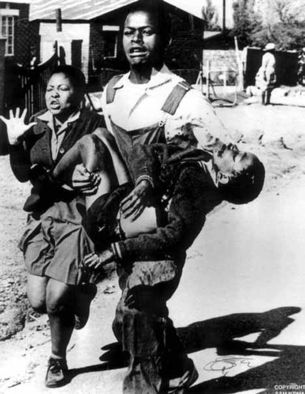
Image: Sam Nzima’s famous June 16, 1976 photograph of Mbuyisa Makhubo carrying Hector Pieterson, accompanied by Hector’s sister, Antoinette.
Hector Pieterson (1964 – 16 June 1976) became the iconic image of the 1976 Soweto uprising in apartheid South Africa when a news photograph by Sam Nzima of the dying Hector being carried by a fellow student, was published around the world. He was killed at the age of 12 when the police opened fire on protesting students. For years, June 16 stood as a symbol of resistance to the brutality of the apartheid government. Today, it is known as National Youth Day — a day on which South Africans honour young people and bring attention to their needs.
Since June 1976, Hector’s surname has been spelled Peterson and Pietersen by the press but the family insists that the correct spelling is Pieterson. The Pieterson family was originally the Pitso family but decided to adopt the Pieterson name to try to pass as “Coloured” (the apartheid-era name for people of mixed race), because Coloured people enjoyed somewhat better privileges under apartheid than blacks did.
On June 16, 2002 the Hector Pieterson Memorial and Museum was opened near the place he was shot in Orlando West, Soweto to honour Hector and those who died around the country in the 1976 uprising.
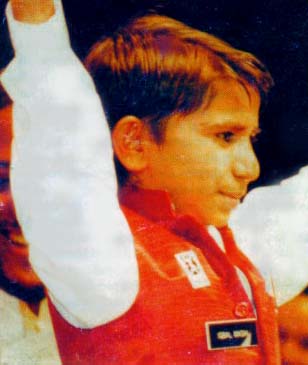
Iqbal Masih was a Pakistani boy who was sold to a carpet industry as a child slave at the age of 4 for the equivalent of (12) USD. Iqbal was held by a string to a carpet loom in a small town called Muridke near Lahore. He was made to work twelve hours per day. Due to long hours of hard work and insufficient food and care, Iqbal was undersized. At twelve years of age, Iqbal was the size of a six-year old boy. At the age of 10, he escaped the brutal slavery and later joined a Bonded Labor Liberation Front of Pakistan to help stop child labour around the world, and Iqbal helped over 3,000 Pakistani children that were in bonded labour, escape to freedom. Iqbal gave talks about child labour all around the world.
He was murdered on Easter Sunday 1995. It is assumed by many that he was assassinated by members of the “Carpet Mafia” because of the publicity he brought towards the child labour industry. Some locals were accused of the crime, however.
In 1994, Iqbal was awarded the Reebok Human Rights Award. In 2000, when The World’s Children’s Prize for the Rights of the Child was formed, he was posthumously awarded this prize as one of the first laureates.
Nkosi, born Xolani Nkosi, was born to Nonthlanthla Daphne Nkosi in a township east of Johannesburg in 1989. He never knew his father. Nkosi was HIV-positive from birth, and was legally adopted by Gail Johnson, a Johannesburg Public Relations practitioner, when his own mother, debilitated by the disease, was no longer able to care for him. The young Nkosi Johnson first came to public attention in 1997, when a primary school in the Johannesburg suburb of Melville refused to accept him as a pupil because of his HIV-positive status. The incident caused a furor at the highest political level—South Africa’s Constitution forbids discrimination on the grounds of medical status—and the school later reversed its decision.
Nkosi was the keynote speaker at the 13th International AIDS Conference, where he encouraged AIDS victims to be open about the disease and to seek equal treatment. Nkosi finished his speech with the words.
“Care for us and accept us – we are all human beings. We are normal. We have hands. We have feet. We can walk, we can talk, we have needs just like everyone else – don’t be afraid of us – we are all the same!”
Nelson Mandela referred to Nkosi as an “icon of the struggle for life.” He was ranked fifth amongst SABC3′s Great South Africans. At the time of his death, he was the longest-surviving HIV-positive born child.
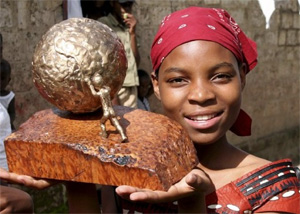
Together with his foster mother, Nkosi founded a refuge for HIV positive mothers and their children, Nkosi’s Haven, in Johannesburg.[6] In November 2005, Gail represented Nkosi when he posthumously received the International Children’s Peace Prize from the hands of Mikhail Gorbachev. Nkosi’s Haven received the US $100,000 prize money from the KidsRights Foundation as well as a statuette which has been named the Nkosi in Nkosi Johnson’s honour. Nkosi’s life is the subject of the book We Are All the Same by Jim Wooten.
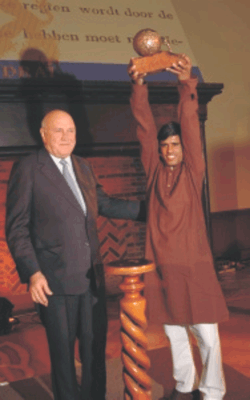
At the age of five, he was taken away from his parents and for three years he worked in the fields. After he was rescued by activists of Bachpan Bachao Andolan, Om campaigned for free education in his native Rajasthan. He then helped to set up a network of what are known as “child friendly villages”, places where children’s rights are respected and child labour is not allowed. He also set up a network that aims to give all children a birth certificate as a way of helping to protect them from exploitation. He also worked to ensure children are given birth certificates. He says such registration is the first step towards enshrining children’s rights, proving their age, and helping to protect them from slavery, trafficking, forced marriage or serving as a child soldiers.
He was awarded the International Children’s Peace Prize by former South African President FW de Klerk, who won the Nobel Peace Prize in 1993.
A 16-year-old Zambian girl, Thandiwe Chama of Lusaka’s Chawama township has scooped the 2007 International Children’s Peace Prize beating 28 other nominees from across the world. The prestigious prize was presented to Thandiwe in The Hague on Sunday by Nobel Peace Laureate, Betty Williams and Live8 initiator, Sir Bob Geldof. The Prize consists of a statuette – “the Nkosi” – and 100,000 euros, which are to be awarded to a direct aid project in the spirit of the young winner’s efforts.
In 1999, when she was only eight-years-old, her school was closed because there were no teachers. Thandiwe refused to accept this and led 60 other children in walking to find another school. As a result, all the children were taken into the Jack Cecup School. Strengthened by this achievement, Thandiwe has been fighting ever since for the right to education for all children. Thandiwe continues to impress, for example by speaking in church about children and AIDS – an issue not always discussed easily in churches. With a friend, she wrote and illustrated a booklet called “The Chicken with AIDS”, telling young children about the perils of AIDS.
“It’s so important to know that also a child has rights. At school I learned about rights. And I knew then that this was something I wanted to fight for. Because if children are given an opportunity, they for sure can contribute in making this world a better place.” – Thandiwe Chama
This article is licensed under the GFDL because it contains extracts from Wikipedia.
Contributor: Clouds


this list has earned a spot in my top 3, it even made me cry…and made my day.
Hey Jamie. By the way, thanks for putting my list on the site.
I’m also from SA.
Cheers
Phan Thị Kim Phúc, the Vietnamese girl, would be a very important notable omission, if not better be included in the list. Some slight overweight seems to be on african children, so that would also help to a nice balance.
Nice list….sadly I’ve only heard of two of them.
110. anshuman tusnial : uummm we are not suppose to shout on the list
Can anyone tell me if the laws about the child labor in India is as same as the entire world?
My neighbor has a 14 year old girl as her maid to do all the daily chores…my cousins wife says that she is beaten and also ill treated… I wonder if I can complain against then without letting them know I did this!!!
kris,
Easily. You just write out a note on your pc explaining the situation and giving the details of the offender, the victim and the offence (including their address, etc.). You do NOT put your own name, address or any details. You print out the letter, put it in an envelope and address it to your local police station or some similar authority. Make sure there is absolutely nothing to identify yourself anywhere. Post it.
When I last lived in England there was an phone line for making anonymous calls about child abuse (in fact I believe it was intended for children themselves). It was fronted by Esther Rantzen, the TV personality, and I believe was called Childline.
I’ve just checked out on the web. Yes, and it now has international branches in India and elsewhere, which might interest others accessing this site. Just feed in Childline for information, or Childline UK for the home site. It gives you all the inforamtion and telephone numbers, etc. It looks as though you may be able to contact them directly via their website.
I am what I am due to a happy childhood.
Good luck.
anne frank should be number 1
I freaking weep every time I read that book, and I think no other collection of writing has ever done so much good in the world
Samantha Smith? I’m assuming that’s some joke in very poor taste. What about Kim Phuc? The little girl (8 or 9 years old,) photographed after stripping of her napalm burned clothes in Vietnam….very sad picture. Her back and shoulders were badly burned.
http://en.wikipedia.org/wiki/Phan_Th%E1%BB%8B_Kim_Ph%C3%BAc
Considering the list and subsequent comments, perhaps Children Who Stirred the World’s Conscience might be more appropriate?
Thank you for a wonderful list. The story of number 4 Iqbal Masih really touched, and saddened me. What an amazing human being. Really, and to have such compassion and determination for others. What a star. So very humbling. So sad that he was murdered.
I hadn’t actually heard of any of the people on this list. I’m glad that the people on this list and their wonderful achivements have been brought foward for attention. The world needs to know about all these injustices, and the wonderful people that fight them.
I don’t know about you guys, but the picture of little Ruby Bridges attending her first day of school after desegregation always choked me up. Talk about a brave little girl! Great list, btw.
I read Anne Frank’s Diary. Well not really her Diary just her Diary entires. It was good. It was funny when Anne was sick and the guy that recently moved in with the family tried to play the ‘Doctor’ by putting his head on Anne’s bare chest. Ha, good laughs. Then, I found out that Anne was a little Bi. It said that she kissed a girl or something of that sort. I don’t really care about that, it just surprised me. D: I mean she was freaking 13 when she wrote that. A year older than me at the time. [Well she was in her 50's-60's, but in the story she was thirteen.]
As for the list.. I need to ask, Why isn’t Mattie J.T Stepanek there? Mattie was a thirteen year old sick boy who loved to make poems. He would write poems called the Heartsongs, and later after his death there was ‘Reflections of a Peacemaker’ A portrait through heartsongs. He made friends with many people, even Oprah. He was a good kid.
… Even though he is not in the list, [Which I don't know why.] I do very much like the list. Even though I only know of one person in it. Number 5 was sad.
You hear about Rudy Bridges so much in school that you begin to roll your eyes at the thought of the name. But actually thinking about what she did, with hating eyes upon her. She is something
Just how, exactly, has Anne Frank changed the world? What “changed” because of Anne?
Just how, exactly, has Samantha Smith changed the world? What “changed” because of Samantha?
Or Hector?
Or Iqbal?
Or Nkosi?
Or Om?
Or Thandiwe?
Compelling stories, yes; but none of these children changed the world.
I would say that Hector, Iqbal and Nkosi most certainly did.
Tom:
Anne Frank put a human face on the Holocaust. Through her diary we feel we “know” her, and it’s therefore all that much more devastating, to know what this poor girl and her family suffered, and to know that she finally died because of that monstrous evil. It almost isn’t to be endured.
But a faceless Holocaust, one of mere figures and statistics, would not be as easy for us to get our heads around. And as such it might be easier for such a terrible thing to happen again.
Having Anne Frank as an example, as a figure that represents the Holocaust, she becomes a symbol which we can hold onto, and it gives it a more firm root, by which we can find more clear determination that such a thing will never be allowed to occur, ever again.
Randall:
That doesn’t answer the question. How did she change the world? She didn’t. None of these children did.
To wit: ethnic “cleansing”/genocide still occurs today. Mass murder at the hand of evil governments and tyrants existed in the years after WWII and still exists today. The holocaust and its progenitors were recognized as evil then, just as current atrocities are recognized as evil now. So how has Anne “changed the world”? Or any of these other children?
Tom, I think you misunderstand the concept.
Most of these children changed the world immediately around them. They changed the world of the children who, otherwise, would be in the same situation they had found themselves in because they changed themselves. That took enormous bravery.
These children bucked the system. They stood up and said “NO”, and they found a way to make things right, not just for themselves, but for others.
That governments continue to commit atrocities is moot. Governments always have, and probably always will.
The point is not to change *everything*, but to change *something* for the better. If enough people, children or adult, each change *something* for the better, that’s a lot of change.
One thing, Tom.
One thing.
segue,
No, I get the concept. It’s a vapid cliche (but I suppose that’s redundant) that sounds profound.
A little girl writing a letter to the head of the USSR did not change anything. Anne Frank did not change anything. Her diary wasn’t published until years after her death, and wasn’t published in English until 1952 or so. They weren’t bucking any system.
Errr….so how exactly did they change the world?????? The world would still be the same, with or without them….
This is an awesome site. I enjoyed viewing all the information. Thank you for sharing.
Thank you for this beautiful information provided.
it was nice told almost everything and easy to understand cooooooooooollllll………..
I loved this site. I am using it for a National History Day project. It is very helpful. I LOVE commenting on this site. This will definately help me with my project. Many thanks.
same as Elizebeth my new friend in national history day project hey everybody sup
huh,.little too late for me to post my comment..
almost cried while reading..
nice kids,. die young..
if they changed stoned hearts, these kids exactly changed the world..
not exactly that changed the world but did something that in one way or anther improved our ways of life…(*_*)..(*_*)
huh,.little too late for me to post my comment..
almost cried while reading..
nice kids,. they die young..
if they changed stoned hearts, these kids exactly changed the world..
not exactly that changed the world but did something that in one way or anther improved our ways of life…(*_*)..(*_*)
very great list! I have watched Anne Franks’s story, I cried the whole time!
i love iqbal masih story
Ruby Nell Bridges (Ruby Bridges Hall) First African-American child to attend William Frantz Elementary School, and the first African-American child to attend an all-white school in the South.Now is chairperson of the Ruby Bridges Foundation, which she formed in 1999 to promote “the values of tolerance, respect, and appreciation of all differences”.
http://www.rubybridges.org/home.htm
Ryan White American teenager from Kokomo, Indiana who became a national poster child for HIV/AIDS in the United States after being expelled from school because of his infection. A hemophiliac, he became infected with HIV from a contaminated blood treatment and, when diagnosed in 1984, was given six months to live. Though doctors said he posed no risk to other students, AIDS was poorly understood at the time, and when White tried to return to school, many parents and teachers in Kokomo rallied against his attendance.
http://www.ryanwhite.com/index.html
tom-
iqbal masih changed the world by letting it know about child labor. if you think that for one minute that he didn’t do or anything you are stupid and cruel. if it wwasn’t for him, child labor might still be big today. he changed the world, something you will obviously never do.
And only two are alive (the others died while still children).
Unless Nkosi Johnson was adopted and later fostered, then I don’t see how you can refer to his mother as his “foster mother”. She’s his mother – legally and in every other way. His first mother did sadly die – and he has a new mother now.
I almost cried as well, which is kind of silly, since these children did GOOD things.
Living in the Netherlands, I’ve been interested in Anne Frank ever since my mother gave me her diary (I was 9 or 10, I think). Like someone said, she gave the Holocaust a face – and after reading her diary, I’ve read more stories and I have more ‘faces’. It helps.
Someone here said that he thought Anne Frank’s brother came to his school or something – well, like others mentioned, she didn’t have a brother, only a sister, Margot. I think maybe you mean her cousins. They fled to Austria or somewhere, and I believe later on they went to live in the USA. I’m a bit fuzzy on the details, I’ve only read it once, but maybe you meant them.
In a few weeks, I will watch a play about Anne Frank, and a childhood friend of hers will be there. I am really looking forward to it!
About the changing the world: Anne Frank did not change the world as a whole, not like wars or something do. It changed the way people viewed and felt about the Holocaust and the Second World War. Her diary was published here in 1947 I think, and she gained enormous attention after that. She’s a symbol of innocence, a symbol of religious persecution.
Image: 1985 USSR Stamp with “Samantha Smith” in Cyrillic
it’s actually in russian
anonymous: cyrillic is the lettering system used in the Russian language
Whoever posted that link about Omayra, stuck in the water, how sad. Please tell me people didn’t just sit there for 3 days, knowing they could not get her out, and just watched her die…
How awful. Please tell me someone gave her something for her pain at the end….
Worst story I ever heard.
#4 Wow. The rest were nice to hear but something aout #4 is just so powerful. Something about his face. Wow.
Amazingly sad that almost all of these 7 saint children died very young whilst those monsters from your Evil lists seem to have lived or still be living a long normal life (Go to hell, Karla Homolka!).
Anyway, when I find any news about such kids or adults who had or still have indeed mighty hearts and great minds, I start thinking maybe it’s nature’s way to make equality on Earth. I mean maybe..just maybe.. if there were no lalauries or homolkas or hitlers, there wouldn’t be mothers thereses and samantha smiths and so on..
Still, it might be weird, but have you noticed that those extremely kind or extremely cruel human beings never had/have lived a normal healthy life? They either had/have experienced abuse (which turned them into sociopaths) or some kind of a deadly disease, socially & politically negative situation..(which maybe inbreathed strength and kindness to them).
“carpet mafia”?
And how about Sophie Scholl?
Um you forgot Micheal Jackson and the Jackson 5. They changed the world too. Heal the wohohohoooooooorld for you and fo me….
God please bless and save all this childreans.
Dj-Abu(Madrid-Spain)
what did thandiwe do?
Beautiful list, made my afternoon!
Changing the world, doesn’t necessarily mean physically, it can mean mentally (inspirationally).
@Tom: They changed the world more than you’re changing it.
Anyway that’s a very nice list!~
Sorry, but on a less aggressive side Tom I think they did change it. They saved children, fought for their rights and (in Anne’s case) made sure we were more knowledgable of the bad things. So we won’t let it happen again.
An amazing list, with some very inspirational and sad stories. Many of the children didn’t live very long at all, tragic.
I’d like to put forward this young lady, I remember watching the images of the starving children which eventually lead to Live Aid, to think she survived is incredible.
http://www.thesun.co.uk/sol/homepage/news/2805488/Wedding-joy-for-Live-Aids-hero-girl-Birhan.html
i chaged the world but i am deid lol
Nadia Comaneci was the first gymnast witch receved a 10.
I think of Ryan White when I read this list, because his struggle directly affected my life. Not to mention he changed how things relating to A.I.D.S. were viewed and handled in America during my childhood.
@justin beiber fan i couldnt stand by and let you say that . seriously ***** you . you are the one who is the ball licker….
Justin Bieber? What the hell dude? Your comment hurts my brain.
Hmmm, where's MJ?
I'd shoot somebody if Justin Beiber was on the list.
Justin, I hope.
I will always think of Iqbal Masih when I read the labels on the clothes I buy. Slavery sickens me.
No Severn Suzuki? How come?
This boy may not have ‘changed the world’, but in my opinion, his courage, loyalty and sacrifice deserve a bit of recognition.
13 year old Jordan Rice was a shy, mummy’s boy, afraid of water and nicknamed ‘Weedsy’ by his teasing older brother for being ‘a sook’. Now, his brother calls him his ‘little hero.’
During the flash flooding earlier this year in Toowoomba, Australia, Jordan Rice, his mother Donna and younger brother Blake were trapped in their car amidst floodwaters. Rescuers eventually found them and reached Jordan first, who was petrified. As they went to grab him and take him to safety he pulled away, yelling for them to take Blake first.
One rescuer fought his way to safety with Blake, while another held onto Jordan’s hand. A torrent of water rushed through, snapping the resuce ropes connected to the Rice’s car, ripping Jordan’s hand from the rescuers, flipping the car and dragged both Donna and Jordan under the rushing water, out of sight.
When I heard this story I couldn’t stop crying. Maybe a list about children who have performed acts of heroism? Jordan Rice conquered his fear and gave his life for his brother; his mother too, was willing to sacrifice herself for her children.