It is now just a matter of days before we see the opening ceremony of the Beijing Olympics in China, the Games of the XXIX Olympiad (or for those who don’t like Roman numerals, the Games of the 29th Olympiad.) This lends us the perfect opportunity to present a list of fascinating facts about the Ancient Olympics – held in Olympia, Greece.
1. No one actually knows what the origins were of the very first games. One myth suggests that Heracles (the divine son of the god Zeus) ran a race in Olympia and decreed that it be repeated every four years.
2. The olympic games were one of two central rituals in Ancient Greece. The other was the Eleusinian Mysteries – initiation ceremonies for people joining the cult of Demeter and Persephone.
3. The Statue of Zeus – the father of the Gods and one of the Seven Ancient Wonders of the World, was housed in a temple at Olympia – the site of the Ancient Olympics.
4. An Olympiad (a period of 4 years which refers to the time between two games) was used as a measure of years by the Ancient Greeks in much the same way as we now use AD and BC. This idea was devised by the historian Ephorus. Previously, every Greek state used its own different method of time measurement which led to a great deal of confusion.
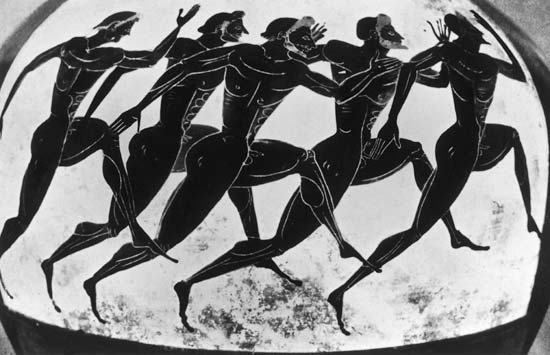
5. The only event at the first olympics was the Stadion race – a race of around 190 meters (measured after the feet of Zeus). The race was named after the building in which the race took place (the source of the English word “stadium”. The stadion race is pictured above.
6. Unlike the modern starting position, racers (of whom 20 would take place) started in a fully erect standing position with their arms stretched in front of them. If there was a tie, the race would be re-run.
7. The winner of the first recorded Olympic Games (the first gold medalist in a sense) was Coroebus of Elis – a baker from Eleia (the region in which Olympia was found). He won in 776 BC. Instead of winning a gold medal – as is now the norm – he received an olive branch – more a symbol than a prize. The town still exists today with around 150 citizens.
8. It is believed that the Greek tradition of athletic nudity started at the games in 720 BC, and it was most likely introduced by the Spartans or Megarian Orsippus. It is from this practice that we have our word “gymnasium” – derived from the Greek word “gymnos” meaning “naked”. Competing naked was meant as a tribute to the gods and to encourage aesthetic appreciation of the male body.
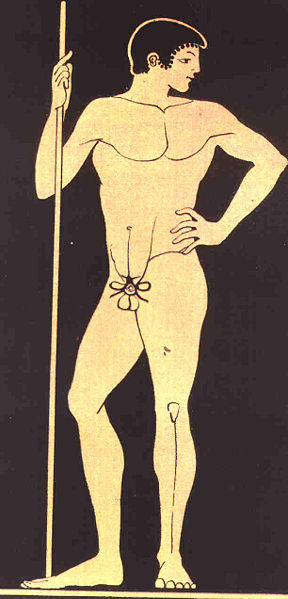
9. While the competitors were naked during the games, it is possible that some wore a kynodesme: a thin leather strip tied tightly around the part of the foreskin that extended beyond the glans (to prevent the glans from showing). It was then tied around the waist to expose the scrotum, or to the base of the penis making it appear to curl upwards. Not all athletes wore the kynodesme. Pictured above is an athlete wearing the kynodesme – the picture is attributed to Triptolemos (480 BC).
10. During the games, all of Greece was under a truce (ekecheiria) – there could be no use of capital punishment, and no wars or battles. This was in order to ensure the safety of competitors and spectators on the way to Olympia. While this was generally adhered to, at least one account exists of a possible breach by the Spartan army, which resulted in a large fine and a ban from attending the games that year.
11. The Olympic Games were part of 4 games – held in order so that there would be one set of games each year. The other three were the Pythian, Nemean, and Isthmian Games, but the Olympic games were the most important.
12. Although the first games were “international” in a sense (in that all Greek City States were allowed to enter), only men who spoke Greek could compete. Eventually members of the Greek colonies were also able to enter.
13. The last running race added to the Ancient Games (after the addition of two longer distance races) was the hoplitodromos – in which competitors would run 400 or 800 yards in full armor with shields and a helmet or greaves (leg armor). This was introduced in 520 BC. Runners would often trip over each other or stumble on shields dropped by other competitors. In the image above we see athletes competing in the hoplitodromos – in far more an orderly fashion than was likely.
14. In its heyday, the games lasted 5 days. The first three were for the sporting events, with the other two days being used for rituals and celebration. On the final day, all participants attended a feast in which 100 oxen (killed on the first day as a sacrifice to Zeus) were eaten. Certainly very different from the secular opening ceremony we will see this week, or, in fact, all olympic opening ceremonies from modern times.
15. As part of the move to making Christianity the official religion, the ancient Olympic Games were finally suppressed by either Theodosius I in AD 393 or his grandson Theodosius II in AD 435. They would not return until 1896. They were held in Athens, Greece.


I'm wondering if the meat was kept fresh for five days or if it actually took five days to cook 100 oxen… either way, it sounds like a good recipe for food poisoning
i know is it true
So how come they brought back the Olympic Games after such a long time?
You should always leave beef for a few days after slaughter before you eat it – 5 days sounds good to me *goes looking for some oxen*
Oh I commented first and didn’t even say anything about the list – it’s very cool. Now I realise why there are so many depictions of running men on Greek vases! I think I just assumed they were painted running in side profile so the painter could paint all the way around the vase…
Geraint: Yeah, I thought you left it in the fridge or in a chiller
If were you being serious I’d like to know why you’d leave meat for a few days. I know you have to leave it long enough for the blood to drain out, but normally that’s just overnight.
Diamond_Dragon: I think it was because they had discovered the ruins of Olympia some years before – and it re-sparked an interest.
the longer you leave meat, the tenderer it’ll be. You don’t want it to be rotten of course. I’ve heard stories about a half a cow being hung up on a hook, when it dropped off it was ready to be consumed.
Now I understand why they pictured an acient olimpian naked. This list taught me a lot, salute.
#8 is interesting. Encouraging aesthetic appreciation of the male body – are there any chances that this tradition of athletic nudity will also resurrect.
Nice list, JFrator.
Hey, I am still waiting for my prize for the list on 4th of July.
pankhudi: If you emailed me your address and details – would you do so again please? I had issues with email over computer changeovers when I was traveling.
JFrater: Ok, I will send it again.
In light of the strong view expressed yesterday, I feel compelled to voice my objection of number 3. The Statue of Zeus – the father of the Gods. I am not sure what I am objecting about but its got to do with religion. And I feel very strongly about it. I think I need to sue JFrater or appear on the Oprah show because my rights have been violated.
Kynodesme?? When you need to go you need to go, unless you battle at undoing knots or bows. I can picture all sorts of bad things happening.
pankhudi – I doubt the athletic nudity will come back, but for now women’s beach volleyball is pretty damn close!! I can’t wait – just hope I can see the athletes through the smog
stewart: haha – nice observation
Saffa: Yeah, good for you guyz
Jfrater:
Fantastic list! Of course you knew I’d say that, the subject being Greece.
pankhudi – I guess you still have the male swimmers.
Another interesting fact about ancient Olympics: Philostratus tells that during Ancient Olympic Games athletes drank herb based tea and they ate mushrooms to improve their performance.
So doping has been going on since the ancient times.
xdarkhor*****: same is true with birds, hang them by the neck, when the body falls off, its ready. An old tradition I have seen. The feathers come out easier too!
For the #5, the stadion was not measured after the feet of Zeus but after Heracles’s (600 times).
stewart and xdarkhor*****: Wouldn’t you be concerned about bacterial contamination. E. coli anyone?
What were they thinking with #8? That just makes me tear up at the thought of it..
Fact #16 – Even though many, many people watch the Olympics and an obscene amount of money is pumped into it, it still manages to be the most mind-numbingly boring event on earth.
Nice list! It’s getting me pumped for the upcoming games!
A very timely list! I am excited about the upcoming games in Beijing. Go Team USA!
romerozombie – I like the use of ‘the most mind-numbingly boring event on earth’ in the context of the game. Surely, it’s not a treat to watch.
Saffa – Watching football will be better, I guess. Lotsa handsome guys there. Hey, football is there in olympics, right?
Tempyra good beef is aged 28 days in a cool dry place, also you can cure meats because with thick cuts of meat only a small surface area is exposed.Its not like leaving ground meat out for a month.Dry aged meat is 100 times better then vacuum sealed refrigerated *****, all the best steak houses dry age their beef.
A fact: the weirdest event ever to be held at the Olympics has got to be poodle-clipping. It only featured in one Games in Paris in 1900. A farmer’s wife won the gold medal. She managed to trim 17 poodles in just two hours!
“Competing naked was meant as a tribute to the gods and to encourage aesthetic appreciation of the male body.”
This made me laugh! As much as I love men, I just can’t see what so aeisthestically appealing about lots of naked men running around. Ew.
bluto: I didn’t know that; I guess the dryness inhibits bacterial growth.
Katie, I have two words for you: naked mma.
Remember how big a scandal it was when Coroebus had his olive branch taken away for steroid use?
rushfan: Naked MMA is only gay if you make eye contact.
rushfan: That’s hilarious! I was newly introduced to the fact that MMA is one of the fastest growing sports out there. I can’t help but look away when they punch each others’ heads!
Tempyra – I am not sure how resilient e-coli is to the average cooking process but you do make a good point, especially when it’s a bird that still has its intestines intact. I can understand a hind quarter of a cow that has been set to mature in a dry cold storage. E Coli has been found on all sorts of vegetables and fruit so I guess you run the risk with just about all fresh produce. This is why you should wash all fruit and veggies really well. Even the pre-washed aesthetically pleasing salad mixes that come in those sealed clear plastic packets.
I’m beginning to wonder about the sanity of those ancient Greeks. I’m not so sure having your orbs of manhood placed front and center is all that conducive to safety. Certainly wouldn’t want to trip and fall on your face – much agony would ensue.
Great List Jamie.
Olympics, woohoo! Nice list!
Too bad nakedness at the Olympics got discontinued…!
I hope the ancients were not as bored as we are by modern olympics.Sycronized swimming ! I bet that wasnt on the menu.
I don’t think I saw this covered in the list, but another interesting fact about the Olympic games was that star athletes (i.e. those who won competitions) in ancient Greece were treated with special aplomb–they were “superstars” almost akin to our star athletes today–they would be given parades and special favors… not by law or as a rule, but just as a tradition–so a big winner at the games could expect to get free meals at the local tavernas, for instance, and such like… that kind of thing, along with the undying admiration of the people of his city (recall that all these games were competitions between city-states, and Greek city-states of the time were small compared to our ideas of “cities” today… so everyone would know and recognize the star athlete and he could therefore expect to always be treated with great respect and so on).
In fact, (and again, I didn’t see this mentioned in the list) poems would be written and dedicated to these athletes and their feats of skill, and the greatest Greek writer of odes, Pindar, (Pindaros) of Thebes, had this as his specialty: the composition of poems glorifying the feats of athletes at the games. These were odes of sublime nature dedicated to the men who competed, usually called by name, but also odes at the same time that glorified the gods and reminded the athlete of his place in the world. Here’s a piece of one to Hieron, victor at the games:
“The fame of Pelops shines from afar in the races of the Olympic festivals, where there are contests for swiftness of foot, and the bold heights of toiling strength. A victor throughout the rest of his life enjoys honeyed calm, so far as contests can bestow it. But at any given time the glory of the present day is the highest one that comes to every mortal man. I must crown that man with the horse-song in the Aeolian strain. I am convinced that there is no host in the world today who is both knowledgeable about fine things and more sovereign in power, whom we shall adorn with the glorious folds of song. A god is set over your ambitions as a guardian, Hieron, and he devises with this as his concern. If he does not desert you soon, I hope that I will celebrate an even greater sweetness, sped by a swift chariot, finding a helpful path of song when I come to the sunny hill of Cronus. For me the Muse tends her mightiest shaft of courage. Some men are great in one thing, others in another; but the peak of the farthest limit is for kings. Do not look beyond that! May it be yours to walk on high throughout your life, and mine to associate with victors as long as I live, distinguished for my skill among Greeks everywhere.”
Another famous line from Pindar, directed at a victor at the games, was:
“O my soul! Do not aspire to immortal life, but exhaust the limits of the possible!”
I had that on the door of my dorm room in college.
Interestingly, the athletes, for all the admiration they won from the people, were not paid. All they received for their efforts (besides the large number of what we today would call “perks”) was an laurel wreath. But this was symbolic of glory for themselves and their city; enough for them.
Olmpics….
Women were banned… but not an adoliscent ..virgin…..Women were completed partly dressed…
Women overtoop the Male Art…..Close to the Hellenic Age…
Keoki….Hawaii
bigski: Ahh, but imagine all of them naked…
All this naked talk. Gutterminds, the lot of us!
Seriously, great list! Reminded me of the origin of the marathon (even if it wasn’t an original Olympic event).
http://www.newsfinder.org/site/more/the_origin_of_the_marathon/
Great list. Makes me think of the origin of the marathon (even though it wasn’t an original Olympic event).
http://www.newsfinder.org/site/more/the_origin_of_the_marathon/
haha who else but the Spartans to suggest nudity during the games.. can you imagine if the rinners had sponcors? with logos on their backs? lol. wonder what kind of products they would indorse, huh
I love the Olympics! I have so many books about it. From womens entry into the games to great photos of the athletes in action.
Boring? Never. To watch people push the envelope for speed and agility is amazing. The intensity and excitement are beyond words. Maybe I’m more into it cuz I was a swimmer thru High School and college, and ran track, too for a few years.
#15: So the Olympic Games are anti-Christian?
Not sure about the nudity being related to the beauty of the male form. I was always taught that the nudity was to insure that women were not participating. Historians have found proof that in the very early games several women dressed as men and won events, only to be put to death after they were outed. Does anyone have anymore info regarding this?
Cdavis:
Not all events were carried on in the nude; some were, but wrestling matches and such, and some foot races (there was also, however, a foot race where the contestants had to wear full armor, as a means of handicapping them and a display of strength coupled with speed… these games were basically–in part anyway–rehearsal and training for the physical demands of warfare).
Chariot races were performed clothed, for instance, and as I recall one woman did manage to win one of these once, disguised as a man (my memory might be faulty here, sorry).
I would not say “several” women participated and were put to death… I vaguely recall reading of *one* instance of this, but can’t recall the circumstances.
A more interesting question is how much the nudity issue had to do with Greek homo*****uality and the eroticism of athletic competition. See my comment here on this list: http://listverse.com/history/top-10-myths-about-the-romans/
Go to comment #84.
There’s evidence that in many fundamental ways the Greek view of *****uality differed from ours. Where we view ***** as gender to gender, they viewed it as “doer” to “do-ee” in a sense, or “dominant vs. submissive.” Hence it was power-centered, in a sense… older men viewing young boys *****lly, and so on. A lot of what we today would call bi*****uality. But always with one partner who is dominant, the other submissive.
Anyway, this sense of eroticism in regards to the male form may also explain the nude competitions. There’s evidence (this is more a personal judgement of mine based on my own scholarship) that the Greeks *in general* were more moved by the male body than the female. Though there’s some examples of Greek poetry that talks about the beauty of the female form, it tends to be rather nebulous and not very extensive. (Not always though). There’s some erotic art that depicts the female form too, of course, but again, much of the erotic art is centered more on the potency of the male. And if you note, the greatest Greek sculpture tends to show the male body in a better light (to our eyes) than the female body—Greek statuary of males tends to show muscular, well-formed, beautiful male bodies… whereas the statuary of female bodies sometimes tend to make women look more… well, functional. Round and shapely, yes, but not our modern idea of what we’d view as erotic. (Though again, on occasion there’s examples of this).
Then again there’s stories of Greek men being moved to giddy heights by the site of particularly well-formed women. But this is to be expected–homo*****ual proclivities in general aside, Greek men were still men just like men of any age. Turned on by attractive women.
But the Greek fascination with the beauty of the male form was still something that was more or less unique to them, in ancient times, and may have something to do with their interest in nude performance of athletics and so on.
Why wouldn’t they walk around naked all the time? Were chariot races an Olympic event? That sounds like a blast! Better than NASCAR.
Cdavis:
Chariot races were very much an Olympic event, though as noted in the list, not at the first few Olympics… I can’t recall when chariot races were introduced as part of the “program,” but at any rate they were definitely an event by the Classical period (6th/5th century, up until the 3rd/4th centuries, after which is the Hellenistic period) and remained so until a stop was put to the games.
Yeah, it hadda be *****in’. Much better than car races. Pretty much, I imagine, like what we see in Ben Hur, only without the obvious cheating (I believe the Greeks would have frowned on this) and, if I’m not mistaken, not originally in a circuit… though again, I could be wrong there. At any rate eventually it was, of course, carried out in a circuit. As I recall there was a great chariot race “stadion” built at Delphi, and one, of course, at Olympia.
The reason Greek men wouldn’t walk around naked ALL the time, of course, is that even in Greece there was a time and a place for eroticism. Also, women weren’t supposed to be “looking”—remember that women were not allowed the same license that men were in any aspect of society, at least in Athens, although throughout Greece women did not have the freedom men had, in a general sense. (Sparta was actually more “liberal” in regards to women than Athens was).
Of course, this created a female “subculture” in some ways, which we see evinced in Sappho and so on. (My favorite Greek poet, by the way, after Homer).
Great List
I have always been an Olympic devotee, so this list made my day. Thanks Jamie!
Now, I just have to wait a couple of days, 8.8.08, and the Opening Ceremonies begin.
The news from the area, however, has not been good, violence and death in the past few days, and my husband and I have been discussing it. We both remember the horror that was Munich, and fear for the safety of the athletes. I’m sure that every precaution has been taken, but terrorists are determined, and with no regard for either their own lives, or the lives of others, might find a way to overcome those precautions.
segue:
I’m not concerned about terrorists at this Olympics. I’ll be very surprised if anything like that happens.
The thing about the Chinese is, they are thorough, careful planners (if they can just keep away from corruption). Also, for something to happen to guest athletes in their country, of that nature–it would be a dishonor to the Chinese that they would find unacceptable. I have little doubt that they simply won’t allow this to happen.
I thought the guy in the picture above number 6 had three dicks! Then I read number 9 and was “Ohhhh, okay.”
#43, anything that took your attention away from “god” was considered anti-christian, back then atleast. Any ways, it originated as a pagan ceremony and we all know how early christians felt about pagans. ^^^^That is not a jab at modern christianity, so dont get your panties in a bunch, people!
interesting list. I’m going to go a fasion a kynodesme for myself and parade down the street.
interesting list, nice info, this is why I like this site…dazzle your friends with random info, lol
This was a very interesting list. They should make a movie about the ancient Olympics. That would be pretty cool, especially the hoplitodromos.
Glad everyone likes the list – I am considering doing more olympics lists this week – what do you all think?
****
#50. Randall
segue:…
Also, for something to happen to guest athletes in their country, of that nature–it would be a dishonor to the Chinese that they would find unacceptable.
****
Randall, I had the same thought, but the recent violence had put a dent in my confidence. Thanks, I’m feeling better.
Also, re the Acting weasels, are you going to do that list?
JAMIE!!!
YES!
lol ure mum
Hey Jamie – -
Do a list on Olympic tragedies and one on Olympic underdogs!
Wow, it would be great if you made this Olympics List Week for Listverse! A definite yes from me!
I was surprised to see the women athletes depicted at the early Olympics when I visited the mosaics at the Villa Romana del Casale near Piazza Armerina in Sicily.
I was also surprised to see the Olympic torch drive by on the back on a Honda at 55mph when watching the torch make it’s way through the Pelopennes and Epidaurus for the Greece Olympics..
Love these lists