I love history – and especially the medieval period, so lists like this are a real pleasure to put together. This is a selection of facts that I hope most people will be unfamiliar with. If you think there are any interesting facts that have been left out, let us know in the comments.
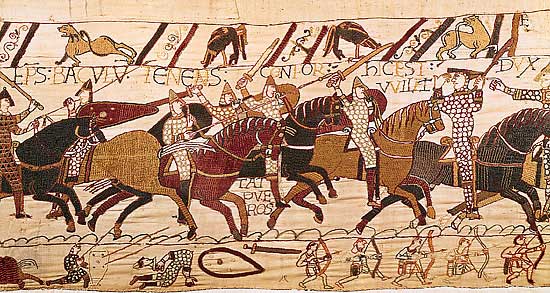
1. The famous Battle of Hastings did not take place in Hastings! It was actually waged at Senlac Hill – which is about 6 miles (10km) north-west of Hastings. “The battle at Senlac Hill” certainly doesn’t have the same ring to it as “The Battle of Hastings”!
2. One of the earliest versions of the London Bridge was destroyed in 1014 when the Saxons rowed up the Thames, tied ropes to it, and pulled it down! This helped regain London for the Anglo-Saxon king against the Danes. It is possible that this event may have been the inspiration for the nursery rhyme “London Bridge is falling down”.
3. Berengaria of Navarre was the Queen of England by her marriage to King Richard The Lionheart. Little is known of her life – but what is known is that she is the only Queen of England never to step foot in England! The entire time that she was married to Richard, she lived in Europe. In fact, Richard himself only spent about 6 months in England as he was so busy traveling on crusader business.
4. In 1086, 10% of the population recorded in the Domesday Book (a large census) were slaves. In some areas, there were as many as 20%.
5. England used to be the native home of Brown Bears, but they became extinct around the 11th century. In latter parts of the Middle Ages, the bears were imported into England for sport.
6. There is much evidence to suggest that King Richard I (the Lionheart) was a homosexual. There is a possibility that he met his wife Berenegaria whilst in a sexual relationship with her brother, the future King Sancho VII of Navarre. It is also reported that he and King Philip II of France were involved. A historian of the time, Roger of Hoveden said they “ate from the same dish and at night slept in one bed” and had a “passionate love between them”.
7. It was not uncommon in England during the medieval period, for animals to be put on trial for crimes. Animals could be sentenced to death if found guilty of their crimes. Take that PETA!
8. The Middle English term “pygg” referred to a type of clay. In the middle ages, people would often keep coins in jars or pots made of pygg – these were called “pygg jars”. By the 18th century, with the evolution of language, these came to be known as a “pig bank” or “piggy bank”.
9. Contrary to popular belief, medieval English people bathed quite regularly in public baths designed for that purpose. This was due to the belief that “cleanliness is next to Godliness”. Public baths were eventually opposed by the Protestants in the 16th century because of prostitution being common there.
10. Most common folk had to produce their own food. For this reason rye and barley bread was common amongst the poor who could not afford the large quantities of manure needed to grow wheat for white bread.
11. Trial by ordeal was common in England in the middle ages. In this trial, the accused would be subjected to a very painful task (such as being burnt by a hot iron) – if they survived the trial, or their wounds healed quickly, they would be found not guilty as it was believed that God had performed a miracle to help the accused. The Catholic Church forbade participation in these trials and demanded the use of compurgation instead. Compurgation was the taking of an oath of innocence by the accused which 12 peers must believe.
12. One bizarre recipe for a medicine to protect against the plague involved drinking ale that has had crushed roasted egg shells, leaves and petals of marigold flowers, and treacle added to it. Needless to say this was not particularly effective.
13. The Barber’s pole symbolizes blood and bandages, as most barbers also performed the roles of surgeons and dentists in their towns. Bandages stained with blood would be washed and hung from a pole outside the barber’s shop – these would then twist in the wind to form the spiral pattern we are all familiar with today. Macabre but true.
14. Prior to the introduction of surnames in England in 1066, everyone born had just one name. When surnames were introduced they would often include a nickname – such as Robert Red (symbolic of his hair color). If Robert went bald over time, his name could change to “Robert Ball” (ball meaning bald in Middle English). In time, the system evolved to a point where people would take the same name as their father – giving us the modern surname system.
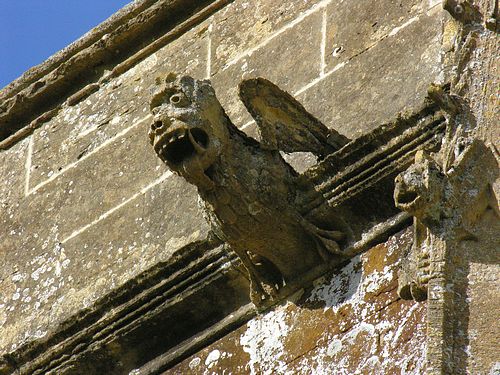
15. Contrary to popular belief, gargoyles were not added to Churches and buildings to ward off evil spirits – they were drain pipes! True gargoyles project out of a wall (decorative monsters are not gargoyles) and rain water flows out their mouths away from the building, rather than down the side of the building causing damage. Their true purpose can be seen quite clearly in the photograph above of St Mary’s Church in Adderbury. Gargoyles can be found all over Great Britain and are visible on virtually every Church built there during the middle ages.


“7. It was not uncommon in England during the medieval period, for animals to be put on trial for crimes. Animals could be sentenced to death if found guilty of their crimes. Take that PETA!”
If by take that PETA you mean that they wouldn’t have existed anymore…then yeah. PETA’s main and somewhat hidden platform is for animal rights, meaning that animals should not be owned people and all the same rights that humans do, such as right to a fair trial. o_O I bet you didn’t know that…neither do many of their members.
It’s an interesting list. I only knew about a few of these. What are the sources used? I’d like to do some follow-up research on some of the topics.
I hope the animals got a jury of their peers.
Great list. I can imagine a new Ren-Fest sales pitch for gargoyle scupltures – “Buy us, we puke rain!”
. . .sure wrong period, but still.
best way to get people to buy gargoyle sculptures.
59. segue: Oooh! Gratz to them!
The episode in question had a vegan girl of Eastern European descent who saw her mother and other hallucinations. It was determined to be ergot poisoning (or something closely related).
66. Cedestra, I haven’t seen that episode, but I’m sure I’ll catch it one day.
I learned about ergot poisoning back in the 60′s, under circumstances that were a bit…well…odd.
After that I did a lot of reading on the subject, and learnt that it probably had a lot to do with some of the “witch” accusations, both during Medieval times, but during the Salem witch trials in New England.
A very naughty little bacteria.
Slightly related: I have just started a “classical music” thread in the forums – http://listverse.com/forums/viewtopic.php?f=16&t=1305. I’ve suggested taking a broad definition of “classical”, so music of this period would fit. (“1, 2, 3, 4 Sumer is icumen in, loude sing cucoo.”)
Personally, I get tired of hearing people say, “But women have been having babies for thousands of years!” Yes, and women (and babies) have been dying in childbirth for thousands of years. Just look back through some genealogy, and you’re sure to find a guy who was married three times because his first two wives died in childbirth.
My friend had to have an epidural with her first baby, because her blood pressure was already dangerously high and the pain was making it go higher. She hadn’t wanted to get an epidural, but without it, the pain would probably have literally killed her.
Very interesting list number 15 is my favorite.
Here is a great example of gargoyles and what jfrater is talking about http://www.youtube.com/watch?v=_JeJhGzkAX0
Fast forward the clip about half way through.
Sorry it’s one of my favorite movies.
All of these just sound like urban myths. I’ve heard about fifty different reasons why barber poles are striped, and gargoyles as drain pipes? Please.
Hey Dustfinger check out the clip on post #70
Dustfinger:
Still don’t believe me?
I had scheduled c-sections and I loved them. There was no pain in recovery. Indeed, I was literally carrying over a hundred lbs at a time a week later moving stuff around my house. I needed to have them. It wasn’t really a choice.
I believe you jfrater. I had heard that before, too.
segue: ‘avent heared that kind of skullduggery since my internship at cockney U. All kidding aside, there’s something warm and appealing and intangibly “islandic” about the way you talk. maybe it was “a bit…well..odd” or “a very naughty little bacteria” but either way, to this yank, I felt like I was watching a Midsomer Murder, and I liked it. Keep talking.
waty (76) Isn’t she great!?! One of the best ever.
I read this last night. I really enjoyed it, especially number 7. If anyone else is interested, the October issue BBC Knowledge has a write up of some cases and “reasons it actually afforded such creatures righs that they are now denied”.
If anyone is interested in the whole “was he/wasn’t he” question of Richard the Lionhearted (or in Robin Hood for that matter) I recommend reading “Locksley”, by an author whose name I can’t remember right now. It’s basically an alternative retelling of the Robin Hood story, including how Richard was a flamer who barely acknowledged his wife, let alone slept with her, so passed that particular “responsibility” to Robin Hood later on in life.
Jamie: You believe everything you read in wiki????
Why make the rainspouts in the shape of monsters rather than any other shape, though?
Dustfinger:
The barber pole explanation laid out here by Jamie has been confirmed by no less a source than the great and omniscient CECIL ADAMS of the legendary STRAIGHT DOPE. So show some respect kid.
good to know these stuff huh..tnx JFrater.ü
JFraater, they did get defense lawyers.
sorry, some did.
Did they use knives and forks in Medieval times?
It thought there were no utensils during Medieval times so there is no utensils at Medieval Times.
ISTR that Berengaria was also the only English queen to be married (and buried) outside England.
I heard somewhere (the Da Vince Code and mainly Wiki) that the term Gargoyle comes from the French “gargouille”, which means Throat or Gullet (also, the Portuguese and Spanish “garganta”, originally the Latin “gurgulio” or “gula”).
This would tie in nicely as the rain seems to come out of their throats and, indeed, would seem to make a “gargling” noise as it does!
To further claifry, the “beasties” adorning buildings that do not serve as water spouts are called “Chimerae” (plural) or “Grotesque(s)”.
Gargoyles are magical creatures who were froaen in stone for hundreds of years and woken up in modern day New York City.
Savanti Romero:
NICE! Bring on Goliath.
-yup im hispanic, and i have like 5 names.
*inhale*; Andriel Ramon Torres Rosario Garcia Queliz . its quiet a mouthful.
at least by the time your mother got done calling you by your whole name, she couldn’t remember why she was mad at you to begin with!!!!
Although that is 6 names, unless I’m missing something.
There’s actually NO evidence that Richard I was gay. As previous posters have noted, sharing a bed wasn’t uncommon. No one at the time accused him, and they weren’t very PC then. Edward VI is recorded as sharing a bed with the Duke of Somerset, and no one thought either man was a homo*****ual. Really, there is evidence that Richard was hetero, since he fathered some bastards (which was above and beyond the call of duty).
So no, not gay.
#76. waty :segue: ‘avent heared that kind of skullduggery since my internship at cockney U. All kidding aside, there’s something warm and appealing and intangibly “islandic” about the way you talk. maybe it was “a bit…well..odd” or “a very naughty little bacteria” but either way, to this yank, I felt like I was watching a Midsomer Murder, and I liked it. Keep talking.
****
Oh, waty, I hate to break it to you this way but…well, I’m American, also.
My mum was Australian, and I did spend part of my childhood there. I speak exactly the way I write, and I am a writer and photographer by nature and training. My husband claims all of the above rubbed off on the way I speak, so don’t worry, my posts tend to be what they are.
“The entire time that she was married to Richard, she lived in Europe.”
England is in Europe.
jfrater, the very wiki article you link to also says this: “The gargoyle’s grotesque form was said to scare off evil spirits so they were used for protection.” (among other things). there’s no reason the sculptures couldn’t serve two functions. i love your lists, but i fear i’ll need better citations and sources than wikipedia to believe ‘em all. i’d be interested to know why rye requires more manure than wheat to grow, for instance. i’m also curious as to what the deleted st. francis fact was. still, keep up the good work!
The comment about Senlac Hill can’t possibly be true- the hill was not named ‘Senlac’ until after the battle.
‘Senlac’ is French for, literally, ‘Lake of Blood’, which the Normans named the area after the battle.
I really wonder how the cure for the plague tastes like…
People in the Medieval period sure were strange!
this list was quite interesting…
King Richard
i wonder if he had ***** w a guy
Lol. I hope the animals get a fair case!
Schmaulie:
Everyone in Lat.Am. uses two last names on a regular basis: father´s first, then mother´s. Some people (myself included) know up to 8 names (in order: father, mother, paternal grandmom, maternal grandmom, etc). Its the only way to trace your family history.
On a similar note, when women get married here they either keep their maiden name or use a “de ….” which basically means “of ….” So a Jane Smith married to a John Jones would be called Jane Smith of Jones. We dont use any of the hyphenated names so popular now…
*****
mirewen (69):
I think you´re missing the point of that statement as I think most people are referring to women who have no medical need. I dont think anyone would be dense enough rant against life-saving medical treatments.
*****
Richard I is my new obsession (well, Plantagenets as a whole)… I had heard the homo*****ual theory but had discounted it because it is based on the bact that he shared a bed with another king and I had read somewhere else that this was a sign of respect and friendship.
I am also fascinated about the legend surrounding him. It seems to me that he earned his nickname because he participated in crusades but…. I´ve also read read that he was actually a cruel and war-hungry king. He did not care about his people, he only cared about how much money he could wring from them to finance his military campaigns. From what little I´ve read so far, he gave a rat´s a** about justice, etc. How do you equate that to the legend of the king with the heart of gold?
I´ll have to do more research and get back to you…
102. GTT:…when women get married here they either keep their maiden name or use a “de ….” which basically means “of ….” So a Jane Smith married to a John Jones would be called Jane Smith of Jones. We dont use any of the hyphenated names so popular now…
****
Wow! That’s really interesting, and useful. I happen to use both my own surname and my husbands surname, hyphenated. I wanted to have a colon between the name, but the government wouldn’t allow that, apparently it wouldn’t be recognized by any software. I think Jane Smith:Jones would look nice.
102. GTT: BTW, re: family history. I have a family history which goes back as far as the early 1700′s at which time my paternal family was already in North America, in what would be the USA.
hah.. Poor peta..
Thanks helped with h/w
cool website helped me wiv me history h/w
i reckon that the list is awsome
im only 15, i live in australia and im doing an an assignment on gargoyles and that info is very helpful
i just thought they had them cause they look good.
shows what i know
also the bit on king richard
man thats wierd
why would you have a wife and sleep a man
get your head right man
I like your website, but you’ve made a mistake in one of the names, is not Berengaria of Navarre, is Berengaria of Navarra. It’s a “county” for saying in some way of spain, and on this time was kingdom inside the territory we know now as Spain.
i’ve always found history boring and this goes to show just how boring it is! lol
not intresting facts
richard was NOT gay. there is not plenty of evidence and no one suggested he was gay until 1948. the account that he spent one night with the king of france was a political act that was common at the time and it was literally just sharing a bed
p.s thats why you probably have a dead end job B2ffoe24-7
This info helped alot during school
This is really useful! I got an A* for a bit of homework when i used this information to help me!- It is a very reailiable information!
Yo these facts gonna save me huge on because this is what i got to study!!!! lol nice facts thanks for the help seeyah
\jng;gfas;igfaSHG\HG;H\GD;FHG\S;HGF;IYHSUGFLHGDF;KHD;FIG\S;HGF;\IHSF;KJg\;dkhgfr;kjHGELDLFJHA\G;DFKJ\A;KJF\A;KDHGF;AKGF;HAGD;FHGA\LSHGF;L\AHGD;FKJA\S;FIHG;YGH\;JHAD;FGY\;KUAHYGDK\HGDLKY\GTD;FKGAT\S;FJUGT\;SAKDHG;KG;KIAGSD;FHG;HGDFG;SDFmf;kjuhy;fad/f\a;dfja/dfa/lify/L/FDYJ Translated=Hi
BUZZIN helped with homework
@robneiderman [94]: “Before 1948, no historian appears to have clearly affirmed that Richard was homo*****ual. However, modern historians generally accept that Richard was homo*****ual. But this was disputed by the reputable historian John Gillingham. The equally reputable historian Jean Flori *****yses the available contemporaneous evidence in great detail, and concludes that Richard’s two public confessions and penitences (in 1191 and 1195) must have referred to the sin of sodomy. Referring to contemporaneous accounts of Richard’s relations with women, Flori concludes that Richard was probably bi*****ual. Flori thus disagrees with and refutes Gillingham, although, he does agree with Gillingham that the contemporaneous accounts do not support the allegation that Richard had a homo*****ual relation with King Philip Augustus.” -Wikipedia entry on Richard I
"3. Berengaria of Navarre was the Queen of England by her marriage to King Richard The Lionheart. Little is known of her life – but what is known is that she is the only Queen of England never to step foot in England! The entire time that she was married to Richard, she lived in Europe"
England is in Europe !!! you mean she lived in continental Europe
.