WARNING: some images may be disturbing. The history books are full of accounts of dreadful plagues and diseases which wiped out large numbers of peoples (sometimes by their millions). This list takes a look at 10 of the more well known and interesting diseases and looks at their effect on history (either through high death toll or changes to the way we deal with the sick). Feel free to mention other interesting illnesses in the comments. This list is no particular order.
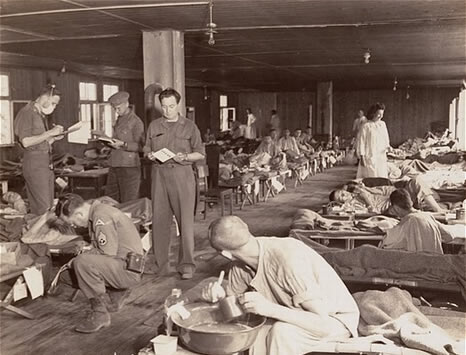
Typhus is any of several similar diseases caused by Rickettsiae. The name comes from the Greek typhos meaning smoky or hazy,describing the state of mind of those affected with typhus. The first reliable description of the disease appears during the Spanish siege of Moorish Granada in 1489. These accounts include descriptions of fever and red spots over arms, back and chest, progressing to delirium, gangrenous sores, and the stink of rotting flesh. During the siege, the Spaniards lost 3,000 men to enemy action but an additional 17,000 died of typhus. Epidemics occurred throughout Europe from the 16th to the 19th centuries, and occurred during the English Civil War, the Thirty Years’ War and the Napoleonic Wars. In the Thirty Years’ War, an estimated 8 million Germans were wiped out by bubonic plague and typhus fever. During Napoleon’s retreat from Moscow in 1812, more French soldiers died of typhus than were killed by the Russians.
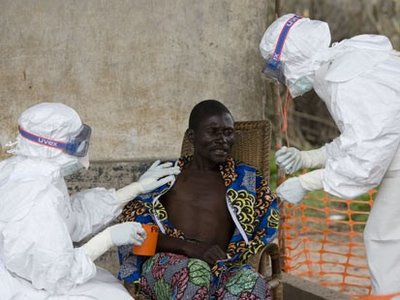
Ebola hemorrhagic fever is named after the Ebola River, where the first recognized outbreak of the fever occurred. The viruses are characterized by long filaments, and have a shape similar to that of the Marburg virus, also in the family Filoviridae, and possessing similar disease symptoms. Ebola first emerged in 1976 in Zaire. It remained largely obscure until 1989 with the outbreak in Reston, Virginia. The virus has been confirmed to be transmitted through body fluids, however, transmission through oral exposure and through conjunctiva exposure is possible. In the early stages, Ebola may not be highly contagious. Contact with someone in early stages may not even transmit the disease. As the illness progresses, bodily fluids from diarrhea, vomiting, and bleeding represent an extreme biohazard. Due to lack of proper equipment and hygienic practices, large-scale epidemics occur mostly in poor, isolated areas without modern hospitals or well-educated medical staff.
Some symptoms of malaria are anemia, fever, chills, and even coma or death. This disease is usually spread when people are bitten by an Anopheles mosquito, which got the infection from another human. Every year, there are about 400 million cases of malaria, killing millions of people. This disease is one of the most common infectious diseases, and a serious problem. Currently, no vaccine that has huge impact has been created, but many are being invented.
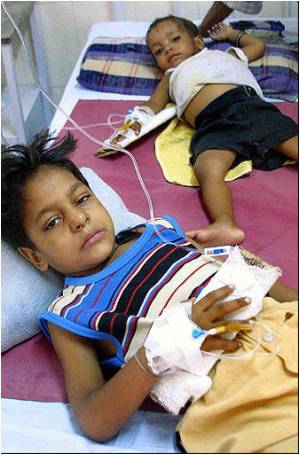
In its most severe form cholera is very fatal. If not treated within three hours, an infected person may die. Symptoms are diarrhea, shock, nosebleed, leg cramps, vomiting, and dry skin. The first cholera outbreak was in Bengal, and from there spread to India, China, Indonesia, and the Caspian Sea. When the pandemic finally ended in 1826, there were over 15 million deaths in India alone. Oral rehydration therapy and antibiotics treat cholera.
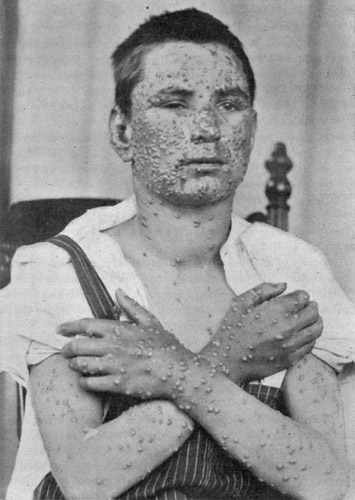
Smallpox is believed to have begun infecting humans in 10,000 B.C. In England during the 18th century this disease killed around 400,000 people each year and was responsible for a large portion of blindness. The main symptom is an outbreak of small bumps all over the body. Other signs include vomiting, back ache, fever, and head ache. The earliest evidence of small pox was in Ancient Egyptian mummies. It is thought that Egyptian traders brought the disease over to India, where it remained endemic for 2000 years. After successful vaccination campaigns throughout the 19th and 20th centuries, the WHO certified the eradication of smallpox in December 1979. To this day, smallpox is the only human infectious disease to have been completely eradicated.
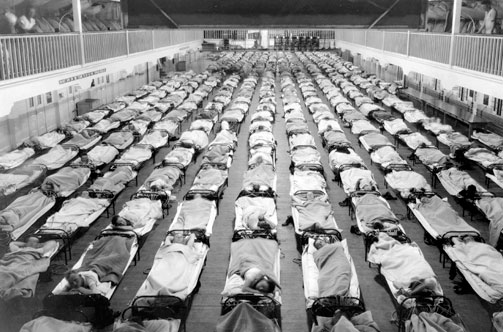
The 1918 flu pandemic (commonly referred to as the Spanish flu) was an influenza pandemic that spread to nearly every part of the world. It was caused by an unusually virulent and deadly Influenza A virus strain of subtype H1N1. Historical and epidemiological data are inadequate to identify the geographic origin of the virus. Most of its victims were healthy young adults, in contrast to most influenza outbreaks which predominantly affect juvenile, elderly, or otherwise weakened patients. The pandemic lasted from March 1918 to June 1920, spreading even to the Arctic and remote Pacific islands. It is estimated that anywhere from 20 to 100 million people were killed worldwide, or the approximate equivalent of one third of the population of Europe. Interestingly, the Spanish flu comes from the same subtype (Influenza A virus subtype H1N1) as Swine flu.
Yellow fever’s symptoms are things such as fever, chills, slow heartbeat, nausea, vomiting, and constipation. The WHO estimated that this disease causes around 30,000 deaths every year, when left unvaccinated. A famous outbreak of yellow fever was in Philadelphia, Pennsylvania in 1793. The illness killed as many as 10,000 people in Philadelphia alone. Most of the population fled the city, including the president. But, the mayor stayed and life and order were soon restored. Pictured above is a yellow fever quarantine station.
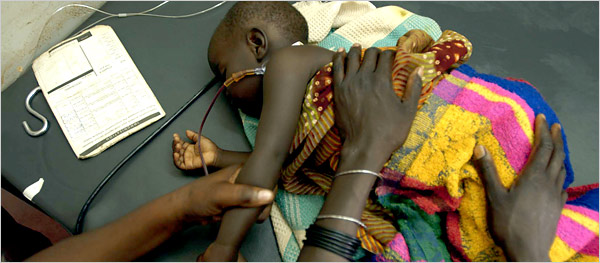
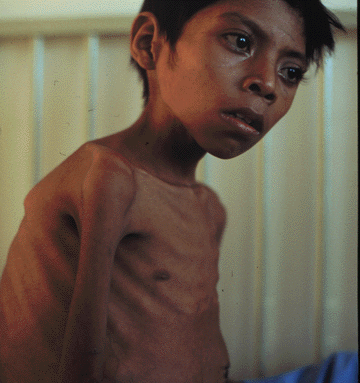
Tuberculosis, or “consumption” as it was commonly known, caused the most widespread public concern in the 19th and early 20th centuries as an endemic disease of the urban poor. In 1815, one in four deaths in England was of consumption; by 1918 one in six deaths in France were still caused by TB. In the 20th century tuberculosis killed an estimated 100 million people. TB is an often deadly disease that normally affects the lungs. Symptoms are coughing, weight loss, night sweats, and blood tinged sputum. Skeletal remains show that people back in 7000 B.C. were infected with TB.
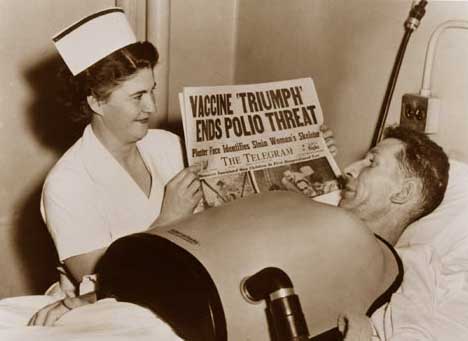
Polio is highly contagious. It is a disease that affects the central nervous system and spine, sometimes leaves the victim paralyzed. Symptoms are headache, neck, back, and abdominal pain, vomiting, fever, and irritability. In 1952, an outbreak in the United States left over 20,000 children paralyzed and over 3,000 dead. Since then a vaccine has been created and most children are protected.
Swollen lymph glands, skin turning red then black, heavy breathing, aching limbs, blood vomiting, and horrible pain are some of the symptoms. The pain is caused by the rotting/decaying of the flesh. All together this illness has caused over 200 million deaths. Perhaps the most famous and horrible pandemic was in Europe in the late 1300s. It was known commonly as the Black Death. This incident almost halved the population of Europe. The bubonic plague is caused normally by the bite of an infected flea. Now, in modern times, several vaccines have been created, and people infected now are treated and cured. Pictured above is a man who suffered bubonic plague during the outbreak in Algeria in 2003.


June 20th, 2009 at 1:36 am
you know what a creepy illness is? harlequin ichthyosis, look it up
June 20th, 2009 at 1:38 am
Wow, that’s some messed up stuff. I’m glad to be living in modern times and a modernized country.
June 20th, 2009 at 1:40 am
Interesting list!
June 20th, 2009 at 1:43 am
I always thought that yellow fever and malaria were the same thing. Interesting to know there is a difference. Very sad that we can’t find cures for all of them.
Good list, purplemoocowz.
June 20th, 2009 at 2:01 am
wow, didn’t know the bubonic plague was still lurking about!
June 20th, 2009 at 2:13 am
Very cool. Very cool.
June 20th, 2009 at 2:17 am
What a happy coincidence. I was looking up some of these (Ebola, Small Pox, Tuberculosis, and Bubonic Plague) just the other day while watching a show about disease.
June 20th, 2009 at 2:31 am
Very good list, Loads of good facts and very interesting
June 20th, 2009 at 3:19 am
hmmmm….no leprosy?
June 20th, 2009 at 3:23 am
though the polio vaccine had some issues.. my uncle when it was first coming out got a bad dose as a baby.. left him mentally retarted the rest of his life.. cause brain swelling.. he was among a few that it happened too the batch was bad
June 20th, 2009 at 3:36 am
I thought the pic for #1 was a wax model from a museum when I first saw it. Kind of hard to imagine a flea wreaking that much havoc. The worst of the pics, however, is the one for the Ebola virus. More than any of them, you can look at that man and know he’s going to die. It’s a horrible, horrible illness.
Which brings me to two issues: 1. I think the descriptions should include more of what the illnesses actually do (how they kill, that is). A lot of this info lists the symptoms but not the actual cause of death (massive organ failure or hypovolemic shock where the ebola virus is concerned). 2. There seems to be an error in the text of #1: “In this incident, almost have of the European population.” doesn’t exactly make sense.
Very interesting list!
June 20th, 2009 at 3:38 am
We got a chikungunya epidemic here right now.
June 20th, 2009 at 3:43 am
A good list, purplemoocowz, thank you for the read…but like so many other lists of this kind, I’m sure a good deal of extra education on the subject will arrive here in the comments section.
@Bjart (1): From my understanding–harlequin ichthyosis–is a birth defect, not a disease.
@corinthian0430 (9): I agree, although not nearly as many victims as some of the other entries–Leprosy –has been documented in almost all cultures from as long ago as pre-biblical days. It is a dreaded disease that has changed communities forever. In ancient to modern days lepers could be found making pilgrimage to some far religious icon, often on their way to an isolated leper colony–which is another fact about this disease that confirms it’s effect on world history.
Lastly–Why no mention of the world’s most famous polio victim, US Pres. Franklin D. Roosevelt? From what I understand it was his contraction of the disease and resulting paralysis that cemented his commitment to eradicate the disease. From that commitment was born “The March of Dimes”, a US organization that spearheaded the effort to find a cure, and enabled Dr.Salk to develop his vaccine.
June 20th, 2009 at 3:59 am
Pic no.1 is sick, though looks like some tribal ink(ed) tattoo. Also, where is AIDS, probably the most advertised against disease.
The heading says “… & their effects on history.”, but most of the descriptions dont have their effects on history. Any particular eason ?
June 20th, 2009 at 4:24 am
You know, I suppose this is a good time for me to ask something about the flu subtype classification that I’ve wanted to know, but haven’t really known where to look. You see the strains like H1N1 (“swine flu”), H5N1 (“bird flu”), etc. Do all those H’s & N’s mean something specific?
June 20th, 2009 at 4:30 am
#4 : “But, they mayor stayed and life and order were soon restored.”
I think it should be “but, *the* mayor stayed…”
Otherwise, a great list *thumbs up*
June 20th, 2009 at 4:38 am
Have to say nice list. My Girlfriend is a hypercondriac so I will have to hide this.
P.S No leprosy
June 20th, 2009 at 4:43 am
A great idea for a list, but as 7raul7 noted the ‘effects on history’ is mostly missing, a shame really as there are some fascinating stories to go with a lot of these outbreaks.
Also, with regard to cholera being “very fatal”, how is “very fatal” different from “moderately fatal” or “a little bit fatal”?
June 20th, 2009 at 5:19 am
As for no. 1, the Black Death was most likely not bubonic plague. As it says, bubonic plague is transmitted by infected rat’s fleas. The Black Death was transmitted directly from person to person – there is so much contemporary evidence for that.
June 20th, 2009 at 5:44 am
I don’t think A(h1n1) will level these illnesses. This virus is not as fatal as those.. H1N1 is only a fast spreading disease but good thing that more and more countries are getting ready for the pandemic. I should prepare, as a nurse, for these illnesses that still affects the present, not only the history…
VERY VERY VERY NICE LIST JAMIE!
ONE OF MY FAVORITES…
AND sadly, I CAn’t register…
June 20th, 2009 at 5:49 am
To #1
I wouldn’t advise telling people to look that up, but anyhow…
Cool list!
June 20th, 2009 at 6:00 am
Another thing not mentioned on the list…in regards to the Spanish flu outbreak, item 5:
Although the initial outbreak of the Spanish flu became a large epidemic quickly, it wasn’t “deadly” until a few months later, when the flu had mutated into a strain that caused more fatalities than not.
This was/is the biggest fear that the medical community has for the current H1N1 virus.
June 20th, 2009 at 6:03 am
harlequin ichthyosis has been on a previous list and it is a birth defect.
June 20th, 2009 at 6:07 am
In the #1st article:
”In this incident, almost have of the European population.”
This makes no sense. Other than that, a good list.
June 20th, 2009 at 6:37 am
in the H1N1 virus the h and the n are always present, that describes the two antigens on the outside of the virus which is how it is identified and how it attaches onto other cells, the numbers are more specific sub strains, such as the swine flu (H1N1) or bird flu (H5N1)
June 20th, 2009 at 6:38 am
in the flu virus***
June 20th, 2009 at 6:47 am
There is plenty of evidence that medieval Black Death wasn’t bubonic plague. First hand accounts of the symptoms, as well as epidemiology don’t line up. I’ve read hypotheses ranging from an ebola-like virus to anthrax, to multiple diseases side by side. All I know is I don’t want it!
June 20th, 2009 at 7:16 am
No mention of SARS?
June 20th, 2009 at 7:21 am
geez guys, we all see the typos and can still read it just fine, so for all of you grammar hammers out there who only write in to point these out i have a little consructive criticism, “shut up” -as always, wonderful list…
June 20th, 2009 at 7:30 am
Ah… the natural anti-thesis of humanity. It’s great biological clean sweeper.
June 20th, 2009 at 7:33 am
Woah, scary stuff. Thats the first time I’ve seen a picture of someone effects by the plague… they’re all very frightening though
June 20th, 2009 at 7:38 am
@corinthian0430 (9): i dont know if leprosy ever had a large enough affect on any area to be put on this list.
June 20th, 2009 at 7:39 am
@flgh (28): wanna know how many people in the usa actually had sars? like 2! not 2000 or 200000 but 2.
June 20th, 2009 at 7:52 am
@lincolnshire poacher(29)
I’m sorry, did I ask for your opinion? And it’s not a typo, it’s a failed sentence.
June 20th, 2009 at 7:58 am
“In it’s most severe form, cholera is very fatal.”
as i’ve said repeastedly Jamie,
you know to learn the difference between it’s and its and use them properly!!!
June 20th, 2009 at 8:02 am
“TB is an often deadly disease that normally effects the lungs.”
Jamie, you need to learn the difference between effect and affect and using them correctly!!
June 20th, 2009 at 8:05 am
tmxicon: the ‘H’ and ‘N’ reference what are called ’surface antigens’, which are the proteins the immune system recognizes in viruses. The immune system then goes about creating protective antibodies to eradicate the infection. It’s also how epidemiologists determine where a disease strain originated, and also what researchers use when developing vaccines.
great list (although HIV is a glaring omission)!!
June 20th, 2009 at 8:13 am
Just to throw out an ethics/ philosophical question, would it be worse for the world to deal with overpopulation that could result from curing all these illnesses than it is to deal with the illnesses themselves?
Also JF I have to point out that in the past week a sports list has been most popular. I happen to know you have another sports list that would be awesome.
June 20th, 2009 at 8:14 am
Contrary to popular belief, Leprosy is actually very hard to contract, it’s not very contagious
June 20th, 2009 at 8:20 am
Malaria could have been eradicated had DDT not been outlawed. It was eradicated in the US, but not 3rd world countries and they bowed to the pressure, so Malaria has killed millions because of “Silent Spring.”
Re:Small Pox I don’t believe it HAS been completely eradicated. I think there are cases in some poorer countries, but they’re not going to report it — it would look bad! So when we go to a 3rd world country (and we will at some point — I grew up overseas), I’m still gonna get my kids vaccinated!
June 20th, 2009 at 8:22 am
@Looser (33): Of course, since the usa is the center of the universe!
Nevermind that china had 5328 sars cases & 349 deaths, hong kong had 1755 cases & 299 deaths, and canada had 251 cases & 44 deaths
June 20th, 2009 at 8:52 am
@flgh (41): Even counting all worldwide deaths, SARS was no where near a high enough death toll to get on this list. The regular flu kills more people, by far.
June 20th, 2009 at 9:02 am
@amerileira (40):
WRONG. You do not “eradicate” a disease simply by killing large numbers of one of its vectors. You display your ignorance of science with that statement.
Moreover, some anti-environmentalism jerk comes on here every now and then and trumpets the greatness of DDT. I’m sick to death of it. DDT was proven destructive to the environment… and in fact, it almost certainly killed my father.
June 20th, 2009 at 9:04 am
Interesting list but I too wish the historical significance of these illnesses was elaborated upon.
There are also a few mistakes in the Ebola entry. The strain that hit Virginia was confined to monkeys; not the strain that affects humans; it happened in a lab. Another case of the media getting half the facts and then running with it. Also the reason that the disease appears in mostly poor areas is because that is where the virus originates – the reservoir for this particular virus has been shown to be tropical fruit bats – from there to monkeys and then to us. Once the disease has been contracted the lack of barrier nursing, autoclaves, and general lack of sanitation make an epidemic a real hazard. Bodily fluids of those infected are considered a class 4 bio-hazard.
Also interesting fact about the Spanish flu – it wasn’t the disease that killed all those folks in the prime of their lives. Their deaths were cause by a cytokine storm – an overreaction of the body’s immune system. Those with the strongest immune systems died. Old folks and children with weakened or under-developed immune systems didn’t.
flgh: Agreed. SARS was a huge deal and very dangerous. Swine flu is a walk in the park compared to SARS. In fact we have more people die during our regular flu season every year. There is a bonus – bacon, pork loin and all products pig are cheap. om, nom, nom.
June 20th, 2009 at 9:25 am
I’m not sure if death is actually characterized as a symptom.
June 20th, 2009 at 9:27 am
^ Talking about Malaria there.
June 20th, 2009 at 9:40 am
Gaara: The final symptom eh?
Randall: One of the saddest things about the whole DDT fiasco is that there are other less environmentally toxic ways to curb the mosquitoes/kill the nymphs but because they’re expensive they’re underutilized. They (DND) flood the little river that runs behind my house every year with some environmentally sound compound that prevents the nymphs from maturing. We’re not worried about malaria but West Nile virus is considered a hazard. Not so much for we civilians but the military is concerned about all those cadets and new recruits on base.
June 20th, 2009 at 9:54 am
Actually, the more research that has been done on the spanish flu, the more they have noticed that the majority of people died from Staph infections rather than the flu itself!
Also, Polio was overdiagnosed and rarely properly diagnosed through culture. Even FDR has been determined to not have had Polio!
Great list tho!
June 20th, 2009 at 10:00 am
Fascinating list, I love learning more about diseases. I guess that’s one of the reasons I choose a bio science course at uni.
#13 deeeziner, birth defects are a group of diseases. The term disease covers all impairments of the normal state of the living animal or plant body or one of its parts that interrupts or modifies the performance of the vital functions and is a response to environmental factors, to specific infective agents, to inherent defects of the organism, or combinations of these factors. Harlequin ichthyosis is a congenital disease like Down syndrome.(reference.com and dictionary.com).
That’s a common misconception, like infectious and contagious are the same.
June 20th, 2009 at 10:20 am
Hello there, given one or two exceptions, this seems quite a definitive list. Well done.
@erikasoup (20): “AND sadly, I CAn’t register…” Yes, the Register button has never worked for me either, just click ‘Login’ and choose ‘Create New Account’ from there.
@mom424 (44): “Those with the strongest immune systems died.” I wonder if that ties in with H1N1? I’ll have to look into this.
I’ve read into the H1N1 mutation quite a bit. I followed the plot from the first rumours of development (weeks before it happened), to the preparations (again before it happened), to the instigation. I’ve also seen the biological makeup of this thing and why it cannot have been created naturally – by any means. I’d be interested in hear any views on this..? (I may post sources)
June 20th, 2009 at 10:48 am
@General Tits Von Chodehoffen (38): “Just to throw out an ethics/ philosophical question, would it be worse for the world to deal with overpopulation that could result from curing all these illnesses than it is to deal with the illnesses themselves?”
Great Question. The world’s population has exploded in the last 100 years or so. I think medical technology keeping disease in check is definitely one of several factors. The current population growth rate has gone way beyond sustainable. I think we’ll all be dealing with this problem a lot sooner then we think.
World population graphs:
http://www.optimumpopulation.org/opt.earth.html
http://www.census.gov/ipc/www/idb/worldpopgraph.html
June 20th, 2009 at 11:08 am
(50) Please post sources and why you think H1N1 was not created naturally.
June 20th, 2009 at 11:12 am
Cool list! If you want to read more, get a book called The Coming Plague by Laurie Garrett. It will scare the bejeezus out of you and it has outstanding chapters on the original Ebola outbreak in 1976 and on the beginning of the AIDS epidemic.
June 20th, 2009 at 12:03 pm
Kennoth: When you post, you will get opinions, whether you want them or not. It was not a failed sentence. The worde is “halved” not “have”. The population was cut in half.
deeeziner: To further your comments about FDR, his pic was put on the dime to memorialize his founding of the March of Dimes. I remember in school, in the 50’s, we were given cards with holes for dimes (like a coin collectors book, to fill up. We were told to put in a dime a week, and collect dimes from relatives, to help fight polio. We felt like we were really doing something positive.
June 20th, 2009 at 12:43 pm
Great list, though I was most definitely not prepared for that last picture for #1. It really caught me by surprise…
June 20th, 2009 at 1:01 pm
Most of the grammar errors have now been fixed.
June 20th, 2009 at 1:13 pm
Yeah, Im surprised AIDS wasnt on the list.
But interesting list anyway!
I was also surprised that Obsessus with Technology- flu type 1 wasnt on here. Millions suffer form that all over the Western world! And it seems to be on an increase!
Also pic no.1 I thought was a wax doll first, I didnt think it was real until I read it.
June 20th, 2009 at 1:14 pm
* to be on THE increase. I thought Id correct myself there, before someone else jumped in!
June 20th, 2009 at 1:48 pm
What is swine flu?
http://www.youtube.com/watch?v=y77oExTDw8I
Swine flu – pigs unaffected!
June 20th, 2009 at 2:12 pm
no swine flu??? that thing caused mass hysteria at the very least, it seemed that the symptoms of swine flu included extreme over reactions to otherwise mild circumstances
June 20th, 2009 at 2:25 pm
Scary stuff… That’s it, I’m moving to Madagascar.
@ 59 (atmos_fear): The current swine flu outbreak has actually saved thousands of lives, because people are more conscientious about washing their hands and going to the doctor when they’re sick. In fact, the funeral industry is having problems because of all the lives SAVED by swine flu.
June 20th, 2009 at 4:05 pm
[that was a really interesting read and was very well presented. well done]
June 20th, 2009 at 4:14 pm
@General Tits Von Chodehoffen (38): Lol, I think that the fact that we don’t live in a ‘Blade Runner/ Mad Max’ near- future dystopia is because we hven’t cured these diseases…
I totally agree with you, I think some things are best left to nature…
June 20th, 2009 at 4:38 pm
Well, this list disappointed me. Where is the discussion around the “Effects on history?”
I would have expected something along the lines of
AIDS: served to mobilize and “de-marginalize” the Gay community.
So, I’ll read the comments; Oftentimes they are more enlightening than the actual list.
Cheers everyone!
June 20th, 2009 at 6:48 pm
AIDS doesn’t actually kill people…It destroys the immune system so that other diseases can kill you. If you lived in a non-infectious bubble with AIDS you wouldn’t die. I think that’s maybe why it’s not on the list…
If none of that made sense or I’m wrong forgive me cos its reeaaalllly late!
June 20th, 2009 at 7:58 pm
Rad list!
#1 picture is freakkkky.
has anyone ever taken that god damn malaria vaccine when travelling. I swear to GAD it makes you even more sick that just sucking it up and contracting malaria.
for 3 weeks i felt like i was on a freaky LSD trip that i couldn’t get out of..
anyone?
I know i’m not alone cuz my gf was tripping balls too and many other backpackers could attest to the ‘wtf’ effects of the vaccine.
what is in that stuff??
Abi….
if it disables your immune system. it kills you. we are nothing without our IS since we know living in a non-infectious bubble is not realistic for anyone with less than 2312 billion dollars to spare.
June 20th, 2009 at 8:02 pm
@Chineapplepunk (63): Ya that is kinda what I was thinking but at the same time it really sucks when you see someone who is sick. I really don’t know, but I’m leaning towards your view on it.
June 20th, 2009 at 8:04 pm
@Shifty (51): Dude thats scary
June 20th, 2009 at 8:05 pm
Bjart’s post on harlequin ichthyosis below refers — if you’re inquisitive, confine your curiosity to reading about it on wikipedia. Take my advice and please don’t watch harlequin ichthyosis on YouTube. I’m not squeamish yet it is so horrible that I nearly threw up. May God have mercy on sufferers of this terrible, terrible disease.
June 20th, 2009 at 9:18 pm
Good job. It made me further appreciate the modern marvels of medicine!
June 21st, 2009 at 12:11 am
Yet another great list! Much thanks to purplemoocowz for the information on one of my favorite topics.
June 21st, 2009 at 12:36 am
I think that number 3 should be removed or a different picture. I myself had TB and that picture is not at all what it is like. I am sorry but it really pissed me off. TB can mess up a persons digestive system but in most cases it ends up nothing like you show. I am not a fancy DAN but I had that disease. Get your stuff in order. The kid in that pic is clearly not suffering from TB. He is suffering from something far worse. Oh and by the way we can stop that suffering if only people were to give a few dollars or pounds. I don’t care about the pic but get the facts right.
Don’y respos unless you are gonna kiss my my ass along the way…
June 21st, 2009 at 1:12 am
just so you know, the child is obviously from a more remote part of the world (where every ass doesn’t have a computer). If left untreated (like most diseases are in rural areas) TB can certainly cause the symptoms depicted in the picture. Seeing as you have access to a computer I am going to assume you live in an area where medical intervention is more readily available so your TB was treated well before it got to this point.
Look before you leap, sweetheart. Either that or stick your foot in your mouth and try to find the other half of your brain.
June 21st, 2009 at 1:13 am
btw, the previous comment was specifically for RedMan
June 21st, 2009 at 2:13 am
Wow! Interesting but that’s scary and the pic of smallpox really scared me.
June 21st, 2009 at 5:36 am
whoa that’s a cool list!
June 21st, 2009 at 6:29 am
@RedMan (72):I believe that the picture used for TB was chosen specifically to illustrate why the alternate name for this disease is CONSUMPTION.
But you are right, more humanitarian effort in third world, health care starved countries might make disturbing pictures of this kind less often a reality to those dealing with such horrors on a daily basis.
And no I WILL NOT kiss your ass, I might catch something…
June 21st, 2009 at 6:38 am
PS–two others not on the list…perhaps because they have always been considered a “dirty” little secret–
Syphilis and Gonorrhea…
They are the real reason for the invention of the condom.
Almost every woman in history, concerned about an undesired pregnancy also had access to a regional form of birth control. Though some of those methods were more successful than others.
June 21st, 2009 at 8:25 am
The list of horror! The list of humanity triumph against of horrors. Sometime we must review this list to not forget the reality of the history ant to honour the wasted lives and the work of scientists and doctors.
Congratulation for subject!
SGC
June 21st, 2009 at 10:28 am
Whilst there is no vaccine for malaria i feel that the impact of the genetic disease sickle cell anemia should be mentioned. There is a reason why the disease is so prevalent among descendants and residents of the malaria belt. Assuming no treatment is given then those with two copies of the mutated gene will die, those with no copies of the gene will die from malaria. Those with one copy of the gene will have enough sickle shaped cells to make it hard for the malaria pathogen to take residence in the red blood cells but not so many as to cause death. For this reason a vast number of individuals who were carriers of the disease survived and passed on the genes.
Also, on a note on smallpox, whilst it has been eradicated some idiot in Birmingham University UK smashed a vial containing a sample some years ago. The pathogen was carried in the air vent to the office above and the person there was the first reported case of death by smallpox since the official eradication.
June 21st, 2009 at 11:33 am
this is so disturbing. thank god for modern medicine.
June 21st, 2009 at 6:14 pm
Yes, this is a very interesting list. For those who want to learn more on their own, there are two well-written books that will turn their blood cold – “The Hot Zone” and “The Coming Plague – New Emerging Diseases in a World Out of Balance” by Laurie Garret, who won Pulitzer prize for her reporting on the Ebola virus. No pictures, but great descriptions and pretty much everything a layperson would want to know about them.
June 21st, 2009 at 7:40 pm
the last one looks painful….. im looking at this on my dsi !!!!!
June 21st, 2009 at 7:59 pm
19 egernunge
June 20th, 2009 at 5:19 am
“As for no. 1, the Black Death was most likely not bubonic plague. As it says, bubonic plague is transmitted by infected rat’s fleas. The Black Death was transmitted directly from person to person – there is so much contemporary evidence for that.”
It could have been pneumonic. Once it goes to that, a cough or sneeze can transmit the bacteria. Untreated, the fatality rate of the pneumonic form is extremely high.
Someone wrote a fictional account of pneumonic plague decimating New York. It’s called “The Black Death” and I read it when I was a kid and it scared the hooey out of me.
Another book that scared me was Richard Preston’s(?) “The Hot Zone”, about the Ebola Zaire and Ebola Reston deals. Ebola kills you so fast and in such a horrific way that it’s hard to transmit, but if someone got on a plane with it and blew bloody spit everywhere…
SCARY!
June 21st, 2009 at 8:19 pm
No HIV or AIDS?
June 22nd, 2009 at 7:00 am
Effects on history weren’t included in the way I expected. Sure, death tolls have an indrect affect, but what about changes in hygiene, use of dead bodies as weapons, fear of contamination and restrictions on emigration?
June 22nd, 2009 at 8:14 am
Interesting, AIDS and Leprosy are not on the list.
June 22nd, 2009 at 9:30 am
AIDS/HIV should definitely be on this list. It is epidemic in Africa, with some countries having an infection rate of over 20%. That’s more than one in every five people.
June 22nd, 2009 at 10:24 am
Very cool list. Just wished that the way they changed the world was mentioned (other than the death toll)
June 22nd, 2009 at 12:50 pm
thank you for this list…with the whole ’swine flu’ frenzy, people need to realize there are DEFINITELY WORSE THINGS we could be catching.
in fact, i HOPE i catch swine flu…based on the numbers, i’d have more of a chance of surviving!
June 22nd, 2009 at 2:23 pm
holy sh*t@ the dude from algeria yikes!
June 23rd, 2009 at 1:05 am
@hiero (35), (36)
“Jamie, you need to learn the difference between effect and affect and using them correctly!!”
“you know to learn the difference between it’s and its and use them properly!!!”
ummm…being a pompous ass AND an imbecile is an unfortunate combination…
June 23rd, 2009 at 8:00 pm
I’m curious about harlequin ichthyosis, but kind of afraid of the pictures. Would someone please explain it or link to an image-free article?
June 23rd, 2009 at 8:59 pm
Ann34- Go on youtube and type it in. Prepare yourself.
June 24th, 2009 at 5:28 am
@Ann34 (93): A short google search left quite a few finds. This link is to an article that is relatively descriptive on a layman level and has the least sensationalized photos of the condition.
http://www.scalyskin.org/content.cfm?ContentID=99&ColumnID=14
Be warned–there are a couple of photos, but the majority of description in this article involve a graphic diagram.
June 24th, 2009 at 5:36 am
@Ann34 (93): Note; The deformed appearance of the eyes is caused by the eyelid’s being drawn backwards due to the tightness and inflexibility of the outer surface skin of the eyelid.
(ectropion).
The same drawing back can occur to the lips, called eclabium, for the same reasons.
I mention this because there is scant explanation for the illustrated examples of these conditions in the linked article and I do not know how much research you plan on pursuing.
June 24th, 2009 at 10:17 pm
hey bjart, u were damn right about harlequin ichthyosis…extremely graphic !!
June 25th, 2009 at 8:34 am
I thought that there was still a strand of smallpox kept in a lab somewhere?
June 26th, 2009 at 8:13 am
June 26th, 2009 at 9:04 am
what about SARS?
June 26th, 2009 at 9:59 am
By the 1960s, malaria was mostly eradicated in some third-world countries because of DDT. Rachel Carson undid all that.
June 27th, 2009 at 4:06 am
A(H1N1) …? Classes back int he Philippines (well in my school) were suspended from June 24 until July 6.
June 28th, 2009 at 7:59 am
malaria would mostly break out in the rural regions of third world countries and people die mostly because of lack of knowledge.
June 29th, 2009 at 8:39 pm
this list was rad.
and that last picture totally freaked me out alittle..
July 13th, 2009 at 5:26 am
I wish more people would read this list: we need those vaccines, thanks to them we beat Smallpox and we can’t allow the polio to come back.
July 22nd, 2009 at 7:43 pm
I wish I could send this to every parent who refuses to vaccinate their child. What is scarier, the debunked notion that vaccines cause autism or a disease that is extremely painful and often fatal.
July 24th, 2009 at 5:40 pm
you totally left out HIV/AIDS
August 1st, 2009 at 1:40 pm
Bubonic Plague is still in squirrels and rats in the mountains in California. It’s everywhere. As far as HIV/AIDS… it hasn’t killed nearly enough people to be in the top 10.
August 4th, 2009 at 6:24 pm
@hillerious (11): Hey my name is Gabe, I am writing to you from California and responding to you about your comment. It seems you know a about the ebola virus and others I suspect. the reason I am writing you is because I am very interested in the study of infectious diseases.
If you could someday share your knowledge with me that would be great, you see, I like having discussions about these topics to better my understanding.
If you have any valid comments in regards to ebola, cholera and other hot agents that would be great. How they work how they can spread, what cures are out there or vaccines…
I like doing research online and with health care providers and thought you fit the bill…
anyway thanks and hope to hear from you
Gabe
August 8th, 2009 at 8:21 pm
harlequin ichthyosis: looked it up. scary crap! wish there were cures for more of these! nice list! good to know.
December 10th, 2009 at 5:43 pm
wow!!!! man dats da 1st time ive seen piks likee datt.man that was freaky but it helped mee understand how bad these diseases are.. but oder dan dat this wasz a good list