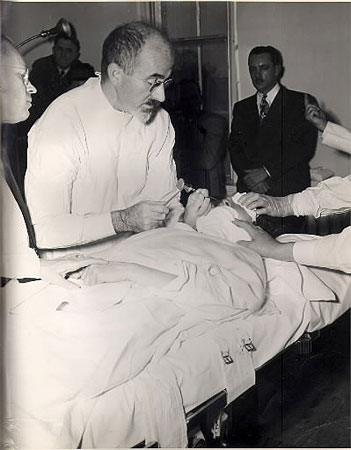
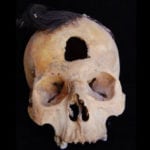
The first documented case of psychosurgery was in 1888 by Swiss psychiatrist Gottlieb Burckhardt. He claimed success in 50% of patients (3 of 6) Burckhardt was met with overt criticism from his contemporary medical colleagues. The next attempt at this type of surgery did not occur until the mid 1930s which produced many documented success stories and soon became an accepted surgery procedure in many countries. From the late 1930s to the 1970s approximately 100,000 psychosurgeries / lobotomies were performed world-wide.
Note: I know many will wonder why Francis Farmer in not included in this list. There is no proof that Francis Farmer ever had a lobotomy and the author who initially alleged this admitted in a court proceeding that he had made it up.
Notable Because: First prefrontal lobotomy procedure in the United States
The first prefrontal lobotomy in the United States was performed in 1936 on 63 year old Alice Hood Hammatt by Dr. Walter Freeman and Dr. James Watts. The doctors started the surgery by making incisions 3 centimeters in length and then using an auger (drill) they made holes in the skull over the left and right frontal lobes. They then inserted a leucotome (a narrow shaft) 4 centimeters straight down through the hole on the left side into the exposed surface of the brain. The entire operation lasted about an hour. Some months after her surgery, Hammatt suffered a convulsion likely related to her surgery. However she continued to live with reduced anxiety and stayed out of mental hospitals. Her husband thought she behaved more normally than ever before after the surgery and called the next five years the happiest of her life. Alice Hammatt contracted pneumonia and died at age 68.
Interesting Fact: Freeman and Watts closely followed the same procedure as Egas Moniz and Almeida Lima who performed the same surgery a year earlier which they called “leucotomy”. Moniz was a Portuguese neurosurgeon and the first Portuguese to receive a Nobel Prize for his discovery of the therapeutic value of leucotomy in certain psychoses.
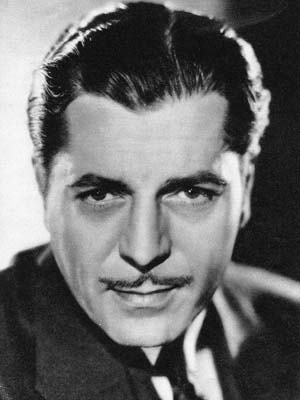
Notable Because: American Actor
Warner Baxter is best known for his role as The Cisco Kid in Old Arizona, for which he won the Academy Award for Best Actor. By 1936, Baxter was the highest paid actor in Hollywood earning $284,000. Baxter made over a hundred films between 1914 and 1950. Later in life Baxter suffered from arthritis. During this time many people were lobotomized for constant pain, such as chronic or severe backaches and agonizing headaches. Baxter’s arthritis became so painful he decided to have an ill-advised lobotomy to ease the pain. Baxter died shortly after the surgery of pneumonia.
Interesting Fact: during the prefrontal lobotomy heyday in the 1940s and ’50s, it was performed on more than 40,000 patients in the United States, and on around 10,000 in Western Europe
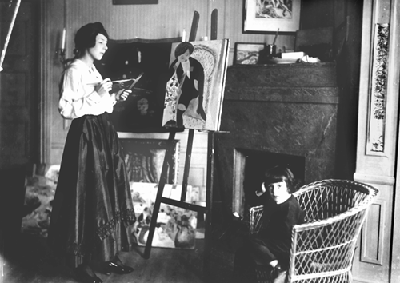
Notable Because: Modernist painter
Sigrid Hjertén is considered a major figure in Swedish modernism and was married to a well know expressionist painter Isaac Grünewald. Hjertén and Grünewald regularly exhibited together at home and abroad and are often recognized as being responsible for introducing modernism to Sweden. Hjertén suffered from lifelong mental health problems that resulted in her being hospitalized for extended periods in the 1930s. An increasing tension can be seen in her art and reaches its height before the disease forces her to quit painting. In 1937 when she was hospitalized permanently, Grünewald divorced her and married his mistress. In 1946 Grünewald and his second wife were killed in an airplane crash. Hjertén died two years later after a botched lobotomy. Sigrid Hjerén’s total production amounted to slightly more than 500 paintings, together with sketches, water-colors and drawings.
Interesting Fact: Scandinavian hospitals lobotomized 2.5 times as many people per capita as hospitals in the United States. Sweden lobotomized at least 4,500 people between 1944 and 1966. A large majority of these surgeries were performed on women.
Notable Because: Internationally recognized singer
Alys Robi (real name Alice Robitaille) was Born in Quebec City and displayed talent for singing and acting at a very young age. She first performed on-stage at the Capitol Theater at age 7. In 1948, at age 25 she was injured in a car accident and entered a period of depression. After a failed romance she suffered a mental breakdown and was interned for several years in a Quebec City asylum. She was subjected to a lobotomy against her will but later credited the operation with her recovery and understood that she was one of the rare success stories. In 1952, she was released and reentered stage but her efforts were impeded by taboos of mental illness. Robi never regained the same level of popularity. However in the early 1990s Robi returned into the public eye after the massive success she had with a song written for her by Alain Morisod. The song is called “Laissez-moi encore chanter” which you can hear in the clip above.
Interesting Fact: Robitaille has published two autobiographies: Ma Carrière, ma vie (“My career, my life) and Long Cri dans la nuit: Cinq Années à l’Asile (“Long cry in the night: five years in the asylum)
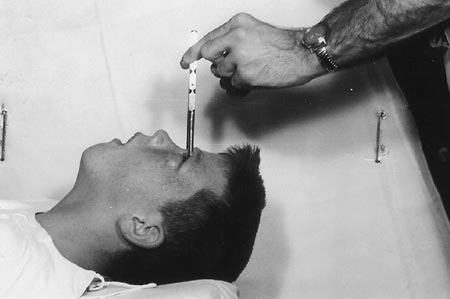
Notable Because: First transorbital or “ice pick” lobotomy
The first transorbital (ice pick) lobotomy was performed in 1946, also by Dr. Walter Freeman. Ionesco was a 29 year-old housewife and mother who was described as violently suicidal. In His Washington D.C. office, Freeman rendered Ionesco unconscious through electroshock. He then inserted an ice pick above her eyeball, banged it through her eye socket into her brain and then swirled it around in a sort of eggbeater motion to scramble the neural connections. The family considered the operation a success and a blessed relief. She lost some memory function but was relatively intact and led a fairly normal life.
Interesting Fact: Ionesco’s daughter is quoted saying “It’s a hard decision to make, but inevitably life is just full of decisions like that… For me it was a good thing. I think for mama it was a good thing. And I think the lobotomy he did on her was a very good thing. Certainly the electroshock therapy was. Of course now they have medicine for this, so it’s all a moot point. But they had nothing back then. That’s the thing, people who are looking at it don’t understand, they didn’t have anything else and nobody was coming up with anything.”
Notable Because: Received Lobotomy at 12 years old
In 1960 Howard Dully was brought in for the procedure because his stepmother described him as “unbelievably defiant,” saying among other things: He objects to going to bed and does a good deal of daydreaming. After Howard’s stepmother visited with Dr. Freeman, he suggested that the family should consider the possibility of changing Howard’s personality by means of transorbital lobotomy.” Howard’s stepmother convinced her husband (Howard’s Father) that is was the best thing for his son and then gave the doctors his approval. Dully took decades to recover from the surgery; he was institutionalized, incarcerated, and was eventually homeless and an alcoholic. Eventually Dully sobered up and received a college degree and became a California state certified instructor for a school bus company in San Jose, California.
Interesting Fact: When Dully was in his 50s he embarked on a two year journey to uncover what happened to him as a child. He spoke with his family and his relatives and other lobotomy patients of Dr. Freeman and gained access to Freeman’s archives. Dully was one of the youngest patients to receive an “ice pick” lobotomy and the first patient ever to obtain a picture of his own lobotomy.
Notable Because: Sister of Tennessee Williams
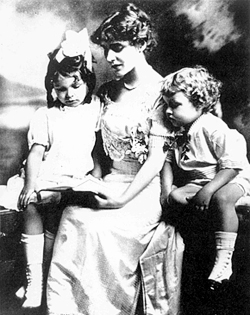
Rose Isabel Williams was born, two years before her brother, Thomas (Tennessee). The two grew up together and became as close as twins. At 18 Rose’s relationships became inconstant and she began to feel unloved. Her behavior had become so erratic that her mother decided to send her away to school in Vicksburg. Later she was committed to a State Hospital and diagnosed as a paranoid schizophrenic. In 1943 after six years of hopeless treatment, including shock therapy, Rose was given a bilateral prefrontal lobotomy that was sanctioned by her mother. After the surgery Rose had lost much of her personality which caused Tennessee intense remorse and guilt for not being able to prevent the surgery from happening and for some time harbored ill feelings toward his mother Edwina for allowing the surgery to happen. Rose provided Tennessee Williams inspiration for his plays, Suddenly, Last Summer and The Glass Menagerie.
Interesting Fact: When Tennessee Williams died in 1983 he willed most of his estate to the University of the South in Sewanee, Tenn., with the bulk of it to remain in trust for his sister during her lifetime. When Rose Williams died in 1996 the University of the South announced that they would receive $7 million. The photo above shows Edwina Dakin Williams reading to her children Rose and Tom (the future “Tennessee”).
Notable Because: Famous Violinist
Josef Hassid (Józef Chasyd) was born in Poland to a Jewish family and is considered by many as one of the greatest violinist of our time. When Hassid lost his mother as a boy he started showing a quite timid and reclusive temperament. In 1938 he moved to Britain with his father and in 1940 made a magnificent first appearance in London at the age of 16. While performing what is considered one of the most technically complicated pieces of music ever written for violin.(Concerto in D major, Op. 35 by Pyotr Ilyich Tchaikovsky) he had a memory lapse. Then in 1941 he experienced deep depression and suffered a nervous breakdown. He was then committed to St Andrew’s Hospital in Northampton where he underwent insulin coma therapy and electroconvulsive therapy. After a short period spent with his father out of the clinic he was eventually diagnosed with an acute case of schizophrenia and committed again, this time to Long Grove Hospital mental asylum in Epsom, Surrey, which had a wing for Polish civilians. There he remained until his death at 26 caused by an unsuccessful lobotomy.
Interesting Fact: Hassid left us with only 9 recordings. You can hear his Meditation de Thais by Massenet in the clip above.
Notable Because: Sister of John F. Kennedy
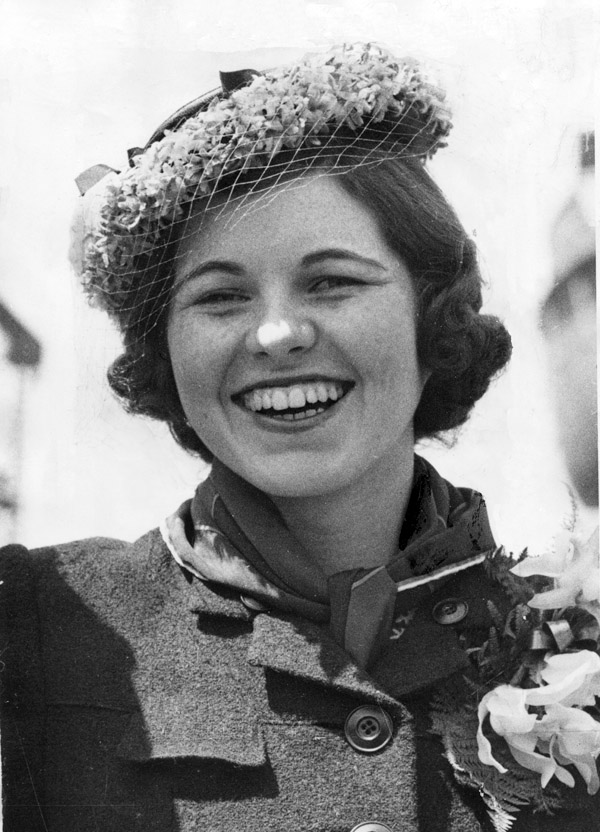
Rosemary was said to have been considered retarded by members of her family but that assessment has been widely disputed by subsequent analysts. Some concluded that Rosemary may not have been as brilliant as other members of her family but she was a fully functioning person, kept a diary and had an active social life. Rosemary was reportedly subject to violent mood swings and a stormy personality however some observers have since attributed this behavior to her difficulties in keeping up with her active siblings. In 1941, when Rosemary was 23, her father Joseph Kennedy was told by her doctors that a new procedure would help calm her mood swings that the family found difficult to handle at home. Her father gave permission for the prefrontal lobotomy to be performed by Walter Freeman and James Watts. After the surgery Rosemary was reduced to an infantile mentality that left her incontinent and staring blankly at walls for hours. Her verbal skills were reduced to unintelligible babble. In 1949, Rosemary moved to an institution and was visited on regular occasions by her sister Eunice Kennedy Shriver who became the founder of the Special Olympics.
Interesting Fact: During the surgery Rosemary had a mild tranquilizer but was awake. Dr. Freeman asked her to recite the Lord’s Prayer or sing “God Bless America” or count backwards. An estimate on how far to cut was based on how she responded. When she became incoherent, they stopped. When Rosemary died in 2005 at age 86 she was the fifth of the Kennedy children to die but the first to die from natural causes.
Notable Because: Last Lobotomy performed by Dr. Walter Freeman
I thought it only fitting to place Dr. Freeman’s last lobotomy in the number one spot. In 1967, Freeman received a visit from Helen Mortensen who was one of his first 10 trans-orbital patients in 1946. She suffered a relapse of her psychiatric symptoms in 1956 and Freeman gave her a second operation. After several more years of working productively, Mortensen wanted a third lobotomy. Freeman did the surgery and severed a blood vessel in Mortensen’s brain. Three days later, Mortensen died. The hospital then revoked Freeman’s surgical privileges and he retired soon after.
Interesting Fact: Walter Freeman performed about 3,500 lobotomies in 23 states during his career of which 2,500 were his ice-pick procedure. Freeman died from cancer on May 31, 1972 at the age of 76. You can watch a short documentary of Dr. Freeman here.


I don’t agree with how you decided how to make the surgeries notable. Only a few of these were notable for the way they were done. I believe that, just because they are famous doesn’t make it notable. It should have had more to do with the procedure itself, the effects afterward, and more like that.
I just don’t get the fascination with famous people. If some random person got a lobotomy at the same time as the actor on the list, he wouldn’t be on the list. So neither should the actor.
@45 madmex: lol I consider myself a dittohead but your comment made me laugh.
If you are going to say that, you can say the same thing about all of the Obamamites in whose eyes he can do no wrong and guzzle down the Kool-aid he is serving up
Great list, Blogball. It is a part of medical history that a lot of people would like to forget, but it needs to be told. I realize that they did not have drugs to fight these sever mental illnesses in the 30′s and 40′s, but they certainly had them in the early 50′s, yet continued these horrendous operations into the mid 70′s. Thorazine was discovered in 1950, and worked very well to controll some of these problems.
A lot of these operations were performed without informed consent. And I think that a lot of the families dot not understand all of the ramifications of getting an icepick in the eye, or having there brain stirred like scrambled eggs. They certainly would have had second thoughts. Or I sure hope they would have.
A lot of these operations (tortures) were performed to keep people in line, or have them be what society thinks is “normal”. A wife that did not treat her husband like he wanted, a kid who disobeyed his parents, a vet returning from war that was suffering from PTSD.
Howard Dully was featured on several stories on NPR news. They were fascinating. You can still hear them by following this link:
http://www.npr.org/search.php?text=howard+dully
blogball: just wanted to chime in and say “well done”.
this is one of those morbidly fascinating topics for me and many others.
my undergrad degree was in psychology and i must say that there is alot of “guess work” going on there. for someone like dr. freeman to assume that he can begin to offer a solution for a problem generated by an organ that science can barely begin to explain how it functions is rather arrogant and presumptious. but so is most of the “science” of psychology.
hopefully, my bias isn’t too obvious.
Cool fact for anyone interested, number 5, Howard Dully went on to write an autobiography called “My Lobotomy”
In fact it’s one of the books I’m reading right now so I thought it neat that he was mentioned on the list!!
(60): Acctually four of the ten were not famous: Alice Hood Hammatt, Sallie Ellen Ionesco, Howard Dully, and Helen Mortensen. I think often famous people bring attention to illnesses or behaviours that society may not otherwise pay attention to. Michael J Fox the Canadian actor who suffers from Parkinson’s comes to mind.
Although I agree that society pays way too much attention to celebrities, there is a potential up side. In the case of Rosemary Kennedy; when the public heard about the Lobotomy and it’s horrific results, it possibly helped end the practice.
Wow… Parents who don’t want to deal with their children (esp the 12 yr old) – eh, just mess with their brain! They’ll be better for it. Grrr… I have a 10-yr-old who gets on my nerves to no end, but I could never conceive of doing this to him. Really, what were they thinking?!
Just wanted to mention re: #5 Owly that the woman in Angel At My Table (Janet Frame) was in fact scheduled to have a lobotomy as well.
The only reason she didn’t have one was that her nurse mentioned she had just won a prestigious literary award for a book of short stories.
This poor woman had a terrible childhood, living in poverty and losing both her sisters in drowning accidents.
And she spent many years in and out of asylums and suffering from electro shock and insulin treatment but went on to be one of New Zealand’s most revered literary figures.
Old asylums, and the methods once used by the so called proffessinals back then I consider more sicker then what any of the paitents ever were. Some of the things they did to there paitents is nothing less then torture and mutilation. Labotomies were only but one cruel aspect. The saddest part is there is some places in the world that still do things like that to “cure” people
thank you chi
@moonbeam (65): I completely understand that. They are good for bringing attention to the illness, but that’s not the reason they were significant, the celebrities listed were significant because they were famous. If they were put down like: “Notable because they brought attention to the effects of lobotomies etc.” that would be different.
@oouchan (23):
Apparently he wasn´t even that difficult. His list of crimes include: “He objects to going to bed and does a good deal of daydreaming…” I would definately have gotten a lobotomy as a child if these were valid causes! So sad…
@blogball (57):
Wow, I have to say, you are a bigger man than me. While I agree that Freeman may not necessarily be 100% pure evil, I dont think he was any good either. This man lied to very sick people to satisfy his own ego.
Fascinating list.
Just a note to say thank you to everybody who mentioned my nic today. I usually lurk about a bit so that I can reply, but today has been productive – at last!
@ringtailroxy (43): Thank you for that – I’m not really very wise, just a bit considered and considerate maybe. I like coming on here, it’s usually the first page I look up as soon the the comp boots up – the subjects are broard and interesting, and sometimes I learn a great deal. I’m a philosopher by nature, so I enjoy topics such as this one. Sometimes my train of thought lets me down, and I wonder if I come across as pretentious. I try to stroke my chin rather than my ego.
@undaunted warrior (47): There are quite a few thoughtful regulars; callie, astraya to name two more – but hey, a fool can be sensible just as a scholar can be an idiot…
@Moonbeam (56): Thank you so much for such as open comment. I’m so glad you took my little comment as it was intended (It reads back a little self-righteous, sorry…). I used to work for the Social Services caring for the severely mentally and physically handicapped – it’s hard to know when to ask them and when to tell them, and there is usually always an element of human dignity involved – hiding just behind the eyes. It’s tough. However, there are possibilities. [It's times like this I wish there was a PM feature]
@blogball (57): mutually appreciated I’m sure.
“Someone who I am very close to said going through cancer treatment was easier than going through depression.” – if you can imagine… sometimes cancer is like a ‘enemy’; you can fight it off. Sometimes depression is like a ghost you can’t fight; a dark shadow about to consume; a parmenant black cloud raining permanently over you. When I hit rock bottom after 3 or 4 years, I was lucky, there was someone there. It took the same time period again to move myself beyond it.
Anyway, I talk too much, I’ll off to watch Magnum P.I. – catch you later perhaps.
@undaunted warrior (47): Oh, and GTT too – there are soooo many great people [depending on which side of the bed they get out of in the morning.]
@GTT (70): True! I would have had one along with my sister and brother. My own kid drives me nuts, but that is normal. Some people just can’t cope with the “teenage” years.
I belonged to a volunteer group for years that helped elderly people with things that were difficult for them to do. At 90 even changing a light bulb can be impossible.
I got to be pretty good friends with a lady and she asked me to input some things she wrote since her writing was pretty bad.
When she was young she had a girl out of wedlock.
Her father thought he should raise the child but she thought otherwise.
He had her hospitalized and then had her lobotomized against her will so he could take the kid.
I had no idea such things happened here in a ‘free’ country and in the early 1900s! The bastard did it with the law on his side which shocked the hel out of me.
I wish I could have ran the bastard over or something but he was long dead and gone by this time. I hope there is a hell so he has a place to spend eternity!
She was a lot smarter than I thought possible; I would have never guessed if she never said anything.
A very real story to add to the list
Can’t believe no one used the great line, ” I’d rather have a bottle in front of me than a frontal lobotomy”
Still a classic after a long night of drinking
Bravo…Great list! Morbid but quite fascinating.
Keep up the great work!
grant: astraya at #13 dropped the line earlier.
as for your point…
“I wish I could have ran the bastard over or something but he was long dead and gone by this time. I hope there is a hell so he has a place to spend eternity!”
don’t you see the same lack of love and desire to harm someone that acts/thinks differently than you do. this sort of barbarism is inherent to the human condition. in that particular phase of history it looked like lobotomies. let’s not make the mistake of assuming that we don’t have our current “modern” methods that are lacking drastically. we just don’t know because we don’t have the viewpoint of history.
a question that has been rattling around in my head since the first time i heard it a couple of years ago.
“what beliefs do you currently hold that your grandchildren will be embarrased to admit about you?”
think of what your grandparents held as reasonable and rational just 50 years ago.
Officially the most badass operation ever. But JF the most recent lists have been a tad on the boring side. Sorry, but just telling it how it is.
@Lifeschool (71): We would love to have you (and other main site people)on the forum side of Listverse. It has a PM feature.
Fascinating list Blogball
@ Dischuker- “I wish I could have ran the bastard over or something but he was long dead and gone by this time. I hope there is a hell so he has a place to spend eternity!”
don’t you see the same lack of love and desire to harm someone that acts/thinks differently than you do. this sort of barbarism is inherent to the human condition. in that particular phase of history it looked like lobotomies. let’s not make the mistake of assuming that we don’t have our current “modern” methods that are lacking drastically. we just don’t know because we don’t have the viewpoint of history.
I gathered a different meaning from the story. I don’t believe the father did it for her own good. He had this done to her as a way to get what he wanted, not because she had anything wrong with her. If that ain’t a bastard, I don’t know what is!
Very nice work. I really liked this list.
As a “mental patient” myself and the mother of one as well I am very, very grateful that there are no therapeutic lobotomies anymore. With my medication and some therapy I can live a perfectly normal life – most people don’t even know there’s anything wrong with me.
@Lifeschool, while I admit it did come across as a bit self-righteous I understood what you meant and I applaud you for your accomplishments.
what the HELL does an ice pick lobotomy differ from a normal one?
Wow talk about an obscure area of knowledge
great list!
@Henry (70): I can see your point; but I guess I’m reading between the lines, or maybe – reading into – this list. Take Tennessee Williams’ sister. She herself was technically not famous, her brother was/is. But she was important because his literature based on her life has historical and literary significance. She contrasts with modern celebrities who often intentionally seek out attention usually with outrageous antics. Rosemary Kennedy didn’t seek celebrity herself, but her experience listed here seems to have had historical significance in exposing this barbaric act, as I said before. It would be pretty difficult to come up with unknown patients who had any significant effect on this surgical practice as both of these woman may have had.
@blogball (58): I can’t explain this, but I was touched by your brief comment of concern about my brother. We know nothing of each other, yet, I felt the kindness. Thank you for that.
@Lifeschool (72): No, no, I didn’t take your comment about depression as self righteous at all. I just tend to want to advocate for a group of people who seem to carry a lot of stigma. My dopey idea that maybe I can enlighten a couple of people who may not have thought much about the mentally ill.
Lobotomies decreased in popularity as television became more affordable to the masses.
Alys Robi – OMG that song was awesome! I could skate to that. I’m downloading it.
86 Kibey – LOL!!!!
This was interesting. Very good list, Blogball!
I cant believe francis farmer is not on this list. I thought she would at least be in the top 5.
oh… i didnt finish reading the intro, i just skipped to the main text.
Saw the title of the list and Reminds me of the movie Repo Man. Guy driving chevy malibu had a lobotomy – speaking about the pros of getting one and radiation.
Sad about the Kennedy sister.
BVery interesting list and subject.
Replace the death penalty with lobotomies as capital punishment.
Thanks for sharing your story Lifeschool. I have to agree with you when it comes to medications and unfortunately most doctors and psychiatrist seem to push them. Though for many people medication seems to do wonders.
Not to sound up myself but I’m a fairly intelligent person, I’ve studied Biological Science at university for 2.5 years (expecting to go back next semester). Though since I’ve started medication I feel like a brainless zombie and my memory now days is dismal.
I’m currently pushing to try CBT but I’m stuck in the health care system, where nothing is happening.
Moonbeam, sorry to hear about your brother. That must be extremely heartbreaking. Though I can imaginge working with children who have developmental disabilities would be rewarding. Both my parents work with adults who have intellectual disabilities and recently my mother has been undertaking duel disability training. It all sounds extremely fascinating to me, though I’ve been interested in mental illnesses since I was about 10 years old.
@Shifty (80): Here, here!! I concur!!!
A few other thoughts to add to this fast growing comment list:
Abuse of the “system”, sadly, has been an “Ace up the sleeve” for the selfish, and tyrannical through out history. Many folks deemed too unruly have often and sometimes famously been taken/forced into prison, religous order and asylum.
The use of court ordered commitment into the mental health asylum was in its heydey at the same time as lobotomy’s chilhood.
Think about the real life trauma induced on “bold” women during the thirties as dramatized in the factual story of Christine Collins, played by Angelina Jolie in “Changeling”.
Things didn’t change with lobotomy’s fall from grace either. Many a husband asked their doctor to prescribe Valium or other tranqs for a too-spunky wife in the 70′s and 80′s.
Any mom who was tired of Jr’s antics immediately called the doctor to see if Ritalin or phenobarbital may be what was lacking in his diet.
On the subject of Doc Freeman and his motivation–Despite the way he fell from grace, at the time of his pioneering of the surgery–He WAS TRULY dedicated to finding a method to CURE his patients. And for his era of medical progress, he WAS making an improvement to the majority of his patients/families lives.
His WORST sin was an inability to recognize when his surgery was no longer effective when weighed against less invasive, more productive therapies discovered in his field.
But a stubborn, unyielding doctor with a God complex IS a very evil guy to have around. It was a good day when the man was forced to step out of the field.
One final thought to those who wonder “How could a family allow such a barbaric surgery to a loved one?”
Imagine living in a less sophisticated era, after being the caretaker for a loved or despised family member for ever sooo long, and a DOCTOR approaches YOU with a new “Miracle” procedure.
How many DETAILS about the “miracle” are you going to ask? Are you going to risk being denied that “miracle cure” through too many questions asked. Do you want to be the guilty one denying “relief” to a suffering family member, because you might not be comfortable with limited answers from the DOCTOR?
Do you really think FULL disclosure of the procedure was given to all family when approached for for the proper releases?
Remember this was the era when “Doctor knows best” was a truism.
Please don’t let my references to Valium, Ritalin, and other valid drugs make you feel that I don’t recognize that there has been great cases of success and improvement to the lives of thousands through “Conscientious and Responsible” prescription of those drugs.
Key words– “Conscientious and Responsible” prescription
makes me think of One Flew Over the CoCo’s Nest
Nicosia (@81) “I gathered a different meaning from the story. I don’t believe the father did it for her own good. He had this done to her as a way to get what he wanted, not because she had anything wrong with her. If that ain’t a bastard, I don’t know what is!”
That’s exactly what I was getting at and because of his mindless selfishness she suffered the rest of her life not having all of her brain functioning. Considering when she was a teenager – Radio was cutting edge- she had a hard time with any of the simplest technology.
The way she wrote it there was also an implication of her keeping the child away from him because of *****ual abuse she suffered and knew it would happen to her child.
That bastard made me ashamed to even be male – to have even have the slightest connection to a person like that is disgusting. You could tell even after all that he did to her- she still tried to say nice things about him because no matter what- he was still ‘Dad’.
I never discussed it since I knew bringing it up was way to hard in the 1st place for her but she did want to get her story out to what family she had left (that never even called or visited her)
I did it for a couple of years and I am glad I did it but afterwards I felt like I needed to curl up into a ball and cry. She would drain me emotionally to a point I never had experienced
Thankgod for alcohol, I could not have done it without it!
@grant (76): someone already said it…see #13.
Just to finish message #36, I think it’s also very important to realise that drugs (even the same drug) will affect each person differently. I was on Prozac for a while, but it turned me into someone I didn’t recognise anymore. Yet, for some people, this or similar drugs have worked wonders. I can’t help feeling though that a person could come to rely on these drugs pretty easily, and form a long term dependence – pushing their real needs further out of sight. But again, I suppose it’s really up to the individual and their individual needs.
@Moonbeam (85): Don’t worry, I think genuine contributions are very welcome here. I’m also under the illusion that some passing wanderer may find and read one these lists and take something from them; and perhaps something you or I, or somebody else has said will be of great help.
@Paramnesia (94): Thank you for sharing so openly. These things are never easy. CBT sound like a very good way to go, and can be more effective than psychotherapy (for example). Me? I got tired of the NHS and went off to look into alternative medicine. After a while I found what really worked and what really didn’t work, and found that even a small help (even a placebo) is still a help. Yeah I dangled crystals around my neck for years – but surely if I felt it was making a diffence for me (for the better) then it’s worth it. Depression has also taught me a lot. If you want to know about human biology; perhaps this will turn out to help you in the long run…?
@Lifeschool (100): I often wonder if depression will be part of my lifelong prognosis. Having a disease that is excruciatingly painful, with no cure and only symptomatic support through the use of heavy doses of narcotic drugs, can lead to a bit of depression. It got so bad at one point that I had a deal with a neighbor; when I’d become suicidal I’d have to go to him for permission. He always said “no”, so I never attempted it, but the thought was always there.
There have been some considerable life changes in the meantime, and those thoughts are no longer a part of my every day. But I remember the psychic pain.
@segues (101):
Sorry, that was mean’t to be a big hug.
Great list! Very well done so as to show a lack of bias; it’s always easy to look back on history and look down our noses at the choices people have made or the things they are done, like they say, hindsight is 20/20. Human history is littered with dead end alleyways such as dubious medical procedures, in many ways our societies grow and evolve just like any regular person would, as we make mistakes we learn (though we often repeat the same mistakes, maybe we’re a slow learner?
)
RE: depression and today’s drive to pass out pills like candy. I don’t think it’s as simple as saying that people are overreacting to their circumstances and are in the mindset that medication will solve all their problems. Part of the trend is of course medical advances, and their success stories (fueled also by drug companies for $$$), but I think also there is an actual increase of people who have mental issues – consider how long a paranoid schizophrenic would have survived 500 years ago, but now with medication they can lead a fairly normal life, have a family etc. If you subscribe to the belief that most mental illnesses and issues are genetic then it is no wonder that more people, what with our medical advances and increased ability to live and thrive in the world, will pass along those issues.
Also take into account the somewhat current trend of obesity and poor dietary practices (fast food, preservatives) – I don’t believe that eating right and exercising is a “fix” for anyone, but there are many benefits to keeping one’s body fit and healthy, and people who suffer from more mild forms of mental diseases may not need medication or may only require reduced dosages if they also exercise and take care of themselves.
The important thing is, of course, to recognize in yourself if you need help and to do something about it. It is a complicated process and there is often no easy diagnosis – it may take months or years to figure out what it is that you specifically need in order to feel normal and happy. Don’t give up hope just because the first thing you tried didn’t work.
Sorry to get a bit preachy, I know that lists like these are going to attract people with mental issues, because of their own fascination with themselves and their problems, and it’s good to remind people that there is help and there is no shame in seeking it.
Pretty freaky and interesting stuff.
The first ice pick lobotomy would have been performed on the Russian revolutionary Leon Trotsky. lol Ok, fine my sense of humour is lame.
This is a very interesting subject and a very good list, except for the fact that its grammar and punctuation leave much to be desired. Better editing would make it more pleasant to read.
@Dorkus Malorkus (106): Are you suggesting Blogball wrote this post frontal lobotomy?
Maybe I need a Frontal Punctubotomy
@blogball (108): bloggy, it might make buying trousers a bit hellish, but how about becoming the first person to have a frontal buttomomy?
There are some lines in this list clearly lifted from Wikipedia. Like it or not, you still have to cite it as a source. A Wired writer was just busted for plagiarizing wikipedia. It’s just not ethical to put your name on something as original when you’ve used material from elsewhere. Not the first time I’ve seen this on this site.
Nope, psych treatments are a lot LOT better than they used to be and I have seen the good and bad of electroshock therapy (ECT).
It is only done as a last resort.
I’ve seen zombies turned into fully functioning humans once more. I’ve seen it do absolutely nothing. I’ve also see it screw people up worse.
Usually, it works.
I’ve watched them done and they are NOT inhumane,
Unfortunately, people still think of these treatments as “barbaric”.
This was actually performed on my Great Grandmother. She was given shock treatments for 7 years for acting oddly and because she was a woman with two children and no husband so obviously an evil person. Then they gave her a lobotomy when she refused to have any further shock treatments. Fortunately she survived. In the 80s she became quite ill again and finally an xray was done of her head. A tumour the size of an orange was found in her head. The doctors operated and determined that the lobotomy had succeeded in stemming the growth of the tumour. If they had found the tumour earlier however, all the shock treatments and the lobotomy would have been unnecessary. She is now in her late 90s and completely catatonic. All that for a fabulous, rebellious and amazing woman.
Ignorant people…so instead of talking to your children and make things better at home ..you send them to get a lobotomy… nice. And ok…some people really need the procedure but … there were many such as Rosemary Kennedy who didn’t really need it. I believe that maybe she had some kind of learning dsability or wasn’t just as “brilliant” as the rest of the family and felt very out of place, I mean with a father as ignorant as hers that preffered sending her to have alobotomy done instead of being more of a father and support her… I understand her frustration. I just feel kinda mad at that because I can somehow relate to that. I also have a learning disability, and i managed somehow to get the best grades because of my pushy and somehow paranoid father but all that has caused me a lot of damage and if I lived in those times…well i can guess my mother could have sent me to get a lobotomy done… Anyways great list
!
what a primitive piece of ***** practice…those doctors need to be *****ing shot
In terms of electric shock treatments my great uncle loved them and said they kept him sane. So they do work for some people.
Psychiatry has made some progress but it is still like surgery was when barbers performed it.
I got on this topic from watching the ghost hunters talk about all the procedures one day in a mental hospital they were investigating for paranormal activity!! Yips!!!
@bill (117): Can you even begin to imagine the horror of having part of your brain disconnected from the rest; made into scrambled eggs?
I have worked every day of my life striving to learn more and more. To have someone, anyone, destroy that, or to destroy who I am as a person, to destroy my sentientce, my soul, just scares me beyond words.
Très intéressant.
Une question : l’année où Rose Isabel Williams (soeur de Tenesse) a été lobotomisée est-elle 1943, ou 1937 comme on le dit en général?
merci d’avance
Dr M. Caire
http://psychiatrie.histoire.free.fr/traimt/lobo.htm
Très intéressant.
Une question : l’année où Rose Isabel Williams (soeur de Tenesse) a été lobotomisée est-elle 1943, ou 1937 comme on le dit en général?
merci d’avance
Dr M. Caire
http://psychiatrie.histoire.free.fr/traitmt/lobo.htm