History is a fascinating topic but so frequently we get things wrong and spread misinformation and myths. This list is the second in our series focussing specifically on historical errors. The first was written just under two years ago, so it is high time we saw another. Hopefully this list will help us all to help put an end to the mythologies that so many people believe today.
The Myth: An Old Religion was practiced in rural Europe until it was stamped out by the witchcraft persecutions, which killed millions of women. [Source]
The Witch-cult is the term for a hypothetical pre-Christian, pagan religion of Europe that allegedly survived into at least the early modern period. The theory was postulated by some 19th and 20th century scholars based upon the conspiracy theory that the European witchcraft which had been persecuted in the witch-hunt had been a part of a Satanic plot to overthrow Christianity, and indeed most of the evidence for the theory was compiled by studying the accounts of the persecutors in the witch trials in Early Modern Europe. The theory notably gave rise to several neopagan religions, such as Wicca and Stregheria in the 20th century. In fact, there was no “old religion” and modern day Wicca originated in the 20th century and was popularized by Gerald Gardner in 1954.
The Myth: Starvation was rife in the Great Depression
It is very common when hearing about the Great Depression to imagine hoards of families starving to death due to lack of food and money, but while money was, indeed, scarce, most people were able to survive through resourcefulness and charity. The depression meant hunger, malnutrition, overcrowding, and poor health. It gave rise to widespread poverty and suffering. While virtually no one died from starvation, many did not have enough to eat. People searched garbage dumps for food or ate weeds. It is the resourcefulness that people learnt during this time that helped to make rationing easier on the British during the Second World War. The replacement of a hands-off approach to the economy with a more regulated one by President Roosevelt has been blamed by many for the current economic crisis.
The Myth: Cleopatra was Egyptian
Though Cleopatra bore the ancient Egyptian title of pharaoh, the Ptolemaic dynasty (of which she was a part) was Hellenistic (Greek), having been founded 300 years before by Ptolemy I Soter, a Macedonian Greek general of Alexander the Great (depicted by Anthony Hopkins in the Oliver Stone film: Alexander). As such Cleopatra’s language was the Greek spoken by the Hellenic aristocracy, though she was reputed to be the first ruler of the dynasty to learn Egyptian. She also adopted common Egyptian beliefs and deities. According to tradition, saddened by the loss of her lover Mark Antony, she killed herself by means of an asp bite on August 12, 30 BC.
The Myth: Slaves built the pyramids
We have all seen the movies and heard the tales of slaves captured by Egyptian military excursions being used to build the pyramids and temples of Ancient Egypt, but, in fact, they are all completely wrong. Contrary to popular belief, excavated skeletons show that the pyramid builders were actually Egyptians who were most likely in the permanent employ of the pharaoh. Graffiti indicates that at least some of these workers took pride in their work, calling their teams “Friends of Khufu,” “Drunkards of Menkaure,” and so on—names indicating allegiances to pharaohs.
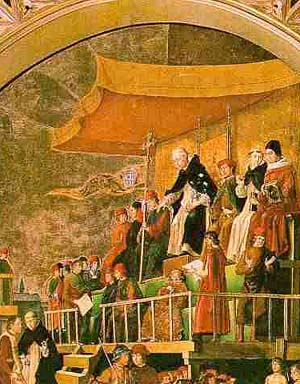
The Myth: The inquisition saw the slaughter of tens of thousands
The modern day notion of a unified and horrible “Inquisition” is an assemblage of the “body of legends and myths which, between the sixteenth and the twentieth centuries, established the perceived character of inquisitorial tribunals and influenced all ensuing efforts to recover their historical reality”. It was the relatively limited persecution of Protestants, mostly by the inquisitions in Spain and Italy, that provoked the first image of “The Inquisition” as the most violent and suppressive vehicle of the Church. Under the rule of the Protestant Queen Elizabeth I and threatened with military attacks from Spain, England found a new surge of nationalism being fueled by anti-Catholic propaganda centered on a series of books and pamphlets that detailed the horror of the “Spanish Inquisition”. But the reality? No more than 2,000 people who were tried by the Inquisition were executed. The Spanish Inquisition (which should not be confused with the Office of Inquisition which still exists in the Church as the Congregation for the Doctrine of the Faith) ceased operating on the 15th July 1834.
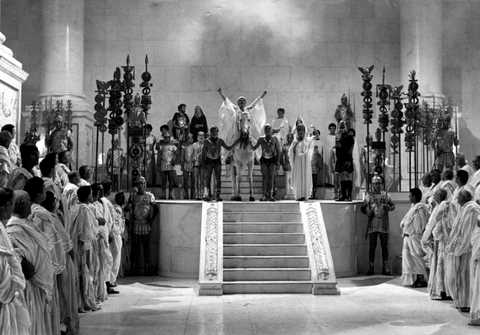
The Myth: Emperor Caligula made his horse a consul (a figurative head of the republican government)
Caligula’s love for his horse, Incitatus, was well known in his time and in present times, but the modern love of a good myth has promoted the horse to a far greater position than in reality. About seventy years after Caligula died, the historian Seutonius wrote of Caligula and Incitatus: “Besides a stall of marble, a manger of ivory, purple blankets and a collar of precious stones, he even gave his horse a house, a troop of slaves and furniture, for the more elegant entertainment of the guests invited in his name: and it is also said that he planned to make him consul.” The fact that this was not a first hand account (hence saying: “it is also said”) the report is dubious. There are no other records that indicate that Caligula did ever indicate that he planned to raise Incitatus to such an important place – let alone do it.
The Myth: Catherine the Great died whilst having sex with a horse
While this myth is very amusing (no doubt the reason for its popularity), Catherine died in bed of illness; there were no equines involved and a Catherine/horse nexus was never attempted. So how did the myth arise? During past centuries the easiest way for people to offend and verbally attack their female enemies was sex. Catherine the Great was always going to attract rumours about her sex life, but her voracious sexual appetite – while modest by modern standards – meant that the rumours had to be even wilder. Historians believe the horse myth originated in France, among the French upper classes, soon after Catherine’s death as a way to mar her legend. [Source]
The Myth: Spanish flu came from Spain
The Spanish flu pandemic (the same virus as Swine flu) lasted from March 1918 to June 1920, spreading even to the Arctic and remote Pacific islands. It is estimated that anywhere from 50 to 100 million people were killed worldwide, or the approximate equivalent of one third of the population of Europe. Although the first cases of the disease were registered in the continental US and the rest of Europe long before getting to Spain, the 1918 Flu received its nickname “Spanish Flu” because Spain, a neutral country in WWI, had no special censorship for news against the disease and its consequences. Hence the most reliable news came from Spain, giving the false impression that Spain was the most—if not the only—affected zone. So thanks to the honesty of Spain, they are now marred forever by the title of the worst flu epidemic in modern history.
The Myth: Amazons were women who cut off one breast so they could use a bow and arrow better
Considering how ridiculous this story is, it is hard to believe that so many people believe it. This element of the Amazon myth was invented in the 5th century B.C. The poor Amazons had to start mutilating themselves because some big boob thoughtlessly dabbled in the dark art of etymology without the proper equipment. Hellanicus of Lesbos imagined the name was derived from the Greek prefix a- (“without”) and mazos, a variant of mastos (“breast”). He was surely wrong, but his folk etymology is still firmly embedded in the collective consciousness after more than two dozen centuries. There was no hint before his time, either in writing or art, that the Amazons had anything other than usual complement of breasts, so we can safely assume that the one-breasted image we have of them flowed from the (false) etymology and not vice versa. [Source]
The Myth: Jesus spoke Hebrew
First of all, Jesus probably did have a knowledge of Hebrew, but he didn’t speak it. The language spoken by Jesus (and the apostles) was Aramaic. Aramaic is a semitic language and it was the day-to-day language of Israel from 539 BC – 70 AD. In fact, contrary to popular belief, some parts of the Bible were never written in Hebrew – but rather Aramaic – chiefly Daniel and Ezra. It is also likely that Jesus was fluent in Greek as this was the secondary language of the region and it was the language of the common version of the Bible used by the Jews at the time. Even one of the most well know sayings of Jesus upon the Cross is Aramaic: “Eloi Eloi lema sabachthani?” meaning “My God, my God, for what have you forsaken me?”
This article is licensed under the GFDL because it contains quotations from Wikipedia.


@Randall(74):
I agree, Alexander did speak Greek apart from Macedonian and the ancient Macedonians were in awe of the Greek culture and religion (i’m a ‘civilization’ fan:-)), but only because Greek culture was dominant and overwhelming. But they did have their own language and own religion (their main god was Dios).
Of course, today’s Macedonians can’t be related to ancient (they’ve kept some interesting traditions, though), but I cannot agree that today’s Greeks are a homogenous nation who have kept their national identity for 2500 years! Impossible, if you consider the Barbarians, Slavs, Byzantines, Arabs, Turks and other peoples who roamed, ruled and populated the Balkans. Maybe this is a common historical myth (a controvertial one, though) for some next list
@Stizzy (71): No, you misunderstood what I wrote. Taking what is accepted by some to be the time and place where Jesus supposedly lived, you can discuss what the language and class system was like during that time. I didn’t say what language Jesus spoke, I said what language people of that time and area spoke and the fact that poor people of the time were almost universally illiterate. Not once did I confirm anything about a historical Jesus.
Reason implies logic. You cannot logically prove the existence of God therefore it is unreasonable. Belief in God requires just that, a belief in something unprovable which is inherently illogical. That’s fine. Logic can’t prove the existence of love either so many people set aside logic to coincide with their beliefs. If this is you, fine. But your belief does not imply reason.
In your example you are comparing an actual person, a King, with a supernatural being, God. You cannot compare the two. People can live in reverence or fear or enslavement of a King but that King is an actual person who can do actual things in the real world, like tax you or kill you.
if you like dogs
In your next list, the number one myth should be that deregulation caused the housing crises.
Government interferance caused the crise.
1-The CRA act in the 70s coupled with the demonization of so called “red lining” forced banks to give loans to people who could not afford them.
2- President after President made minority home ownership a goal regardless of the possible harm to the very home owners themselves and to their lenders.
3- President Bush put number two on streroids.
4- Clever bankers figured out that they could bundle bad loans and sell them as investments.
5- Number four gave banks even more incentive to make bad loans.
6- kaboom
@Gore (121):
Honestly Gore, you should quit while you’re behind, because you just keep digging yourself in deeper.
“I agree, Alexander did speak Greek apart from Macedonian”
AGAIN—there was very little difference between ancient Greek and ancient Macedonian. Ancient Macedonian was essentially nothing but a separate dialect of Greek. Macedonians and Greeks could easily understand each other, though the Greeks considered their Macedonian cousins to be uncouth and unsophisticated, and their dialect to be the same. In much the same way that we mock hillbillys. Nevertheless, we don’t speak of “hillbilly” being a separate language.
“and the ancient Macedonians were in awe of the Greek culture and religion (i’m a ‘civilization’ fan:-)),”
Good for you. So am I, but I also possess an advanced degree in this stuff and have taught it.
“but only because Greek culture was dominant and overwhelming.”
WRONG. Again, the Macedonians (of the times) and the Greeks were essentially the same people.
“But they did have their own language”
As I’ve already pointed out, this is not really correct. There were varying dialects but their language was not different enough to be considered a separate tongue in and of itself.
“and own religion (their main god was Dios).”
WRONG. This shows your simple ignorance of Greek. “Dios” is simply a transliteration of a GREEK word. And “Zeus” and “Dios” are, in fact, in essence the same word. In ancient Greek “Zeus” is pronounced “dh-ZAY-ohs.” “Dios,” obviously, sounds very, very similar “dh-ee-ohs” and the meanings are in fact exactly the same.
“but I cannot agree that today’s Greeks are a homogenous nation”
I never said they were. You didn’t read carefully. I said they were MORE homogenous than, for instance, other peoples in the Balkans. That’s all.
you forgot to mentions that DIOS really just means GOD (and so is Zeus really)
(im the from the "old world" so im pretty sure i know this as a fact: O))
I’m a bit late here but I didn’t mean to come across as hypocritical. I was only pointing out that people did worship deities long before Christianity, I didn’t say what they were believing was necessarily real, I was saying there was evidence for it. Which is exactly what number one is doing…
Ookay now that I think back I realise that I did sound like a hypocritic, so apologies for that. It was early, so I’m sticking with that as my excuse
Oh, and Mark, number 38, I’m not an atheist
@faketree78 (122):
You’re repeating your error:
“…I said what language people of that time and area spoke and the fact that poor people of the time were almost universally illiterate.”
And so you clearly didn’t read my comment directed to you earlier. So I’ll repeat it:
@faketree78 (67):
DEAD WRONG:
“However, this is likely the only language he spoke as he was supposedly a peasant carpenter. No only would he not speak the aristrocratic language of the time, but its likely he would be completely illiterate. Only the wealthy would have the resources and time to learn to speak a second language or learn how to read and write.”
This shows the raging historical ignorance of far too many people out there in the world. Let’s leave aside the existence of Jesus–which I’ve defended before–and go right into these ridiculous, uninformed claims that he “had to be illiterate.”
What utter rubbish. It seems that many ignorant people, such as you, assume that most people, or at least the “peasantry” of the classical world were stupid, illiterate retards with just enough brainpower to do their meaningless, menial jobs and live out their miserable lives. Nothing could be further from the truth. IN FACT the Classical civilization of Greece and Rome—meaning the empires they encompassed–were CIVILIZATIONS—meaning that many people, perhaps even most, were educated to at least SOME extent and certainly could read and write the languages which were used throughout the empire. This was a civilization VERY MUCH akin to our own—including not only education (if by no means as democratized as ours) but comparatively high technology (for the time) and scholarship–as well as a high degree of technical and artistic skill. Jesus, as a tradesman (like his father and family) would have had AT LEAST a basic education and would have certainly known how to read and write. Aramaic would have been his primary language, but Koine Greek—the common everyday speech of MUCH of the Roman Empire–surely would have been his second language, and he very probably would have learned to read it as well. This is not surprising, as it was common.
As for this ridiculous assertion that “only the wealthy” can learn more than one language–that, I would assume, is simply American silliness and ignorance (I myself am an American by the way, but obviously far better educated than YOU)… it is QUITE COMMON for people in Europe, for instance, to know more than one language–as they are in close proximity to other languages their whole lives—certainly many of them know English, the “common language” of our day—just as Greek was in Jesus’ day. It was not a matter of “wealth,” but of simple cultural expediency and common knowledge.
As for the existence of Jesus himself, that would take far longer to go over and as I say, I’ve addressed this before. But I fully intend to come back to it. Needless to say, you and others who dismiss his existence are simply, again, showing your historical ignorance. (And by the way, I am no “Jesus Freak” or Christian nut…I am an HISTORIAN with training and education in the subject–especially ANCIENT history).
@Bubette Duponte (30): You are right. Reagan’s policy of de-regulation is the reason that we are in the mess we are today. It has been shown many times that a bunch if greedy people run a lot of these industries, and cannot be depended to police themselves. De-regulation also crippled the airlines industry.
As far as the great depression, Roosevelt did many things to help pull the country out of poverty. The Work Projects Administration and the Civilian Conservation Corps are just two of the programs he instituted, and they should be started again today.
Moist! I thought that this list was going to whomp big time, but it’s a-okay. The next time Lawson and I are playing kickball I’ll think of this list.
How do u Pronounce Deity? somebody help me please.. thanks
Can someone come up with a list of the top 10 annoying ads? The smileycentral ad on this page and all listverse pages that yells “hello!” every time I refresh will easily make top 3.
@ Randall
I’m impressed by your knowledge of ancient Greek history. I’m Greek and you probably know more than me.
On the Greek – Macedonian subject I have to say that we and FYROM (Greeks don’t recognize the Macedonian state by that name) are very much biased from what we’ve been taught our whole lives. Can you recommend me a good archeology book written by someone not biased?
As far as I know Macedonia is a geographical area divided in two countries, Greece and FYROM (Former Yugoslavian Republic of Macedonia). The Greek Macedonia (southern part) is a district a bit like what Florida is to the USA. And FYROM (northern part) is another part of that geographical area.
Bible stories are way to fantastical to be reasonably believed. I think that back then, people believed in anything, just like we do today. Very few people actually seek the “truth”. Back then, or today.
Raiden (131)- It’s like “day-ity”
This is a fairly controversial list, I see. How unfortunate that people feel the need to show their ignorance by trying to show how much smarter they are than the list author/other people in the comments. But I have to say that it is almost as entertaining to watch the debates as it is to read the lists sometimes. :p
@magdalena (133):
Thanks—ancient Greece in particular has been a passion of mine since I was a boy. I have a tiny bit of Greek in me—one my ancestors came from Calabria, in Italy, and he, in turn, had Greek ancestry from there.
As far as an archeology book to recommend—do you mean one that addresses, specifically, the history of the ancient Greeks and the ancient Macedonians, and their relationship? I can’t think of one off the top of my head that does that *specifically,* but there’s so many great books on the archeology and history of the ancient Greeks that I could recommend…. let me look into my library at home and I’ll see what’s best. Just thinking about it for a moment, there’s DH Kitto’s “The Greeks,” and Moses Finley wrote a few also, of course… but whether any of these specifically address the Macedonians in particular, I can’t recall. And these are more surveys than actual archeological texts. Let me see what I can come up with.
Yes, I do know that present-day Macedonians like to deny that they were ever “Greek,” and prefer to claim Alexander as their own, as “strictly Macedonian.” This is merely typical Euro nationalist bluster.
Oh, and this has been bothering me, so I figure that I’d better ask someone who clearly knows their history- Randall, did Amazons really exist and what is the story on them? I’d kind of like to believe that there were some ass-kicking ladies in those days.
Haha, I’m almost expecting an answer that goes, “Yes, Kage, there is a Santa Clause”.. LOL
Kage:
Sorry to disappoint you, but there’s little historical evidence to suggest that a people called “Amazon” ever existed in the ancient world, let alone the matriarchical warrior society of legend.
On the other hand, they certainly seem to have a place in Greek mythology going back to the Bronze Age–and Herotodus, the Greek historian, mentions them as apparently real, in his Histories. (Herotodus can’t always be trusted, though he’s far more authoritative than old-time critics have led us to believe). One can’t entirely rule out a tribe of female warriors—but it seems unlikely that they ever actually existed.
The theory is that they somehow got confused with the Scythians, who definitely were a real people who lived in the area northwest of greece, beyond Thrace. Some accounts place the Amazons there, and it’s not surprising that they may have been confused at some point–the Scythians were long-haired and sometimes went beardless, and it’s also quite possible that they fought alongside their women. The Scythians were “barbarians” as far as the Greeks were concerned, but at varying times they had good-to-fairly friendly relations with them, based in part on their shared love of freedom and in part on certain artistic/cultural elements. (The Greeks had a fondness for Scythian art, which was crude compared to their own but nevertheless of high craftsmanship). They shared a mutual dislike for the Persians as well.
Whether the Amazons were actually the Scythians we’ll probably never know—but there’s no particular proof that the women warriors ever actually existed.
Well, boo. Oh well, there are plenty of women in history that were ass-kicking soldiers, too bad most had to dress like men to do so.
@Randall (142): Thanks for that answer man i honestly found it very informative.
I remember reading somewhere that the Amazons were called upon to help defend Troy.
Sarmation women were thought to be amazons and it was said that when a girl was born they would put a hot bronze iron on her left breast to hinder its growth. So it would explain the amazons.
@Karl (2): and egomania.
I have to agree with other comments made about number 10. And would add that it would seem that it would be wise to confirm or explain what you mean by “old religion” with regards to it existing or not!
Of course there are Amazon women. Haven’t you ever seen the movie Cannibal Women in the Avocado Jungle of Death?
@Anonymous (21): Jesus probably did speak fluent hebrew. He wouldn’t have been able to quote scripture otherwise. HOWEVER aramaic was the street language of the region (much like eastern european jews speaking yiddish) and so he most likely taught most of his sermons in aramaic so that the common man could understand him.
@archiealt (25): ahem jesus almost certainly existed. anyone who says otherwise is kidding themselves. AND he almost certainly was crucified. I think the romans kept records of these things.
Elohi Elohi lama shabachtani? That is hebrew! sorry buddy but your wrong. But you are right that Jesus also spoke Aramaic.
@Rina (48): HONEST TO GOD MAN!! Do you TRY to make CHristians look like a-holes??? What people need isn’t someone saying “Hey you’re doomed and im not nah nah nah nah nah!” they need convincing! i wouldn’t believe in God if i didn’t see some viable proof! why should they??
@Randall (128): Its amazing to me because I have a different view for something that is under dispute that you consider me ignorant. I could be just as well read on the subject as you since there are differing opinions on the subject.
The times of Jesus’ supposed existence is not on par with our current civilization. School is virtually mandatory for children these days. It was not during the times of Jesus. It was only necessary to learn the family trade during these times. If Jesus was trained as a carpenter, there is no reason for him to have learned to write. In the bible is states when Jesus was young he learned to speak, then learned to play, and as a young adult, learned the family trade. Nowhere is anything mentioned about his education. And more to the point, NOTHING has even been found or written that would prove otherwise. There isn’t a Gospel of Jesus. There are no instructions to his followers on how to continue his ministry. In fact, the first bible was written in Greek, not Aramaic. Why wouldn’t Jesus’ direct followers write down his ministry? Because they were likely illiterate too.
To assume that in a civilization like the Roman or Greek empires everyone had some form of education is unfathomable. The world now is in the greatest technological revolution it has ever seen. Information is available at a moments notice. Yet, there are still people that are uneducated and functionally illiterate. For most people not of the wealthy class, it was not required and usually not even necessary to learn to read or write.
I’m sorry but denying the existence of Jesus is not an ignorant premise as it is also a highly debated topic among biblical scholars today. There are many intelligent, studious people on both sides of the argument. That being said, there is nothing conclusive proving his existence like anything in his own words, or anything in his own words second hand, or documentation of his arrest and execution, or documentation of him being expelled from the jewish temple, or anything like that. The most ‘evidence’ comes from one single book that has been fabricated over hundreds of years and a few mentions of someone named Jesus or Yesuah in secondary sources which would be like the name Daniel or Michael or Robert today, very common names.
@Looser (151): Yes, the Romans sure did keep records of their trials and executions. Which begs the question I just posed, where is the record of Jesus’ arrest and execution? There isn’t one. Know why? Read my post above.
My grandfather helped to eke out a living for the family by selling “urban venison” sandwiches at the Wichita train station during the depression. Urban venison being RAT MEAT!
Ewww….I just realized that grandma had to be the one preparing those sanwiches!…YIKES!!
Regarding list # 9, “the replacement of a hands-off approach to the economy with a more regulated one by President Roosevelt has been blamed by many for the current economic crisis,” This statement is naïve, simplistic and biased. Deregulation is more likely to be one cause of the current recession. Economic events can’t be pinned solely on political leaders. Business practices, financial institutions and outside factors all contribute to economic crisis.
In the USA the current recession has been attributed to the housing bubble (which is a rapid increases in property value until mortgage payers can’t keep up because actual income doesn’t enable people to continue to pay), and the sub prime mortgage crises (extreme rise in mortgage delinquencies and foreclosures). This has been attributed to lax lending standards by lending institutions.
Although it is correct that the US government encouraged granting mortgages to people who were not financially qualified, the unchecked greed of lending institutions and the insurers who guaranteed them accelerated the problem.
There are numerous other contributing factors such as: engaging in two absurdly expensive wars; energy costs (fuel is needed in the manufacture and transporting of produced goods); loss of faith in the economy leading to lack of investing and spending; excess supplies of produced goods combined with decreased consumption of goods; and so on. These problems lead to loss of jobs; collapse of financial institutions like Bear Stearns; bankruptcies, and so on which in turn contribute to the original causes of the recession, thus creating a vicious circle.
I realize that I’m no finance expert and my short essay here doesn’t begin to explain recession, but neither does blaming a depression era US president.
faketree: first of all, heads up. if you don’t know much about randall, i’ll let you in on some secrets.
he argues about many things and has opinions on even more. the ONE topic you want to avoid in discussions in the ancient world, ESPECIALLY the greeks and romans. you can bet a rebuttal is being crafted right now and it will not be with kid gloves.
as far as your argument goes, lemme point out some holes…
you say you want first hand or second hand information. you can find these sources in every hotel room in the world (seemingly). i bet you have these sources at your house. if not, you can go to any number of different websites to look at these sources. i’m speaking of the Bible of course.
you say this is “one single book that has been fabricated over hundreds of years” with “a few mentions” of a guy named Jesus.
first off, it isn’t one single book. it is 66 separate books brought together into one volume. but let’s just look at the New Testament since that is the relevant material about the existence of Jesus of Nazareth. this is 27 separate accounts of the life, times, teaching, ministry and interactions of Jesus. these are all first or second hand testimonies.
and to say that there are just “a few mentions” is to grossly underestimate the unified story of those books. that is like saying the lord of the rings trilogy has a few mentions about some golden ring.
if you want to have a reasonable discussion, please come with something more than this.
and, just to reiterate, heads up.
@faketree78 (154):
Your “different view” is NOT based on knowledge of the subject–therefore I called you “ignorant,” and I repeat it. “Different views” aren’t valid if they’re ill- or un-informed. As yours is.
“Its amazing to me because I have a different view for something that is under dispute…”
To what are you referring? I called you to task specifically on account of your ridiculous remarks stating that most people in the Classical period, living in the Roman Empire, were illiterate. That’s not “under dispute,” that’s just an “opinion” based on pure ignorance. It’s wrong, and there’s no “debate” or “dispute” about it.
If you’re referring to the existence of Jesus as an historical figure, that’s something else, but this is still not “under dispute”—not by any accredited or recognized historian that I’m aware of.
“I could be just as well read on the subject as you since there are differing opinions on the subject.”
Again, A) there in fact are NOT “differing opinions” on these subjects, except those opinions held by the ill-informed. B) you most certainly are clearly NOT as well-read as myself, since you aren’t aware of your egregious errors and spoke so absurdly on topics which you obviously have no authentic knowledge of.
“The times of Jesus’ supposed existence is not on par with our current civilization.”
This is a ridiculous statement. Naturally comparing the modern world to the Classical is silly. I never said the two were “on a par.” But the mistake you make is not at all understanding the NATURE of classical civilization. It was not populated by a vast mob of illiterate louts run by a small minority of educated elitists. Civilizations don’t endure on that basis.
“School is virtually mandatory for children these days. It was not during the times of Jesus.”
I made a point of saying that education was not democratized, in the classical world, the way it is in ours. Nevertheless, this is not the same thing as saying that most people were illiterate and incapable.
“It was only necessary to learn the family trade during these times. If Jesus was trained as a carpenter, there is no reason for him to have learned to write.”
This is where you show your ignorance.
In point of fact there are many records of common citizens–particularly those in trades–who were required to use writing as a basic component of holding the status which they held, and did so, in the classical world. The skills to read and write were taught in an instutional sense to many, but taught as part of a system of apprenticeship and “work-study” to many more. Hebrews of the day were in fact fairly well-educated and most probably knew how to read and write. This was certainly true also of most other citizens and subjects of Rome.
“In the bible is states when Jesus was young he learned to speak, then learned to play, and as a young adult, learned the family trade. Nowhere is anything mentioned about his education.”
So? So your argument is that if the Bible didn’t mention it, it didn’t happen?
And in point of fact the Bible does suggest more than once that Jesus was educated. It makes it pretty clear that he understood Greek and was aware of Greek philosophy, and it states that he was certainly knowledgeable enough in regards to Hebrew scripture. None of this would have been capable without an education.
Jesus, in fact, came from what was probably a fairly-well-off family of tradesmen, and there is no reason to think that he was not formally educated at least to some extent, since anyone else of his status would have been so.
“And more to the point, NOTHING has even been found or written that would prove otherwise. There isn’t a Gospel of Jesus. There are no instructions to his followers on how to continue his ministry. In fact, the first bible was written in Greek, not Aramaic. Why wouldn’t Jesus’ direct followers write down his ministry? Because they were likely illiterate too.”
And again, this further shows your complete ignorance.
What we have today, faketree, is not the original version of the gospels—scholars have in fact long since established that the four gospels of today can be traced back to far earlier texts–two that we know of, possibly going back to one original source text–that COULD, indeed, take us back to the generation of the apostles. Moreover, there are other writings that were “unrecognized” by the church a few hundred years later for various reasons, that have since been found to be associated with this source material, and can again be traced back to a time earlier than the present gospels as we have them.
In short, you’re wrong again, and there were almost certainly writings which preceded the present Gospels. Furthermore, we have the fact that Paul clearly wrote, and he was not removed from the original apostles at all. That his writings survived while theirs, if they wrote, did not, means nothing to the argument at hand.
“To assume that in a civilization like the Roman or Greek empires everyone had some form of education is unfathomable.”
All right, listen up jackass.
A) I “assume” nothing of the kind. I never said EVERYONE had some form of education—I said that perhaps MOST did.
B) I “assume” NOTHING, anyway. I was SCHOOLED in this material. I have TAUGHT it. I don’t make “assumptions,” pal—I speak on authority.
“The world now is in the greatest technological revolution it has ever seen. Information is available at a moments notice.”
Yeah, no *****. But this was not at all true one hundred years ago. Would you argue then that OUR civilization TODAY is therefore far superior to that then? “Superior” perhaps, though that’s subjective to some extent. We have superior technology. But greater technology and greater AVAILABILITY of information does not in and of itself make us superior on all levels.
Similarly, while classical civilization certainly had its faults–and they were legion—it was not, as I have repeatedly said, simply a gigantic cipher populated by illiterate idiots.
“Yet, there are still people that are uneducated and functionally illiterate. For most people not of the wealthy class, it was not required and usually not even necessary to learn to read or write.”
Okay, that does it. I DEMAND that you back up this statement with PROOF—with EVIDENCE that people “not of the wealthy class” were automatically illiterate in the classical world.
You have no basis for making that statement and IN FACT it contradicts clear evidence that says otherwise. You’re not speaking with any authority, you’re simply parroting bull***** that you “feel” must have been true about the classical world, because you have in your head an image, probably, of a vast multitude of ignorant savages ruled over by an elite minority. That’s RUBBISH, pure and simple.
“I’m sorry but denying the existence of Jesus is not an ignorant premise as it is also a highly debated topic among biblical scholars today.”
OH IT IS? SHOW ME these “biblical scholars” who debate the existence of Jesus. NAME THEM. Who are they?
“That being said, there is nothing conclusive proving his existence”
IN FACT, faketree, there is little or no “conclusive” evidence proving ANYONE’S existence at that time unless they were a ruler or some other powerful personage. Are we to deny everyone for whom we don’t have verifiable personal writings or whose name doesn’t appear etched in stone somewhere? By your logic, we should.
You also seem to (conveniently) forget that there was a little incident which we know as the FALL OF CLASSICAL CIVILIZATION which led to the loss of MOST EVERY KIND OF WRITTEN RECORD there was—not only literature (most of which is tragically gone) but writings of EVERY kind. We have less than a TENTH of what existed BEFORE the fall of Rome, even to this day.
You cannot take an absence of material as proof that someone of the time did not exist, therefore. Neither, of course, is it proof that any particular person DID exist.
But the very idea that a personage such as Jesus could have been invented out of whole cloth, and swallowed by the multitudes only a short time after his “fictional” life and death is RIDICULOUS. There is NO evidence AT ALL of ANYONE denying his existence, when in fact it would have suited the purpose of many to do so (had he actually been fictional). And the loss of writings and records is no argument for this—there is enough left showing that the Romans as well as Hebrews of the day openly bought the existence of Jesus without the slightest doubt or skepticism. He was, in short, clearly well-known and accepted as real. Had he not been so, SOME indication would have survived that SOMEONE was calling him into question. This was, after all, a figure of some importance, even in the early days following his supposed life.
What we in fact have is evidence that many who were concurrent with him DID write about him, even if the text themselves are lost–and NO evidence contradicting his existence, which would be expected if anyone had ever suspected that he was simply “made up” by some group or other.
People who deny the existence of Jesus ALWAYS have some axe or other to grind, some bias and/or some agenda. You don’t want to believe the guy was the son of god, that’s your business. Nobody says you have to. But HISTORY strongly suggests the man was a real human being, and in fact to most scholars it’s simply accepted that he was, because we know that the classical civilization he was part of was no more capable of simply “making up” such a figure than it would be for us today to do so.
i told ya.
@DiscHuker (160): Nice one.
@geoploomb (85):
A body.
I think you need to list all your sources… seriously. There is ample evidence there was an old religion before Christianity. One which Christianity boldly drew upon to incorporate new peoples into the fold.
@Randall
“IN FACT, faketree, there is little or no “conclusive” evidence proving ANYONE’S existence at that time unless they were a ruler or some other powerful personage. Are we to deny everyone for whom we don’t have verifiable personal writings or whose name doesn’t appear etched in stone somewhere? By your logic, we should.”
Deny no, but doubt their existence – yes. How is there any problem in that? How does me doubting your BFF’s existence have any effect his actual existence?
It is possible he did exist. It is possible he did not.
It is also possible that the only reason you are alive is because you think you are alive. The only thing you know is that you do not know anything.
just loving the comments tonight
@Randall (157):
ah Randall…you are, in the words of my Georgia father,
“A Long Drink of Water”
which is a compliment.
i may have blindly assumed that a historical Jesus, existing in Roman times & crucified, may not have existed.
now, my thinking has changed…a little.
let’s say he really was aother living, breathing man. okay. aren’t all tall tales, legends, & folklore usually based in some wee part upon truth & real people?
rtr
Randall appears to be one of those people who make me ashamed to be a Christian
Please, PLEASE, don’t let him mar your view of Christians
Cool list
I think the comments are just as interesting- it cracks me up how totally riled people get over religion. All I can say is that anyone who doesn’t believe what I believe is just plain *****ing wrong. Oh, and not I’m NOT gonna tell you what I believe, just take it as read than I am right
Waaa-zaaaa!! Great List
@The Sea Captain (166):
I’m not a Christian, you twit.
And just why, while we’re on the subject, however, should you feel “ashamed” of me, anyway? Because I insist upon historical accuracy and scholarship over prattle and nonsense?
Thats really interesting.
I love how “twit” has grown to popularity on profanity free message boards as a censor-safe insult.
@Bbones (162):
WOW, “Bbones,” that’s *deep.* Think that up all on your own did you?
Pinhead.
And JC is NOT my “BFF,” kid. He’s an historical figure whose existence I defend because I myself am an historian and a well-read individual with a MIND that can think critically and select accurately between what is bull***** and what is not.
Now peddle your mealy-mouthed little philosophies elsewhere, shrimp.
That second to last line in my post to “archiealt” should read:
A) I can assure you *I’ve* read EXTENSIVELY “both sides” of this “argument,” clown. Further, I don’t need your coaching to do so.
@ringtailroxy (164):
Thank you, and I’m honored.
@Randall (157): I’m hesitant to respond since you choose to speak to me in such an inflammatory way. You seem to be well educated and have an excellent grasp of the time period we are speaking but I guess the education hasn’t translated into manners. And you are obviously just a reader and not a scholar or you wouldn’t argue in such a fashion. Anyway, I’ll just list some quotes so you can talk down to them, not me.
Despite your tone, literacy in the ancient world is a highly debated topic, as stated here…
“While the studies in this collection are far from the last word on an exciting subject, they are nonetheless state-of-the-art productions which, in conjunction with Ancient Literacy, considerably advance our understanding of the complexities involved in the study of literacy in the ancient world.” referred to two books, Ancient Literacy and Literacy in the Roman World that sit on either side of the fence of widespread illiteracy of the time.
“In Greco-Roman antiquity generally literacy was narrowly limited and heavily concentrated in the aristocratic classes. Although the levels and extent of literacy may have varied somewhat with period and region, in no ancient society was there mass literacy. Book culture was similarly limited, being contingent not only on literacy but also on the cost and availability of hand-produced books.” – Gamble ‘Literacy and Book Culture’
“Studies of literacy have shown that what we might think of as mass literacy is a modern phenomenon, one that appeared only with the advent of the industrial revolution. It was only when nations could see an economic benefit in having virtually everyone able to read that they were willing to devote the massive resources–especially time, money, and human resources–needed to ensure that everyone had a basic education in literacy. In nonindustrial societies, the resources were desperately needed for other things, and literacy would not have helped either the economy or the well-being of society as a whole. As a result, until the modern period, almost all societies contained only a small minority of people who could read and write.” – Bart Ehrman in Misquoting Jesus
BTW, Bart Ehrman is a biblical scholar, since you wanted me to mention one.
“Levels of literacy were low in classical antiquity by comparison with those prevailing in the most educated countries of the last 200 years. That is entirely to be expected, for each society achieves the level of literacy which its structure and ethos require and its technology permits.” — W.V. Harris in Ancient Literacy
“Looking also at Roman Egypt with its intense official demand for documentation, A.E. Hanson (“Ancient illiteracy”) uses the evidence of papyri, incuding a selection published here for the first time, to examine how large numbers of illiterate and semi-literate people functioned in a world that required writing. What emerges from her *****ysis is the importance of social networks in enabling Egypt’s peasant and sub-elite population to participate in a stratified, bilingual society.” Hanson in Ancient Illiteracy
That should do it.
On second thought, it probably won’t do it. I’m sure you have some kind of response. While the quotes may not have proved illiteracy in the times of Jesus, it at least shows that it is a debated topic.
@archiealt (165): thank you for writing that. i began to smile as i was waiting to scroll down to see the response that was surely coming.
i look forward to what this is going to turn into.
@faketree78 (152):
So, just to be clear: nothing in the Bible is even CLOSE to being a credible source of this existance (I´m not talking about his divinity here, just the fact that a human being named Jesus, who may or may not have been a crazy, delusional nut-case who called himself God, existed) because the Bible is almost like a comic book. It´s like a 2000-year-old Superman story? Did I get that right?
Yay, thanks for the Xena image (#2)!
faketree:
So you think you Googled your way out of this, I see. Uh, no. I’m afraid not.
“I’m hesitant to respond since you choose to speak to me in such an inflammatory way. You seem to be well educated and have an excellent grasp of the time period we are speaking but I guess the education hasn’t translated into manners.”
Clearly yours hasn’t translated into humor, or for that matter an ability to critically approach a subject. YOU came on here and made DEFINITIVE statements that you clearly expected no one to question. Well your statements were AT BEST debatable and at worst purely disingenuous.
“And you are obviously just a reader and not a scholar or you wouldn’t argue in such a fashion.”
WRONG. But let’s ignore this little insult and correct you instead on something else. YOU seem to have mistaken this little List site for a scholarly journal. It isn’t. I therefore present quite a different persona here from what I have in the past, in a professional capacity. Reason: for amusement, entertainment, and because nine times out of ten it MAKES NO DIFFERENCE. I’m not interested in debate here, I’m interested in correcting the BS of people who throw their half-assed opinions around as though they were fact. Which is what you did.
“Despite your tone, literacy in the ancient world is a highly debated topic, as stated here…”
SO NOW it’s “highly debated” is it? Backpedaling from your earlier statements—which were ENTIRELY DEFINITIVE. NOW you come at it with slightly less conclusiveness, now that I called you on it. NOW you’re qualifying. Uh huh.
And sorry, faketree, but a few quotes you managed, after several hours, to cough up from whatever hasty research you did online does NOT justify the statement that “literacy in the ancient world is a highly debated topic.”
YOU had made the sweeping statement that most people in the Classical world were illiterate. You as much as implied that the masses of the Roman Empire were uncivilized louts run by an elite. THIS IS IN FACT WRONG, and your desperately-thrown-together quotes here do not negate that fact.
But let’s clear another thing up here. I NEVER SAID that literacy was universal or even near universal in the classical world. I merely took umbrage at YOUR assertions that it was damn near unheard of. YOU started this with sweeping, over the top statements based on little or no real evidence. I CORRECTED you. Now you’re back with justifications and qualifications. Well this changes nothing. We know damn well from multiple sources that literacy of varying degrees was, if not common, common enough to be considered fairly widespread across more than just the aristocratic classes of ancient Greece and Rome, and their attendant empires.
AND I remind you that all this began also because of YOUR assertion that Jesus had to be himself illiterate–which was pure bilge. He demonstrated, in EVERYTHING that was reported about him, a wide degree of knowledge and learning that strongly suggests a man who had been educated to at least some degree and was certainly literate. You demonstrate an utter lack of the subject when you tried to assert, definitively, otherwise.
“In Greco-Roman antiquity generally literacy was narrowly limited and heavily concentrated in the aristocratic classes. Although the levels and extent of literacy may have varied somewhat with period and region, in no ancient society was there mass literacy.”
A loaded pair of sentences making broad and not entirely supportable statements.
Harry Gamble (if that’s whom you’re referring to) is an accredited scholar, yes. But a religious scholar–NOT an archeologist or historian. He and a small group have rendered the conclusion–based on slim evidence–that literacy in the Roman Empire was barely in the double digits. But his/their definition of “literacy” is selectively narrow–it is, in short, based on modern standards. As I said earlier, no one has ever asserted that literacy in Rome was universal or even close to it. But there is ample evidence that more than just the aristocratic classes were able to read and write–it in fact is almost certain that across the trade and merchant classes reading and writing were expected skills.
Moreover, Gamble’s interest is in Christian and pre-Christian Rome. Nowhere, to my knowledge, does he specifically address the literacy in the Levant, which was known to be quite high, nor in the pre-Roman periods when the Greeks were the dominant power in the Near East. The tradition of literacy in these regions and periods was passed down, and regardless of how it may or may not have been neglected under Rome, it still nevertheless existed.
Unfortunately I’m out of time and will have to return to this tomorrow.
@GTT (178): That is quite a way of putting it but yes, the Bible alone isn’t a credible source of existence. All the books of the bible refer to Jesus in the past tense. He was apparently long dead when these books and letters were written. There isn’t one document that has been found that was written while Jesus supposedly lived that mentions anything about a Jesus of Nazareth.
Yes, absence of proof does not constitute truth but the burden of proof isn’t on me. Its on those who seek to prove Jesus’ existence and as yet there is nothing definitive.
@Randall (180): You win. Way to narcissistic to even discuss anything. If quotes from books written that dispute your views aren’t good enough to even consider the remote possibility that you could be in error of something, there’s nothing else I can do. Have a good night.