Just as the parties from Christmas begin to dwindle, preparations are started for the celebration of New Year. It is a time when even the least-likely party-goer will ready himself for a night of booze, singing, and food. This list looks at 10 of the most common and interesting traditions of New Year from around the world.
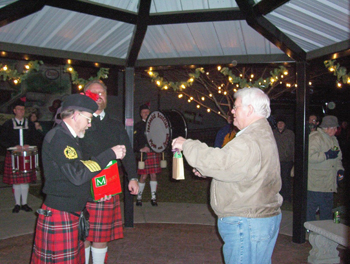
First-footing is an ancient European New Year’s custom that continues into the present in many areas. The first person to enter a home after midnight on the first day of the year should be a male, preferably with dark hair. Blondes may have been associated with Vikings – visitors who never brought good luck. The first-footer should carry a gift, such as a coin for prosperity, bread for food, salt for flavor, or whiskey to represent good cheer. The first-footer can be a resident of the house, but must not be inside during the hour leading up to midnight. No fair stepping outside and coming back in again!
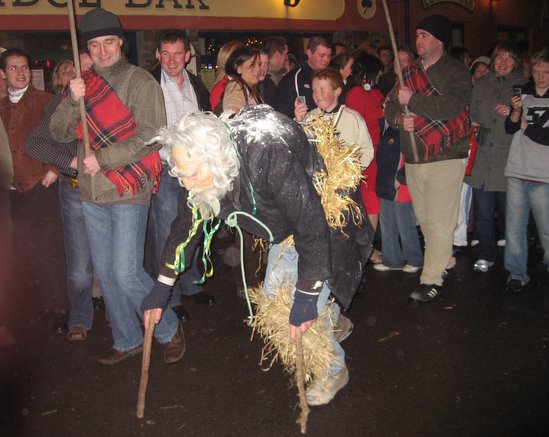
There is an Irish tradition of predicting the political future of the country by checking which way the wind blows at midnight on New Year’s Eve. If the wind is from the west, there is a chance that good fortune will reign that year. If the wind is from the east, however, the British will prevail. Mistletoe was handed out to ward off bad luck, and single women put a sprig of mistletoe under their pillows in hopes of catching a dream about their future husbands. Another tradition peculiar to Ireland is pounding on the doors and windows of the house with bread. This practice was to chase out evil spirits and ensure bread for the upcoming year.
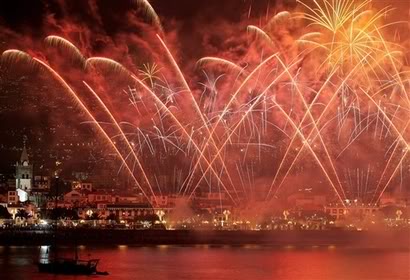
Madeira, a Portugese island, holds a place in the Guinness Book of Records for the most lavish New Year’s party. In 2007, 8,000 fireworks per minute made up the display in Funchal, the capital city, for a total of 600,000 fireworks. Visitors from around the world fill the tiny harbor, where the dazzle is reflected. In 2009, the government is spending 12,000,000 Euros to ensure the most spectacular celebration anywhere in the world. Other famous fireworks displays take place in Rio de Janeiro, Sydney harbor, and, of course, New York City, were visitors watch the descent of the giant six-foot crystal ball marking the last moments of the old year.
New Year’s is the oldest holiday still being celebrated. The Babylonians celebrated the new year as early as 4000 B.C. At that time, the new year began on the first new moon after the Vernal Equinox. The celebration continued for eleven days, with each day having a different purpose and activity. Then, as now, resolutions were made. A common Babylonian resolution is to return borrowed farm equipment. At this time each year, the king was stripped of all power to undergo a ritual of humiliation, in which he was hit by the priest and separated from everyone for three days to pray. When he reappeared, ceremonies of restoration were performed to ensure that nature would support him during the coming year.
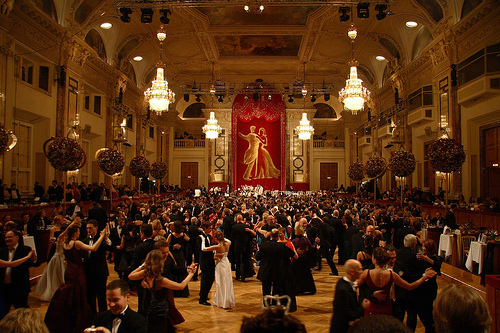
Austria has one of the most glamorous of New Year’s celebrations. At the Imperial Ball, a tradition of the Hapsburg dynasty that has continued for hundreds of years, dancers wear white gowns and black jackets. At midnight, “The Blue Danube,”is played. The Strauss operetta, “Die Fledermaus, is performed each New Year’s Day. Celebrants dine on suckling pig – considered good luck. The tables are often decorated with candy pigs. Children pour molten lead into a tub of water. A soothsayer then reads the shape of the lead. It is considered bad luck to find that your lead resembles an old woman.
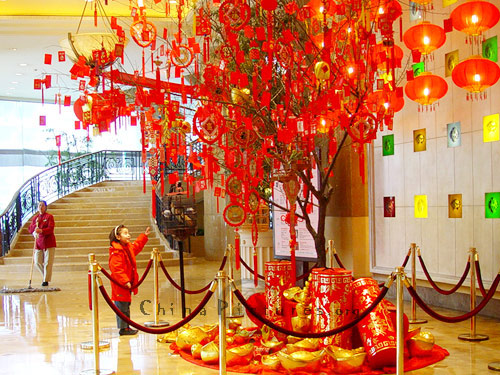
By the Chinese calendar, the year 2009 is actually 4706, a year of the ox. Chinese New Year is celebrated on the second new moon after the winter solstice. In 2010, it will fall on February 14. Firecrackers and noisemakers will chase away evil spirits. The fabulous dragon and lion will dance in the streets. People will wear red, the most auspicious of colors, and red envelopes with lucky money will be given to children. Tangerines are often given for good luck, but odd numbers are unlucky, so the tangerines are given in pairs. The third day of the new year is the day the mice marry off their daughters, so people go to bed early, so they don’t disturb the mice.
It is traditional in Japan to spend a full week preparing for the new year to arrive. The house must be thoroughly cleaned, so that no evil spirits can linger. All debts must be paid. And most importantly, all disagreements must be resolved and forgiven. Before midnight, 108 bells ring, to symbolize the elimination of 108 troubles. With no troubles, disagreements, debts, or disorder to contend with, all are free to welcome in the new year with every expectation of peace and prosperity. The day after New Year’s is First Writing Day, when people write their hopes and dreams for the new year.
For African Americans, New Year’s Day has a special significance, and is often called Emancipation Day or Jubilee Day. On January 1, 1863, the Emancipation Proclamation, freeing all slaves from bondage, was read in Boston. Today, many African-American families hold “watch services” on January 1. Traditional foods include black-eyed peas, collard greens, ham hocks, and macaroni and cheese. The uniquely African-American celebration, Kwanzaa, continues over seven days starting December 26, so the New Year’s celebration is often part of Kwanzaa’s way of reconnecting people with their African roots. Kwanzaa began in the United States in the 1960s, and is not celebrated in Africa.
“Auld Lang Syne” has been called the most familiar song to which nobody knows the words. But this year, you will! Written by Robert Burns and first published after his death in 1796, the song became an instant standard in 1929 when Guy Lombardo and his Royal Canadians played it on New Year’s Eve, broadcasting from the Waldorf Astoria in New York City. The title literally means, “Old Long Time.” Roughly translated, here are the words:
Should old acquaintance be forgot, and never brought to mind?
Should old acquaintance be forgot, and days of auld lang syne?For auld lang syne, my dear, for auld lang syne.
We’ll take a cup of kindness yet, for days of auld lang syne.We two have run around the hills
And pulled the daisies fine.
But we’ve wandered many a weary foot
Since the days of auld lang syne.We two have paddled in the stream
From morn till the sun was down.
But seas between us two have roared
Since days of auld lang syne.So here’s a hand my trusty friend.
Give us a hand of thine.
We’ll take a good-will drink again
For auld lang syne.
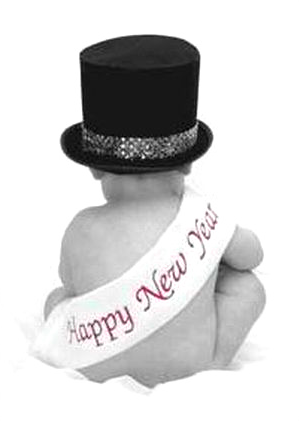
Using a baby to symbolize the new year has been controversial from the beginning. Many cities watch for the first baby of the new year, to shower him or her with gifts from local merchants and lots of media attention. But parading a living baby through the streets brought disapproval from Greek mothers as early as 600 B.C. Egyptians also used a live human baby to symbolize the birth of a new year. Early Christians disapproved of the practice, but its popularity eventually overcame all objections, and the symbol remains one of the most popular. Today’s baby is traditionally a diapered boy with a sash labeled with the number of the upcoming year he represents.


isn’t this list a bit early? at least for the parts of the world that consider january 1st as “new year’s day”?
Yea, what about the other parts then?
Only joking Io… I dont know anyone who celebrates i=New Years on the 17th of November either…
well taash, as the list mentions the traditional chinese new year is at a different date, as it the jewish new year, and i’m sure others. the point (which you obviously got) is that none that i now of are right now, or even a week from now. odd timing choice jaimie.
-LO
-as is-
I really like no 7. We should do the same to our politicians.
-know of- damn typos, sorry.
Strange…I am Chinese…but i have never heard of the mice carrying off their daughters part. Weird!
@ lo, Was only joking my love
Yes, there are other New Years that are celebrated, but as the Listverse fans are predominantly Western (at least from what I have observed), this list would probably be more appropriate closer to the end of the year in the Gregorian Calendar.
@ Molly S: It would be more appropriate for the majority of listverse fans, sure, but its not inappropriate now. Or else every list would have to have some significance to the day its posted, right?
This is a fun list, interesting and well-written!
Mike Seneca
Chicago
Imperial Ball #6 – “dancers wear white gowns and black jackets” – that’s a fairly strict dress code. If it gets hot can you take your black jacket off and just dance around in your gown?
#2 – “roughly translated”? Fae Scots? Awa and bile yer heid! Michty me.
@lo (1): Closer to New Year there will be more lists appropriate to to the season, but on a technical note it is good for us to get a solid list into Google’s records so that we get a high page rank when people start searching for New Year lists. Having a good page rank for a list has in past cases given us a 400% increase in traffic. As well as entertaining we have to consider revenue – this is one way we do that.
The New Year’s Tradition in my part of the UK is to let out the old year and let the new one in. To do this, as the clock begins to strike midnight, the house back door is opened (letting out the old) and then just as the final chime rings out, the front door is opened (letting in the new).
@Iain (13): I suspect that it means women wear white gowns and men wear dinner jackets (which is the correct term for dinner suits – or black tie if you prefer). In other words, it is one level below the most formal men’s attire which is “white tie”. You can read the excruciatingly unpopular list on white tie here. I should add that it is one of my favorite lists as I spent a year researching it.
Now, having re-read your comment, I wonder if you are being facetious noting the ambiguity in the list. If so, disregard my previous statement.
thanks for the explanation jfrater
i know this isn’t a purely pro-bono venture, i want you to make a living too
Hi hi
11. Getting really drunk and telling strangers you love them.
@jfrater (15):
I never thought the explanation would be so logical!
Earlier, I meant to also say that the photos and video are excellent!
Mike
Well done JF – you caught on eventually. Consider it disregarded!
@jfrater (17):
early to bed and early to rise makes a page rank healthy you wealthy and everybody wise.
on another note: when will u post those submarine stories??
…
@Iain (22): I find it extremely disturbing when someone outsmarts me! Nevertheless, I shall let your comment stand
@arsnl (23): Hah! If only it made me wealthy! I can’t even afford drapes! my house is like a goldfish bowl! Perhaps I ought to start charging for the free live ***** every time I have a house party!
I have never been able to understand why such an arbitrarily chosen day is celebrated a) at all, or b) with such great gusto. This may be because I am rarely invited to such parties. This may be why I am rarely invited to such parties.
@seneca (21): Despite recent comments on a recent controversial list, I try to be as honest and open as possible with everyone here. I would like to think that all of my comments (except the silly emotional drunken ones) are as truthful as possible. I can promise only one thing: I will never lie on this site. I am proud to say that I have never done so previously, and I certainly don’t intend to begin now!
And thanks for the compliments on the photos and videos. When someone contributes a list I always feel a bit left out – so picking the photos/videos is my way of contributing to the contributions
@astraya (27): You can always invite yourself! If you are in NZ on January 1, 2010 consider yourself invited to my place. It is never an especially huge celebration, but this year I have *****loads of fireworks lined up
Oh – and as a religious person you should know that January first is (at least to Catholics) a Holy Day of Obligation because it is the feast of the Circumcision of Our Lord. As Catholicism created almost all Western holidays, it is very likely that this is behind the modern celebration of New Year.
@jfrater (29): Very interesting thgeory about why we celebrate New Years… bit of research for me to do!
@Taash (30): Research is always good – even if I am wrong it is a good thing that it might inspire you to dig deeper
@jfrater (29):
jaimie, i know that the feast of circumcision came up on another list, and i know you went to seminary school and studied these things more deeply than i. what i can’t work out is why in the US -where i was raised a catholic with after-school “religious ed” and all we never heard about this holy day.
it’s especially weird when you consider that in the US circumcision is the medical “norm” for nearly all baby boys born in hospitals, utterly regardless of the parents’ religion (far more so than equally “westernized” and “christianized” countries in europe, for example).
do you know why US catholics/christians “forget” this particular holy day? in light of our “medical traditions” it just seems extra odd to “forget” this religious day, yet we in the US generally do….
p.s if i could possibly be in NZ (for which i haven’t the funds) i’d love to be invited to you new year’s party! i get the sense you love wine like i do!
“As Catholicism created almost all Western holidays, it is very likely that this is behind the modern celebration of New Year.”
1) I hope you mean that Christianity created almost all Western holidays.
2) Even so, the new year has been variously dated from the Annunciation (introduced by Dionysius Exiguus), Christmas and Easter, all of which make far more logical and convincing starting dates than the Feast of the Circumcision.
@lo (32):
Hi Lo,
I wonder if you had your “after-school ‘religious ed’” in Chicago, as you mentioned that you’re a Chicagoan?
I had twelve years of Catholic grade school and high school in Chicago. For most of those years, we went to Mass daily at the church which was part of the school.
We indeed knew that January 1 was a Holy Day of Obligation, and we indeed went to Mass that day with our parents.
I do wonder why you weren’t taught such.
My high school was taught by Augustinian monks. They were really great guys. They hid their greatest secret from us students – that Martin Luther was an Augustinian monk!
Mike
little early for this, reminds me of x-mas decorations up NOW
Astraya (27): You know, you can always go to visit your relatives for New Years. I’m sure your New Years experience would range from boring to exhilerating, depending on whose place you went to and how much you let your hair down.
@seneca (35):
well i went to public schools in the suburb of naperville, but did after school “religious ed” up until confirmation time at SS. peter & paul catholic church. -and i semi-ironically now live in a historic house, 137 years old, that is literally surrounded on 3 sides by that same church’s properties, and across the street of the front of my rented domicile is north central college, a nominally methodist institution (and a very academically good small uni-level school.)….
but i swear that that particular holy day never came up in any of the church education of my youth. i wonder why not?
@astraya (34):
In the west, Christianity and Catholicism are really one and the same until Martin Luther arrived.
In the east, the Orthodox (recognized as a true religion by Roman Catholics) may have used a different day.
The Orthodox celebrate Christmas on January 7.
The Orthodox actually have a better Easter date than Roman Catholics, as theirs is in sync with Jewish Passover. Roman Catholics had the same Easter until we changed our calendar. Was it to the Gregorian calendar?
Interestingly, Roman Catholics recognize Anglican priests as true priests.
Mike
In Scotland it is traditional to throw the door open for a ‘first footer’ – many celebrants will go from party to party to ‘first foot’ the household the parties are held in.
In other countries, Scots will ‘recruit’ a first footer – usually a family member who will leave the ‘hoose’ by the back door and re-enter it by the front (as many will do in Scotland – there is no taboo against it) to leave and re-enter is acceptable so long as:
a) the leaving is done via the back door
b) re-entering is done via the front door
c) no-one SEES the first-footer leave the ‘hoose’
d) the first footer carries drink, food and a piece of
coal – the coin is not always practiced (We’re Scots,
remember)- never heard of a first footer carrying salt
However, different parts of Scotland often have different requirements for their first footers – so the coin and the salt may be usual elsewhere. However, drink, bread and coal have a;ways been a necessity for a first footer in our traditions.
@lo (38):
Wow, Lo! The area where you live sounds beautiful!
I’m just a few miles east of you, at the intersection of I-88 and Highland Avenue, three miles west of the Oak Brook Mall.
Andres probably lives right between us.
Mike
im surprised the persian new year is not in this list……….
Quite interesting I asked everyone in the office to sing Auld Lang Syne, and they didnt even know what it was, till I sang it lol… goes to confirm that NOONE knows the lyrics, even though everyone knows the tune
Yet another ”W-T-F?” list!
When Christmas decorations start going up before Halloween and stores have Christmas advertising in September it is referred to as Christmas creep. So this is an example of New Years creep. Also, a lot of Oktoberfest start in September and are over early in October.
WOOO! Madeira!
I knew it had to be mentioned in this list
I’m glad the one in New York wasn’t put above others. Interesting list even if the timing is a bit weird.
I would love to attend the Imperial Ball in Austria. It sounds quite glamorous.
The Emancipation Proclamation declared the freedom of all slaves in any state of the Confederate States of America that did not return to Union control by January 1, 1863.
In effect, it freed slaves in states that the Union held no power. Really, it freed nobody immediately.
The proclamation did not name the border states of Kentucky, Missouri, Maryland, or Delaware, which had never declared a secession, and so it did not free any slaves there.
The Emancipation Proclamation didn’t do what everybody thinks it did.
JFrater, is that an actual Austrian ball or did you steal a clip from Godfather Part II? j/k. How you coming along with audio clips on my theme songs?
I have a Leap-year baby, so I understand the pride and joy of parading a baby through the streets on the new year.
The Kwanzaa menu seems less about African roots and more about their southern roots in the U.S. I could be wrong though. Mac-n-cheese could have been big in Africa hundreds of years ago…
@jfrater (17), I thought your white coat dress list was quite *****y.
This list was fun and informative, though I’m not in the mood for New Years just yet.
@8bithero (48), I was just going to comment on number 3… you beat me to it!
The ‘traditional’ foods listed are of not African-American originality, as Southerners have always eaten black-eyed peas and collards on New Years as this symbolizes good fortune: coins (black-eyed peas) and dollars (collards).
I like the Japanese custom (#4). It’s so logical. Most of the customs are about getting drunk and stupid and have a good chance of getting the new year off to a terrible start. It’s just so darned reasonable to pay off your debts, make amends, clean house and do everything possible to make the new year a pleasant one.
Didn’t know about the Mice thing for Chinese New Year (lived with an International student from China for a while). I remember lots of red and lots of polka dots.
Filipino New Years traditions include lots of round foods and I think that may have been a Chinese influence. Every year, my mom buys twelve round fruits that are supposed to bring good luck for the coming year. I am no where near as superstitious as my family, but I always appreciate an influx of fresh fruit.
@ronsantohof (45): Also, a lot of Oktoberfest start in September and are over early in October.
That is the way ALL traditional Oktoberfest celebrations are. It begins in late September, lasts for sixteen days, and ends in early October. It’s not something new.
8bithero is correct. In fact, the “Emancipation” Proclamation also did not include areas within Union control in states which had seceded.
Great list, SharonE. By the way, what is a New Years list was doing here in mid-November anyway?
I see, Jamie has already explained it. Silly me.
how about shooting the new year? so scarry where I live!
@jfrater (29): Huh. I’m Catholic and have never been to mass on January 1st. Whoops
The cat submitted by message before I got to complete it – other than the details of the Emancipation Proclamation this is a very interesting list. I too want to go to the Imperial Ball!
Is it a tradition anywhere else to go outside and bang on pots and pans at midnight? My friends had a guest from Sweden a few year’s ago who thought that that was one of the funniest things he had seen.
I hadn’t heard of any of these traditions, maybe because I live in South America and we have our own kind of things we do every New Year. I’ll share some with you:
- Put a golden ring in a glass of champagne, toast with it at midnight. Means you’ll have wealth and will get married, if you’re single.
- Eat 12 grapes or 1 spoonful of black eyes peas as the bells strike 12. For wealth and prosperity.
- Grab a backpack or a suitcase and, when the clock hits 12, go around your block or walk up and down the stairs inside your house. Means you’ll travel. I’ve been doing this for 4 years and it has worked every.single.time.