Villains – we all love to hate them. Without wicked characters, most books would be extremely dull. This list looks at ten of the most vile of the vile villains to grace the pages of literary works.
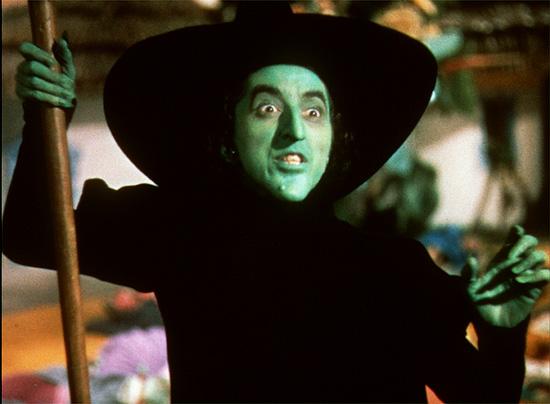
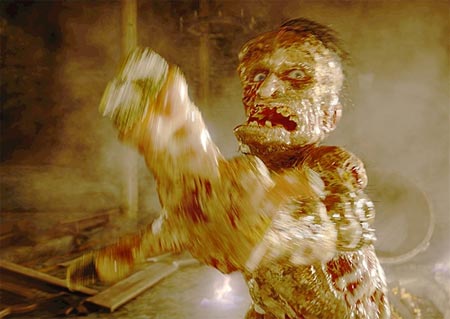
She covets. That is her nature. She wants Dorothy’s silver slippers. The Wizard himself believes that the Witch’s magic is more powerful and could kill him in an instant if he goes near her.
The Wizard finally offers Dorothy a trip home if she will kill the Witch. That’s how loathsome she is to the embodiment of good in Oz. The Witch actively tries to kill Dorothy and company several times, with wolves, bees, the winged monkeys, crows. She captures the Cowardly Lion and tries to starve him to death. She tries to burn the Scarecrow to death. All to force Dorothy to give up the slippers. She steals one of Dorothy’s slippers, by tripping her over an invisible bar. Dorothy finally has enough and throws a bucket of water on her. Why does it kill her? Because water is pure. The Witch is thorough corruption in all respects, and thus the embodiment of impurity.
No wonder Huck Finn doesn’t really care for religion. Why should he honor his father, if his father is a drunken child beater? When he first appears, he is pasty white, sweaty, filthy, stinks, and repeatedly threatens to beat Huck to death if he doesn’t stop trying to be civil for Miss Watson.
He is probably the only character in the story that Huck really hates, but Huck is also scared to death of him, and reluctantly obeys him as much as he has to. Pap kidnaps Huck and forces him to live with him, tries to sue the local judge for the money Huck found at the end of “Tom Sawyer,” on the pretense that Huck is Pap’s property, because Pap made him, and thus the money belongs to Pap, and was never Huck’s to give away.
Huck finally just escapes from him out of terror and loathing. Jim finds Pap dead later, and doesn’t tell Huck until the end. No one sheds a tear.
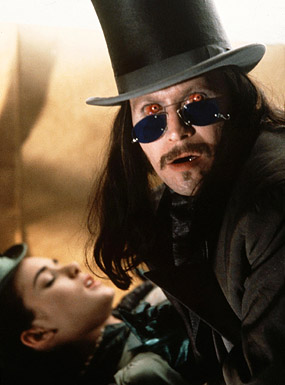
Forget all that sexual stuff you see in the movies. Dracula vants one thing: blood. He requires the blood of humans to survive, and has no qualms at all about killing everyone in the whole vorld, vone neck bite at a time, to keep his thirst quenched.
The interesting about Dacula is that he kills vone person at a time, and yet manages to vipe out the entire crew of a Russian cargo ship bound to England. He does this in the form of a volf, because as a volf, he is supremely savage, ripping people to pieces and lapping their blood off the ground.
His motive for traveling to England is simply that he currently lives in a remote area of Transylvania, and there aren’t a lot of people to suck dry. England has “teeming millions,” as he puts it.
The main characters of the book start to get in his way, and he immediately starts viping them out, vone by vone, turning Lucy Vestenra into a vampiress, scaring her mother to death. Van Helsing starts plotting against him, and he retaliates by going after Mina Harker, the most dear to everyone of his rivals.
He is vicked, cruel and heartless right to the end, ven they cut his head off and stab him through the heart.
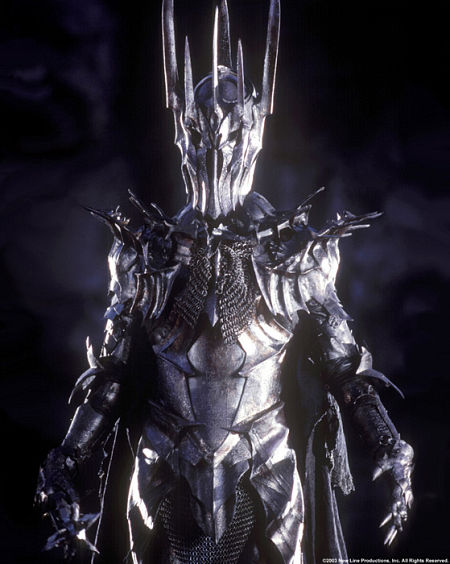
All he wants is the whole world of Middle-earth brought under his control. Power, power, power. That is his motive. He also has a generous capacity for revenge against the Valar and elves, for defeating him at the end of the 2nd Age, before the story begins.
He has no one to answer to, as the most powerful entity in Middle-earth, and as a result, commits atrocities rampantly across the whole land. He sends his armies into Gondor, Rohan and the Shire, without provocation, for the sole purpose of finding his Ring of Power, and killing everyone in the way.
He is finally undone, destroyed into permanent spirit form, by one of the smallest creatures of Middle-earth, but according to the lore of the story, he is not dead. He has merely been dealt so severe a blow that he will never rise again (we hope).
His final words are, “If one good deed in all my life I did, / I do repent it from my very Soule.”
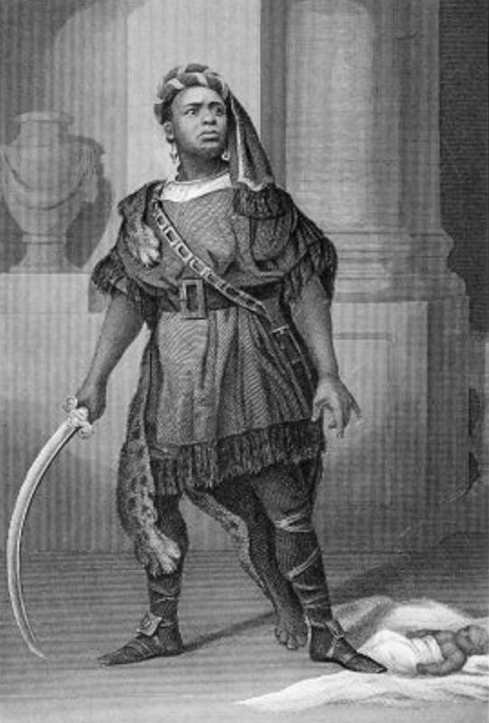
That’s the vilest “screw you” in literary history. He is the main instigator of the carnage throughout the play, and yet his only motive is that he enjoys what he’s doing. He loves to hurt people. He wants people to hate him. It is ecstasy to him. He proclaims in his big speech, while standing with his head in a noose, that his only regret is that he was not 10,000 times worse before he was caught.
He convinces Demetrius and Chiron, the sons of the Queen, Tamora, to kill Lavinia’s betrothed, Bassianus, in front of her, just to make her grieve. They do this, then rape her and cut her tongue out and hands off, so she can’t tell. Aaron eats it all up. It’s delicious fun to him.
Then he frames Titus’s sons for Bassianus’s murder, and lies to Titus, that if one of his family will cut of his hand and send it to the emperor, the emperor will spare his two sons. Titus complies, cutting off his hand, which is returned from the emperor, along with Titus’s sons’ heads anyway. Aaron knew it would happen, and loves every minute of it.
He’s finally caught and forced to die by starvation and dehydration. He refuses to show remorse.
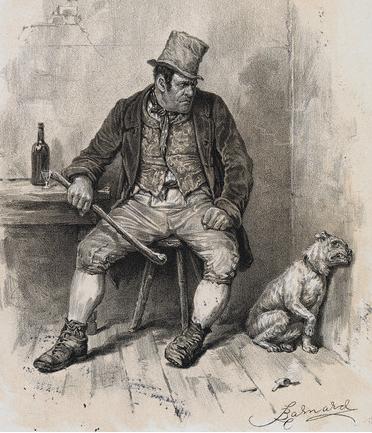
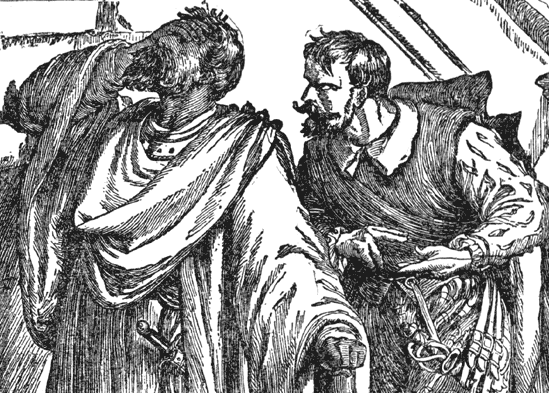
Dickens describes him thus, early in the novel: “a stoutly-built fellow of about five-and-thirty, in a black velveteen coat, very soiled drab breeches, lace-up half boots, and grey cotton stockings which inclosed a bulky pair of legs, with large swelling calves;–the kind of legs, which in such costume, always look in an unfinished and incomplete state without a set of fetters to garnish them. He had a brown hat on his head, and a dirty belcher handkerchief round his neck: with the long frayed ends of which he smeared the beer from his face as he spoke. He disclosed, when he had done so, a broad heavy countenance with a beard of three weeks’ growth, and two scowling eyes; one of which displayed various parti-colored symptoms of having been recently damaged by a blow.”
Oliver Reed played him to terrifying perfection in the musical version, “Oliver!” He is Fagin’s finest protege, from years back, and now, he is well trained to steal and burglarize, but he is depicted as being just as likely to kill a man when no one is looking, rather than try to pick his pocket without being noticed.
He has absolutely no moral scruples of any kind. He is only out to make a buck for himself. Nancy, the poor whore he sleeps with, thinks he loves her, and because she used to be a pickpocket also, trained by Fagin, she feels unstable. Sikes seems to offer her stability. Until he beats her to death for trying to stop him from beating Oliver to death.
He regularly beats his dog, Bull’s Eye, until the poor dog needs stitches. Its so patently terrified of him that it follows him around, afraid to run. Sikes is finally undone by the London mob, which hounds him through the streets until he accidentally hangs himself.
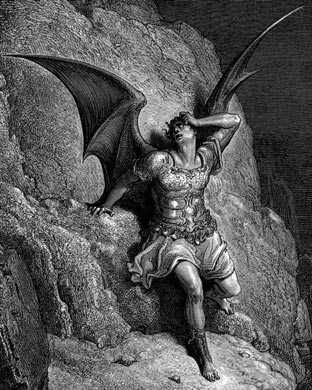
from Milton’s “Paradise Lost.”
His motive for attempting to overthrow God is that he believes himself to be more beautiful, more powerful, and thus rightfully deserving of the Throne of Heaven.
So he and his minions, whom he has corrupted from God, wage war against God and his minions. Not smart. They lose, although they make a better fight, 3 days’ worth, than expected, because they can’t be killed if they’re already in Heaven.
Then they’re thrown into Hell, where Satan immediately decides on revenge. But not open war. That failed once. No sense in trying again. If he can’t beat God, he’ll ruin all of God’s work. It’s all Satan has left as a weapon. It makes him repugnantly underhanded, no longer willing to stand and fight like a man.
He stabs God in the back, as it were, by corrupting his greatest creation, humans, and introducing sin into the mortal universe. It will require the death of God’s own Son as recompense. Satan’s story is easily the most vengeful ever told.
Jean ValJean is released from prison after nineteen years, all for stealing a loaf of read for his starving family. That was a five year sentence. The rest was aded on for escape attempts.
Once out, he finds it difficult to function as a citizen, and steals out of habit. But a Bishop pities him and covers for him so he doesn’t go back to prison. Valjean then turns over a new leaf and six years later, has become mayor of Montreuil-sur-Mer.
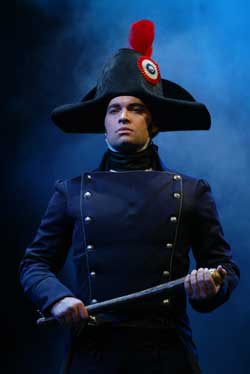
Enter Javert. He is Montreuil’s chief police inspector and used to work at the prison where Valjean was incarcerated. He suspects the Mayor to be Valjean when Valjean lifts a horsecart off a helpless man. Only Valjean could be so strong, Javert remembers.
What follows is almost a thousand pages of abject misery for Valjean, as Javert hounds him all over France. His motive? The law must be upheld. Valjean had stolen a child’s silver coin out of habit as soon as he was released. He then tried to give it back but couldn’t find the child.
Over and over, Javert witnesses the magnanimous good deeds Valjean commits, and refuses to give up the chase. Valjean finally gets the drop on him, but refuses to kill him, even though Javert’s pursuit is the primary reason for several of Valjean’s family members’ deaths.
He releases Javert, who cannot reconcile this mercy with his conscience, and drowns himself in the Seine, rather than live in a world where there is good.
Grendel is the classic monster in all of literature. Except for his lineage, directly back to Cain of the Bible, he has no motive for killing and devouring as many of the innocent townsfolk of the meadhall, Heorot, as he can.
Whether he enjoys it or not is not said, but he is sure to enjoy the meal of thirty people at once. Beowulf arrives and rips his arm off. Grendel flees rather than keep fighting like a man. Beowulf finds him in his mother’s cave, like a spoiled bully finally beaten. he is cowering in a corner, and Beowulf beheads him. Good riddance.
He is the pettiest, the most underhanded, the embodiment of the prime, immortal blemish of mankind: envy. He has been said to have no motive for destroying the life of every major character in the play, other than revenge, at first, for Othello’s passing over him for the post of Lieutenant.
Othello chooses Cassio for Lieutenant, while Iago believes he is better for the promotion from Ensign. He then sets about ruining both Othello and Cassio’s lives with a web of lies. He cannot fight Cassio or Othello face-to-face, because he is afraid they will kill him.
So he corrupts Roderigo, a local moron, who is in love with Desdemona, Othello’s wife. Thus, Roderigo does all of Iago’s dirty work for him, causing Othello to go mad with jealousy over his wife’s apparent affair with Cassio.
By the time it’s over, Roderigo has gotten in a fight with Cassio, and they wound each other. Then in the confusion, Iago stabs Roderigo in the back to silence him. Othello kills Desdemona, whose best friend, Emilia, rats on her own husband, Iago, who immediately kills her to save himself.
How do you kill a fiend so vile? It is left somewhat ambiguous at the end, with Lodovico promising to torture Iago. Whether he will be killed is not stated.


nescient fools, I shalt sweep thou all with my broom
Perhaps Moriarty isn’t listed because he’s only in one of Doyle’s stories, “The Final Problem.” Not much with which to work as far as being a vilest villain. It helps if you’ve read the work before you suggest to add him to the list.
Iago is a solid choice for #1. I would have selected Richard III over Aaron the Moor however.
I agree with the first post; a hero list would be a great list.
I think there is one glaring omission in this list. I would have put Macbeth on this list. Hell, this entire list could be populated with characters from Shakespeares’ work alone.
Good list; I enjoyed it.
@psychosurfer (105):
The Marquis de Sade was an author, not a character.
Flamehorse courts controversy by dragging Satan’s name through the mud. OF ALL THE *****ING CHEEK.
Very well written list. An entertaining and refreshing read.
Dude..Pennywise. That was one bad clown/spider/whatever the hell he actually was.
Wow, those of you who are saying Dorothy’s slippers are ruby have clearly never read the book. In Baum’s original book, her slippers are silver. They were changed to ruby for the 1939 film adaptation because the color would show up better.
Disagree with the Shakespeare characters and their placement. A true villain does acts without motivation or provocation. They do it because that’s just how they are. They see the world differently than we do.
Aaron does fit this, well enough that I would have given him a higher ranking, but his sacrifice of himself for the sake of his child brings question to his evilness.
While Iago does cause some major mischief, it’s a misnomer to call him a villain. He is motivated by jealousy and greed, and it actually kind of pathetic in many ways.
Look at Edmund from lear as a villain of a high degree. The amount of damage he causes is insurmountable, and he is calm and collected till the bitter end. His dismisal of other “evil” people blaming nature, or fate is a testament to this ” should have been that I am,
had the maidenliest star in the firmament
twinkled on my bastardizing.”
Hey guys, I submitted another list, so hopefully it’ll be published soon!
@bucslim (116):
Thanks much, pal. I’m honored. Now I know you love me.
Positing oddball locations for Troy was a game for the bored, eccentric, and literary elite going way back–not anywhere NEAR as widespread as the game of proposing weird locations for the Garden of Eden or Atlantis, but still, it came up from time to time. Of course anyone who follows the mainstream view in any way knows that Troy is in Anatolia, because that’s where Homer said it was. There was then a lot of arguing about WHERE in Anatolia it was—but Hisarlik won out when Schliemann dug up the city there, and this was then confirmed by his successors, Wilhelm Dorpfeld, Carl Blegen, and the German team which is still there.
Now, actually the more usual play with Troy by the left-fielders was to connect fictional Trojans with later locations–like the Brutus or Bruton I mentioned. This goes back to Aeneas supposedly being the founder of Rome–and the Aeneid was written for that very purpose–to give Rome a legendary connection to the great city of the far-flung past. The Romans, ever the nouveau-riche of the classical world, were somewhat touchy about their humble origins, and stealing from the far-older and nobler Greeks wasn’t enough for them—they wanted some kind of ancestry that was as old.
As things stand right now, there have been ever more exciting finds in and around Hisarlik which continue to confirm it as Troy. The hope has always been to find writing there, but as yet there’s been nothing. However, this is probably due to the fact that A) the later, classical builders on the site levelled the top of it, where the palace would have been… thus perhaps destroying forever any archive that may have been there… and B) Schliemann himself surely added to this destruction when he carved out the center of the site, thinking that the Homeric Troy was far deeper than it actually turned out to be.
There remains the hope that some fragments of writing might someday be found in the debris from Schliemann’s digs… but I don’t think archeologists are holding their collective breath. The more exciting finds have been the Hittite archives, which as I said, are now known to make mention of a previous “war” over the city Wilusa, between the Hittites and the Greeks. Even Paris, the son of Priam, the king of Troy, is mentioned… as “Alexandros,” which was Paris’ other name. Even Priam might be there, as a villainous usurper named Piramajadus (I might have that spelling wrong) though of course this wouldn’t fit Priam’s character–but we can assume that many details got garbled in the 500+ years of retelling between the actual war and the time when Homer lived.
Sadly, we have no writings from the Hittites or the Mycenean Greeks that are *contemporary* with the Trojan War. This is because the survival of the records we DO have was purely accidental. Both the Mycenean Greeks and the Hittites wrote on clay tablets. When dried they were destroyed, either naturally or deliberately. To get them to last, you had to bake them in an oven. But this was rarely done. So few tablets survive that were deliberately designed to do so. (Some do, of course).
BUT, at the end of a particular city’s life, if you had a conflagration–a great fire set by invaders or what have you–some of the tablets were “baked” accidentally, and thus we have these records from the END of several cities–Pylos, for instance, and Myceneae. In other locations deliberate bakings occurred to preserve records—at Knossos on Crete for instance. The Hittite archives, I believe, are a mix.
A temporary ditch has been discovered surrounding Hisarlik/Troy, far out from the city, which has been posited to have been an “anti-chariot” defense measure. The size of the Troy site has also been greatly expanded from the original thinking, and it is now recognized that Troy was a very large city for its day.
There are many physical details about the city unearthed by Schliemann, et al, that match Homer’s descriptions… Homer could not have seen these, since in his day the city was buried under layers of earth.
It just makes no sense that the Greeks would have “co-opted” this story from ancient Britons or Celts. Their contact with them was tenuous. And Homer’s Iliad is the Greek national epic. They would not have “borrowed” a story so vital to them from another culture. Nothing about it matches the culture of ancient Britain.
I think some of this stems from weird British pride on the part of eccentrics like Wilkens, who are ruffled at their national failings in the ancient world. They want to have a culture as old and as high as ancient Greece, and to even subtract from it if possible.
@Woyzeck (124): I obviously know that but it seems that my comment wasn´t clear enough, you could cite any of his characters since all of them have a autobiographical factor (even wicked Juliette and virtuous Justine).
No, Marv, it appeared with the atheistic trolls proclaiming God to be a villain, and then it went on to you. If you’re from “DC,” you’re probably a federal employee. It was nice of you to get on the internet during working hours to defend your boss/messiah. Now go back to your work in DC–running the country into the ground.
Have you guys actually read Les Miserables? If you have, I’m very impressed, it’s over 1400 pages and most of it isn’t even about the story. So kudos to those who have read it!
@damien_karras (92) Elphaba comes from L. Frank Baum, who wrote the Oz series. Oh yeah, and how many of you knew that there was more than just “The Wizard of Oz?” That was actually one of the less impressive books in the series, in my opinion.
And to whoever said stuff about the letter V, were you being serious? He was making fun of the way Dracula talks.
Anyway, this was an okay list, although I agree that it seems like he thought of famous movie/play villains and then went back to the books or scripts.
I’m not going to read all of the comments and maybe this has already been said
BUT
In the movie “The Wizard of Oz”, they wanted to stay true to use silver slippers as well but you couldn’t see them in the back drop, so they went to red!
Also, they considered Shirley Temple for the part of Dorothy :X
Yes, Marv, because the country was so high above being run into the ground before your boss took office. . .
Flock O’Seagulls:
And it’s nice to see YOU have internet access in the trailer park, goofball. Good for you. Running water too?
How very *prick-like* of you to make the blithe assumption that Marv works for the federal government. And how very douche-baggy of you to assume that simply because Marv doesn’t believe Obama to be a “villain” that he must instead view him as a “messiah.” What it must be like to live in a world with no middle grounds and greys. I’d suggest anti-psychotic medication to clear that right up.
As to the idea of God being the villain, we were talking about God as a character in “Paradise Lost,” clown—a tome I have little doubt you have never encountered, much less actually read.
i don’t think anyone has mentioned them yet but what about Mr. Croup and Mr. Vandemar from Neil Gaiman’s Neverwhere. i think they’re probably my favourite literary villains (them or General Woundwort, but it might be a bit odd to have a rabbit on this list…)
@El the erf (110):
He corrupted the Men of Númenor and had them practice human sacrifice.
@Randall (130): Very interesting thank you, I was aware of the whole controversy around Schliemann claims, still when I read his “The Gold of Troy” as a teenager, I found it quite entertaining and adventure inspiring.
I agree with Gastby, Moriarty is not suitable, as he only appears in one single story. It’s Hollywood’s take on Holmes that has given him such status.
YES! another person thinks IAGO is the worst villain!!! loving it!
Alex from A Clockwork Orange
Grenouille from Perfum
O’Brien from Nineteen Eighty Four
Captain Nemo from 20,000 Leagues Under the Sea (maybe not as evil as the others, but still a pretty messed up individual)
L. Frank Baum was something of a villian himself; in the aftermath of the battle/massacre at Wounded Knee he called for the extermination of all native Americans.
@psychosurfer (131):
Ah, I see. I misunderstood.
Iago is honestly one of the most inspiring villains in all literature, he’s the basis for so many after him, I’m glad to see him so high on the list. Morgoth probably should be thrown above Sauron seeing as Sauron was what, his high priest, back in the day?
And say what you like but I think Voldemort was pretty damn evil, and I’d call Harry Potter pretty damn fictional. I think he deserves a spot on the list without question. I see this list leans more towards classic literature but really, this guy was freaking evil.
Flock O’Seagulls
I don’t think Obama is a Messiah. I’m just tired of idiots jumping on the internet spewing anti Obama crap without any proof or justification. You made a blatantly politcal statement by claiming that he is one of the Worst Villians in Literature (You do realize he isn’t a fictional character right?). Oh and don’t worry, your welfare checks are going to be processed just as quickly as they always are. By the way I’m not a Federal employee nor do I work for the government. I’d say more but Randall put you down much more effectively than I can.
Thanks Randall!
To those that wish to ‘flame” you Flamehorse–Bah! This list was a good read in itself, and has kept the comments primarily scholarly—It’s a little tiring to go through 400+ comments made up of fanatical foam froth.
For me, I was a little disappointed to not find a King villain. I kind of see Annie Wilkes, the killer nurse who wants to keep a human as her personal pet. Or Leland Gaunt from Needful Things. He may not be a killer, but he has a knack for causing the misery of others for his own amusement.
But I do carry high hopes that we will see another list of literary villains.
And for those that say that King is not an author of “literature”, what is the definition of the word that precludes his inclusion?
Yes, I’ve read Paradise Lost, Randall.
No–God is only a villain to dip*****s like you, Randall.
If you’re in DC and you’re not a fed. employee, then you’re on the dole. I, however, am gainfully employed, thank you very much, and I am not the denizen of a trailer park, Randall.
The list is about villains in “fictional literature,” Marv. The villain need not be fictional. “Dreams of My Father” and “The Audacity of Hope” are not only works of fiction, but ghost-written ones at that.
Both of you can now return your heads to where the sun doesn’t shine.
I’d like to nominate Anton Chigurh from “No Country for Old Men” and “Randall Flag” from “The Stand”
Flock O’Seagulls
Have you even been to DC? I’ve been in this city for 14 years (Gainfully employed for all of them.) There are lots of people who live and work here who are not on the dole and don’t work for the federal government. Your post about that shows how ignorant you are.
Mr. Seagull’s, flaming others really doesn’t seem necessary here. And assuming really isn’t working out for you, it seems.
the list is interesting
Think it would be a good idea make a greatest sci-fi villains list to avoid debate over fiction vs science fiction.
Not sure if this has been mentioned yet…
but Big Brother from 1984. I can’t think of anything more terrifying than an entity (whether an individual or representation of a collective) trying to wipe out all individual thought.
And I also would have liked to see a King villian. “RF” has been a constant theme in so many of his books, and is basically the embodiment of all evil.
Answered my own question about Stephen King and literature…Apparently the Nobel Committee feels he is an author of literature…They awarded him a Nobel prize in 2005.
Gatsby, Barry
Moriarty actually appears in two stories.
And it is implied in The Final Problem that many of the crimes Holmes worked were in fact orchestrated by a large crime ring. Which we learn in the book is Moriarty.
There for he is indirectly involved in many of Holmes stories.
And I still think Napolean from Animal Farm was vile. I mean he was Stalin esque. But definitley a great list.
Scratch that…God I hate phony google info.
I don’t think Moriarty qualifies as one of the Vilest Villains. It seems that he is more of a criminal mastermind. Kind of the Anti Holmes. I agree with a poster upthread that nominated Ellsworth Toohey. One of the few characters in Literature that I actually loathed while I was reading it.
I would like to suggest Captain James Hook.
and maybe mr. Hyde (although he is also mr. Jekyll, no villain)
@max (21): Vhat are vou talking avout?
How is the wicked witch of the west vile?
all she wanted to do was take back her sisters shoes from a Dorthy, which the shoes didn’t even belong to her in the first place
@El the erf (55): Nah, I disagree. Because Wormtail, despite himself, helped them in the end, and then was strangled to death by the hand that Voldemort gave him.
Voldy, on the other hand, didn’t have a compassionate bone in his entire body, even before he lost it. So definitely, Voldemort was worse than Wormtail.
Also, Hannibal Lecter should be on this list. Even though he later became an antihero, he’s still pretty freaking vile.
@Randall (101): OOH! Good suggestion. I forgot all about O’Brien!
Boring list
@archiealt (102):
{}
oIIo
oIIo
||
|| I.
|| |:
_||_ |:
.’ || `. |:
/ || \ |:
| :: | |:
)_ :: _( |:
_)( :: )(_ |:
) ._)::(_. ( |:
/ II \ |:
| .-.|| | |:
\(___)( / |:
`.__\/__.’ I’
Well that was supposed to be a violin, playing just for the complaints.
<<>>
I don’t believe there is any documentation that there was a Jesus much less documents of his trial. In fact I think more historians who aren’t blinded by faith agree that Jesus is a composite at best.
I’d like to present an argument for Big Brother. Yes, he is probably not a person, but that is just a huge part of what makes Big Brother so terrifying. Big Brother is nowhere and everywhere at the same time. Big Brother knows what you are thinking and doing at any given moment, and if you so much as mistakenly think about anything opposing Big Brother, Big Brother will hunt you down, fix you, and then kill you. Sure Big Brother wasn’t a person, but he had such PRESENCE that he could be seen as a villain. Besides, who says that a villain had to be a single person and could not be an organization or something constantly lurking inside the collective mind of an entire society. WAY worse than Iago to me (though I an not in contention with his appearance on the list).
Speaking of George Orwell novels, how about Napoleon from Animal Farm? Sure, it’s a pig, but it’s satire; what do you expect?
Voldemort, for some reason, never seemed as villainous as he was hyped up to be. Cruel? Yes, definitely. But top ten worthy? I don’t know.
I agree with Grendel’s mother.
Disagree with Edmund from King Lear. His actions were mainly out of his frustration for being passed over for everything in favor of his brother, and while that is hardly forgivable, it is an actual reason for his evilness. And he repents while he is dying.
Definitely disagree with the inclusion of Grendel, Satan (at least the Paradise Lost version), and Javert.
Agree with Bill Sikes.
I would include Claude Frollo from the Hunchback of Notre Dame for a similar reason that I wouldn’t include Javert. Javert was doing what he did was right, though it caused a lot of suffering, and eventually he saw the light. Frollo also had good intentions and was actually once very compassionate, but over time his frustration grew until he became (in my book) one of the most horrifying antagonists.
Just my random thoughts.
Love the list! I was thinking of some characters from various mythologies, though I don’t know if one could consider that literature.
Surely Satan should be no.1?
Since he’s the embodiment/origin of evil, surely nobody else would even be on the list if it wasn’t for him?
where on earth is Nurse Ratched, Hannibal Lector, or the sort?
@Mendacity (2): i agree that most of this list isnt particuarly good but Iago was not a petty criminal. he was a master manipulator who destroyed lives out of spite and envy and never repented. that goes with the lists name of vilest villians
I don’t know if plays count in this list, but Mrs. Lovett was a vile villain.
Haven’t posted in a few days. Got to now. This list was terrible. Dracula at 9 and just some other lame asses thrown in the mix? And Satan? I mean come on! Yawwwwwwnnn!!!
I sense a lot of discontent with this list, and I have to say it wasn’t my favorite either.
I do agree with most of the choices, but I think the problem is that you excluded some that people wanted to see on there, like Voldemort, Randall Flagg, etc..
Still, I enjoyed the list.
Dorothy’s slippers in the book were silver. MGM made them ruby ‘cos they looked purty in Technicolor.
I read recently that the book’s underlying theme was the U.S. monetary system. Baum was a populist and a supporter of silver currency.
http://www.halcyon.com/piglet/Populism.htm
I was excited to see Aaron the Moor on the list I always think of him as the evilest character I’ve ever seen.
I would also place Joker on the list because his role as antagonist to the Batman character is so so good.
No Randall Flagg! No Jean Jackets.
The worst part about this list is that it pales beside real life which has produced so many more evil bastards.
@me (109): Did you think the man that corrupted Hadleyburg was a villain? I thought he was a backwards sort of hero. He showed the town the emptiness of the “honesty” they prided themselves on. By the end of the story, he actions had made them less smug and actually more honest.
@Some Guy in NEPA (177):
Nope, sorry… the old theory about the populist symbolism in The Wizard of Oz is nothing but balderdash:
http://www.straightdope.com/columns/read/362/is-em-the-wizard-of-oz-em-a-satire-of-the-french-revolution