
 Mysteries
Mysteries
Mysteries  Weird Stuff
 10 Weirdly Specific Conspiracy Theories from the 1990s
 Movies and TV
 10 Characters Who Never Forgot a Grudge
 Technology
 10 Historical Inventions That Changed War Forever
 Humans
 10 Everyday Concepts That Are Shockingly Modern
 Animals
 10 Animals Everyone Gets Wrong
 Weird Stuff
 10 Bizarre Superstitions That Drive the Stock Market
 Movies and TV
 10 Films That Were Praised but Got History Wrong
 Our World
 10 Major Cities Being Swallowed by the Earth
 History
 10 Times Saying the Wrong Thing Became a Death Sentence
Mysteries 10 Fresh Clues That Might Crack Old Mysteries
Weird Stuff 10 Weirdly Specific Conspiracy Theories from the 1990s
Movies and TV 10 Characters Who Never Forgot a Grudge
Who's Behind Listverse?

Jamie Frater
Head Editor
Jamie founded Listverse due to an insatiable desire to share fascinating, obscure, and bizarre facts. He has been a guest speaker on numerous national radio and television stations and is a five time published author.
More About Us
Technology 10 Historical Inventions That Changed War Forever
Humans 10 Everyday Concepts That Are Shockingly Modern
Animals 10 Animals Everyone Gets Wrong
Weird Stuff 10 Bizarre Superstitions That Drive the Stock Market
Movies and TV 10 Films That Were Praised but Got History Wrong
Our World 10 Major Cities Being Swallowed by the Earth
History 10 Times Saying the Wrong Thing Became a Death Sentence
15 Fascinating Planets Outside Our Solar System
Exoplanets or “extrasolar planets” are planets found outside our solar system. They are designated by affixing a lowercase letter, starting from “b” towards “z” depending on order of discovery, to their parent star’s Flamsteed designation or catalogue numbers.
When PSR1257 + 12 B and PSR1257 + 12 C (they used uppercase letters for these very first ones because they did not yet use the current nomenclature), and later 51 Pegasi b, the first confirmed exoplanets were discovered in the early 1990’s, they were hailed as the most significant breakthroughs in the field of Astronomy since the Copernican Revolution and caused an uproar in the scientific community, and revived hopes of finding Earth-like planets and perhaps life outside the Solar System. Before those discoveries extrasolar planets were deemed nonexistent by most reputable astronomers and mere mention of their existence was treated as science fiction such that no self-respecting scientist took them seriously until relatively recently. Since then Exoplanetology, the study of exoplanets has evolved rapidly into a new branch of Astronomy, uncovering more than 400 such planets (30 of which in the month of October 2009 alone), but most of them were disappointingly similar to the first ones: hot bloated gas giants revolving very close to their star with orbital periods measured in days – sometimes termed “roasters,” and brown dwarves – failed stars which can be easily mistaken for the most massive planets.
The most plausible explanation for this is that the commonly used indirect methods of exoplanet detection are biased towards large, massive objects with short orbital periods which make them the easiest to identify. Every once in a while though, with the help of advanced technology and new innovative means of improving our detective capabilities and a bit of luck we get a few surprises:
15
Oldest Planet
PSR B1620-26 b (discovered: May 30, 1993, confirmed: July 10, 2003)
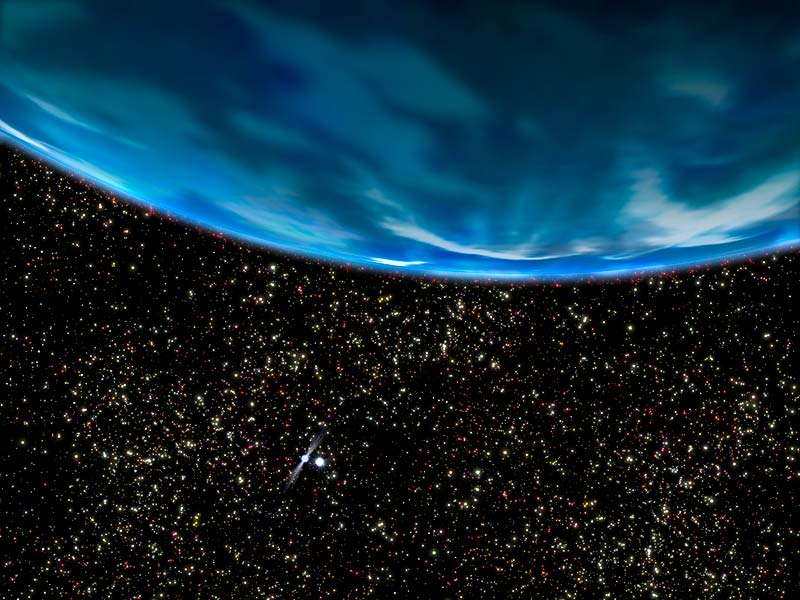
PSR B1620-26 b, nicknamed “Methuselah” for biblical reasons, is the oldest exoplanet found to date at 13 billion years old, possibly the oldest ever considering the Universe itself is only a little older at 13.7 billion years old! It was found deep inside the core of what is called a “globular cluster” of stars, which are composed of the very first stars that were formed right after the Big Bang. And based on our knowledge of planet formation planets are born soon after their parent star, so if the exoplanet’s star is really old, then the planet itself must be really old as well. It was confirmed to be a planet only in 2003 which is good news for planet-hunters because if planets can be readily formed as quickly as stars just after the Big Bang then they must be as common too.
14
Closest to Solar System
Epsilon Eridani (Epsilon Eridani b discovered August 7, 2000)

It’s actually a system of planets, not unlike how we like to call our own solar system. The name “Epsilon Eridani” stands for the parent star, or their “sun,” and it has two probable planets orbiting it: one confirmed (Epsilon Eridani b) another yet unconfirmed (Epsilon Eridani c), making it the closest planetary system at just over 10 light years from the solar system. It even has not one but two asteroid belts, an inner one between Epsilon Eridani b and the star and an outer one between b and c, and also a dust ring beyond c’s orbit believed to be produced by extrasolar comets bumping into each other.
13
Most Suns
91 Aquarii b (November 16, 2003)
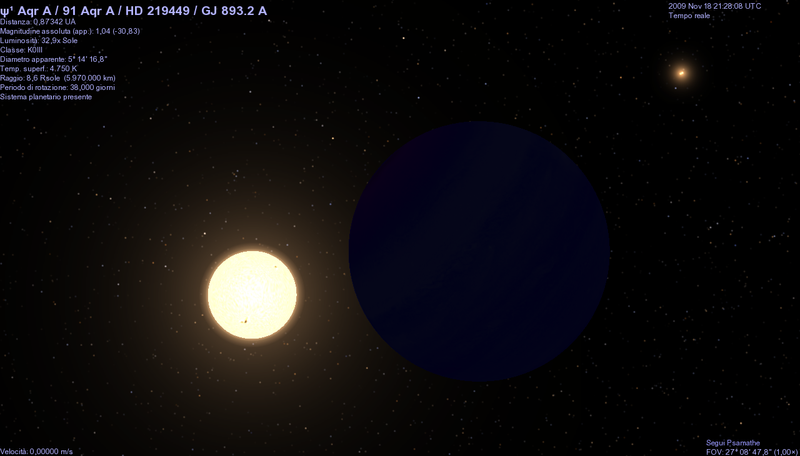
When we think of planets we are used to the idea of planets around the sun in a single star system but in fact a surprising number (about one in two) of the stars we see in the night sky are really multiple star systems; that is, a group of two or more stars orbiting around their common center of mass (they appear as single points of light because of sheer distance). In the 91 Aquarii system there are five stars, and in November 2003 it was discovered that a gas giant planet was orbiting the primary star, 91 Aquarii A, and thus the planet is alternatively named 91 Aquarii Ab to distinguish it from the other stars in the system and to make room for possible undiscovered planets around those other stars. This gas giant is special because our methods of detecting exoplanets around stars require a great deal of precision which could unfortunately be thrown off by even one other nearby star, making it one of the few planets discovered in multiple star systems.
12
Most Exoplanets in One System
55 Cancri (55 Cancri b discovered April 12, 2006)

This is quite similar to the previous one in that it is a binary star system, a two-star multiple star system just like Tatooine (which by the way has become a new scientific term describing planets in multiple star systems after the hypothetical HD 188753 Ab, which could have been the first of the “Tatooine planets” was hypothesized back in 2005 but was later disproved) from Star Wars, but this time it has five medium-size “Neptune-mass” planets orbiting around the larger star 55 Cancri A, in order of distance from parent star: 55 Cancri e, b, c, f, and d (or 55 Cancri Ae, Ab, Ac, Af, and Ad to distinguish them from the other star, 55 Cancri B). This is the most number of confirmed planets orbiting one star other than the sun and hence raises the possibility of finding more planets around stars with or without known planetary systems by showing that our solar system of many planets is not unique.
11
Exoplanet’s Atmospheric Composition Known
HD 209458 b (November 5, 1999)
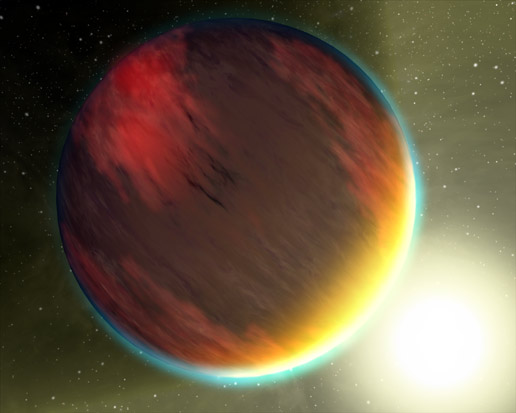
Another “special” gas giant in the sense that its orbital plane aligns perfectly with our line of sight i.e. it regularly passes through the face of its parent star as seen from Earth. This “transiting” of the planet allows us to more accurately calculate its size by analyzing the amount of its parent star’s light that is blocked off as it passes and more importantly determine the composition of its atmosphere through Spectroscopy, the study of interactions between radiation and matter (in this case, the interaction between gases and vapors in the planet’s atmosphere and its sun’s starlight). Using this method they have detected the presence of sodium vapor and more recently (October 2009) some water vapor, carbon dioxide, and methane in the planet’s atmosphere. It is also only the second planet revealed to possess organic compounds, with HD 189733 b being the first one on October 5, 2005.
10
Gas Giant in “Habitable Zone”
Gliese 876 b (June 23, 1998)
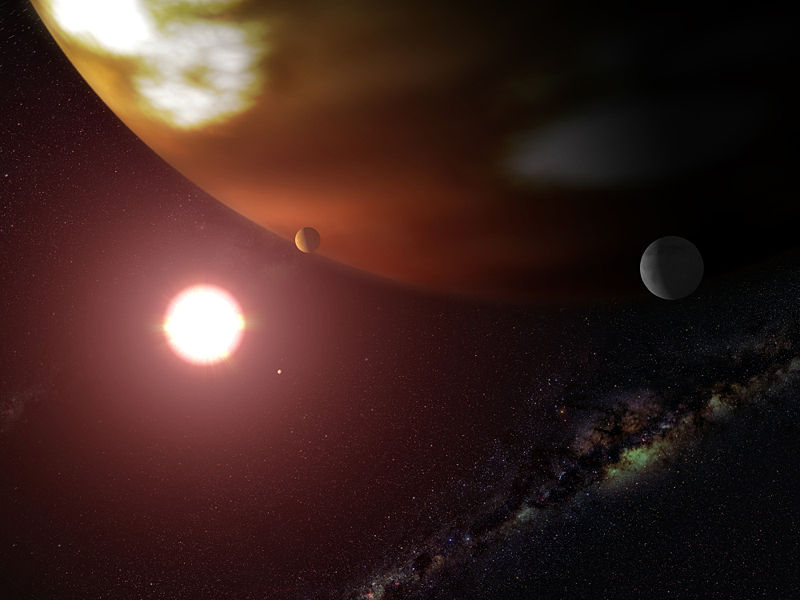
The habitable zone is the imaginary spherical shell surrounding a star where conditions are optimal for liquid water to exist on an Earth-sized planet orbiting within that shell. This gas giant is special because it orbits inside its sun’s habitable zone. “But so what,” you say, “how is it ‘habitable,’ we can’t live on gas giants, you know!” While it is true that we humans are as of now incapable of living on or in a gas giant, take a quick look at the gas giants in our solar system: they all have some relatively big, icy moons, and it is not impossible (albeit not certain) that Gliese 876 b could have some habitable moons (think Pandora and Polyphemus from the movie Avatar). Even if not, there is no reason not to believe that life could originate in or on gas giants, as evidenced by a paper from respected astronomers discussing the possibility of life in Jupiter’s thick atmosphere.
9
Survivor
V391 Pegasi b (March 2007)

This gas giant was found orbiting a white dwarf star (a type of dead star) which means that at some time in the past during the star’s red giant phase (a red giant is a large dying star preceding the white dwarf stage) the planet must have been skimming its sun’s surface or possibly even orbited inside the dying star! This bodes well for the planets in our own solar system including Earth, because our sun is believed to begin its red giant phase five billion years into the future, engulfing the orbits of the inner planets and possibly reaching the present-day orbit of Mars. But even if the Earth does survive inside the red giant sun the surface will be totally sterilized by the high temperatures in the red giant sun.
8
First “Super-Earth”
µ Arae c (August 25, 2004)

Up to now we have been talking of a few noteworthy gas giants in a universe of hot bloated gas giants, but this planet, the first “super-Earth,” or large rocky exoplanet discovered, brought researchers much closer to finding Earth-like planets outside the solar system. A “super-Earth” is defined as an exoplanet with a mass between that of the Earth and the giant planets in the solar system. They are generally considered to be rocky because for an object the size of the earth its weak gravitational force tends to attract more of the densest most massive materials (e.g. rocks and metals) but little of the lightest materials like gases, which could then be easily blown off by astronomical phenomena like radiation from its sun, atmospheric escape, or large asteroid impacts. As this rocky protoplanet grows to approach Jupiter-mass, however, its strengthening gravitational attraction allows it not only to pull more objects to its surface but also hold on to the lighter gases, setting off a vicious spiral which eventually leads to it becoming another gas giant. It demonstrated how advancements in technology achieved through cooperation in the intensive development and constant innovation of new techniques can pay off and lead to bigger things (or rather smaller things, as our refined techniques have detected exoplanets with smaller masses since then).
7
Possible “Hot Neptune”
Gliese 436 b (August 31, 2004)

It was discovered soon after the first super-earth, with their masses and diameters roughly equivalent. Initial calculations, however, suggested a density greater than those of gas giants but not quite as dense as rocky super-Earths, and led scientists to believe it was made primarily of the next most abundant compound in the universe: water (which in turn is composed of some of the most abundant elements in the universe: Hydrogen and Oxygen). But given the planet’s high surface gravity due to its high mass and small radius, and the fact that it orbits close to its star, any water comprising the planet is thought to be exotic forms of “hot ice” or water compressed into a hot, solid state by enormous pressures, like how carbon atoms are compressed into diamonds by pressures beneath the Earth’s surface.
6
Lava-coated Super-Earth
COROT-7b (February 3, 2009)
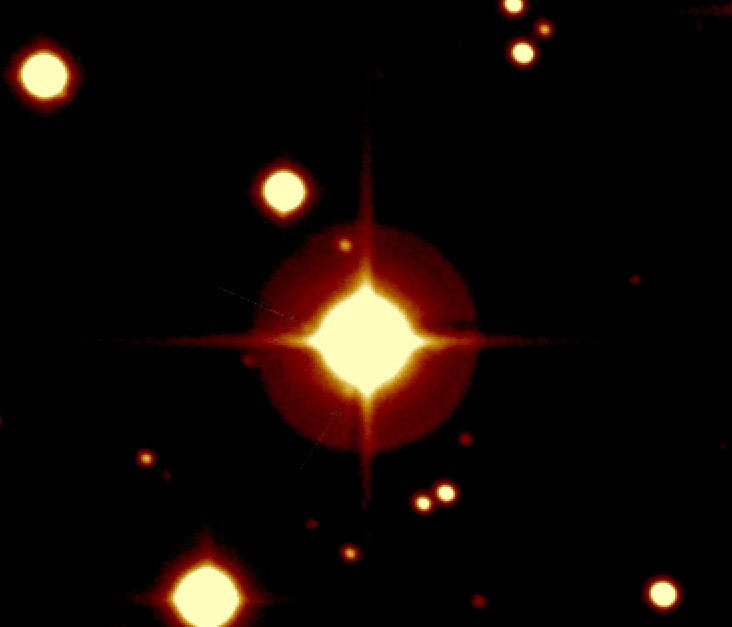
This recent addition to the fast growing list of extrasolar planets thrilled scientists when they determined its diameter to be only about 1.7 times that of Earth with a density and inferred composition similar to that of Earth. It was among the smallest exoplanets at the time of its discovery and the most Earth-like, if not for a literal sea of molten rock and metal covering its entire surface due to its orbit’s extreme proximity to its sun! It is also one of the few super-Earths with an atmosphere, but only a really thin and tenuous one with trace amounts of water vapor and various metals in gaseous form because of extreme conditions on its surface.
5
First Planets to be Photographed
Fomalhaut b and HR 8799 b, c, d (November 13, 2008)
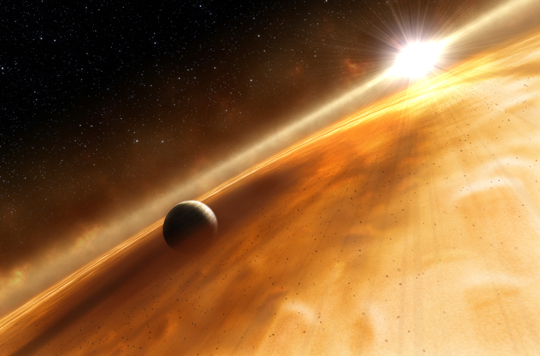
Direct exoplanet observation has been compared to watching a gnat flying across the face of a searchlight on a foggy day from miles away (source: National Geographic). Fomalhaut b and HR 8799 b, c, d are the first exoplanets directly imaged in optical wavelengths (that is, in colloquial terms, photographed) using huge Earth-based telescopes at W.M. Keck and Gemini Observatories in Hawaii along with the Hubble Space Telescope. Truly an impressive feat, yes, but not quite as impressive as the next one.
4
Farthest planet from parent to be imaged
GJ 758 b (November 2009)

It’s roughly the same distance from its star as Neptune is from the sun, so it only receives and reflects a tiny fraction of its sun’s light, like Neptune. But if you thought observing Neptune from the Earth is hard enough, try photographing an object as dim as Neptune, only from 50 light years (about 500 trillion kilometres or 300 trillion miles) away in another star system! That’s exactly what the Hubble space telescope did in November 2009. What’s really interesting about this and the previous item is that these telescopes are scheduled to be replaced by a new generation of more powerful telescopes, some of them dedicated solely to planet-hunting (notably the Terrestrial Planet Finder or TPF to be launched in 2015 with a stated mission of – you guessed it – finding terrestrial planets). So if the old general purpose and soon-to-be-obsolete Hubble telescope can accomplish that, who knows what more we could find with the newer, specialized telescopes!
3
Planetary collision
HD 172555 (August 2009)
Planet Smash-Up Animation NASA JPL Spitzer Space Telescope HD

Infrared detectors on Nasa’s Spitzer Space Telescope detected large amounts of vaporised rock, along with fragments of hardened lava, known as tektites, which are usually formed by meteorite impacts. The existence of such a large amount of these kinds of material that would be enough to obscure a star’s light points to a huge impact – a planetary collision – in order to produce that much debris.
Its discovery shows that catastrophic planet-scale collisions are not very uncommon in the universe, and supports the widely accepted theory that the Earth’s moon was created by a similar event in the distant past. Furthermore, computer simulations have predicted the remote possibility of future collisions in our solar system 3 billion years into the future, far from the 2 years that pseudo-scientist nuts want you to believe.
2
Super-Earth Closest to Solar System
GJ 1214 b (December 16, 2009)

This one is very much like COROT-7b but it is closer to Earth at 42 light years and hence can be more comprehensively studied. Like COROT-7b its surface is much hotter than Earth’s, but much milder than that of COROT-7b which could allow for a thicker and denser atmosphere, if one exists.
1
Most Earth-like Exoplanet Yet
Gliese 581 d (April 24, 2007)
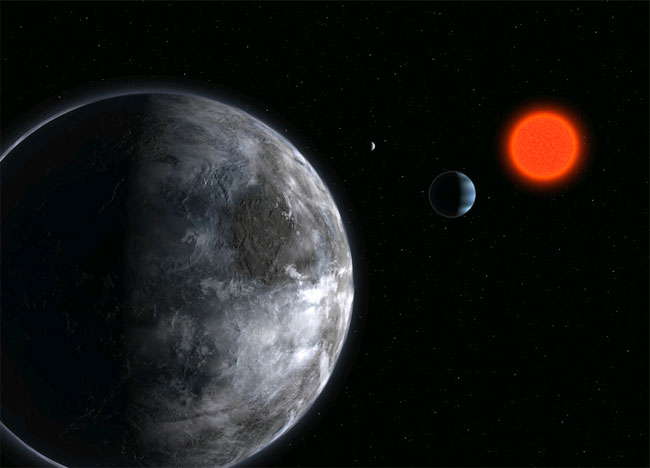
At 7 to 14 times the mass of Earth this planet is considered to be a super-Earth but remarkable in that its orbit is inside the habitable zone, and has a solid surface allowing for any water present on its surface to form liquid oceans and even landmasses characteristic of Earth’s surface, although with a much higher surface gravity. So striking is its resemblance to Earth that it has inspired some people to send greetings intended for possible intelligent life forms that could have developed similarly to us.
+
Exoplanet Naming Society

Can you imagine talking about exoplanets at a party and going about how awesome PSR1257 + 12 B, PSR1257 + 12 C, PSR B1620-26 b, HD 209458 b, µ Arae c, COROT-7b, GJ 758 b, GJ 1214 b, and HD 172555 are? That’s what’s led to the creation of the Exoplanet Naming Society a little over a year ago, which aims to replace the current designations of exoplanets with mythological names for easy reference, like the planets in our solar system. Now you can participate in this exciting new age of discovery by assigning obscure unpronounceable names to distant balls of rock and gas for future grade school children to memorize.
More Great Lists
 10 Hypothetical Planets That Could Exist In Our Solar System
 10 Strangest Unexplained Phenomena In Our Solar System
 Top 10 Most Fascinating Mummified Bodies Found Outside Egypt
 Top 10 Deadliest Planets In The Universe
 Top 10 Giant Facts About the Dwarf Planets
 10 Awful Rampage Killings That Happened Outside The US
 10 Things We Eat That Are Banned Outside The US
 10 Absolutely Badass Anarchist Women Who Challenged…
 10 Surprising Facts About Japan's Railway System
fact checked by
Alex Hanton
More Great Lists