Christianity was the founding religion of both the Western and Eastern empires and, as is to be expected, enormous amounts of literature has been produced based on the tenets and ideals of Christianity. This list looks at ten of the greatest masterpieces in writing which come from a Christian perspective.

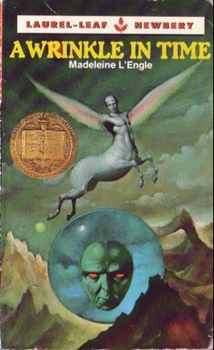
This book makes the list primarily for mixing science and Christianity in a favorable way. The two subjects are often seen as being at odds with each other, but in L’Engle’s book, the protagonist, Meg Murry, and her scientist family, all very intelligent, discover a way to fold space-time and travel anywhere in the Universe, instantly. They go to the planet Uriel, which is like Heaven, where everything is good and winged centaurs sing praises. They then learn that the Universe is being attacked by a monster called the Black Thing. The Black Thing captured Meg’s father when he was working on faster-than-light travel, and took him to the planet Camazotz, where everything is controlled by a disembodied brain called IT. IT demands absolute conformity, to the point that all houses and towns and cities look precisely the same. Camazotz has been enveloped by the Black Thing, of which IT is the ruler.
Throughout the book, Meg and family discover many fascinating things, including three immortal women named Mrs. Which, Mrs. Whatsit, and Mrs. Who, each of whom is very unique. Mrs. Who speaks several languages, and frequently quotes Shakespeare and the Bible. The protagonists finally wind up at Camazotz, and her brother is kidnapped by IT. The rest of them escape, but after learning how to defeat IT, Meg goes back to rescue her brother. IT cannot tolerate the emotion known as “love.” They return to Earth much the wiser about how to live decently and treat others well.

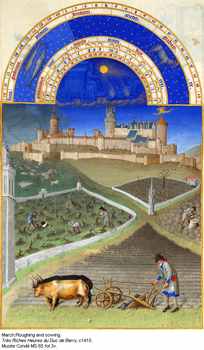
One of the more explicit allegories, with every character named for the quality or emotion he or she displays. In Malvern Hills, Worchestershire, a man named Will (free will) dreams of a tower on a hill, and a fortress in a valley (Heaven and Hell), and a “fair field full of folk,” between them (mankind). He sets out on a journey to attain the tower. Piers, a plowman, appears and offers to guide Will to the tower. On the way, Piers speaks to him of Truth, while Will searches for anyone who might enter the tower with him, namely Dowel (Do well), Dobet (Do Better) and Dobest (Do Best). Will is searching for how a Christian should live, according to Catholicism.

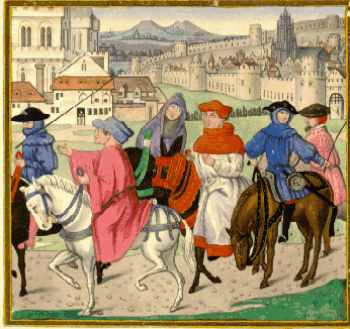
It is ranked so low on this list because, although it deals with Christianity in post-Black Death England, it is more a critique of English society at that time. It’s reliance on Christian philosophy and morality, however, requires that it be given a spot here. Various characters meet up on a road as they walk to Canterbury Cathedral to see the shrine of Thomas Becket. There is a knight, a miller, a cook, a friar, nuns, etc. They decide to have a story contest to pass the time, and the stories they tell all deal with various principles and ideas of the Catholic Church in England at that time.
Chaucer wrote this work during the Great Schism, as it is known now. The Catholic Church split right down the middle in 1378, and this lasted until 1417, after his death. One pope said the throne should be in Rome. Another claimed himself as pope and said it should be in Avignon, France. It was finally resolved with a Council and a few excommunications, and the election of a new pope in Rome. The tales show a diversity of theological understanding, various disagreements, and yet, the characters remain together in their journey to Canterbury, which Chaucer uses to symbolize Christianity holding all its followers together, whether they agree or not on any issue.

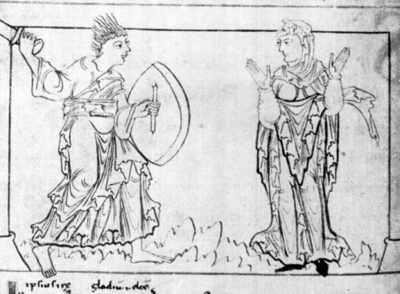
“Psychomachia” means “Battle for the Soul.” It ranks so high, despite not being well known, for being one of the very first, if not the first, Christian allegories. It is an epic poem of about 1,000 lines, not very long, which tells the story, in the style of Virgil’s Aeneid, of a titanic and desperate battle between virtues and sins, inside a nameless character, intended as the reader. All the famous deadly sins and cardinal virtues are present, though not precisely listed in their modern forms. Pagan idolatry initiates the conflict, bringing Pride into the fray, which is defeated by Selflessness, and so on. The final fight is comprised of the double threat of Hatred and Wrath versus Love, which finally defeats all sin in the name of Christ Jesus. 1,000 Christian martyrs then praise the Faith with a Hallelujah.

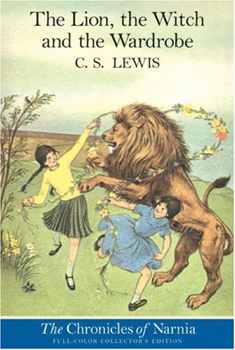
His entire Narnia series of children’s books teem with Christian themes, but the first that he wrote, and most famous, is the most explicit, being a loose retelling of the life of Jesus. “Aslan” is Turkish for “Lion.” And for the child in all of us, Lewis includes talking animals, lots of magic, fantastic creatures like centaurs and unicorns, naiads and dryads, which are like tree spirits (similar to Tolkien’s ents). Narnia is under the spell of Jadis, the White Witch, who has set herself up as the Queen of Narnia, and makes it eternally frozen and snowing, but never Christmas.
Four children from Earth find their way into Narnia, and discover that their arrival is predestined, and heralds the long-awaited coming of Aslan, who will right all the wrongs. Along the way he teaches them what is virtuous, what is sinful, and then deals with the error made by one of them, Edmund. The Witch demands the boy die for the crime of betraying his own siblings. Aslan offers himself in the boy’s place, and the Witch thinks that this Deep Magic will give her control over Narnia once and for all. Boy, is she wrong.

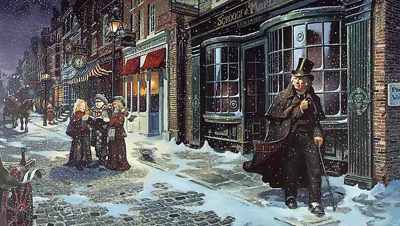
Many critics believe that Christmas is the most popular holiday around the world at present, not because of the Nativity story, but because of its revival in Dickens’s mid-Victorian novella about charity for all, regardless of religion, social standing, or anything else. In secular terms, that is what Christmas should be about, he argues in this book: giving to others without thought of recompense; the one time of the year when all differences should be put aside for a brotherhood of man.
Ebenezer Scrooge is an odious miser, a money lender, who refuses to give money to anyone for nothing. He lends to those he thinks can pay him back, but he charges quite a lot of interest, and is quick to charge more when payment is late. He does not care how poor or unable anyone is to pay him back, or how desperately they need food and shelter. But that all changes on Christmas Eve, when he is visited by the ghost of his old partner, Marley, who warns him that he is in danger of Hell. Then the ghosts of Christmas Past, Present, and Yet to Come, visit him and show him how horrible a man he is. He changes for the better and everyone lives happily ever after, beginning on Christmas Day.
Many of the story’s elements have entered the vernacular around the world. Misers are now nicknamed Scrooges, and people much more frequently say, “God bless us, everyone.”
But is it explicitly Christian? Yes, it must be considered so, because even in secular terms, the root of the word Christmas cannot be ignored, and Dickens chose this holiday over all the others. Thus, the principles of charity for all and generosity and love are evoked in Christ’s name.

The most obviously allegorical of all Christian allegories. The protagonist is named Christian, who reads the Bible and then is burdened by a heavy packpack, which holds the knowledge of his sin. He is met in the fields one day by a man named Evangelist, who directs him to the Wicket Gate. Christian immediately leaves his wife, children, and home to seek the Gate and a deliverance from his sin, lest he sink in Tophet (Hell). Tophet is thought to be where, in Jerusalem, the Canaanites sacrificed children to the god Moloch by roasting them to death. Christian is diverted on his journey by Mr. World Wiseman, who tempts him to seek deliverance through the law (earthly law). Christian refuses and reaches the gate, where Good Will instructs him further. He finds the place of deliverance, which is Calvary, where the straps of his backpack snap and he is relieved of his burden. In the 2nd part, Christian’s family finally goes after him and thus finds deliverance from their sins, and reunion with Christian in Paradise. Good Will reveals himself as Jesus.

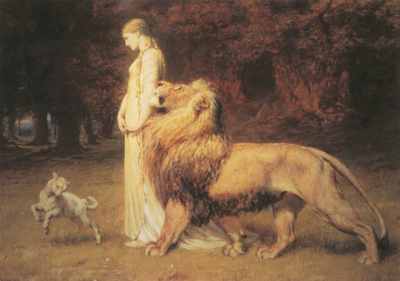
It is probably the longest single epic poem in English, and Spenser intended it to be twice or four times as long as what he finished. It is 6 Books, each celebrating a particular virtue: holiness, temperance, chastity, friendship, justice, and courtesy. The first book is the most famous, since Spenser wrote in such a laid-back style that it takes him quite a long time to say anything, and most readers quit with the first book. He also invented the Spenserian stanza for the work. In the first book, the protagonist is the Redcrosse Knight, symbolizing King George of England (the red cross was and still is on the English flag).
He rides over the English countryside, getting into adventures, and rescuing Una, a damsel in distress, who symbolizes both Queen Elizabeth I and the Virgin Mary. She travels with a lion (God’s law) and a lamb (God’s love). She recruits him to save her family’s castle from a monstrous dragon (Satan), whom the Redcrosse knight defeats in combat after putting on the armor of God. This duel, near the end of the first book, is one of the most famous events of the poem, and a classic tale of a knight slaying a dragon. The protagonists come across various villains on their journey, such as Duessa, who represents the false Church, Archimago, a sorcerer who represents paganistic heresy, who hates Redcrosse and England, and King Arthur and Merlin.

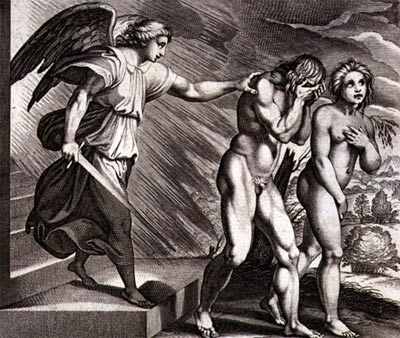
Rather than an allegory, this epic poem is overtly theological, and a masterpiece of explanation as to why God allows people to suffer, how sin began, why Jesus must be the Messiah, etc. Milton enters deep into philosophy many times, especially when God, watching from Heaven, explains that mankind has just committed sin and killed itself by disobeying his law (don’t eat that tree’s fruit). So with Man officially fallen from grace, the Son of God, still in Heaven, having not yet been born mortal on Earth, who has no name, announces to his Father that he will descend into the world of men, become one, and allow himself to be killed to atone for Man’s sin.
Satan, meanwhile, is given one of the most interesting portrayals in literature. He is practically the hero of the poem, from his and his minions’ point of view. They are cast out of Heaven for warring against God. Satan wants to be God, and refuses to quit. Now burning in Hell, he and his minions discuss how to get back at God. Some want more open war. Satan advises against this, and decides on surreptitious treachery: he knows of God’s newest and greatest creation, Man, on Earth, and will travel out of Hell, up to Earth, and corrupt that creation, to make God despair and hate him. How evil!
One of the most fun moments in the poem is a flashback showing the actual war in Heaven. You ask yourself how those already immortal can be killed, but this is not the issue. Satan and his angels fight against Michael and his angels, and whoever is stronger will overpower the other and gain the throne, casting the losers out of Heaven to Hell. Michael and his angels are nearly beaten back to the walls of the Holy City, but are saved at the last moment by the Son of God, who saddles up a chariot of ethereal fire and does what everyone would love to see in a film: Jesus kicking ass. After all, he’s not a tame lion.

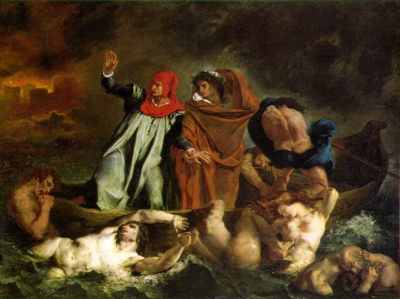
The Divine Comedy is the finest work in the Italian language, which is saying a lot. We would be hard-pressed to decide on the greatest work in the English language, or any other language, but Dante has Italian pretty well sewn up. He invented terza rima for the purpose of this epic poem, a rhyme scheme still popular and widespread today. It does a fine job interlocking the 3-line stanzas. The Comedy, as he titled it, doesn’t have one single joke. It’s a comedy in the sense that Dante, the main character, journeys upward from Hell, through Purgatory, to Heaven, and not the other way around. So it has a happy ending and is not a tragedy.
But the most famous Canzon of it, the Inferno, is 34 books of the most awe-inspiringly elaborate, horrifying tortures anyone has devised in fiction. The modern Christian conception of a lake of fire is nowhere to be found. Instead, much more interesting are the punishments Dante devises for the various sinners in response to their particular sins. Hell is in 9 circles, and Dante constructs it as an amalgam of the Ancient Greek and Roman Hells, combined with Christian ideas. Various popes and cardinals are down there, along with all who died before Jesus’s death removed sin from mortal man. The Harrowing of Hell is mentioned near the beginning, after which the Old Testament heroes, such as Noah, Abraham, Moses and King David, are rescued up to Heaven.
The entire poem is a critique of various famous figures from Dante’s time, and antiquity. Some he admired, like Homer, Virgil, Horace, Ovid, and Lucan, are in Limbo. Julius Caesar is there, and Saladin, who was decent and chivalrous. Alexander the Great, however, is eternally boiling in Phlegethon, a river of blood in the 7th Circle. Talk about macabre. And if you’re wondering, yes, lawyers are down there, boiling in a sea of pitch.
For its jaw-dropping brilliance of imagery from page one to page end, and the fact that the reader has been taught quite a few lessons without realizing the work’s didactic nature, Dante must surely secure for his masterpiece the first spot.


Wow, "Where's the Bible" has become so cliche, that even EXPECTING IT has become a cliche.
As for the list, I (this is just opinion) think A Clockwork Orange should be on here, because it has very deceptively christian morals.
GOD-DAMN IT BASSBAIT, "CLICHE" IS NOT A *****ING ADJECTIVE.
"*****ing" wasn't an adjective either, but has become one with repeated contextual use.
'*****ing' is an attributive verb (cfr. the eating man, the playing child), so your argument is invalid. Although you may argue '*****ing' has underwent some semasiological changes, grammatically it's used entirely correct.
Ooh, linguïstical burn. By a foreigner! The lesson to be learned: never ever try to chastise someone if you aren't absolutely certain of your case, or if you haven't got a good excuse for making a mistake. Like being a non-native speaker.
You know your *****, Armin. No wonder you made Principal.
Meh, ya got me. I'm actually not a grammar chastizer, I was just *****ing with good ol' Woyz. Just good natured fun…but bear in mind, I never said his usage wasn't correct.
@armin: dude i admire the way you corrected maggot. Yet when segues pointed out that your grammar was off you got offensive and used the foreigner card. Hmmm thats very honest of you.
As i've said, being a foreigner is a good excuse for mistakes. However, when correcting someone, I make sure my arguments are thouroughly researched. That's the difference
Hippocritical dik.
**Hypocritical dick.
Look up at this exact moment, and watch gleefully as the joke sails through the air right over your head.
You have a right to your opinion, naturally. You do not have the right to force your opinion on those who have a different belief system.
There are, I would hazard a guess, more people in the world who believe in God than who don't. They all call him by different names, have different representations of his appearance (multiple appearances in some religions), and have different laws surrounding (usually minor) daily life…however, they all have *ONE* thing in common: they teach people how to better live with their neighbors (in the global sense).
How dare you?
Who died and left you the Great and Wonderful Oz?
Absolutely! I say three cheers for segues! Refering to "more people in the world who believe in God than who don't", if you want some statistics, 2.2 billion people are Christians, 1.5 billion are Muslims, and 14 million Jews (Christianity, Islam, and Judaism are the three major monotheistic religions), so about 50% of the world's population believes in one God. There are about 1 billion Hindus (the world's largest polytheistic religion), and Buddhism has 1.5 billion followers. So, altogether, there are roughly 6.2 billion people (Earth has about 7 billion people on it) that have at least some religion. Compare that to 161 million atheists, or 2.3% of Earth's population.
Jesus.
Furthermore, the majority does not necessary mean the correct or the best. Forgot to add that, sorry for the re-comment.
Are not all religious writings fiction? I think the Bible, old and new testament, the Koran, and the Book of Mormon should be the top 3 works of Fiction. They would be comedies if not for the horrors perpetrated by those who take them seriously and are arrogant enough to think that any God would condone what they are doing based on their interpretations of what a god would want.
It's hard to read, isn't it? This discussion has been started with a lot of different comments, and still you try once more. Why not just hook in on one of the earlier discussions? And I know you want to show you're an intelligent person, and your hip and cool and progressive and whatnot. But it is getting really annoying. Why are you so trying so hard to express your individualism and intelligence by parroting the same thing all others have said? If you really were so intelligent and individualistic, you wouldn't need reaffirmation every time you come into contact with religion.
So please, leave religious people alone, as long as they don't hassle you. Show some intelligence and accept there are people who believe different albeit illogical things, and respect them.
Thank you for that Armin Tamzarian. Well said. It’ almost if the more they announce their non religious beliefs the more they think it will be a fact. They don’t realize that they are believers as well. They just may believe in something different and I respect that.
By which you mean, they believe in things for which there is evidence. No atheist claims to believe in nothing. That's just stupid.
Woyzeck, if you are, like I suspect, Polish, I think a 'kurwa' is justified. Haven't you read what I just wrote? Clearly 'Say it ain't so' isn't ready/willing to be confronted with this. I agree with you, not believing those christian beliefs are a lot more logical. But you shouldn't be so militant about trying to convert those christians. If they want to believe those things, let 'em. As long as they don't bother you, what's the matter?
OK, that makes sense. I'm not Polish, but did you just tell me that a ***** is justified? I agree, a ***** is ALWAYS justified.
Everybody on Listverse wants to know where Woyzeck is from. What nation could have birthed such a man?
Es gibt ein ganzes tonälspiel genennt Woyzeck, geschreben dürch Büchner. Aber ich glaube Woyzeck wär eine Slävischer nahme.
Jste čeština?
"Clearly 'Say it ain't so' isn't ready/willing to be confronted with this"
Armin Tamzarian, How do you know that I wasn't confronted with what you believe first and I believed it? And now I believe somthing else and have accepted that as the truth?
That happens quite a bit.
@woyzeck
A nation of kurwas thats for sure j/k
We do know he’s a londoner. My bet is armenian. No no. Azerbaidjian. I saw his sister at eurovision. Haaawwwt.
@armin: dude dont use words that can be recognized by anyone that speaks a slavic language.
The Emperor wears no clothes, right?
In one of my huimor columns for the University Chronicle (GO, BEARS!) many years ago, I wrote about the phenomenon of people who have two first names and John Milton was one of them. His wife asked him, "Are you in theJohn, Milton?" Milton, who was blind, replied, "I certainly hope so."
There`s a website about the prophet Muhammed. It`s on a website. And there great unless you`re a muslim that is.. Persian drawings of him are pretty vile, , Renaissance paintings show him being dragged into hell, by a Demon, their`s a picture off those cartoons which caused Muslims to go ape a few years ago painted onto a Pigs arse and a statue of some knight stamping on him. Don`t you wish some off these things would happen to Bin Laden?
I was going to give this comment a dislike, because it's so incoherent, but I love this bit so much: "There`s a website about the prophet Muhammed. It`s on a website."
He should have said its on the net
There's a special place in hell for those who think that non sequiturs form the basis for a good argument.
If there is no God, where does moral law come from? (IE: being kind rather than a jerk, not cheating on your wife, feeling bad when someone dies or goes away)…Help me understand what you are thinking.
It's really practical: If murdering were allowed, society wouldn't last. It's the same for most other general rules. The other rules were invented to keep others from being more powerful/superior.
Then why do animals have no sense of ethics or morals? You don't see lions eating grass instead of killing zebras because they think it is wrong, do you? You don't see koalas eating mice instead of the eucalyptus leaves because the trees' population is going down, do you?
You sir, are bad at making *****ogies.
Lions have some kind of ethics: don't kill every zebra in sight, only the ones needed for food. It's one of the rules vital to their survival, so they adhere to it. Koalas don't have the environmental consciousness to realise the number of eucalyptus trees is dwindling, so they keep eating. In time, a lot of koalas will die, and the number of eucalyptus trees will be able to rise again. It's a normal conjectural movement of nature.
However, apes seem to have the same beginnings of morals as humans do. As you might know, apes are a sociable bunch, so they need ethics to be able to work together. Be it in the form of defleaing eachother like most species of apes, or in the form of mutual *****/***** like bonobo's.
That was two terrible examples. The first one because you are suggesting that eating meat is immoral despite the fact Humans are meat eaters and of course Koalas do not have the mental ability to weigh up these type of issues that you are talking about.
On there other hand there is an excellent book called The Moral Lives of Animals which states the following;
“an elephant with a leg injury whose fellow elephants in her herd slowed down for her and even fed her. They tell how dogs can agree for a session of rough play that’s not supposed to hurt and those that overstep the bounds, by for example by biting too hard, get frozen out of the group. Caged rats taught to push a level for food won’t do it when that prompts the scientists to give a rat in the next cage an electric shock. Vampire bats share the blood they collect with bats that can’t go out to hunt for their daily dose”
I understand … What was the process for agreeing which rules would stick and which did not? Where and when was this process of rule making?
In The Bible, God isn`t kind. He comes across as self-centred, evil, homophobic, egotistic, *****ist, greedy, a genocidal killer.. he comes across as a megalomaniac. Basically, everything a person shouldn`t be. these things are FACT.
I will give you that. in the Old Testament, God is very bloodthirsty. But, in the New Testament he is completely different. He is forgiving. I believe it shows that anyone can change, you just have to give them the oppurtunity.
I'm sorry to interrupt, but why do most christian churches take rules from both testaments then? Wouldn't it be more logical to only follow the rules of the 'changed' god?
Well, God in the Old Testament set down some pretty good rules (like the 10 Commndments), but the God in the New Testament also set downs good rules. Old Testament God sets rules about obeying him, while New Testament God sets rules about how to treat other people.
Good rules? You mean like in Leviticus?
Some rules in Leviticus are good. Some of those rules are meant for health reasons. Back when the Bible was written, sometimes meat was undercooked. Therefore, meat that was hard to cook or was known to contain diseases that could only be killed if it was cooked, were banned. Other rules have to do with ethics. Some (like the rules on homo*****uality, *****uality in general, fraud, etc.) are meant as ethical rules. I think some of those are up for followers to decide if they want to abide by them or not.
Exactemundo! All rules were time- and placebound. Then why do you try to implement them in modern society?
I think that the ethical laws still apply to modern society. I am not Jewish, so I do not know why people still follow dietary laws. Like I said, it is up for followers to decide if they want to abide by them or not.
Like what ethical rules? How can 3000 year old rules still apply today without any reasonable explanation? And I don't think 'god said so' is reasonable.
Well, rules about fraud, self harm, and ***** all apply to today's society.
How do rules against ***** and self harm benefit modern day society?
The fraud one can be categorised under 'no stealing', which is beneficial for a society. The other two, not so much. The only reason you think they are good, is because of christian indoctrination. When you look at them objectively, there's no reason to find them bad.
i think our modern day society needs rules against *****. You can look at it in 2 ways. First our society is based on a structure, the family. Its part of us and its what made us so successful in evolution. A family based on monogamy and may i say monandry can raise their children in a proper environment, they dont have to compete for the affection of the head of the family ad all children receive the same attention.
On the other hand we are evolved human beings and ***** is an objectification of the prostitutes. Even if it is consented by both parties it is what it is.
And self harm: that only arrives to people in need. Is it just to let people in need suffer?
Morality – as a product of evolution or religion, dependig on your beliefs- is NEEDED
On the other hand: ***** is a good way to vent *****ual frustration for single men (and women). It also gives some people a job, which is a good thing I think.
But how is ***** an objectification of prostitutes? They are able to provide a service with their bodies, for which there is demand. Should professional sport be prohibited too then?
The problem is, you have the christian value of '***** is special', which it isn't. Love is.
Morality is indeed needed, as I have stated. But the current morality isn't entirely needed, but partly fabricated out of avarice and a hunger for power.
And I'd rather not get in the discussion about wether 'traditional' families are better for raising children, that would be too off-topic.
If everyone went arond cutting themselves and paying other people to have *****, we wouldn't have a very productive society, would we?
That's the most pathetic comment I've read in a long time. Can you say hyperbole?
Again, is there any practical objection against self harm or *****? Apart from 'everyone will drop everything and only do those things for the rest of their existance?
I totally agree with Armin on this. You can't just say not to do something because 'everyone will drop everything and only do those things for the rest of their existance." I mean, this rule could practically be applied to anything (i.e. drinking, smoking, having ANY sort of *****). If you want to argue against *****, you're going to have to use a more convincing argument.
So how can he be omniscient and then completely contradict himself. Also, how hypocritical was it for Him to have put one of the commandments as thou shalt not kill, and then wipe out Sodom and Gommorrah, not to mention about a hundred other examples.
One of the most amazing modern works of Christian literature, a work I highly recommend, is "Eli" by Bill Moyers. It features a man who is critically injured in a car crash, and he wakes up to a world in which Jesus was born in today's world, not 2000 years ago. It covers much of what we read in the Gospels, but puts it all in a modern context. It was one of the most inspiring books I've ever read (and I've read "Pilgrims Progress" and "Inferno").
Oooh, that sounds interesting! Thanks for the reccomendation! I really want to read that now.
Me, too. I haven't heard of it.
You can find it on Amazon or in the Religious fiction section at your local bookstore.
boring list! and the last 15 lists have been sooo boring; just not interesting. –this site has gone from one of my daily readers, to a forgotten bookmark in just two weeks…..
Well there's an idea for you to contribute: Top 15 Boring Lists On Listverse.
I believe Hannah Hurnard’s Hinds’ Feet on High Places should be included. It’s in the same general category as The Pilgrim’s Progress: Much-Afraid lives in the Valley of Humiliation where she is employed by the Chief Shepherd from the High Places–the mountains surrounding the valley. Her extended family, the Fearing clan, mistreat her and one another such that Much-Afraid wishes to escape to the High Places where they cannot follow. Because she is crippled, Much-Afraid is accompanied by Sorrow and Suffering, guides chosen by the Shepherd. Like Christian, Much-Afraid encounters various parables on her journey, and she is frequently harassed by negative forces in the form of those of her relatives who are strong enough to reach the lower regions of the mountains. Unlike Christian, though, Much-Afraid’s personality and behavior start to change in response to the lessons she learns. At first, whenever her relatives appear, Much-Afraid calls on the Shepherd to rescue her; later in her journey she becomes angry with them and even throws stones at them to drive them away. Eventually, Much-Afraid reaches the High Places and is transformed into Grace and Glory. She discovers that Sorrow and Suffering have become Joy and Peace, and that they had needed her help to reach the High Places as much as she had needed theirs.
The reason I hold this book worthy of mention, though, is what happens at the end. One day, after spending a long, happy time in the High Places, Grace and Glory glances back down into the Valley of Humiliation. She sees her family, and for the first time she understands that they are just as unhappy as she had been, and for the same basic reasons. The Shepherd tells her he wants very much to help them as well, but they won’t speak to him or allow him into their homes. Grace and Glory knows they probably won’t listen to her at first either–hese people made her life miserable, but she now recognises that she hadn’t treated them any better–but since she does have a pre-existing relationship with them, she feels they may be a little more receptive to her, and since she can stand up for herself, it will be less necessary for the Shepherd to present himself as an adversary to her family on her behalf. The book ends with Grace and Glory, Joy, Peace, and the Shepherd returning to the valley.
Are you crazy? Are you actually talking about the list at hand? No mentioning the atheist/religious debate?
*Sarcasm off
Well honestly, my hats off to you cuz you managed to avoid this topic. In fact i am sorry that i cant express my admiration to your comment (and some others) that avoided altogether that annoying and reccuring topic without mentioning said topic/debate.
What about "The Satanic Bible" by Anton Szandor LaVey? He must have believed in Christianity, or he wouldn't have bothered to oppose it in such a degree.
Actually, he helped popularize what is known as Atheistic Satanism. Theistic Satanism is where a divine being known as Satan is worshipped. This can be Satan as per the Bible, or a being separate from Judeo-Christian theology altogether. But Atheistic Satanism (LeVey's kind) is where you worship the darkness of humans (selfishness, animal instincts, etc.), not an actual being. So in reality, LeVeyan Satanists are atheists in that they do not believe in a god or deity. They just like being sinners, and make it their lifestyle.
I was waiting for #1- The Bible! But I guess that would be a little controversial, wouldn't it?
Hey Amanda. You seem like a very original person. Want to date sometimes? Send me your contacts, maybe we can hit it off.
No wait. That comment has been made about a million times now. Please disregard the above. I found you aren't really that original, and also to lazy to read all comments.
Moonbeam always seemed to me a woman (lady if she reads this comment) of the female *****. Why did you say dude?
So,you're saying you're unable to argue in a logical manner?
…that was directed at Armin.
No. How do you reckon I was saying that?
*Face palm*
Dude, cockblock!
*Buttock palm*
Glad everyone liked it, who liked it. To those who thought it was boring: violin.
Now, I included A Christmas Carol out of a desire to make Christianity a little more acceptable to those who hate it or think it's incorrect. You can think of it as secular humanism as advocated by Jesus (and others). And because it's a daggone good book. Someone mentioned Orlando Furioso, Ben-Hur, and a few others. Rest assured that I have read those mentioned, and I considered several of them as honorable mentions. But I think a lot of #10.
And to the Peanut Gallery, demanding the Bible's inclusion, allow me to quote a movie I like: "Pete, the personal rancor reflected in that remark I don't intend to dignify with comment."
Thanks, Jafe, for the opening blurb. I agree with it. And I had a lot more about #1, including the Paradiso, but the list was already too long, so thanks for parsing it a bit.
l' Amor che move il sole e l'altre stelle.
Goodnight
Where is Dostoevsky and/or Tolstoy?
The Brothers Karamazov, Resurrection, The Idiot, Anna Karenina, Crime & Punishment, etc. Their omission is a grave injustice, indeed.
Boy, you sure do love stirring the gigantic pot of ***** that is the easily trolled masses, don't you?
Christopher Moore's The Lamb. As an agnostic I come the closest to believing in Jesus after reading this book. Anyone, Christian or not should read this book.
Verses aren't fiction.
As someone who is opposed to organized religions, i must say that the best works influenced by religious ideals are the ones that can be enjoyed even by those who don't belong to those religions.
The Lion, the Witch, and the Wardrobe and Paradise Lost are two of my absolute favourites pieces of literature. And as a child, i never once for a second understood the allegory between Aslan and Jesus, that came years after i had already renounced Christianity, but it's still an absolute classic.
@Christian Blue – I’m an atheist and Dostoevsky’s The Brothers Karamazov is my favorite book of all time.
Dante's Divine Comedy = <3
I do admit though, I always did find it intriguing that the character he used in the comedy was himself instead of some made up character. At least I think it was himself, since the dude being led around by Virgil was named Dante. Could be wrong, correct me if so. Anyways, I always wondered why he would do something like that in a work of fiction, and how he was able to conjure up such vivid descriptions of Hell in the Inferno book. The level that always was most fascinating to me was the specific area in the 7th level that was reserved for suicide. Having a tree grow slowly around and through you while your soul was ripped and stretched for eternity seems particularly unpleasant to me, and the fact that he imagined such a punishment is enough to make me shudder.
Does Everyman not count because it is a play?
No E.T.?! ;D
“Where is the bible?”
well, every comment that starts with this seams to get some attention. Hehehehe
anyway, i just wanted to say that the list is interesting but boring.
The comments section is the best part. I am a scientist and a very open minded one. I dont take sides and i like fights like these. To fuel up a fight, i can keep on jumping from one side to the other.
Just the other day, i discovered weed. Its amazing. I wish i had started taking it earlier. I am a much happier and more productive person now. Snoop Dogg is with me on it.
I am not selling weed on listverse but everyone should try it once.
About religions, i think the end justifies the means. In the end, people stay together in love and peace. Reverse psychology style.
Wow, Jesus kicking ass, cool, gotta see that…
I read A Wrinkle in Time and never thought of it being Christian. Perhaps I'm slow.
Can someone explain please?
I never got that either. The list explains it. Did you read the list?
I was hoping to see one of Erasmus of Rotterdam's books on here- perhaps "Handbook of a Christian Knight"?
“Christianity was the founding religion of both the Western and Eastern empires”
As has been already said, that opening just slammed this list down to the bottom for me. I dunno which empires the author was referring to but…
——
***** is a job. Like any other. You work in order to get paid. You provide your services, to be more specific, in return for financial benefits. Sure, the services provided are rather intimate but that’s what it is. A service industry.
what about harry potter. there is a lot to be said for this being a Xristian allegory
Lord of the Rings? You do Not get more Christian than that. Cs Lewis even chided Tolkien for making it to obvious
He said it should be more subtl…like Narnia
Someone earlier posted that Christ came to bring the sword. I think these comments prove that very well. He didn't necessarily mean physical confrontation (although that obviously took place), but he certainly knew those that followed him would be scorned, ridiculed, etc. etc. It is interesting that those least engaged with Christianity (atheists) seem to be the ones most offended by his name. Very curious.
It was already mentioned in the comments but I have to say "How can you forget Lord of the Rings?". Its extremely christian and although I personally found reading it the biggest struggle (Due to how boring it is), its story and representations of Good and evil are most fascinating compared to many others on this list (I have read 9 of the 10 listed so I can say that
)
Brian said…"Christopher Moore's The Lamb. As an agnostic I come the closest to believing in Jesus after reading this book.."
I'm not sure people can grasp Jesus' message through literature. We read about the Gospel, but our minds usually send the information to our egos, which then alter the message before sending it to our souls. Music is the best way to preach the Gospel, it bypasses the ego entirely.
http://tinyurl.com/23v8v6l
Bob said…"Someone earlier posted that Christ came to bring the sword."
I believe Jesus is wielding a scalpel, not a sword.
For some reason I expected to see the Bible xD
bwahaha I got more thumbs down than you. nyah, nyah, nyah. quite the contest.
Darn..I was -5 earlier. Someone likes me, apparently.
You forgot the bible!
Tolkien said that the Christian themes in his work were at first written unconsciously. As in, he didn’t try to make his work explicitly Christian. However, he has said at heart Lord of the Rings is a Christian story.
Jeez, like 35 different people say "hey, you forgot the Bible" as thought a dozen people just before them didn't already say the same thing. Typical thoughtless and lazy athiesm rearing its ugly head time and time again…
Very good list, but this reads like a "best sellers" list rather than a Greatest Works list. I won't deny how difficult it is to do such a list, but this is like puting up the New York Times Bestsellers and calling them the Top 10 greatest books. I would have liked to have seen some of the Christian Mystics included, or perhaps some of the writings by Thomas Aquinas (or any other saint, for that matter). Anyway, good effort.
Where the hell is the Bible?!
That book is entertaining if you get the right stories. And it's fiction… C'mon!
And here come all the anti Christian commenters. So funny how it's a list of fiction books and people can't help themselves. Also funny how the anti-Christian and Athiest people can't help themselves from bashing Christianity the first chance they get. Missing something in your lives perhaps?
Funny how agnostics and athiests in a recent study know more about the christian religion than christians…sad really. So what if an anti-christian or athiest comments that the bible should be included as it's a great fictional piece. That's about as good as the original poster saying that A christmas carol is a great christian fiction because it was written about christmas….go figure. Even a non christian knows there's moral guidelines in the book about caring, sharing, and helping others that are more of a pointer to christianity than a holiday that may or may not be the birth date of jesus. I still think it was merely a way of competing with the popularity of the pagan winter solstice.
Everyone's wondering where The Lord of the Rings is. It's a great book, one of my faves, but it's not explicitly Christian enough for the list. I had an honorable mention list that included it, and Ben-Hur, and a few others.
The Arthurian Romances are Christian, yes, but more concerned with chivalry and the birth of England, etc. To me, the Death of Arthur and Chretien's stuff are about as Christian as "Gone with the Wind." The story takes place during a time of Christianity, but the story does not use the life or ministry of Jesus as a plot device.
How does A Christmas Carol use the life or ministry of Jesus as a plot device in a way the matiére de Bretagne doesn't?
You're right, they both do. But I think A Christmas Carol is better.
I think George MacDonald is conspicuously absent from this list, particularly his novel Lilith.
I don't see what makes "A Wrinkle In Time" specifically Christian. It certainly has morals that some streams of Christianity embrace (or at least purport to embrace), but none that are exclusively Christian.
These morals could also be attributed to many other religions, or even secular humanism.
Christianity can't take credit for everything- don't you have enough?
the cloister and the hearth
To my fellow Christians: please remember to turn the other cheek. Pride is a sin also and getting angry and showing it in such an inflamed manner gets you no where. It is also about free will. You told the Good News. Love despite being hated and abused, and stop giving ugly comments.
I would’ve added “The Master and Margarita” by Mihail Bulgakov. One of my favourite books of all times.
10 greatest works of christian fiction.. Ho-o-o-o-t
It’s a good list – as good as any “top 10″ list could be for literature or anything else for that matter. Top 10 lists are opinions and can serve as guides, perhaps. My only query would be where is Tolkien’s _Lord of the Rings_? I’m referring here to the literature not the movie.
I only read the Inferno, and it’s interesting to read for a non-Christian.
Why isn’t the Bible on this list?
You forgot the bible.
Copy that. They fixed some things that weren’t broken.
I am not able to view this web site correctly on saffari I feel there is a drawback
Is it okay to drink coconut milk, maybe a 1/2 cup per day?
Doh! Sometimes I forget to sit back and just look at terms that whole lgugnaae thing. Thanks for clarifying. I don’t like the term system either; I feel like it puts limits on things closes them down into something that can be completely understood. I think things are a bit more complicated. You convinced me awhile ago to get this Barfield book. And I’ve had a hard time getting in to Blake, but I feel like I should keep trying.I wasn’t surprised by Adam’s interpretation based off of experience. And I’m not surprised about your experience either. It bums me out. I’m not sure why there is such a huge disconnect between pastors and science. I come from a sciencey family my dad had a doctorate in geothermal physics and my mom was a math/chemistry major in college (she still teaches math). I can’t discount science as fake and silly. But I also think scientists can use more imagination!! There’s a link on Silliman’s post yesterday to a physicist ironically enough.I don’t know if you’ve read anything by Hugh Ross, but he’s started an organization called ( which takes the contemporary Christian view of science to task. I think his research is the best Christian science I’ve come across, as his whole idea is that there needs to be a dialog (especially between evolutionists and creationists again, more closing labels!!) via commendable scientific processes on both sides of the 6 dimensional coin.All of that to say thanks for the dialogue and sharing a bit of your own background! I hope we can have more in the future!
Name