
 Weird Stuff
Weird Stuff
Weird Stuff  Movies and TV
 10 Characters Who Never Forgot a Grudge
 Technology
 10 Historical Inventions That Changed War Forever
 Humans
 10 Everyday Concepts That Are Shockingly Modern
 Animals
 10 Animals Everyone Gets Wrong
 Weird Stuff
 10 Bizarre Superstitions That Drive the Stock Market
 Movies and TV
 10 Films That Were Praised but Got History Wrong
 Our World
 10 Major Cities Being Swallowed by the Earth
 History
 10 Times Saying the Wrong Thing Became a Death Sentence
 Music
Music 10 Stars Who Secretly Wrote Hit Songs for Other Singers
Weird Stuff 10 Weirdly Specific Conspiracy Theories from the 1990s
Movies and TV 10 Characters Who Never Forgot a Grudge
Technology 10 Historical Inventions That Changed War Forever
Who's Behind Listverse?

Jamie Frater
Head Editor
Jamie founded Listverse due to an insatiable desire to share fascinating, obscure, and bizarre facts. He has been a guest speaker on numerous national radio and television stations and is a five time published author.
More About Us
Humans 10 Everyday Concepts That Are Shockingly Modern
Animals 10 Animals Everyone Gets Wrong
Weird Stuff 10 Bizarre Superstitions That Drive the Stock Market
Movies and TV 10 Films That Were Praised but Got History Wrong
Our World 10 Major Cities Being Swallowed by the Earth
History 10 Times Saying the Wrong Thing Became a Death Sentence
Music 10 Stars Who Secretly Wrote Hit Songs for Other Singers
Top 10 Tips for Achieving Financial Freedom
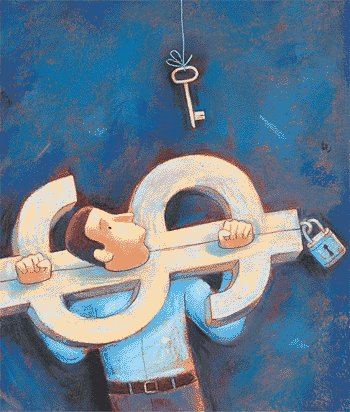
We all want to get out of debt but it can seem like a long and hard road to financial freedom. In reality, it is not difficult as long as you follow a few steps and remain dedicated to the cause. This is a list of ten tips to help you find your financial freedom.
10 Face Facts
Before you go any further, you need to sit down and work out exactly what you owe, to whom you owe it, and what interest rate you are paying. This information will be very helpful with the rest of these tips. It is very easy to think of all of our debts as small payments each pay, but when you add them all up they can amount to a massive debt. This can be a very scary task but unfortunately it must be done. If you need to, get a friend or family member to sit down with you to help you go through old bank statements to make sure you miss nothing out. The good news is that once you have done this, the hard part is over. You have faced the debt and now it is time to kill it.
If you need more help, here’s Finding Your Fortune – bridging the gap between you and your financial freedom at Amazon.com!
9 Stop Spending
Be satisfied with what you have. For the next few months you are not going to be able to spend money on treats. It is very important to be able to resist all of those wonderful things that we all want to have. If you are always wanting to buy new things, you are going to find it very hard to stick to the tips in this list and that can lead to failure and, even worse, more debt, unless you can start being satisfied with what you have. Chances are, shopping is what got you in to this predicament in the first place, so nip it in the bud now. You absolutely must stop acquiring new debt.
8Increase Your Income
While this is not always possible, you should certainly try to increase your income (even if by only a small amount). The more money you have to put on debt, the faster you will eradicate it. You can take a part time job at a supermarket, at a fast food restaurant, or even just offering to do odd jobs around the neighborhood. There are a huge variety of part time jobs available in all manner of areas.

7Pay Yourself
It is very important that you give yourself enough money to spend each pay cycle. If you try to skimp in this area, you will break your budget and undo all of the good work you have achieved. This is not to say that you should not be trying to reduce expenses, which is also very important. When working out your “play” money, be sure to include everything you might normally spend money on. If you leave something off you can put the whole budget out of whack.
6 Stop Saving
Until you are out of debt, stop saving. In fact, if you have savings put aside, you should immediately transfer the full amount on to your debts. Your savings account will be making you far less interest than the money you will save by reducing debt at high interest. Here is a very basic example:
Savings @ 5% : $10,000 (Total interest earned in one year: $500)
Credit Card @ 21% : $10,000 (total cost of debt for one year: $2,100)
By putting your $10,000 on to your debt, you are saving $2,100 in interest charges at the expense of $500. It would be utterly foolish to leave your money in the savings account.
Everyone needs a Victor 15706 Heavy-Duty Printing Calculator at Amazon.com!
5Consolidation Loans
Unless you have managed to get so deeply into debt that you can’t make minimum payments on all of your loans and cards, you should definitely not get a consolidation loan. If you are in such a bad state that you simply can’t afford your debts, a consolidation loan may be the only choice you have short of bankruptcy. Make sure you shop around and get the lowest rate possible. You should also try to keep the term down as it will become a part of your debt budget (item 1) and you want to clear your debts as soon as possible.
4Reduce Expenses
Frugal living can be very rewarding. Not only do you save money, but you learn a lot about survival and taking care of yourself. There are some very simple ways you can reduce expenses. For example, perhaps you go out on the town twice a week – reduce it to one night and have the other night in – you can still enjoy yourself but you won’t be paying bar prices for liquor. If you always buy brand goods at the market, start buying generic – you can save a lot of money doing this. You should also consider buying in bulk as bulk buying is almost always cheaper. Keep your eyes out for good deals and coupons. While this may seem like a difficult step, you will eventually find that you prefer to live like this because of the many rewards that come from exercising your brain in seeking out ways to reduce spending. A very beneficial side-effect to this (which I have personally experienced) is that you can dramatically reduce the amount of trash you produce by buying only what you need and buying in bulk. This can be looked at like a game. When I was following this plan, I found myself trying every week to reduce the amount of money I was spending. The less I spent, the better I lived (as a result of home cooking and pride in my efforts). Do not buy pre-packaged or prepared meals – you are paying a lot of money for nothing. You should also be aware that certain meats, like chicken, can go up in price dramatically when you buy skinned and boneless. It does not take much time to do this yourself.

3 Credit Cards
Credit cards can be as good a tool to get out of debt as they were to get you into debt in the first place. If you have a credit card with a low interest rate that is not maxed out, consider moving a higher interest debt (or as much of it as you can) to the card. The interest savings may seem low, but every penny counts.
If you have maxed your cards out, the first thing you need to do is cut them up. You will not be using credit cards on this plan (and if you absolutely need one for important internet purchases, get a pre-paid credit card).
2 Budget
First of all, this budget will include all of your income and all of your expenses, but, it will not include any of your debts – they will go on your special debt budget (see item 1). In this budget you should list your total income, your total outgoings, and your total surplus. As a part of this budget you should also include your required spending money (item 7). It is imperative that you stick to this budget – it is your lifeline. If you are not honest when creating it, you will find the whole thing collapses within one or two pay cycles. Include every expense.
1 Make a Debt Budget
This is different from your regular budget. Your regular budget will tell you how much money you have left after all other expenses have been paid, the debt budget will tell you what you owe and how much to pay on each debt.
Transfer the total surplus from your budget to the debt budget. This is the most important money you have – it is the money that will give you financial freedom.
Next you need to itemize all of your debts in order of highest interest paid to lowest interest paid. Pay the minimum amount required on all but the highest interest debt – this is the only time you should be paying minimum payments. Keep doing this until you remove the high interest debt entirely. Once this is done, put 100% of the money you were spending on that debt to the debt with the next highest interest; keep doing this until you have paid all of your debts off. This creates a snowball effect and you will be amazed at how quickly your debt is reduced. It is one of the best motivators for people working on debt reduction. You should remember to do this in conjunction with item 3 (transfer highest interest debts to lowest interest debts where possible).
Once you have paid all of your debts off, start putting the full amount of your debt payment money into savings and investments. You were already living without the money – why not keep doing so and save it for something special.
More Great Lists
 10 Times Social Media Shut Down Freedom Of Speech
 Top 10 Tips For Perfect Happiness
 Top 10 Tips For The Perfect Diet
 Top 10 Tips From History On How You Can Survive A Depression
 10 Sex Tips From History's Greatest Thinkers
 Top 10 Top-Level Domains That Caused Controversies
 Top 10 Best Movies From The Top Genres
 Top 10 Worst Movies From The Top Genres
 Top 10 Ridiculously Over The Top Horror Movie Deaths
fact checked by
Alex Hanton
More Great Lists