
 Mysteries
Mysteries
Mysteries  Our World
 10 Countries Where Water Scarcity Gets Seriously Weird
 Weird Stuff
 10 of the Most Bizarre Buildings Around the World
 Creepy
 10 American Urban Legends Far Stranger Than Bigfoot
 Movies and TV
 10 Radical Reimaginings of Frankenstein
 Facts
Facts 10 Explosive Facts You Probably Don’t Know About Volcanoes
 Pop Culture
 0 Things That Became Massive Hits the Second Time Around
 Humans
 History’s 10 Little-Remembered Acts of Charity
 The Arts
 10 Iconic Masterpieces Attacked by Pure Pettiness
 History
 History’s Ten Most Lopsided Battles Ever
Mysteries 10 People Who Infamously Appeared out of Nowhere
Our World 10 Countries Where Water Scarcity Gets Seriously Weird
Weird Stuff 10 of the Most Bizarre Buildings Around the World
Who's Behind Listverse?

Jamie Frater
Head Editor
Jamie founded Listverse due to an insatiable desire to share fascinating, obscure, and bizarre facts. He has been a guest speaker on numerous national radio and television stations and is a five time published author.
More About Us
Creepy 10 American Urban Legends Far Stranger Than Bigfoot
Movies and TV 10 Radical Reimaginings of Frankenstein
Facts 10 Explosive Facts You Probably Don’t Know About Volcanoes
Pop Culture 0 Things That Became Massive Hits the Second Time Around
Humans History’s 10 Little-Remembered Acts of Charity
The Arts 10 Iconic Masterpieces Attacked by Pure Pettiness
History History’s Ten Most Lopsided Battles Ever
10 New Shark Secrets That Recently Dropped
Sharks have a lot of curious eyes upon them. Scientists love to follow and film these animals wherever they go, making fascinating discoveries more frequent than ever before. New behaviors are not the only bombshells to rise to the surface. Researchers are spotting sharks they’ve never seen before (and no, not new species!), witnessing bizarre autopsies, and even shattering the belief that sharks are silent creatures. So, put on your snorkel and explore these facts and more in today’s list!
Related: 10 Incredibly Unsettling Things We Still Don’t Know about the Ocean
10 Blue Sharks Can Change Color
Is This The Most Efficient Shark EVER?

A shark is covered in tooth-like scales, or dermal denticles. Each “tooth” contains guanine crystals that reflect certain wavelengths of light while absorbing others, affecting how we perceive the animal’s color. In blue sharks, the denticles reflect bluish light and absorb the rest, giving the species its namesake hue.
But blue sharks appear to have a unique ability, one that suggests their appearance might not be as fixed as it seems. Between their guanine crystals are adjustable spaces. When these spaces tighten, the crystals are forced into compact layers, and the sharks appear darker and more intensely blue. When the spaces widen, the crystals may reflect yellow and green wavelengths instead. Interestingly, this mechanism is similar in principle to how chameleons shift color.
While nobody has seen blue sharks suddenly turn green or yellow, their shifting crystals may function as camouflage. When a shark dives deeper, increased water pressure could compress the crystals and darken the skin, helping the predator blend into dimmer depths. As the shark rises closer to the surface, the spaces relax, subtly lightening its coloration once again.[1]
9 Sharks Rub Against Manta Rays
Never-Before-Seen Shark Behavior Catches Them Using Manta Rays As Scratching Posts

Sharks are not immune to parasites. While they have little defense against internal pests, some sharks appear to have developed an inventive way to rid themselves of skin parasites—by rubbing them off on other animals. In late 2024 and early 2025, divers captured this previously undocumented behavior on film, and what they observed was as surprising as it was amusing.
The footage was recorded off the coast of the Revillagigedo Archipelago. Divers filmed three separate occasions in which itchy Galápagos sharks followed massive manta rays. Instead of attacking them, the sharks used the mantas as mobile cleaning stations.
Remarkably, the rays remained calm while juvenile sharks slid across their bellies and even near their mouths. However, this tolerance did not extend to adult sharks. When a larger shark attempted the same maneuver, one manta quickly ducked away, rolling and changing direction to evade it. The persistent shark tried repeatedly but failed each time.
The manta’s reaction likely reflects the increased threat posed by larger sharks, which are known to prey on manta juveniles and occasionally attack adults. The footage suggests a surprising level of risk assessment and selective tolerance in manta ray behavior.[2]
8 South African Sharks Eat… Other Sharks
Shark Eat Shark | Cannibal Jaws 2 | National Geographic WILD

In South Africa, the waters off Mossel Bay are a known great white shark hotbed. For years, researchers believed that the sharks were drawn to the area primarily because of Seal Island. Located about 2,000 feet (610 m) from the coast, the island hosts roughly 4,000 seals—a tempting food source.
But in 2023, researchers noticed that the numbers didn’t add up. At any given time, an estimated 40 to 60 great whites patrol Mossel Bay. For all of them to feed primarily on seals, they would need to consume around 1,500 seals per hunting season. In reality, only about 150 seals were killed. This raised a critical question: If seals weren’t the sharks’ main prey, what were they eating?
Scientists began observing great whites congregating near river mouths, where smaller shark species were abundant. Suspecting shark-on-shark predation, researchers tagged 20 smooth-hound sharks with devices that emitted signals when the animal was consumed. After roughly 70% of the tagged sharks were eaten, tissue samples were collected from great whites. Fatty acid analysis revealed that a significant portion of their diet came from other sharks. While great whites eating sharks is not unheard of, the study suggests this behavior occurs far more frequently than previously believed.[3]
7 A Super-Healing Shark
Gravitas: ‘Super healing shark’ regrows dorsal fin year after injury | U.S. Scientists shocked

Somewhere out in the open ocean is a silky shark that likely should not have survived a severe injury in 2022. That year, scientists attached a satellite tag to its dorsal fin to track its migration. Weeks later, diver John Moore encountered the same shark near Jupiter, Florida—and was shocked by what he saw.
The shark’s dorsal fin was badly damaged, with a large portion missing. Moore sent photos to the University of Miami and the research team that had tagged the animal. The wound showed straight-edged cuts, and the tracking device was gone, strongly suggesting that the shark had been captured and the tag forcibly removed. With nearly 21% of its dorsal fin missing, researchers expected the shark to die, either from impaired swimming or infection.
A year later, the same shark returned to Jupiter. Moore photographed it again, revealing that the dorsal fin had regenerated to approximately 87% of its original size. While slightly stunted, the fin appeared functional and healthy. This event is exceptionally rare and represents the first documented case of dorsal fin regeneration in a silky shark, and one of only a few documented cases in sharks overall.[4]
6 Even Their Eyeballs Have Teeth
World’s Largest Shark Found to Have Teeth on Its Eyeballs

Sharks are famous for their teeth—but teeth on their eyeballs sounds like an urban legend. Surprisingly, it’s true. One shark species really does have eyes covered in tiny teeth. Thankfully, this isn’t some eldritch sea monster with weaponized blinking. It’s the gentle whale shark.
Known for their massive size, docile nature, and plankton-based diet, whale sharks revealed this bizarre trait only recently. In 2020, researchers studying the species discovered that their eyes are covered in dermal denticles—the same tiny, tooth-like structures that armor a shark’s skin.
Each eye can host as many as 3,000 denticles, many of them concentrated around the iris. The likely reason is protection. Whale sharks lack eyelids, leaving their eyes constantly exposed. The denticles may act as a protective shield, reducing damage from debris, parasites, or accidental contact while the shark feeds or swims through dense plankton clouds.[5]
5 A Bright Orange Albino
Jaws-dropping: One-of-a-kind orange shark discovered off Costa Rica

In 2024, Juan Pablo was fishing off the coast of Costa Rica when he caught a shark at a depth of 121 feet (37 m). To his surprise, the nurse shark was bright orange with completely white eyes. It looked more like a massive koi fish than a predator. Pablo snapped a few photos and measured the carrot-colored carnivore before releasing it back into the ocean.
Normally, nurse sharks are brown or tan, a shade that allows them to cruise along the sandy seafloor and blend in with their surroundings. So why did this one look like a traffic cone? Marine biologists diagnosed the shark with an extremely rare combination of two conditions. The animal was an albino (lacking dark pigment) and also had xanthism (an excess of yellow pigment). This condition is known as albino-xanthochromism, and Juan Pablo’s catch is the first documented shark to receive this diagnosis.
The real mystery was the shark’s apparent success. At roughly 6.6 feet (200 cm) long, the animal was estimated to be at least ten years old and fully grown. Despite its highly visible coloration, the shark had survived into adulthood, challenging the assumption that animals with abnormal pigmentation rarely thrive in the wild.[6]
4 A Unique Shark Autopsy
Greenland Shark: The Shark That’s Twice As Old As America
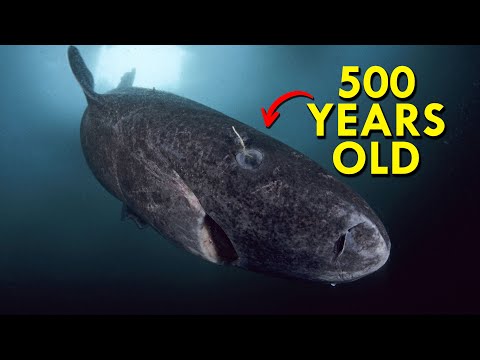
In 2022, a senior research fellow walking along a beach in Cornwall came across a dead shark. Based on its distinctive features, the scientist identified it as a Greenland shark—an exceptionally rare find.
The discovery was remarkable. Greenland sharks are known for having the longest lifespans of any vertebrate, with estimates suggesting they can live between 250 and 400 years. Their elusive nature and deep-water habitat, reaching depths of around 8,530 feet (2,600 m), make it extraordinarily difficult for scientists to study them.
After briefly leaving to gather help, the researcher returned to find that the tide had carried the shark away. Fortunately, the body was recovered days later and taken to the Cornwall Marine Pathology Team for a necropsy. The shark was female and classified as a juvenile, despite being approximately 100 years old—meaning she was born just after World War I.
The autopsy revealed something never before documented in the species: meningitis. Pathologist James Barnett observed discoloration of the brain and cloudy fluid surrounding it, both strong indicators of infection. Tests confirmed the presence of bacteria consistent with meningitis, which may also explain why the shark was found far outside its usual habitat before death.[7]
3 The Great White Shark Hybrid
Shark Scientist EXPLAINS Bermuda White Shark Hybrid.

In 2024, the story of the great white shark took an unexpected turn. Scientists collected genetic samples from 89 great whites around the world and sequenced their genomes. While the sharks appeared identical, their DNA separated them into three distinct populations that diverged from one another between 100,000 and 200,000 years ago.
Each group occupies its own region: one in the North Atlantic and Mediterranean, and two others in the North Pacific and Indo-Pacific. The separation may have occurred during an Ice Age, when lower sea levels isolated populations long enough for them to become genetically distinct.
Because great white sharks are threatened, this discovery raised concern. The three populations show little evidence of interbreeding, meaning that if one group disappears, the others cannot easily repopulate that region. The study identified a single first-generation hybrid near the Bermuda Triangle, originating from two different lineages.
While the hybrid’s existence suggests limited compatibility, genetic analysis indicates that gene flow between populations does not persist beyond the first generation. Either hybrids are sterile, or their offspring do not survive, reinforcing the genetic isolation of the three groups.[8]
2 The First Great White Pup
Has a Great White shark newborn been filmed for the first time? | BBC News

In shark lore, there is a creature so rare it borders on myth: a newborn great white shark. No one has ever directly observed a great white giving birth or definitively documented a pup in the wild.
That may have changed in 2023. Biology student Carlos Gauna launched a drone off the coast of Santa Barbara to monitor a group of pregnant great whites. When one female dove beneath the surface and failed to resurface, a small shark soon appeared in her place. The animal was roughly the right size for a great white pup and was strikingly pale.
Skeptics questioned the footage, suggesting the shark might be an albino juvenile due to its lack of the species’ typical gray coloration. They also pointed to a pale film shedding from its body. However, other biologists support Gauna’s interpretation, noting that the pup’s rounded fins and size resemble known near-term embryos. The shedding film may represent the pup emerging from its embryonic layer.
If further evidence confirms this interpretation, Gauna may have captured the first-ever footage of a newborn great white shark in the wild.[9]
1 Some Sharks… Crackle
First shark sound recordings captured by researchers

In 2021, researchers at the University of Auckland noticed something unexpected while handling rig sharks in a laboratory setting. As the sharks were moved between tanks, they produced an audible clicking or crackling sound. This was surprising, as sharks were long believed to be silent.
Several years later, researchers revisited the phenomenon. They recorded rig sharks while briefly holding them during tank transfers. Each shark was held for approximately 20 seconds, during which the clicking sounds were captured. Some of the recorded sounds exceeded 155 decibels, a level comparable in intensity to extremely loud impulsive noises.
While the study confirmed that some sharks can produce sound, the mechanism remains unknown. Rig sharks lack a specialized sound-producing organ, leading scientists to suspect the noise may involve tooth movement. The purpose of the sound is also unclear. Because the clicks fall outside the sharks’ hearing range, they are unlikely to be used for communication. One hypothesis is that the loud crackling may serve as a deterrent against predators such as toothed whales.[10]
More Great Lists
 10 Ancient Places That Dropped Surprising New Finds
 10 Rare Things Lost to History That Were Recently Found
 10 Remarkable Things We've Recently Learned about Animals
 10 Recently-Added Astrological Placements
 10 U.S. Military Plans That Were Top Secret Until Recently
 Ten Formidable Bugs and Insects That Scientists…
 10 Amazing Architecture Secrets from Around the World
 10 Riveting U.S. Classified Secrets Revealed
 10 Surprising Secrets of Ancient Medieval Fortresses
fact checked by
Darci Heikkinen
More Great Lists