
 Mysteries
Mysteries
Mysteries  Our World
 10 Countries Where Water Scarcity Gets Seriously Weird
 Weird Stuff
 10 of the Most Bizarre Buildings Around the World
 Creepy
 10 American Urban Legends Far Stranger Than Bigfoot
 Movies and TV
 10 Radical Reimaginings of Frankenstein
 Facts
Facts 10 Explosive Facts You Probably Don’t Know About Volcanoes
 Pop Culture
 0 Things That Became Massive Hits the Second Time Around
 Humans
 History’s 10 Little-Remembered Acts of Charity
 The Arts
 10 Iconic Masterpieces Attacked by Pure Pettiness
 History
 History’s Ten Most Lopsided Battles Ever
Mysteries 10 People Who Infamously Appeared out of Nowhere
Our World 10 Countries Where Water Scarcity Gets Seriously Weird
Weird Stuff 10 of the Most Bizarre Buildings Around the World
Who's Behind Listverse?

Jamie Frater
Head Editor
Jamie founded Listverse due to an insatiable desire to share fascinating, obscure, and bizarre facts. He has been a guest speaker on numerous national radio and television stations and is a five time published author.
More About Us
Creepy 10 American Urban Legends Far Stranger Than Bigfoot
Movies and TV 10 Radical Reimaginings of Frankenstein
Facts 10 Explosive Facts You Probably Don’t Know About Volcanoes
Pop Culture 0 Things That Became Massive Hits the Second Time Around
Humans History’s 10 Little-Remembered Acts of Charity
The Arts 10 Iconic Masterpieces Attacked by Pure Pettiness
History History’s Ten Most Lopsided Battles Ever
10 Funny Ways That Researchers Overthink Christmas
Scientists leave no stone unturned, not even at the North Pole. While most people munch on mince pies and decorate Christmas trees, researchers—often in good fun—try to find scientific explanations for various aspects of the festive season. From why Santa Claus has an unhealthy job to the neuroscience of Christmas cheer, here are 10 times scientists studied Christmas with fascinating results!
Related: 10 Christmas Towns Whose Name Has Nothing to Do with the Holiday
10 How To Cut Christmas Cakes Correctly
The Scientific Way to Cut a Cake – Numberphile
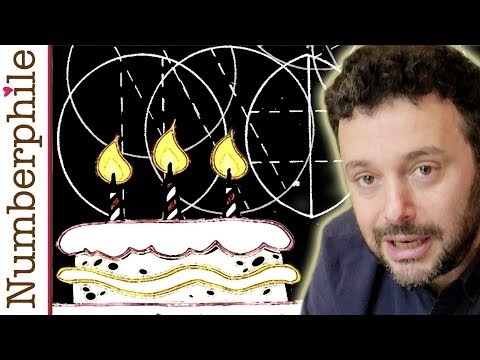
Many families follow a sumptuous festive meal with Christmas cake. Few people consider that they might be slicing the cake incorrectly. But according to a mathematician, Sir Francis Galton, you can dry out the cake with the wrong cut.
In 1906, Galton published an article in a scientific journal titled “Cutting a Round Cake on Scientific Principles.” In it, he suggested the perfect slicing technique to keep a cake moist.
The solution, according to Galton, is to cut the cake across the middle. Once the first serving is removed, two semicircles remain, which can then be held together by an elastic band. This prevents drying air from reaching the exposed interior of the cake.[1]
9 The Gift Wrap Experiments
PART ONE: People Appreciate Poorly Wrapped Gifts

Every year, Americans spend billions of dollars on gift preparation. They buy wrapping paper, bows, ribbons, and other decorations. In 2019, researchers wondered whether a fancy package actually made recipients like a gift more. The surprising answer was no.
They came to this conclusion after running a series of experiments. Volunteers were told they were joining a research study—but that was a lie. Researchers pretended to be so thankful for their participation that, upon arrival, volunteers received a wrapped mug. Half were sloppily wrapped, while the rest looked neat. Those who received the neatly wrapped gifts liked their mugs significantly less.
Further experiments revealed why—a perfectly wrapped present creates higher expectations of a great gift. A sloppy package lowers expectations, which often leads to a pleasant surprise, especially when the gift itself is good.[2]
8 Christmas Moons Are Wrong
What does the waning gibbous moon phase mean?

Many Christmas wrapping papers, cards, and books show the Moon. In 2010, a Dutch astronomer named Peter Barthel noticed that both a UNICEF Christmas card and an Advent e-calendar depicted a waning moon. This moon rose at 3 a.m., and here’s why that’s a problem. The card showed children decorating a Christmas tree, while people were caroling on the calendar—activities unlikely to happen so early in the morning.
Barthel expanded his research to Christmas art from the United States and the Netherlands. He found bloopers in 40% of Dutch Christmas book illustrations. Gift wrap samples fared worse: 65% showed the wrong moon. In an older Dutch paper collection, six out of nine samples failed as well.
American Christmas art wasn’t perfect either, but artists were more likely to choose a full moon, which is more plausible since it rises in the early evening.[3]
7 Is Jupiter The Christmas Star?
Christmas Star 2020: Jupiter, Saturn to meet in rare “great conjunction”

The Star of Bethlehem is one of the most enduring symbols of Christmas. When astronomers tried to identify the real celestial object, they didn’t focus on the December sky as it appeared over 2,000 years ago. Most scholars now believe Jesus was likely born in the spring, when shepherds would have been tending their sheep. Christmas was later fixed on December 25 through theological tradition and alignment with existing Roman festivals, not by a single decree from Emperor Constantine.
The Bible describes the Magi following a star that appeared “in the east.” Since they traveled from Persia, scholars debate whether this phrase refers to direction or to astronomical rising. Shooting stars are unlikely candidates, as they wouldn’t last long enough to guide a journey. Halley’s Comet passed Earth in 11 BC, but comets were considered bad omens at the time.
Jupiter is considered a stronger possibility. Known as the “king planet,” it appeared in the constellation Leo, a symbol of kingship. During the period in question, Jupiter also underwent retrograde motion, making it appear to reverse direction in the sky—an event that would have fascinated ancient astronomers.[4]
6 The Neuroscience of Christmas Cheer
Christmas Brain: The Science Behind Christmas Cheer

In December, people who look forward to the festive season experience a mix of expectation, joy, and nostalgia—often called “Christmas cheer.” But what does this feeling look like inside the brain?
In 2015, Danish scientists scanned volunteers’ brains while showing them various images, some with Christmas themes. When participants saw mince pies and other seasonal icons, certain brain areas became more active. However, no single “Christmas cheer center” lit up. Instead, researchers observed a broad network of activity.
This may be because Christmas cheer functions like an emotional category rather than a single emotion. People associate the holiday with their own memories, foods, family traditions, and music, making Christmas cheer deeply personal and neurologically diverse.[5]
5 All The Reindeer Are Female
Why Rudolf the Reindeer is actually female, according to science | BBC Global

Santa’s reindeer are traditionally assumed to be male, but biologists suggest otherwise. Three biological clues point toward an all-female team.
The biggest giveaway is antlers. Both male and female reindeer grow them, but males typically shed their antlers in late fall—often before December. Females, on the other hand, keep their antlers throughout winter, meaning Rudolph would still be sporting hers on Christmas Eve.
Male reindeer also expend most of their energy during the autumn mating season, while females build fat reserves that can increase body mass by up to 50%. This extra fat improves endurance and cold resistance. Finally, reindeer herds often follow experienced females during long migrations, making them ideal leaders for a demanding Christmas Eve journey.[6]
4 Santa’s Job Is Unhealthy
What If Santa Really Delivered Presents In One Night?

In 2024, experts gave Santa Claus a hypothetical medical check-up—and the results were alarming. He appears overweight or obese, placing him at risk for type 2 diabetes, heart disease, stroke, and osteoarthritis. His rosy cheeks could indicate rosacea, or perhaps the effects of consuming all the alcohol left out for him, which could lead to liver damage.
Flying a sleigh at extreme altitude presents additional dangers. Santa would face intense UV radiation, freezing temperatures capable of causing frostbite, and oxygen levels reduced to about 30% of normal. Hypoxia could trigger confusion, increased heart rate, and high blood pressure.
Chimney work isn’t any safer. Prolonged exposure to soot and particulate matter increases the risk of lung disease, cancer, dementia, and Alzheimer’s disease. Santa may spread cheer—but at great personal cost.[7]
3 The Santa Shaman Theory
Santa Is a Psychedelic Mushroom

A popular theory claims that Sámi shamans from northern Scandinavia inspired Santa Claus. According to the story, shamans dried psychedelic mushrooms, entered homes through roof openings, hallucinated flight, and wore red clothing while herding reindeer.
The idea spread widely and was covered by major outlets. But in 2023, National Geographic spoke to Tim Frandy, a Sámi descendant and professor of Nordic Studies, who said the theory badly misrepresents Sámi culture.
Historically, Sámi midwinter traditions focused on silence and safety rituals meant to ward off a feared creature called the stállu. Families did not consume mushrooms, and evidence that shamans used them is scant. Frandy also noted that traditional Sámi shaman clothing is poorly documented, making the red-costume claim unfounded. In short, the theory says far more about modern mythmaking than Sámi history.[8]
2 Rudolph’s Nose Changes Color
Why Does Rudolph Have A Red Nose?

Santa’s lead reindeer famously has a red nose—but astronomers found that its color depends on motion. In 2024, researchers calculated how Rudolph’s nose would appear under extreme Christmas Eve conditions.
This is due to the Doppler effect, where motion alters how light is perceived. Similar to how a car horn’s pitch changes as it passes, high-speed travel can shift color.
To deliver gifts to roughly 300 million households, Santa would have about 0.2 milliseconds per stop. At around 10% of the speed of light, Rudolph’s nose would appear bright orange while approaching and dark red to black while flying away. It’s only red when standing still.[9]
1 Why Nobody Can See Santa Claus
The Christmas Chronicles When Santa Has 9 Seconds To Deliver A Present

In 2016, physicist Katy Sheen of the University of Exeter tackled a childhood mystery: why nobody ever sees Santa Claus, despite his noisy, chimney-based deliveries.
Sheen explained the phenomenon using Einstein’s special relativity. At extraordinary speeds, Santa would experience length contraction, becoming thinner in the direction of travel—allowing him to slip down chimneys with ease.
At the same time, his speed would turn him into a rainbow-colored blur. Sounds like sleigh bells and laughter would shift beyond the range of human hearing due to the Doppler effect. Santa might even produce a sonic boom. Between physics and perception, it turns out Santa’s invisibility may be scientifically inevitable.[10]
More Great Lists
 10 Ways Your Christmas Tree Is More Lit Than You Think
 10 Funny Tutorials in Games
 Laughable Leaders: 10 Funny Presidential Moments
 10 Funny Cases of Nominative Determinism
 10 Unexpectedly Funny Slang Terms from the Roaring Twenties
 10 Unusual and Funny Constitutional Provisions You…
 Top 10 Christmas Movie Moments
 Ten Festive Facts You Never Knew about Christmas
 10 Festive Facts about 'A Christmas Carol' and Its…
fact checked by
Darci Heikkinen
More Great Lists