
 Weird Stuff
Weird Stuff
Weird Stuff  Technology
 10 Bizarre Places Electricity Is Hiding in Plain Sight
 History
 10 Nail-Biting Espionage Operations of the Cold War
 History
 10 Groundbreaking Innovations That Prove the “Dark Ages” Weren’t Dark
 Weird Stuff
 10 Bizarre Queen Ant Dramas That Belong in a Soap Opera
 Food
Food 10 Caribbean Foods with Dark and Unexpected Histories
 Movies and TV
 10 Controversial Documentaries That Shaped Public Perception
 Miscellaneous
 10 Times Big Business Turned People into Test Subjects
 Animals
 10 Ancient Legends About Odd Animals
 Weird Stuff
 10 Bizarre Times the Law Redefined Ordinary Things
Weird Stuff 10 Ridiculous Flat-Earth Arguments That Fail Simple Tests
Technology 10 Bizarre Places Electricity Is Hiding in Plain Sight
History 10 Nail-Biting Espionage Operations of the Cold War
Who's Behind Listverse?

Jamie Frater
Head Editor
Jamie founded Listverse due to an insatiable desire to share fascinating, obscure, and bizarre facts. He has been a guest speaker on numerous national radio and television stations and is a five time published author.
More About Us
History 10 Groundbreaking Innovations That Prove the “Dark Ages” Weren’t Dark
Weird Stuff 10 Bizarre Queen Ant Dramas That Belong in a Soap Opera
Food 10 Caribbean Foods with Dark and Unexpected Histories
Movies and TV 10 Controversial Documentaries That Shaped Public Perception
Miscellaneous 10 Times Big Business Turned People into Test Subjects
Animals 10 Ancient Legends About Odd Animals
Weird Stuff 10 Bizarre Times the Law Redefined Ordinary Things
10 Ridiculous Flat-Earth Arguments That Fail Simple Tests
More than two millennia ago, observers had already gathered evidence that Earth was round. Today, astronomy, physics, navigation, geodetic surveying, and satellite technology have established that it is an approximately spherical planet—more precisely, one that bulges slightly around the equator.
Yet flat-Earth theories continue to attract attention online. Their arguments often begin with something that seems intuitive: the ground looks flat, water looks level, and nobody feels the planet moving. But intuition developed over ordinary human distances isn’t always reliable on a planetary scale. Better yet, you can test many of these claims without boarding a spacecraft or taking NASA’s word for it.
Related: 10 Conspiracy Theories That Try to Rewrite History
10 If Earth Were Spinning, We Would Feel It
Why don’t we feel the Earth spinning?

At the equator, Earth’s surface moves at approximately 1,037 miles per hour (1,670 kilometers per hour). Flat-earthers argue that motion this fast should produce a powerful sensation, constant wind, or people being flung from the surface.
The claim confuses speed with changes in motion. A passenger aboard a smoothly moving airplane does not feel its cruising speed because the passenger, aircraft, and cabin air move together. People, buildings, oceans, and most of the atmosphere likewise share Earth’s steady rotation. Rotation does create acceleration, but its effect is small compared with the gravity holding everything to the planet.
We can still measure Earth’s movement. In a Foucault pendulum, a heavy weight swings back and forth in a nearly fixed plane while Earth rotates underneath it. To an observer standing on the rotating floor, the direction of the pendulum’s swing appears to shift over time. The experiment provides visible evidence of Earth’s rotation without requiring photographs from space.[1]
9 Water Always Finds Its Level, So Oceans Cannot Curve
Globe water level explained… for Flat Earthers!!!

Water poured into a glass settles into what appears to be a flat surface. Flat-earthers extend that everyday observation to the oceans, arguing that water cannot remain attached to a curved planet without flowing away or somehow bending.
However, “level” does not mean forming one endless geometric plane. Gravity pulls matter toward Earth’s center, so the direction called “down” changes gradually from one location to another. A calm ocean surface settles perpendicular to the local direction of gravity. Over short distances, that surface appears flat. Across an entire planet, it follows Earth’s overall shape.
Geodesists use the term “geoid” for a model of the irregular surface that global mean sea level would follow under the influence of Earth’s gravity. Mountains, trenches, variations in density, and Earth’s rotation prevent the planet from being a perfect sphere, but none of that produces the limitless flat ocean required by a flat-Earth model. Water finds its level locally while still following a curved global surface.[2]
8 Ships Disappear Because They Sail Too Far Away
Flat Earthers claim objects disappear because of diffraction?

Flat-earthers sometimes argue that ships vanish over the horizon only because they become too small for the unaided eye to see. Distance certainly makes objects appear smaller, but it does not explain the order in which a departing ship disappears.
As a ship sails away, its hull vanishes first. The bridge, smokestacks, and masts remain visible longer because they are higher above the water. A telescope may enlarge the portion still in view, but it will not ordinarily restore a hull already hidden below the geometric horizon. If the observer climbs a hill or tower, part of the ship may become visible again because the higher position extends the observer’s line of sight.
Atmospheric refraction can complicate individual observations by bending light and making distant objects appear raised, lowered, stretched, or distorted. Even with that qualification, the repeated bottom-first disappearance of ships matches what observers should see when objects travel away across a curved surface. If distance alone were responsible, the entire ship would simply shrink uniformly until it became too small to distinguish.[3]
7 Antarctica Is an Ice Wall around the World
The Ice Wall at the End of the World | Antarctica Explained

One of the most elaborate flat-Earth claims holds that Antarctica is not a continent surrounding the South Pole. Instead, it is supposedly a gigantic wall of ice encircling the world’s oceans and preventing them from flowing over the edge.
In reality, Antarctica is an irregularly shaped continent covering approximately 5.4 million square miles (14 million square kilometers). It contains mountain ranges, glaciers, ice shelves, valleys, volcanoes, and a vast interior. Ships have traveled along its coasts, aircraft have crossed it, and expeditions have moved between coastal areas and the geographic South Pole.
The continent is also not an unexplored region controlled entirely by mysterious guards. The U.S. National Science Foundation operates three year-round Antarctic research stations, including the Amundsen-Scott South Pole Station. Numerous other countries also maintain research programs there. Their scientists study everything from ice cores and wildlife to astronomy and geology. Making the ice-wall claim work would require generations of researchers, pilots, sailors, support crews, mapmakers, and governments to conceal the true geography while somehow conducting real operations across the continent.[4]
6 NASA Created the Globe to Fool Everyone
How Do We Know the Earth Isn’t Flat? We Asked a NASA Expert

A central flat-Earth argument claims that NASA invented the spherical Earth and manufactures photographs to preserve the deception. Supporters often point out that some modern images are composites assembled from multiple photographs or sets of satellite data. They then treat image processing as proof that the planet itself has been fabricated.
One major problem is that people measured Earth long before space agencies existed. More than 2,000 years ago, the Greek scholar Eratosthenes compared the shadows cast at two Egyptian cities. Knowing the distance between them and the difference in the Sun’s angle, he calculated Earth’s circumference with surprising accuracy.
Modern geodesy has refined those measurements using ground surveys, radio telescopes, gravity observations, and satellites. Navigation, weather forecasting, communications, mapping, and global positioning systems all depend upon models that account for Earth’s measured shape and motion. Individual images may be adjusted, colorized, or assembled to display large areas clearly, but those production techniques do not erase centuries of observations or the technologies that use spherical geometry every day.[5]
5 Gravity Is Not Real—Density Makes Things Fall
Gravity and Density | FLERFPRATT 7

A particularly unusual flat-Earth argument claims that gravity does not exist. Instead, objects supposedly fall or rise only because of their density and buoyancy. Rocks move downward because they are denser than air, while balloons rise because they are less dense.
The problem is that density is a property, not a force. It can help determine whether one material will sink or float in another, but it cannot create motion or supply a direction. Without gravity or another form of acceleration, there would be no ordinary “up” or “down” for denser and lighter materials to follow.
Buoyancy also depends upon gravity. Fluid pressure increases with depth because gravity pulls the fluid downward. This pressure difference produces an upward buoyant force on an immersed object. A helium balloon rises because the surrounding air creates a buoyant force greater than the combined weight of the balloon and helium. Density helps determine the result, but gravity provides the conditions that make buoyancy work. Replacing gravity with density is therefore like explaining why a car moves by describing its color.[6]
4 Airline Routes Only Make Sense on a Flat Map
Why Airplanes Fly On A Curved Path

Some flat-earthers claim that airline routes expose problems with the globe. Flights may appear to curve dramatically north or south on a rectangular map, even when a straight line seems shorter. Other arguments focus on routes in the Southern Hemisphere, which can appear strangely long or indirect on certain flat-Earth maps.
The apparent problem comes from forcing a curved surface onto a flat image. Every world map projection distorts some combination of distance, direction, shape, or area. A route that is shortest on a globe may consequently look curved or badly misplaced when transferred to a rectangular map.
On a sphere, the shortest surface route between two locations follows part of a great circle. This is why a flight from New York to Tokyo may curve northward toward Alaska rather than following the line that looks straight on a common wall map. Airlines do not choose routes by drawing lines across one projection; they calculate distances using geographic coordinates, weather, winds, restricted airspace, fuel requirements, and other practical considerations. The routes work because spherical geometry describes the world the aircraft actually fly over.[7]
3 The Stars Simply Circle above a Flat Plane
Destroying Flat Earth Without Using Science – Part 2: The Stars
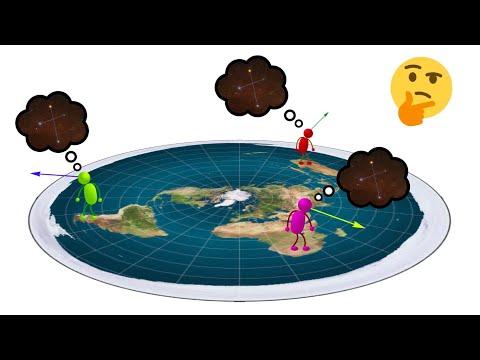
Some flat-Earth models place the stars on a rotating dome above a stationary plane. This can seem to explain why stars cross the sky each night, but it cannot reproduce what observers see from different latitudes and hemispheres.
In the Northern Hemisphere, stars appear to circle the north celestial pole near Polaris. As an observer travels south, Polaris appears progressively lower in the sky. Near the equator, it approaches the northern horizon, and it is no longer visible from locations much farther south. New constellations simultaneously rise into view.
Observers in the Southern Hemisphere see stars circle a different point in the sky. When facing their respective celestial poles, northern and southern observers also record star trails curving in opposite apparent directions. On a spherical, rotating Earth, those patterns follow naturally because people at different latitudes face different portions of space. Polaris’s changing height has even served navigators as an approximate measure of northern latitude. A single dome circling above a flat surface has a much harder time explaining why the sky changes so consistently with an observer’s location.[8]
2 The Sun Is a Small Spotlight above a Flat Earth
The Flat Earth Sun’s Spotlight

One of the stranger flat-Earth models proposes that the Sun is a relatively small, nearby object circling above the world like a spotlight. Day falls beneath the illuminated portion of the plane, while regions outside the beam experience night.
That explanation creates more problems than it solves. If the Sun were close enough to travel in circles above a flat surface, its distance from an observer would change dramatically throughout the day. It should appear much larger when overhead and progressively smaller as it travels away. Instead, careful measurements show that its apparent size remains nearly constant between sunrise and sunset.
A nearby Sun should also seem to recede into the distance rather than pass below a sharply defined horizon. The spotlight model struggles to reproduce the observed boundaries between day and night, the changing length of daylight throughout the year, and periods when the Sun remains above the horizon near one of Earth’s poles.
In the established model, the Sun is approximately 93 million miles (150 million kilometers) from Earth. Earth’s daily rotation produces sunrise and sunset, while its tilted axis and orbit account for seasonal changes in sunlight. One arrangement explains all those observations without requiring the Sun to behave like a roaming celestial flashlight.[9]
1 The Gyroscope’s 15-Degree Drift Was Not Earth’s Rotation
Flat earther accidently proves earth’s rotation with $ 20k gyro. That’s kind of a problem, right?

The most damaging evidence against a claim sometimes comes from the people attempting to prove it. In the 2018 documentary Behind the Curve, flat-Earth experimenter Bob Knodel discussed using an expensive ring-laser gyroscope to test whether Earth actually rotated.
The expected result was straightforward. A stationary Earth should produce no steady rotational drift. If Earth completed one 360-degree rotation every 24 hours, however, the instrument should detect approximately 15 degrees of rotation per hour.
The gyroscope recorded a 15-degree-per-hour drift.
Rather than accept that the device had measured the predicted rotation, the experimenters looked for ways to isolate it from an unknown external influence. But changing the proposed cause did not erase the measurement. The instrument had produced precisely the result expected on a rotating Earth.
A gyroscope alone does not establish every detail of Earth’s shape, but this experiment directly contradicted the stationary model it was designed to support. Few arguments collapse more spectacularly than one tested by its own believers with professional equipment—only for that equipment to return the number predicted by conventional science.[10]
More Great Lists
 10 Things Engineered to Fail on Purpose
 10 Times Actors Flat Out Refused to Say Lines in…
 10 Scams So Simple You Won't Believe They Work
 10 Extremely Simple Concepts That Completely Changed…
 10 Hilariously Over-Engineered Solutions to Simple Problems
 10 Ridiculous Ways Works of Art Have Been Ruined
 10 Times Children Were Arrested for Ridiculous Reasons
 10 Ridiculous Times World Records Were Rejected
 10 Ridiculous Myths about Dodgy Stuff in Your Food and Drink
fact checked by Darci Heikkinen
More Great Lists