
 Movies and TV
Movies and TV
Movies and TV  Misconceptions
 10 Dinosaur Myths That Refuse to Go Extinct
 Weird Stuff
 10 Ridiculous Flat-Earth Arguments That Fail Simple Tests
 Technology
 10 Bizarre Places Electricity Is Hiding in Plain Sight
 History
 10 Nail-Biting Espionage Operations of the Cold War
 History
 10 Groundbreaking Innovations That Prove the “Dark Ages” Weren’t Dark
 Weird Stuff
 10 Bizarre Queen Ant Dramas That Belong in a Soap Opera
 Food
Food 10 Caribbean Foods with Dark and Unexpected Histories
 Movies and TV
 10 Controversial Documentaries That Shaped Public Perception
 Miscellaneous
 10 Times Big Business Turned People into Test Subjects
Movies and TV 10 Tough-Guy Actors Who Unexpectedly Broke into Song
Misconceptions 10 Dinosaur Myths That Refuse to Go Extinct
Weird Stuff 10 Ridiculous Flat-Earth Arguments That Fail Simple Tests
Who's Behind Listverse?

Jamie Frater
Head Editor
Jamie founded Listverse due to an insatiable desire to share fascinating, obscure, and bizarre facts. He has been a guest speaker on numerous national radio and television stations and is a five time published author.
More About Us
Technology 10 Bizarre Places Electricity Is Hiding in Plain Sight
History 10 Nail-Biting Espionage Operations of the Cold War
History 10 Groundbreaking Innovations That Prove the “Dark Ages” Weren’t Dark
Weird Stuff 10 Bizarre Queen Ant Dramas That Belong in a Soap Opera
Food 10 Caribbean Foods with Dark and Unexpected Histories
Movies and TV 10 Controversial Documentaries That Shaped Public Perception
Miscellaneous 10 Times Big Business Turned People into Test Subjects
10 of History’s Greatest Pranks & Hoaxes
It’s incredibly difficult to pull off the perfect prank.
It takes days—sometimes even months or years—of preparation and execution to get it right. Many prank attempts fail in the first few stages due to timing, lack of commitment, or simply because the target audience didn’t get the joke.
If done well, however, pranks can fool hundreds, even thousands, of people at the same time.
Related: 10 of the Weirdest Places That Have Been Preserved
10 The Sydney Iceberg
WORLD Greatest April Fools Prank

The “Sydney Iceberg” prank appears on many lists of the greatest pranks of all time, and for good reason. On April 1, 1978, people near Sydney Harbor were fooled by what looked like a giant iceberg, as promised by a local adventurer and millionaire businessman, Dick Smith. He convinced them that he had towed it all the way from Antarctica. According to him, it would be cut into pieces and sold as fresh Antarctic ice for ten cents each.
In reality, the “iceberg” was just a barge covered with plastic sheets, shaving cream, and firefighting foam. To make it more believable, Smith even arranged for hundreds of callers to contact media outlets ahead of time. Unfortunately, he didn’t predict the weather, and the fake iceberg melted and collapsed due to an unexpected spell of rain, revealing the prank before it could be fully unveiled.
Known for similar stunts before, Dick Smith estimated the total cost of the prank at $1,450, which he later said was completely worth it for the attention it generated.[1]
9 The Piltdown Man
40 Year Hoax: The Piltdown Man | Plainly Difficult Short Documentary
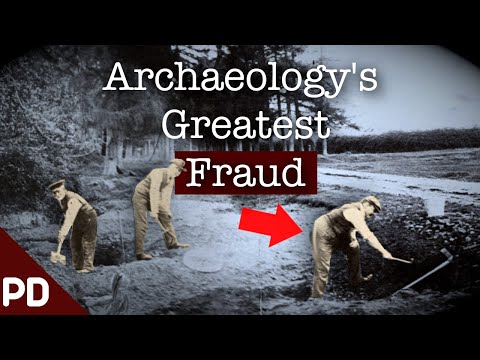
The so-called Piltdown fossils were first discovered between 1911 and 1912. They included what appeared to be a human skull, jawbone, and teeth. Originally dubbed the “Piltdown Man,” the remains were believed to represent the earliest Englishman in history, and many scientists praised the find as the long-sought missing link in British evolution.
In 1953, however, the Natural History Museum in London revealed that the fossils—which had influenced scientific thinking for decades—were actually a hoax.
The jawbone turned out to be from an orangutan, artificially stained with chemicals to appear ancient. Although the skull fragments were human, they were far more recent than originally claimed. The revelation shocked the scientific community, damaged the reputations of respected researchers, and delayed progress in understanding human evolution by diverting attention from genuine discoveries.
In 2016, a detailed study confirmed that the mastermind behind the hoax was Charles Dawson, the original researcher who claimed to have found the fossils.[2]
8 The “Jovian–Plutonian” Gravitational Effect
That Weird Time When People Floated Away Because of Jupiter and Pluto #planet #space #hoax

The “Jovian–Plutonian” gravitational effect refers to a famous April Fools’ Day prank by Patrick Moore, a respected British astronomer, science writer, and television presenter. On April 1, 1976, he announced on BBC Radio 2 that a rare alignment between Jupiter and Pluto was about to occur. According to Moore, this event would briefly reduce Earth’s gravity and allow people to feel weightless if they jumped at the precise moment.
Though entirely false, the prank became legendary after listeners phoned in claiming they experienced a “strange floating sensation” when they tried it. Even decades later, the story continues to circulate online, with some still falling for it. In reality, Jupiter and Pluto are positioned on opposite sides of the sky, making any such alignment—and its supposed gravitational effect—impossible.[3]
7 The Berners Street Hoax
The Prank That Paralysed London | The Berners Street Hoax

Theodore Hook was a dramatist in early-nineteenth-century England known for his elaborate jokes. He is best remembered for the Berners Street Hoax, which took place on November 27, 1809, when he sent roughly 4,000 letters to traders, workers, and professionals across London, all directing them to 54 Berners Street—where, in reality, nothing was happening.
The chaos began at 5 a.m. with chimney sweeps, followed by coal carts, bakers, doctors, undertakers, and even high-ranking visitors like the Duke of Gloucester. Traffic in the area ground to a halt. The unsuspecting resident, Mrs. Tottenham, was overwhelmed by the constant stream of visitors, who arrived bearing everything from wedding cakes to grand pianos. Even the Mayor of London appeared, having received what he believed was a personal letter from her requesting assistance.[4]
6 The Republic of San Serriffe
History’s Greatest Hoax: The Tale of a Faked Empire

According to a story published in The Guardian in 1977, the Republic of San Serriffe was a tiny island nation in the Indian Ocean shaped like a semicolon. As readers eventually discovered, it was an elaborate April Fools’ Day prank presented as a seven-page travel supplement filled with entirely fictional details. Nearly every aspect of the country was based on printing puns, with names like Sans-Serif for the nation itself, Bodoni for the capital, and Flong for its indigenous people. The dictator, General M. J. Pica, was even named after a typographic measurement unit.
The prank proved extraordinarily successful, in part because advertisers joined in on the joke. Kodak reportedly ran a contest for photos of the nonexistent island, while other companies played along to maintain the illusion. San Serriffe became a recurring in-joke at The Guardian, with similar satirical features appearing in later years. Today, the fictional republic even has its own page on Wikitravel, further blurring the line between parody and reality.[5]
5 The Eruption of Mount Edgecumbe
A 1974 “eruption” of Mt. Edgecumbe in Sitka is one of the best April Fool’s day pranks ever

Mount Edgecumbe is a real dormant volcanic mountain located near Sitka, Alaska. On April 1, 1974, residents noticed something alarming: smoke rising from the crater. Fearing the volcano had become active, they alerted authorities, prompting a U.S. Coast Guard helicopter to investigate. As the pilot approached the summit, he discovered a massive pile of burning tires arranged inside the crater to spell out “APRIL FOOL” in 50-foot-high black letters.
The prank was orchestrated by local resident Oliver “Porky” Bickar, who had collected 70 tires over the course of three years. With the help of friends and a helicopter pilot, he placed the tires in the crater and ignited them. The stunt drew international attention after being reported by the Associated Press and has since become one of the most famous April Fools’ Day pranks ever recorded.[6]
4 The Great Moon Hoax
The ‘Great Moon Hoax’ that fooled the world – BBC REEL

On August 25, 1835, the now-defunct New York Sun published an article claiming the discovery of life on the Moon, supposedly based on research from the Edinburgh Journal of Science. The story described fantastical creatures such as unicorn-like animals, two-legged beavers, and winged humanoids resembling bats. It also detailed lunar landscapes filled with towering amethyst crystals and flowing rivers.
The article was the first installment in a six-part series and quickly captured the public’s imagination. Although it was entirely fictional, the hoax—written by reporter Richard Adams Locke—was originally intended as a satire of speculative astronomy. Instead, it became a sensation. The Sun’s circulation soared, and readers from all walks of life accepted the story as fact. The prank was partly inspired by earlier lunar fiction, including work by Edgar Allan Poe, and remains one of the most successful media hoaxes in history.[7]
3 The Washing of the Lions

The “washing of the lions” is often cited as one of the earliest recurring April Fools’ Day pranks. Beginning in 1698, London residents were periodically invited to attend a ceremonial washing of the lions at the Tower of London. Despite the absurdity of the event, many people fell for the invitation time and time again.
The most famous instance occurred in 1856, when invitations were distributed under the name of a supposed “senior warden” called Herbert de Grassen. The letter, sealed with crimson wax, warned attendees not to offer gratuities, lending it an air of official authority. According to contemporary accounts, crowds arrived expecting a grand spectacle, only to leave disappointed when no lions—and no washing—appeared. The prank endured for decades, becoming a curious footnote in London folklore.[8]
2 When Alabama Changed the Value of Pi
How Pi was nearly changed to 3.2 – Numberphile

On April 1, 1998, a story published in the New Mexicans for Science and Reason newsletter claimed that the Alabama state legislature had voted to change the mathematical constant pi from 3.14159 to a more “biblical” value of 3.0. The story spread rapidly across the internet and was picked up by media outlets around the world, prompting widespread disbelief and outrage.
The article was actually a parody written by physicist Mark Boslough of Los Alamos National Laboratory. It was intended to satirize political interference in science education. The fictional bill was attributed to a legislator named Leonard Lee Lawson and supported by a supposed religious group called the Solomon Society. Despite attempts to clarify the joke, Alabama lawmakers reportedly received calls from concerned citizens demanding that the decision be reversed.
Part of the reason the hoax felt plausible was that something similar had almost happened before. In 1897, the Indiana legislature seriously considered House Bill No. 246, which would have effectively redefined pi as 3.2. The bill passed the Indiana House unanimously before being stopped in the Senate by a mathematics professor who happened to be present and pointed out its absurdity. That real historical episode helped lend credibility to the Alabama prank more than a century later.[9]
1 The Spaghetti Harvest
1957: The SPAGHETTI HARVEST | Panorama | Classic BBC clips | BBC Archive

The “Spaghetti Harvest” remains one of the BBC’s most famous April Fools’ Day pranks. It aired on Panorama, the long-running investigative news program, on April 1, 1957. The segment showed Swiss farmers harvesting strands of spaghetti from trees, presenting the process with complete seriousness. The idea originated with cameraman Charles de Jaeger, who wanted to test just how much viewers trusted television.
Despite obvious clues that the segment was a joke, many viewers took it at face value. Some contacted the BBC to ask whether spaghetti really grew on trees, while others wanted advice on cultivating their own spaghetti plants. Not everyone appreciated the humor, however, and a number of viewers complained that the program had gone too far. In a later interview, producer David Wheeler said he had “no regrets about it at all,” cementing the prank’s legacy as a classic piece of broadcast mischief.[10]
More Great Lists
 10 Most Elaborate Pranks of the 1900s
 The Ten Greatest Engineers in Science Fiction History
 10 Animals That Turned Out to Be Hoaxes or Spoofs
 10 Hoaxes That Purported to Prove the Bible
 The 10 Biggest Celebrity Death Hoaxes Ever
 Top 10 Greatest Movie Soundtracks of All Time
 The Ten Greatest Television Romances of all Time
 Top 10 Greatest Things Terrible People Did
 10 Greatest Corporate Faceplants of All Time
fact checked by Darci Heikkinen
More Great Lists