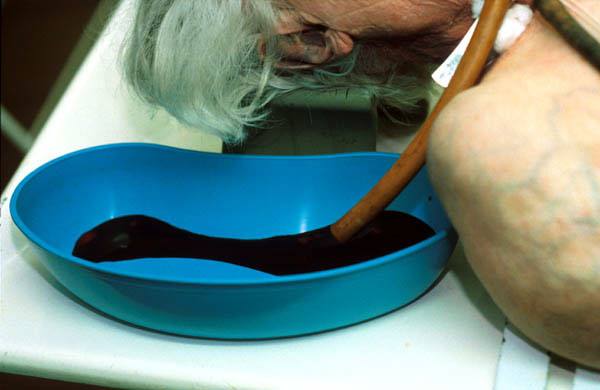
[WARNING: Contains disturbing images] Okay – this is a fairly morbid topic but a very interesting one. Embalming is not required by law in many countries, but it is often performed for the benefit of loved ones. An embalmer has the very responsible task of ensuring that family members are not left with an undesirable last memory of their loved one. These are the five steps involved in the embalming process.
1. Pre-Embalming
At anytime, day or night, the funeral professional may be called upon to do his or her job. People have a tendency to die at the most inconvenient times, and a mortician cannot wait until later to retrieve a body. This means lots of getting up at 1 AM and having to work on holidays.
When someone dies and once authorization has been granted by the family, doctor, and/or by the medical examiner, the embalmer is called to make the “removal” of the body. After filling out the appropriate paperwork the embalmer takes the body to the funeral home, and if embalming is requested or required, begins the process.
An embalming report is filled out that logs all jewelry and personal items on the body; details any discolorations, cuts, bruises, etc. on the body; and documents the procedures and chemicals used during embalming. This report can become very valuable if a deceased’s family bring a lawsuit against the funeral home.
All clothing, bandages, IV needles, catheters and such are removed. A strong disinfectant spray is used to clean the skin, eyes, mouth, and other orifices. If rigor mortis (the stiffening of muscles after death) has set in, it is relieved by moving the limbs and head about and massaging the muscles. If the decedent is a man, he is normally shaved at this point. Razor burn (yes, not even death can save you from this) is less likely before the arterial chemical firms the skin of the face. Even women and children are shaved to remove the fine “peach fuzz” we all have on our faces. This is done to avoid the makeup from collecting on the hair and making the makeup more noticeable.
2. Feature Setting
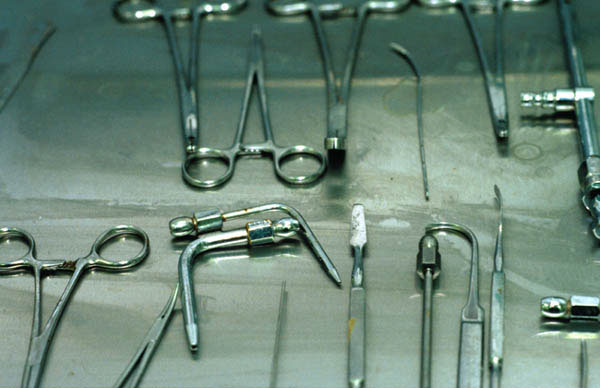
Next begins the process of placing the facial features and the body itself in the position it will remain in the casket for viewing. This is done before arterial embalming, because the body will be truly “set” – firmed in position once formaldehyde reaches the tissues.
Great care is taken to close the eyes. The traditional method for doing this involves placing a bit of cotton between the eye and eyelid. Many times after death the eyes sink back into their sockets, so small plastic “eye caps” are placed on each eye ball. A small amount of stay creme is placed on the eyecap to avoid dehydration of the eyelids. Contrary to popular myth, the eyelids are never sewn shut, but in some cases that may be glued together to prevent separation.
The mouth is closed either by tying the jaw together with a piece of suture string or by a special injector gun. With the suture method, a curved needle with a piece of suture string is threaded through the jaw below the gums, stuck through upper jaw into to the right nostril, threaded through the septum of the nose into the left nostril, and then passed back down into the mouth. The two ends of suture are tied, careful not too tightly, so that a natural appearance of the mouth is created.
To finish closing the mouth, many times a mouth former is used. A mouth former is similar to an eyecap as it has a textured side that grips the lips, but it is shaped like the mouth. A small amount of stay creme is also used on the mouth to avoid dehydration and help hold the lips in place. The mortician may also squeeze inside the mouth a little mastic compound, a paste kind of like caulk to give the mouth a better and more pleasing shape.
3. Arterial Embalming
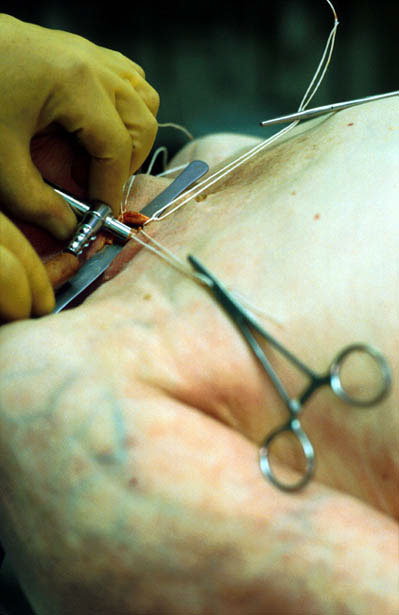
Arterial embalming is begun by injecting embalming fluid into an artery while the blood is drained from a nearby vein or from the heart. The two gallons or so needed is usually a mixture of formaldehyde or other chemical and water. In the case of certain cancers, some diabetic conditions, or because of the drugs used prior to death (where body deterioration has already begun), a stronger or “waterless” solution is likely to be used for better body preservation. Chemicals are also injected by syringe into other areas of the body.
Once the embalming fluid begins to flow into the arterial system, pressure begins to build up in the entire vascular system. This helps the fluid reach all parts of the body and penetrate into the tissues. Evidence of this can be seen in bulging veins throughout the body. The jugular drain tube is opened periodically (it is normally closed) to allow blood to escape and prevent too much pressure in the vascular system which could cause swelling. The blood drains directly into the sewer system, which sounds gross, but in reality much worse things go into our sewers.
Once arterial injection has been completed, the arterial and jugular tubes are removed, the vessels are tied closed, and the incision used to access the vessels is sutured closed and sealed with a special chemical.
4. Cavity Embalming
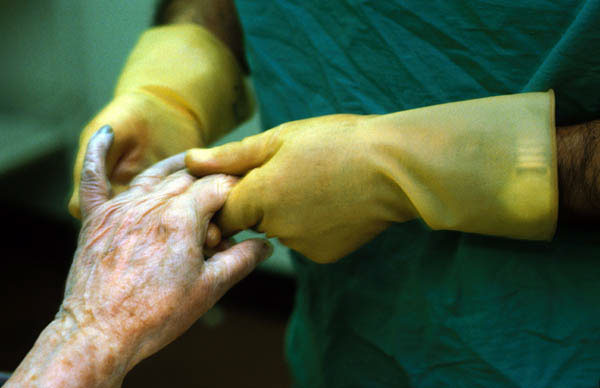
Arterial fluids mainly treat the skin, muscles, and organs themselves. What’s inside the organs (such as urine, bile, etc.) begins to decompose. Gases and bacteria can build up and cause distention, odor, and purge (such as brown fluids coming out of the mouth – not exactly the way you want to remember grandma). These bacteria can sometimes spread to other parts of the body, even after arterial embalming, causing decomposition problems (and then sometimes legal problems for the funeral home).
Cavity treatment starts with aspirating (suctioning) fluids out of the internal organs in the abdomen and thoracic cavity. This is accomplished this with the use of a trocar. The embalmer uses it to puncture the stomach, bladder, large intestines, and lungs. Gas and fluids are withdrawn before “cavity fluid” (a stronger mix of formaldehyde) is injected into the torso. The anus and vagina may be packed with cotton or gauze to prevent seepage if necessary. (A close-fitting plastic garment may also be used.)
These steps apply only to a body that has not been autopsied. During autopsy all the internal organs are removed and inspected by the medical examiner and then placed back inside the body or sometimes incinerated. At the funeral home, the mortician removes the viscera and places it in a plastic bag called a “viscera bag” and allows it to soak in cavity chemical. The inside of the body cavity is aspirated with a special instrument and then coated with an embalming gel and/or an embalming powder. The treated organs are then placed back inside the body or the bag full of organs gets placed at the foot end of the casket (so never try to admire a deceased’s shoes!)
5. Post-Embalming
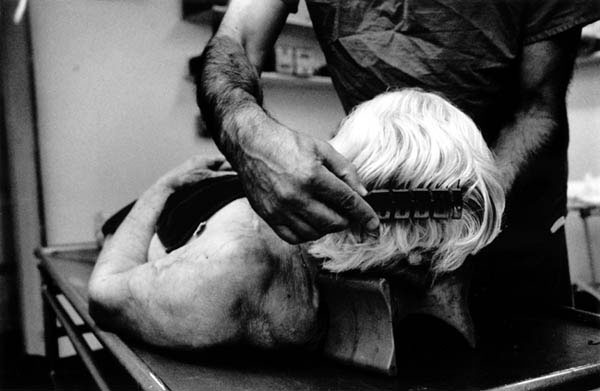
The body and hair are washed once more to remove any blood or chemicals and then thoroughly dried. Any restorations are done now, such as rebuilding features, masking sores or abrasions, etc. Makeup gets applied to the face, neck, and hands. Either a translucent makeup is used in normal cases or an opaque makeup is applied if the skin is discolored. In either case, the effect should be a subtle as possible to avoid Uncle Roger looking like Aunt Rose. The fingernails are trimmed. The hair is styled, either by the embalmer or by a professional hairdresser or barber.
The remains are dressed in the outfit chosen by the family. This outfit almost always includes underwear, shoes, and socks. In the case of autopsy or other difficulties, plastic undergarments are placed on the body to prevent leakage.
Finally comes casketing. The body is placed into the casket and posed in the proper position. The family normally views the body at this point and decides on any changes that need to be made. During the viewing period (which can sometimes last for several days) the embalmer will periodically check the body for signs of decomposition and takes any corrective action.
Source: Everything you ever needed to know about Embalming. Images are copyright Edmond Terakopian


I just recently (nov 3rd, ’08)sent my official transcript to the Dallas Institute of Funeral Servive. I will be starting in may ’09 at a cost of $1000 per month books included and going from 7:30am to 12:30pm mon-fri. Is there a less expensive Mortuary school around DFW? I live in Arlington TX, 20 min. from downtown Ft. Worth and Dallas. I actually get to skip the 1st quarter of classes due to my previously earned credits. Sooooooo, anybody have an idea of a school nearby me that is less costly? P.s. My degree would only be an Associates and I would start May ’09 and gradutae May 2010. Also, I wonder if Funeral Directing and embaling is offered as a Bachelors, I am about 4 classes away from an Associates in Arts allready, ie: 2 yr degree in nothing…
Still interested in doing this even after reading it.
That’s what I’m going to Lindenwood University for.
Hello, I was just wondering, for those who work in this field, what kind of facial expressions are most common on the recently deceased? This may be a morbid question, but I and interested in knowing this imformation. If you can’t answer this, please tell me where I can get the answer.
Thanks.
These are very disterbing images, oh boy
Hello. I was wondering 2 things. Firstly what is this wood putty everyones been mentioning?
Also when a woman who would always be made up dies is her makeup replicated on her?
I’ve only seen two embalmed people: my grandfather and an elderly, female friend of the family. My grandfather had diabetes and congestive heart failiure (he was just shy of 85). In both cases, the embalming/prep work was very nice. My grandfather probably looked worse in the last few weeks of his life–I remember it being very difficult to shave his face, since his skin had a spongy, frail quality (diabetes complications?). The only unusual thing was a touch of edema about the neck and ears. I noticed a pleasant odour, too, somewhat like carnauba wax (the makeup?). The experience of seeing my grandfather in this condition was good for my family, as he did not look well during his last year. We had him buried in a wooden (Batesville, I think) casket, in a concrete vault.
I’m curious about what happens when one dies overseas, as in war. I see the troops coming home in the Ziglers…are they embalmed before being brought here? Otherwise, i’d suspect they’d deteriorate terribly in transit.
there was a documentary on TV, about the Air India bombing, where Babar Khalsa terrorists killed a planeload of people over the ocean. One of the decedents was presented for identification to the family and his skin was a florid green; this was probably because he was in the seawater. I can only imagine the odour. It’s truly a good thing that embalmers can spare families this experience. There are many medical procedures performed on the living that are far more invasive than embalming. Funeral homes and graveyards seem to be more peaceful places than hospitals, with their ambience of fear, worry and pain.
Adam
i want to become an embalmer becuase it is facinating what they do to the human body!
Relax guys, it wont bother you anymore once you’re on there table. I promise.
Wtf?
Huh?
Very intresting. How long does an embarmed body last for befor the body starts to decompose?
I am actually in school studying embalming right now. It’s burnin’ me out how this description is identical to what we have seen, and learned so far. I think it’s an amazing line of work to get into, and i love it!!
I found this entire thing fascinating. I didn’t find it to be at all morbid. As many courses in Anatomy and Physiology and the science that I’ve taken, I have never known much about imbalming. I came on this site because suddenly I was curious to know what they did to the eyes of the deceased to keep them from collapsing. I guess I remember seeing that on a show about embalming but I was reminded. I plan to be an organ donor and I was having a hard time with the idea of donating my eyes. Now it doesn’t seem so scary.
I have been to 5 open casket viewings. Three of them were family members and I only touched one of the bodies and that was my grandma whom I was very, very close to and felt that is was necessary to touch her. She looked just like she did before she had died and it was so surreal. It seemed that at any moment she would sit up and say “Gotcha”. But of course, much to my grief, she never did. Her hands were even as I remembered. I’m so grateful I have that memory of her and got to say goodbye, as painful as it was to see her there. I had the hardest time going into the room…When I touched her, she felt hard, like rock coated in a smooth material and very cold. I could smell the HCHO and it was difficult. She always had her own “smell”. Remembering her distinctive aroma (soap, shampoo and her skin), and the fact that she no longer smelled like Gramma, helped me to let go of her a little…helped to realize she was just a shell at this time. It wasn’t any less painful but it helped me face my grief. So, as I touched her, I touched her head lightly and her hands and her sweater and her hair. I brushed her cheek and felt the stiffness of her body. But I was curious as to why not only was she almost completely flattened but it felt like paper or “stuffing” around her chest. Like someone had wrapped her. She was too sick to donate organs so it just seemed strange that she had that weird lumpiness feel with what felt like paper or fill around her chest. Could someone that knows about this stuff possibly tell me what I was felt? What she wrapped in something? I’m really curious. I found nothing in this information, both the descriptions and the comments, that would indicatewat this was…
Lastly, the only thing that has given me a sick feeling was that for some reason I was compelled to look at her neck, which didn’t have makeup on it. I guess when you are greiving you forget that they are wearing make up to cover discoloration. Anyway, I looked at her neck which was covered by her sweater. I lifted away the sweater and saw the grey/green artery covered, neck. It was disturbing and I can’t help but wish that I had not done that. But at least she looked beautiful and so I don’t let that be what I remember when I think about what she looked like the day I saw her.
I am so appreciative to the embalmer for making her look like Gramma. Losing her was aweful and I am so thankful that she looked like herself, and even healthier in a way…not really dead. I was grateful. As painful as the memory was, it was one of the most important memories I will ever have….
I saw a video on mortuary practices, on Youtube, where they placed tissue paper into the pantlegs of a decedent’s suit, to make it look ‘crisp’…apparently, it looks weird, seeing a formally, dressed person, when their clothing doesn’t hang neatly as it would when they’re vertical (formal wear is meant to drape smartly on the person, when they’re standing). I think the overall effect is like when they put tissue in folded shirts, on store displays. I imagine that they don’t put makeup on UNDER the clothing, so that it doesn’t smear.
Shoulder pads just annoy me when I’m dressing / casketting the deceased. They arent designed to be pressed into a pillow.
The public is not used to seeing a dressed person laying down so we take a few steps hidden under the clothing to make them appear more natural.
With shoulder pads, I either take them out or pad the area below them, in the armpit section of the clothing. This serves to fill in the hollow there when the shoulder pad is pushed outwards by contact with the pillow. The product used for this is usually “Kapok”, the same padding stuff in a upholstered sofa.
For emaciated cases, often I will cut a 1/4 inch thick sheet of cotton padding and top it with a section of bed sheeting to lay upon the deceased’s chest prior to dressing. Doing so serves to make the chest look and feel less boney. Its a skill to do this properly without looking or feeling like they have been wrapped.
I dress my cases fully prior to cosmetisizing. Around the neck I place a 2 foot square sheet of plastic before doing up the clothing around the neck. This is to avoid getting the cosmetics onto the clothing. The plastic stays on until the person is in the casket and positioned properly, then it is pulled out from under the clothing. Sleeves are rolled or pushed up to do the hand and wrist makeup, any jewelery is placed on and turned so that they face the other way. Doing such allows for cosmetics to be undisturbed as would occur of one were to try and place rings and such on cosmetisized hands. Once positioned correctly in the casket, the sleeves are returned to normal position and any jewelery is turned to the correct position, stones facing out. I learned the hard way that getting cosmetics out of a jeweled ring setting is a bugger, so this method works for me.
Hope this helps everyone out.
136. Mutt -
little stuff like that in that context..would’ve never occurred to me. really is kinda cool to see it from your perspective.
amazing this is one of the older and somewhat more morbid lists on site..still gets comments. some of which, like yours is not only fascinating but enlightening as well.
thanx.
i so get the ring gunk thing too.
I plan on being A Mortician, and I start next October.
I looked at the old ways they did embalming, it didn’t look to pleasent and I got to see the buckets they drained the blood in. When I start I actually get to work on real people, from monday to thursday i go from 8:30 to 1 to the school were I learn to reconstruct faces, and work in the labs on real bodies. And friday we go to the cemetary and do the burials. People see it as weird, but its actually intresting. And what you posted has actually helped me out a lot!
My uncle has a funeral home, I grew up around this kind of stuff my whole life, I used to joke around in school by saying I have more dead friends than live ones. Death is a part of life and it isn’t creepy or gross it is just a transition…
I am 20 years old, married, and I am currently a student of morturary science. I get so many crazy looks from people because of my desired profession. My friends joke with me, calling me the “Reaper”, “Undertaker”, and even have me programmed as “death” in their phones, with Imperial Death March as my ringer i.d. The simple truth though is that mortuary science is a form of art. It’s taking the remains of a once living human being, and putting a spark of life into them again one last time before the deceased is layed to rest. It helps bring closure to the family when they know you have done everything to help them honor the life of a loved one even in death, and know that you are there to help through the grieving process (which is said to last up to a year). It is a trade that requires much sympathy, composure, and honesty, and it is something to be respected, not ridiculed.
***NOTE: I have heard that people are actually dumb enough to use embalming fluid as a drug…BAD IDEA!!! The fluids used for the embalming process are not just formaldhyde. When injected into the body, these chemicals kill off white blood cells, which fight disease and bacteria, therefore making the remaining organs very vulnerable to infection. To live flesh, it will basically kill the cells in the exposed area, inevitabley causing the skin to rot away, depending on severity of the exposure. DO NOT try to use these chemicals as drugs, or fingernail polish remover…your fingertips will more than likely deteriorate.
mmmmmmm. don’t think I could do this for a living.
OMG… that is more elabirate than i thought.I think i would like to see one go down.
this is really cool stuff. Dude i would love to do it
This is a really good read and i’ve read it all. I enjoyed reading everyones opinions and thoughts cause you know death does effect our lives in someway or another. For 3 years i worked for an answering service for over 1600 funeral homes/cemeteries/and body donation programs. Its amazing in an evening how many ppl pass away. I usually did the overnights cause i wasn’t getting calls for the nearest florist or what time jane’s arrangements were for, and you’d be surprized how many ppl are actually involved in the passing of a person.
Also for one of those years i worked as well in a local funeral home.. i have to say it opened me up to a whole different world. Although i never dealt directly with bodies and the embalming process i did learn a lot in the lunch room. I loved the job and would go back in a .. just knowing your there for someone in a great time of need makes you feel really good even if you were that person they called at 3am when their loved one passed at home, and they never get to meet you cause your miles away answering that phone to relay that message to the director.
I was simply curious about the process of embalming. It is very neat and not morbid at all. I am not interested in becoming an embalmer or mortician but I do have respect for what they do after this article. I don’t know why more of this subject is not aired in public to remove the mystery. There is so much silence surrounding the industry that it makes one wonder what has to be kept secret. Thanx for the posting.
Actually, I am going to school now for this profession. I havent had any course related classes yeat but im very anxious to get started…No im not crazy or weird or anything, but i just like the fact that im helping a family and also helping someone who was once living and is now literally helpless..You can think of it as a CNA they clean their patients, they fix their hair they do everything the patient cant.. So it’s not that bad.. I hellped get my mother dressed who passed away in march of 08 and it was a great farewell for me it was more like a bondin effect it had on me… But its not that bad and you guys were right Funeral Directors dont get as much recognition as they should…
Very interesting input from everyone. Such a variety of thoughts on the whole thing. Personally, I have become INTRIGUED by cemeteries in the past 5 years..well, always interested since a child. Death, to me, is just a temporary setback, cause how I see it, we are ‘recycled’ per say. Unusual, but I found this by looking up the reusing of blood. Have had a fascination…(not of the gory type) with Elizabeth Bathory, and the whole ‘history’ there. Using blood to make herself look younger. OK, now, I was “shown” a video explaining that everything, if available, gets reused. (I mean no harm to someone viewing this just after someone has passed)If..the blood is sent down the sewer(and I mean if)it is being reused.The ONLY reason I have seen that this has been in effect, be due to the Biblical aspect of it. Being sent this way, only prolongs its ingestion (again, I mean no harm..) Now, this is another thing, (and I am only posting this to have this be a “digital copyright” theory, so to speak) Bathory, used blood to make her look younger (if it truly worked, no real proof)but based on this theory,’IF’ being taught things are ‘reused’, wouldn’t that be the product being used in the collagen/facial product to improve aging? Makes sense, based on my research on the matter..
I too have been looking into being an undertaker. Spend a LOT of time at the nearby cemeteries, its an energy thing…My ONLY fear has been, Fear of actual blood in the past, has made me ill, but the recent Bathory /Mcfarlane figure, intrigues me.
I believe…(again, this means no disrespect) When ye passes on, everything shuts down, but the mind. Ye just lay round, waiting for someone to keep ye company…like someone who walks talkin, just talkin…keepin company. Cant respond, but just keepin company. Call me crazy, but just a good feelin…for both So many forget their ‘loved ones’…
@~`~~`~~
Love,Monika
“KEEPIN it KOZMIK!”
I am a working Embalmer and Funeral Director, i am a member of the BIE (British Institute of Embalmers) and manage 4 funeral homes. it is really good to hear so many positive comments about our fabulous profession. For anyone considering joining our ranks I would highly recommend it. Embalming and Funeral Directing play a huge role in all our communities and I for one am very proud of the contribution everyone in the funeral service industry makes to our society in what can be a demanding, but very satisfying job.
Im sending off my application to the Co-op today. Im a recently ex archaeologist and given Ive spent so much time digging people up it only seems fair to work on the other side of the coin( to mix my metaphors). This has been a jolly interesting read, thankyou all.
Mushak and everyone else that is following this thread,
As an embalmer I’ve always imagined an archaelogist hundreds of years from now investigating and exploring one of the deseased that I have prepared. Would they find my methods interesting to study? Would it be a breathtaking article in the “Universe Geographic” magazine in the future to see the abdominal or mouth closure methods used by current embalmers?
Would I be recognized by the way I tie off a suture?
Just keeps me working neat and tidy when I embalm.
Occasionally we do excavate current cemeteries, but then were not allowed to investigate the remains. Eventually we will start to recognise skeletal damage from pathological exams. In order to leave your mark on skeletal remains (which is what we’d normally excavate) Mutt, you’d need to leave some post mortem mark on the bone or use copper wire to close the mouth, that would leave a tell tale green mark on the facial bone or teeth. Either that or embalm so thoroughly that mummification occured! I’d definitely go for mummification given the chance.
This is a profession i have always been interested in, and feel i am at a time in my life (turning 30 & children starting school)i need to persue it! is there any way to study for any part of the qualification home learning or nights?as i need my present job for income but i am willing to volenteer in a mortruary to gain some some experience & get a foot in the door!i live in Edinburgh!
Excellent read! I am currently in the process of changing my career to that of an Embalmer. I have researched the profession thoroughly for the past few months after having an interest in this sort of work for a number of years. I start my Course in June and I will say that even at 40 + years of age it is NEVER too late to change ones career and start afresh. Some excellent comments and a ver interesting read here that has made me believe that my decision to Embalm is the correct one for me.
I have been in death care for over 13 years . I have been a superintendent of on of the largest memorial parks in the United States . This far in my career I just made the change of goining into the funeral service as a mortuaty tech.
The benifits are this ! Job security have you ever notice a funeral home laying off staff ! 2) good salery 3) retirement
so as grizzley as it sounds or seems , its a good career. For those who are thinking of this as a possible career go to a funeral home and as if you can witness what they do up close!
19 years ago when my baby son passed away, it was a friday. We next saw him at the funeral home on the monday after he had an autopsy and even though we were warned what to expect, it was still a shock as he was frozen. “Someone” had not gotten him out in time to “thaw”. I dressed him the next day before he was placed in his coffin and his little head and chest had been stitched back together with huge stitches and he looked nothing like my baby. He was also a lot bigger.I really didn’t feel like I was burying my son at all.
This is freaky. they’re combing his hair! All of his blood is cumming out.
I wanted to know exatly what happens when someone is embalmed, now the thought of someone doing all this to me makes me shudder although I must admit to finding the whole thing fascinating.
I’m currently a Nurse who is in the process of changing my profession to Embalmer. The class starts in August, (and for those of you interested), it’s a 2 year course that offers an Associates Degree. When completed you are eligible to be either a Funeral Director or an Embalmer. I’m not sure exactly what other states offer, but I live in New Orleans, Louisiana, and here you are not required to have a Bachelors degree to start. However,once finished with the course, you must be an intern for at least a year before they let you out on your own.
To Mutt or anyone else already an Embalmer: I realize that this profession is highly rewarding. This and several other factors have led me to my decision to enter the field. But I have a question…
As a Nurse I’m compensated quite well, and I was curious as to how any of you feel about your pay scale. Do you think an Embalmers job is underappriciated in this way?
Although a very rewarding career, you probably make more now than you will as a people pickler.
I drive a 10 year old minivan ’nuff said?
Lil one: Like I stated I have been in death care for 13 years now . As a nurse you make at least 40-60k a year. You will never make this as a embalmer/funeral director unless you own your own home or have worked in this field for some time. If you work for a private funeral home you will never make what you do , your lucky if you make 35k a year. If you work for less say SCT, Stewart Enterprises,Stonmour, or other companys you might make a higher salery but then you have to think of benifits, Most of the above funeral service companys offer benifits but! private funeral homes might not! I think you should try it out part time and explore the career to see what or if this is somthing you want to persue. Today a career change , is somthing you really must think about. BUT ! If you do decide to change and it dont work out , you can allways go back to nursing .
Many thanks to both Mutt and cemeteryman for their response…
Your input was just about what I expected.
My real purpose in taking the Funeral Director/Embalming course is to open up a door for me in the Medical Examiners office as a Diener.
I’ve shadowed a Diener already, and it was the most facinated thing I’ve ever seen in my life. However, where I live requires you to have an Embalmers license to actually be employed in this job. (For anyone interested, a Diener is an autopsy assistant).
A diener actually makes about the same as I do as a Nurse. (Pretty unfair if you ask me, because to me an Embalmers job takes much more skill/art and care than disecting someone). Embalmers actually take the mess after an autopsy and do great wonders with the body. Many kudos to you all actively employed in this field! We are all greatly appriciative of the job you do to make our loved ones appear so “normal” even after some of them have experienced great trama in death.
Lilone Its funny I worked as a diner to when I was in High school all the way till I went into the service. Here in New York you do not have to have a embalmer license . Its on the job training if you can find the job! Many stay untill retirement . You may want to check out a course at given for pathologist assistant at I think its in Virginia you might want to check it out, Type it into to the internet the schools for this and you will find it . You can transfer your credits and for nursing this will help a lot Cemetery man
After loosing my beloved uncle i often wondered how “Embalming” worked. It was told in every detail that you can understand and i found it extremely interesting, yes I would love to watch someone being embalmed life is too precious so enjoy because we never know if were be the next one to be embalmed
Interesting website. I am trying find out if enbalming is the law in Quebec as some members of my family wish not to be enbalmed.
Hey Deb, just give a call to a local FH. They’d be more then happy to answer it probably.
But i’m thinking they don’t have to be because the jewish religion don’t embalm
I worked for several years in the Ottawa Hull area. There is no requirement for embalming unless you would like an extended delay visitation or shipping out to another location such as crossing international borders. Most air carriers will refuse to transport an unembalmed body.
If your family members want to be viewed within a day or so of death, often a funeral home may do what is called ‘minimal preparation’ this would be a general cleaning up and setting the features (eyes, mouth etc) into a more acceptablke position.
Most often this type of viewing is brief, and for immediate family members.
A closed casket visitation may take place with an unembalmed body inside. Again, not for an extended period of time.
great site, very informative, always been intrested in embalming, never done anything about it, time for a career change. Can anyone please tell me what qualifications i need to become one.
Hello Mutt,
It is a fascinating subject of what happens to our bodies during the dying process and afterwards. I am doing a history project and would like to know how people were embalmed in 1608, was there a similar process, I know from records that spices were bought for the job.
Thanks.
Sonia
Interesting list and comments. I like this type of stuff. I did several papers on Egyptian embalming and find this very interesting. I for one would like to be embalmed like a Pharoh…72 days for that!. If I can’t be a mummy then I might donate my body to the Body Farm. I won’t be using it anyway.
i hipe someone can pls ans a question for me. This morning my three nephews and their dad was killed in a semi-truck vs jeep accident and their mother is in critical condition. My question is how long can the family hold the body because they havent told the mother as of yet and most seem to bury a loved one in 3-4 days. Would they go ahead or what would be the process to store the bodies till she can recover from her injuries and bury her family..
pls help
Angelbaby , I am sorry of this mishap but to try to let you know that after the corner releases the remaines to the family the funeral home is then chosen by the family. The process of embalming can last years if the embalmer compleats his job right. With in my cemetery I have had to exume remains that have been buried for many years and still the remaines look just like they did when they passes away. I hope that everything works out .cemeteryman
Like cemetery man.. I am also in the Funeral industry.. however I have been in it for only 4 and a half years. I love every aspect of the Business.. Reading everones intake on this posting brightens my day. Thank you to all those who support and take into consideration that being a Funeral Director/Embalmer is truly a blessing. Those of you who are interested in the Business, GO FOR IT! However.. if money is the only issue.. This job is NOT for you.. You can live comfortably but not materialistic.
When deceased service members come home, what kind of casket are they placed in? Are they embalmed before they come back to the USA? Do they place the bodies on ice before coming back to the USA? Why do they always got to Dover Air Force Base? Why is the length of time from the funeral to burial in Arlington National Cemetary so long. Thanks.
IAM SUCH A SCARY CAT BUT I DONT KNOW WHY I ALWAYS WANNA KNOW IAM ALWAYS CURIOUS AND WHEN I GOTTA FALL ASLEEP I CANT BUT THIS IS ALOT OF INTERESTING SUBJECT!!!
Huggie, I retired with 22 years in the service, All the remaines go to Dover because this is where the largest mortuary is located. Another is in Fort Lee VA . This is where they train their mortuary techs 92mickes. When the 92 mickes remove them from the battle fields,they are taken to mortuary services photo finger prints D.N.A tested embalmed placed in a body bag and placed in a steel metal casket and shipped state side. Up on arrivel here in the states, they are removed from the metel caskets placed in a regular casket sent to the family for services.
Cemeteryman, Where do you actully work? When was in Mortuary school (Commonwealth Institute of Funeral Service) One of my professors pretty much new EVERYONE in the Funeral industry. Im glad I ran into this blog! I jst learned something new today!! (in reference to your last response) =)
jomarie603 I am now a superintendent of a cemetery located on the New York and PA border . I have at least 15 yrs in the death care industrey .
like several of you, im ready for a career change and very interested in Funeral Services. However, it is difficult to find information on careers and courses. Im in Newcastle-upon-tyne: are there and training centres nearby? Sadly i still have a mortgage to pay so need to maintain a similar salary: does any1 have an idea of salary range for embalmers, trainee and qualified?
Kay, go to the british institute of embalmers website http://www.bioe.co.uk they have a list of tutors avaliable in different areas. its very hard to get into, not many jobs around. to become qualified you will need to do about 2 years (part time course) these mainly happen in the evenings and when i done mine cost £2000, but that was 8 years ago so i do not know what it is now. wages vary from company to company, both trainee or qualified, there is no set amount. its not as well paid as we would hope considering what we do !! good luck x