“Great is the victory, but the friendship is all the greater”, said Emil Zatopek when asked about the Olympic Games. The Olympics have become a magnet for all that is good within the human spirit. We look at ten moments in the history of the games when the actions of athletes have transcended race, color or nationality to speak to the soul…
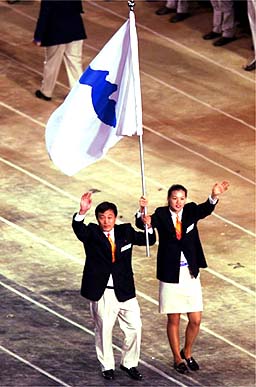
They were divided at the 38th parallel, but reunified in Sydney. It was probably only symbolic-perhaps even delusional, but when an event can bring two countries which are officially at war to march under the same flag, it gives the spectator an idea of the strength of the Olympic movement. A flag with the map of undivided Korea in blue over a white background was carried by Park Jung Chon, a North Korean judo coach and Chun Un Soon, a basketball player from South Korea while the band aptly played an emotional folk song. Same uniform, same flag, same song – it seemed for one fleeting moment in history, the two nations forgot the past and embraced the future.
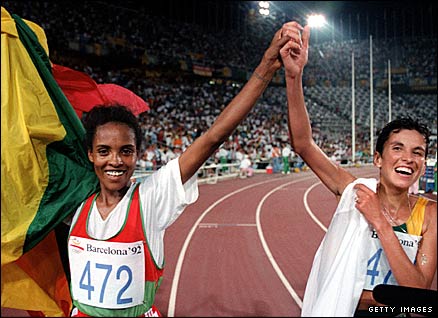
The two were as different as they come. One, a white South African. The other, an Ethiopian. Derartu Tulu and Elena Meyer had just finished first and second in the 10,000 meters. What followed was perhaps the most poignant victory lap in history. Hand in hand, the two Africans celebrated their victory together. For many, it heralded South Africa’s re-entrance into the sporting arena after years of apartheid but it was the beauty of two African athletes, in their hour of glory to recognize each others performance that seemed to provide the shining light for the dark continent.
Pyambu Tuul represented Mongolia in the marathon at Barcelona in 1992. He came in last. When asked why he was so slow, he replied ‘”No, my time was not slow, after all you could call my run a Mongolian Olympic marathon record.” Not satisfied, another reporter asked him whether it was the greatest day of his life. To which came the reply which can throw anybody off their seats. “And as for it being the greatest day of my life, no it isn’t”, he said,”"Up till six months ago I had no sight at all. I was a totally blind person. When I trained it was only with the aid of friends who ran with me. But a group of doctors came to my country last year to do humanitarian medical work. One doctor took a look at my eyes and asked me questions. I told him I had been unable to see since childhood. He said ‘But I can fix your sight with a simple operation’. So he did the operation on me and after 20 years I could see again. So today wasn’t the greatest day of my life. The best day was when I got my sight back and I saw my wife and two daughters for the first time. And they are beautiful.” Simple, ain’t it? It’s the races that we run within ourselves that are most important.
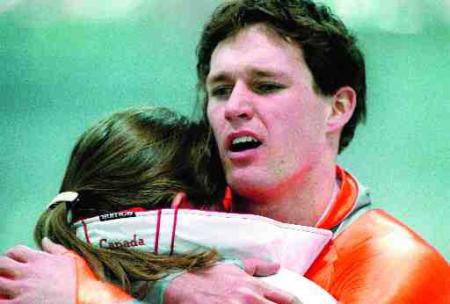
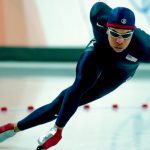
It seemed to be happening all over again. A sense of deja vu had set in. Dan Jansen, the speed skater who had promised so much, but had failed to deliver was competing in the 1000 meters finals at Lillehammer. Surely, it was his last chance at redemption. Four years earlier at the Calgary games, he had competed in the 500 meters speed skating event hours after hearing the news of his sister Jane’s death. He had failed to make much of an impact. The jinx continued in Albertville. Call it what you will-destiny, an act of divine providence, whatever-he skated like never before, created a world record, and took home the gold. And if there is anything called poignancy in sport-it is this- Dan Jansen, holding his little girl and looking up to the heavens saying ‘This is for you, Jane.’
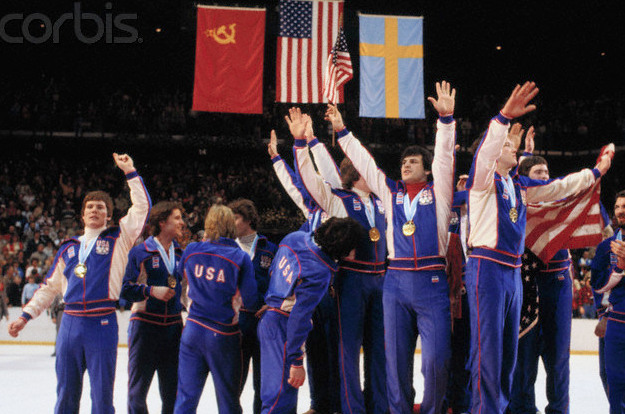
Lake Placid, New York, 1980. The Soviets had invaded Afghanistan. Carter was not sending an American Contingent to the Moscow Summer Olympics. It was in this cauldron of spite that the American team comprising of mostly amateurs had just taken the lead against the mighty Soviets. Ten minutes of intense hockey followed, but the Soviets could not breach the American defense. With the clock winding down, ABC’s Al Michael’s immortal words ‘Eleven seconds, you’ve got ten seconds, the countdown’s going on right now! Morrow, up to Silk. Five seconds left in the game. Do you believe in miracles? YES’, were accompanied by jubilation on the rink as well as the stands. Decades later, its still the video you show your kids to teach them what it is to be American.
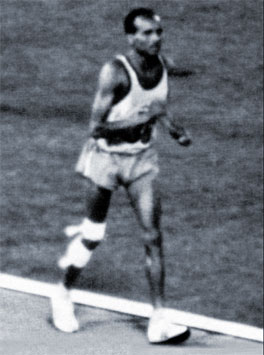
Momo Walde won the marathon gold in the high altitude of Mexico city in 1968. One hour later, a little known Tanzanian runner, John Stephen Akhwari entered the Olympic stadium – the last man to do so. Wounded after a fall and carrying a dislocated knee, he hobbled up to the track for for one last surge to the finish. He then retired to a thunderous applause by a small crowd which was lucky enough to get a glimpse of this gallant champion. It was later written of his perseverance – ‘Today we have witnessed a young African runner who symbolizes the finest in the human spirit. A performance that gives true dignity to sport – a performance which lifts sports out of the category of grown men playing in games.’ But Akhwari was far more modest. When asked why he did not quit, he replied,’My country did not send me 5000 miles to start the race. They sent me 5000 miles to finish the race.’
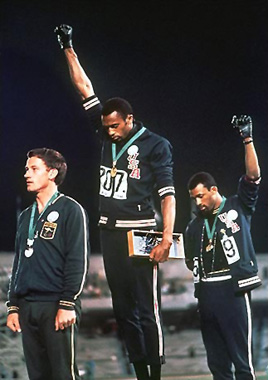
An image which even if you saw a thousand times, spoke to your heart in so profound a manner that it embodied the spirit of the times. The image is that of Tommie Smith and John Carlos raising a hand covered in a black glove with Peter Norman donning the Olympic Project for Human Rights badge. It will be remembered as the most iconic image of protest at the Olympic games, but all three of them were ostracized after. It was only years later that their act was to be recognized as a demonstration for dignity. It’s one of those moments when sport ceases to be just sport- it assumes the task of being a vehicle of change and progress.
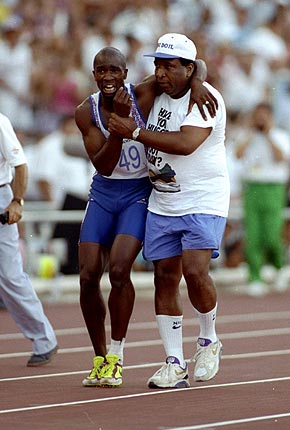
A career plagued by injuries, Derek Redmond arrived at Barcelona with an eye on the gold medal. It wasn’t to be. With 175 meters to go in his 400 meters semifinal he pulled his hamstring. The dream had ended it seemed. Not for Redmond though. The succeeding events are etched in the minds of millions. Crying he stands up again, only to try to finish on one leg. His father watching from the sidelines joins him with words of comfort – “We’ll finish together”.’ Strength is measured in pounds. Speed is measured in seconds. Courage? You cant measure courage’, were the words used by the IOC to promote the Olympic movement by the act of perseverance. But for Derek Redmond, it was the only plausible thing to do.
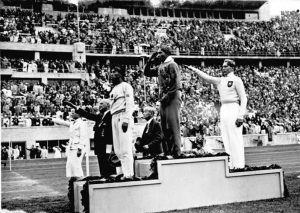
In full view of the Fuhrer, a nineteen year old German athlete gave Jesse Owens some advice – ‘play it safe, make your mark several inches before the takeoff board and jump from there.’ Owens, the grandson of a slave and the son of a sharecropper took the advice, qualified for the finals and took his tally of gold medals to four. The first to congratulate him was Luz Long. “It took a lot of courage for him to befriend me in front of Hitler… You can melt down all the medals and cups I have and they wouldn’t be a plating on the twenty-four carat friendship that I felt for Luz Long at that moment,” he said, recounting his rendezvous with the blue eyed German but for all his heroics, Jesse had to take the freight elevator in the Waldorf Astoria to attend his own reception.
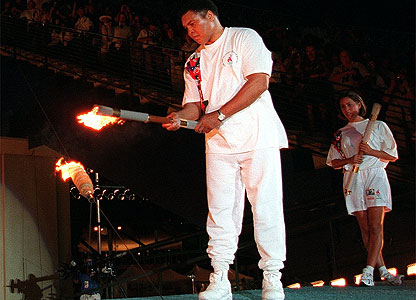
At last he emerged from the background. A body weathered by Parkinson’s but the mind astute as ever. Shivering he lit the flame. No other sportsman in the history of sport had meant so much to so many as Muhammad Ali. For the dignity of the man was consummate – never relinquishing ideals for money or fame, Ali was the people’s champion – the underdog in sport and life. “They didn’t tell me who would light the flame, but when I saw it was you, I cried” said Bill Clinton. He wasn’t the only one.


Number four should not be on this list. The Olympics are not for pushing political agendas. They made a mockery of what the Olympics stood for by doing that.
What about Kerri Strug?
Yay! I like it! I’ve always watched the Olympics not just for the sports, but for the symbolism of it all…
Pretty beautiful list.
Maybe I should follow the Olympics for once…
shut plasmatwa2 your just rascist
I don’t usually comment on these things, but that was a pretty incredible list. Good job!
As I scrolled down, I could sense Ali would figure in the list. Good list Dash. I wonder when you’ll show up at listverse.
Not a fan of this list. Honestly I never saw what made the Olympics as special as people keep telling me they are. I must be missing something.
I couldn’t agree more with the sentence “No other sportsman in the history of sport had meant so much to so many as Muhammad Ali”. Great list, great idea.
plasmatwa2, I think most of these events on this list are, in some way, politically motivated. Even if they weren’t thinking it at the time, the actions and words could be used to support or to reject certain political ideas. It is a shame, yes, but still it is the way it is, and they need to be taken in the spirit that these people were feeling at the time.
There are some here that I didn’t quite understand, like number 6, but there are also some incredible moments here. I was expecting Kathy Freeman’s victory lap, where she carried both the Australian flag and the Aboriginal flag, but again, most people who are not Australian wouldn’t understand the controversy and the full meaning behind it.
plasmatwa2, go to your local dvd and hire out “Salute” The Movie. Perhaps that will help you understand why No.4 should be on the list and the emotion’s it created.
Personally, Derek Redmond should be No.1, even though he realistically would never have even come close to beating Quincy Watts and Steve Lewis, the Americans who finished 1-2 in the final.
Also Kostas Kenderis winning the 200m at Sydney in 2000 was pretty emotional for the Greek commentators!
Plasmatwa2 (#1), the #4 entry is not political. Human rights and equality are not political. It is humanitarian. Political is any country who boycotts the olympics, denying the greatest athletes the chance to step past that barrier that divides us in order to participate in the one event that unites us.
The Olympics is the one time when nations unite, not through politics, but through achievement and personal fortitude to demonstrate, but for one brief moment, to all people what is possible for man and what is possible for mankind.
It is not political, nor should it ever be. To stand for freedom, equality and the pursuit of a dream is what mankind strives for daily.
The Olympics brings it (and us) all together to cheer not only for the athletes, but for the courage, the perseverance and the unity that still escapes us.
(Long-winded, ain’t I?)
Great list!
Plasmatwa2(#1), the list is titled Top 10 emotional Olympic moments. I think those two men were pretty emotional and it sparked many emotional responses.
Miracle on Ice is about as emotional a moment for Americans as it gets. It is, for me, the finest moment in American sports history.
@Manda (10):
There’s some political motivation behind number six given the US and Soviet relations that Dash tried to describe in the above paragraph, but The Miracle on Ice was also notable because of the “underdog” tone of the medal rounds. The Soviets were long-reigning champions of hockey while the US team hadn’t really played together prior to the Olympic qualifiers. The paragraph above used the term amateurs indicate non-professionals but there is a bit of a distinction between an amateur from the amateur leagues and one from the collegiate level (there was a mix of both on the team). At the Olympics, USA was seeded 7 out of 12 teams so they were a longshot for the gold, especially given that the Soviets had won the past four Olympic golds in Hockey and that they had also humiliated the US team in an exhibition game a month prior to the Lake Placid games. It’s called the Miracle on Ice because no one expected the US to win a medal, much less the gold they got.
As far as universally emotional moments these are all up there except for number 6 – Miracle on Ice. Don’t get me wrong – that was a huge effort by the guys and a big deal in itself but not on the same level as the rest. Just one guy’s opinion of course.
I still don’t know anything about what number 4 was, you didn’t explain…i’m only 18, I don’t really watch the olympics and I don’t know what it’s referencing……….
?
What about when John Landy doubled back during the 1500m in Melbourne in 1956 to check on Ron Clarke? He then made up a huge deficit and went on to get the bronze? Yes … I’m Australian, so of course I also agree with Manda. Also, how about Erik the Eel? Nice list though, couldn’t agree more with 4 – I saw an awesome doco on it one night.
During the rehearsals for the opening ceremony of Sydney 2000 a truncated version of the parade was held, with each country announced (in French then English) and a placard holder and flag-bearer walking around the track then into position in the middle of the field. Korea(s) wasn’t announced in the list of nations, but just before the host nation came “Individual Olympic Athletes”, so I guessed that the Koreans would be marching there.
On the night, something in French filled the scoreboard, and the woman announcer spoke in French. I thought “Hmm, this didn’t happen during the rehearsal”. The scoreboard then showed the English, at which point people began to catch on, and the male announcer then said “The delegation of the Olympic Committee of the Republic of Korea, and the delegation of the Olympic Committee of the Democratic People’s Republic of Korea, marching together as – Korea!”. That got possibly the third biggest cheer of the parade, behind the USA and Australia.
Just for a moment, it all seemed possible.
I was in Korea at the time of the 2008 Olympics. Plans for combined teams, supporter squads, travel etc dissolved in acrimony. In the end South Korea finished in the top 10. The only North Korean medal winner I remember (a pistol shooter) was disqualified for drug use.
(BTW, the “Individual Olympic Athletes” were those from East Timor, whose Olympic Committee hadn’t been recognised at that stage. They also got a big cheer.)
I remember watching the #3 on the TV when it happened, it was really emotional stuff. Glad it made the list.
There is a photo of Jesse Owens at the Berlin Olympics that Hitler was going to use as propaganda for the master race. Owens is standing on the top with Nazis on the second and third platforms. Both Nazis are giving the nazi salute while Owens is saluting the stars and stripes. This is a moment that transcends petty country squabbles that so often show their putrid heads even on this site. Owens represented everybody the Nazis thought to be enemies of the thousand year Reich. Think of all the people and countries that would come to be victimized by WWII and the aggressors. Some 90 million people were still alive at the moment this photo was taken, those 90 million people would die in WWII. Considering the context this may be the single most haunting sports photograph I’ve ever seen. And as photographs chronicle moments, it counts.
@plasmatwa2 (1): I thought the olympics stood for equality – something which was lacking in the US at the time of item 4 – hence the protest.
@KK (17): at the time America had apartheid – blacks and whites couldn’t legally mix in many circumstances. When the two black men won the medal they wore black power symbols to show their plight to the world and the white Australian wore a badge in support of it.
Great list, Dash. Well-written and researched.
@Manda (10): How did you not understand #6? It’s one of the greatest moments in the history of American athletics. After years of being shut down by the dominant and seemingly invincible Soviet hockey team, the U.S. hockey team, made up of all college players, with an intense team chemistry and a little bit of luck finally defeated the Soviets. It was also a time when tensions were roughly at their peak between the two nations. This moment showed incredible spirit for the young Americans to prove that even the mighty Soviets could not intimidate us.
Derek Redmond and his father, possibly the most emotional sports story I have ever heard. I would put that at Number 1.
I could be wrong, but aren’t the black gloves they are wearing actually the Australian’s?
I have to agree with plasmatwa2 about #4. The black power salute wasn’t about achieving equality; it wasn’t about Martin Luther King’s goal of a world where people are judged on the content of their character. It was about the Black Panthers’ leftist agenda and Malcolm X’s radicalism (before he mellowed into a more reasonable stance). And the salute was done during the American national anthem, which in essence means these two were saying that their political position outweighed their support of their country. I disagree strongly with many things America does, but I always stand for the anthem and salute the flag with my hand over my heart, and I look askance at Americans who don’t.
Great list, but I do miss Matthias Steiner holding the photo of his recently deceased wife after he won the gold medal in weightlifting in 2008. Even though we Germans do not have a reputation for being emotional, I cried like a baby when I saw it on TV.
Well I think jfrater in his usual conciseness has addressed the major points as to why number 4 was significant, but in a rare show of displeasure to my own country I’d also like to point out that it was ONLY ONE YEAR PRIOR that Australia undertook a referendum to actually consider Aboriginals as citizens (they were previously listed under “Fauna”). Given Australia’s renowned love of sport, this certainly represented a major step forward. I think it was almost as important for Aussies as it was for the US. And well, obviously South Africa had to follow suit or we would have kicked them out of the Cricket Tour.
Awesome list. You’ve really cheered me up on a day that has so far offered nothing but a savage hang over. It’s impossible to look at the image for number four and not feel something, incredibly poignant.
The Olympics are all about politics and corruption.
Awesome list, Dash! I loved readed it. Of course, I’m doing so with tissues at the ready…damn you for making me tear up!
I remember seeing number 3 on TV. That one stuck out far more for me than the rest. So did number 1.
Great job!
I just have to say you ruined the list putting those american moments on it…
@gabi319 (15): and @kgb99 (25):
but you guys understand that the us winning a gold at hockey doesnt mean squat to the rest of the world,right?? I get that it was an amazing moment for you all but i dont understand why it should be on this list since its so politically charged. Athletes represent also the people of that nation so i dont know why should the writer stress so much on the political side of things. It wasnt a battle against something that affects humanity like all those other moments( man versus racism, man versus diseas or man versus hate)
@kgb99 (25): Only for americans. It is not something the rest world finds emotional.
@Gabriel (36): The rest of the world.
sad to say that i’m not familiar with most of the items on this list =/
Great list!
This should be a funny bonus:
kk (#17) i’m 16 and i know exactly what number 4 is about, age is no excuse for ignorance. these men were having to win medals for a country that barely counted them as citizens, it was humiliating for them and so they took a very brave stand. Also, this list would have been good if it wasn’t so corny, honestly some of the language in this is just so….and the line about ‘it shows what it means to be american’, surely this applies to every country – overcoming the odds? however, i do think this is a great list, if not a bit cheesey.
Peter Norman (what an Australian name) died recently and Tommie Smith was one of the pallbearers at his funeral. RIP.
I liked the list for the most part. However, when you talk about courage, it made me think of the Jamaican bobsleigh team in the 88 Olympics in Calgary. THe personified courage, but not caring what others think and staying true to a goal. That being said, I think that there are hundred of others who should be on this list because most people who make it to such a level are pretty amazing people.
Awesome list… I know that the point of the Olympics is for it not to be politically charged, but it can’t be helped when nations make it so by segregating people, and such.
@Kenny5, in your world if anyone disagrees with you that person is a racist. Just like if a white person disagrees with Obama’s policies that person is a racist.
I, personally, agree with plasmatwa2. It was totally about politics.
And you might want to learn to spell before posting to big boy sites like this.
It gave me goosebumps, it gave me tears. A truly inspiring list. Thank you.
AMAZING LIST!!!!!!!!!!!!!!!!!! well done!!!!!!!!!!!!!!!!!!!! First list in a while that i read all of the blurbs underneath!
Everybody knows the Soviets let America win that game! and most of the stuff on this list is propaganda, which is what the Olympics is all about. Billions spent bankrupting countries to promote false ideals. Greed, politics, global capitalism, and most of all deception, drive the games.
Numbers 8,5 and 3 really put things into perspective don’t they? Makes me feel crazy for complaining about having too much homework to do.
awesome list again!
you should not see sport events as the defining point of what is the best athlete. In dutch, we have a saying that loosely translates as “participation is more important than victory”. This is especially true of the Olympic Games.
If there is one better way to show that we are all human, that we all live on this globe together, that nothing can stop us if we work together, it is the Olympics. 204 nations, 11,028 athletes, 302 events… I cannot think of any other event, whether it is sports, art, music or something else, that can unite the entire world under one flag, saying those delighted 3 words: “Citius, Altius, Fortius” (faster, higher, stronger, or the Olympic credo).
really, if only the combined nations of this planet would do something similar for other things, like climate, poverty, diseases, or other world-dividing things. if there would be a Climate games, or a Povertysolver championship, those problems would be solved.
If we combined under a common flag, like a stronger, more powerful version of the UN, we could overcome challenges that are seemingly too great to tackle.
but that will never happen, since the governments of this world are too stubborn to group together for something as small (in their eyes) as poverty, climate change, global illnesses.
Awesome list Dash! Shows why the Olympics really exist
I would have added Nadia Comaneci to the list; the first ever gymnast to get a perfect 10.
There should be another list, top 10 blemishes in Olympic history. The Chinese extravanganza was the worst in my opinion. Olympics has drastically changed over the years. Now, the spirit looks tired, the athlete looks lost and the only winner-takes-all is the sly advertiser.
@Arsnl (35):
I wasn’t even making it a USA moment. The other fellow was (and it a very rude way, might I add. Not everyone cares about nationalism, about Soviet-US history together, or even about hockey). Yes, I used team names but merely for clarity. I see it as an underdog story of a recently-formed, ragtag team taking on and eventually beating a polished team who had been together and winning together for upwards of 16 years. So many fictional sports movies will use this story as inspiration for theirs that the general storyline has become cliche. Replace the teams and sport with the those of a preferred favorite and no doubt the ebullient feelings would be the same. That’s why upsets in sports are so emotional since they are unexpected. It’s sad for the heavy favorite but a great moment for the underdog and those that supported them.
So no, not a humanitarian “this versus that” cause but that wasn’t the standard ruling for this list. If it were, we wouldn’t see a few of these other items on here. I actually liked items 8, 6, 5, and 3 the best because it can be boiled down to just about the sport. They clearly did not have “1st place” tattooed on their foreheads or a gold medal with their name engraved on it waiting for them but they still persevered. That’s admirable.
Why no links ???? Great list, but without video a bit dry.
#3 always makes me cry, even just seeing the picture of father and son together. You can hear people tell you that their father is an outstanding human being, but to actually see it is awesome.
It makes me appreciate my father even more, because I know whenever I need him, no matter what the situation, my Daddy will always be there for me. To have that kind of love and encouragement is your life is far more precious than any medal could ever be.
Nobody’s saying it? What a cheesy list. Sounds like the writer was the narrator for one of those awful Memorable Moments in Sports highlight reels on television.
1976 Munich was a pretty emotional Olympics…
@42 Bo,
With all due respect, you only know what you have read or been “taught.” If you are correct that “age is no excuse for ignorance,” then I hope you understand that there is a difference between reading about something and living through it. There is a difference in being “taught” what happened and actually experiencing it.
The Tommie Smith and John Carlos symbol was not about equality. The “Black Power” raised fist was about inequality in the form of a black run country. The actual event during the Olympics widened, not closed, the racial divide that existed in parts of the country at the time. Many people of all ages and races at the time took the protest not as a symbol of “equality,” but as a sign of selfishness and hypocrisy.
It is only recently that the protest has come to be seen differently and something “positive.” For those of us who lived through it, we marvel at the revisionist history and wonder at the ignorance.
Great list, and I teared up as I read them.
However, I was surprised at the lack of women athletes on the list. You’d think women didn’t compete in the games. When Joan Benoit crossed the finish line in 18984 during the first women’s marathon, I was a mess.
A few other readers mentioned other women athletes whose moments are important and as valid as those of the men. In the words of Abigail Adams, we ask you to “remember the ladies.”
I simply do not agree with your choice for the number one spot. It is true that Muhammad Ali was perhaps the pioneering athlete who made his mark not only in the ring but culturally as well. But your statement that “For the dignity of the man was consummate – never relinquishing ideals for money or fame, Ali was the people’s champion,” is utterly false. It is true that he refused entry into the Army based upon his religious convictions and thereby caused the boxing commissions to strip him of his heavyweight title. But his public statements and actions towards Joe Frazier were despicable and racist. He called Joe, a black man, an Uncle Tom and the ‘white man’s hope.’ From the start of the Fight of the Century to the Thrilla in Manila, Ali taunted Frazier relentlessly and many times it was racially tinged. Ali used his iconic status as the symbol of hope for African Americans in the United States against a person he was supposedly trying to represent and as a way to raise the box office dollars for these fights. That right there is doing it all for the cash and relinquishing his ideals.
What most people don’t know is that when Ali was banned from the sport and destitute, Joe Frazier was helping him with cash and petitioning to get his boxing license back. Ali paid him back by showering him with ugly racial slurs in public. That is extremely undignified in my opinion, but because he was Ali, people didn’t raise a fuss.
Ali’s entire public persona was centered around promoting himself as the greatest of all time. Whether you think that’s true or not, it really isn’t the epitome of being dignified. He was a loudmouth and everybody knows that and was one of the reasons people loved him.
One could make a case that he relinquished his ideals for the money and fame simply by watching his last few fights. This was a man clearly trying to hang on to every ounce of fame and money because it was obvious he was past his prime and could barely move around the ring, much less box.
I completely understand that it was an emotional moment for a large amount of people, that it was supposed to represent some sort of enduring spirit in athletics, that an American cultural icon was lighting the Olympic flame and that many people were crying.
I was sober and dry eyed and cannot understand how people can overlook his treatment of a fellow African American. It’s simply unforgivable.