
 Animals
Animals
Animals  Weird Stuff
 10 Unexpected Objects People Have Treated as Sacred
 Movies and TV
 10 Tough-Guy Actors Who Unexpectedly Broke into Song
 Misconceptions
 10 Dinosaur Myths That Refuse to Go Extinct
 Weird Stuff
 10 Ridiculous Flat-Earth Arguments That Fail Simple Tests
 Technology
 10 Bizarre Places Electricity Is Hiding in Plain Sight
 History
 10 Nail-Biting Espionage Operations of the Cold War
 History
 10 Groundbreaking Innovations That Prove the “Dark Ages” Weren’t Dark
 Weird Stuff
 10 Bizarre Queen Ant Dramas That Belong in a Soap Opera
 Food
Food 10 Caribbean Foods with Dark and Unexpected Histories
Animals 10 Mass Animal Die-Offs That Looked Like the Apocalypse
Weird Stuff 10 Unexpected Objects People Have Treated as Sacred
Movies and TV 10 Tough-Guy Actors Who Unexpectedly Broke into Song
Who's Behind Listverse?

Jamie Frater
Head Editor
Jamie founded Listverse due to an insatiable desire to share fascinating, obscure, and bizarre facts. He has been a guest speaker on numerous national radio and television stations and is a five time published author.
More About Us
Misconceptions 10 Dinosaur Myths That Refuse to Go Extinct
Weird Stuff 10 Ridiculous Flat-Earth Arguments That Fail Simple Tests
Technology 10 Bizarre Places Electricity Is Hiding in Plain Sight
History 10 Nail-Biting Espionage Operations of the Cold War
History 10 Groundbreaking Innovations That Prove the “Dark Ages” Weren’t Dark
Weird Stuff 10 Bizarre Queen Ant Dramas That Belong in a Soap Opera
Food 10 Caribbean Foods with Dark and Unexpected Histories
10 Mass Animal Die-Offs That Looked Like the Apocalypse
In the winter of 2010, residents of a small Arkansas town awoke to find thousands of dead birds littering their lawns. Just days earlier, tens of thousands of dead fish had surfaced in the same state. It was the kind of coincidence that fuels conspiracy theories, yet investigators ultimately traced the two disasters to entirely different causes.
Across the globe, mass animal deaths have repeatedly transformed familiar landscapes into scenes from an apocalyptic novel. Some were caused by disease, toxic algae, or extreme weather, while others remained mysterious until years of research finally exposed the culprit. What unites them is their terrifying scale: entire populations erased in days or weeks, leaving scientists scrambling to understand what happened and whether it could happen again.
Related: Outbreak (1995): The Foreshadowing of 10 Modern Epidemics
10 The Week Birds Fell and Fish Filled the River
The Mystery of Birds Falling from the Sky – The Beebe Bird Apocalypse Explained

On New Year’s Eve 2010, the town of Beebe, Arkansas, received a horror movie for a holiday. Beginning around 11:30 p.m., an estimated 4,000 to 5,000 red-winged blackbirds began falling from the sky over a single square mile (2.6 square kilometers). Necropsies found massive blunt-force trauma, including internal bleeding and broken bones. Poison, disease, and severe weather were ruled out, leaving investigators with a bizarre question: What sends thousands of healthy birds plummeting from the night sky?
The leading explanation was a barrage of professional-grade fireworks. The explosions apparently flushed the nearly night-blind birds from their roost, causing the panicked flock to crash into houses, cars, signs, and the ground. Two days earlier, another mass death had begun roughly 125 miles (201 kilometers) away. Tens of thousands of freshwater drum floated along a 17-mile (27-kilometer) stretch of the Arkansas River.
Conspiracy theorists quickly linked the incidents, but investigators found no connection. The fish most likely suffered gas-bubble trauma after spillways at a nearby dam were opened, while fireworks probably doomed the birds. Arkansas had experienced two wildlife disasters in the same week, but apparently through nothing more sinister than an extraordinary coincidence.[1]
9 Four Million Common Murres Starved During “The Blob”
Half of Murres seabird population dies after this happened
Between 2014 and 2016, an enormous patch of abnormally warm water spread across the northeastern Pacific Ocean. Scientists nicknamed it “the Blob,” which sounds almost comical until considering what it did to the wildlife living above it. Tens of thousands of dead common murres began washing ashore from California to Alaska. The seabirds were emaciated, with empty stomachs and wasted chest muscles, suggesting they had starved while surrounded by an ocean that should have been full of food.
The bodies found on beaches represented only a fraction of the disaster. By examining long-term breeding-colony surveys, researchers later estimated that approximately four million murres died, nearly half the population in Alaska. The marine heatwave increased the metabolisms and appetites of predatory fish while reducing the quantity and quality of the murres’ prey.
The birds suddenly competed with fish in an ocean that could feed neither. Even more disturbing, many colonies showed little sign of recovery years later. What initially looked like thousands of isolated carcasses had actually been the largest documented single-species wildlife die-off of the modern era.[2]
8 The Caspian Seal Mystery
2.500 dead seals found on Russia’s Caspian coast
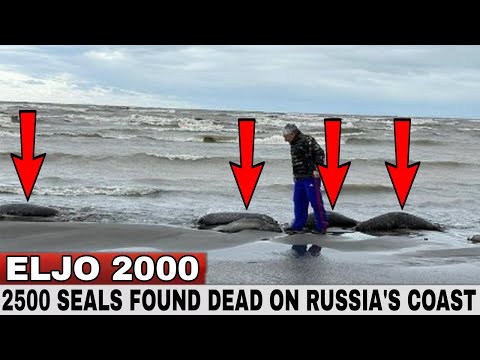
In December 2022, the shores of the Caspian Sea in Russia’s Dagestan region became littered with dead seals. Officials initially counted about 700 carcasses but revised the figure upward to approximately 2,500 as more bodies washed ashore. None showed obvious signs of violent death, and investigators found no evidence that the animals had become tangled in fishing nets. Tests also failed to uncover an immediate pollution event that could have killed so many seals at once.
Early reports suggested that the animals might have suffocated after natural gas emissions depleted oxygen in the water. Later examinations, however, pointed toward a far more complicated biological killer. Researchers found severe pneumonia associated with mixed infections involving influenza viruses and a morbillivirus related to the pathogen that causes canine distemper. It was not the first disaster to strike these animals; another large die-off killed thousands around the Caspian Sea in 2000.
Each outbreak lands on a population already devastated by hunting, pollution, habitat loss, and fishing nets. Caspian seal numbers have fallen by more than 90 percent since the early twentieth century, meaning another mysterious epidemic could push the endangered species even closer to disappearance.[3]
7 The Melting Sea Stars
What Is Sea Star Wasting Disease?

Beginning in June 2013, divers along the Pacific coast of North America began finding sea stars that appeared to be melting. Animals from more than 20 species developed lesions before their arms twisted away from their bodies and their organs seeped through their skin. The outbreak stretched from Baja California to southern Alaska, making it one of the largest marine wildlife epidemics ever recorded. Researchers initially blamed a virus found in sick animals, but the same virus later appeared in healthy museum specimens collected decades earlier.
The mystery endured for more than a decade. Then, in 2025, scientists identified the likely killer as a strain of the bacterium Vibrio pectenicida. The bacterium produces toxins that damage the animals’ tissues, explaining the horrifying progression of sea star wasting disease. More than five billion sea stars may have died, while sunflower sea stars disappeared from much of their range.
Their absence triggered another ecological disaster. With fewer predators to control them, sea urchins multiplied and devoured kelp forests that shelter countless marine species. The sea stars didn’t simply melt away; their disappearance helped transform entire stretches of the Pacific coast.[4]
6 The Red Tide That Paralyzed Southern Chile
The Terrifying (but Awesome) Science Behind Red Tides

In early 2016, the waters of southern Chile became a marine graveyard. A surge of toxic algae killed an estimated 40,000 tons (36,000 metric tons) of farmed salmon in the Los Lagos region, destroying about 12 percent of the annual production of the world’s second-largest salmon-farming nation. Weeks later, approximately 8,000 tons (7,300 metric tons) of sardines washed up near the mouth of the Queule River, while dead clams and other marine animals piled along the shores of Chiloé Island.
Officials blamed an unusually severe red tide intensified by warm water associated with El Niño. The crisis became more controversial when authorities allowed the salmon industry to dump roughly 4,700 tons (4,300 metric tons) of decomposing fish offshore. Local fishermen suspected that the discarded salmon had worsened the bloom, although scientists did not establish it as the cause.
The government declared a disaster zone and banned fishing across affected areas, prompting furious fishermen to blockade roads and isolate parts of Chiloé. What began with microscopic algae ended with lost livelihoods, public protests, and accusations that an industry built upon the sea had helped poison it.[5]
5 The Botswanan Elephant Deaths
Cause of Death Found for 300 Elephants in Botswana

In the spring of 2020, one of the strangest elephant mysteries in recent history unfolded across Botswana’s Okavango Delta. Between March and June, approximately 330 elephants were found dead near seasonal water pans around the village of Seronga. The victims included animals of different ages and both sexes. Poaching was the first suspicion, but every carcass still had its tusks. Anthrax and several other infectious diseases were also investigated and ruled out.
After months of testing, Botswana’s government announced that toxins produced by cyanobacteria in the watering holes were the most likely cause. The deaths stopped as the seasonal pans began drying, strengthening the theory without making the diagnosis completely certain. Investigators were still puzzled that other species drinking from the same water appeared unaffected, although elephants may have consumed larger quantities or disturbed toxin-rich sediment while bathing and drinking.
Researchers worry that warmer conditions could make dangerous cyanobacterial blooms more frequent. Hundreds of the largest land animals on Earth had apparently been killed not by hunters, drought, or starvation, but by toxins hidden in the water they depended upon.[6]
4 The Saiga Antelope Catastrophe
Mysterious disease killed 90% of Saiga antelope in Central Kazakh Steppe | Global Ideas

In May 2015, conservationists watched in horror as one of the most dramatic mass deaths in mammal history unfolded on the steppes of Kazakhstan. Within approximately three weeks, around 200,000 saiga antelope died, eliminating more than 60 percent of the species’ global population at the time. Witnesses described apparently healthy animals that stopped grazing, became weak, and collapsed with signs of respiratory distress. Entire herds vanished, including mothers and their newborn calves.
The killer was hemorrhagic septicemia, a form of fatal blood poisoning caused by the bacterium Pasteurella multocida type B. The shocking part was that the bacterium normally lived harmlessly inside the antelopes’ bodies. Researchers concluded that an unusually warm and humid period triggered explosive bacterial growth, allowing the organism to invade the animals’ bloodstreams.
Similar weather-linked die-offs had struck saiga in the 1980s, but none had approached this scale. The catastrophe had been written into the species’ own biology: a harmless passenger waiting for the right combination of heat and moisture to become a killer.[7]
3 The Patagonian Whale Graveyard
Life After Death: The Whales of Golfo de Penas

In June 2015, marine biologist Vreni Häussermann flew over a remote fjord in Chilean Patagonia and discovered an apocalyptic sight. Scattered across the isolated bays of the Gulf of Penas were the remains of at least 337 whales. Aerial and satellite photography revealed 305 bodies and 32 skeletons. Based on their size and location, the animals were identified as sei whales, Balaenoptera borealis, an endangered species that generally lives far offshore.
The remoteness of the area and its rough seas prevented scientists from reaching most of the carcasses, making a definitive diagnosis difficult. A later scientific analysis identified a harmful algal bloom as the leading explanation. Sei whales filter enormous quantities of water for krill and other small animals, allowing toxins from an algal bloom to become concentrated in their prey.
The discovery also revealed that large groups of these supposedly oceanic whales had been feeding close to shore in a previously unknown habitat. Scientists could not prove exactly what killed every animal, but the evidence suggested that a toxic bloom had created the largest baleen-whale die-off ever recorded.[8]
2 The Frog-Killing Fungus
This Frog-Killing Fungus Could Wipe Out Entire Species

For decades, a silent killer has been attacking frogs and salamanders around the world. The culprit is the chytrid fungus Batrachochytrium dendrobatidis, commonly called Bd. It invades amphibian skin, interfering with the animal’s ability to regulate water and essential salts. Because amphibians rely upon their skin for functions that other animals perform with lungs and kidneys, a severe infection can disrupt the heart and eventually kill its host.
A major 2019 study estimated that chytridiomycosis had contributed to population declines in at least 501 amphibian species across more than 60 countries. Of those, 90 were reported extinct or presumed extinct in the wild, while another 124 had declined by more than 90 percent. The researchers described it as the greatest documented loss of biodiversity caused by a disease, although some scientists have since questioned the exact totals.
Humans helped transport the fungus through the international trade in amphibians, releasing it into populations that possessed little natural resistance. Unlike the other catastrophes on this list, this was not a mass death confined to one beach, forest, or unfortunate season. It was a worldwide extinction event unfolding one wetland at a time.[9]
1 The Bird Flu Panzootic
Is it time to worry about bird flu?

Since 2020, a form of highly pathogenic avian influenza has done what earlier outbreaks failed to accomplish: spread through wild birds across much of the planet and remain in circulation. H5N1 viruses in clade 2.3.4.4b first caused enormous losses in Europe before reaching North America in late 2021. By the following year, tens of millions of farmed birds in the United States alone had died or been culled to contain outbreaks. Unlike earlier waves that faded seasonally, this one continued circulating among migratory and resident birds.
The toll soon expanded beyond poultry. Gannets, cranes, pelicans, gulls, penguins, and other wild birds died in immense numbers. The virus also crossed into mammals, infecting foxes, bears, seals, sea lions, mink, cats, and dairy cattle. Countless wild animals undoubtedly died in regions where no one was present to test or even count them. Health agencies still consider the risk to the general public low, but the virus’s ability to cross species barriers remains deeply concerning.
This is no longer a collection of isolated poultry outbreaks. It is a continuing animal panzootic, spreading through ecosystems on a scale that the world has never previously recorded for H5N1.[10]
More Great Lists
 10 TV Show Spin-Offs That Surpassed Their Original Series
 10 Phony Myths and Urban Legends That Just Won't Die
 10 Thrilling Examples of "I'm Not Ready to Die (Yet)"
 10 Times People Swore the Apocalypse Was Just Around…
 10 Dates When the Apocalypse Was Supposed to Happen
 10 Crazy Trick-or-Treat-Like Traditions You Might Not Know
 10 Exotic Foods That Look Like Aliens
 Ten Actors Who Actually Like Watching What They Star In
 10 Deadly Tiktok Challenges That Spread Like Wildfire
More Great Lists