
 Misconceptions
Misconceptions
Misconceptions  Weird Stuff
 10 Ridiculous Flat-Earth Arguments That Fail Simple Tests
 Technology
 10 Bizarre Places Electricity Is Hiding in Plain Sight
 History
 10 Nail-Biting Espionage Operations of the Cold War
 History
 10 Groundbreaking Innovations That Prove the “Dark Ages” Weren’t Dark
 Weird Stuff
 10 Bizarre Queen Ant Dramas That Belong in a Soap Opera
 Food
Food 10 Caribbean Foods with Dark and Unexpected Histories
 Movies and TV
 10 Controversial Documentaries That Shaped Public Perception
 Miscellaneous
 10 Times Big Business Turned People into Test Subjects
 Animals
 10 Ancient Legends About Odd Animals
Misconceptions 10 Dinosaur Myths That Refuse to Go Extinct
Weird Stuff 10 Ridiculous Flat-Earth Arguments That Fail Simple Tests
Technology 10 Bizarre Places Electricity Is Hiding in Plain Sight
Who's Behind Listverse?

Jamie Frater
Head Editor
Jamie founded Listverse due to an insatiable desire to share fascinating, obscure, and bizarre facts. He has been a guest speaker on numerous national radio and television stations and is a five time published author.
More About Us
History 10 Nail-Biting Espionage Operations of the Cold War
History 10 Groundbreaking Innovations That Prove the “Dark Ages” Weren’t Dark
Weird Stuff 10 Bizarre Queen Ant Dramas That Belong in a Soap Opera
Food 10 Caribbean Foods with Dark and Unexpected Histories
Movies and TV 10 Controversial Documentaries That Shaped Public Perception
Miscellaneous 10 Times Big Business Turned People into Test Subjects
Animals 10 Ancient Legends About Odd Animals
10 Dinosaur Myths That Refuse to Go Extinct
Dinosaurs are the celebrities of prehistory: instantly recognizable, endlessly merchandised, and constantly misunderstood. Thanks to movies, outdated museum displays, and “fun facts” passed around like campfire stories, much of what we think we know about these animals doesn’t hold up under closer examination.
Did every T. rex roar like a jet engine? Were all dinosaurs scaly, dull-colored giants doomed by sheer bad luck? Did they all live at the same time, in the same places, and behave in the same ways? Spoiler alert: no. New fossils, improved technology, and more sophisticated research methods have overturned plenty of supposedly settled dinosaur facts.
This list tackles ten dinosaur myths that sound right, feel right, and appear almost everywhere. Some are harmless misconceptions, while others fundamentally change how we imagine these remarkable animals. Either way, prepare for some prehistoric myth-busting reeducation.
Related: Ten Surreal Attempts to Bring Species Back from Extinction
10 We Have Found All the Dinosaurs
There Were Way More Dinosaurs Than You Think

It is tempting to think that the dinosaur record is basically finished. Museums are packed with skeletons, documentaries feature an endless parade of names, and it seems as though every interesting dinosaur must have been discovered by now.
In reality, paleontologists have probably met only a fraction of the non-avian dinosaurs that once existed. Dinosaurs lived for more than 160 million years across nearly every continent and in countless habitats. Fossilization, however, requires an unusually specific series of events. A body must escape scavengers and decay, become buried quickly, survive geological forces, and eventually appear somewhere scientists can reach it.
The fossil record also favors certain environments, periods, and locations. Some rock formations are exposed at the surface and easy to investigate, while others remain buried beneath cities, forests, oceans, or younger layers of rock. Political instability and limited funding leave additional fossil-rich regions barely explored.
Even after two centuries of dinosaur research, paleontologists still name a new species about every two weeks. Some come from newly excavated fossils, while others emerge when scientists reexamine bones that have been sitting in museum collections for decades. The dinosaur catalog is not complete. We are still turning the pages.[1]
9 All Ancient Reptiles Were Dinosaurs
Dinosaur vs. Reptile: The Ancient Divide Explained
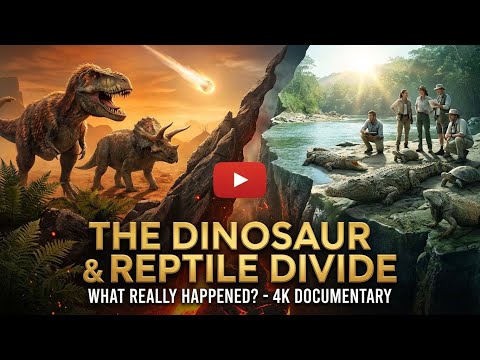
“Dinosaur” is not a catch-all term for anything huge, toothy, and prehistoric. Dinosaurs were one particular branch of the reptile family tree, and most were adapted primarily for life on land. Many famous creatures that regularly appear in dinosaur movies and toy sets do not qualify.
Take pterosaurs, for example. They lived alongside dinosaurs for much of the Mesozoic Era and were close relatives, but they belonged to a separate group of flying reptiles. Their wings consisted of skin and other tissues stretched from the body along an enormously elongated fourth finger. Birds, by comparison, fly with feathered forelimbs inherited from dinosaurs.
The so-called ocean dinosaurs were not dinosaurs either. Plesiosaurs, ichthyosaurs, and mosasaurs were marine reptiles that independently evolved streamlined bodies, flippers, and other adaptations for life at sea. Some lived at the same time as dinosaurs, but sharing an era does not make two animals members of the same group.
Even the word “pterodactyl” can be confusing. People often use it casually for every pterosaur, although it properly applies to particular members of that much larger group. When it comes to prehistory, enormous teeth, leathery wings, and dramatic flippers are not enough to earn something a place in the dinosaur club.[2]
8 Dinosaurs Were All Huge
Where Are All the Tiny Dinosaurs?

When most people hear “dinosaur,” they picture a skyscraper-sized monster stomping around like it owns the planet. That image makes sense because many of the most famous fossils belong to enormous animals.
Consider Dreadnoughtus, a titanosaur that reached approximately 85 feet (26 meters) long. Its weight remains debated because estimates depend on how scientists reconstruct the missing parts and calculate body mass. One estimate placed it at approximately 53 short tons (48 metric tons), or roughly the combined weight of several African elephants. No matter which estimate proves closest, it was unquestionably enormous.
But dinosaurs did not follow one giant body plan. Anchiornis was approximately crow-sized and measured only about 2 feet (60 centimeters) long. Microraptor, another feathered dinosaur, reached approximately 2.5 feet (77 centimeters), much of which consisted of a long tail. Other non-avian dinosaurs were closer in size to chickens, turkeys, or house cats than elephants.
Even gigantic species began life as eggs small enough for an adult to protect in a nest. Hatchlings had to grow through several radically different stages before reaching their enormous adult dimensions. So, yes, some dinosaurs were among the largest land animals in Earth’s history. Others were small enough to disappear into the undergrowth—or start chewing on your shoelaces before you noticed them.[3]
7 T. rex Could Outrun a Jeep
A paleontologist explains why T-Rex could never have caught that Jeep | Steve Brusatte

Movies love the idea of an adult T. rex charging after a speeding vehicle, teeth flashing in the rearview mirror. Over the years, popular estimates have given the predator running speeds that would make it a prehistoric track star.
Biomechanical research paints a less cinematic picture. A fully grown T. rex weighed several tons, and every running step would have forced its leg bones to absorb tremendous loads. In 2017, researchers combined computer simulations of the animal’s movement with estimates of the stress its skeleton could withstand.
When their digital T. rex attempted true running gaits—movements in which both feet leave the ground—the forces on its legs rose beyond what the researchers considered safe. Their results suggested that an adult probably could not run without risking serious skeletal damage.
That does not mean T. rex was sluggish. Its exact maximum speed remains debated, and younger, lighter tyrannosaurs may have moved differently from massive adults. A determined multi-ton predator could also cover ground effectively without entering a full sprint. Still, the evidence does not support the supercharged Jeep-chaser of movie fame. If one appeared in your mirror, however, you would probably step on the gas anyway.[4]
6 Dinosaurs Were All Dull-Colored
What Colors Were Dinosaurs?

Classic dinosaur art often defaults to gray, brown, or muddy green, as though every species emerged from the same military-surplus paint bucket. For most dinosaurs, fossil bones cannot reveal exact colors. A few exceptionally preserved fossils, however, have allowed scientists to recover parts of the original palette.
The key evidence comes from microscopic structures called melanosomes. In living animals, these structures contain melanin, and their shapes and arrangements correspond to particular colors and patterns. When similar structures survive in fossilized feathers or skin, researchers can compare them with those of modern animals.
One of the best examples is Sinosauropteryx, a small feathered dinosaur from northeastern China. Researchers found evidence that it had a reddish-brown back, a lighter underside, alternating bands along its tail, and a dark stripe across its eyes. In other words, it apparently wore a raccoon-like bandit mask.
Scientists cannot reconstruct every shade, and melanosomes reveal some colors more reliably than others. Much of any dinosaur’s appearance therefore remains educated speculation. What the fossils do show is that dinosaurs could possess stripes, countershading, facial markings, and possibly glossy or iridescent feathers. The endless gray-green parade belongs more to old artwork than to prehistory.[5]
5 Mammals Appeared After the Dinosaurs
The Mammals that Lived Alongside the Dinosaurs

It is a familiar movie setup: dinosaurs rule the world, an asteroid clears the stage, and mammals finally make their entrance. The real history is much messier. Mammals and their close relatives were already scurrying beneath dinosaur feet during the Triassic, and true mammals lived alongside dinosaurs for well over 100 million years.
Most Mesozoic mammals were small, which helped create the image of timid, rat-like creatures hiding in the shadows. But they were more diverse than that stereotype suggests. Some climbed trees, dug burrows, swam, glided through the air, or hunted other vertebrates.
One especially striking example is Repenomamus robustus, a stocky mammal from what is now China. It was approximately the size of a large house cat, and one fossil was discovered with the bones of a juvenile Psittacosaurus preserved inside its stomach. Whether it hunted the young dinosaur or scavenged its body is unknown, but the fossil proves that dinosaurs occasionally ended up on the mammalian menu.
The extinction of the non-avian dinosaurs about 66 million years ago opened enormous ecological opportunities. Mammals soon diversified into many larger forms and occupied niches once dominated by dinosaurs. But they did not appear after the dinosaurs. They had been living, hiding, climbing, and occasionally eating dinosaurs all along.[6]
4 All Dinosaurs Were Cold-Blooded
Dinosaurs Probably Weren’t Cold-Blooded, According to Eggshells

Older reconstructions often treated dinosaurs like oversized lizards that spent their mornings sprawled on warm rocks, waiting for the sun to charge their internal batteries. Fossil evidence now suggests dinosaur metabolism was far more complex.
Microscopic examination of dinosaur bones has revealed dense networks of blood-vessel channels and tissues associated with rapid growth. Feathers would also have helped active animals retain body heat, while fossils from polar regions show that some dinosaurs survived long periods of cold and seasonal darkness.
In 2026, researchers added unusually direct evidence. They analyzed carbon and oxygen isotopes preserved in three T. rex teeth from two individuals. Because tooth enamel forms at body temperature, its chemical bonds can function as a molecular thermometer.
The results produced an average temperature of approximately 97°F (36.3°C), close to the normal temperature of a human and considerably warmer than crocodilians found in the same rock formation. This suggests that T. rex generated enough internal heat to maintain a body temperature largely independent of its surroundings.
That does not mean every dinosaur ran at the same temperature as a bird, mammal, or T. rex. Different groups may have employed different metabolic strategies, and enormous dinosaurs could retain heat simply because large bodies cool slowly. The important point is that “cold-blooded” was not a universal dinosaur setting.[7]
3 T. rex Stood Upright
Nothing About T. Rex Was Normal… Here’s Why

If you grew up picturing T. rex as a chest-out monster standing almost vertically with its tail dragging along the ground, you are not alone. That “living tripod” pose became one of the most recognizable images in paleontology.
The American Museum of Natural History helped popularize it when its famous T. rex mount went on display in 1915. The towering animal stood upright, its backbone rising steeply from the hips and its tail resting on the ground behind it. Illustrators, filmmakers, and toy manufacturers copied the pose for generations.
The problem was balance. A real T. rex carried an enormous skull in front of its hips and a long, muscular tail behind them. Those two masses counterbalanced each other. Rather than standing like a person, the dinosaur held its backbone roughly parallel to the ground, with its head extended forward and its tail lifted clear of the earth.
Fossil trackways support this reconstruction because they rarely show grooves made by dragging tails. Modern skeleton mounts therefore give T. rex a more horizontal, birdlike posture. The old image remains everywhere, but the tyrant lizard king was not permanently posing for a vintage movie poster.[8]
2 All Dinosaurs Had Scales
Are Scales a Lie? Dinosaur Skin Explained | PaleoFAILS

If you grew up picturing every dinosaur as a giant, shrink-wrapped iguana, decades of fossil discoveries have wrecked that image. Spectacular fossils—especially those from northeastern China—preserve delicate impressions showing that many dinosaurs possessed feathers or simpler feather-like filaments.
One of the most dramatic examples is Yutyrannus huali, an early relative of T. rex. It measured approximately 23 feet (7 meters) long and weighed around 1.5 short tons (1.4 metric tons). Fossils from three individuals preserve evidence of shaggy protofeathers, making Yutyrannus the largest dinosaur known from direct evidence to have worn a feathery coat.
These early feathers probably evolved for insulation or display rather than flight. Smaller predatory dinosaurs may have used feathers to retain heat, attract mates, camouflage themselves, cover nests, or protect their eggs. Only later did specialized flight feathers help certain dinosaurs take to the air.
This does not mean every dinosaur resembled an enormous chicken. Skin impressions show that many species had scales, and some dinosaurs probably carried a mixture of scales and feathers—like modern birds, which have feathered bodies but scaly feet. The outdated part is not picturing any dinosaur with scales. It is picturing every dinosaur with nothing else.[9]
1 Dinosaurs Are Extinct
Famous Paleontologist Dishes on Dinosaur Extinction
A catastrophic asteroid struck near what is now Mexico’s Yucatán Peninsula approximately 66 million years ago. The resulting fires, darkness, climate disruption, and collapse of food chains wiped out every known lineage of non-avian dinosaur.
But “non-avian” is doing important work in that sentence. One group of dinosaurs survived, and its descendants remain all around us. They are birds.
Birds did not appear after the asteroid strike, nor did surviving dinosaurs suddenly shrink and sprout wings. Avian dinosaurs had already evolved during the Mesozoic Era from small, feathered theropods. They belonged to the same broad dinosaur lineage that included predators such as Velociraptor and Tyrannosaurus rex.
Modern birds retain plenty of dinosaur traits, including feathers, hollow bones, wishbones, air-filled respiratory systems, specialized eggs, and similar nesting behaviors. Evolution transformed their bodies over millions of years, but it never removed them from the dinosaur family tree.
More than 10,000 bird species live today, from tiny hummingbirds to towering ostriches. That means dinosaurs still swim, hunt, migrate, sing outside bedroom windows, and steal unattended french fries. The next time a gull raids your lunch, remember: You have just been robbed by a dinosaur.[10]
More Great Lists
 10 Famous Songs That Bands Refuse to Play Live
 10 Extinct Species That Are Still Alive Genetically
 10 Species That Refused to Go Extinct
 10 Extinct Creatures That Aren't What We Thought
 10 Most Persistent Health Myths and Why They're False
 10 Insane War Stories That Turned Out to Be Myths
 10 Popular Myths about the American Justice System
 10 Phony Myths and Urban Legends That Just Won't Die
 Modern Echoes: 10 Ancient Myths Reimagined
fact checked by Darci Heikkinen
More Great Lists