Most religions have one or two unusual practices or devices but occasionally you find one which is just completely weird. This list contains ten of the more unusual things found in modern religions.
1. Mormom Temple Garments Wikipedia
In some denominations of the Latter Day Saint movement, the temple garment (or the Garment of the Holy Priesthood, or informally, the garment or garments) is a set of sacred underclothing worn by adult adherents who have taken part in a ritual ceremony known as washing and anointing ordinance, usually in a temple as part of the Endowment ceremony. Adherents consider them to be sacred and may be offended by public discussion of the garments. Anti-Mormon activists have publicly displayed or defaced temple garments to show their opposition to the LDS Church.
According to generally-accepted Mormon doctrine, the marks in the garments are sacred symbols (Buerger 2002, p. 58). One proposed element of the symbolism, according to early Mormon leaders, was a link to the “Compass and the Square”, the symbols of freemasonry (Morgan 1827, pp. 22-23), to which Joseph Smith (creator of Mormonism) had been initiated about seven weeks prior to his introduction of the Endowment ceremony.
2. Scientology E-Meter Wikipedia

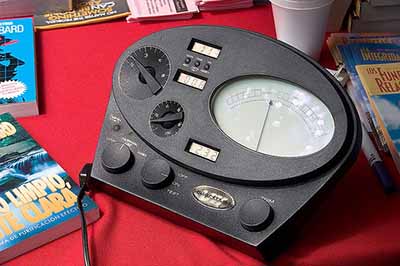
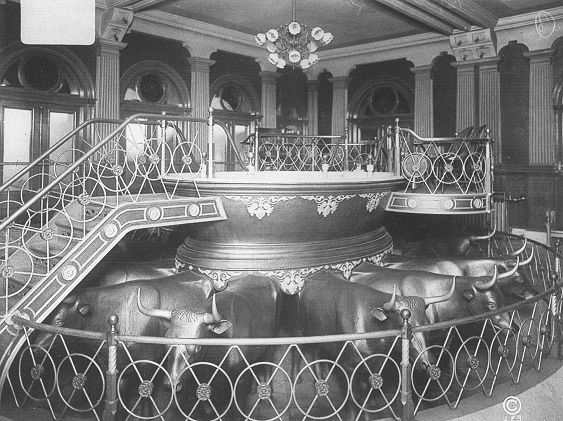
An E-meter is an electronic device manufactured by the Church of Scientology at their Gold Base production facility. It is used as an aid by Dianetics and Scientology counselors and counselors-in-training in some forms of auditing, the application of the techniques of Dianetics and Scientology to another or to oneself for the express purpose of addressing spiritual issues.
E-meter sessions are conducted by church employees known as auditors. Scientology materials traditionally refer to the subject as the “preclear,” although auditors continue to use the meter well beyond the clear level. The preclear holds a pair of cylindrical electrodes (“cans”) connected to the meter while the auditor asks the preclear a series of questions and notes both the verbal response and the activity of the meter. Auditor training describes many types of needle movements, with each having their own special significance.
A 1971 ruling of the United States District Court, District of Columbia (333 F. Supp. 357), specifically stated, “The E-meter has no proven usefulness in the diagnosis, treatment or prevention of any disease, nor is it medically or scientifically capable of improving any bodily function.”
3. Exorcism Cogitz
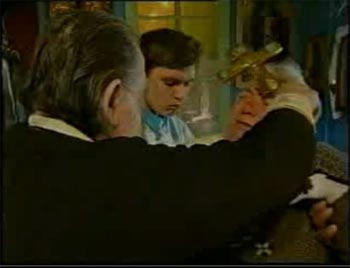
Exorcism is the practice of evicting demons or other evil spiritual entities from a person or place which they are believed to have possessed (taken control of). The practice is quite ancient and still part of the belief system of many religions, though it is seen mostly in the Roman Catholic and Eastern Orthodox Churches.
Solemn exorcisms, according to the Canon law of the church, can only be exercised by an ordained priest (or higher prelate), with the express permission of the local bishop, and only after a careful medical examination to exclude the possibility of mental illness. The Catholic Encyclopaedia (1908) enjoined: “Superstition ought not to be confounded with religion, however much their history may be interwoven, nor magic, however white it may be, with a legitimate religious rite”.
To listen to two authentic recordings of exorcisms, visit the Top 10 Incredible Recordings. For more audio, video, and images of excorcisms, you can go here.
4. Jewish Kaparot (כפרות) Wikipedia
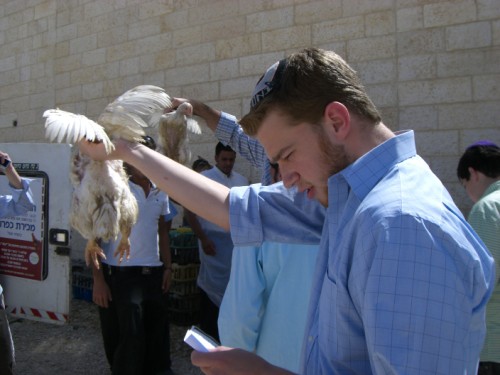
Kaparot is a traditional Jewish religious ritual that takes place around the time of the High Holidays. Classically, it is performed by grasping a live chicken by the sholder blades and moving around one’s head three times, symbolically transferring one’s sins to the chicken. The chicken is then slaughtered and donated to the poor, preferably eaten at the pre-Yom Kippur feast. In modern times, Kapparos is performed in the traditional form mostly in Haredi communities. The ritual is preceded by the reading of Psalms 107:17-20 and Job 33:23-24.
On the eve of Yom Kippur 2005, more than 200 caged chickens were abandoned in rainy weather as part of a Kaparot operation in Brooklyn, NY; some of these starving and dehydrated chickens were subsequently rescued by the American Society for the Prevention of Cruelty to Animals. Jacob Kalish, an Orthodox Jew from Williamsburg, was charged with animal cruelty for the drowning deaths of 35 of these chickens. In response to such reports of the mistreatment of chickens, animal rights organizations have begun to picket public observances of kaparot, particularly in Israel.
5. Shamanism Wikipedia

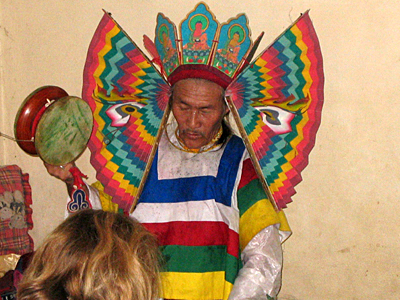
Shamanism refers to a range of traditional beliefs and practices concerned with communication with the spirit world. There are many variations in shamanism throughout the world, though there are some beliefs that are shared by all forms of shamanism. Its practitioners claim the ability to diagnose and cure human suffering and, in some societies, the ability to cause suffering. This is believed to be accomplished by traversing the axis mundi and forming a special relationship with, or gaining control over, spirits.
Shamans have been credited with the ability to control the weather, divination, the interpretation of dreams, astral projection, and traveling to upper and lower worlds. Shamans were used in Tibetan Buddhism as a form of divination by which the Dalai Lama was given prophesies of the future and advice.
6. Dowry Wikipedia

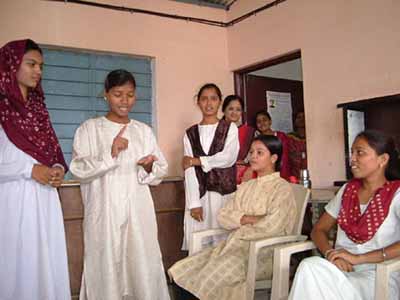
This is a cultural practice rather than a religious one. The practice of dowry exists across India. Despite laws against it, the practice continues. The girl child’s dowry and wedding expenses often sends her family into a huge debt trap. As consumerism and wealth increase in India, dowry demands are growing. In rural areas, families sell their land holdings, while the urban poor sell their houses.
To curb the practice of dowry, the government of India made several laws detailing severe punishment to anyone demanding dowry and a law in Indian Penal Code (Section 498A) has been introduced. While it gives boost to a woman and her family, it in the same time also put a man and his family in a great disadvantage. Misuse of this law by women in urban India and many incidents of extortion of money from the husband done by the wife and her family (this is called sowry) have come to light.
7. Mormon Baptism of the Dead Wikipedia
Baptism for the dead, vicarious baptism or proxy baptism is a religious practice of baptising a living person on behalf of an individual who is dead; the living person is acting as the deceased person’s proxy. It has been practiced since 1840 in The Church of Jesus Christ of Latter-day Saints where it is also called temple baptism because it is performed only in dedicated temples.
In the practice of The Church of Jesus Christ of Latter-day Saints, a living person, acting as proxy, is baptized by immersion on behalf of a deceased person of the same gender. The baptism ritual is as follows: after calling the living proxy by name, the person performing the baptism says, “Having been commissioned of Jesus Christ, I baptize you for and in behalf of [full name of deceased person], who is dead, in the name of the Father, and of the Son, and of the Holy Ghost. Amen.” The proxy is then immersed briefly in the water. Baptism for the dead is a distinctive ordinance of the church and is based on the belief that baptism is a required ordinance for entry into the Kingdom of God.
The Church of Jesus Christ of Latter-day Saints vicariously baptizes people regardless of race, sex, or creed. This includes both victims and perpetrators of genocide. Some Jewish survivors of the Holocaust and their supporters have objected to this practice.
8. Jainist Digambaras Wikipedia
Digambar also spelled Digambara is one of the two main sects of Jainism. Senior Digambar monks wear no clothes, following the practice of Lord Mahavira. They do not consider themselves to be nude — they are wearing the environment. Digambaras believe that this practice represents a refusal to give in to the body’s demands for comfort and private property — only Digambara ascetics are required to forsake clothing. Digambara ascetics have only two possessions: a peacock feather broom and a water gourd.
The native Jain communities of Maharashta, Bundelkhand (MP/UP), Karnataka, Tamil Nadu are all Digambaras. In north India, the Saravagis and the Agrawals are also Digambaras. In Gujarat and Southern Rajasthan, the majority of Jains follow the Svetambara tradition, although some Jain communities of these regions like the Humad are also Digambaras.
9. Islamic Niqab (نِقاب) Wikipedia

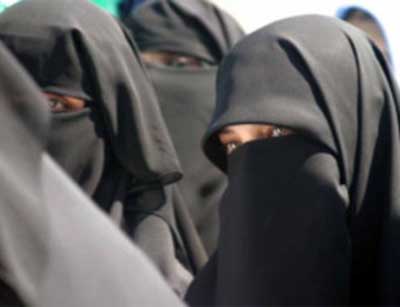
A niqab is a veil which covers the face, worn by some Muslim women as a part of sartorial hijab. It is popular in the Arab countries of the Persian Gulf but it can also be found in North Africa, Southeast Asia and the Indian subcontinent.
The niqab is regarded differently by the various schools of Islamic jurisprudence known as madhahab. Some see it as obligatory, or fard , while others see it as recommended, or mustahab, and a few see it as forbidden. The majority of scholars believe hijab is required, but only a few see niqab as required, although this is not the common perception among the general population.
10. Jehovah’s Witnesses Refusal of Blood Transfusions Wikipedia
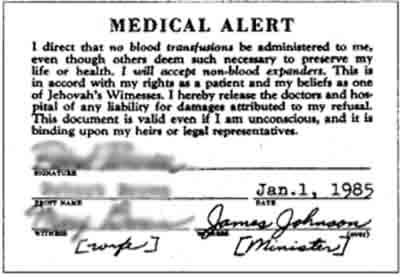
A fundamental doctrine of the Jehovah’s Witnesses teaches that the Bible prohibits consumption, storage and transfusion of blood, including in cases of emergency. This doctrine was introduced in 1945, and has been elaborated upon since then. Although accepted by a majority of Jehovah’s Witnesses, evidence indicates a minority does not wholly endorse this doctrine. Facets of the doctrine have drawn praise and criticism from both members of the medical community and Jehovah’s Witnesses alike.
In 1964, Jehovah’s Witnesses were prohibited from obtaining transfusions for pets, from using fertilizer containing blood, and were even encouraged to write to dog food manufacturers to verify that their products were blood-free. Later that year, Jehovah’s Witnesses doctors and nurses were instructed to withhold blood transfusions from fellow Jehovah’s Witnesses. As to administering transfusions to non-members, The Watchtower stated that such a decision is “left to the Christian doctor’s own conscience.”


Indian dowry is not religious ceremony. Do damn research before posting it.
it says that it is a cultural rather than religious belief, you should read everything before you post something.
yes it is , indian beliefs are so out of age, wake up
The practice that Chris is referring to is known as communion. You can get a full breakdown on WikiPedia. It was a commandment of Jesus at the last supper, and it is to commemorate the manner in which Jesus would die.
He said as often as they met, they should take communion in remembrance of Him.
There is some difference between Protestants and Catholics on this issue: Catholics believe that communion is transformed in the hands of the priest to the literal body and blood of Christ, while Protestants take it to be a symbolic gesture.
you liar the death and blood of christ symbolizes the killing of the first born male which is mentioned in the old testament and is an evil practice that is still going on today. that wikednesss about god killing his first born son is derrectly related to that stupid story about god telling abraham to kill his son
Chris: It was toss up between that and Exorcism; exorcism won.
“you are a fool” – it is included because the majority of practitioners are Hindu. For the same reason we can add the Burka of the Muslims – it is not an obligation of the religion specifically but is a traditional practice predominant in Islam.
As a Hindu, listing ‘dowry’ as a ‘religious’ practice makes me laugh!
Oh please people read it before compalining. His exact words are "This is a cultural practice rather than a religious one." – it's the opening line.
It does say it is a cultural thing, but why then don’t you put it in a list for weird cultural things. This is not the place for it.
How about Christians symbolically eating Jesus' body and and drinking his blood? Thats always seemed weird to me, why would they want to do that?
Symbolic anything is ok I think.
I mean, if someone symbolically put their penis in ones butt against his/her will, regardless of its weirdness, I feel that it would be much better than the real thing!
**this is not a plug to talk about people who practice the art and science of ***** ***** and this is not promoting forced ***** to/from anyone. If two willing adult participants want to have ***** and practice ***** ***** I feel they should have the freedom to do so. Live and let live.**
you're an idiot
that’s symbolic only for protestants. For catholics, they are actually drinking and eating the real blood and body of jesus
http://www.newadvent.org/cathen/05573a.htm
With regard to baptism for the dead, check 1 Corinthians 15:29, where, in a discussion regarding resurrection for all as a result of Christ’s victory over death, Paul explains that all must be resurrected. In support of his position, he asks: “Else what shall they do which are baptized for the dead, if the dead rise not at all? why are they then baptized for the dead?” This is a reflection of Mormon belief that baptism is essential for salvation (as Jesus explained to Nicodemus), and that God is merciful and allows all people the opportunity to receive baptism, even if not given the opportunity in this life (i.e., and including, those who have lived in parts of the world where there was never an opportunity to gain knowledge of Christ’s atonement for sin). This is really a manifestation of Mormon belief in God’s justice and mercy.
With regard to Mormon garments from the temple, stating that they are weird is oversimplistic. Rather than wearing a cross necklace or Christian T-shirts, Mormons wear the garments as a reminder to them of certain covenants they have made with God, including covenants to be honest in their dealings with their fellow men and to maintain fidelity in marriage. I’m not sure whether you think that is weird simply because they are worn under the clothes rather than outside for all to see.
Very nice, I appreciate that.
I do too. We should all practice tolerance of religious garments/undergarments and jewelry.
oh please they look like the old swimming suits from the 1920's.
No circumcision?
“This is a cultural practice rather than a religious one. The practice of dowry exists across India.”
Looks like they did do the research… lol
Daniel: Thanks for the comment. Regarding Baptism of the Dead, I think that the fact that no Christian group practised this until the LDS Church was created by Smith puts a real shadow of doubt on the doctrine. Additionally, the Biblical verse itself when read in the context of the whole Epistle does not support the view. Let me quote Reed and Farkas:
In regard to people being baptized for the dead (I Cor. 15:29), the verse is a question regarding their line of reasoning. If they didn’t believe in the resurrection of the dead, they weren’t being consistent in their reasoning. The verse does not condone the practice. This doctrine of baptizing for the dead violates many other verses in the Bible. Apparently, even though they didn’t believe in the resurrection, they were erroneously baptizing for the dead. Heb. 9:27 states “Just as man is destined to die once and after that to face judgment …” No more chances!
The only problem with this view, is that billions have died without baptism. According to this view, they can never be accept Christ and be baptized as he required. The beautiful thing about baptism as understood by Mormons is that every person will have the opportunity, in this life or in the spirit life following, to accept Christ and choose baptism.
Hello one and all,
I feel that it is worth adding that exorcism is also common to Islam. What’s more there are a whole subset of supplications (du’a) intended to guard one’s property and/or self from the influences of the unseen (Jinn, Shaitan (plural)) (which may or may not be evil.).
I recall seeing a clip of an alleged exorcism carried out in indonesia. If you are curious you might want to try to find it on youtube.
Allah hafiz,
jcw
what about taoist practices?
John Waters: I have seen an Islamic exorcism on youtube so it is definitely there.
thedude: Want to name some odd ones for us?
jfrater: Thanks, I was not sure and I can’t hit youtube from work. I am also unwilling to use a proxy or torpark
.
John: no prob
Good post!
Makes we wanna be a Digambaras, and less like “dumbass” …who cares if dowry isn’t a religion? The rest was info that more people should learn more about. Keeps us from becoming ignorant.
Dowry is not particular to Hindus, it is common in Sikh families and Muslim families in India and Pakistan. It is not Hindu but more a preponderance of the people of the Indian subcontinent.
it still seems to me to be the most retarded inhumane thing on earth…the hindu caste system has to be number 1 …
untouchables? ..really ????
There are some notable differences in dowery in muslims from the subcontinent.
1) The dowery is paid from the husband to the wife. Not the wife’s family. The bride’s family has no right to her dowery. If a muslim or muslim family disagrees with this, they are in error.
2) Contrary to practice among american muslims (I, being an american muslim married to a desi woman, have no experience with other groups of muslims), the dowery can be prohibativly expensive. Payment is frequently postponed partially or in full, rendering the husband in debt to his wife.
3) It is also common for the sisters and unmarried female cousins to bribe the husband on the night of the wedding and “mehndi” (kind-of a pre wedding shower for both families) by either stealing his shoes or grabbing his finger. In my case it was both…
(ugh)
They also cram super dense desi sweets down your throat. I swear to this day I get physically ill when I see a laddoo. Desis of other faiths also engage in this pancreas-destroying practice.
As for the Jains, I was studying religion for years before converting to Islam. My less than objective conclusions of their faith is that it seemed intriguing but ultimately it was just too much of a sausage fest for my tastes…
John Waters – Converting from one religion to other only shows that you never knew any religion to begin with and hence will never know any other!
I laugh on you.
Harshal: gee – that was a bit mean.
Another satisfied customer!
Seriously, though, our intrepid H1-B in waiting needs to brush up on his ESL a bit more before attempting such ad hominem attacks on folks.
I must add that my jibe on the Digambaray was:
1) intended to be in jest and was friendly in nature.
2) based on the (in hindsight dubious) assumption that they would not get their non-existant panties in a bunch over such a statement.
Hindus – body piercing on Deepavali
Shias and Catholics – self-flaggelation
Catholics in Philipines – ritual crucifixion
Dervishes
Chinese – Food offering to the dead, burning hell money, paper TV, houses
Western observer: how do you really expect the dearly-departed to receive all these money, TV and houses that you burn?
Chinese: The same way you expect your dead to smell flowers
Here’s something Hindus are happy not to talk about anymore:
http://en.wikipedia.org/wiki/Suttee
And to all the Hindu zealots here, what about Devadasis and failed attempts to mitigate the abominable practice?
http://en.wikipedia.org/wiki/Devadasi
Sure, stand up for your belief… but also acknowledge what’s *****ed up.
And “body piercing on Deepavali”…? WTF? SOME of us only do that on Kali-related festivals…
Those are all sorts of weird, though what does that scientologist’s machine really do?
Dowry has nothing to do with those hindus or their religion. It is an Indian thing and a community thing. In our community (Syrian Christian) this is also common practice. My muslim bretheren also have this.
Let me qoute the text; "This is a cultural practice rather than a religious one." I wish people would stop making this point…
The scientology machines measure the number of dead alien souls you are dragging around with you, I believe.
Jennifer: I believe you are right. Utterly crazy. I think the aliens are called Body Thetans.
anyone else like the jainist picture? hahahaha j/p
Jerusalemexporthouse:
The E-Meter is really a simplified polygraph (I suppose it can be considered a monograph). It measures skin conductivity. In other words, it detects sweaty palms. The idea is that the “auditor” asks the scientology candidte (“the mark”) questions and records the value of resistance from the e-meter. In theory (their theory) your “thetan level”, or the amount of influece the brainwashed alien soul inhabiting your body influences you, can be determined and you can be scheduled to purge this influence for a “nominal fee”.
There is a southpark episode that covers all of this and more, you should see if you can find a copy either online or on your p2p network of choice.
Also, check out xenu.net for more information regarding scientologies dubious practices/beliefs.
One more thing about the E-Meter:
Write William S. Burroughs was a big fan of early scientology and wrote at length about the e-meter concept. He later recanted his position regarding scietology once he realized that L. Ron Hubbard was a grifter. He continued to experiment with the E-Meter on his own. I believe that Brion Gyson also shared some of this enthusiasm.
For the record I think that the whole thing is a sham, and am in no way supportive of the “church” of scientology. A’udhu billah
John: In one of the Burroughs’ short films he makes mention of auditing. It must have been produced at that time. Burroughs was definitely interested in some weird stuff in his lifetime. He is one of my all time favourite authors and I own all of his novels.
“Burroughs was definitely intersted in some weird stuff in his lifetime.” is quite possibly the biggest understatement that I have ever seen on a web forum.
Have you bought his boxed set of CD’s from Giordano Poetry Systems? It’s amazing. The last disc has a few hours of his experimental “cut up” recordings. People talk about negativeland or EBN being revolutionary… Burroughs was doing it almost half a century prior.
John: no – I didn’t know it was about actually. I have only seen his videos on youtube and read his novels. I will have to add it to my wishlist!
My step dad indirectly gave me an explanation of scientology…that religion makes absolutely no sense at all…
Fruckert: Frequently such is the case with cults that feature secret or protected doctrines.
Do some more research on the Jehovah’s Witnesses and their views of blood transfusions. The dog food and fertilizer thing actually made me laugh out loud. Actually the whole second paragraph is untrue.
LB: how well do you know your religion? The second paragraph comes from The JW magazine The Watchtower, February 15, 1964, p. 127-128.
Personally I find suicide bombing that kills civilians kinda weird. Maybe that’s just me.
Chipper: suicide bombing is not specifically a religious practice. It is an evil thing, I agree, but is not specifically a traditional aspect of any religion. And I think to label it “weird” degrades the true horror of what it is.
#5 is interesting. a shaman getting a blowjob!
kitchenrat: haha I didn’t notice that.
Only 10 weird religious practices?? How about ALL religious practices. Every one invented by man, and every one totally nuts. Every. Stinkin’. One.
Mormon Theology the whole religion is weird.
I’ll second iremon “Only 10 weird religious practices??”
It’s all loony.
At least pagans have more fun.
Steve
Steve: unless you are on the receiving end of a human sacrifice
Someone above mentioned weird Taoist religious practices. While I do know that they exist,
I’ve always seen Taoism as more a philosophical thing, rather than as something more religiously prescriptive. While it can be used religiously, I don’t think it has to be in order for one to get benefit from it. I think one can adopt some measure of Taoism into one’s life, and be completely free of religion at the same time.
I’m a passive atheist, for example, but I embrace some Taoist thinking as I find it directly in the Tao Te Ching (Dao De Jing).
I see a lot of people expressing anger over the general concept of any sort of religious practice, and I wonder why it is they do so. While some are certainly frustrating, especially from the perspective of an outsider or uninformed person, all the vitriol doesn’t do anyone any favours whatever. If, for example, you are throwing off the mantle of Catholicism, and spend your time griping about the Church, what that says to me is that you are allowing the Church to remain in control of you. Hardly logical for something you say you aren’t a part of anymore.
If you’re letting something go, just let it go. Go on to the next thing.
Sorry for the novel. It’s a topic near and dear to my heart. I spend a lot of time trying my best to emphasize to people that atheism isn’t about hatred, though many who hate call themselves such. And, to label an entire section of human culture as useless, weird, wrong, or otherwise, is more than a little juvenile and narrow of vision.
Taoism is a philosophical thing, rather than as something more religious. If anyone were to honestly look into it, they would see that is Exactly what it is. A Good Moral Compass to guide one's life by. The Tao Te Ching is an excellent book.
laf: thanks for that well written comment. It is a good contribution to the topic!
John Waters: can you send me an email (jamie@frater.com) please?
Mormom?
arandaphobic: wow – that is interesting.
The refusal to accept blood is scripturally sound and is hardly “weird.” Witnesses have encouraged entire hospital programs to examine bloodless surgery and blood alternatives, which is medically superior to surgery and procedures involving blood, and is safer. I can understand why some may see that as strange, since it often casts the impression that Witnesses don’t care about their health or wellbeing. But, that’s far from the truth. Abstaining from blood is a scriptural point, since blood is sacred to God, and it represents life.
Ben: "It shall be a perpetual statute throughout your generations, in all your dwelling places, that you eat neither fat nor blood" (Lev. 3:17) – why do JW's eat fat? If the anti-blood laws in the Bible are what the JWs think, surely fat is the same then?
Also, even the most orthodox Jews who follow all of the old dietary laws do not consider the law against eating blood (it refers to animal blood incidentally, not human) to prohibit blood transfusions.
Also, the Old Testament dietary laws simply don’t apply to Christians today (cf. Col. 2:16–17, 22), and the ones given at the Council of Jerusalem passed into disuse as Jewish conversions to Christianity became uncommon toward the end of the first century and the Church became mainly Gentile. They weren’t immutable doctrines, but disciplinary rules. Remember, Christ said that it is not what goes into the mouth that is dirty, but that which comes out. He abolished the traditional Jewish dietary laws.
you know what jfrater…you are sooo so right…why do they eat fat? the old testament does not apply to christians. But what about the scripture that says “For the holy spirit and we ourselves have favored adding no further burden to YOU, except these necessary things, to keep abstaining from things sacrificed to idols and from blood and from things strangled and from fornication. If YOU carefully keep yourselves from these things, YOU will prosper. Good health to YOU!” Acts 15:28,29
that’s new testament aint it? if i were a christian..a real christian, a true christian…i would want to truly -and without fail- follow what the bible says! aint that why they are called Christians?
Weird (horrible) religious practice #1:
Hindu ritual of Sati. Ritual suicide or murder of a widow on her husband’s funeral pyre. Outlawed completely many years ago, but from time to time, one still hears of it.
See wikipedia: http://en.wikipedia.org/wiki/Sati_%28practice%29
Warren
warren: Sati is mentioned in the Top 10 Bizarre Traditions
jfrater, while witnesses do adhere to principles in the mosaic law, they are not strict followers of the mosaic law. In the christian greek scriptures (new testament) there are many mentions of not using blood ( including acts 15:20)
Emily: sure – though I think the entire Christian world (except Witnesses) seems to regard those verses as relating to consumption of animal blood (which, incidentally, is not forbidden – it was (like the old testament command) a disciplinary rule – that is why black pudding has long been a staple food of Western Christendom) and not to the transfusion of human blood. I just can’t be convinced that Russell had a clue when he was “interpreting” the bible – he lied on the stand about his knowledge of Greek and the wheat scandal doesn’t help either. I own a copy of the Russell version of the bible and some of the translations from Greek are quite horrifically wrong.
Considering the variety of diseases that are transmittable by blood, but too expensive to screen for, not taking blood transfusions doesn’t sound so weird. More and more hospitals around the country are developing bloodless surgery units, and not for just JWs. But because they think it is good medicine and more and more people are requesting it. Jackson Memorial and Baptist Health Systems are just two examples in the South Florida area. And as for Russell, if he did lie, so did the Apostle Peter when he denied Christ. Don’t hold a person’s mistakes over the entire body of good work that they did. We all lie.
And the command to abstain from blood, was given to Noah after the leaving the ark. To the Israelite nation, as well as to the early Christian congregation as recorded in Acts. With all of the symbolism attached to blood in the Bible, even Jesus speaks of his blood in symbolic terms, it is safe to make the conclusion that more than dietary rules were being commanded. Blood had sin-atoning value. Hence its preciousness. And its use in sacrifice. Life itself is in the blood.
Aaron: in all western hospitals blood is checked before being used for transfusions. Also, the biblical laws against taking blood were against animal blood – not transfusions. As I said in a comment above, even the most orthodox Jews allow transfusions. And St. Peter’s denial of Christ is quite different from what Russell did – he lied for profit – St Peter lied to save his life.
Also, as I also said above (you should read the comments – they are quite interesting) Christ said that it is not what goes into the mouth which is dirty but that which comes out – the early Christians considered this to be the eradication of dietary laws – hence it is now okay to eat blood. The first time any group splitting from Christianity decided otherwise was with Russell.
Thanks for posting as debate is good, but I do think we can all benefit from some research in to what the original groups believed about these commandments rather than trying to make up our own doctrines later without sufficient knowledge of the past.
Acts 15:28,29 says to ‘abstain … from blood’. That would include eating animal blood. Christians are not free to eat blood. And yes, blood is checked. But they don’t check for everything. They can’t. There are plenty of non-blood alternatives and techniques. Also respected medical institutions have non-blood surgery units. So the refusals of blood transfusions are really a non-issue. Doctors are more and more becoming confident in using the latest blood saving techniques to reduce blood loss such as the cell saver, which captures lost blood and recirculates it back into the body.
King David was an adulterer and murderer. But God forgave him. Is the alleged lying worse than that? God doesn’t hold sins against a person if they are repentant. It isn’t the nature of the sin that is as deadly as the person’s attitude about that sin. If all God saw was sin, none of us would be approved.
And that “lying for profit” accusation is totally unsubstantiated. He was running a non-profit Bible publishing organization. This is also outside the criticism of this weird religion list.
Funny how it’s alway the other guy who doesn’t really understand things? Please refrain from unprovoked attacks, false accusations, hearsay, libel, innuendo, and philosophizing in general.