There are so many astounding science fiction books out there that this has been one of the hardest lists for me to put together. I have added and culled but finally I have a list of the most important 15 Science Fiction Books of all time. I realise that not everyone will be satisfied with this list – so please use the comments to add the books that I couldn’t due to space and time. In no particular order…
1. The Time Machine H G Wells
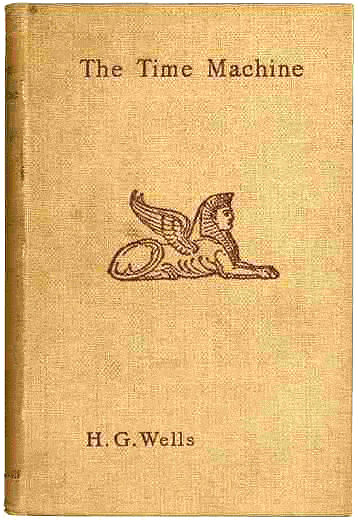
The Time Machine was first published in 1895, making it the oldest book on this list. Considered by many to be one of the greatest science fiction novels of all time, this book coined the term “Time Machine” which is almost exclusively used to refer to any device that allows humans to move through time. The book’s main character is an amateur inventor who lives in London. He is never identified, instead being referred to simply as “The Time Traveller”. Having demonstrated to friends that time is a fourth dimension, and that a suitable device can move back and forth in this fourth dimension, he completes the building of a larger machine capable of carrying himself. He immediately sets off on a journey into the future.
2. Stranger in a Strange Land Robert Heinlein
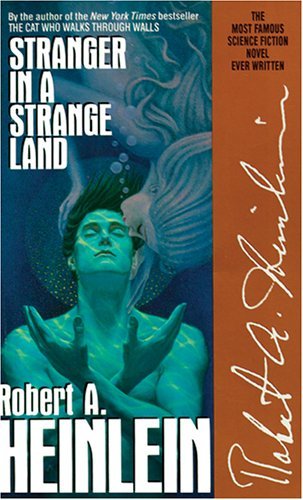
Stranger in a strange land tells the story of Valentine Michael Smith, a human raised by Martians on the planet Mars, upon his return to Earth in early adulthood. The novel explores his interaction and transformation of Earth culture. Typically of Heinlein, this book cover a variety of human taboos, including homosexuality, nudism, and cannibalism. The book introduces the character of Jubal Harshaw who is a central figure in many later books by Heinlein. It won the 1969 Hugo award and has not been out of print since the first publication. Eventually Stranger in a Strange Land became a cult classic, attracting many readers who would not normally have read a work of science fiction.
3. The Lensman Series E E “Doc” Smith
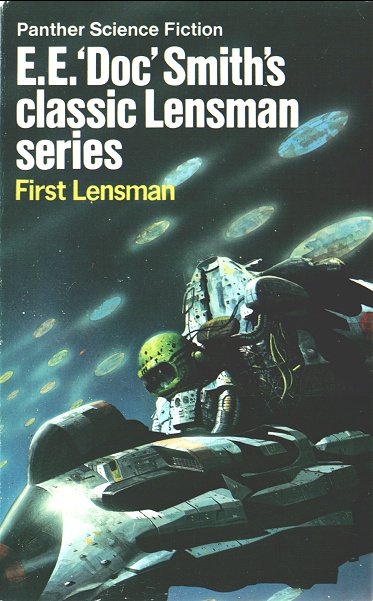
I remember one summer in my childhood when all the other kids were busy hanging out at the movies and playing video games, that I spent every day lying in the backyard all day reading every book that E E Smith wrote (luckily my dad is a keen Sci-Fi fan so he had them all). Doc Smith was my introduction to Science Fiction – and what an introduction it was! The Lensman series was the first set of science fiction novels conceived as a series. It was also the original source which introduced many innovative concepts into science fiction, and a variety of ideas newly introduced in the series later were taken and used to solve non-fictional problems. In this sense the series was ground-breaking and defined an entire genre.
4. 2001 – A Space Odyssey Arthur C Clarke
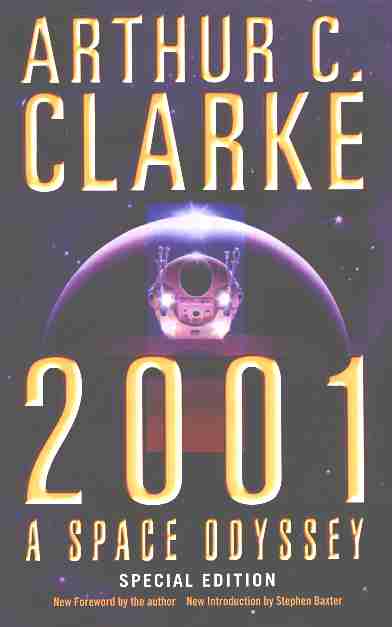
Interestingly, this book was developed concurrently with Stanley Kubrick’s film and published after the release of the movie. In the background to the story, an ancient and hidden alien race uses a mechanism with the appearance of a large crystal Monolith (black in the film) to investigate worlds all across the galaxy and to encourage the development of intelligent life. This novel was followed by three others: 2010 (also made into a movie), 2069, and 3001. As yet no plans exist for the remaining two to be made in to films.
5. Fahrenheit 451 Ray Bradbury
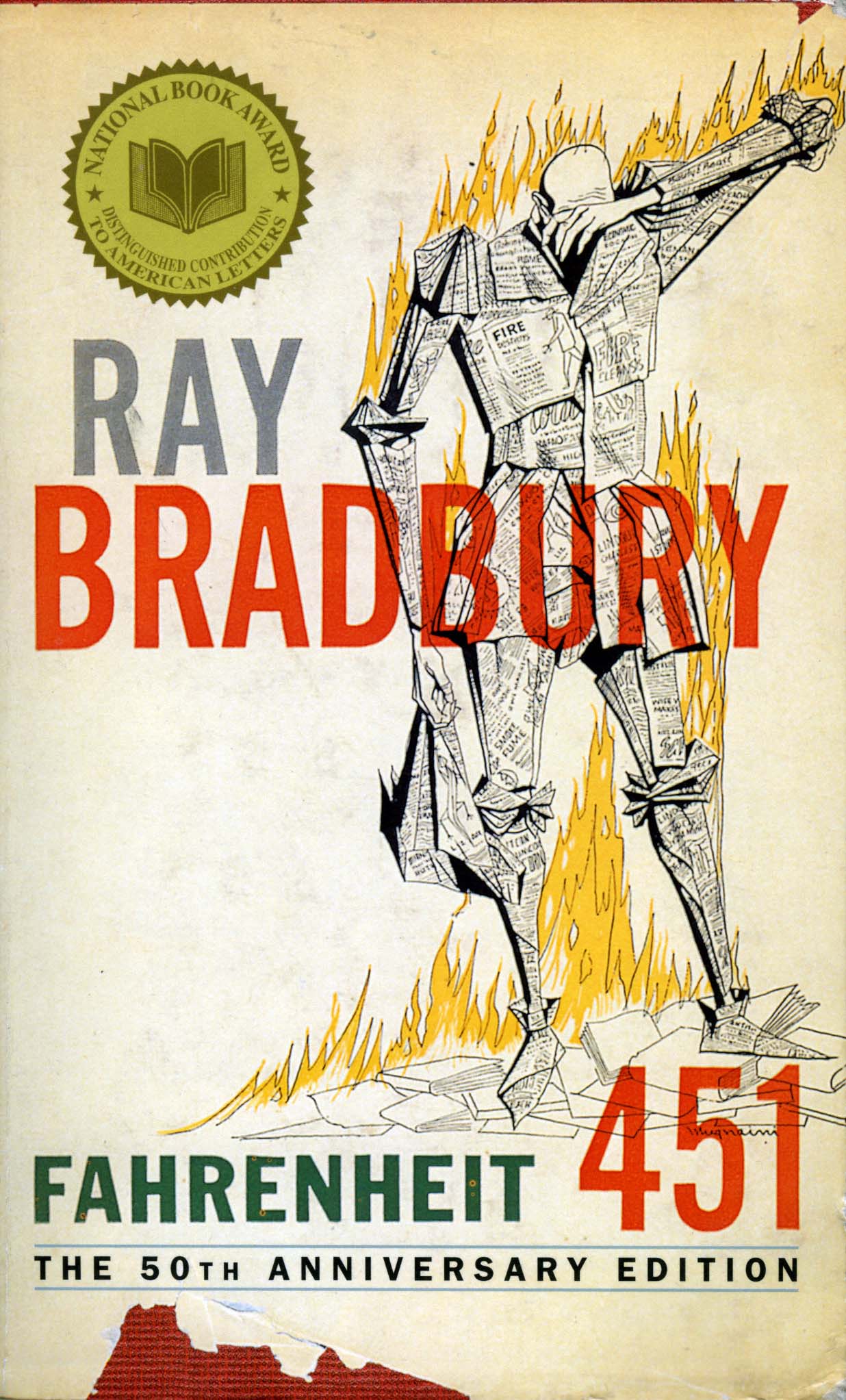
The novel presents a future in which all books are banned and critical thought is suppressed. The central character, Guy Montag, is employed as a “fireman” (which, in this case, means “book burner”). 451 degrees Fahrenheit is stated as “the temperature at which book-paper catches fire, and burns …” It was originally published as a shorter novella, The Fireman, in the February 1951 issue of Galaxy Science Fiction. Fahrenheit 451 takes place in an unspecified future time in a hedonistic and rabidly anti-intellectual America that has completely abandoned self-control and bans the possession of books. People are now only entertained by in-ear radio and an interactive form of television. The protagonist, Guy Montag, is a fireman, certain that his job—burning books, and the houses that hold them, and persecuting those who own them—is the right thing to do.
6. The Foundation Series Isaac Asimov
The term ‘Foundation Series’ is often used to include the Robot Series and Empire Series, which are set in the same fictional universe. In total there are fourteen novels and dozens of short stories written by Asimov, and six novels written by other authors after his death. The series is highly acclaimed, deservedly winning the one-time Hugo Award for “Best All-Time Series” in 1965. The premise of the series is that scientist Hari Seldon spent his life developing a branch of mathematics known as psychohistory, a concept devised by Asimov. Using the law of mass action, it can predict the future, but only on a large scale; it is error-prone for anything smaller than a planet or an empire. Using these techniques, Seldon foresees the fall of the Galactic Empire, which encompasses the entire Milky Way, and a dark age lasting thirty thousand years before a second great empire arises. These books are captivating and if you start book one, you won’t stop until you finish book fourteen.
7. Slaughterhouse-Five Kurt Vonnegut
Slaughterhouse-Five; or, The Children’s Crusade: A Duty-Dance With Death is a 1969 novel by Kurt Vonnegut. Widely regarded as a classic, it combines science fiction elements with an analysis of the human condition from an uncommon perspective, using time travel as a plot device and the bombing of Dresden in World War II, the aftermath of which Vonnegut witnessed, as a starting point. A disoriented and ill-trained American soldier named Billy Pilgrim is captured by German soldiers and is forced to live in a makeshift prison. Billy has become “unstuck in time” for unexplained reasons so he randomly and repeatedly visits different parts of his life, including his death. He meets, and is later kidnapped by, aliens from the planet Tralfamadore, who exhibit him in a Tralfamadorian zoo with Montana Wildhack, a pornographic movie star.
8. The Hitchhikers Guide to the Galaxy Douglas Adams
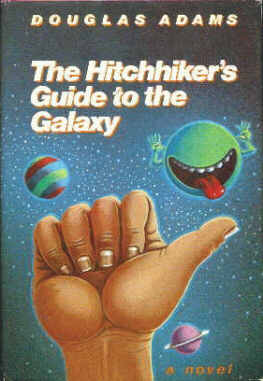
The Hitchhiker’s Guide to the Galaxy is a science fiction comedy series created by Douglas Adams. The series follows the adventures of Arthur Dent, a hapless Englishman who, with his friend Ford Prefect, an alien from a small planet somewhere in the vicinity of Betelgeuse, escapes the demolition of Earth by a bureaucratic alien race called the Vogons. Zaphod Beeblebrox, Ford’s semi-cousin and part-time Galactic President, unknowingly saves the pair from certain death. He brings them aboard his stolen spaceship, the Heart of Gold, whose crew rounds out the main cast of characters: Marvin, the Paranoid Android, a depressed robot, and Trillian, formerly known as Tricia McMillan, a woman Arthur once met at a party who he soon realises is the only other survivor of Earth’s destruction. After this, the characters embark on a quest to find the legendary planet of Magrathea and the Question to the Ultimate Answer.
9. Dune Frank Herbert
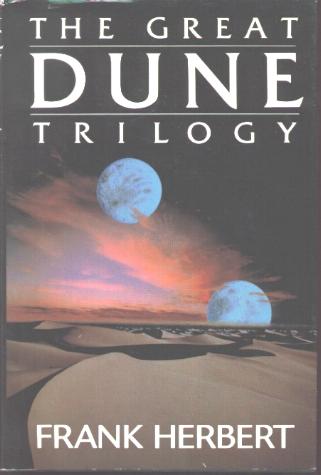
Dune is a science fiction novel written by Frank Herbert and published in 1965, and is frequently cited as the best-selling science fiction novel in history. Dune is set far in the future amidst a sprawling feudal interstellar empire where planetary fiefdoms are controlled by noble Houses that owe allegiance to the Imperial House Corrino. The novel tells the story of young Paul Atreides as he and his family relocate to the planet Arrakis, the only source of the spice melange, the most important and valuable substance in the universe. In a story that explores the complex interactions of politics, religion, ecology, technology, and human emotion, the fate of Paul, his family, his new planet and its native inhabitants, as well as the Padishah Emperor, the powerful Spacing Guild, and the secretive female order of the Bene Gesserit, are all drawn together into a confrontation that will change the course of humanity.
10. Neuromancer William Gibson
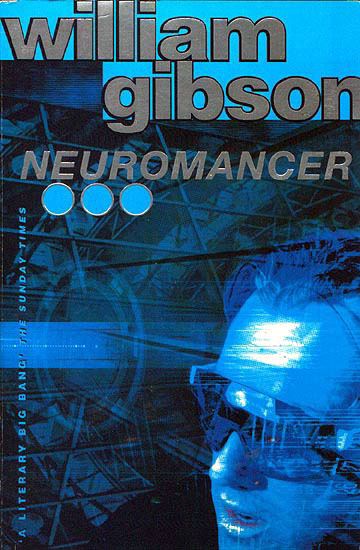
This ’80s novel caused a sensation when it was published. Set in a near-future world, this novel helped to popularize the cyberpunk genre. The novel uses visual power and imagery it’s predecessors were not able to achieve. The main character of Neuromancer is Case, a console cowboy, who, by linking his brain directly with computers, pirates data kept in the cyberspace matrix. This is simulated by a worldwide database with a crippled nervous system. With the aid of Molly (who has concealed cybernetic weapons), they embark on a violent adventure.
11. Do Androids Dream of Electric Sheep? Philip K Dick
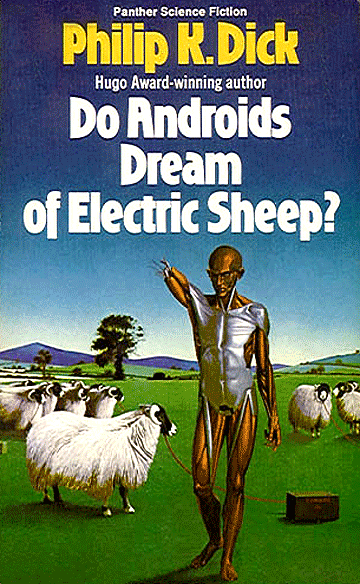
Published in 1968, this novel, even today, is years ahead of its time. Set in the future, the World War had obliterated millions with entire species extinct. This causes the humans to look for a new home planet. However, large corporations build artificial animals, which look extremely realistic, and are successful in creating artificial humans, used for slave labor. This causes great fear amongst the human population and the androids are subsequently banned. The androids are on the run, and Rick Deckard is brought in to hunt down the escapees to “retire” them. This book was the inspiration for Blade Runner.
12. Gateway Frederik Pohl
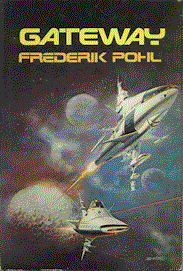
Winner of both the Hugo, and Nebula Awards, Gateway is the story of the ultimate futuristic goldrush! Set in the 21st century, Gateway – a large asteroid – has been found; containing hundreds of ancient space ships. All of these ships have pre-programmed courses set. Little is known about the builders of these ships, the Heechee. The curious humans explore the destinations that are preset which result in either vast wealth, or death. The two main characters are Robinette Broadhead, who becomes a prospector, and Sigrid, his digital psychotherapist. Much of the novel consists of Broadhead’s conversation with Sigrid, interspersed with his memories of Gateway and the journeys he has taken in the Heechee ships. A slow moving thinking person’s novel which builds to an amazing crescendo.
13. Ender’s Game Orson Scott Card
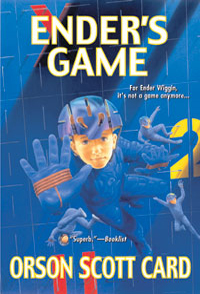
Taken from home at the tender age of 7, surrounded by enemies, with no hope and impossible odds, he is Earth’s last hope. Ender excels in the field of combat. The invasion of the alien insects ‘buggers’ looms over the Earth. Ender is put to the test when he leads Earth’s defensive and retailitory attack against the aliens. The dialogue, visuals, and details bond you to the characters and make this story incredible.
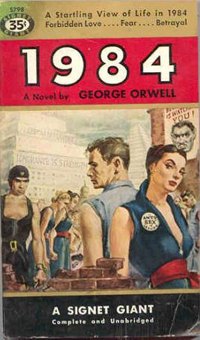
14. 1984 George Orwell
George Orwell wrote 1984 a year before his death to show the world the grim and bleak future of a society subject to totalitarianism. It’s a disturbing and chilling story of Big Brother, where sex is frowned upon and only to be used for reproductive purposes. It was written in 1949, four years after the end of WWII and the paranoia and fear that arose from that time, as well as the threat of communism, gave birth to 1984. In the novel the world has been grouped into three opposing forces: Oceania, Eurasia, and Eastasia. Winston Smith, of Oceania, is living in London, a society where you are monitored constantly through telescreens which are in every room. Even if you are physically alone, you are always being watched and individualism is forbidden. The government provides the ‘entertainment’: movies and music. Crime is monitored by the Thought Police, an elite and secretive government organization that can erase you and all records of your existence.
15. Brave New World Aldous Huxley
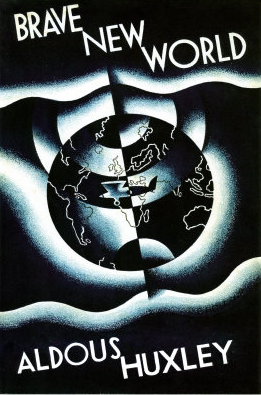
Huxley is one of my favourite writers. Brave New World is set in a dystopian future which anticipates developments in reproductive technology, biological engineering, and sleep-learning that combine to change society. The world the novel describes is a utopia, though an ironic one: humanity is carefree, healthy and technologically advanced. Warfare and poverty have been removed and everyone is permanently happy. The irony is that all of these things have been achieved by eliminating many things that humans consider to be central to their identity — family, culture, art, literature, science, religion, and philosophy. It is also a hedonistic society, taking pleasure from promiscuous sex and drug use, especially the use of soma, a powerful drug taken to escape pain and bad memories through hallucinations.
I must, of course, give a tip of the hat to Jules Verne who should be on the list but I just couldn’t decide who to cut in his favor.
Contributors: Ryan Sweeney, and Fritha Keith


Leon: heh okay – at least compromise
Came upon this site today and know I will spend too much time here. Enjoyed your list. I’ve read some and you and the commentators have tempted me to read others. Naturally, I read all waiting for someone to list my favorite. Not finding it, I recommend “The Man Who Fell To Earth” by Walter Tevis (better known perhaps for “The Hustler”. If you are not familiar with TMWFTE, I think you will find it beautifully written and profound. It also will break your heart.
I just left a rather long comment that did not send (If it did, I apologize for the repetition). I’ll be briefer here. I enjoyed reading your list and especially appreciated your commentary. I will add the ones I have not read to my list as well as several recommended by your readers. Naturally, I looked at the list and each comment for a reference to my favorite: “The Man Who Fell To Earth” by Walter Tevis (perhaps better known for “The Hustler’). Do you know this work? I think it is profound and funny in parts; but, ultimately, it will break your heart.
Thanks for the list; keep them coming.
Joan: I have not read The Man Who Fell to Earth – but I will definitely do so now – what a great recommendation! Thanks
First time on site. Third time trying to leave a comment. I’m registered now, so here goes. I had many nice things to say about you, your list, and your readers and there lists, but you’ll just have to take my word for it. I’m all out of time. Here is my recommendation: “The Man Who Fell To Earth” by Walter Tevis. I’m surprised no one mentioned it. Does anyone know it? It is profound and funny, but ultimately heartbreaking
Liked the list!
*their lists–sorry
jheffernan: sorry – that is probably my fault. I was changing a bit of the code in the background. I see all three of your comments. Sometimes if you get an error, the comment has still posted – so if it happens again just refresh the page and check.
Thanks
I would argue for the second half of the “Amber” series. The original five are much more fantasy. Ghostwheel helps kick the second five to SF. If you want a Zelazny that is a cover-to-cover one sitting, Damnation Alley fits that bill.
Let’s here it for RA Heinlein! I started with him more than 30 years ago. Don’t remember my first, but Farmer in the Sky was one of them. If you don’t like a lot of ***** in your SF or Sci Fi, then avoid everything RAH wrote. Oh, and a lot of other fabulous writers.
How about some Viehl (sp?)? I’m waiting for something new from her.
All y’all think alternative history isn’t truly SF? What about Turtledove’s Colonization series? Or Eric Flint’s Ring of Fire? Ya, it’s kinda along the lines of Guns of the South, but still . . ..
There are a couple of others who have ventured into alt history, including Richard Dreyfuss, but that’s all I can pull to mind.
More Vonnegut!!!
Cat’s Cradle?
Sirens of Titan?
I’ve read, enjoyed and learned from all but two on the list—which two, I’ll never tell—but some of those authors convinced me to become a sci-fi writer myself.
http://www.ninjabearpress.com
Thanks to those of you who also recognized “A Canticle for Leibowitz”! A very prescient work that anticipated so much of what we now take for granted! As for “Hitchhiker’s Guide”? Hey great stuff! Who said science fiction has to be serious?
Amber, you are right about Heinlein except for one. My favorite book of his would have to be “The Moon is a Harsh Mistress” and has really no ***** in it. Perfect for those that can’t handle some of his more extreme books.
u fogot to put scientology on ther, dunno if its got a book, but its a great bit of science fiction
“Ender’s Game”, meh – read the short story instead, it’s much tighter.
“Weyr Search”, Ann McCaffrey (again, the original short story. The thousands of pages of typing that followed is a waste of your time.)
“R.U.R.” Karel Capek, one of the most formative robot / what’s a human? novels.
“War of the Worlds”, H.G. Wells
“Left Hand of Darkness”, LeGuin – the ideas may be related to Wolf’s Orlando, but the execution, breadth, and depth are hard to find in any other SF writing. A little preachy, but not heavy-handed as in “Planet of Exile” or “The Word for World is Forest”, for instance.
“Fantastic Voyage” Asimov – straight adventure, and who can forget Welch in the scuba suit in the movie?
“Canticle for Leibowitz” second the recommendation
“Earth Abides” George R. Stewart, as long as I’m thinking about end-of-the-world.
If I were making the list, I’d pair “The Time Machine” with “The Invisible Man”. You mentioned Asimov’s Robot series along with Foundation, so you could do the same for Wells.
I could never get into The Lensman Series E E “Doc” Smith, but I acknowledge that many others thought it great.
Fahrenheit 451, Neuromancer, Gateway, 1984, and Brave New World all do belong on this list, as, of course do something from Heinlein, Asimov and Clarke. One may quibble about which books by Heinlein {Tunnel in the Sky}, Asimov {Robot series} and Clarke {Rendezvous with Rama} belong on the list (and I like what you did with the Asimov entry, although I feel strongly that his Robot series was better and more influential than Foundation), but something from each does belong on the list
I agree with Revie that Vernor Vinge’s A Deepness in the Sky and A Fire Upon the Deep are great, but so is “Marooned in Real Time.”
Many have mentioned several of Neal Stephenson’s books, but few if any have mentioned his “Diamond Age,” which I find to be his best science fiction so far.
Having read “Do Androids Dream of Electric Sheep?” after watching the excellent Blade Runner, I found the book to be a severe disappointment. One of the rare cases where the movie was better than the book it came from. Everyone else I’ve talked with who went out to read the book after seeing the movie agrees.
You list Dune, but show the cover of the Trilogy. In my opinion, this is a mistake. Dune was great. Its sequel, not so great. The sequel to that…
To the list of suggested works by Roger Zelazny, I add, “Eye of Cat”, “My Name is Legion”, and “Doorways in the Sand”.
Also for your consideration, I suggest C.J. Cherryh’s Chanur series, Cyteen Trilogy and “Forty Thousand in Ghehenna.”
I also have to second “Earth Abides” as a great book, but I’m not sure that it quite belongs on this list.
I’ll be very, very short.
))))
Stanislaw Lem!
Fiasco, His masters voice, Solaris….
well, great list, but this is my favorite 15
1.A.Clarke: Robots series
2. F. Herbert: Dune series(all of it)
3. R. Zelazny: Lord of Light + Amber series(I know it’s fantasy, but man, it’s cool)
4. R. Heinlein: Ringworld series
5. Iain M. Banks: Player of Games
6. Lois Mcmaster Bujold: Vorkosigan series
7. D. Adams: The Hitchhikers Guide to the Galaxy
8. R. Morgan: Takeshi Kovacs series
9. Alastair Reynolds: Chasm City
10. D. Koontz: Odd Thomas
11. W.Gibson: Neuromancer
12. D.K.Moran: The Ring
13. D. Simmons: Hyperion series, screw Endymion crap he really didn’t have to do them
14.Kim Stanley Robinson: Mars trilogy-a long and sometimes hard read, but great nonetheless
15. Gene Wolfe:Urth – Book of the New Sun
Did you consider Vernor Vinge’s A Fire Upon the Deep? It’s the most recent classic that I can think of.
I like this list, all except #2.
R.A.H. himself stated, in “Number of the Beast” ( which personally I would put in the #2 slot) that even he hated that novel, and that the only reason he wrote it was for money.
Don’t get me wrong, “Stranger” is a great read. But any true R.A.H. fan would never place it that high on a list of best Sci-Fi novels of all time.
A comment on a previous comment.
Comment # 138. ( Marius) R.A.H. did not write the Ringworld series. That series was written by Larry Niven, possibly most famous for his collaboration with Jerry Pournelle on the “Mote in God’s Eye” duology.
Once again, great list.

I really enjoyed reading the comments and other peoples recommendations. I do agree Stanislaw Lem is a wonderful sci-fi write. Some of my personal favorites of his are The Tales of Pirx The Pilot, The Futurological Congress, Return to the Stars, lastly, one of my all-time favorite books, The Cyberiad. I can recite the first story (How The World Was Saved) from that book by memory.
I have yet to check out Fiasco or his other works…
I am quite shocked that not more people have listed Arkady and Boris Strugatsky’s Roadside Picnic.
Also, jfrater, you should do a follow up of this list based on the recommendations listed by fellow viewers here. It’s just an idea.
I believe that Enders Game is a fantastic book. it reaches topics further than Sci Fi. I prefer to read it from a psycological point of view. I think it is a brilliant illustration of how the borders between genius and madness flirt.
First of all I would like to, once again, say how much I have (and still do) enjoy this list and all the comments that it has evoked! I had posted a comment on August 26th, 2007 at 6:29 am, alas when I tried to log in it said that I do not exist! So I registered again!
I see that many people put their own list or particular books and authors that they thought should have made the list. I am a R.A.H fanatic so if I had my way the top fifteen books would have all been by Robert, but that’s just me. He changed my outlook on life and the way I thought about many things.
Here is a list of some of my other favourites:
Neverness: David Zindell
The Amtrack Wars: Patrick Tilley
The City and The Stars: Arthur C Clarke
Arthur C Clarke: Robots Series
Why Call Them Back From Heaven: SIMAK
Battlefield Earth: L. Ron Hubbard
It would be remiss of me if I did not add that these list/lists do not contain a hundredth of what I have read. All of these wonderful books have left an indelible mark on my psyche and I am grateful to the genius that is the way of true story tellers. I have loved them all!
Piers: I love that too – it really pleases me that almost all of our comments are well thought out and really add value to the lists. We are very lucky.
Enders game is an excellent novel, it is used by the Marine corps to hel teach officers the psychlogy of leadership. Also Treason by Card is a good book as well. RAH is one of my all time favorite writers I have read all is novels and they are all great.
I am currently in the middle of The Time Traveler’s Wife by Audrey Niffenegger and I must say, it is very, very good – maybe even great.
John Brunner’s Shockwave Rider really belongs on this list. Consider that it was written in the early 70′s….
i’m currently reading a collection of science fiction short stories, including “Martian Odyssey”, “Arena”, and Asimov’s “Nightfall”. Top 10 Science Fiction short stories would make a good list.
I just finished Matter by Iain M Banks. It’s good (finally, another Culture novel!)but, IMHO, his best is Use of Weapons. It makes my personal top 10…
I love Sci Fi and have been researching the genre for 12 years so far. My prefernce is reading for pure pleasure and escapism so my list might be a little different than many. I’ve read 240 different authors so far.
Here’s my list of favorites:
Fred Hoyle – The Black Cloud (1957) [ p.251 ]
James P. Hogan – Inherit the Stars (1977) [ p.140 ]
Joe Haldeman – The Forever War (1974) [ p.218 ]
Frederik Pohl – Gateway (1977) [ p.278 ]
John Wyndham – The Day of the Triffids (1951) [ p.228 ]
Arthur Charles Clarke – Childhood’s End (1953) [ p.222 ]
H G Wells – The First Men In the Moon (1901) [ p.220 ]
Edgar Rice Burroughs – A Princess of Mars (1912) [ p.159 ]
Kurt Vonnegut jr. – The Sirens of Titan (1959) [ p.326 ]
Gordon R. Dickson – Dorsai ! (1959) [ p.249 ]
Alan Dean Foster – Midworld (1975) [ p.179 ]
David Feintuch – Midshipman’s Hope (1994) [ p.391 ]
Robert James Sawyer – Calculating God (2000) [ p.334 ]
John Steakley – Armor (1984) [ p.426 ]
Walter Jon Williams – Dread Empire’s Fall: The Praxis (2002) [ p.438 ]
Francis Paul Wilson – Healer (1976) [ p.261 ]
Fredric Brown – What Mad Universe (1949) [ p.198 ]
Roger MacBride Allen – The Ring of Charon (1990) [ p.500 ]
Kevin James Anderson – Assemblers of Infinity (1993) [ p.355 ]
Edwin Lester Arnold – Gullivar of Mars (1905) [ p.193 ]
Gregory Albert Benford – In The Ocean of Night (1976) [ p.333 ]
Alfred Bester – The Stars My Destination (1956) [ p.197 ]
Stephen R. Donaldson – The Gap Into Conflict: The Real Story (1991) Adult Reading only [ p.241 ]
David Gerrold – A Matter For Men (1983) [ p.397 ]
Megan Lindholm – Alien Earth (1992) [ p.385 ]
George R.R. Martin – Tuf Voyaging (1978-1985) [ p.374 ]
Elizabeth Moon – Trading in Danger (2003) [ p.294 ]
John Scalzi – Old Man’s War (2005) [ p.313 ]
Raymond F. Jones – This Island Earth (1952) [ p.191 ]
Tom Godwin – ” The Cold Equations ” (1954) short story [ p.23 ]
James H. Schmitz – ” Gone Fishing ” (1961) short story [ p.57 ]
Thomas J. Ryan – The Adolescence of P-1 (1977) [ p.280 ]
Poul William Anderson – Tau Zero (1970) [ p.208 ]
Isaac Asimov – Nemesis (1989) [ p.362 ]
Isaac Asimov – Second Foundation (1953) [ p.191 ]
Orson Scott Card – Ender’s Game (1985) [ p.384 ]
Stephen Coonts – Saucer (2002)lighthearted humor [ p.340 ]
Michael Crichton – Sphere (1987) [ p.335 ]
Ann Carole Crispin – Starbridge (1989) [ p.306 ]
Robert L. Forward – Rocheworld (1981) [ p.470 ]
Edmond Hamilton – The Star Kings (1949) [ p.190 ]
Dean Koontz – Phantoms (1983) Sci-Fi-Horror [ p.352 ]
Alan E. Nourse – The Universe Between (1951) [ p.160 ]
Jerry Pournelle & Larry Niven – The Mote in God’s Eye (1974) [ p.560 ]
Bob Shaw – Orbitsville (1975) [ p.224 ]
John Herbert Varley – Titan (1979) [ p.277 ]
David Weber – Path of the Fury (1992) [ p.423 ]
Jack Williamson – The Legion of Space (1935) [ p.191 ]
Greg Bear – The Forge of God (1987) [ p.473 ]
Gregory Albert Benford – In The Ocean of Night (1976) [ p.333 ]
Ben Bova – Venus (2000) [ p.382 ]
Edgar Rice Burroughs – Tarzan of the Apes (1912) [ p.245 ]
Ursula K LeGuin – The Lathe of Heaven (1971) [ p.175 ]
Murray Leinster – The Wailing Asteroid (1961) [ p.200 ]
Kim Stanley Robinson – Red Mars (1993) [ p.572 ]
Carl Sagan – Contact (1985) [ p.448 ]
hi – no idea if it’s a great list or not becuase I’ve only read one of the books – The Hitchhiker’s Guide to the Galaxy, actually. Amazing book, as I love sarcastic humour like that. Anyway, I have a bit of a problem – at school (I’m 13 and in yr 9), we have to choose 2 books with a theme that connects the two of them, and then write a comparative essay on them. There were a few example pairs, such as Hitchhiker’s Guide and The War of the Worlds, the theme being the final frontier. I read Hitchhiker’s Guide, loving it, but when I started The War of the Worlds, I didn’t particularly like the old Victorian-like english that Wells uses and the depressing plot. I know I’m being a typical teenager and a bit fussy about that, but I don’t like being forced to read a book. So, are there any other books you could suggest with a related theme to Hitchhiker’s Guide that you think I could enjoy? I’ve tried looking myself, your list being inspiration, but I’m finding it hard thinking of a theme in the first place for Hitchhiker’s Guide. Mmm…any thoughts? Thank you for any help you can give me!
Hi Navessa , if you enjoy Douglas Adams – Hitchhiker’s Guide to the Galaxy(1979)you will also enjoy:
1.Robert Sheckley – Mindswap(1966)
2.Rudy Rucker – Master of Time and Space(1984)
3.Spider Robinson – Callahan’s Crosstime Saloon(1977)
Most people recognize that Hitchhiker’s Guide was strongly influenced by Sheckley’s 1966 Mindswap. I understand that Adams admitts to this himself. Have fun !
Ice
Just a comment wrt marius above who lists :
” 4. R. Heinlein: Ringworld series ”
In actuality The Ringworld series was written by Larry Niven (starting with Ringworld in 1970)
Hi
This list obviously misses Stanislaw Lem’s books (Fiasco, Star Dairies for instance). How comes that writer considered once as most widely read (check Wikipedia) has not appeared even once?
Simon
Hi Simon, not sure if you were refering to the omission of Lem from my list in particular. I have read his 1974 novel “The Futurological Congress” (p.149). It was ok but not fantastic in my opinion. Perhaps his other work is better.
Usually what I do when I’m researching a new author is read a hundred or so reviews on the various novels an author has written. Then I select the book that appeals to my preferences the most. If I read it and don’t particular love the work then that author is pretty much dead from my point of view.
The way I look at it, there are so many hundreds of authors to try out they only get the one shot. Hopefully all the research I do in advance of selecting the book to read will help me avoid missing something great. Can you imagine if I had read Pohl’s “In the Problem Pit”(1976) first and killed that author from further consideration. I would have missed his brilliant and thoroughly enjoyable ” Gateway “(1977).
Ice
Hey there Ice! I hear what you are saying. If I may be so bold, and to give some advice, it would be this: I used to read anything remotely to do with Science Fiction and then one day I found that I had become so selective that I could not find books that “fitted” the criteria that I had set. The minute I went back to grabbing a book and just reading. (If it was real crap, then I put it down!) All I can say is that the magic came back for me! I discovered stories and authors I would never have read if I stuck to the tried and tested! Cheers.
Hey Piers, That’s not a bad suggestion you’ve made – to add in a random element to my search process. It’s what I did when I was younger. In fact that’s how I first came across Frederik Pohl’s Gateway(1977) which stands to this date as one of my top 20 or 30 favorite novels of all time.
My plan, once I’ve finished phase 1 of my “research” project( 12 years so far! ), is to go back to my favorite 40 or 50 authors and read the rest of their stuff. It’ll give me something to do as the years drift by and the demons of age attempt to destroy my will to live. LOL !
Some background on my Sc-Fi Research Project in case anyone is interested ( I’d be shocked if that were the case ! ).
When I was 12 my brother gave me A Princess of Mars(1912) by Edgar Rice Burroughs for . I loved that book. All 12 year olds should read that book. It’ll get them hooked on reading for life. Of course I read the entire series. There’s 11 in total. I went on to read another 35 novels by the same author and enjoyed most of them. He wrote Tarzan(1911). Which stands as one of the best know stories ever written.
Alas, once a guy enters his teens reading drops off the list of priorities and other pursuits move into the forefront. When I graduated from University and was finally done with reading for necessity I decided to see if I still enjoyed reading Sci-Fi.
At the time there was no such thing as the internet so trying to find information on who to read was very difficult. Asking for recommendations was hit and miss since EVERYONE LIKES SOMETHING DIFFERENT. I realized that this is the most absolute truth in fiction.
I knew 2 different people who had read a book called Dune(1965). One guy loved it and the other guy hated it. But wait, its the same book, how can that be ? Well, its as simple as different people like different things. So I suppose it goes without saying that the important thing is to be able to find the novels that YOU enjoy.
So that’s what I set out to do. Listening to other people’s recommendations I came across some stuff I liked and a lot of stuff I hated. It almost put me off reading Sci-Fi altogether.
When the internet came along it became my primary source of information. I no longer asked people I knew for recommendations and thereafter relied on my own internet research.
The good thing about the internet is that you can get 30 or 40 different people’s reviews/opinions on the same book at the clik of the mouse. You can cross correlate several “top 100″ or “best of” lists in a matter of minutes. After a while you get to be able to read between the lines and root out the stuff that you’ll probably like.
My success rate ( ie. finding a book that I LOVE is around 80% ). I still come across some that slip past my radar and make me squirm with annoyance, but not often.
I’ve printed off about 60 different “Best of” lists including of course Hugo, Nebula, Philip K Dick award, etc etc and have methodically gone through EVERY list and researched ALL books written by every author. I keep notes in four 3 ringed binders of all the research for every book/author. I have about 800 pages of notes so far – 5 to 10 novels per page of notes !
When I find a book that looks promising I order it from the inter-library loans department and it usually shows up in a couple weeks.
Once I’ve read the book I write a one or 2 paragraph summary of my thoughts on the authors style and whether or not I enjoyed the book. I then give it a rating based purely on my enjoyment level. An 8/10 would be a book that I loved reading. A 9/10 would be a stunning novel that uttering absorbed me, thrilled me, excited me, moved me, a book that I always looked forward to getting back to as soon as I could, a book that I never wanted to end …
A 10/10 , well … I’ve only given a 10/10 to one novel. In December of 2005 … frequently I could read no more than one or 2 sentances at a time. I would have to stop and breath and relax for a moment before going on. My emotional response was too intense. I’ll probably never give another 10 as long as I live.
Anyway, I’m rambling… So I keep a database of all the books I’ve read ( 331 I believe ). Alphabetic by author (243 authors). With the title and year as well as a page count, my rating and the exact date when I read the book. When I’ve got my top 50 authors list I’ll go back and read the rest of what they’ve written. That should keep me busy for a few more years !
One might say that I am obsessive. They would be correct.
Ice
Hey there again Ice!
Wow, what a response! Hell man, you sound like someone who I would like to meet! I really would love to know what book received the coveted 10/10! Perhaps one or two that received a 9/10 as well! I love books with a passion, but have never gone quite as far as you! It sounds fascinating, I would not mind reading the notes in your four 3 ringed binders that you have kept for the books and authors! Perhaps you should put them up on your website and let up peasants have a gander. I am sure that it will make some brilliant reading! This site and the list that jfrater started was found by luck and I have to tell you and all the other people here, what a really cool experience this has been and still is! It’s been a pleasure to meet you Ice, jfrater as well. Also to all the other folk here for their excellent comments and book lists. Keep the comments coming! I look forward to the E-Mail notifications when new comments are added.
Stay well all, Piers
This list & all the subsequent comments are amazing! I’ve read many of the books listed & agree 100%, but now I see I have a long way to go..
I think we definitely need someone to invent a direct mind upload ala The Matrix training programs other wise I’ll need to live to 200 to get them all in!
Thanks to all,
Zman
Oh dear god. This is too much fun.
As a professional bookseller and former scifi junkie (my addiction has turned to music and my reading to more diversity) I have so many opinions on this subject its absurd.
I like the list. I don’t agree, but I cannot argue with the selections being great. Many of the books selected are from people who are so important to scifi that one feels the need to select them, though I would not call Clarke a great writer. A great mind, though not a great writer. And while I love Enders Game, I do agree that it is a bit juvenile in its style, akin to much Bradbury.
I’m disappointed that more people didn’t mention John Brunner, particularly Stand on Zanzibar, but perhaps thats because him, as well as Roadside Picnic by Strugatsky have largely been unavailable in the US.
On the contrary, I do defend the Heinlein choice.
Much thanks to the list, and to all the comments, as you have reminded me of a few novels that my more educated friends have recommended over the years. Im particularly enjoying the conversation between piers and icecube as well
-j
Ice – ok, I realise that this is specifically a sci-fi list, but it is interesting to come across someone who is, like myself, seemingly obsessive about books. I must have thousands; my garage is unusable due to boxed books that will not fit in the shelves (or on the floor) in my house, and I am currently looking for another garage to rent because I am out of space in my own one. Whilst I do not take the trouble to maintain filed notes like you do (oh…I wish you hadn’t told us that!) I did make a start cataloging my books a year ago, starting with modern ones for which I am able to scan ISBN barcodes (older ones, of course, will need to be entered into the database manually).
My obsession is also characterised by the fact that :
- I still have the first “real” book I read right through at age 6;
- if I come across a copy of one of my favourite books I will often buy it even though I already have it (multiple copies in some cases…I just can’t let it sit there…!!); and
- for many of my favourite books I can tell you the shop/place where I found it and can, in some cases, still remember the moment I discovered it.
I also (modestly) collect literary first editions and antiquarian works and have, on more than one occasion, paid many hundreds of dollars for a book when it seems to me that I am probably the only person on earth who wants it! It goes without saying that once I have it, I carefully put it away and continue to enjoy a “reading” copy of the same work. Anyhow, thank God for AbeBooks and eBay !! BTW, don’t tell my wife about the “hundreds of dollars” thing
Hmmm…reading the above, maybe I am just “obsessive” and the book thing is ancillary
I can still remember when I was a flat-broke university student and there was this book I came across that I just had to have; a cheap(ish) paperback biography. Upon getting a part-time job, I would go every lunchtime and read a chapter before hiding the only copy of the book behind others so it wouldn’t get sold before I had the money. It’s still one of my favourite books – the anguish I went through to get it probably adds to my enjoyment of owning it. (FWIW, the book was called We Will Not Cease; its an autobiography of Archibald Baxter, detailing his ordeal as a conscientious objector in WWI; Baxter is also the father of one of NZ’s most famous poets). Naturally, I have more than one copy of this now
Whilst my reading habits extend from biography, finance, science, sport, literature, art, mathematics, literature (prose / poetry) etc., the one thing I have no appetite for is science fiction ! And, believe me, I’ve tried. for example, Stranger in a Strange Land bored me, I’m sorry to say; as did 2001:A Space Odyssey. As an aside, my friend’s sister was married to Douglas Adams and I even turned down a vague opportunity to meet the guy once (which, of course, I regret now). I just couldn’t get excited over it, whereas my sci-fi friends couldn’t believe my nonchalance.
It’s pleasing to see the great Fred Hoyle on your list above (Sagan too, of course); Hoyle was a scientific giant in his day – though, admittedly, his views on the “big bang” are a litte unorthodox by today’s standards
Ice, a coupla questions :
1. do you collect editions of your favourite authors eg. first or signed eds.? Or is it “merely” the reading that does it for you?
2. did you ever think of collating all of those aspects (style, characterisation, plot etc) that represent a great sci-fi novel to you…and then writing one yourself ? Or, maybe you’ve possibly tried this already…?
Lastly…please do not keep us in suspense; what was the 10/10 book ?
Hi Piers, Ocireloki, Kiwiboi, its always a pleasure to interact with like minds. Perhaps this is one of the truths of the human experience.
Piers, I plea guilty to dangling the unnamed “10/10 book” out there. Shameful of me to do so. I was curious to see how people would respond. Something that I realized years ago, as I mentioned above, is that different people like and love different things. This is true of course of books, movies, women, food, sleeping positions and so on and so forth. My 10/10 will probably be different than someone else’s 10/10. I would be reluctant to disclose the title and have someone make an entirely valid comment that the book was terrible in their opinion. On some level it would hurt my feelings.
To be fair though I will provide sufficient data for the truly curious ( or for someone as obsessive as myself ) to identify the title with a few clues. I will warn you that there is one little trick to my game that will make the discovery somewhat unexpected. Think of it as a treasure hunt. Of course you may discover the treasure and find you do not like the colour of the gems. LOL
The author is a winner of the John W. Campbell Memorial Award. The author is also a past nominee of both the Hugo and Nebula awards. The book was first published in 1993 and the author was 35 years of age at the time of the publishing. You will know you have the correct title if you do an Amazon search for the book and discover 16 reviews ( as of 2008may15 – I just checked ). All 16 reviews rate the novel a perfect 5/5. Of all the titles I’ve researched over the years this is the only book that I’ve seen receive 16 perfect scores.
I should mention also that perhaps part of the reason I loved this particular novel was my ability to identify with the main character, his upbringing having been very similar to my own. Sadly with the way society is going these days I suspect many people have gone through similar experiences.
But enough of that ! I find myself out of control once again on another tangent. Who really cares about my 10/10. Its more important for you to find YOUR 10/10. Maybe its on my list. I hope it is.
The best way to determine whether or not my list is of any use to YOU is perhaps to review the titles first. See if there are any that you have read and if you also liked the same title. If so, you can assume that the chances that you will like other titles on my list is therefore greater. If, on the contrary, you find that some of my favourites do NOT appeal to you then my list is quite likely of no use to you. Pretty simple I think.
I’m guessing that my list will be very useful for 40% of people, moderately useful for 30% of people and disastrously useless for everyone else. LOL !
OK , here’s a little info that may help anyone interested in figuring out whether we may think alike and thus whether our reading preferences may be similar. My vocational background is in science. My work is in the area of reflection data signal *****ysis. While I do have an undergraduate degree is physics my brain has had enough of complex thought when 5:00pm rolls around and I would thus be considered a LAZY reader. As I said earlier I read for fun, relaxation, escapism, pleasure. I enjoy books that are involving, intelligent, thought provoking, exciting, mysterious, emotionally moving.
I have ZERO patience for authors that are trying to impress me with their vocabulary. If they’re using a ten dollar word when a 50 cent one will do I think they’re missing the point. This is not a technical manual, you are supposed to be telling me a story. It drives me crazy when they’ve chopped the story into seven or eight separate plot streams that will eventually coalesce towards the end. I can never keep track of who’s doing what and where. If the character count gets up to around 50 or 60 by page 100 its a big negative. If the author insists on inventing bizarre multi syllabic names that I cant even pronounce inside my head I’m not happy. If the sentence structure is awkward or runs on too long it bugs me. Have you read J.D.Salinger’s – The Catcher in the Rye (1951) ? One of the great novels of our time. Its easy to read. The way books should be in my opinion.
In short, I like a book that is compelling and enjoyable yet flows smoothly and easily. When I’m reading a book that I enjoy I don’t even notice that I’m sitting in a room reading. My eyes scan the page so quickly that my brain and my consciousness becomes immersed in the story and I detach from my surroundings completely. For me personally this does not happen if I must stop every third sentence to figure something out. Weird yes ?
For people that enjoy challenging complex innovative difficult literary science fiction that makes you work and struggle while you’re reading then my list is not for you. I actually enjoy the pulp SciFi from the 30′s and 40′s – the good stuff anyway – much of it is drivel – but the good stuff is wonderful ! Take another look at my list. Some of it would be considered ” literary ” fiction and I guess much of it would be pulp.
Ok, enough of that. Back to reality. Ocireloki, you mentioned Strugatsky’s Roadside Picnic (1977) [p.145] which I read in May of 2003. The story involves a zone of alien garbage presumably left behind after visitors from another world landed on earth for a short stay. The stuff they tossed away is both mysterious and dangerous not to mention highly valuable. Brilliant idea in my opinion and highly original. The only reason it didn’t make it onto my list was the author’s focus on forwarding his political opinions rather than on telling the story. Don’t get me wrong , I did enjoy the book. I just felt that it could have been so much more. But some people like a novel with a little more intellectual meat in them and for those persons Roadside Picnic might be perfect. Me, I’m a simpleton. LOL
Kiwiboi, I share your love of books in much the same way. I too had as many as seven or eight hundred books stored in various bookcases all over my house. Not the thousands that you have but more or less the same concept. I loved the sight of them and I loved the feel of them. But eventually I realized that I had focussed more on the collecting of the books than on the reading of them. Much the same way I object to an author who focusses more on the art of writing than on the art of telling a story.
So one day I loaded up a truck and brought them all to a used bookstore. Of course I had to keep my favourite 20 volumes but that was all. After that point I discovered I spent no time at all searching for books and more time reading. Which seemed to make me happy so I stuck with it. Still, I find myself in my office every once in a while pulling out one of my old favourites from decades ago and just feeling the pages, gazing at the cover and joyously revelling in memories that drift back to me from years ago.
You also asked whether I had ever considered writing a novel myself. Certainly my concept of what represents good science fiction writing will differ from someone else’s, but one thing I can say with 100% confidence is that I am absolutely incapable of writing anything. Everything that I admire and search for in good writing is totally beyond my abilities. I write like a buffoon. Numbers I’m not bad with but words – nope, no way, can’t do it. LOL ! Maybe that’s why I admire good fiction so much. Its like magic to me.
But its so funny that you asked because I have fantasized about THAT VERY THING ! I dream about being able to extract all the elements of good writing and a good story and to write the most incredible Science Fiction novel of all time, one that is read and enjoyed by all readers not just readers of Sci Fi. But of course that task will need to be left to someone else. Perhaps once we develop that ” direct mind upload ala The Matrix training program ” mentioned by pianomanzz Zman then my research/database could be cross correlated with James P.Hogans brain and BOOOM !!! – you’d have the thermonuclear novel of the millennium ! But alas, Mr.Hogan is a god and I am a nobody so it’ll never happen. Oh ya, plus, I guess that direct mind upload thingy doesn’t exist yet so that’s a bit of a fly in the ointment … LOL
OK here’s my list again, just in case someone has just joined this site for the first time and doesn’t know what flippin list I keep talking about …
Here’s my list of favourites – Including Publishing Date and Page Count :
Top 100 Science Fiction Books of All Time: ( actually there’s less than 100 )
Top 15 Science Fiction Books of All Time: ( actually there’s more than 15 )
( do you think search engines will be able to pick up on those “Top … Science Fiction” character strings ? )
Intentionally in no particular order at all:
Fred Hoyle – The Black Cloud (1957) [ p.251 ]
James P. Hogan – Inherit the Stars (1977) [ p.140 ]
Joe Haldeman – The Forever War (1974) [ p.218 ]
Frederik Pohl – Gateway (1977) [ p.278 ]
John Wyndham – The Day of the Triffids (1951) [ p.228 ]
Arthur Charles Clarke – Childhood’s End (1953) [ p.222 ]
H G Wells – The First Men In the Moon (1901) [ p.220 ]
Edgar Rice Burroughs – A Princess of Mars (1912) [ p.159 ]
Kurt Vonnegut jr. – The Sirens of Titan (1959) [ p.326 ]
Gordon R. Dickson – Dorsai ! (1959) [ p.249 ]
Alan Dean Foster – Midworld (1975) [ p.179 ]
David Feintuch – Midshipman’s Hope (1994) [ p.391 ]
Robert James Sawyer – Calculating God (2000) [ p.334 ]
John Steakley – Armor (1984) [ p.426 ]
Walter Jon Williams – Dread Empire’s Fall: The Praxis (2002) [ p.438 ]
Francis Paul Wilson – Healer (1976) [ p.261 ]
Fredric Brown – What Mad Universe (1949) [ p.198 ]
Roger MacBride Allen – The Ring of Charon (1990) [ p.500 ]
Kevin James Anderson – Assemblers of Infinity (1993) [ p.355 ]
Edwin Lester Arnold – Gullivar of Mars (1905) [ p.193 ]
Gregory Albert Benford – In The Ocean of Night (1976) [ p.333 ]
Alfred Bester – The Stars My Destination (1956) [ p.197 ]
Stephen R. Donaldson – The Gap Into Conflict: The Real Story (1991) Adult Reading only [ p.241 ]
David Gerrold – A Matter For Men (1983) [ p.397 ]
Megan Lindholm – Alien Earth (1992) [ p.385 ]
George R.R. Martin – Tuf Voyaging (1978-1985) [ p.374 ]
Elizabeth Moon – Trading in Danger (2003) [ p.294 ]
John Scalzi – Old Man’s War (2005) [ p.313 ]
Raymond F. Jones – This Island Earth (1952) [ p.191 ]
Tom Godwin – ” The Cold Equations ” (1954) short story [ p.23 ]
James H. Schmitz – ” Gone Fishing ” (1961) short story [ p.57 ]
Thomas J. Ryan – The Adolescence of P-1 (1977) [ p.280 ]
Poul William Anderson – Tau Zero (1970) [ p.208 ]
Isaac Asimov – Nemesis (1989) [ p.362 ]
Isaac Asimov – Second Foundation (1953) [ p.191 ]
Orson Scott Card – Ender’s Game (1985) [ p.384 ]
Stephen Coonts – Saucer (2002)lighthearted humor [ p.340 ]
Michael Crichton – Sphere (1987) [ p.335 ]
Ann Carole Crispin – Starbridge (1989) [ p.306 ]
Robert L. Forward – Rocheworld (1981) [ p.470 ]
Edmond Hamilton – The Star Kings (1949) [ p.190 ]
Dean Koontz – Phantoms (1983) Sci-Fi-Horror [ p.352 ]
Alan E. Nourse – The Universe Between (1951) [ p.160 ]
Jerry Pournelle & Larry Niven – The Mote in God’s Eye (1974) [ p.560 ]
Bob Shaw – Orbitsville (1975) [ p.224 ]
John Herbert Varley – Titan (1979) [ p.277 ]
David Weber – Path of the Fury (1992) [ p.423 ]
Jack Williamson – The Legion of Space (1935) [ p.191 ]
Greg Bear – The Forge of God (1987) [ p.473 ]
Gregory Albert Benford – In The Ocean of Night (1976) [ p.333 ]
Ben Bova – Venus (2000) [ p.382 ]
Edgar Rice Burroughs – Tarzan of the Apes (1912) [ p.245 ]
Ursula K LeGuin – The Lathe of Heaven (1971) [ p.175 ]
Murray Leinster – The Wailing Asteroid (1961) [ p.200 ]
Kim Stanley Robinson – Red Mars (1993) [ p.572 ]
Carl Sagan – Contact (1985) [ p.448 ]
Enjoy !
Ice
Think of it as a treasure hunt. Of course you may discover the treasure and find you do not like the colour of the gems. LOL
Found it. Well, amazon in the UK is out of stock; so I’ll order it somewhere else.
Actually, Ice, I was a little surprised at the plot, as it is not suggestive to me of (what I perceive to be) sci-fi. Notwithstanding this, it seems to be just the sort of thing I would find totally compellng, so thanks so much for the lead.
And have no concerns on the “don’t blame me if it’s not your cup of tea” thing…I know exactly what you mean, and have so often recommended a book making the same disclaimer
Strangely, your choice reminded me straight away of one of my all-time favourite novels. It’s called One Deadly Summer, written by Sebastien Japrisot, a French crime/thriller writer. It’s a book I read probably once a year (I originally purchased a Penguin p/b edition maybe 20 years ago). There is a film of the story, but I found it disappointing. Japrisot is also the guy who wrote A Very Long Engagement, which, as you will know, was recently made into a movie (which I have yet to see).
Have you read J.D.Salinger’s – The Catcher in the Rye (1951) ? One of the great novels of our time. Its easy to read.
LOL, I absolutely hate that book; and, personally, I found the narrative style very, very irritating. Everybody else seems to love it, so maybe I am in a minority of one
But I agree 100% with you about the annoyance of writers whose pretentious style interferes with the story. This one does exactly this for me.
But its so funny that you asked because I have fantasized about THAT VERY THING ! I dream about being able to extract all the elements of good writing and a good story and to write the most incredible Science Fiction novel of all time, one that is read and enjoyed by all readers not just readers of Sci Fi. But of course that task will need to be left to someone else.
Ice…just DO IT ! Would the enjoyment and fulfilment of the writing process not be reward enough? So what if your hopes of publishers fees, author’s royalties, adoration of millions, female stalkers, movie rights etc. etc. don’t come to fruition…!!??…hmmm…ok, sometimes it’s best to leave well enough alone! Just kidding, of course
Seriously though…if you feel so inclined, why not at least give it a try?
And Ice..thanks again for the hint and the interesting comments (I include the other posters in this too – keep it up guys!)
Recognising that jfrater published his own list of favourite books, a Your View of the “10 Books You Would Take to a Desert Island – And Why?” would be a great list
Kiwiboi, I like your honesty ! So you’re one of the guys that hated “The Catcher in the Rye”. While I did mention it as one of the “great novels of our time” and as I understand it is broadly considered as such, it didn’t appeal to me personally either. Although when I checked my database I gave it an ok rating:
J.D.Salinger – The Catcher in the Rye (1951) [ 7.0-6.5/10 p.214 ] 2006may19-2006may23
Not quite the “hate” rating you gave it but no where near the loving comments lavished by literary critics. I guess that just confirms what we knew already, that different people like different things.
I did like the part where the main character got into an in depth discussion with a cab driver about what they do with the fish in the ponds of Central Park NYC. Our hero assumed they would need to remove them every year before the winter freeze up. The cabbie was adamant that the fish were able to continue to live while frozen in the ice by absorbing nutrients through their skin. ” Its their nature ” he would say. That line always cracks me up. In so many ways its an accurate observation one could use to explain the seemingly irrational actions of so many humans on this planet. Its their nature.
Now I’m going to say something that will both shock and displease many : I secretly believe that thousands of people have read ” Dune ” as their first foray into Science Fiction (having heard that it is THE best Sci Fi ever written) and they didn’t like it. Plus, they never read any Sci Fi again, EVER. They figured that if this is the best that the genre has to offer then I’m gonna stick with my mysteries or thrillers or whatever.
I mentioned before that a few people have made that comment to me , that they hated Dune. But the way they said it was as if they were afraid to. Like it was blasphemy. Or that they would be considered stupid for trashing ” The best Sci Fi ever written”. After that I wondered to myself how many people must have read Dune and hated it. And did they ever read any Science Fiction again after that. We’ll never know.
People unfamiliar with the genre have no idea of how broad a range of styles exist in Science Fiction. I believe this is the result of the incredibly broad range of backgrounds of authors writing Sci Fi. You have your 180 IQ scientists who in their spare time compute the divergence velocity of separating galaxies like Sir Fred Hoyle. Then you have your literature major former newspaper editors like Frank Herbert. These brain types think completely differently and as a result their writing styles are completely different.
It is ironic to note that while Hoyle would be considered a brilliant powerful mind his writing style is extremely simple and straightforward. On the other hand one would not assume that a former newspaper editor such as Herbert would have quite the same raw brain power as an astrophysicist but Herbert’s style is incredibly complex, inventive, and challenging. You could almost say it’s the opposite of what you’d expect. In fact it is exactly what I have observed over the last 230 or so authors. The scientists tend to write straightforward prose and the non-scientists use a more convoluted style. Edward Elmer Smith 1890 – 1965 ( aka EE Doc Smith ) was a Phd Chemist who was incredibly popular in the 1940′s and 50′s with his Lensman and Skylark series. He also wrote in a very easy to read style similar to the Heinlein juveniles. I love reading those old Doc Smith books. Mind you, I have the brain of a twelve year old. LOL !
Of course, we get to pick which style we prefer. But I’d hate to think that thousands of people have been turned off Sci Fi because they just happen to pick up a book that didn’t appeal to them. I was almost completely turned off sci fi in my early post University days because of the same thing. I tried to plow through several of the ” Gor” books because I loved the covers and I thought that because I could find them everywhere that they must be popular. Well, the reason that I could find them everywhere was that people primarily purchased them because of the stunning Boris Valejo cover art featuring the smoking hot scantily clad females. Then , once they tried to read the first chapter or two they promptly brought them to the used bookstore to trade for something better. There’s one series of books that sold millions just based on the cover art !
I bet someone who was good with computer programming could build an algorithm that asked the average person 15 or 20 simple questions about who they were, how they thought and what their preferences were and it could spit out a list of the 100 or so books that they would most enjoy – both Fiction AND non-Fiction. Global book sales would go through the roof.
I know amazon tries to do something like this in a very rudimentary way by tracking previous selections but I think it could be done so much better with a little thought.
Of course we all know what would happen – tickets sales for hockey games would plummet , baseball players would no longer make 10 times what the average surgeon earns, the World Wrestling Federation would collapse, funding for space exploration would triple, illiteracy rates would drop to zero, sales of coca-cola and pepsi would vanish, smoking would cease to exist on the planet, overall population health would skyrocket and democratic cultures would no longer vote idiots into presidential power.
And thus the BOOK FINDING SUPER AI will never be built since the wealthy powers that be prefer to keep us stupid ! LOL
Ice
I think Ender’s Game is a classic because it brings you into the life of Ender himself. It shows how many people respects him but are not aware of the burden he carries. That brings me to a great question that I think one of you can answer…. Is Ender dead or if he gains his memories as Peter(A clone of his Brother Peter the Hegemon) will he change back to the Ender we all know and love….
P.S. When does the next book to the series come out??
Comment #166 on Top 15 SF books…
http://listverse.com/literature/top-15-great-science-fiction-books/
Ice, et. al.,
I won’t (yet) give away the author/title of the 10/10 that got 16/16 5-star amazon ratings, but will give this page to help:
en.wikipedia.org/wiki/Science_fiction_writer
I ordered the book, and will try it out.
WHICH TITLE DOES NOT FIT?
I have long wondered whether the greatest SF *film* of all time was more Kubrick’s or Clarke’s (I incline to K), but the novelization of “2001: A Space Odyessy” does not belong here. As others have said, “Childhood’s End” would be a better choice.
DUNE
This does belong, but as IceCube666 said (in post #164), it would not be a good first SF novel to read, if only because it is difficult (though rewarding).
GOOD INTRO TO SF
There are many, of course, but the one that comes to mind is Heinlein’s “The Moon is a Harsh Mistress”.
I find Heinlein easy to read, and mostly agree with his worldview/philosophy.
Asimov’s Robot series, while not scintillating, is accessible, and is another “try-this-first”, not-too-challenging intro to SF.
ASIMOV
His best long non-fiction work might be An Intelligent Man’s Guide to Science” – the physical sciences volume (I haven;t yet picked up his life-sciences volume). I was amazed at how he wove a fabric of the history of science – with many cross-references – in this volume. It was mostly old news to a “science-guy” like me, but told very entertainingly, mainly becasue I did not know the stories behind the discoveries.
Anyway, thanks for the tip on (oops, almost called it by name!)
In #39 owlathome said:
“Some sci-fi has great writing,
some sci-fi has great ideas
and some sci-fi has both.
The latter is rarest.”
Indeed, as a whole the ideas are what make SF worthwhile, and we get plenty of that with serviceable writing. The great SF novels should have great writing as well.
In #40 owlathome said:
“Afterthought:
There are no
women writers
on the list”
and cited Ursula K. Le Guin’s “The Left Hand of Darkness.”
It has been 30 years since I read this, and remember it as having some novel (to me) ideas.
Regards under-represented-ness, I would say, that for a women to have ONE citation on a list of fifteen and have women “correctly represented” – would require that 6% of published SF authors be women, AND that the best of them are as good as the best of the men.
(simplistic – but a good first try)
Considered another way, this is like saying that the NBA Hall-of-Fame is under-represented by white players.
(since around 1970, about 25% of NBA players are white)
Or, that the ranks of all time chess players is under-represented by the better-half of humanity.
I’m sure that owlathome could think of other examples.
I’d like to see owlathome cite more than three titles by women – that belong in the top 30 or so.
Hi guys, just wanted to toss in my two cents wrt the subject of female SciFi authors.
Here’s 4 female authors that I love:
Ursula K. LeGuin – Highly intelligent, insightful style that reads smooth like silk. recomm: The Lathe of Heaven (1971)
Ann Carole Crispin – Inventive, gripping straightforward delivery. recomm: Starbridge (1989)
Lois McMaster Bujold – (Former Military Nurse) Emotionally moving stories that are sometimes gruesome. Soap Opera combined with action. recomm: Shards of Honor (1986)
Elizabeth Moon – Classic pulp style, fun, exciting, satisfying in the extreme. Very EASY to read. Imagine if EE Doc Smith had a sister and her name was Liz. recomm: Trading in Danger (2003)
Thanks for not giving away the title of my 10/10 book, Jim ! I will mention one more hint though. The 10/10 book itself is NOT SciFi although the author is a science fiction writer.
Funny that one of my favorite books is not even science fiction. My other favorite is Fred Hoyle’s Black Cloud(1957), but I don’t think many people would rank it as highly so I’m not suggesting it to anyone.
I guess you could read a few reviews for The Black Cloud on Amazon to see if it might appeal to you. Ya never know. LOL
Have fun !
Ice
great list indeed. I was wondering whether “Ender’s Game” would be in here and I am glad to see it. It’s an amazing book and I can never get enough of it. I suggest the parallel story of Bean in the Shadow saga which is a really great series of books.
The same goes of course for the “Hitchiker’s guide to the galaxy”, the whole 5 books of which I seem to be reading every two years. At this rate I will end up reading them almost 30 times before I die!
Wow. Great selection.
I was once stuck in my flat in Nepal during the rather suspicious killing of the nepalese royal family.
But I had these books, and they gave me hope for a better future. I will never forget gateway, reading it while locked in my house…
Great list. May I recommend you read some cory doctorow. Once you do you never go back, he is amazing.
I am legend is a good classic SF novel, as is The Forever War. However Frankenstein should have been in there somewhere, you could have made the list into a top 20
Gargh! I guess this is why I wasn’t born a detective…
Ice, give us a little more clue for your 10/10 book.
I was just taking a short break from work earlier, randomly surfing and came across this site.
Here I am 2 hours later (still not working) trying to find your 10/10 book.
.
.
.
Still searching….
Well, they day is gone, don’t think I’ll get any more work done….. but I think I found it.
I live in a third world country, and the chances of getting this book is slim to none. I can’t remember what I clicked on but I’m now reading it through Amazon online reader.
I am tingling with anticipation. I am on the first few pages and this comment may well be premature, but I have to say I agree with Ice’s statement “If they’re using a ten dollar word when a 50 cent one will do I think they’re missing the point.”
A tip to others, it is now 18 July and till now amazon.com still registers 16 5-star reviews. No 4-star or below reviews.
Excellent list, though 15 is an impossibly small number to work with. I would include The Annubis Gate by Tim Powers, Book of the New Sun by Wolfe, The Stars My Destination by Bester, The Mote in God’s Eye by Pournelle and Niven, Orbitsville by Bob Shaw, Dying of the Light by George R.R. Martin, A Bridge of Time by Robert Charles Wilson, and Dancers at the End of Time (trilogy) by Moorcock. Would have substituted these titles to represent a few of the great authors on your list: The Moon is a Harsh Mistress for Heinlein, The Man in the High Castle or Flow My Tears the Policeman Said for Dick, Rendevouz with Rama for Clarke, and Something Wicked This Way Comes for Bradbury.
Yikes! The correct title for Robert Charles Wilson’s great novel is A Bridge of Years.
Double yikes! My list should have included Way Station by Clifford Simak, the grandest of the Grand Masters.
“The Stars My Destination by Bester
The Mote in God’s Eye by Pournelle and Niven
Orbitsville by Bob Shaw
A Bridge of Time by Robert Charles Wilson
The Moon is a Harsh Mistress for Heinlein
Rendevouz with Rama for Clarke”
… I love all those books.
This other one you mention ” The Annubis Gate by Tim Powers ” I’ve never read. Is it any good ? Does it read smooth or is it a fair bit of effort to enjoy ? Its the only one on your list I’m unfamiliar with and all the rest I’ve tried and agree are great !
Thanks, Ice
Ice – Powers’ stories are very readable although his plot twists and concepts are a little more challenging than the others on my list, except maybe those by Dick. I’ll say this: The Annubis Gate is without any doubt one of my three favorite SF titles period. If you try it, let me know what you think.
Wagers
Thanks very much for the info, Wagers. If it is one of your favorite 3 titles and I love the rest of your list my guess is that Anubis will be really good. I’m looking forward to it.
I’ve just checked and there’s a copy in Red Deer I’m going to order. I’ll let you know how it works out. I’m always on the hunt for new authors to try ( 246 different authors so far ).
Much appreciated.
Ice
Great discussion – I’m definately checking out some of these titles I haven’t read.
My 2 cents;
No particular order;
The Time Machine
The Stars My Destination
A Canticle for Leibowitz
Cordwainer Smith collection
Kindred (spec. fiction, but could be included here)
Martian Chronicles
The Man in the High Castle
The Left Hand of Darkness
Frankenstein
Twenty Thousand Leagues Under the Sea
The Science Fiction Hall of Fame, Vol. 1 1929-1964 (great short story intro to sci-fi)
It’s always a risk picking “recent” stuff, but maybe along the lines of; Forge of God/Anvil of Stars…
Picking 15 is HARD!
I think Margaret Atwood’s “Oryx & Crake” should be on the list. It was even considered for the Booker Prize.