Throughout the history of the Catholic Church, thousands of saints have come and gone. Many of them become patron saints because of the experiences in their own lives. These experiences are often bizarre and frequently gruesome. This list looks at ten of the more unusual cases.
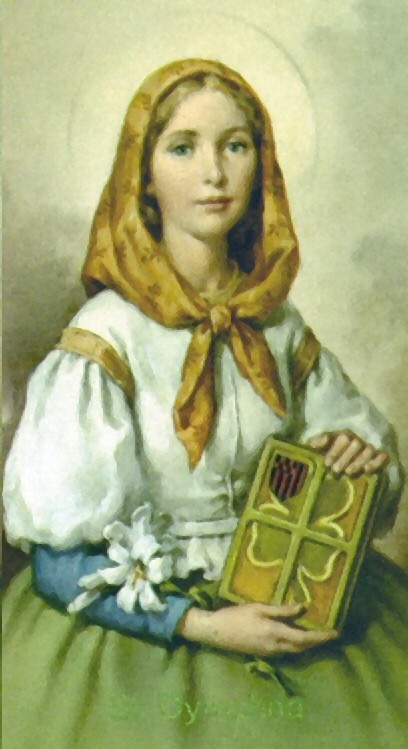
St Dymphna’s story is truly sad, but one that parallels many popular folk legends. Dymphna was a virgin daughter of a pagan king. She secretly baptized into Christianity. After her mother died, her father became insane with grief, and declared that he would only marry another woman as beautiful as his wife. Eventually he noticed that Dymphna his own daughter, shared his wife’s beauty. He determined to marry her, but the girl fled from him in horror, accompanied by a trusted priest. They sought sanctuary elsewhere but were found by her father’s men. The priest was promptly killed, and her father once again proposed to her. She refused to marry him, and he himself struck off her head. Dymphna is depicted as a beautiful, virginal, young girl. She is often holding a holy bible and white flowers. She is the patroness of incest victims and the mentally disturbed.
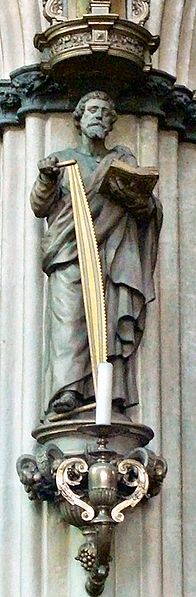
Simon Zelotes (or Simon the Zealot) was one of the twelve disciples. He had previously been a violent man but was converted by Jesus. Not much is known of his life after Jesus’ death, but he is believed to have travelled widely preaching the gospel. Legend has it that he was martyred in Mesopotamia by being hung upside down and sawed to death – longitudinally. He is often depicted holding the saw that was the instrument of his martyrdom.
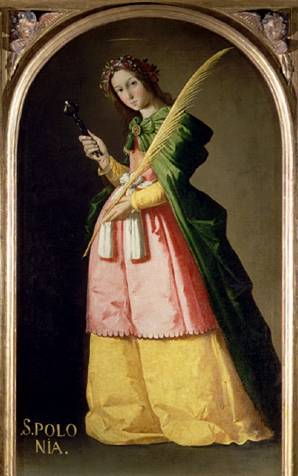
St Apollonia was an old deaconess who fell victim to the persecutions of Christians in Alexandria. As Christians fled the city, Apollonia was seized by a mob. They beat her and knocked all her teeth out. They then lit a huge fire to burn her if she did not renounce Christianity. Begging for time as though she would comply with their demands, instead she jumped into the flames herself and died without renouncing her faith. She is the patroness of dentists, and is depicted holding pincers containing her tooth or with a gold tooth on a necklace.
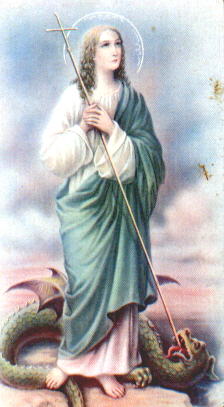
St Margaret of Antioch was a popular saint in the middle ages. Legend states that she was the daughter of a pagan priest, but decided to convert to Christianity. This angered her father as well as a suitor whose advances she rejected. They had her reported to the authorities as a Christian, and she was jailed. In jail she met the devil in the form of a dragon, who proceeded to swallow her whole. The cross she carried however, irritated the dragon’s belly and she was able to tear her way out using the cross and emerge whole from the dragon. Several attempts were then made to execute her by drowning and fire, all of which failed, leading many who witnessed her tortures to be converted. She was finally beheaded. She is often depicted emerging from the dragon’s belly, cross in hand. Appropriately, she is the patroness of childbirth.
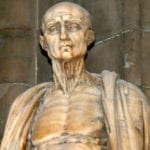
Saint Bartholomew is one of the Apostles of Christ. After Christ’s death he travelled the world as far as India, evangelizing and preaching the gospel. He fell afoul with the pagans in Armenia where he was martyred. Legend states that he was flayed alive (removing the skin from the body while keeping it as intact as possible), and then crucified upside down on a cross. He is the saint invoked by those who deal with skins and leather. He is depicted in art as a man holding his flayed skin.
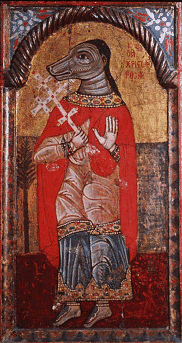
St Christopher belonged to a tribe in North Africa known as the Marmaritae. That area of the world was then largely unknown and considered inhabited by all sorts of strange creatures, including dog-headed men. Some conflicting legends surround Christopher. In one he is a dog-head captured by the Romans and forced to serve them. He becomes a Christian convert and thus a unique figure amongst his kind. Another legend has St Christopher carrying an infant across a river, only to find him growing unbelievably heavy as they progress. The child then reveals himself to be the Christ child and his heaviness due to the weight of the world on his shoulders. Still other legends exist about St Christopher actually being granted the face of a dog by God, to ward off unwanted female attention. He is often depicted as a richly robed dog-headed man – a cynocephalus.
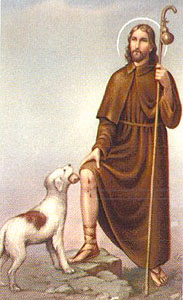
St Roch was born of nobility but soon renounced his life of wealth and privilege to work amongst plague victims. He travelled the country effecting many healings of plague victims. When he too contracted the plague, he retreated to a secret hut in the woods. He was there befriended by a dog, who brought him sustenance and licked the sores on his leg until he was healed. When he eventually returned to civilization, many who had previously known him were dead. He was imprisoned, and with his dog continued to minister to suffering prisoners until his death. He is the patron saint of dogs and is invoked against diseased body parts. He is depicted lifting one hem of his robe to reveal his leg sores, while his faithful dog licks them.

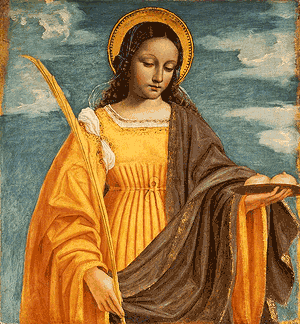
As a beautiful woman St Agatha attracted the attentions of a powerful judge named Quintianus. When she refused his advances he had her sent to a brothel. She prayed and after 30 days remained still untouched. Quintianus then ordered that she be chained, whipped, stretched on a rack and burnt. During these tortures her breasts were cut off. Legend states that St Peter miraculously healed her wound that night. The enraged Quintianus then had her rolled on hot coals and glass until she finally expired. She is the patron saint of breast cancer sufferers. She is depicted carrying her breasts on a plate. On her saint day ( 5 February) in Sicily, little marzipan confections resembling breasts are still eaten today.
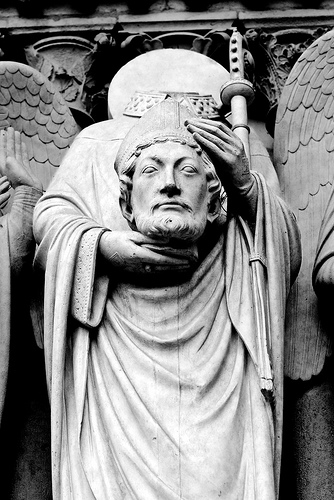
St Denis had an exceptional youth, testifying and converting pagans to Christianity. He eventually became bishop of Paris. His many conversions however, ultimately enraged the pagan priests, who decided to execute him by beheading. Legend states that after his head was chopped off, he picked it up and walked several miles with it tucked under his arm, preaching all the way. He is represented as a headless body holding its decapitated head in its hands.
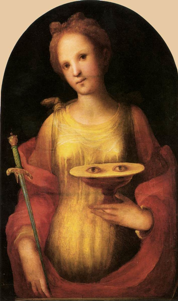
St Lucy as a young girl decided to devote her life to Christ and refused to marry the groom selected by her mother. Though her mother eventually accepted her decision, her jilted suitor was not so generous, and reported her as a Christian to the authorities. Trying unsuccessfully to force her into prostitution, the soldiers found her body strangely heavy and immovable. Thus as punishment, she was tortured by having her eyes gouged out, and then killed. Legend states that God restored her sight before she died. She is represented in iconography as a young martyr holding her eyes on a plate, and is the patron saint of eye problems and blindness.


@Matt: you're right, but you have to mind that we are living in the 21st century. The christians were cruel and fanatic in a time where everyone was cruel or fanatic
And everyone is soooo much better now. lol?
Man it must of sucked to be an early christian. Thank God I’m no saint:P
all those deaths are awful! i’d rather not be a saint!
I suppose the irony is in the fact that the “Christian” Church eventually came to embrace such a propensity for gruesome deaths. This is why I don’t mind Creationists; there’s certainly far worse on the scale of religious fanaticism.
am i the only one hear who lol’d @#3
Thanks to John Paul 11 the catholic church is suddenly a bit top heavy with saints. I read that he made more saints in his twenty odd years as pope than there were saints before he came along. So, the question is, what are all these new ones the patron saintsof? Maybe they have a modern flavour, like St Chavney, the patron saint of wii consoles. Can’t help thinking ol’ JP2 might have devalued the whole saints thing, causing galloping saint inflation. If it is indeed possible to devalue such nonsense. And don’t even get me started on the cherabim, seraphim, archangels, uberangels, quadrangels etc.
With regards to comment number three, surely Mother Theresa had the most tragic death of all, dying on the same day as Princess Di. Nobody noticed.
whoopee: you are right about JPII – unfortunately it worked in the reverse and he made so many that no one knows who they are and it diluted the quality of the early ones. His pontificate was a disaster. Thankfully Pope Benedict is taking things very very slowly. Remember though – not every saint is a patron. According to the Catholic Church, every person in heaven is a saint – being declared so by the Pope just means that everyone around the world can revere the person. Most of the saints are unknown for that reason
Oh – and regarding your mention of Mother Theresa (who I am not a particularly big fan of) – I believe she wanted obscurity in her death – and she certainly got that!
Why aren’t you a fan of Mother Teresa? Was it because she put JP2 on hold to help out one of her kids at her convent? I’m just wondering.
whoopee: mother theresa died about a week after princess diana and a lot of people DID notice, the world lost two of its greatest humanitarians so close together
and ouch, sucks to be a saint
Some other stuff i read about Mother Theresa, which I’m sure you know.. the documentary in 1969 that propelled her to stardom had Malcolm Muggeridge (the very pious ex-BBC stalwart) convinced that she had godly powers because the lighting in her place of work (hospital) should have been too dim to create a viable picture for the television yet it turned out perfectly well lit. The truth was that the cameraman was trying out a new type of film that dealt better with dimly lit areas. Muggeridge ignored this and went on about her on all sorts of religious shows on telly. And now she’s a saint. Thanks to Kodak.
Don’t mean to come across as anti-mother-theresa. She did some good work. It’s just funny how these legends are created.
interesting list!!
Really Interesting List. Being A Atheist I can’t Understand How People Can Beleave This Stuff. Number 10′s The Patron Saint Of Incest Victims.. Lucky Her.
There is only one tragedy in life- not to become saint!
So incredibly happy I didn’t live back then!
I’m an agnostic with a vague C of E/Methodist upbringing but I find the lives of saints absolutely fascinating. Good list.
Becoming a saint of some fairy tale… please, these people’s lives were needlessly wasted. Stupid pagans killing Christians, stupid Christians being Christians. Stupid people looking for reasons to kill.
i don’t tell anything
going to a catholic high school (im not catholic) i learned about a lot of these in church history. that was my worst class too….great list!
@whoopee
Patron saint of wii console. I LOL’ed so hard at that….
the fact that all this crap is still accepted by Catholic Church is a clear example of its sillyness.
#5 “granted the face of a dog by God, to ward off unwanted female attention”.
I think this may have happened to me!
Saints are just people in heaven. Not everyone is going to be a patron of something. To pray means to ask humbly. Prayers to saints are meant to ask them to intercede with the Big Man on our behalf.
We tell the stories of their lives and deaths because they are inspirational. To the Catholics the saints are our heros. They are people we should emulate in their efforts to do what is good and what is right. What is so important about martyrs in particular is that you could kill them before you could force them to do something that was plainly wrong. Most were directly tortured in some way to get them to denounce their faith.
Traditionally, all children baptized Catholic share at least one name with a saint. That is why some people from other cultures have a ‘christian’ name and their given name. It takes a very long time for people to be cannonized as saints so the backlog was huge when Pope John Paul II started going pressing to clear it up. Part of the effects of that is that a lot of new names from new cultures have become available for baptisms. Also, a lot of countries now have their first saints. The USA got it’s first couple too.
Interesting list. Funny though how history and art tends to recall them more for the ick-factor of their gruesome deaths than for what good they did to deserve elevation to sainthood. If I got flayed alive or violently de-boobed I dunno if I’d want people commemorating it by eating marzipan mammaries.
Regarding #8, ST. Apollonia: why is she a saint if she committed suicide? Don’t suicides go to hell?
strange…. no mention of Saint Agatha, usually depicted showing off her breasts…. in a plate
loved this list. It makes me cringe to read about being skinned alive and sawed in half. Not to mention that poor lady in number 3. If we could only be so strong to hold onto our faith in the face of this magnitude of torture.
Nice list Dana! Not enough mention of Saints these days and their sacrifices. Like St Roch, a dog once licked my weeping sores. Unlike St Roch, my sores became infected…
St Margaret of Antioch – the patron saint of childbirth. So all mothers are dragon incarnations of the devil? Sounds like the Catholic Church to me alright….
chutia – St Agatha is there, and sure enough she is holding her breasts (chopped off) on a plate.
There seems to be a pattern here – one with her eyes (gauged out) on a plate, one with her teeth (knocked out) on a necklace, one with his balls (ripped off)on a stick, one with his heart (cut out) on a pole, one with her buttock cheeks (sliced off) on a silver salver, one with his penis (cut off) on a coctail stick and one with his head under his arm. It’s all a bit samey if you ask me
24. Spange – “history and art tends to recall them more for the ick-factor”
In regards to art, they are depicted that way because many Christian religious paintings served a narrative purpose. A vast majority of Christians and recently converted were illiterate back then, so the stories were translated into images and symbols of defining Christian moments that made them worthy of sainthood. Northern Renaissance religious works relied so much on symbolism that (with understanding of the various symbols) the life, deeds and general personality of the depicted saint can be derived from a single painting. The acts of torture or organs on a plate…well, I don’t think people back then had the luxury of squeamishness that we cling to now.
As far as WHY they celebrate skin flaying or marzipan boobies…well, you’d have to ask a Christian because I don’t know!
Very interesting list. I am not Catholic so never fully understood how someone became a saint. Are any of those recently named saints, patron saints? What are they patron saints of and how are they remembered in stories? Alot of these say legend says… were these real people or passed down stories to each generation? I too have always been fascinated with saints. As a child I always thought they were something like a ghost that helped in times of trouble.
Chutia you poor child. See Number 3.
As I have said before, “Every time a stupid comment is made on ListVerse, a retarded angel/Saint gets its wings…”
#1 is definetaly creepy.
why the hate for mother teresa?
Very well-researched list and fascinating material. What is Simon Zealots the patron saint of?
31: Gabi. Good point re: the depiction in art. I always take the placing of organs on a plate to suggest an offering – essentially a (possibly willing) sacrifice. The very unpleasantness of that in itself conveys a message and I think it’s that message that prods any tendency to squeamishness. I don’t think we should tell people it’s the right thing to do to give up life for faith. I’m sure that most people don’t see it that way now, but I imagine that such imagery was (as you point out) much more influential on the psyche of people living several centuries ago.
32: JwJwBean. I was just looking these people up to check the dates on them and whilst initially skimming the info I read that Margaret of Antioch was declared apocryphal in the 5th century – that said hers is one of the least likely sounding legends. I always thought they were mostly real people but that time and retelling has probably taken their stories a little way from the truth.
spange – if faith isnt something to give up your life for then what it? (not trying to argue, just curious)
interesting list…silly catholics…
why.. plates? lol
This was pretty interesting. I enjoyed reading it.
I’m not a Christian, but I kind of like the concept behind the patron saints. I can’t really explain it. I just like it, the same way I like namedays
St. George, patron of England, killed a dragon… ¿dragon?
# 10 St. Dymphna – very sad he must have been really possessed by his wife – sad ending
Thanks Dana.
#38 Heyyooo: That is a good question. I don’t have wholehearted faith in anything at this time. So I don’t know if I would give my life up for it. I guess that believing in something with faith and being told your faith will be proven and rewarded in death, then it isn’t so hard to give your life for it.
#41 IrigD: What are namedays? I am curious.
Having attended parochial (that is, Catholic) schools from K – 12, I had much exposure to the saints. In grammar school, when I was 8, 9, 10 my favorite book in the tiny school library was “The Lives of the Saints” fully illustrated. I’ll bet I can still recite some sections by heart.
I was simply astonished that anyone would gladly go through what these people went through for the sake of not denying their faith for a single day! I was still at an age where I was both proud and aghast, but pride won the day every time.
Yet only two years later, at 12, my teacher nun ripped all pride of faith from me, indeed, ripped my faith from me. Now I can look back at the stories in Lives of the Saints with a different eye. They may not all be true, but that hardly matters. What matters is that they are stories to give strength in time of trial to everyone, not just Catholics, and not just about faith.
Looked at correctly, these stories should be able to guide us through any kind of life crises; just change the words as required and the story is the same.
Just a thought.
jwjwbean – its interesting because there are the obvious things people would give up there lives for spouses, children, country (at least I hope) but there are obviously other things that people give up their lives for. Going along with what you said I wonder if an atheist would die for his beliefs.
segue
how did the nun rip your faith from you?
Did you walk in on her diddling with herself?
I think some things should be cleared up. For example, St. Christopher is no longer an actual saint because they are not sure (the Church) if he actually existed:
http://www.catholic.org/saints/faq.php#St.%20Christopher
“Before the formal canonization process began in the fifteenth century, many saints were proclaimed by popular approval. This was a much faster process but unfortunately many of the saints so named were based on legends, pagan mythology, or even other religions — for example, the story of the Buddha traveled west to Europe and he was “converted” into a Catholic saint! In 1969, the Church took a long look at all the saints on its calendar to see if there was historical evidence that that saint existed and lived a life of holiness. In taking that long look, the Church discovered that there was little proof that many “saints”, including some very popular ones, ever lived. Christopher was one of the names that was determined to have a basis mostly in legend. Therefore Christopher (and others) were dropped from the universal calendar.
Some saints were considered so legendary that their cult was completely repressed (including St. Ursula). Christopher’s cult was not suppressed but it is confined to local calendars (those for a diocese, country, or so forth).”
It’s unfortunate… even my patron saint’s existence is debated
” It is not therefore meant to cast even the shadow of a doubt around the existence of the saint. But the conclusion reached when these texts have been carefully studied is that, if the principal facts forming the outline are to be accepted as true, the multitude of details by which these facts are almost obscured, most of the wonderful narratives with which they are embellished, and the long discourses that are put into the mouth of St. Catherine, are to be rejected as inventions, pure and simple.” (Catholic Encyclopedia)
38:heyyooo. In the scope of my life, I don’t think there is anything worth willingly dying for – I’d probably risk my life for a few things, ie people, but no causes, certainly not faith. I understand to an extent why people might feel like they could or should sacrifice themselves for a cause, but I just don’t think it’s the right way. I suppose that’s all idealistic thinking – that we shouldn’t fight things out we should talk – and the reality almost demands that conflicts provide sacrifices, willing or otherwise, to a cause. That doesn’t make it less wrong though.
All of which is a terrible digression from the gory paintings and bizarre confections. The difference here is that I rather suspect many of the people listed above had little choice in whether they died at the hands of their oppressors.
AG: actually they have it slightly wrong – being dropped from the universal calendar only meant that you didn’t have a universal feast day; St Christopher, St Philomena, and the others are still considered to be saints and can still be prayed to – they are just not mentioned in Mass on the same day through the Church anymore
heyyooo: I think it isn’t so much hate of Mother Theresa – it is just that she is held up in such high regard by the world that people tend to be a little more critical than usual. Mind you – we have had some comments on previous lists that really were hating on her – for that I have no explanation – some people are just mean I guess
Spange: you are right – these people mostly had no choice – I guess the choice that they DID have was whether to have dignity in their dying – which is what makes them saints
This was an interesting list. I don’t believe in any of this saint and martyr stuff, however. It’s amazing what people would do for a their faith….or a klondike bar.
24. Spange: “violently de-boobed” had me spitting out my corn flakes! Thanks for that!
47. heyyooo – Why wouldn’t an atheist die for his beliefs?
Lack of a belief in a god doesn’t mean a lack of all beliefs.
32. JwJwBean:
The way canonization works is a bit difficult to explain. From what I remember and I haven’t bothered to relook it up there are several steps to it.
The first and simplest way to be considered a saint is to be a martyr. To be a martyr you have to die while being persecuted for your faith. Some one has got to be making an active effort to get you to deny your religion at the time or it just plain doesn’t count.
The second way is much harder. A saint has three miracles attributed to their prayers during their lifetime. There can be no scientific explanation for those miracles. Then, there has to be three miracles attributed to the blessed’s intervention after they have died. Again there can be no scientific explanation.
The investigations into the lives of the people suspected of joining the Church Triumphant in heaven take a really really long time. Typically it takes more than a hundred years to before some one is canonized. Part of the reason for that is because it makes it easier to be certain if you investigate past the point where people are actively campaigning on the behalf of the person.
scrumpy – i was just posing a question. it just seems interesting to die for the belief in nothing. Atheists believe there is no god, so essentially they are dying for a belief in nothing. It would seem difficult to die for the belief of nothing. But i suppose if your belief is nothing, the life is nothing and therefore the prospect of dying is not that important.
st. christopher is still extremely popular, because he is the patron saint of travelers. many people keep one of his medals in their car, or on their person when flying (even some non-catholics who see it as a good luck charm anyway). for the same reason he’s always been very popular with sailors. athletes like him too. and he has 2 tom wait songs that mention him!
how could i know all this and not know that he was initially depicted as a dog-headed reformed cannibal over ten feet tall? (at least according to wiki).
when i was 8, i was preparing for my first communion (a catholic sacrament where one participates in the “body and blood” of christ eucharist ceremony for the first time) and we had to pick a saint in religious ed class to “guide” us, i picked saint lucy/lucia (i liked lucia better because of it’s closer tie to the latin term for light, from which it was derived)!
weirdly, a few years later i was diagnosed with a rare eye disease Thygeson’s superficial punctate keratitis, it basically cleared up the the time i was 15, but it made me wonder why i’d been so drawn to the patron of sight (and blindness) a bit earlier. (in truth, i was probably because i’d gotten glasses at 8, but still, if you believe you think of these connections.) i am not a practicing catholic today, i’m an atheist, but still respect those who feel faith betters their lives.
http://webeye.ophth.uiowa.edu/dept/DIAGTRT/Thygeson/Thygeson.htm
-this site describes thygeson’s irritation as “minor” but i can tell you that when it was in a flare up i had almost unbearable photosensitivity and it felt like there was sharp sand in both my eyes that hurt even more when i sifted my gaze or blinked (and i was 11 when it started).
and the people who mentioned that a saint had to hold or otherwise show their personal symbol for the illiterate faithful to identify them are totally correct.
57. heyyooo-
“But i suppose if your belief is nothing, the life is nothing and therefore the prospect of dying is not that important.”
or if you don’t believe in god(s) or an afterlife that makes this life EVERYTHING, all we get, not nothing.
and that means you might give your life to save the life of someone you loved, to allow your young child to grow up, for example. just because someone doesn’t believe in god doesn’t mean they fail to care about anything or anyone, what an ignorant thing to say.
Very interesting list. I do think sometimes too much is made of saints, that their status may be raised a lil too high, but the things some of them suffered boggles the mind!
What’s interesting though, is that of the Christians who have died or been killed for their faith in the entire 2000 year history of the church, 70% have been killed within the last 100 years. Makes you wonder what’s going on that we don’t hear about.