
 Our World
Our World
Our World  History
 10 Chilling Murder Mysteries from Ancient History
 Movies and TV
 10 Things You Might Not Know About the Addams Family
 History
 10 News-Worthy Events That Made 1926 a Year to Remember
 Movies and TV
 10 Movie Costume Redesigns That Disappointed Fans
 Mysteries
 10 True Stories Behind Bizarre Historical Mysteries
 Our World
 10 Terrifying Forces Scientists Recreated in the Lab
 Religion
 10 Forgotten Greek Gods Beyond Olympus
 Crime
Crime 10 Infamous Crime Scenes That Became Tourist Hotspots
 Our World
 10 Rare Hybrids with Wild Backstories
Our World 10 Ancient Earth Events That Sound Like Sci-Fi Plot Devices
History 10 Chilling Murder Mysteries from Ancient History
Movies and TV 10 Things You Might Not Know About the Addams Family
Who's Behind Listverse?

Jamie Frater
Head Editor
Jamie founded Listverse due to an insatiable desire to share fascinating, obscure, and bizarre facts. He has been a guest speaker on numerous national radio and television stations and is a five time published author.
More About Us
History 10 News-Worthy Events That Made 1926 a Year to Remember
Movies and TV 10 Movie Costume Redesigns That Disappointed Fans
Mysteries 10 True Stories Behind Bizarre Historical Mysteries
Our World 10 Terrifying Forces Scientists Recreated in the Lab
Religion 10 Forgotten Greek Gods Beyond Olympus
Crime 10 Infamous Crime Scenes That Became Tourist Hotspots
Our World 10 Rare Hybrids with Wild Backstories
Top 10 Weapons That Could Have Lost Us The War
Imagine if the Nazis had bombed New York City the same way they bombed London. Imagine if they had a fleet of aircraft carriers rivaling, at least, Japan’s fleet. Imagine if they fielded a jet fighter in large numbers well before D-Day. Imagine that they had guided missiles, an assault rifle like the AK-47 and (gulp) “the bomb.”
Well, you don’t have to imagine, because Nazi Germany developed many weapons systems and programs that could — COULD — have been game changers had they been completed, completed sooner, or fielded in large numbers. These 10 weapons listed below show just how close-run WWII was. Fortunately, the weapons were never fully developed, built in small numbers or deployed too late to seriously affect the course of the war. Nazi politics, strategic materials shortages, the Allied bombing campaign, production problems and even boneheaded interference from Hitler himself fortunately relegated these systems to mere idle speculation, instead of the tools that won the war for the Nazis. But it boggles the mind to imagine what might have happened if Hitler didn’t go to war in 1939, but waited several more years.
10
“The bomb”
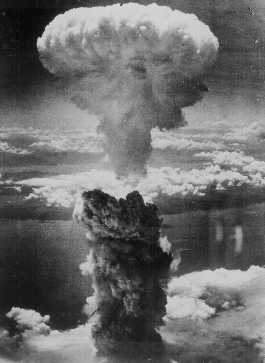
It’s a matter of minor debate concerning how far along the Germans were in developing an atomic bomb before Allied bombers wiped out the efforts for good. But make no mistake, they were trying to build one. Could you imagine Hitler having atomic bombs? America, of course, developed the atomic bomb first—to be used initially against Germany. This is number 10 rather than number one because everything else on this list actually existed, either as prototypes or as operational weapons.
9
The Focke Achgelis Fa 223 helicopter
TOP 10:Helicopters – Focke-Achgelis FA223 Drache (NO.9)

The “Dragon” helicopter was invented some time before the war, but the Germans were the first ones to actually put a whirlybird into production. The Fa-223 was the latest in Focke’s helicopter designs and was a good aircraft. And, for once, interference from Nazi bigwigs actually only played a minor part in production and deployment. Twenty examples were built by the winter of 1942-43 when Allied bombers plastered the only factory making them. Attempts to resume production failed, and resources were directed to more critical systems. But imagine if the Nazis had succeeded in deploying such an aircraft in large numbers before the war turned against them. The clip is from Military Channel’s Top Ten Helicopters. Fascinating fact: When German paratroopers rescued Mussolini in 1943, they were supposed to go in using a Fa 223. But the helicopter developed engine trouble, and the troopers used gliders instead.
8
He-100 fighter
The Flaming Coffin – Heinkel He 177 Greif

In March 1939, Luftwaffe pilot Hans Dieterle achieved an absolute average speed record of 463.9 mph, the last such speed record set before the war. His aircraft was the Heinkel He-100V8, a fighter prototype. Although possessing excellent flight characteristics (speed, dive, maneuverability, range, etc.) the He-100 never entered production. Nazi officials decided to stick with the Messerschmitt BF-109 as its primary fighter and ordered Heinkel to focus on making bombers. Aviation enthusiasts and historians disagree as to why the He-100 died: Was it politics, poor decisions by Heinkel, production problems or something else? The He-100 prototypes were retired or sold to other nations, especially Japan, whose decent mid-war Kawasaki Ki-61 fighter—the only non-radial fighter Japan fielded—was based on the He-100. Why could this have been a game-changer? Because had the Nazis and Heinkel gone ahead with production of this fighter, which was supposedly superior to even the hot Focke Wulf FW-190 introduced later in the war, events such as the Battle of Britain could have turned out much differently. The He-100, for example, had much greater range than the 109 and was far superior to the Me-110, and could have easily fended off British fighters trying to get at German bombers. Note: The clip appears to be a Japanese film of Dieterle’s record flight.
7
Type XXI U-boat

The U-boats (submarines) used in World War II were superior in every way to their WWI counterparts, and the Type XXI vessel outclassed every other submarine of every navy. The Type XXI, dubbed the Elektoboote, was the first operational submarine designed to run totally submerged for extended periods—meaning, far longer than the submerged operational viability of the Type VIIC, the most numerous U-boat type. The Elektroboote could stalk Allied ships with far more impunity than earlier models thanks to its greatly improved batteries and “stealth” modifications that made it difficult to detect by Allied sonar. The type’s weapons systems were superior, including hydraulically-loaded torpedoes and torpedoes aimed by sonar, which eliminated the need to raise the U-boat to periscope depth for attack. Between 1943 and 1945, German shipyards built 118 Type XXI boats. But only four were combat-ready by the time the Germans surrendered, and only one ever went on patrol. Boneheaded production decisions, including those by Albert Speer, and Allied bombing prevented this deadly boat from ever becoming a menace.
6
Strategic bombers

After its successful debut in the Spanish Civil War, the Luftwaffe set on a strategy of using only tactical bombers (light, medium and dive bombers), eschewing the four-engine heavy bombers being developed in England and America. This concentration on highly vulnerable and lightly armed bombers meant that the Luftwaffe never had a true strategic heavy bomber. Although in possession of some four- and six-engine planes at war’s start, none was truly suitable for strategic bombing. Luftwaffe attempts to finally build long-range city-killers were either disasters or abandoned. The Heinkel He-177, the only Luftwaffe strategic bomber to enter into production, was a disastrous failure. It was a flawed four-engine design featuring two engines mounted in tandem on each wing, which frequently cased fires. Hitler also demanded that massive plane be capable of dive-bombing, which was totally wacky, and contributed to its serious problems. Along the same lines was the “New York bomber” program, which featured two aircraft, the Junkers Ju-290 and the Messerschmitt Me-264, with designs to bomb New York City. But the program never went beyond the prototype stage. The few models of the decent Ju-290 were used not as bombers but long-range couriers between Nazi Germany and Imperial Japan late in the war. Meanwhile, one complete Me-264, which curiously looked like the American B-29 Super Fortress, was completed and another two were under construction when the “New York bomber” program was abandoned permanently. The clip, which doesn’t have sound, is of a J-290.
5
Heinkel He-219 “Owl” night fighter
Rare WWII Archive: Heinkel He 219 Bomber, Taxiing, Taking Off & Landing | Footage Farm Ltd 300306X

This superb, purpose-built, 2-engine night fighter was the best Axis night fighter of the war, and one of the finest piston aircraft made prior to the jet age. Just one He-219 downed 25 Allied bombers in a matter of *days* during the prototype period; the plane was that good. While possessing excellent flight characteristics, formidable weaponry and radar guidance, the plane was somewhat complex to build. Heinkel only built a few hundred, partially because they were ordered to concentrate on bombers. Instead, the Luftwaffe relied on modifying existing aircraft, namely Me-110s and Junkers Ju-88s. In far larger numbers, the He-219 could have brought nighttime RAF bombing operations to a close. The clip, which doesn’t have sound, appears to be of a captured He-219 with USA markings.
4
Graf Zeppelin aircraft carrier
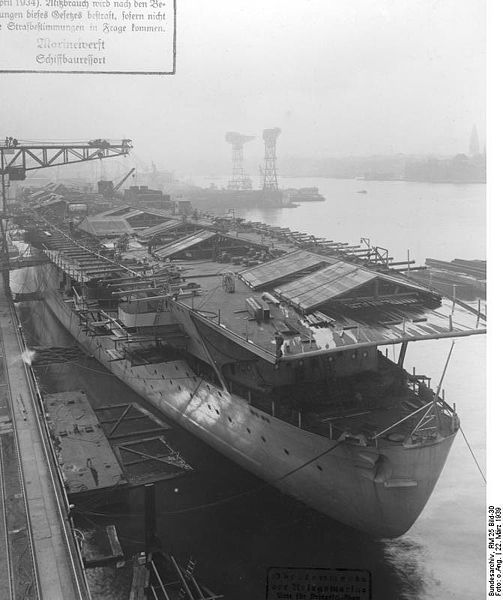
The Kriegsmarine (German navy) never had an aircraft carrier during WWII, but it came close. In 1935, Hitler deemed that the Kriegsmarine would build aircraft carriers. At this point in naval history, the battleship was still the primary naval vessel, and aircraft carriers something of a novelty; therefore, naval treaties concentrated on limiting battleship tonnage. In 1937, shipbuilders laid the keel for the 33,500-tonne Graf Zeppelin and launched her the next year. However, she was never completed. Herman Goering thought that the carrier would intrude on the duties of his Luftwaffe, and Admiral Karl Doenitz championed U-Boats over surface vessels. Such territorial fights and the increasing shortage of war materials led to her abandonment at 80% completion. The Soviets captured the Graf Zeppelin in 1945, but it wasn’t learned until 2006 that the Soviets used her for target practice and sank her in 1947.
3
V-2 and other guided weapons
WW II : RARE COLOR FILM : NAZI V2 ROCKET FACILITY

Germany employed many radio-controlled weapons during the latter half of the war, including the V-1 Buzz bomb, a slow, primitive cruise missile that was easy to shoot down. Radio-controlled air-to-surface missiles, such as the Henschel Hs 293 guided bomb, were a hassle for Allied shipping until techs found ways to jam the signals. Of all the German radio-controlled weapons, the V-2 ballistic missile was the most successful. However, the Nazis used the V-2 primarily to terrorize London, Antwerp and elsewhere during the last full year of the war. Much more powerful and faster than the V-1 “buzz bomb,” the Hs-293 and the “Mistel” (an old bomber packed with explosives literally flown by remote to a target), the V-2 was quite difficult to shoot down and packed a powerful explosive punch. One wonders what could have happened if the Germans had used such weapons exclusively against Allied troops instead of civilians. Considering that by summer 1944 the Allies had near total air domination in the west and the Soviets were closing hard from the east, such a weapon could have proven costly to the Allies—and cheaper than sending in fighters and bombers. With a mobile launch platform and a high-speed flight, the V-2 could — COULD — have gone a long way to negating Allied air power. But almost all of the 10,000 V-2s launched directly targeted civilians.
2
Sturmgewehr StG-44 assault rifle

Germany fielded many powerful weapons systems for the Wehrmacht, including the fearsome Tiger and Panther tanks and the 88-mm cannon. (My wife’s late grandpa had many stories about being fired on by those %#$@! 88s.) The Wehrmacht’s small arms inventory was good, though a little unwieldy. The basic German soldier went to war equipped with the Karabiner Kar98, an old but powerful and reliable bolt-action rifle with a 5-shot cartridge. (The Kar98 is still in use!) Elite German troops, such as the paratroopers, as well as the SS and Gestapo, were often equipped with the MP-40 or 41 machine pistol / submachine gun. German armories, however, created a very powerful and versatile submachine gun *almost* akin to the famed postwar Soviet AK-47. In trained hands, the StG-44 could lay down a devastating hail of 7.92mm bullets (the same as used by the Kar98), and provided the power of the Kar98 and up-close versatility of the MP-40. During the last year-and-a-half of the war, they proved their effectiveness, so much so that when Hitler asked his generals in July 1944 what they needed, one of them exclaimed, “More of these rifles!” However, the StG-44 came too late in the war to have any appreciable effect. East German police units used them as late as the early 1960s. The clip is from Military channel’s Top Ten Combat Rifles.
1
Messerschmitt Me-262 “Swallow”
The Me-262 was the world’s first operational jet fighter. Despite frequent engine problems, the Me-262 was a fast and deadly aircraft, and outpaced almost all Allied fighters (only the P-51D Mustang could match it.) It could have gone operational in the fall of 1943, when the war was still pretty much in the balance. At that time, the Luftwaffe still had not lost most of its veteran pilots and Allied escort fighters could not penetrate too far into the Reich. The Me-262 could have swept Allied bombers and fighters from the sky, giving Germany critical air dominance once more. Fortunately for the world, Hitler himself demanded that the new fighter aircraft be modified for dive-bombing use — a purpose for which it was not designed. This meddling delayed construction and deployment for more than a year. By the time the Me-262 took to the skies operationally in late 1944, it was far too late. The clip shows a restored Me-262 at a 2006 air show in Berlin.
More Great Lists
 10 Reasons Why A Nuclear War Could Be Good For Everyone
 Top 10 New Finds Involving Ancient Weapons
 Top 10 Near Misses With Nuclear Weapons
 Top 10 Brutal Improvised Weapons
 Top 10 Badass People With Badass Weapons
 Top 10 Disturbingly Practical Nuclear Weapons
 Top 10 Potentially Great Films That Got Lost In…
 Top 10 Underwater Ruins Of Lost Civilizations
 Top 10 Body Parts We Lost To Evolution
More Great Lists