
 Music
Music
 Weird Stuff
10 Facts About Imagination That Sound Like Fantasy
 History
10 Bizarre Things That Happened During the Siege of Paris
 Weird Stuff
10 Times Nature Gave Plants an Unbelievable Plot Twist
 Our World
10 Examples of Molecular Genetics Hiding in Plain Sight
 Weird Stuff
10 Machines and Everyday Objects Given Surprisingly Formal Farewells
 Space
10 Times Space Junk Made a Fiery Return to Earth
 Weird Stuff
10 Real Species That Look Absolutely Fake
 History
10 Overlooked World War II Stories That Deserve More Attention
 Weird Stuff
Top 10 Strange Side Quests of the U.S. Census
Music 10 Hit Songs That Took a Different Turn in the Studio
Weird Stuff 10 Facts About Imagination That Sound Like Fantasy
History 10 Bizarre Things That Happened During the Siege of Paris
Who's Behind Listverse?

Jamie Frater
Head Editor
Jamie founded Listverse due to an insatiable desire to share fascinating, obscure, and bizarre facts. He has been a guest speaker on numerous national radio and television stations and is a five time published author.
More About Us
Weird Stuff 10 Times Nature Gave Plants an Unbelievable Plot Twist
Our World 10 Examples of Molecular Genetics Hiding in Plain Sight
Weird Stuff 10 Machines and Everyday Objects Given Surprisingly Formal Farewells
Space 10 Times Space Junk Made a Fiery Return to Earth
Weird Stuff 10 Real Species That Look Absolutely Fake
History 10 Overlooked World War II Stories That Deserve More Attention
Weird Stuff Top 10 Strange Side Quests of the U.S. Census
10 Hit Songs That Took a Different Turn in the Studio
We tend to hear a hit song and assume it arrived fully formed: the right singer, the right beat, the right instruments, all waiting in the studio. But some songs took the scenic route. Bands tried one style, producers pushed for another, and early demos pointed toward sounds that would never make the final recording.
Here are ten familiar hits whose path to the version we know included a few surprising detours.
Related: 10 Metal Bands Who Accidentally Created Pop Hits
10 “Every Little Thing She Does Is Magic”
The Police – Every Little Thing She Does Is Magic (’77 Demo)

The Police – Every Little Thing She Does Is Magic (Official Music Video)

By the time Sting brought “Every Little Thing She Does Is Magic” to the Police, he already had a demo he liked. The rest of the band wanted to make it sound more like the Police. They tried slower versions, reggae, and punk, but none of those arrangements seemed to work.
After all that experimentation, they circled back to Sting’s original demo. Drummer Stewart Copeland overdubbed his part, and the song kept the arrangement the band had spent so long trying to replace. Sometimes the best way to find a hit is to take it apart, try several alternatives, and realize the first idea was already doing the job.[1]
9 “One Week”
Barenaked Ladies – One Week (Official Music Video)

Barenaked Ladies’ “One Week” is a fast-talking, high-energy hit with crunchy guitars and crashing drums. Its original demo was much smaller: the band described it as an acoustic number.
The finished recording grew during production. Producer David Leonard layered in heavy, distorted electric guitars, giving the song a bigger, louder sound than the band’s original sketch. The quick lyrics were already there; the studio helped turn their modest musical setting into a full-on pop-rock sprint.[2]
8 “The Real Thing”
Russell Morris – The Real Thing (1969)

Australian singer Russell Morris first encountered “The Real Thing” as a gentle ballad by songwriter Johnny Young. Producer Ian “Molly” Meldrum heard something much bigger in it. Working with engineer John Sayers, he transformed the song into an elaborate psychedelic production, layering instruments, vocals, and sound effects.
The finished recording ran for more than six minutes, an unusually long single for the time. It became a landmark Australian hit, complete with a swirling sound created by running two tape machines at slightly different speeds. The original ballad had supplied the song; the studio turned it into a trip.[3]
7 “Roxanne”
The Police – Roxanne (Official Music Video)

Sting first conceived “Roxanne” as a bossa nova. When he brought it to the Police, drummer Stewart Copeland suggested changing its rhythmic feel. The group worked the song into the tango and reggae-inflected sound of the recording.
That blend became part of the Police’s early musical identity. It also gave the song an unusual lilt: the story is a plea to a woman working the streets, but the rhythm is catchy enough to make listeners sing along before they stop to consider the lyrics. The finished track even preserves an accidental piano chord—and the band’s laughter—at the beginning.[4]
6 “Sympathy for the Devil”
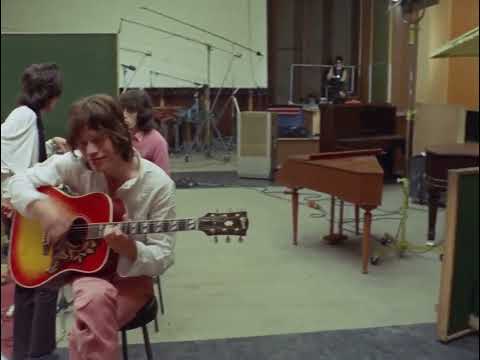
The Rolling Stones Making Sympathy For The Devil in 1968
The Rolling Stones – Sympathy For The Devil (Official Video) [4K]

Mick Jagger brought “Sympathy for the Devil” to the Rolling Stones as a folk-style song with acoustic guitar. Keith Richards thought a different rhythm might unlock it, and the band began reshaping the arrangement. Richards moved to bass, the percussion built, and the song developed into the samba-like recording we know.
The studio transformation was captured in Jean-Luc Godard’s film One Plus One. Viewers can watch the Stones try ideas and gradually assemble the song’s hypnotic groove. It’s a rare look at a major hit becoming itself through experimentation, rather than arriving in the studio with every part already settled.[5]
5 “Heart of Glass”
Blondie – Once I Had Love/The Disco Song (Heart of Glass Demo)

Blondie – Heart Of Glass

Blondie worked on “Heart of Glass” for years under the earlier title “Once I Had a Love.” The band tried it as a ballad and a reggae song, but neither version clicked. When producer Mike Chapman asked Debbie Harry what contemporary music she liked, she pointed to Donna Summer and Kraftwerk.
That gave the band a new direction. They added a drum machine and synthesizer, creating the sleek dance sound that helped make “Heart of Glass” Blondie’s first No. 1 hit. The band came out of New York’s punk scene, so the disco turn surprised some fans—and at least one band member. It also worked beautifully.[6]
4 “Another Brick in the Wall, Part 2”
Pink Floyd – Education (Another Brick In The Wall, Pt. 2) [Band Demo #1]

Pink Floyd – Another Brick In The Wall, Part Two (Official Music Video)

Roger Waters originally wrote “Another Brick in the Wall, Part 2” with one verse and one chorus. Producer Bob Ezrin wanted to turn it into a full-length single, and he suggested trying a disco beat. David Gilmour was skeptical, but the band recorded the track with drums and bass laid down first, then built the rest of the arrangement around them.
Ezrin also pushed to extend the song and add a children’s choir. Those choices gave the track its instantly recognizable groove and chorus. Pink Floyd’s protest song about a school system became an international hit with a beat that would not have sounded out of place on a dance floor.[7]
3 “Take On Me”
a-ha – Take On Me (Demo)

a-ha – Take On Me (Official Video) [4K]

“Take On Me” did not become a global hit on its first attempt. a-ha recorded several versions over a period of years, including an early release that went largely unnoticed. After the first album version failed to catch on, the band persuaded its label to let them record the song again with producer Alan Tarney.
Tarney went back to an earlier demo and heard the charm and buoyancy he felt the previous version had lost. That became the basis for the recording listeners know. The song’s eventual success also owed something to its groundbreaking animated video, but it took three versions to arrive at the sound that made people stop and listen.[8]
2 “Born in the U.S.A.”
Bruce Springsteen – Born In the U.S.A. (1982 Demo Version – Offical Audio)
Bruce Springsteen – Born in the U.S.A. (Official Video)

Before it became a booming rock anthem, “Born in the U.S.A.” was a stark acoustic demo. Springsteen recorded it during the same period as the spare songs that became Nebraska. The E Street Band later built a much bigger arrangement around it, with a pounding drum sound and a sing-along chorus.
The contrast between the solo demo and the finished track is striking. One version leaves the listener alone with Springsteen’s voice and guitar; the other sounds built for a stadium. The recording’s triumphant sound also led some listeners to miss the song’s bitter story of a Vietnam veteran returning home to hardship.[9]
1 “The Sound of Silence”
Simon & Garfunkel – The Sound of Silence – Live HQ (aka The Sounds of Silence)

Simon & Garfunkel – The Sounds of Silence (Audio)

Simon & Garfunkel first recorded “The Sound of Silence” as a quiet acoustic folk song. After that version failed to gain much attention, Columbia producer Tom Wilson took the recording and overdubbed electric guitar, bass, and drums—without telling the duo.
The new folk-rock version climbed the charts and reached No. 1. It also prompted Simon and Garfunkel to reunite and record another album in the style of their surprise hit. The song most people know, then, was created when a producer gave an existing performance an entirely different musical frame—and the singers heard the change only after it was done.[10]
More Great Lists
 10 Common School Activities and Events That Took a…
 10 Mega-Hit Songs That Nearly Didn't See the Light of Day
 10 Hit Songs That Were Written in Just a Few Minutes
 Ten Singers Who Absolutely Detest One of Their Hit Songs
 10 Fictional Bands with Real Hit Songs
 Top 10 Strangest Songs to Have Hit Number One
 10 Stars Who Secretly Wrote Hit Songs for Other Singers
 10 Movie Studio Decisions That Completely Backfired
 10 Disc Jockeys Who Barricaded Themselves in the Studio
fact checked by Darci Heikkinen
More Great Lists