
 Our World
Our World
Our World  Animals
 10 Elusive Animals That Finally Showed Up for the Cameras
 Our World
 10 Incredible Places Authorities Put Off-Limits
 History
 10 Boring Ancient Documents That Exposed Astonishing Secrets
 Animals
 10 Extinct Creatures That Aren’t What We Thought
 Weird Stuff
 10 Wild Facts You Might Not Know About Quicksand
 History
 10 Royal Dynasties That Endured for Centuries
 Travel
 10 Famous Movie Sets & Filming Locations You Can Still Visit Today
 History
 10 Super Unsettling Historical Facts We Wish Were False
 Weird Stuff
 10 Bizarre Ways People Used Blood in the Past
Our World 10 Surprising Secrets of America’s Interstate Highway System
Animals 10 Elusive Animals That Finally Showed Up for the Cameras
Our World 10 Incredible Places Authorities Put Off-Limits
Who's Behind Listverse?

Jamie Frater
Head Editor
Jamie founded Listverse due to an insatiable desire to share fascinating, obscure, and bizarre facts. He has been a guest speaker on numerous national radio and television stations and is a five time published author.
More About Us
History 10 Boring Ancient Documents That Exposed Astonishing Secrets
Animals 10 Extinct Creatures That Aren’t What We Thought
Weird Stuff 10 Wild Facts You Might Not Know About Quicksand
History 10 Royal Dynasties That Endured for Centuries
Travel 10 Famous Movie Sets & Filming Locations You Can Still Visit Today
History 10 Super Unsettling Historical Facts We Wish Were False
Weird Stuff 10 Bizarre Ways People Used Blood in the Past
Top 10 Famous Spies
In and out of wartime, spies play an essential role in information gathering for their nations (and, on occasion, as double-spies for other nations). The spies listed here are the most famous in history.
1. Mata Hari Born: 1876; Died: 1917
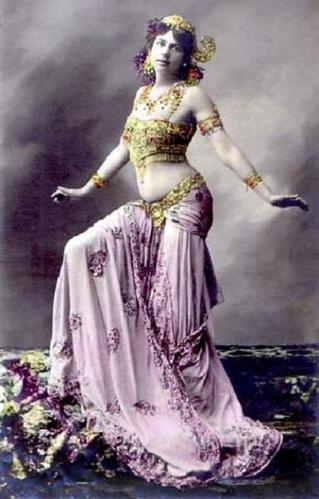
Mata Hari in a dancing costume
Spied For: Germany (and Possibly France)
Mata Hari was the stage-name for Dutch-born Margaretha Geertruida (Grietje) Zelle who was an exotic dancer and high class prostitute in Paris. In 1905, after divorcing her husband, she began her career as an exotic dancer, taking the name Mata Hari (meaning “sun” or “Eye of the Dawn”). She posed herself as a princess from Java. Posing as an exotic person was possible in those days because the lack of telecommunications. During this period of her life she was often photographed in scant clothing or nude.
She mixed with the upper class and became a courtesan to many important high-ranking military men and politicians. This put her in a very good position to gather information. During World War 1, the Netherlands remained a neutral nation, enabling Mata Hari, a Dutch national, to cross national borders freely. At one point she was interviewed by British Intelligence and she admittedly to being a spy for the French. The French later denied this. It is still unknown whether this was true.
In January, 1917, the German Military Attache in Madrid sent an encoded radio signal to Berlin, stating that they were receiving excellent information from a German spy codenamed H-21. French intelligence intercepted the messages and were able to identify H-21 as Mata Hari. On February 13, 1917, Mata Hari was arrested in her Paris hotel room. She was subsequently tried for espionage and found guilty. She was executed by Firing Squad on the 15th of September, 1917 at the age of 41.
Drop yourself right into the real-life action with Double Cross: The True Story of the D-Day Spies at Amazon.com!
2. Julius and Ethel Rosenberg Born: 1915, 1918; Died: 1953
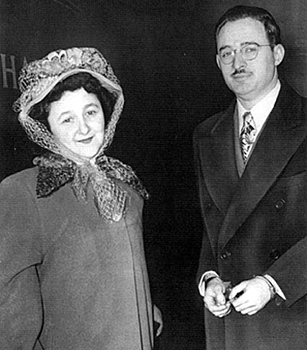
The Rosenbergs
Spied For: The Soviet Union
Julius and Ethel Rosenberg were American Communists who were executed for passing nuclear secrets to the Soviet Union. They met in the Young Communist League in 1936, where he was a leader. They had two sons. Julius was recruited by the KGB in 1942 and was regarded as one of their top spies. He passed classified reports from Emerson Radio, including a fuze design which was later used to shoot down a U-2 in 1960.
Julius also recruited many people sympathetic to the cause to assist the KGB. He provided the KGB with thousands of documents from the National Advisory Committee for Aeronautics including a complete set of design and production drawings for the Lockheed’s P-80 Shooting Star. A former machinist at Los Alamos (the US Nuclear Development Area), Sergeant David Greenglass confessed to having passed secret information on to the USSR, and in doing so, implicated his brother-in-law: Julius Rosenberg. He initially denied any involvement by his sister Ethel. The Rosenbergs were arrested.
In 1951 the case against the Rosenbergs began. Greenglass, the prosecution’s main witness, told the court that his sister Ethel had typed nuclear secrets he gave her at a meeting in their home, and that he gave Julius a sketch of a cross-section of an implosion type nuclear bomb. Both Rosenbergs were found guilty and sentenced to death. Their conviction gave fuel to Senator McCarthy’s investigations into anti-American activities. They were both executed by electric-chair in Sing Sing Prison in 1953.
3. Aldrich Ames Born: 1941
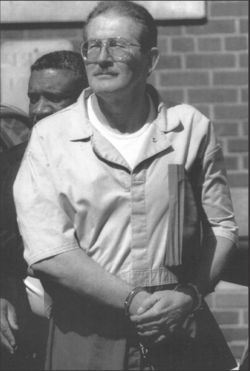
Ames in FBI custody (1994)
Spied For: The Soviet Union
Ames is a former CIA Counter-intelligence Officer who was convicted of spying for the Soviet Union in 1994. On his first assignment as a case officer, he was stationed in Ankara, Turkey, where his job was to target Soviet intelligence officers for recruitment. Due to financial problems in his personal life as a result of alcohol abuse and high spending, Ames began spying for the Soviet Union in 1985, when he walked into the Soviet Embassy in Washington to offer secrets for money.
Ames was assigned to the CIA’s European office where he had direct access to the identities of CIA operatives in the KGB and Soviet Military. The information he supplied to the Soviets lead to the compromise of at least 100 CIA agents and to the execution of at least 10. He ultimately gave the USSR the names of every CIA operative working in their country; for this they paid him 4.6 million dollars. Ames used the money to live well beyond his means as a CIA agent, buying jewellery, cars, and a $500,000 house.
In early 1985, the CIA began to notice that they were losing their “assets” at a very rapid rate. For unknown reasons they were not willing, in the early stages, to believe that they had been infiltrated by the KGB, instead presuming the leak to be via bugging devices. When the FBI were finally brought in to investigate, Ames became the primary suspect. Fearing he would defect on a CIA trip to Russia, The FBI arrested him at the airport with his wife. He was given a life sentence and is incarcerated in the US Penitentiary in Allenwood, Pennsylvania.
A spy is nothing without his tools! Be your own spy with a Portable Mini Spy Camera at Amazon.com!
4. Giacomo Casanova Born: 1725; Died: 1798

Casanova, the great lover
Spied For: Venetian Inquisitors
Casanova, born in Venice, is most well known for his womanizing and his book The Story of My Life which gives the best account of life in the eighteenth century that we have. Due to the financial support for many patrons of his mother (an actress) he was able to go to school to receive a very good education. This enabled him to become a lawyer. Over many years his romantic affairs with women in power made him a very powerful man. He gained and lost riches at a rapid rate (in one case he lost the equivalent of over 1 million Euros in one night).
Between the years of 1774 and 1782, he worked as a spy for the Venetian Inquisitors of State. It is not known what his role involved as his famous diary ended the year he began his work. In 1782 he was exiled from Venice for spreading libel against one of the City patricians.
After his exile he became a librarian and lived out his life in the service of the Chateaux of Dux in Bohemia.
5. Klaus Fuchs Born: 1911; Died: 1988
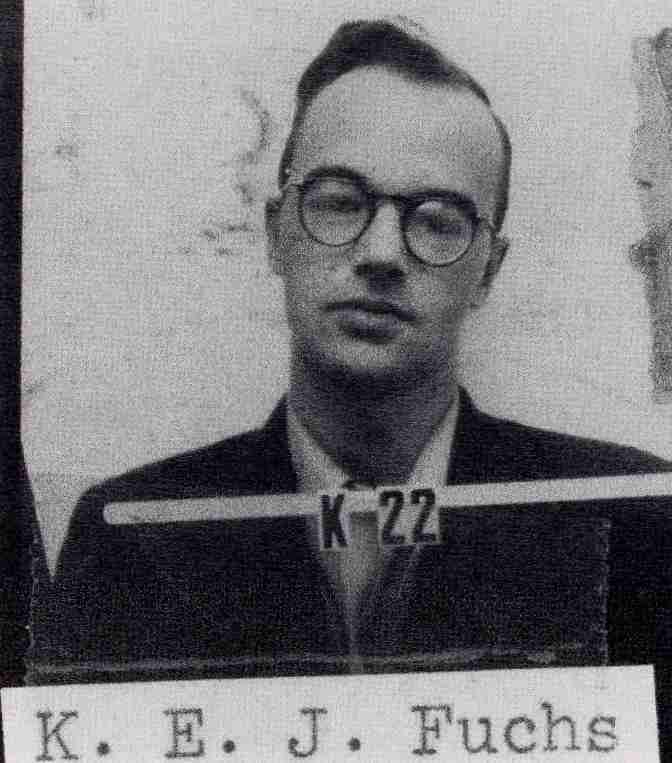
ID photo of Klaus Fuchs
Spied For: The Soviet Union
Fuchs was a German-born theoretical physicist who worked in Los Alamos on the atom bomb project. He was responsible for many significant theoretical calculations relating to the first fission weapons and early models of the hydrogen bomb. Whilst attending university in Germany, Fuchs became involved with the Communist Party of Germany. After a run-in with the newly installed Nazi government, he fled to England where he earned his PhD in physics. For a short time he worked on the British atomic bomb project.
It was while he was working for the British that he began to give information to the Soviets. He reasoned that they had the right to know what the British and the Americans were developing. In 1943 he was transferred to the United States to assist on the Manhattan project. From 1944 he worked in New Mexico at Los Alamos.
For two years he gave his KGB contacts theoretical plans for building a hydrogen bomb. He also provided key data on the production of uranium 235, allowing the Soviets to determine the number of bombs possessed by the United States. On his return to the United Kingdom in 1946, he was interrogated as a result of the cracking of some Soviet ciphers. He was tried and sentenced to fourteen years in prison, the maximum term under British law for passing military secrets to a friendly nation. he was released after nine years and immediately moved to Germany where he lived out the remainder of his life.
6. Major John Andre Born: 1750; Died: 1780
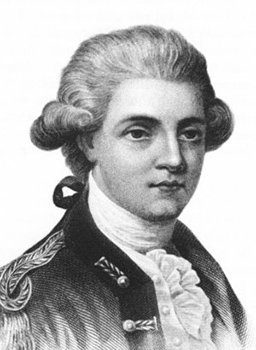
British Officer John Andre
Spied For: The British
John Andre was a British officer hanged as a spy during the American Revolutionary war. At the age of 20 he joined the British Army and moved to North America to join the occupying forces. He was a great favourite in society, both in Philadelphia and New York during their occupation by the British Army. During his nearly nine months in Philadelphia, André occupied Benjamin Franklin’s house, where it is said he took items from Franklin’s home when the British left Philadelphia.
In 1779, he became adjutant-general of the British Army with the rank of Major. In April, he was placed in charge of the British Secret Intelligence. By the next year (1780) he had begun to plot with American General Benedict Arnold, who commanded West Point, and had agreed to surrender it to the British for £20,000 — a move that would enable the British to cut New England off from the rest of the rebellious colonies.
Using common clothes and a false passport, Andre travelled toward New York with documents supplied by Arnold. He was stopped by three men at gunpoint. During the following conversation in which both parties were confused over the allegiance of the others, Andre admitted he was British. The three men searched him and found the papers he was hiding. He was put on trial before a board of senior officers. On September 29, 1780, the board found Andre guilty of being behind American lines “under a feigned name and in a disguised habit”, and that:
“Major Andre, Adjutant-General to the British army, ought to be considered as a Spy from the enemy, and that agreeable to the law and usage of nations, it is their opinion, he ought to suffer death.”
He was hanged as a spy at Tappan on October 2, 1780.
7. Nathan Hale Born: 1755; Died: 1776

The execution of Nathan Hale
Spied For: The Continental Army
Nathan Hale was a captain in the Continental Army during the American Revolutionary War. He is Widely considered to be America’s first spy after he volunteered for an intelligence-gathering mission, but was caught by the British. He is best remembered for his speech before his hanging, in which he said: “I only regret that I have but one life to lose for my country”.
Hale was born in Connecticut and went to Yale University where he graduated with first class honors. After leaving University he became a teacher until the break-out of the Revolutionary war in 1775. He immediately joined a Connecticut militia, becoming a first Sergeant. During the Battle of Long Island, Hale volunteered to go behind enemy lines to monitor the movements of the British. He disguised himself as a Dutch teacher and made his way to New York. He was captured in a tavern after he was tricked into betraying himself as a patriot. He was apprehended near Flushing Bay in Queens.
He was reportedly questioned and found with physical evidence. According to the traditions at the time, he was found guilty of being an illegal combatant – a crime carrying the death penalty. He was taken to what is now 66th Street and Third Avenue and hanged. He was 21 years old. A British officer wrote this of Hale at the execution:
“He behaved with great composure and resolution, saying he thought it the duty of every good Officer, to obey any orders given him by his Commander-in-Chief; and desired the Spectators to be at all times prepared to meet death in whatever shape it might appear.”
8. Belle Boyd Born: 1844; Died: 1900
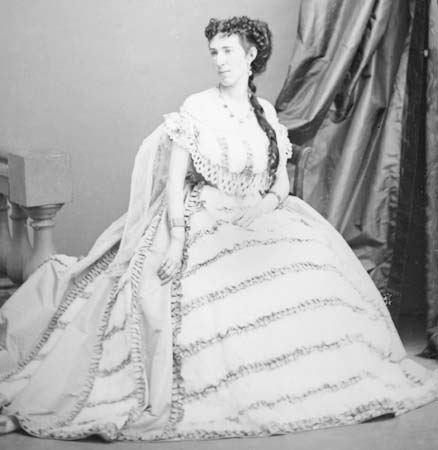
Confederate Spy, Belle Boyd
Spied For: The Confederates
Bella Boyd, born Maria Isabella Boyd, was a confederate spy in the American Civil War. She operated from her father’s hotel and gave valuable information to Confederate generals. Her career in espionage had a rather startling begining: when a group of Union soldiers broke in to her parents home with the intention of raising the US flag, one of them insulted Belle’s mother. Belle pulled out a pistol and shot one of them. She was 17 years old. A board of inquiry acquitted her but she was placed under surveillance. She profited from this by charming military secrets out of at least one of the Union sentries guarding her. She later wrote of him:
“To him, I am indebted for some very remarkable effusions, some withered flowers, and a great deal of important information.”
Belle passed the secrets she learned to the generals through her slave Eliza Hopewell. One evening in mid 1862 she overheard a general laying out plans for a move that would temporarily lower the Union military presence at Front Royal. That evening Belle rode to a confederate general and confided the details to him. When the confederates rode on Front Royal, Belle ran through bullets to greet the captain. For her contributions she was awarded the Southern Cross of Honor.
Belle was arrested after her lover gave her up on July 29, 1862. She was held for a month in the Old Capitol Prison in Washington but was freed one month later. She was arrested again but was set free on that occasion also. After a short time living in England, she returned to the united States and toured the country giving talks on her time as a Civil War spy. She died, during her tour in Wisconsin, of Typhoid at the age of 56.
9. The Cambridge Five Born: 20th Century; Died: 20th Century
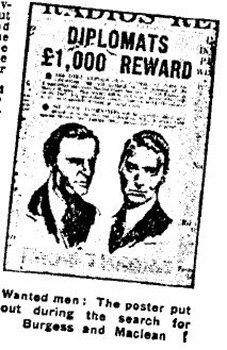
Cambridge Five Wanted Poster
Spied For: The Soviet Union
The Cambridge Five was a ring of Soviet spies in the UK who passed information to the Soviet Union during World War II and into the early 1950s. It has been suggested they may also have been responsible for passing Soviet disinformation to the Nazis. Whilst they are called the Cambridge Five, the fifth member is still unknown. Here is a short profile of each of the four known members:
Kim Philby: Of the five, Philby is believed to have done the most damage to British and American intelligence, providing classified information to the Soviet Union that caused the deaths of scores of agents. He was born in India to St. John Philby, a British officer and eventual advisor to the King of Saudia Arabia.
Donald Duart Maclean: Donald was recruited as a straight penetration agent while still an undergraduate at Cambridge. His actions are widely thought to have contributed to the 1948 Soviet blockade of Berlin and the onset of the Korean War. Maclean was brevetted a colonel in the Soviet KGB.
Guy Burgess: Burgess and Anthony Blunt contributed to the Soviet cause with the transmission of secret Foreign Office and MI5 documents that described Allied military strategy. He was most useful to the Soviets in his position as secretary to the British Deputy Foreign Minister, Hector McNeil.
Anthony Blunt: Blunt was an English art historian, formerly Professor of the History of Art, University of London and director of the Courtauld Institute of Art. After visiting Russia in 1933, Blunt was recruited in 1934 by the NKVD (forerunner of the KGB). A committed Marxist, Blunt was instrumental in recruiting Guy Burgess and Donald Maclean.
They were originally known as the Cambridge Spy Ring because all became committed communists while attending Cambridge University in the 1930s. There is some conjecture as to when they were actually recruited to Soviet intelligence, but Anthony Blunt claimed that it did not happen at Cambridge. Rather, they were recruited after they graduated.
10. Richard Sorge Born: 1895; Died: 1944
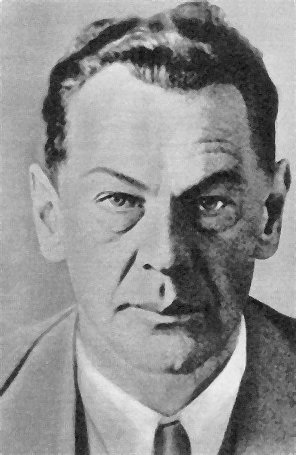
Soviet Spy in Japan
Spied For: The Soviet Union
Richard Sorge is considered to have been one of the best Soviet spies in Japan before and during World War II, which has gained him fame among spies, and espionage enthusiasts. Sorge was born in Azerbaijan during the reign of the Czars. His great uncle was an associate of Karl Marx. In October 1914 Sorge volunteered to serve during World War I. He joined a student battalion of the 3rd Guards, Field Artillery. During his service in the Western Front he was severely wounded in March 1916 when shrapnel cut off three of his fingers and broke both his legs, causing a lifelong limp. During his convalescence he read Marx and adopted communist ideology.
After being fired from a teaching and mining job, he fled to the Soviet Union where he was recruited as a spy for the and using the cover of being a journalist was sent to various European countries to assess the possibility of communist uprisings taking place. In 1922 the Communists relocated him to Frankfurt, where he gathered intelligence about the business community.
In May 1933 the Soviet Union decided to have Sorge organize a spy network in Japan. On 14 September 1941 Sorge advised the Red Army that the Japanese were not going to attack the Soviet Union until a) Moscow was captured, b) the size of the Kwantung Army was three times that of the Soviet Union’s Far Eastern forces and c) a civil war had started in Siberia.
Sorge was arrested on October 18, 1941 in Tokyo, in the house of his lover after a policeman picked up a note that he threw on to the road instead of destroying, warning him that he was being watched. Even under torture, he denied all ties with the Soviets. Sorge was not exchanged for Japanese prisoners of war, because the Soviet government as well as Sorge himself denied that he was spying for USSR. He was hanged on November 7, 1944, 10:20 a.m. Tokyo time. The Soviet Union denied all knowledge of him until 1964.
Technorati Tags: espionage, Politics, spies
More Great Lists
 Top 10 Blockbuster Movie Scenes Reviewed By Real-Life Spies
 10 Famously Hard-Core Female Spies
 Top 10 Ghost Towns Inside Or Near Famous Cities
 Top 10 Famous Haunted Landmarks You Didn't Know Were Haunted
 Top 10 World Famous Books That Got Rejected
 Top 10 Places Famous For Bizarre Reasons
 Top 10 Universally Famous Songs With Deceptively…
 Top 10 Horrific Details Of Famous Historical Events
 Top 10 Surprising Facts About World Famous Writers
More Great Lists