
 Weird Stuff
Weird Stuff
Weird Stuff  Mysteries
 10 Tragic Disappearances and Deaths in Joshua Tree National Park
 History
 10 Ways Childhood Really Sucked in the Old West
 Music
Music 10 Name Origins of Famous Bands from the 1990s
 Religion
 10 Biggest Turnarounds by the Catholic Church
 Weird Stuff
 10 Unbelievable Times Laws Had Unintended Consequences
 Humans
 Ten Historic Women Who Deserve Way More Credit Than They Got
 Movies and TV
 10 Films That Spawned Major Lawsuits
 History
 Ten Times Towns Were Wiped Off the Face of the Earth
 Creepy
 10 of the Most Disturbingly Haunted Public Houses in the UK
Weird Stuff 10 Niche Subcultures That Are More Popular Than You Might Think
Mysteries 10 Tragic Disappearances and Deaths in Joshua Tree National Park
History 10 Ways Childhood Really Sucked in the Old West
Who's Behind Listverse?

Jamie Frater
Head Editor
Jamie founded Listverse due to an insatiable desire to share fascinating, obscure, and bizarre facts. He has been a guest speaker on numerous national radio and television stations and is a five time published author.
More About Us
Music 10 Name Origins of Famous Bands from the 1990s
Religion 10 Biggest Turnarounds by the Catholic Church
Weird Stuff 10 Unbelievable Times Laws Had Unintended Consequences
Humans Ten Historic Women Who Deserve Way More Credit Than They Got
Movies and TV 10 Films That Spawned Major Lawsuits
History Ten Times Towns Were Wiped Off the Face of the Earth
Creepy 10 of the Most Disturbingly Haunted Public Houses in the UK
Top 10 Quirkiest Early Flying Machines
This topic is a dream for lovers of lists because there are so many hilarious and quirky attempts at flight that have been documented through history. After wading through hundreds of choices I have picked the 10 quirkiest – you are sure to love them!
10
Chanute’s Gliding Machine
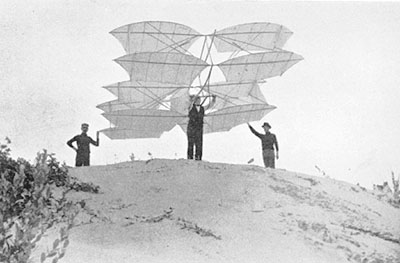
We all know the trite adage that less is more, but apparently no one told Monsieur Octave Chanute – he seemed to think that more is best as is demonstrated by his ungainly multi-winged flying machine! French born Chanute was a retired engineer living in Chicago, Illinois, when he began to dabble in aeronautics. In 1896 he started testing his “gliding machines” in Dune Park, Indiana, on the shore of Lake Michigan.
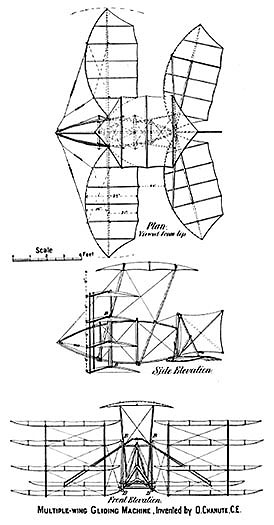
The bizarre appearance of this machine with its wings that swung back and forth, caused many people to ridicule the concept – especially as later “classic” designs used trussed and fixed wings. But, even though the glider was a failure, its design contained the germ of an idea that was later used in numerous designs of military aircraft: pivoting movable wing surfaces (seen most notably in the F-111, and B-1).
His glider was built to test the idea of using pivoting wings to control the center of wing pressure – providing stability. Chanute invented the “strut-wire” braced structure that would be used in all biplanes of the future. Before his interest in aviation, Chanute was a well respected railroad engineer who designed and constructed the Chicago stockyards and the Kansas City stockyards. Octave Chanute went on to be the main enthusiast for the Wright Brothers during their early aerial trials, encouraging them and supplying them with the latest aerial information.
9
Alexandre Goupil’s Sesquiplane
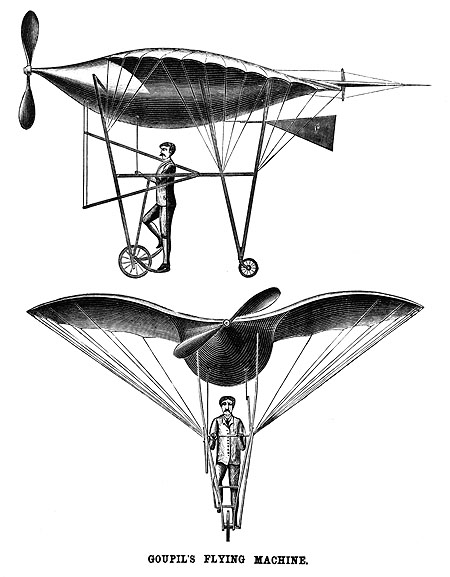
Alexandre Goupil was a well regarded and well known French engineer who designed this bird-like flying machine in 1883. The sesquiplane (a monoplane with additional half-wings) was meant to be powered by a steam engine mounted inside the rounded body of the machine. The engine was to drive a single tractor propeller and it was to have a wheeled landing gear. A rudder was to be mounted below the tail surface.
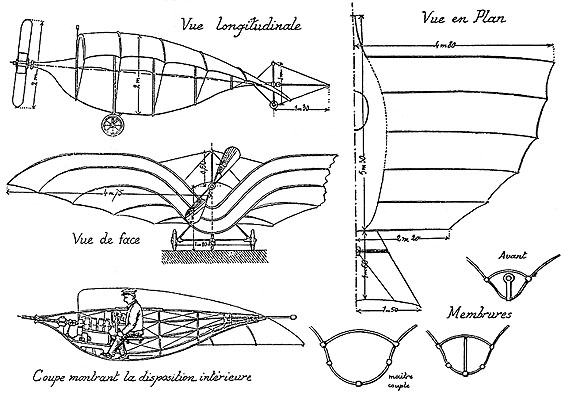
Goupil built and tested a version of his design without the engine. The test machine had a wing span of just over 19 feet 8 inches. Surprisingly it had considerable lift – hoisting itself and two men into the air in a wind of around 14 MPH. Goupil’s design foreshadowed modern “blended lifting body” configurations.
Pictured to the left we have the initial machine-driven design, while the image at the top shows the unpowered test version. (Click the images for a larger view.)
8
Charles Ritchel’s Flying Machine

Charles Ritchel’s flying machine was first demonstrated publicly during May and June of 1878. The framework was constructed of brass tubing and it held a gas bag of rubberized fabric. Mabel Harrington was the first to fly this hand-cranked machine though Mark Quinlan is believed to have made the majority of the future demonstration flights, including two lasting over one hour each. Eventually Ritchel would go on to build and sell five of these machines.
Ritchel had plans for a trans-contentinental airline comprising aircraft hand-cranked by 11 men each. This was not to eventuate. Not satisfied with just aviation, Ritchel was actually a prolific inventor – with his most famous invention being the funhouse mirror. He also invented a mechanical money box in which a coin is placed in a monkey’s hand which then tilts the coin back in to a hole in its stomach. Some people attribute the invention of roller skates to Ritchel. Ritchel died in poverty.
7
Thomas Moy’s “Aerial Steamer”
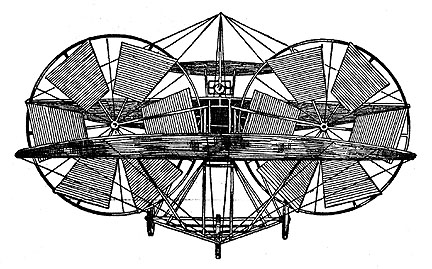
Thomas Moy’s tandem-wing monoplane called “Aerial Steamer” was a large machine with twin propellers each six-foot in diameter. It was powered by a steam engine (also built by Moy) which reached 3 horse-power at 550 RPM. His plane used a tricycle landing gear. In June 1875, Moy tested his machine in the Crystal Palace in London, England. It managed to reach 12 MPH while running on a track, but it did not generate enough lift to leave the ground. Despite the failure, some design elements (such as the twin-propellers and tricycle landing gear) made their way in to other future plane designs. There is some documentation to suggest that the plane may have lifted 6 inches off the ground, but this not conclusive.
6
Leonardo Da Vinci’s Flying Machine
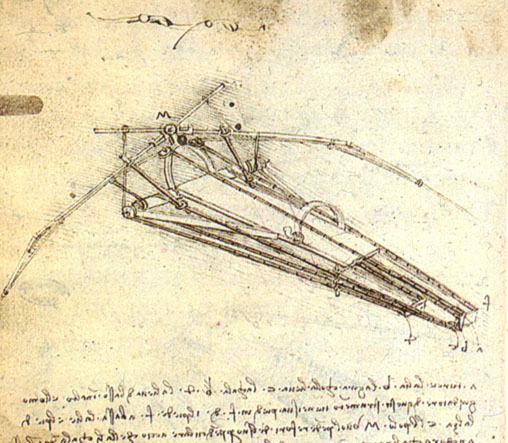
Leonardo Da Vinci was an Italian polymath who was probably the first European to seek a practical solution to flight. He designed a large number of devices, including parachutes, and he studied the flight and structure of birds.
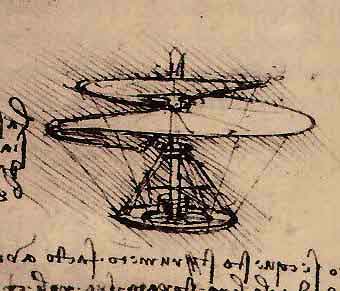
In 1485 he drew a very detailed plan for a human powered ornithopter (a wing-flapping device designed to fly). There is no proof that he attempted to build the device. For the next four centuries, the concept of flying devices designed around birds occurred again and again. For much of his life, Leonardo was fascinated by the phenomenon of flight, producing many studies of the flight of birds, including his c. 1505 Codex on the Flight of Birds, as well as plans for several flying machines, including a helicopter and a light hang glider. Most were impractical, but the hang glider has been successfully constructed and demonstrated. He conceptualised a helicopter (pictured right), a tank, concentrated solar power, a calculator, the double hull and outlined a rudimentary theory of plate tectonics.
5
Le-Bris’ Artificial Albatross
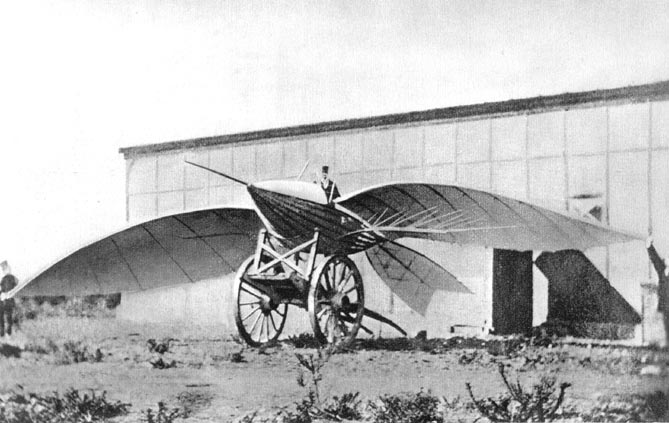
Le Bris built a glider, inspired by the shape of the Albatross bird and named L’Albatros artificiel (“The artificial Albatross”). During 1856 he flew briefly on the beach of Sainte-Anne-la-Palud (Finistère), by being pulled by a running horse, face to the wind. He thus flew higher than his point of departure, a first for heavier-than-air flying machines, reportedly to a height of 100 metres (300 ft), for a distance of 200 metres (600 ft).
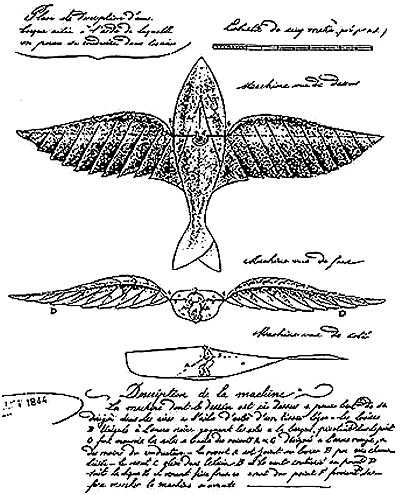
In 1868, with the support of the French Navy, he built a second flying machine, which he tried three times in Brest without great success. It was almost identical to his first flying machine, except that it was lighter and had a system to shift weight distribution. His flying machine became the first ever to be photographed, albeit on the ground, by Nadar in 1868.
Le Bris invented flight controls, which could act on the incidence of wings. This invention was patented during March 1857. Le Bris’ dedication to the cause of soaring flight, his innovative derivation of design and function from nature, and his translation to mechanical device, rather than merely being a copying of a natural form, was in itself a remarkable achievement. He persevered with his experiments, succeeding in a fashion, despite personal injury and insult, and despite being relatively poor.
4
Cayley’s Glider
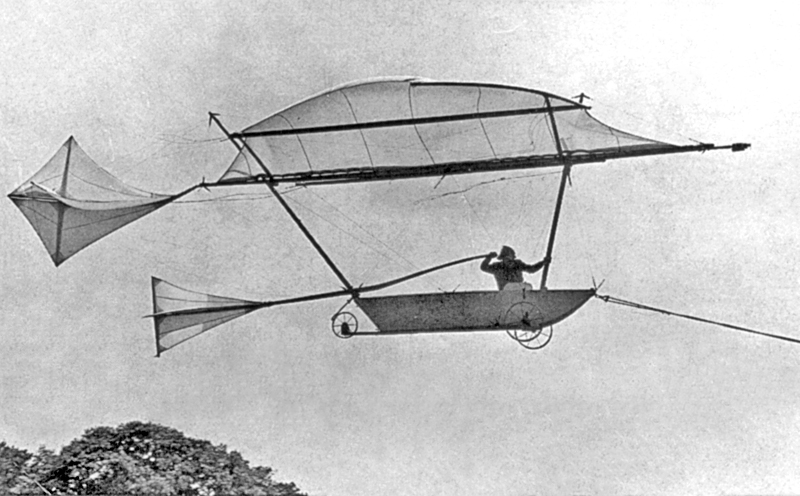
Sir George Cayley is considered to be one of the most important people in the history of aeronautics. He is considered by many to be the first true scientific aerial investigator and the first to really understand the underlying principles of aviation and flying. His first device (a model helicopter) was built in 1796 with contra-rotating propellers. Three years later he inscribed a medalion which clearly showed the forces that apply in flight. On its reverse he sketched his plan for a monoplane gliding machine.
In 1804 Cayley designed and built a model monoplane glider of strikingly modern appearance. The model featured an adjustable cruciform tail, a kite-shaped wing mounted at a high angle of incidence and a moveable weight to alter the center of gravity. It was probably the first gliding device to make significant flights. Pictured above is a replica of Cayley’s glider.
3
Giffard’s Airship
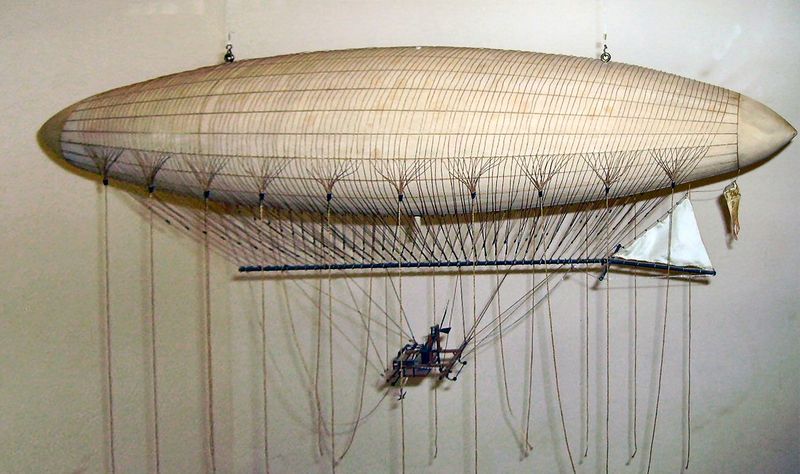
French engineer, Henri Giffard invented the injector and the powered airship with a steam engine weighing over 400 lb; it was the world’s first passenger-carrying airship (known as a Dirigible). Both practical and steerable, the hydrogen-filled airship was equipped with a 3 hp steam engine that drove a propeller. The engine was fitted with a downward pointing funnel. The exhaust stream was mixed in with the combustion gases and it was hoped by these means to stop sparks rising up to the gas bag; he also installed a vertical rudder.
On 24 September 1852 Giffard made the first powered and controlled flight traveling 27 km from Paris to Trappes. The wind was too strong to allow him to make way against it, so he was unable to return to the start. However he was able to make turns and circles, proving that a powered airship could be steered and controlled. In response to his declining eyesight, Giffard committed suicide in 1882, leaving his estate to the nation for humanitarian and scientific purposes. His name is one of the 72 names on the Eiffel tower. Pictured above is a model of Giffard’s airship. [Wikipedia]
2
Clement Ader’s “Bat” Planes
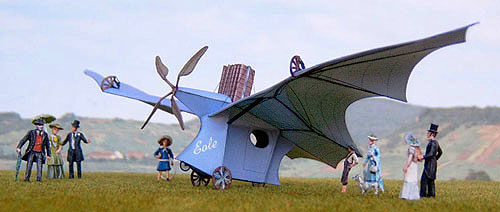
Clement Ader was, by all accounts, a brilliant man who taught himself engineering. His interest in aeronautical matters began in earnest in 1870 when he constructed a gas balloon, and later he invented a number of electrical communications devices. He is most well-known, however, for his two remarkable flying machines, the Ader Eole (model pictured above) and the Ader Avion No. 3. (below.)
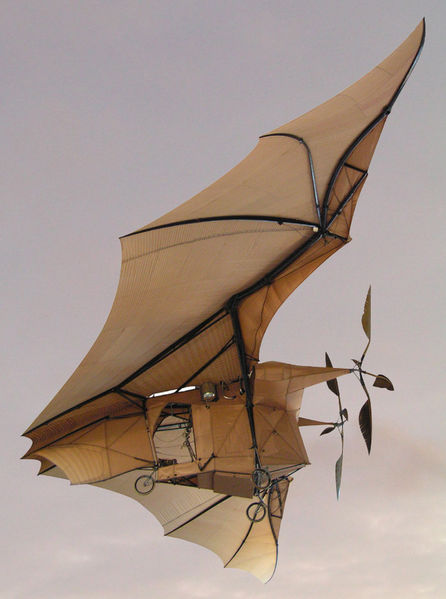
Clement Ader claimed that while he was aboard the Ader Eole he made a steam-engine powered low-level flight of around 160 feet on October 9, 1890, in the suburbs of Paris, from a level field on the estate of his friend. He also claimed a flight of some 900 feet in his Avion No. 3 and two witnesses confirmed the event. The Avion No. 3 was a triumph of engineering design derived from nature. Not only did it have an external resemblance to a bat but much of its internal wing structure followed that of the bat, also. To many people, the Ader Eole and Ader Avion No. 3 have become the very symbols of Victorian Era attempts at powered flight.
The claim Ader made about his flight in Avion 3 have been largely disproven, though both planes were remarkable machines in many regards and the majority of French people consider him to be the father of French Aviation.
1
Gusmão’s Lighter-than-air Airship
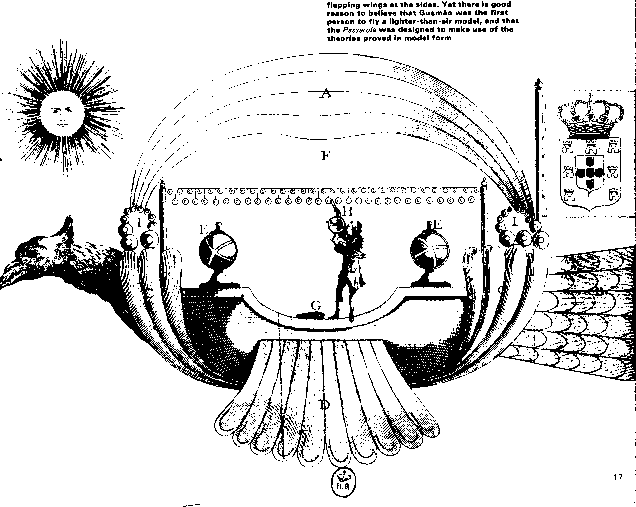
Bartolomeu de Gusmão (1685, Santos, São Paulo, Brazil – November 18, 1724, Toledo, Spain), was a Portuguese priest and naturalist born in Colonial Brazil, recalled for his early work on lighter-than-air airship design. In 1709 he presented a petition to King John V of Portugal, begging a privilege for his invention of an airship, in which he expressed the greatest confidence. The contents of this petition have been preserved, as well as a picture and description of his airship.
The vessel was to be propelled by the agency of magnets which, apparently, were to be encased in two hollow metal balls. The public test of the machine, which was set for June 24, 1709, did not take place. According to contemporary reports, however, Gusmão appears to have made several less ambitious experiments with this machine. His contrivance in the main represented the principle of the kite (aeroplane). In all probability he did not have magnets in the aforementioned metal shells, but gases and hot air generated by the combustion of various materials. [Wikipedia]
This article is licensed under the GFDL because it contains quotations from two Wikipedia articles cited above.
More Great Lists
 Top 10 Fascinating Facts About The Golden Age Of Flying
 Top 10 Remarkable Early Human Relatives
 Top 10 Killers that Started Down a Dark Path at an Early Age
 10 Eerie Early Images Of Gods
 10 Strange But Interesting Early Photography Fads
 10 Serial Killers Who Were Shockingly Released From…
 Top 10 Top-Level Domains That Caused Controversies
 Top 10 Best Movies From The Top Genres
 Top 10 Worst Movies From The Top Genres
fact checked by
Alex Hanton
More Great Lists