It is no secret that I love language and all things related it to. Also, being a bit of a pedant, I love to share titbits of information about words, phrases, and language in general. Therefore, I have put together a list of misconceptions (one of my favorite types of list) about common sayings. Some involve spelling errors, while others involve conception or comprehension errors. Be sure to tell us your favorite (and by that I mean most hated) common errors in the comments.
Common Saying: To get off scot free
Many people think that this saying refers to Scottish people being tight with money – hence something being free, but in fact the word “scot” is an old Norse word which means “payment” – specifically a payment made to a landlord or sheriff. So this phrase – while meaning what most people think it means, has no connection to the Scottish people – it just means to get off without having to pay.
Common Saying: As fit as a fiddle
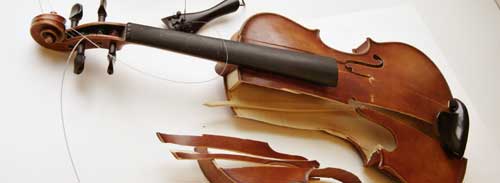
This is another phrase where a single word has confused people – “fit” in the context of this saying does not mean “healthy” which is a 19th century definition. Its original meaning was “suitable” – and it is still used in that context in the sentence “fit for a king”. As fit as a fiddle means “as appropriate as can be” – not “in excellent health”. The first use of the phrase, incidentally, was in the 16th century and it was originally “as right as a fiddle”.
Common Saying: If you think that, you have another thing coming
This is a complete aberration of the original phrase because of the sound of English. The correct phrase is “if you think that, you have another think coming” – in other words, “what you think is wrong so think again”. Because the “k” in “think” often ends up silent when saying “think coming” people have changed the phrase over time. Of course, “another thing coming” makes no sense at all. To illustrate how global this error is, when you google “another thing coming” it returns 139,000 results; when you google “another think coming” it returns a mere 39,000 results.
Common Saying: Eat humble pie
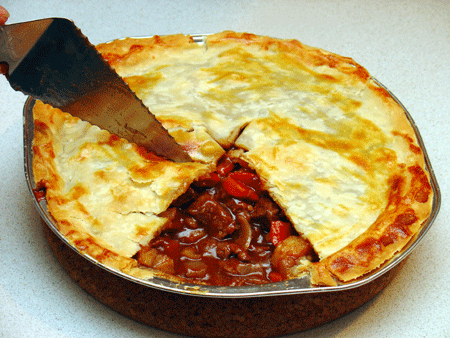
This phrase means “to be humble in apologizing for something.” I was slightly reluctant to put it on the list because it actually does mean what people think it means, but there is still a misconception here; people think that this phrase means to eat a pie made of humbleness but it actually means to eat a pie made with umble (pictured above). Umble is an old English word for offal – the bits of the animal seldom eaten today (sadly). It was a pie that was normally eaten by the poor as the finer cuts of meat were left for the rich only. “To eat a humble pie” is an example of metanalysis (words being broken down into parts or meanings that differ from the original) as it sounds just like “to eat an umble pie”. Other examples of this in English are “an apron” which used to be “a napron”.
Common Saying: Rule of thumb
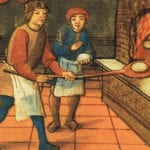
People commonly think that this saying is a reference to a law allowing a man to beat his wife as long as he uses a rod no thicker than his thumb. It is, of course, completely untrue. There is no record of any judge in Britain ever making a ruling like this – or any lawmaker passing a law. The phrase actually refers to doing something by estimates – rather than using an exact measure.
Common Saying: On tender hooks
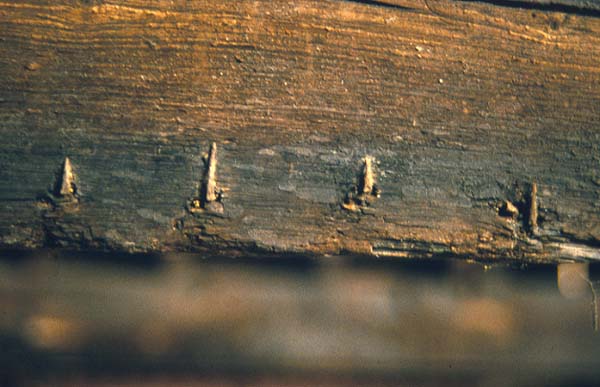
This phrase is very commonly misspelt. First off, what exactly is a tender hook? It doesn’t seem logical does it? Well – that is because it isn’t. The phrase is actually “on tenterhooks”. A tenter was a medieval tool used for making cloth – the tenterhooks (pictured above) were small hooks to which the fabric would be stretched in the manufacturing process. To be on tenterhooks means to be left hanging – or to be in a state of suspense.
Common Saying: I’ll take a raincheck
This phrase is usually meant to mean “I won’t do it now but I will later”. This is the commonly accepted meaning (and has been for a long time) so it is now considered to be correct. It is included here merely out of interest because its original meaning was slightly different. Initially, a raincheck was offered to people who had tickets to a baseball game that was rained out – they would offered a “raincheck” which was a ticket for a game at a later date to make up for the missed game. This eventually found its way into shopping jargon in general where a raincheck was an offer to sell an out-of-stock good when it arrived back in stock. The meaning has eventually broadened to a point that it is not an offer any longer but a response.
Common Saying: To give someone free reign
This is a spelling error that leads to a misunderstanding – though the meanings remain the same fundamentally. Many people presume this phrase to mean that a person given free reign, has the “royal” power to do anything they want. In fact, the correct phrase is “free rein” and it comes from the days before cars when horses were used as our main mode of transport. When navigating a steep or winding path, one would relax the reins so that the horse could pick the safest path as he was more likely to do a better job than the rider.
Common Saying: To wreck havoc
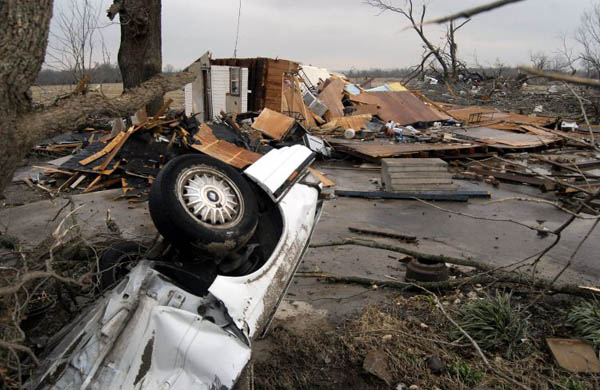
Havoc means chaos – and to wreck something is to put it into a state of chaos. So why would you make chaos out of chaos? You wouldn’t. What you might do is wreak havoc though – because “to wreak” means “to cause to happen”. The two words are pronounced differently – wreck sounds like “rek” while “wreak” sounds like “reek”. It is a small – but common, error.
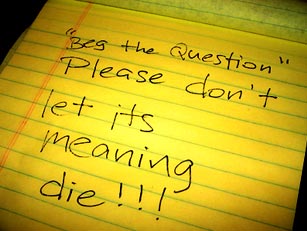
Common Saying: To beg the question
Let’s face it – 99% of people reading this list will not know the correct meaning of “beg the question”, but that implies that the mistaken meaning should really be considered correct through common usage – so let us not fight about right or wrong – I will just state the facts: “to beg the question” does not mean “to raise the question”. Originally the phrase was “to begge the question” and it appeared in English around the 1580s. It is a reference to a question (or phrase) which implies the truth of the thing it is trying to prove. Confusing? Okay – here is an example: “why does England have fewer trees per acre than any other country in Europe?” This is a “begged question” – the person asking is implying that England has fewer trees – when in fact, it may not. Another example is “he must be telling the truth because he never lies”. Decartes was begging the question when he said “I think, therefore I am”. Oh – and for those of you who are used to using the term in the wrong way, consider using “prompt the question” as a correct alternative.
Contributor: JFrater


I've actually never heard "wreck havoc"
I've always said "wreak"
Great list :]
Same here I have never heard "Wreck" that just doesn't make sense what-so-ever.
I’ve never heard wreck Either, Also, I’ve Always used tenterhooks instead of tender hooks, I didn’t know what tenterhooks were, but I always figured it was something that went out of fashion without the phrase leaving. I’ve never heard tender hooks either, or if I have, I probably just passed it off as accent
Nice list. Do some people actually say ‘Wreck havoc’?
In apple pie order… ordering a pie… :p haha!
Another sublime list from JF.
interesting list! For once I’ve actually heard of most of the correct sayings and for a few of them I hadn’t even heard of the common mistake (never heard anyone say to wreck havoc for example) but anyway, great list
Good list, I was aware of most of these – I’ve never heard anyone say tender hooks or wreck havoc though, Australia must be pretty gramatically correct – but I did learn a thing or two
I’m not sure I’ve ever heard the term ‘to wreck havoc’. It doesn’t even sound right like a saying should.
Great list! Most of these I already knew, but I did learn some things today, too!
And as for begging the question, this is all I can say:
http://www.qwantz.com/archive/000693.html
pretty good list like usual i just cant help but wonder why the rule of thumb guy has an apple logo on his shirt..
Hmmm, nice list but I’ve never heard any one say “wreck havoc” …and I live in KY LOL! I also thought to beg the question or beg your pardon even after the question or pardon was given meant that it was to ask the person to repeat/ re-phrase the question/apology to make things more clear.
NUMBER ONE IS EDUCATIONAL..THANK YOU JFRAT.ü
As a Rule of Thumb, I Beg the Question. If you think you can Wreck Havoc and have Free Reign while we’re On Tender Hooks. I’ll Take a Raincheck and you’ll Eat Humble Pie because you got Another Thing Coming, if you think you’re as Fit as a Fiddle and Scot Free.
Great list – one we use here is – Lets go and paint the town red.
Which realy means lets get out and party in town and genarly have a good time.
i always wondered where sayings like this came from. where dick *as sick as a parrot* come from?
I’ve always said ‘another thing coming’ even though I’ve suspected the correct term. Not anymore though!
I actually knew the correct meaning of all of these, the incorrect meaning I didnt know that well. Rule of thumb for example, the incorrect meaning was hilarious.
I beg to differ!
I’ve never heard anyone say ‘wreck havoc’ either. Also, I remember once watching a cookery programme and they were smoking some fish on hooks and the man smoking the fish said that’s where the phrase ‘on tenterhooks’ came from. I’ve looked it up (briefly) and I can’t find any reference to fish-smoking. Maybe he was just reusing cloth hooks?
I’m too busy to read this in one foul swoop so I’ll go through it with a fine toothcomb later. I wait with baited breath for future lists on similar sayings.
I’m from Sweden and I would guess that the word ‘scot’ is a derivative from the word ‘skatt’ (or vice versa) which literally means some form of tax.
Can I just say that in England (where English is used properly and not in the basterdised American form) I have never heard of the expressions wreck havoc or on tender hooks. Here, we use the correct forms as stated above. I can only but assume, sadly, that a phrase such as “wreck havoc” is used by over excited frat boys in which something “awesome” happened.
Just thought I’d point that out
When you lose that awful accent, then we'll talk about something being bastardized.
Again just like almost everyone else, never heard “wreck havoc”. The picture for “rule of thumb” is amazing and so is the incorrect meaning for it, which again I never heard.
And tinydancer, wasn’t there already a list confirming that the “American” English was closer to the “correct” English than the British version of it? And also saying that Americans are the ones using the wrong usage of the sayings is just ignorant. We aren’t the only ones that get things wrong, you know.
I always wondered about the Raincheck – I’m not a native English speaker, and I always wondered about that expressing when I heard in film or TV shows, for the longest time I thought they were saying something like a “re-check” just because raincheck made absolutly no sense. so thank you for clearing that up
I knew a bunch of these already, but was disappointed not to see ‘I could care less’ on the list.
Hello tinydancer. I am glad that you’re all smart and can speak English properly. Really, it makes me very happy. Now all you have to do is work on not being *****.
Excellent list, Jamie. Thank you. Here’s another one:
The Quick and the Dead.
This expression was famously misused in the title of the 1995 movie with Sharon Stone. It assumes that the ‘Quick’ refers to the speed of the draw of the gunslinger. The true meaning of the word is ‘alive’. It is still used in this context when we refer to the first movement of a fetus as ‘the quickening’, to quicksand (living sand) , or to trimming a fingernail into the quick.
First recorded in the 4th century Old English as “cwice”, the phrase appears in the 1385 Wycliffe Bible as:
And thei schulen yyue resoun to hym, that is redi to deme the quyke and the deed.
And in the king James version:
Who shall give account to him that is ready to judge the quick and the dead.
i always heard that as *I couldn’t care less*
6twistedbiscuits, you definitely reminded me about how much it bothers me when people say I “could” care less instead of couldn’t. If you just think about it when you say could, it kind of doesn’t work out with the way most people mean it. Unless you actually COULD care less about something, then go ahead and say it but it just doesn’t have the same emphasis as couldn’t. I actually think you should replace the “Wreck havoc” with “Could care less”.
*edit- I will give credit where credit is due, ChickyBee was the one to think of “could care less”. And sorry for so many posts, I may or may not have been drinking.
tinydancer: Wow. Really? Do you have something against us bastards? I as an American have never said “wreck” nor have I heard it so pick on another country and their frat boys okay? Jerk.
6 twisted biscuits = as sick as a parrot comes from the mining days when the miners would take a bird with them into the mine and when the bird died then they knew that the air levels were dangerous and they would resurface. they would usually use parrots and budgies
Surely canaries and not budgies? Hence "A canary in a coalmine"?
I agree with tinydancer.
anyone mention
a MUTE point instead of
a MOOT point
I agree with Katiebug. I have always known it to be “wreak havoc.” Who says “wreck?” I live in the South, and nobody I know would ever says “wreck” though they have a habit of saying “chunk” in lieu of “chuck.” As in, I’m going to throw something at you, ergo, I chuck it at you. But they say, “I will chunk it at you.”
Eh…nice list either way.
@33 Canacan – The mine story is an unlike source. Not the bird in the mine part, but that a coal miner would use a parrot. These are tropical birds and were very rare and expensive. I do not think that poor miners could afford such an expense nor would the mine owners select to risk it.
In any event “as sick as a parrot” often refers to “disappointment”. As such, this may make more sense. To have paid dearly for an imported bird only to see it get sick would be a disappointment indeed.
In the olden days when people went out to party in town there used to be lots of free-for-all brawls in the inns and taverns, which resulted in lots of blood spillages. Hence the term ” to paint the town red”. Seriously !…NOT! !
My personal fave (not that anyone truly cares) is “for all intensive purposes,” when it fact it’s “for all intents and purposes.”
I too never heard ‘wreck havoc’ instead of ‘wreak havoc’, but you got me on ‘another think coming’ so it balances.
Also, like TJ, I hear ‘mute point’ instead of ‘moot point’ a lot.
I like the saying ‘for love nor money’ But i believe that it does have misconstrued usage, can someone clarify. I understand it to be theres no way in hell im doing that *****e?
This woulda been a nice place to clear up that whole: “Have your cake and eat it too” nonsense.
I’d love to WRECK HAVOC on-Tiny BRAIN DEAD Dancer. By the responses posted, I am not alone.
Here’s another for you: people often say “spitting image” but the correct saying is “spit and image”. Dunno why.
Tinydancer, I’m confused upon a point you are making. Are Americans the only ones who “bastardize” your precious form of “proper” English? What about Australia and the other English speaking nations? Do they bastardize the language as well? Face it, I’m sure by your logic the Romans have a bone to pick with the French, Italians and Spanish for bastardizing their language as well. Here’s a common expression for you: get off your high horse. You are not better than anyone else here. Do you understand that? Awesome!
Wouldn’t the fact that most English-speakers have adapted these phrases for decades and use them predominantly these ways effectively redefine them? i.e. they are no longer really incorrect as they sound okay to all of us?
Also, on Number 8, good to see some Judas Priest influence here!
What about “Suffer fools” ?
Late O’ Day: By the way, Have = Eaten Therefore, the term means you can’t have eaten your cake and then eat it again. At least that is the interpretation from Wyk.
Ok I have never heard anyone say “to wreck havoc”. I have always heard “to wreak havoc”. And it appears a lot of people who have commented who have also never heard “to wreck havoc”. Which begs the question (haha just kidding Jamie!)..which prompts the question, where did you get to wreck havoc from? Have you actually heard people use it?
Hahaha I’m also so glad you had the beg the question thing on here because just the other day on another website someone in the article said “which begs the question…” then someone commented and said “oh that’s not what begs the question means”. And then I thought “well..what does it mean then??” Someone else even asked but the original commenter never said anything back. NOW I know what that person was talking about!!
A great interesting list, other than number two. The rest are kind of understandable misunderstandings (lol), but number 2 is pure stupidity.
I never want to eat an umble pie- it looks gross. Cool list, though.
It seems as if the writer of this list was the one who made all the spelling errors, and not the people who use the sayings. I would say 95% of the people who read this list have never heard of “wreck havoc” or “on tender hooks”. I think the person who wrote this has just misheard these sayings and they are now passing on the misspelling.
#31 – No need for credit, just glad to see I’m not alone!
Another random one that drove me nuts was when discussing assignments in high school, many classmates would refer to theirs as ‘a working progress’ instead of a ‘work in progress’
Hrmm… perhaps this could spawn a list of ‘Commonly Mangled Sayings’ ?
There was one misconception that used to really annoy me, it was “no pain, no game” its actually “no pain, no gain”.. A lot of people already know that, but a lot of people DON’T.
I’ve never heard of wrecking havoc either- and thank you many times for the tender hooks thing. That bothers me. also on my “pet peeve” list:
* Irregardless. I don’t care if it’s in the dictionary. It’s not a word.
* Flammable and Inflammable. Inflammable..you keep using this word. I do not think it means what you think it means.
* “I’m LITERALLY going to starve to death I’m so hungry!” “I have so much homework I’m LITERALLY going to die!” I am figuratively going to punch you in the head if you keep using literally wrong.
* PIN number. Urg.
I know those are words and not phrases, but they all needed to be said,
Quite a non-controversial list JFrater. (If you discount tinydancer’s allegations, that is.)
But informative nonetheless.
English is such a delightful language, with a rich history, and many diverse sources. No wonder it is used as the language of the world, because everyone can identify with it, and “bastardize” or “wreck havoc” on it, in their own way. But it’s all fun.
One phrase that does seem to get on my nerves is “Believe you me”. I maybe wrong, but it just doesn’t seem proper. Does it?
Pocket: your post made me laugh, thank you for that.
I have heard people say wreck havoc vice wreak havoc, so it happens.
I would consider “to raise” and “to prompt” the questions to be very similar in their meanings. One of the synonyms I found for “raise” in this context was “provoke.” One of the synonyms I found for “provoke” was “prompt.” Perhaps I’m reading too much into it?
As far as the discrepancy between “rain check” for the baseball game and the context today, I really don’t see that as such a wild misconception.
posted too quickly. The end of that sentence is “so there they are” if anyone was wondering.
There’s an article about common phrases on mental floss today. Never knew how “pleased as punch” came about. Pretty neat.
Callie: just in reference to PIN number; I think that is an issue that covers a lot of territory. Whether it’s personal identification number number or network interface card card or to a lesser extent: bunny rabbit or puppy dog, etc. These certainly make me cringe, but then I catch myself doing it too.
I use “couldn’t care less” but I have always liked “could care less”. It makes me think that the person could care less if they tried, but it isn’t worth the effort to them.
I’m from Canada so “wind chill factor” comes up frequently. Some people pronounce it “windshield factor” and it makes me want to smack them.
I’m going to call Rob Halford and tell him he has another think coming.
Also – some guy told me one time he was going to ‘kick my ass’ and ‘beat the ***** out of me.’ As I laid on the ground in a puddle of my own blood, I figured out that he didn’t actually ‘kick my ass’ once and as I remained in control of my bowels, he didn’t actually ‘beat the ***** out of me.’ I grabbed my phone and texted him that he shouldn’t say things he doesn’t actually mean. He should have said he was going to slap me a few times and then punch me repeatedly in the solar plexis while his buddies held me up. I suppose he could have chosen to kick me in the ass as I was sprawled out on the ground, but he chose to kick me in the stomach and in the face a few times.
Boy was he stupid.
And I’d like to say to Jamie that his use of my picture in #6 is copyright infringement. You’ll be hearing from my lawyers pal!