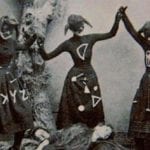
Once depicted as brutal, grunting, slouching sub-humans, Neanderthals are now known to have had brains as large as ours and their own distinct culture. They buried their dead, tended their sick and co-existed with our own ancestors in Europe for thousands of years before becoming extinct just as modern humans flourished and began to spread throughout the continent. This list looks at ten of the most persistent myths about Homo neanderthalensis.
The myth: Neanderthals couldn’t speak; they grunted
It has been long believed that Neanderthals couldn’t speak like humans – having only a basic capacity for sound in their throats, but in 1983, scientists found a Neanderthal hyoid bone at a cave in Israel (the hyoid bone is part of the vocal mechanism) which was identical to that of modern humans. This means that their capacity for speech (at least physically) is the same as our own. There is no reason to believe that they did not have at least a basic system of vocal communication.
The myth: Man is descended from Neanderthals
In fact, Neanderthals and modern men existed side by side as two separate groups. Recent DNA studies have found that the Neanderthals are a distinct evolutionary line – a line which was ultimately a dead end as they all died out around 30,000 years ago. The extinction of Neanderthals was most likely caused by slightly lower birth rates and higher mortality rates, combined with an increasingly unstable climate.
The myth: Neanderthals were hairy
There is absolutely no reason to believe that Neanderthals were any hairier than modern man. Computer models have shown that excess hair on neanderthals would have caused over-production of sweat which would have frozen on the neanderthals potentially leading to death.
The myth: Neanderthals exclusively used clubs as weapons
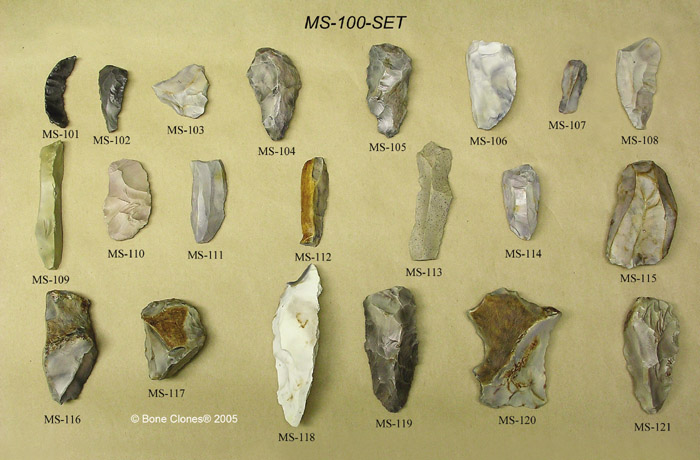
Actually the Neanderthals had many highly developed tools and weapons – such as spears for killing mammoths and stone tools. They are thought to have used tools of the Mousterian class, which were often produced using soft hammer percussion, with hammers made of materials like bones, antlers, and wood, rather than hard hammer percussion, using stone hammers. Many of these tools were very sharp. There is also good evidence that they used a lot of wood, objects which are unlikely to have been preserved until today.
The myth: Neanderthals had bent knees and walked like chimps
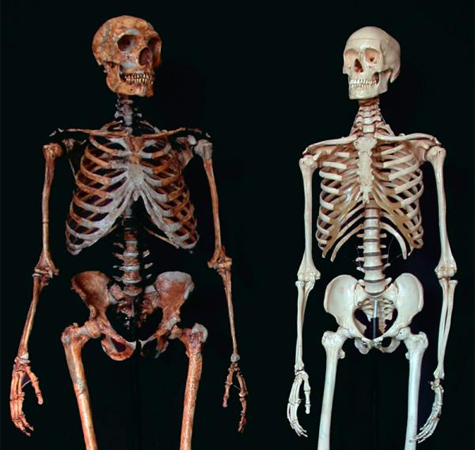
This is one of those very unfortunate cases of a discovery leading to much confusion. A skeleton of a neanderthal was discovered at the start of the 20th century that had bent knees giving rise to the popular belief that all neanderthals did. In fact, it turns out the skeleton was of a Neanderthal that suffered from arthritis. Neanderthals walked upright in the same manner as modern humans; they were generally only 12–14 cm (5–6 in) shorter than modern humans, contrary to a common view of them as “very short” or “just over 5 feet”.
The myth: Neanderthals were savage
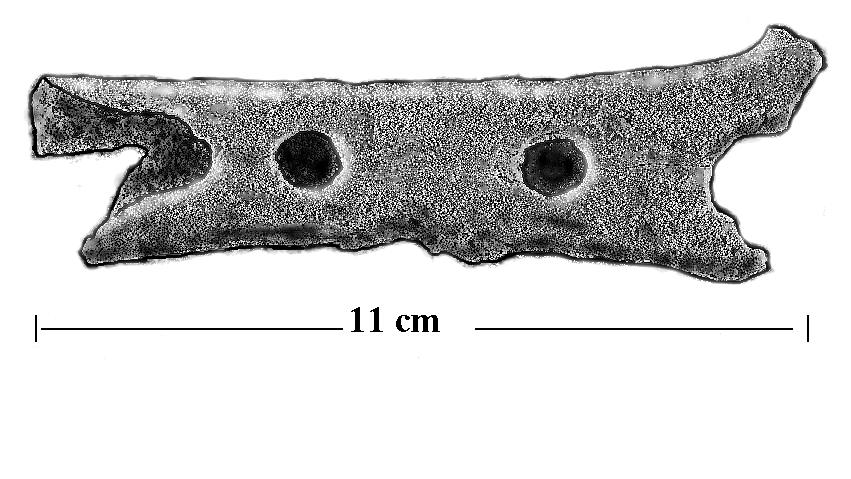
There is actually much evidence to show that Neanderthals cared for the sick and old in their communities. There has been fossil evidence that shows potentially life-threatening injuries which were completely healed, indicating that the Neanderthal who suffered the injuries was nursed by to health by another member of his group. There is also evidence (via fossilized musical instruments) that Neanderthals enjoyed and played music. You can listen to a clip of a Neanderthal tuba here [Source] and a Neanderthal flute here [RAM format, Source, More Info]
The myth: Neanderthals were ethnically equal
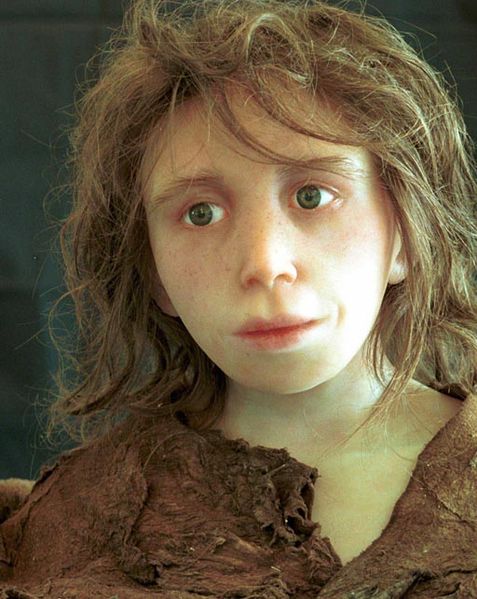
Because we use one term to describe all Neanderthals, we tend to think of them as a single group of people sharing identical traits and features, but it is most likely that there were different ethnicities in Neanderthals just as in humans. A recent study has determined that there were probably three racial groups within the Neanderthal family. From the study: “The conclusions of this study are consistent with existing paleoanthropological research and show that Neanderthals can be divided into at least three groups: one in western Europe, a second in the Southern area and a third in western Asia.” [from Genetic Evidence of Geographical Groups among Neanderthals]
The myth: Neanderthals lived in caves
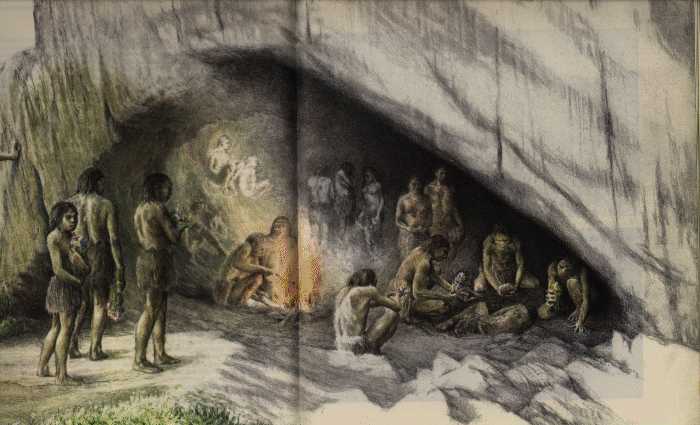
Okay – this is partially true – some Neanderthals did live in caves (hence “cavemen”), but many of them lived in huts: “Winter homes were Ice Age huts, built teepee style, from branches and mammoth bones, covered with animal skins. These huts were used for many years, so they built them carefully. Holes were dug, deeply into the ground. Poles were inserted into these holes, and then tied tightly together at the point of the teepee, at the top, with string made from animal guts. Warm furs were laid over this structure and sewn tightly in place. Large rocks were piled around the bottom, to help hold the hut together.” [Source]
The myth: Neanderthals had faces like Apes
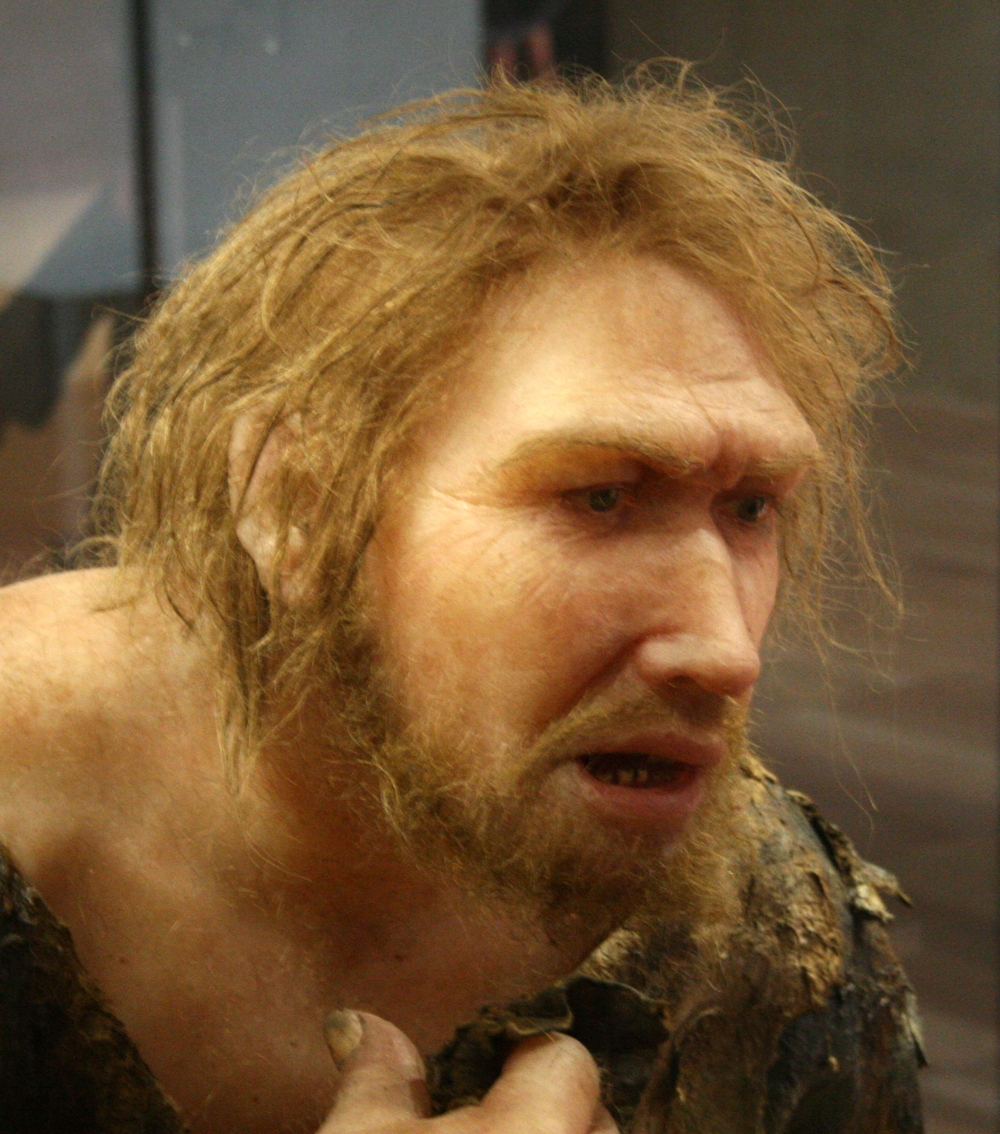
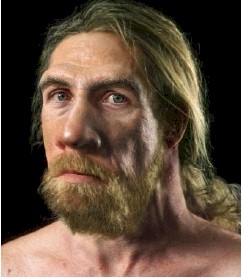
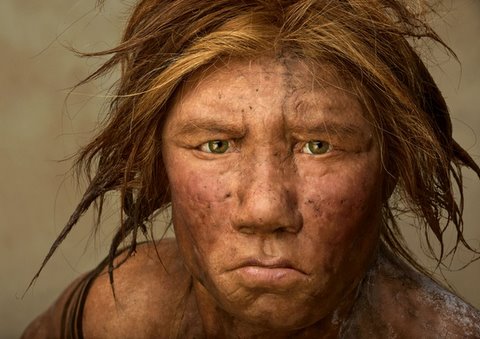
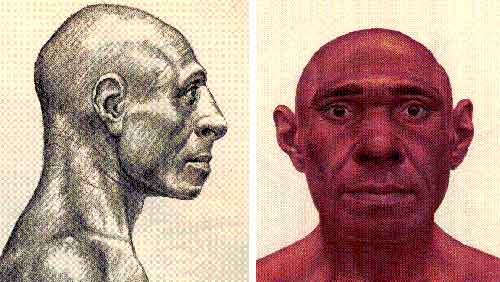
This misconception came about through poor reconstructions from largely arthritic skeletons. In 1983, Jay Matternes (a forensic artist who did much work in fleshing out skulls for homicide investigations) performed a reconstruction on a much better specimen than had been seen before. The result is in the photograph above. It clearly shows that the Neanderthals looked virtually the same as us. If you saw the man above in a suit walking down the street, you would not think anything of it. The same is true of the other reconstructed neanderthal pictures on this list.
The myth: There are certain questions about the physical attributes of Neanderthals that we will never know
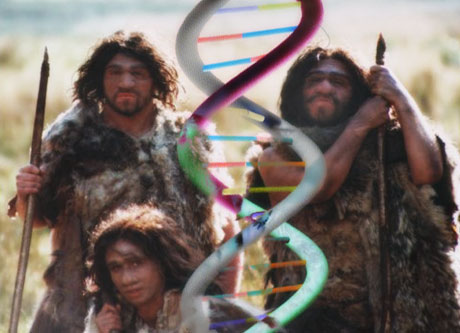
As of 2009, the complete Neanderthal genome has been mapped. The most important implication of this is that it now becomes technically possible to clone a Neanderthal – to raise them back from the dead so to speak. The current estimated cost of doing this is $30 million US and no one is putting up the cash. There are ethical questions that are always going to be raised regarding cloning and this is also a hindrance. But there is absolutely no reason not to believe that we will – one day – be able to give birth to and raise a Neanderthal (or at least the closest thing possible to one).


June 16th, 2009 at 1:45 am
I find it strange that everyone thinks Neanderthals are “cave-men” or whatever. It makes no sense to think of us hunched over and crawling about like little animals. It’s merely portrayed as such because of people buying WAY too much into Darwinism.
I’d bet that if he hadn’t said we descended from monkeys, no-one would believe we began as hunched over, knuckle dragging people.
June 16th, 2009 at 1:45 am
It’ll be interesting to see the creationists spin on this.
June 16th, 2009 at 1:46 am
wow
June 16th, 2009 at 1:47 am
Shoshan – darwin never said we evolved from monkeys
June 16th, 2009 at 1:50 am
Another great list Jamie, and although you have added source links where possible, I imagine there will be many who will deride this list, as usual.
My knowledge of Neanderthal comes from lay sources–Clan of the Cave Bear, National Geographic, Nova, etc. It would be nice if some of these type of mass media, would update the general public on the advances of knowledge of this ancient culture/species.
My first read thoughts…
Item # 9–”The extinction of Neanderthals was most likely caused by slightly lower birth rates and higher mortality rates, combined with an increasingly unstable climate.”
I can see these factors affecting our modern civilization too.
Item #6–Judging by the skeleton on the left, I can still imagine Neanderthal as an apelike species. Perhaps not hunched over when walking, but with the fixed ribcage, wider pelvic region, and femurs set into such a wide pelvis, I’m definitely reminded of today’s gorilla.
Item #2–”If you saw the man above in a suit walking down the street, you would not think anything of it.”
I WOULD TO think something of it–but being a polite person, I’d probably keep it to myself. LOL.
June 16th, 2009 at 1:51 am
I am so very glad that the stereotypes and misconceptions about this topic were finally cleared up. It was a very pleasant surprise for me when I saw that neanderthals were not just neanderthals. Also very interesting to me was that neanderthals are of a different genetic genome.
W00T!
June 16th, 2009 at 1:57 am
I’m a student in archaeology, and I’m specialized in Prehistory and love the Mousterian period in Europe.
First of all, that picture of a Neanderthal flute.. it has been proven that its not a flute, and the object was created naturally either by hyenas gnawing at the bone or through bacteria or acid (I forgot the exact determined reason, but its funny for me to see this because I just read about this two days ago while studying for my exams).
And they are not “thought” to have used tools of the Mousterian class, we KNOW they did, and so did homo sapiens in the first stages. I forgot if Mousterians used soft hammer percussion more.. but anyway, you don’t use soft or hard hammer percussion more than the other. Most of the time they start “breaking” flint with hard hammer percussion, and finish the point or “blade” with soft hammer percussion (sorry, I don’t have the english vocabulary for this stuff).
Finally, their capacity of speech is said to exist, but is thought to be less evolved. Most scientists believe they could produce a smaller panel of sounds then us.
Good list though.
June 16th, 2009 at 1:58 am
Shoshan: the article clearly states that neanderthalsare not our ancestors and as said before, Darwin never claimed we evolved from monkeys.
Loved the list, I knew almost nothing about neanderthals so it was a very interesting read for me. I’m loving this site recently.
June 16th, 2009 at 2:00 am
One last thought here:
Item #1–Cloning a Neanderthal-to what purpose. Without the nurturing society that was integral to the Neanderthal’s life and habits what could be learned by such an experiment.
It would be like cloning any other extinct animal, just a exercise, to titillate the scientists involved with physical structure and evolution. Perhaps some tidbits on final musculature and IQ ability, which would be nullified through the specimens’ limited DNA diversity.
The true knowledge to be gained concerning habits, lifestyle and tool usage are not inherent through DNA replication, but through cultural structure, which could NEVER be replicated.
June 16th, 2009 at 2:04 am
Oh, also, Neanderthals had bigger brains then us, only their frontal lobe was smaller… hence we think they weren’t as clever
June 16th, 2009 at 2:11 am
I THINK THERE STILL AROUND TODAY JUDGING BY THE PEOPLE I WORK WITH
June 16th, 2009 at 2:30 am
@10 the size of the brain does not determine intelligence.
June 16th, 2009 at 2:30 am
i have a neanderthal friend here..in the office..my seatmate..hehehehe
June 16th, 2009 at 2:50 am
Ah, awesome list. I’ve always had our respect for our Neanderthal cousins. Though I often wonder though, as I am not educated in anthropology, if it was possible for Neanderthals and Homo Sapiens (if they were even Homo Sapiens then) to cross-breed. If so, then perhaps the Neanderthal line isn’t so dead after all? Is anyone able to answer this question for my inquisitive mind?
Oh and Shoshan no. 1, apologies, but your comment seems to make no sense to me.
June 16th, 2009 at 3:01 am
As I recall, a difference between Sapian and Neanderthal tool use is that Sapian tools improved over time but Neanderthal didn’t.
There’s also a belief that Sapian and Neanderthal interbred – some say that was impossible; the genes are too different. What’s the latest?
June 16th, 2009 at 3:18 am
No. 1 sounds like bullsh*t. If 30 million $ was all that was needed, we would have a lot of neanderthals already cloned, or as written,’back from the dead’. Surely 30 million $ is not a huge amount considering what many research institutes in the U.S.A get for useless studies & projects. Raising an extinct species back from the dead has too big an appeal, & im sure the benevolence of the great America would have already done it. Either it costs way, way more, or it isn’t possible yet.
June 16th, 2009 at 3:32 am
I don’t even know why we have a distinction between Neanderthals and Humans. There seem to be very few differences between us.
The term “Neanderthal” should just be scrapped, and they should be undistinguished from homo sapien aside from being ancient man.
June 16th, 2009 at 3:33 am
Oh, Please -Let’s hope this list doesn’t bring up a debate on Evolution
June 16th, 2009 at 3:36 am
LOL at #2
If i saw that walking down the street in a suit I would assume it was Nikolai Valuev’s non-gigantic little brother.
There is nothing normal about that face.
June 16th, 2009 at 3:38 am
You forgot to include the likelihood (solid archaological evidence certainly indicates) that Cro Magnon (the Homo sapiens that lived beside Neandertal (NO ‘h’) also actively hunted, exterminated and occasionally ATE his Neandertal neighbours: bones were found which have the same groovings created by knife blades and teeth similar to those created on animal bones uncovered at other Cro Magnon refuse middens
June 16th, 2009 at 3:39 am
Regarding no. 1, it appears it is not “technically possible”. The leader of the Neanderthal genome project has said that “starting from the DNA extracted from a fossil, [cloning] is and will remain impossible”.
Other than that, it’s an interesting list. I did know that Neanderthals were a lot more developed than they’re usually portrayed, but not that they were this developed.
June 16th, 2009 at 3:39 am
Sorry – meant to say that the last post was meant to be in response to Point #9 – “The extinction of Neanderthals was most likely caused by slightly lower birth rates and higher mortality rates, combined with an increasingly unstable climate.”
June 16th, 2009 at 3:53 am
#20 – actually, it is spelled with an “h”. It is true that the German valley Neandertal is spelled without an h today – but it was spelled Neanderthal when they discovered the skeletons.
June 16th, 2009 at 3:55 am
Good list very interesting.
Shoshan, read Darwin before you comment on him.
June 16th, 2009 at 3:55 am
can anyone tell me ıf a neanderthal ıs close enough to the human race to be able to reproduce?
June 16th, 2009 at 4:03 am
Very awe-inspiring. Prolly the closest thing we had to a real life seperate bloodline… like D&D orcs and ogres except more human in appearance and not nearly as ugly XD
June 16th, 2009 at 4:22 am
nice!
June 16th, 2009 at 4:23 am
For all of you that are interested in whether neanderthals and humans could reproduce together: http://www.stonepages.com/news/archives/002635.html. It isn’t much, but it is interesting nonetheless.
June 16th, 2009 at 4:36 am
The tuba article linked in number 5 appears to be an April Fool’s joke.
June 16th, 2009 at 4:37 am
Awesome list – amazing how stereotypes and misconceptions are perpetuated.
For those wondering about inter-breeding – studies that I’ve seen show that Neanderthal/Humans share a common ancestor (much the same as we do with the great apes) but developed independently, with little or no fraternization – “While unable to definitively conclude that interbreeding between the two species of humans did not occur,” Rubin said, “analysis of the nuclear DNA from the Neanderthal suggests the low likelihood of it having occurred at any appreciable level.” – The genes always give it away.
http://www-news.uchicago.edu/releases/06/061115.neanderthal.shtml
June 16th, 2009 at 4:53 am
There’s simply nothing wrong with #2. In fact, he looks rather endearing, in an Ernest Borgnine kind of way.
June 16th, 2009 at 4:53 am
Once I heard someone saying that Neanderthals were less violent than us. Is that a misconception as well?
June 16th, 2009 at 4:57 am
I for one would welcome our newly cloned Neanderthal overlords when it happens.
June 16th, 2009 at 5:20 am
I feel like such an idiot. I thought for half of the list it was saying “Netherlanders”. Great list, very interesting.
June 16th, 2009 at 5:27 am
@Sasquatch (34): I am a little embarassed for you
June 16th, 2009 at 5:30 am
Whilst it certainly varies from country to country (varies from over 6 foot in some regions to 5′4 or so), average human height is about 5′8… so if Neanderthals were 5-6 inches shorter than current humans, they were just over 5 feet after all (5′3/5′2).
June 16th, 2009 at 5:48 am
I just saw a special on TV about them and apparently, it’s due to the Neanderthals that we HAVE speech. When was the last time facts were checked?
June 16th, 2009 at 5:48 am
@ No 17. what you said is akin to saying we should scrap the word Donkey and Zebra and call them all horses. Yes they are all very alike but are completely different.
Neanderthals may have had similar characteristics to homo sapiens but they are massively different.
They are not ancient man, we did not evolve from them in the same way we did not evolve from chimpanzees, we share common ancestors. Neanderthals were an evolutionary dead end whereas homo sapiens (so far) are not. I think you need to read this list again!
June 16th, 2009 at 5:48 am
Interesting list. I like history but have a hard time retaining it. hehe
As for cloning….I don’t know about that. Wouldn’t that be boarderline unethical? (sp)
@7raul7 (16): Just to say, it didn’t say America was going to be doing the study. It just said American “dollars”. Also to add, we are not the only country doing off-the-wall research, so any country is as likely to grab this project. Although I hope none do.
June 16th, 2009 at 5:54 am
34 Sasquatch
Is that even a word LOL, btw I’m from the Netherlands
June 16th, 2009 at 6:07 am
It’s obvious why they became extinct. They were all homos. Sorry
I think it is very likely that neanderthals and homo sapiens could reproduce. Could they reproduce fertile offspring is more important and far less likely, though still conceivable.
June 16th, 2009 at 6:09 am
I love this list. It makes me want to pick up where I left off in the “Clan of the Cave Bear” series. Those books are genius. Man, could you imagine the kind of ridicule they would face today if they were still around? Although, I’m sure racism was alive and well 30,000 years ago. I think they look like a gentle creature.
June 16th, 2009 at 6:22 am
It’s a shame that human evolution became more superior in a way… If neanderthals were alive today, do you think they would blend in? It’s something we may never know :’(
June 16th, 2009 at 6:25 am
Do you think that a Neanderthal could play Resistance 2 on superhuman difficulty?!?!
June 16th, 2009 at 6:26 am
@deeeziner (9): I completely agree… The only purpose a Neanderthal clone would serve is to stroke the ego of the scientist who cloned him. Completely useless, not to mention highly unethical…
jamie: Great list!
June 16th, 2009 at 6:27 am
I thought our arm/leg hair was left over from needing to to look big when we were scared? So even if they aren’t our direct ancestors, wouldn’t they still have had more hair jsut because we’re a more evolved species? Jsut spitballing here.
June 16th, 2009 at 6:48 am
Good thing I just read “Evolution: A novel” by Stephen Baxter. Very interesting…..
June 16th, 2009 at 6:51 am
nice list
June 16th, 2009 at 6:54 am
Regarding #2 – I’m sorry Jamie, but if I saw that dude walking down the street I’d probably try to hide my children and grab a shotgun. I mean, c’mon, he looks like a magenta skinned Shrek. Don’t you know these people have a penchant for buggery? That’s what Randall told me.
And you forgot to mention that these are the same people who figured out that beaver ass juice was tasty.
June 16th, 2009 at 6:56 am
Here is a real list.
Myth 1: They were anything but ancient humans.
Myth 2: They lived millions of years ago.
Come on, people. Millions of years? How would you even know? So retarded.
June 16th, 2009 at 7:14 am
Why do they only show men? I wanna see some hot neanderthal women!!!
June 16th, 2009 at 7:26 am
@Bob
I think the researchers with science degrees have more credibility then a guy on an internet message board named Bob. Do you have proof to say otherwise?
@bucslim
Once you try beaver ass juice, You’ll never know what you’d ever do without it.
June 16th, 2009 at 7:47 am
Callie:
Nope, doesn’t work that way. “More highly evolved” does NOT equal “less body hair.” We don’t really know why our hominid ancestors began shedding their fur, but it wasn’t a requisite item for becoming smarter and better than the Austrolopithecines or what have you. It was just something that our hominid ancestors developed as a matter of course–possibly because, as Desmond Morris once argued, they found hairless bodies more attractive and so gradually the hirsute types were “selected out” of the gene pool and the tendency to be relatively fur-free become dominant.
But that has nothing to do with being “more highly evolved.”
June 16th, 2009 at 7:59 am
Speaking of hair – I’m not so sure I can go along with the whole notion that they didn’t have excess hair. I saw some dude the other day jogging without his shirt on. It looked like he was delivering a black alpaca rug. It didn’t take me two guesses as to which Right Guard © Pit product he’d buy.
So that’s got to be some sort of left-over gene right?
June 16th, 2009 at 8:03 am
@Giggles – The picture on #4 (Ethnicity) is taken from a model reconstruction of a female neanderthal.
June 16th, 2009 at 8:06 am
All these myths could be said about black people too.
June 16th, 2009 at 8:12 am
@Taylor (56):
What? The? Hell? Are? You? Talking? About?
June 16th, 2009 at 8:18 am
Okay, I’m reading some silly stuff being said here in the comments. Let’s get a few things straight and clear here, okay?
To begin with, it IS “NeanderTHAL.” It’s been spelt that way since the first discoveries were made. The variances between German and English aside, tradition usually trumps.
The real issue is that there was no clear consensus for a long time as to the actual classification of Neanderthals. Were they “Homo Neanderthalensis”—a separate species? Or were they “Homo Sapiens–Neanderthal Variety”? Both have been used, with the scales tipping towards the latter in recent years. But then DNA studies have shown that they WERE genetically “separate” from us in many ways–so as far as I know, this distinction has not yet been academically called, one way or the other.
Which brings us to the next question—could Neanderthals and our direct ancestors interbreed? Well up until just a few years ago, no one knew for sure. It was assumed in general that they might have been able to. But again, the latest evidence suggests that it was less likely to prove successful.
We’re still left with the fact that Neanderthals pre-dated our own species by several tens of thousands of years in Europe and the Near East. Then, within 20,000 years of our intrustion into those lands, the Neanderthals were gone. It sounds like a long time, but in terms of survival of a species it isn’t much time at all. If Neanderthals bred with Homo Sapiens Sapiens and were thus “swallowed” into our gene pool, one might expect that to take about that long, at least—but one might also expect, then, that Neanderthal genes would still be detectable within our own genome, and that some pockets of “true Neanderthal” genetics might survive in places. But thus far we don’t believe that either of these is true. It seems far more likely that the Neanderthals were simply out-done and out-competed by our direct ancestors, who were more adaptable, more aggressive, and had an edge in technological development.
Neanderthals were successful for a long period, and don’t deserve, by any means, the scorn that was heaped upon them in earlier times. But in restoring a truer picture of the Neanderthal’s worth, we must also acknowledge where they stagnated. There has been little or no evidence suggesting that Neanderthals had any real “art” in any sense. They were tool users, yes, and successful ones—but their tools and other artifacts are always crude (if effective) compared to those of our ancestors. Our ancestors (Cro-Magnons for instance) were artistic, inquisitive people who adapted and improved as the situations demanded. The Neanderthals, by contrast, were static. There is little evidence that in tens of thousands of years their hunting and living technologies changed in the slightest—nor, as I said, did they in any way adorn their artifacts with higher ideas of design or artistry. Our ancestors, on the other hand, were doing this from the get-go. Clearly, while successful for the niche they inhabited, the Neanderthals were vulnerable. And with climate change and new competition from more skillful, more adaptable cousins, they came to an end.
Lastly, this business about Neanderthal cannibalism—we must remember that while this issue has been hinted at for some time based on questionable evidence, it’s come to the fore recently on the basis of the findings at really only ONE site. And while it seems like fairly compelling evidence, it doesn’t necessarily suggest by extension an overweening tendency on their people as a whole to be cannibalistic. A supposition like that is jumping the gun, to say the least.
June 16th, 2009 at 8:52 am
Regarding #9 on the list: if we didn’t evolve from neanderthals, who DID we elvolve directly from? Like, who was our closest ancestor? Am I even making sense?
June 16th, 2009 at 9:00 am
They’re not extinct I see them in GIECO commercials all the time.
June 16th, 2009 at 9:10 am
#5 needs to be edited. The source of the “Neanderthal tuba” is clearly identified as an April Fools Day joke. Even the Wiki link described the flute as being a guess at best. I am not convinced that Neanderthals had any musical instruments. I am not suggesting that Neanderthals are savage, but I don’t think they had musical instruments, at least not based on your research.
June 16th, 2009 at 9:11 am
If you look at the newspaper headlines this morning it is more than just a possibilaty that us “modern man” raped these neanderthals too!
In any case I attended a Confederations Cup Socccer match between the USA and Italy last night and there were literaly thousands and thousands of neanderthals around!
June 16th, 2009 at 9:18 am
We have evolved from the “missing link” that creature is yet to be discovered.
June 16th, 2009 at 9:22 am
Hi all. Hey Randall! – very nice to hear from you again.
First we had Marketing Giraffes, the Lesser Known Tour-de-France Performances, now Misconceptions about Netherlanders – it’s all a bit mad! – call me a Cupid Stunt.
Very interesting list. There has been a few shows about this subject on telly recently – along with a BBC show highlighing the ‘human journey’ out of Africa. According to these, the last Neanderthal population died out in Gibraltar – having been pressured to live there by the Sapians. Their final demise is said to be because the last group(s) were so small that they could not maintain the gene pool because of in-breeding.
I wouldn’t surprise me if the sapians had tried to push the natives out. (…It wouldn’t surprise me if it was the sapians who were doing the cannabalising!) But moving on from theories; the world was in the thick of a great ice age around this time, and this was a life threatening situation for all.
The photo in No.6 looks to me like a neanderthal woman vs a sapian man – looking at the hips??
June 16th, 2009 at 9:33 am
Is this list a Geico commercial?
And what exactly is the difference between Neanderthals and Homo Sapiens? All these items seem to point to them being similar.
June 16th, 2009 at 9:38 am
Yes, the last known Neanderthals were in southern Spain, and they were presumably pushed out there by homo sapiens.. it was a barren land at the time, little vegetation, which explains why homo sapiens took a while to move down there… so Neanderthals could live “in peace”.
As for homo sapiens/neanderthal interbreeding, genetic studies suggest it didn’t happen.
Neanderthal were an extreemly amazing species. They are the 2nd most intelligent species to have lived this earth after us, so that’s something. I believe their extinction is not due to a lack in adaptation (they were clever, how could they not face environmental crisis better than other animal species?) but to harsh competition with the only other extreemly similar humanoid left, us.
June 16th, 2009 at 9:40 am
Hannah:
Our common ancestor with the Neanderthals is probably Homo Heidelbergensis, a descendant of Homo Erectus. But this has not, to my knowledge, been definitively proven yet.
June 16th, 2009 at 9:43 am
The difference between Neanderthals and Homo Sapiens is simple. First we believe they couldn’t interbreed (or at least that this interbreeding didn’t create any fertile descendants) hence this makes Neanderthal and Homo Sapiens a different species altogether.
Secondly, Neanderthal has recognizable physical characteristics which differentiate them from modern humans, that is thick eye lobes, wide nasal holes, bigger brain but smaller frontal lobe, thicker bones, no chin, smaller forehead, smaller stature.
June 16th, 2009 at 9:54 am
I wish more human species were around today. I find it quite depressing we are the only ones left. Does anyone think that the Homo Sapiens could evolve further, or are last of the human species?
June 16th, 2009 at 9:55 am
More info about the Neanderthals Gibraltar refuge I saw in the BBC show, and possible causes of extinction, can be found here:
http://news.bbc.co.uk/1/hi/sci/tech/5343266.stm
June 16th, 2009 at 9:56 am
Metalwrath:
I’d question just how “adaptable” Neanderthals were. We have to remember—they ultimately died out. And while it’s believed this was due in large part to competition with Homo Sapiens Sapiens, it’s also clear that the changing climate may have had something to do with it as well, along with the fact that the Neanderthals seemed incapable of changing along with their environment. They seemed to have remained static throughout their existence, which is borne out by examination of their artifacts and tools. This, to me, says that they were less adaptable than the demands of their environment called for. Certainly less adaptable than our ancestors were.
June 16th, 2009 at 10:19 am
@Randall (71): Also on the BBC site, I found this link to another BBC show called Horizon. It more or less runs along the lines of what Randall thought in #71, and clarifies JF’s insights for item #10.
http://news.bbc.co.uk/1/hi/sci/tech/4251299.stm
Looks like the picture in item #6 could be a neanderthal male after all??
June 16th, 2009 at 10:21 am
Norman:
It’s wrong to think of evolution as some kind of ladder or stairs that species climb. I know that’s been the metaphor for a long time, but it isn’t wholly accurate.
Now, the fact is that human beings are and have been very successful as they are; we’ve spread and multiplied to dominate the planet in less than 50,000 years, and much of that dominancy has been established in the last 10,000 – 15,000 years or so. A random mutation might come along, in the genome, which could work to that individual’s benefit–such as creating someone who’s immune to AIDS, or cancer or what have you–and that benefit could thus be passed on to that individual’s descendants. So sure, the *potential* to evolve is still there. But whether we’re actually continuing to evolve is questionable at best.
We may be artificially selecting certain traits within ourselves, it’s true. But we tend to frown on actual eugenics, so even this kind of “artificial” selection amongst ourselves has a random nature to it. The fact is that evolution is determined by mutation and selection–so perhaps, yes, certain traits amongst us are, without our being fully cognizant of it, being “deselected” out of the species… but whether this leads to a “betterment” of mankind can’t be answered. And whether any “better” or extremely “positive” traits are being selected FOR is even more questionable.
The bottom line is, it might be better, sure, to have bigger brains or what have you—but unless there’s a cause for such a step to occur, it won’t just “happen” on its own–except by chance.
June 16th, 2009 at 10:41 am
Interesting list, Jamie. I already knew a lot of the items on the list, and questioned a few, but it’s all intriguing anyway. I’ve just begun reading Richard Dawkins “The Ansestor’s Tale”, which I’m sure will enlighten me some more; much of my prior knowledge has come from Jared Diamond, Stephen Jay Gould, E.O. Wilson to name but a few (I have a bio/science library section containing more than a dozen world renowned, peer reviewed scientists). Once I’ve finished it I’m sure I’ll have more to say on the subject. Right now, I’ll simply say that Randall seems to have some handle on the subject and I will allow him the floor.
June 16th, 2009 at 10:46 am
I agree with those of you who observed that there are still Neanderthals among us.. we are still behaving in such barbaric, inhuman, and greedy ways that one wonders if there has been evolution or devolution….
June 16th, 2009 at 10:47 am
ah…what a lovely list!
and rather insightful comments…although it is obvious there are still a few ignoramuses out there…
i have nothing to add. i’m all evolution/anthropologied out.really.
i can remember my fascination with the Jean M. Auell novels i read as an early teen…nothing was more amazing to me than the first time i finished “Clan of the Cavebear” at the age of 13…especially the sacrifice of the bear & subsequent intoxicated cannibalism of another clan member…
meh. no big comment from me today. i’m sick (no, not SINE FLU…just the flu) and in the death-throttle of midterms. every year i tell myself i will NEVER take another accelerated summer course…i’ve been saying that for 3 years in a row now…
oh-and as for my beloved Bucslim…
why do you have to go and tell people how good beaver ass juice is? i thought that was OUR dirty little secret…
rtr
June 16th, 2009 at 10:52 am
@Norman (69): Yes, I was just gonna say, nature abhors a vacuum – any need will be fulfilled in time. So what is there left which we still need to evolve into?
Some say that Man already has (or is about to have) reached the height of evolution. We have successfully adapted to the hunter/gatherer lifestyle, and have engineered our way out of it again. What’s next? How about extra large bottoms for all the time we spend sitting at computers? Perhaps we’ll evolve a higher tollerance towards alcohol? Perhaps the human body will evolve an extra long middle finger; so we may greater illustrate our displeasures??
No, but seriously….
June 16th, 2009 at 10:55 am
Wow.
June 16th, 2009 at 10:56 am
@segues (74):
are you looking at the bookcase in my living room? if so, you missed these authors:
David Quammen
Christopher Hitchins
Micheal Schermer
might i recommend…
“Song of the DoDo” by David Quammen (island biogeography and shear visual poetry. he is my all-time FACORITE author.)
“God is Not Great” by Christopher Hutchins (he’s nowhere near as pitt-bullish as Richard Dawkins, more of a friendly atheist)
“Why People Believe Weird Things” or “The Science of Good & Evil” by Micheal Shermer (both delightfully insightful intros to Shermer’s style of skepticism…)
yeah. go on. you know you want to go to Amazon.com and place an order…i won’t tell…
rtr
p.s. my awesome dad sent me “After the Ice: A Global Human History, 20,000-5000 BC” by Steven Mithen for summer reading…but i haven’t even read the table of contents yet…looks good…
June 16th, 2009 at 10:56 am
Randall
We are still evolving. Case in point, lactose tolerance. There are many more examples. You point out AIDS immunity, there is proof it is already happening.
http://discovermagazine.com/2009/mar/09-they-dont-make-homo-sapiens-like-they-used-to/article_view?b_start:int=0&-C=
June 16th, 2009 at 10:57 am
Does the “missing link” come before the Neanderthals or after?
June 16th, 2009 at 11:05 am
great list, and the neanderthal tuba was pretty funny sounding.
June 16th, 2009 at 11:08 am
@ron (80):
a great many years ago (when i was a spite of 18 and the world was new and bright & i was an insane raver girl) i was exposed to HIV during a multi-person tryst at a rave.(yeah…shush now. you all know the days i am talking of…either that or you wanted the opportunity & it never came)
well, obviously i did not contract HIV (and neither did the other 3 females) but i did learn something very interesting back in 1994 from my immunologist…
that there is a connection to those of european decent having a stronger resistance to HIV than other nationalities due to the genes of survivors of the Great Plagues. very very cool.
http://www.nytimes.com/specials/women/warchive/980526_2007.html
http://www.wired.com/medtech/health/news/2005/01/66198
rtr
June 16th, 2009 at 11:11 am
haha this whole list seems like something the geico cavemen would be handing out pamphlets on the city street corners
June 16th, 2009 at 11:12 am
ron:
There you go. So it depends on what people will accept as “evolving.” Certainly we’re still subject to selection and mutation, though I’d still want to argue, I think, that ALL traits are being selected, but who knows? Maybe without our knowledge some traits ARE being “selected out.”
But of course, some people want to know when we evolve big, ET-like heads and extra thumbs and all that. And the answer to that is, it’s random and may not happen at all. Despite relatively minor selected or deselected traits, we are still the same species we have been for at least the last 50,000 years, and it’s likely to remain so for quite some time.
June 16th, 2009 at 11:13 am
What a GREAT list!. I’m going to send this one to my friends. Makes me want to learn more about them.
Best,
M
June 16th, 2009 at 11:14 am
79 ringtailroxy: David Quammen is one of the scientists I have and did not mention. I’ve read most of Shermer but he’s not interesting to me (yeah, so why did I read so much of him? Because sometimes he sparks something that I just have to follow up on!)
I also have all of Sagan, Richard Rhodes, V.S. Ramachandran, Peter Medwar, Francis Crick, and so many more that I really don’t want to bore everyone silly with the entire list!
rtr, I have a problem. I’ve had it as long as I can remember. I have to be reading three books at a time. One has to be science, one *may* be fiction, one has to be history or biography. Of course, the one that may be fiction often turns out to be another science.
This is not optional. I must do this. I am commanded by some inner guide which I must obey.
My son and one of my daughters have inherited this to some degree, but less significantly than I.
Weird.
June 16th, 2009 at 11:33 am
7 Metalwrath:
In my archaeology class (not my major; just took it because it was interesting) we learned about the tools too and the soft hammer percussion was much more fine work than the hard.
We took a trip to the Center for American Archaeology at Kampsville, IL and while there, we got to dig at a test pit adjacent to the Koster site (I found a tool, but it was in the plow zone, darn it), make stuff from clay and play around with flintknapping. I liked that so much that I got a little kit and a book later. I’m not very good at it, but it was fun.
We also visited Cahokia which was very interesting. I recommend a trip there if you ever get the chance. None of these things qualified as Neanderthal but it was still very interesting, especially their technological stuff.
June 16th, 2009 at 11:39 am
This is a fascinating list, thanks Jamie.
Randall, I’m amazed at how much you know about… well, everything. You must have a very curious mind.
Can anybody provide or point us to a timeline so we can see how Homo Erectus, Homo Heidelbergensis, Neanderthals, Cro Magnon, and Homo Sapiens Sapiens all fit and/or overlap?
(btw, long time reader but first ever comment)
June 16th, 2009 at 11:40 am
@segues (86): Books are great arn’t they? You can learn SO much more from one book than a whole series of TV shows, and a swath of web sites.
Your preference doesn’t sound too much like a problem – more a benefit!? Being so widely read is so much better than, say, reading all of one thing and non of the other.
@Randall (84): You may not know of a new LV feature… Simply click on the name of the commenter you want to reply to, and a nice easy referal link will apear in the comments box, like I’ve done here…
June 16th, 2009 at 11:41 am
58 Randall –
Very well put.
Most of the perpetuations of myths about Neanderthals seem to come from books and movies. Even Jean Auel’s Earth’s Children series has them as nonverbal (although with a rich sign language). She also uses them to raise issues about persecution and prejudice.
Even though her research is pretty meticulous, she takes a great deal of dramatic license in her books.
June 16th, 2009 at 11:44 am
69 Norman
“I wish more human species were around today. I find it quite depressing we are the only ones left. Does anyone think that the Homo Sapiens could evolve further, or are last of the human species?”
Perhaps we will evolve to the point where most of us no longer have our heads up our a$$es. I swear every day I hear more and more of this once seemingly rare permutation!
June 16th, 2009 at 11:49 am
75 RedViolet12
“I agree with those of you who observed that there are still Neanderthals among us.. we are still behaving in such barbaric, inhuman, and greedy ways that one wonders if there has been evolution or devolution….”
Which is assumption at best, and stereotyping at worst.
June 16th, 2009 at 11:55 am
very informative list!
@Michael (88): http://www.archaeologyinfo.com/species.htm
seems like a fairly accurate timeline with articles and links and such.
June 16th, 2009 at 11:58 am
@Lifeschool (89): Nifty.
June 16th, 2009 at 12:04 pm
@Egis Nu (93): Very interesting graph, nice find bro!
@Randall (94): Isn’t it just!
June 16th, 2009 at 12:13 pm
@Egis Nu (93): Thanks very much, that’s great!
June 16th, 2009 at 12:13 pm
Deeeziner (5) :”Item # 9–”The extinction of Neanderthals was most likely caused by slightly lower birth rates and higher mortality rates, combined with an increasingly unstable climate.”
I can see these factors affecting our modern civilization too.”
What are you talking about???? We have an excessively high birthrate, people are living longer than ever and we can all but control our climate!!! Is there something im missing?
June 16th, 2009 at 12:16 pm
@Michael (88):
Thanks, and here’s another timeline:
http://www.geocities.com/palaeoanthropology/timeline.html
Note though, that the details are sketchy still, and these dates are all approximate, more or less.
June 16th, 2009 at 1:04 pm
@Lifeschool (89): Yes, I’ve always found that reading something sort of “set’s” it in my mind, much better than watching a television show about the same thing. I know the trigger for using reading as a memory tool, far more than normal that is, was the summer I read the encyclopedia from cover to cover. I was about nine.
June 16th, 2009 at 1:23 pm
this list is racist.
June 16th, 2009 at 1:31 pm
nice list overall, jfrater is it just me or is this your second list in a row? Not criticizing I just like yours best
June 16th, 2009 at 1:39 pm
Just before I go, just a note to say what a joy it has been to follow this thread today; everybody working to help each other – it’s been educational – I’ve certainly learned a lot. See you tomorrow….
June 16th, 2009 at 3:07 pm
I was actually just reading about the history of man today and then I saw this O.O Small world. Really interesting list – when I was reading today I read these same facts and it really did surprise me, espicially about Neanderthals being a different hominid than Homo Sapien. Very interesting stuff
June 16th, 2009 at 3:14 pm
Great list. I’ve learnt new stuff today. Thanks
June 16th, 2009 at 3:48 pm
“There are certain questions about the physical attributes of Neanderthals that we will never know”
Ah, but the mitochondrial DNA will be from the mother. This might change the whole thing.
June 16th, 2009 at 4:02 pm
Woops, it appears I have quoted the wrong sentence.
Basically, cloning is unlikely to succeed because when you insert the DNA into the gamete, the surrogate’s mitochondrial DNA is what the final organism will have. If this is incompatible with the DNA we’ve inserted, or at the least, not optimized, then we might end up with an organism unable to live for more than a few hours.
June 16th, 2009 at 4:32 pm
@Lifeschool (64): says,
“First we had Marketing Giraffes, the Lesser Known Tour-de-France Performances, now Misconceptions about Netherlanders – it’s all a bit mad!”
I realize I’ve also made errors in my comments in other lists but there seems to be regular types of commenters who keep rearing their ugly heads.
There’s:
* Mr Reed Half, who reads the titles and the headings of the lists without reading the rest. He misses the info that says stuff like, “this isn’t a best of – list” or, this list “isn’t in any particular order,” or “lesser known examples of”
* Mr Rhett Dundant who won’t read the previous posts and repeats the same comments, corrections, or questions
* O. Zone, who’s post has nothing to do with the list at hand
* Wyatt Cannot-Beunderstood, who makes absolutely no sense with words strung together randomly, and with no attempt at logic or basic grammar
* X. Ploding, the angry guy
* Ida Inflame, who is trying so hard to upset that it’s not even believable. (See this from @Taylor (56):
*I.M Soreligous, who blows up at anyone who even vaguely sounds atheist or from a different faith
And every one’s favorite:
* I.M First, The ever present “I’m the first one to comment on this list!” – Yee Haw
June 16th, 2009 at 4:41 pm
@segues (100): Funny that I get the opposite effect. If I watch I learn better. Not meaning from a TV, but usually hands on stuff. Unless it’s really interesting then I seem to retain it. Very weird.
@Moonbeam (108): That was great! (had to give you a thumbs up for that one!)
June 16th, 2009 at 4:46 pm
I know this will automatically negate me from any serious circles of modern day Neanderthal thinking highbrows but it just so happens that I watched the entire 1981 movie, CAVEMAN, on the Great Ubertube just the other day and I am now certain that among the many guilty pleasures man has on this earth, one of them happens to be caveman comedy.
June 16th, 2009 at 5:12 pm
Sorry for the slightly ignorant post.
I’ve always wondered whether, with, the advent of modern medicine we are actually slowing/halting evolution. If people who would have otherwise died due to an illness are now living would that affect the human race for the worse?
Again it could also be argued that without medical treatment the human race may have been wiped out altogether.
Are/have there been studies into this? I’d love to know whether modern medical treatment is, ironically, actually having a negative impact on our species and may in fact be compromising our survival as a species.
I appolize if this is at all offensive/ignorant or what have you but it’s something which has always intrigued me and I’d like to know everyones opinions on the matter.
Many thanks.
June 16th, 2009 at 5:38 pm
@ENWOD (111): No, no – I think yours is a great post. I can’t find any proof to back this up, but a teacher once told me that people with poor eyesight would have been less likely to survive in less civilized times. Also through natural selection those who couldn’t see well would have been less likely to be accepted by someone of the opposite sex. But because of corrective lenses, having weaker eyes have nothing to do with survival or attractiveness. So she claimed that humans are increasingly more likely to need glasses or contacts. This may be nonsense or true, I don’t know – sorry I couldn’t provide evidence.
June 16th, 2009 at 5:51 pm
We know so much about Neanderthals because they buried their dead, unlike our ancestors They have found Neanderthal graves with remnants of flowers in them too.
June 16th, 2009 at 5:51 pm
Thanks for making me feel less of a prat lol.
I’ve always wondered whether diseases are more prevelant because of modern medicine – for example, various infectious diseases, various hereditary genetic diseases etc. Because the advent of medicine has allowed these people to live (I’m not intending to sound callous here, so sorry) but medicine may be more of a hinderence than a help, essentially if we lived like animaly – if those people were allowed to die, which would have otherwise happened without medicine and our own inginuity and intelligence, then would these diseases be almost unheard of?
It’s always intrigued me and I’d like to know if any scientific studies back this up or even if any have been carried out. So I guess what I’m really asking; is medicine actually a hinderence to the human race rather than a help?
Thanks Moonbeam
June 16th, 2009 at 6:13 pm
@Looser (98): Crap–Someone ACTUALLY read my comment..I know I would be called out as I hit the submit button. Here’s my thinking–But keep in mind it’s a 2/3 logic..and definitely has no statistics on my part to back it:
A. Seems like there is more and more Americans having to use the fertility doctor to achieve pregnancy, if they take at all..so therefore my personal feeling that we have a decreased birthrate. Probably well skewed the opposite due to global population.
B. The well documented, yet highly controversial, statistics showing the global warming is occurring. Now nobody said it was going to become fatal overnight. Personally I wonder if there is something to the theory of Earth’s magnetic poles switching their polarity, though this is also not an overnight change. But that a whole new discussion.
C. Did I mention my post was more of a 2 out of 3 type comment?
So there you go Looser..my take on the thing. Hardly worth further debate. As a sidenote–I come to mainsite for the pleasure of the lists foremost, and the exchange of comments, secondly.
Sure we have our personal favorite commentors, and obviously some of the members here DO enjoy a long winded and/or feisty fight for recognition, and I have enjoyed my share of laughs at the goings on myself.
On some rare occasion, when I have felt like it, for whatever reason, I will throw a little sassy debate back and forth. But not tonight.
June 16th, 2009 at 6:27 pm
@Diogenes (110):Aluna that movie, Bobo!
June 16th, 2009 at 7:28 pm
Didn’t Neanderthals have large brains? http://news-info.wustl.edu/FEC/1999/neanderthal.html I have a Portugese friend. She and her sons have been told over and over again that their teeth, feet and other features closely resemble Neanderthal norms. They are all Mensa members, the seventeen year old is a professional novelist, and the thirteen year old is learning Latin from an online course for his summer amusement. Also, anthropologist Loren Eisley wrote an essay in which he recalled walking barefoot through a swamp. He found a set of footprints that were pure Neanderthal. He chased them frantically, thinking that he had discovered a living fossil human. Then he noticed that he may have been backtracking, due to his unfamiliarity with the land. He thought for a moment, and put his foot in one of the Neanderthal footprints. They were his footprints.
June 16th, 2009 at 10:31 pm
haha i thought this list was about the netherlands when i read the title
June 16th, 2009 at 11:39 pm
Claire B – they are still Ancient forms of hominid – therefoe human/humankind – and as for your horse-donkey-zebra argument: pure BS – they can (and have) interbreed/bred so your analogy;is not only specious but also stupidly wrong!
Randall – your argument for a single site is erroneous – since the ?Spanish find recently, Austrian and french specimens have also shown similar markings. Besides even were there only one example; this does not make it an erroneous conclusion of cannialism (BTW – cannibalism is eating one’s OWN species, not another: my mistake in word-usage originally) after all there are many examples of dinosaurs where there is only ONE specimen (or part of one) does this make its assignation to a genus erroneous – - – of course it doesn’t you idiot.
June 17th, 2009 at 1:09 am
It’s all crap. The first man on the planet was Adam, a normal human being like u and me. Neanderthals were also humans, just another race, like many other races today with distinct physical features and languages and customs etc. Over the thousands of years that humans have existed on the planet, we’ve taken many shapes and sizes.
I can’t believe that people still belive today in the concept of ‘Early Man’ who lived like an uncivilized barbarian before mankind came to being.
Ok, now go ahead and start ostracizing me.
June 17th, 2009 at 3:06 am
The reconstruction picture of the neanderthal man, resembles a guy that works at our local tescos… maybe the clone has already been done and put out there!
June 17th, 2009 at 4:40 am
No. 12 “@10 the size of the brain does not determine intelligence.”
Yes it does, men have larger brains than women, and higher IQs, foo’.
June 17th, 2009 at 5:52 am
@Tomo (120): At your invitation I begin.
What are you truly trying to say? That the biblical Adam was actually created with cellphone, vehicle and indoor plumbing, all waiting for him upon opening his eyes?
Or That biblical Adam had to wear a fig leaf and live in the wild while his neighboring race Neanderthal human was enjoying all those contraptions of man that you imply were not the product of evolution and technological progress.
June 17th, 2009 at 6:54 am
hmmm… by ostracize, did Tomo mean criticize? because if Tomo truly meant ostracize, then he/she should be ignored and exiled from the group by popular vote.
June 17th, 2009 at 7:18 am
@deeeziner (115): I DID read your comment. in fact i pasted it onto MY comment so I could read it multiple times before i posted! and the fact of the matter is we have an excessively high birthrate! i’ll accept the possible global warming thought but there is no arguing that we have definite population control problems! And it may seem like more and more people are using the fertility doctor but these are people who before this technology came out simply wouldn’t have a child! and even if the number HAS increased its due to the number of std’s we have. (dont argue on that one in the 1960’s there were 2 std’s now there are more than 25!!!!)
June 17th, 2009 at 7:57 am
@gabi319 (124): He’s got my vote!
June 17th, 2009 at 8:24 am
@Carole (113):
Carole, our ancestors DID, in fact, bury their dead. That was the whole point that made it surprising, at first, to find that the Neanderthals did it as well.
June 17th, 2009 at 8:43 am
@Shagrat (119):
Calling someone an idiot when you yourself are talking out of your ass is not the smartest move, Shagrat—but then I believe we’ve crossed each other here before and my recollection is that your brainpower was shown to be inadequate then, as well. I suggest more sleep, exercise, a better diet, and harder study.
“your argument for a single site is erroneous – since the ?Spanish find recently, Austrian and french specimens have also shown similar markings.”
This was NOT “my” argument—nor is it in point of fact actually an “argument” per se; it is, in the first place, a matter of debate amongst professional archeologists as to the meaning and context of the finds you’re referring to, not only considered on their own, but in the light of other, less conclusive finds. But the fact remains that while there have been INDICATIONS of cannibalistic practices at various Neanderthal sites (including the ones you mention) there is still only the ONE site where it is considered, by consensus of the professionals, to show pretty conclusive proof of some kind of butchering of fellow Neanderthals… and if I recall there was some strong indication of actual cannibalism at that site as well.
But as any archeologist will tell you, SIGNS of butchering do NOT automatically equal cannibalism–i.e., the actual EATING of one’s fellow creatures. There is a great deal of evidence for ritualistic butchering of the dead for various reasons OTHER than consumption of them as food.
BUT… even if it WAS cannibalism—and I say, if memory serves there is some good evidence from—I believe the Spanish site–that there WAS actual cannibalism… this does not automatically make Neanderthals unusual. Similar indications have been found amongst our OWN direct ancestors from time to time. No one can say it conclusively, but it seems possible that cannibalism was practiced by both species.
Or… maybe it wasn’t. Any anthropologist will tell you that cannibalism as a regular, routine, widespread practice has never been proven to have existed amongst our higher hominid ancestors (or Neanderthals) nor amongst ourselves. RITUALISTIC cannibalism at times, yes… and single-scenario cannibalism out of desperation and need, of course—but widespread practice of it as a routine—no. This doesn’t mean it DIDN’T happen–but the evidence for it is slight at best. Ritual cannibalism, sure. But as a routine practice, where you’ll eat your neighbor just as soon as you’ll eat that goat across the stream? No.
Furthermore, the notion that, because some indications of cannibalism have been found at these Neanderthal sites thus suggests a conclusion that the Neanderthals were done in by some kind of self-inflicted “mad-cow” type disease is pure conjecture, and pretty flimsy conjecture at that. AGAIN—similar indications have been found amongst our direct ancestors—but we’re still here.
“Besides even were there only one example; this does not make it an erroneous conclusion of cannialism” (sic)
In fact it does, if one means routine, regular cannibalism as a widespread practice. There is no way to tell from the evidence at hand that this would be the case. RITUALISTIC cannibalism, perhaps yes… but even here, you’ve got ONE site that shows it very strongly, and others with weaker evidence that SUPPORTS the idea. That’s all.
You wanna show off by calling me an idiot again, I suggest you come prepared to back it up.
June 17th, 2009 at 8:44 am
@Looser (125):
May I just point out that in fact many highly developed nations actually have a decreasing population, Italy comes to mind. In actualy fact, take a look at Malthus’ and Boserup’s population growth theories.
I’ll try and make sense and post an actual post when I’m a little more with it.
June 17th, 2009 at 9:59 am
ENWOD:
Your question (is modern medicine more of a help than a hindrance?) is based on a premise that’s only partial, not fully developed—that disease “toughens up” a species by weeding out the ‘weak and feeble’ and selecting FOR increased immunity amongst the larger population. While there’s some truth to that, in an evolutionary sense, it slips up somewhat.
Okay, let’s put it this way—say you have Group X, which is a full population of human beings. Now, left to their own devices, let’s say that a fraction of this larger group—we’ll call the fraction Subgroup Y—will croak from halitosis. While at the same time, another fraction of the whole–subgroup Z—carry a mutant gene that makes them immune to the dreaded bad-breath disease which kills billions every year.
Now… the way selection works, as a mechanism, is that it allows for a greater number of individuals from one group to live on to produce offspring than another group. Thus the genes from that group which live on to make more babies end up more heavily distributed in the greater population… and if the losing group continues to shrink down from producing fewer offspring—either from failing to obtain mates or from death before being able to reproduce—then eventually the genes in that group are reduced to a smaller and smaller subset of the overall population until they’re gone or so small in number as to be negligible in importance.
SO… one might say that the strain that has resistance to halitosis would win out, and the ones who die from it lose. And so gradually a resistance to the disease is introduced into the larger population, and, over time, voila—no more deaths from halitosis.
But wait. In the first place, the microscopic critters which cause disease are THEMSELVES evolving. And given their proclivity for reproduction, they produce generation after generation while we larger, more complex creatures, with our slow way of doing things, are still at home watching cartoons.
It’s thus a never-ending back and forth between Us and Them (the “Them” being bacteria and viruses) and no one ever *really* has the upper hand.
Moreover, there are new theories making the rounds these days which say viruses are in fact RESPONSIBLE for what we are and all the good things we have—but that’s another, larger discussion for another day.
ANYWAY… let’s say then that by medical means you save the poor saps in Group Y who would have died. Okay, so they’re still passing on their “weaker” genes. But so are the folks with the “stronger” genes. So… in a sense you might argue that you’ve made the overall species “less strong,” but you haven’t made it *weaker*—if you can see the distinction. In fact, in a long, long way of looking at it, in the end you’ve *evolved* a way to keep the species going and more successful by keeping it’s numbers up. You’ve evolved a complex brain that can create medicines that defeat natural selection to a small extent. In the end, this might mean a few “weak” genes are left in the gene pool—but selection doesn’t guarantee that they would have been entirely weeded out anyway—it just means that they MIGHT be less successful.
Human beings, in fact, are the most successful single species on the planet, hands down, in terms of evolution… and one component of this success is the way we can use our brains to defeat the sometimes capricious nature of natural selection. Now, it could be argued that the microbes are still our most dangerous adversary–in fact our only one, really… but they’re many species with vast numbers and a reproductive rate that we can’t match. (of course, they’re not all against us, either).
Now… would it make more evolutionary sense to allow those f*ckers a free reign with us, as a species? Or would it make more evolutionary sense to use every tool evolution has given us to defeat them in as many battles as possible, in our never-ending war with them? The former allows a free reign to natural selection—which may or may not produce results which benefit us–it is no guarantee. The latter, however, keeps the ball primarily in our court.
The numbers bear out that the latter course was and is the way to go. Before our discovery of science and medicine and our first widespread uses particularly of the latter, we, as a species, were few in number and vulnerable. That was only about 10,000 years or so ago—a blink in the vastness of cosmic and evolutionary time. But despite repeated missteps where we’ve done our best to do damage to *ourselves*—we’ve not only survived by we’ve grown to billions, to dominate the planet—entirely because of our large brains and, as a byproduct of that, the medical science we have made use of over the centuries to help us along.
Of course, our changed lifestyle and technology have brought NEW threats to us from the microbes—but that just shows it for the never-ending battle it is.
But I’d take medicine, even as flawed as it is, any day… over taking our chances with what selection may or may not dole out to us.
June 17th, 2009 at 10:44 am
Clearly the actress Tischa Campbell-Martin has descended from Neanderthals.
June 17th, 2009 at 12:06 pm
@Looser (125):Well it’s kind of flattering that i have caught some attention here..But i suspect pretty son we might become the target of idle gossip. Just kidding
This last post of yours at least tells me that you DO see where I was coming from in my original post, despite whether you feel there is any true validity there.
That is all I can ask.
@ENWOD (129): Thank you for the support to my opinion based comment.
One last note: as I re-read the list item in question I came across one small, but important word in the text:
“–slightly— lower birth rates”
And that also lends a bit more credence to my opinion. Slightly. lol
June 17th, 2009 at 12:08 pm
typo–pretty soon, not pretty son.
June 17th, 2009 at 1:06 pm
@deeeziner (133): Cool down, you’re comment was read and understood by quite a few people I should imagine.
I didn’t see it as anything other than a valid view; if it wasn’t, you’d surely know about it by now.
June 17th, 2009 at 2:03 pm
@Lifeschool (134): Thank you
June 17th, 2009 at 2:07 pm
@Moonbeam (108):
You forgot I.M. Godless, who uses any list even tangentially related to science to go on a rant about how religion is stupid and anyone who believes it ignorant, superstitious, and irrational.
June 17th, 2009 at 2:59 pm
I am not extinct, just been resting for a while. Of to take the mammoth for a walk.
June 17th, 2009 at 4:22 pm
I once read from reader’s digest that there were giant human footprints found with six toes, and they were dated to around the time of the neanderthals. Where the heck did THOSE come from?
June 17th, 2009 at 9:54 pm
Randall n°71 :
Kind of a late answer here but hell…
I believe Neanderthals’ industry did evolve somewhat remarkably (but perhaps through contact with Homo sapiens). For example, early Neanderthals participated in the late Acheulean stone industry then started their own for which they are most known for : the Mousterian (which by the way, is also common to Homo Sapiens in the Middle East), and finally, in the last thousand years of their existence they had the Chatelperronian industry (bigger diversity in stone tools, and a bone industry in some particular sites).
@ Mabel n°88:
). This summer I’m gonna dig in three different sites, including two Neanderthal sites, one of which has human remains!
I don’t really know the geological/cultural periods in North America. I’m from Europe (France to be precise… best country in Europe for prehistoric sites, and probably for archaeology in general
June 17th, 2009 at 9:58 pm
@The Music Hearer 138:
Where were those footprints found?
I know there were huge-ass apes or something in Asia, 3 meters tall, and our distant ancestors (Homo erectus I think) encountered them (must have been terrifying).
Sorry, I’m probably not helping you out much here, I read about this some while ago, forgot most of it.
June 17th, 2009 at 10:01 pm
I wonder if possibly we are a result of interbreeding between Cro-magnon and Neanderthal man. There are some people who seem to exhibit more Neanderthal-like traits like the larger nose and pronounced brow ridges (mainly seems to crop up in males)
June 18th, 2009 at 8:17 am
(140) I’m trying to find the book I read them in, but I think it was somewhere in the pacific islands.
When I read that book, I looked up more on them, and the only other reference I found toward abnormally large people with six toes was in the bible, but those footprints were found nowhere near the middle east.
I figure those footprints either came from:
1. giant apes
2. People with a birth defect
3. An entirely different species of humans.
I hope its number 3, because that would be so cool.
June 18th, 2009 at 8:45 am
@THe Music Hearer (142):
These stories of huge fossilized footprints and even enormous skeletons are old ones that have appeared in Frank Edwards’ old “Strange Science” books and others. But upon closer examination, it always turns out that the evidence has been conveniently “lost” or misplaced or destroyed since it was found. Oftentimes they’re just old hoaxes or stories made up by newspapers (it was a regular habit before 1900 or so for newspapers to occasionally make up oddball stories in order to sell more papers—thus the “airship phenomena” of the latter years of the 19th century–most stories from which, it has been determined, were invented).
Bottom line is, I know of no ACTUAL anomalies of this nature that there is any real evidence for. The few that HAVE presented physical evidence can all be dismissed as misidentifications or mistakes.
Sorry.
June 18th, 2009 at 8:57 am
@Vendetta1000 (141):
The latest evidence says no. This has been discussed within this thread already, in fact.
June 18th, 2009 at 9:36 am
@ENWOD (129): you are confusing world population with the birthrates of european countries. im well aware that italy has a steeply declining birthrate but at the same time china, india, and most african nations are producing more people than ever. the global population is quickly climbing towards 7 billion.
June 18th, 2009 at 9:58 am
@Metalwrath (139):
Please note that I did NOT say that Neanderthals weren’t tool users, and I in fact did say that their tools were efficient, if often crude. (Compared to later tools created by our own direct ancestors).
I would argue, however, that it’s going much too far to say that they displayed “remarkable” evolution in their tool technology. Compared to the rapid and ever-changing developments in tools and their use amongst our own ancestors, the Neanderthals in fact showed a remarkably *static* development, with very little innovation and even less design finesse. Yes, they were industrious and their tools were well-fit to their needs. But again, compared to us, they were by no means innovators and their designs remained crude.
In… what? 100,000 years (or was it longer?) Neanderthals made very little headway or innovation in the actual practical development of their tools. Some, yes… but not a great deal. Whereas we, in only a few thousand years, improved upon nearly every tool and design one could possibly think of.
Moreover, in all their existence, the Neanderthals seem to have shown not the slightest proclivity for art or artistic design (at least as far as we know) whereas our ancestors were artists right from the beginning. Clearly they (our ancestors) thought in abstract terms that apparently escaped the Neanderthals entirely.
June 18th, 2009 at 12:25 pm
I can see there is a lot of debate going on here as well as a few unanswered questions. Allow me to clear things up a bit. (Confession time) I have a Neanderthal fettish. They are extra hairy and grunt a lot – although I only know that from all the fornication, so they may be able to communicate in more sophisticated ways, but who the hell wants to talk to a cave woman? They’re only good for one thing, really. An ancillary benefit (I thought) was that interbreeding was not possible. Wrong. I had a shot-club wedding last August and my little cave bastard is just now learning to scrawl.
June 18th, 2009 at 9:53 pm
Nice summary, raj. In the future, I’m just going to skip all the other comments and read yours. You’re a real time-saver!
June 19th, 2009 at 12:02 am
@Tomo (120):
I’m right there with you, my friend.
Randall = LU Arch Mage
He skeers me just a lil’bit…I don’t think there’s anything he don’t know ’bout…
June 19th, 2009 at 7:55 am
No comment I really find that odd . But , regardless of that , i think they r very nice at the same time !!! hehehehehehe =)
June 19th, 2009 at 1:06 pm
i dont believe in evolution, but i do believe in neanderthals. i personally think they were another… “breed” of people. people who were not humans, (as we are the “human” breed) but none the less a type of people. just a different species or breed.
June 20th, 2009 at 2:27 am
Timely list. Just saw a show on the neanderthals (History Channel, I believe). Good discussion.
June 20th, 2009 at 5:21 pm
ever seen Ron Perlman?
June 21st, 2009 at 1:09 am
Haha. I always think of Ron Perlman when Neanderthals are shown or talked about.
June 21st, 2009 at 1:28 pm
54- Bucslim:
“I saw some dude the other day jogging without his shirt on. It looked like he was delivering a black alpaca rug.”
HAHAHA I can’t stop laughing!
June 21st, 2009 at 6:39 pm
@16, believe it or not money doesn’t just come from nowhere. As unfortunate as it is, people have more important things to spend money on. But you’re right, I don’t see why even with the steep price that we couldn’t pull it off. I guess they just need someone willing to pay Millions for the sake of getting absoutley nothing back in return, other than seeing a sight that no other human has ever saw before :/ But with the economical state the worlds in… There may be better luck in the future. As allways, humanity looks to the future =)
June 21st, 2009 at 11:41 pm
You know what I love about this site. For every person that disagrees with you, there is one that agrees with you.
Thanks Margaret (#149) and don’t worry, we’re all scared of Randall. He knows too much to be humanly possible. Maybe he’s just an encyclopedia computer program that calls itself Randall and over the years has developed into an autonomous android know-it-all… freaky!
June 22nd, 2009 at 7:10 am
@Randall (146):
“not the slightest proclivity for art or artistic design (at least as far as we know)”
When was art brought into the conversation? Well, from what I recall… no, not much has been found in regards to Neanderthal art artifacts aside from a few shell pendants. Although there was some discussion about a Neanderthal “face mask”, but if anyone else has seen it, then they’d know “Face Mask” is a term I use extremely loosely. PERHAPS someone did jam a rock in the crevice to create the eyes but I’m skeptical about believing they found a rock, shaped it to create its the face, shaped another rock to create the eyes that they inserted later…all of which serves no real discernible function. Even with the earliest Paleolithic Art of our ancestors, art served some kind of function – whether it be a map of sorts to record food sources or what is thought by some to be the beginnings of human superstition and ritual practice with regards to the non-figurative cave paintings. Purely ornamental art (as this Neanderthal face mask would have to be since there is no way to use it as a functional piece) doesn’t arrive until much later in the timeline. …probably the Neolithic period with the discovery of pottery.
June 22nd, 2009 at 10:01 am
@gabi319 (158): I may be wrong, but with all of the artists in my family, and all of the artistic rhythms pulsing through my body and my brain, I have always considered it a fact of nature that humans were born, were from the beginning, artistic beings. As far back as one can go in the historic record, there are samples of art for art’s sake. Little pieces of beauty created by the hand of man for no other reason but that it was possible and because he (or she) was driven to do so.
Even people who did not live on to become part of the grand scheme of things, to become fully human, or becoming fully human did not meet the challenge of survival; even they created beauty to make their lives more beautiful.
Yes, sure, I hear the experts give reasons such as ritual art, appeasing the gods, all manner of reasons to do with religion or superstition, but they always leave out the most obvious reason; the sheer desire to create beauty.
June 22nd, 2009 at 11:09 am
@segues (159):
Yes, humans have always had the artistic ability to think ‘outside the box’ and beautify their surroundings… the major difference I see between then and now is that we have the time and luxury to do so whereareas, our ancestors were more focused on seeing that their basic needs of food, water, shelter and safety were met. That’s why most artifacts found are interpreted to have some functional purpose. Note that I did say “what is thought by some…”. Take Venus of Willendorf and others made in the Stone Age. Many believe it is a fertility statue. Some believe it is a representation of the hard-to-obtain, beautiful, ideal female body (meaning very, very healthy which was a rarity). There are the rarer ideas that it is a precursor to the dildo…being even more of an, erm, ‘functional tool’ than the other interpretations.
Non-figurative cave paintings are thought (again by some) to be the beginnings of superstitions but it’s not a hard and fast rule. The locations of most of these paintings are somewhat deep within the caves (giving them shelter and most likely safety), I’ve heard they are mildly humid environments (meaning a water source somewhere) and if they can appropriate food, then they would have the time and luxury for artistic development. A whole manner of interpretations can be made from these paintings.
June 22nd, 2009 at 1:42 pm
@gabi319 (158):
“When was art brought into the conversation?”
*I* brought it into the conversation. Do you have a problem with that?
Do you not see the relevance of art in regards to the question of the cultural/technological development of Neanderthals? My remarks, in fact, were directed at “Metalwrath.” Perhaps you should re-read the conversation betwixt the two of us. I think the relevancy is self-evident.
Art is closely akin to design; in fact, in the context of this discussion the two are nearly indistinguishable. However, leaving that aside, it also is simply another indicator of the higher level of thought which our direct ancestors were more capable of, as opposed to the level attained by the Neanderthal. A near-total absence of art, on the part of the latter, ought to tell you something.
“Well, from what I recall… no, not much has been found in regards to Neanderthal art artifacts aside from a few shell pendants.”
Which is my point.
“Even with the earliest Paleolithic Art of our ancestors, art served some kind of function – whether it be a map of sorts to record food sources or what is thought by some to be the beginnings of human superstition and ritual practice with regards to the non-figurative cave paintings.”
And again—my very point. Our direct ancestors were making use of art, developing it, extending it—in short, HAD art, from the beginning. The Neanderthal did not.
“Purely ornamental art (as this Neanderthal face mask would have to be since there is no way to use it as a functional piece) doesn’t arrive until much later in the timeline.”
Not true, first of all. Your information is faulty. Moreoever, it isn’t always that easy to distinguish what is “purely ornamental” and what is not. Furthermore, it’s hardly relevant. I was not referring only to “ornamental art,” but to art, period. Our ancestors had it, made use of it. Neanderthals did not.
“…probably the Neolithic period with the discovery of pottery.”
If you check your facts you’ll find this to be incorrect. There are examples of what is probably “ornamental art” going back to paleolithic times. But NOT in the hands of Neanderthals.
Hence my point.
June 22nd, 2009 at 2:53 pm
“@10 the size of the brain does not determine intelligence.”
@12: The size of the frontal lobe is important. Every neurological condition that includes shrinkage or lesion on the frontal lobe clearly show that the persons suffering from these conditions are severely impaired in reasoning, planning, impulse-control etc.
But apart from there’s another theory about the extinction of the Neanderthals. The Neanderthal skeleton is best adapted for short-distance walks and hunting, conservation of energy and other conditions prevalent in the Ice Age. Most of all, Neanderthals seem to have been extremely robust in comparison to the “fragile” modern humans.
Modern humans were long distance runners, a clear advantage in the times of retreating glaciers and forests at the end of the ice age of that time.
Funny, I live some 20 or 30 kilometers away from the Neandertal (the modern German spelling, meaning Neander valley, the discovery site of Neanderthal 1, the first homo neanderthalensis discovered). And the borderline of the last Ice Age (Weichselian glaciation) runs exactly through my city (Essen).
June 22nd, 2009 at 7:34 pm
@Randall (161):
No need to get your knickers in a twist, Randall. Wasn’t refuting you – in fact, I was adding on to your comment. That question was a benign and passive question showing I was quite pleased to see art discussed in the comment lists. Waited a number of months before I began to see it discussed with any semblance of regularity that I’m seeing now.
Notice I took the ONE and ONLY “evidence” of Neanderthal artistic ability and refuted its claims? I’m thinking quite along the same lines as you, sir.
And as I said to segue, art for art’s sake was a luxury. It’s possible and very likely if given ideal circumstances with which to create it but wasn’t a common practice until probably the Neolithic times with the clay death masks of the middle eastern region. It could be that the venus sculptures and the handprint cave paintings going as far back as the Paleolithic times are purely ornamental but there are far fewer of these than of art that we find in the Neolithic period. And again, it COULD be purely ornamental or it might not. I brought up the ornamental vs. functional art because this Neanderthal “Face Mask” can’t be used as a functional piece (that I could see from pictures of it), requiring even more creatively abstract thinking to make something with no functionality, which is an artistic process they have not shown to possess despite what may be said about it.
June 24th, 2009 at 10:26 am
What I find most interesting about the course of human evolution is that we seem to have tricked nature to some extent (or perhaps vice versa). While most (if not all other?) species have only at their disposal the tools that nature has equipped them with to survive (claws, exoskeletons,etc), humans have the ability to fill in the gaps that nature has left through tools. We have no armor, so we made it. We had no natural weaponry, so we made them. Fast forward several millions of years and we have created what is basically a hive mind in the internet. Vaccinations, warning labels, space shuttles.
So my question to someone who knew more about the subject than I, would be: Do we have increased intelligence because we’re so soft and squishy and non-poisonous that the less intelligent specimens were taken out tout de suite? Excruciatingly simplified, of course.
Something else I have always been interested in is, I wonder at what point basic survival became so un-challenging that it became not about surviving but about…conquering, excelling. As far as I know, we don’t NEED a written language to survive and yet at some point one (well many) evolved.
June 25th, 2009 at 6:53 am
@gesikah (164):
In the first place, you’re laboring under a fairly common false premise; namely, that we (humans) are somehow “above” or “separate” from nature because we have the ability and know-how to reshape it to fit our needs. But the fact is that we have not superseded nature in the slightest–we are, for all intents and purposes, behaving “naturally” in everything we do. To put it another way: you say that nature gave other species only certain tools with which they have to work with, to survive… but that we humans have the ability to “fill in the gaps” that nature left us through toolmaking, etc. Therein lies your error. We have no “gaps” and never did; our species has in fact obeyed every “rule” of evolution nature has laid down for all other species, and we have been hugely successful at it. Why? Because nature in fact DID give us tools to work with–tools just as good as, and in fact often far better than, the tools nature gave other animals. The primary tool nature/evolution invested in us is quite simply our massive, reasoning brain, along with the ability to walk upright, which freed our hands for other work.
With that very complex but wholly singular tool kit (brain/hands) we have accomplished ALL the feats you cited, from simple survival to the wonders of modern science. None of this–none of it–was a “superseding” of nature but in fact a fulfillment of the gifts nature/evolution gave us. Period. We are a part of nature, not separate from it or above it.
Now, on to your question—in a sense it’s a good one, but only on the face of it. Further thought shows that it’s still based on that false premise.
You might at first think, okay… the ONLY thing we have going for us is our brains… so since we’re ALL weak and defenseless, the smart ones would have used their smarts to survive while the dumb ones got eaten. And so gradually the intelligence of the species increased.
But to begin with, the fact is that our species is no smarter now, in terms of pure brain power, than it was when it came into being. We have greater *collective KNOWLEDGE,* built up over thousands of years, handed down through communication and teaching. But this is not the same as raw intelligence. Our intellectual capacity is unchanged. If you took an individual Homo Sapiens Sapiens from, say, 50,000 years ago, and brought him into today’s world, and could manage to teach him our language, he could come to understand as much as we do, and would be just as smart as us, on average. His KNOWLEDGE would be less than ours at first—but his capacity for reasoning, understanding, and learning would be the same.
Now, if you take it back further, to the species before ours, the ones that we descended from, you might think your question still has some relevancy. And perhaps it does have some, but it still is a tad off the mark. Sure, natural selection may have worked to allow the smarter proto-humans to survive long enough to produce offspring, while the dumb ones became lunch for the big cats and other predators before they could pop out kids… but this doesn’t seem to have been a deciding factor in regards to what got us here. Rather, the evidence has suggested that it’s when we turned to predation that we really began our first leaps and bounds. Walking upright preceded this, of course, but evidence suggests that the additional protein added to the diet of our ancestors (through consuming animal flesh) helped develop our brains much faster and more efficiently. Predators, naturally, also tend to be smarter than prey–they have to be–and this may have helped us along as well, as did having to compete with other predators. Being smart enough to AVOID getting eaten may also have helped, so your question isn’t all that bad, as a point—but the fact is that nature had never really left us all that “weak and defenseless.” No less so, at first, than any of our other primate relatives. Then, as we moved away from the strengths THEY had and have, we developed other, far better strengths—and our tremendous success as a species has borne out that this is so. A chimpanzee could beat the living crap out of me, even if I was a world class bodybuilder or weightlifter and was even the strongest man in the world. If that chimp and me went mano-e-mano, he’d hand me my ass. But give me the raw materials to make a weapon, and the chimp has far less of a chance, and in fact, given time and resources, I’d easily beat him.
This was true of our earlier ancestors. They were never WHOLLY defenseless against their enemies, once they had figured out how to use their brains and hands. In short order (relatively speaking) they came to best them and far surpass them. The big cats didn’t stand a chance, and today we rule the world and they hunt easier prey… and we’ve made our other primary competition—wolves/dogs—into our obedient, beloved servants.
As to your other question about basic survival and when it became “un-challenging”—well, the answer to that one lies in our social nature. For the individual survival has never lost its challenge. If you had to live wholly on your own, you’d find survival tough as hell, though you could manage if you were up to it as an individual. But we have in fact always been social and never really solitary. And it’s through our social connections that we make survival easier. When we can rely on other individuals–and they can rely on us–we parse out the work and share responsibilities, and make survival for all more efficient and easier to manage. So did this happen when we “evolved” tribal units of a kind, or only when we got to the level of cities and the like? I’d argue the latter. Civilization is in part a product of being able to have leisure time to put to the work of excelling and producing the seeming-superfluous (which often proves to in fact be quite valuable) but of course it also in turn produces MORE leisure time after a fashion, which allows, if all goes well, for MORE chances to excel and produce things that go far beyond the needs of mere survival. Written language was one of those efficiencies that grew out of a more civilized form of communal living. There’s little evidence that there was any kind of written language before the Sumerians or so… and it’s hardly coincidence that they were the first civilization (as far as we know–other than Dilmun) that mankind produced. When the efficient use of SOCIAL time and effort made survival less challenging, we were freed up to make things even MORE efficient—and written language was one of those tools that we thus developed.
But again–ALL of this is still “natural” in every sense of the word. We are still a part of nature.
June 25th, 2009 at 8:54 am
they did clone a Neanderthal man, they called him george w bush.
June 25th, 2009 at 2:55 pm
This is a great post!
June 25th, 2009 at 9:03 pm
@Randall #165
I totally agree with your thinking of humans as still being natural. I’ve often thought on this and even had some interesting discussions with friends about this.
It never ceases to amaze me to reflect on the fact that through millions of years of evolution Homo Sapiens Sapiens have come to exist. The fact that using the highly developed brain/hand combo has brought this species to the cusp of being able to spreads its metaphorical wings and begin populating nearby planets and in time the stars proves just how powerful these evolutionary traits have become.
An interesting thought on the idea of continued evolution -physiologically speaking- is this: the rate of evolution can be closely matched with the size of the animal population, right? IE: if you have an animal population of about 500,000 you would not see the same, dare I say, speed in evolution as you would in say a population of around 6,000,000,000?
I would like to theorize that perhaps we as a species are changing, maybe in subtle ways like a slightly greater resistance to disease here, being born without wisdom teeth ever appearing later when entering puberty and adulthood etc. Maybe this can happen at the aforementioned accelerated pace because the shear population of our species allows for far more evolutionary combinations to be tried tested and either proven successful or a failure. Here is the kicker though; with the human population seeming to ever expand the evolutionary speed might perhaps increase if only marginally with it.
In this way you could perhaps liken all of what I have just said to say a computer. Put one in a room and tell it to crunch numbers and it takes you 10 years. Add another computer and have it also crunch those same numbers but working in tandem with the first computer and you have just reduced your projected time to completion. The ironic match up here is that human beings are highly sophisticated biological machines that do ultimately have a level of programming and that is to reproduce ourselves.
Our large brains and dexterous hands have really only been an aid to this programming and have excelled in allowing us as highly sophisticated sentient bio-machines to expand our population a geometric rates, populate nigh on almost every corner of the planet and remain as one of the worlds super-predators.
Just my $0.02
July 1st, 2009 at 5:21 pm
So, according to this, Neanderthals became extinct partially due to global warming… probably caused by those damned Homo-Sapiens.
July 2nd, 2009 at 7:00 am
@HarryBalszak (169): Got it in one, Harry!
Drat those Homo Sapiens Sapiens, running about in all of their Flintstonemobiles.
July 4th, 2009 at 1:21 am
The progress in genetics leads us to the knowledge about these first europeans and ways to understand the reasons why they were wiped out off their homeland. I am happy to see that progess is faster and faster and that the picture of these humans becomes sharper. I feel sorry for their fate and wish that they will be rehabilitated or at least recognized as what they have been really been. But what if they had strange traditions, which led our ancestors to destroy them?
July 12th, 2009 at 11:55 am
Randall.
I was reading somewhere, in relation to us still evolving today that there is in fact a percentage of the population who have resistance to aids. This resistance first came about a few centuries ago as resistance to smallpox [i think!]
What I’d really like to know regarding evolution is this.
We are told that neanderthals never improved their tool making, but they must have evolved to a point where they began making tools, why do you think they stopped improving?
Also we are told that homo erectus was probably our direct ancestor, yet they also did not improve on their technology for the whole of their existence. How then did they become us if they were stagnant for 1 million years? what kick started things! ?
July 22nd, 2009 at 8:59 pm
As far as breeding is concerned, according to the 60% genetic map we have of h. neandertahalensis, there is no genetic evidence to show that any Neanderthal DNA made it’s way into h. sapien DNA, meaning it is unlikely that any interbreeding on any scale took place.
The study shows that about 200k years ago h. neanderthalensis was 99.5-99.9% genetically divergent from h. sapien, meaning offspring would most likely not have been viable.
Due to the more robust skeletons of the neanderthals, it is also unlikely that a h. sapien female could pass a neanderthal child through her birth canal, but a neanderthal female could birth a h. sapien baby successfully.
What we do know is that h. neanderthalinsis lived closely enough to h. sapien that they attempted to emulate their art and carvings, as nearly identical bone carvings have been found at Neanderthal sites, but since Neanderthal tools and skills were not as advanced their designs are flawed and less detailed. It is mostly agreed upon that h. neanderthalinsis was out-competed by h. sapiens due to their inferior tool-making skills and general intelligence.
@ priscilla
that is not correct about h. neanderthalensis not improving their tools. They started with hand axes, moved on to blades and small slicing tools used from flakes they broke from prepared rock cores. Also, they used wooden and bone tools of varying complexity.
also: it is more likely that h.ergaster led to h. erectus and h. heidelbergensis, erectus went extinct and h. h led to us and h. neanderthalensis. (http://anthropology.si.edu/humanorigins/ha/a_tree.html) <– Smithsonian website on the subject.
July 22nd, 2009 at 10:44 pm
I’m a stunt man. I’ll drop kick a neando in the throat, and send that wareman back to Indonesia…
July 23rd, 2009 at 5:40 pm
I am not convinced that the scientists have everything right on this issue. I too believe as I have seen others post that the term “neanderthal” should not be used and I do not think that we have enough evidence to say that they were completely distinct from us humans. Also we should note that the scientists have very, very few skeletons to go on and they have already proven themselves wrong on a number of issues. We should take what has been learned more as a hypothesis rather than absolute fact. But I enjoyed this list very much!
July 24th, 2009 at 5:38 am
I dont understand this… if Neanderthals were so similar to us why did they eventually go extinct whereas we, having lived side-by-side with them, survived?
July 28th, 2009 at 1:31 am
Neanderthals died out because they were exterminated by a more intelligent breed, the Cro-magnon, say, modern man (homo sapiens).Of course this is not a very “politically correct” idea, but it is a fact (Nature is not very politicaly correct).By the way there is no species (be it human, animal or even plant)that didn’t go extinct other than by predation by other species!It is the rule.I challenge everyone on this site to prove otherwise!
August 8th, 2009 at 8:35 pm
awesome list, regardless of what everyone here is saying. i believe many of these things could be true and are at least partially true. jeeze guys chill out! its no reason to get all defensive.
September 11th, 2009 at 1:22 pm
This might just blow your mind.
http://paranormal.about.com/library/weekly/aa022800b.htm
Makes you wonder how many “extinct” species could be hiding out there.
September 17th, 2009 at 2:36 pm
no comment
October 10th, 2009 at 7:36 pm
Ariane (177) is apparently of the opinion that the K-T boundary was caused by some kind of super predator arriving on Earth, eating all the dinosaurs, and vanishing without a trace?
October 23rd, 2009 at 6:52 am
Seem utopian and absurd. Neanderthals may live in today’s society
According to the appearance and the reconstructed skull of such people is very rare, their intellect is several times lower.
http://www.tiputeorija.lt/index.php?option=com_content&task=view&id=68&Itemid=76
http://video.google.com/videoplay?docid=-2707258963809688424#docid=7113880940822502772
December 7th, 2009 at 2:44 am
Neanderthals were stronger than people alone nemito meat. Their genes are close to us. Human evolution takes place in steps. Before 10,000 people with very high forehead was low. Before 10,000 years did not have introverts.
Human evolution is made up of types. If a mutation occurs in a large benefit from the formation of a new human type which has the exact structure of the brain. Brain structure and constitution is inherited, although the blood, skin color can mix.
Neanderthal man is a man who lived and types of Java Man and live with the current people. Now most of the new changes the types of sophisticated people.
December 20th, 2009 at 3:01 pm
@Randall (58)
“It seems far more likely that the Neanderthals were simply out-done and out-competed by our direct ancestors, who were more adaptable, more aggressive, and had an edge in technological development”
Perhaps yet another myth to be exploded. Clive Finlayson, in his “The Humans Who Went Extinct”, argues we Homo Sapiens are “children of chance” – there is no evidence of us out-doing or out-competing, let alone waging ethnical war and making a racial clean sweep of the Neanderthals. We just happened to be in the right place at the right time, and the Neanderthals’ demise was largely caused by climatic changes – before they could develop their culture any further. Modern humans arrived, picked the baton up, and were lucky enough to escape the Neanderthals’ fate. As Finlayson writes, the classic picture of modern humans getting into Neanderthal caves and killing or ejecting what was left of that declining community could easily be turned round: modern humans could enter Neanderthal caves only when Neanderthals let them in – having vanished. Hardly before.
“There is little evidence that in tens of thousands of years their hunting and living technologies changed in the slightest—nor, as I said, did they in any way adorn their artifacts with higher ideas of design or artistry. Our ancestors, on the other hand, were doing this from the get-go.”
Not really. Archaic modern humans – our early ancestors – used the same Mousterian artifacts as the Neanderthal did, and for a long, long time. On the other hand, lack of Neanderthal artistic production evidence might just be due to the fact that such evidence is yet to be discovered. Lastly, the Chatelperronian argument: are we sure the Neanderthals borrowed fresh technology from modern humans, or might it have been the other way round instead?