
 Movies and TV
Movies and TV
Movies and TV  Misconceptions
 10 Dinosaur Myths That Refuse to Go Extinct
 Weird Stuff
 10 Ridiculous Flat-Earth Arguments That Fail Simple Tests
 Technology
 10 Bizarre Places Electricity Is Hiding in Plain Sight
 History
 10 Nail-Biting Espionage Operations of the Cold War
 History
 10 Groundbreaking Innovations That Prove the “Dark Ages” Weren’t Dark
 Weird Stuff
 10 Bizarre Queen Ant Dramas That Belong in a Soap Opera
 Food
Food 10 Caribbean Foods with Dark and Unexpected Histories
 Movies and TV
 10 Controversial Documentaries That Shaped Public Perception
 Miscellaneous
 10 Times Big Business Turned People into Test Subjects
Movies and TV 10 Tough-Guy Actors Who Unexpectedly Broke into Song
Misconceptions 10 Dinosaur Myths That Refuse to Go Extinct
Weird Stuff 10 Ridiculous Flat-Earth Arguments That Fail Simple Tests
Who's Behind Listverse?

Jamie Frater
Head Editor
Jamie founded Listverse due to an insatiable desire to share fascinating, obscure, and bizarre facts. He has been a guest speaker on numerous national radio and television stations and is a five time published author.
More About Us
Technology 10 Bizarre Places Electricity Is Hiding in Plain Sight
History 10 Nail-Biting Espionage Operations of the Cold War
History 10 Groundbreaking Innovations That Prove the “Dark Ages” Weren’t Dark
Weird Stuff 10 Bizarre Queen Ant Dramas That Belong in a Soap Opera
Food 10 Caribbean Foods with Dark and Unexpected Histories
Movies and TV 10 Controversial Documentaries That Shaped Public Perception
Miscellaneous 10 Times Big Business Turned People into Test Subjects
10 Classic American Muscle Cars
Ah yes, Detroit muscle. American automobile ingenuity at its finest. I’m talking 1960s era Chevys, Fords, and Mopars, and I’m talking ones that go fast. Ok, I expect the typical Listverse flak about this list being “too American”, but cry me a river. If someone wants to do a European Sports Car list, more power to ya, but these machines are my idea of heaven on four wheels.
This is of course not a definitive list but before you comment, please note: you’ll find no pony-cars here, my friends. Maybe I’ll do a follow-up list of Camaros, Mustangs, etc. if this one is well received, but for this one I wanted to profile the more humble looking street machines. And sorry, I love ’em, but in my world ‘vettes are “sports cars”, not muscle cars, so that marque is likewise omitted. And so without further ado, here are ten of my favorite muscle machines, right down to specific model-years that are of special appeal to collectors and enthusiasts. And yes, they are in no particular order (well maybe slight consideration) so don’t obsess about the ranking.
10
1963 Impala Z11 427
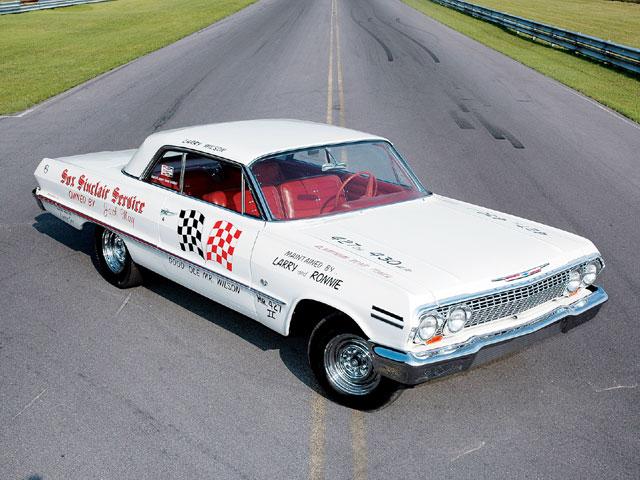
Chevrolet’s famed 409 engine was immortalized in the 1962 Beach Boys song of the same name, and was the desire of many muscle car enthusiasts in the early 60’s. In ’62 the hot set-up was to order the 409 in the lightweight “bubble-top” Bel Air 2-door hardtop. Well, kicking it up a notch in 1963, Chevrolet introduced the Z11 option package for its Impala line. The package included a modified 409 increased to 427 cid by way of a stroked crank, and had special heads, valves and a two-piece aluminum intake manifold sporting dual quads. Output was rated at 430 hp. The additional Z11 features were not limited to the engine compartment however, as the hood, fenders bumpers and other items were made of aluminum to lighten its overall curb weight. This was a RPO (regular production option) package supposedly available to the general public, but appears to have only been selectively sold to racers with the intent of furthering Chevrolet’s cause at the drag strip. No matter, the ’63 Impala SS with a standard 425 hp 409 was plenty fast for the average joe, regularly turning sub-15’s in the quarter mile. Only 50 or so (qtys vary by source) Impala Z11s were sold in 1963, and there are 7 known to be still in existence today.
9
1964 Ford Thunderbolt
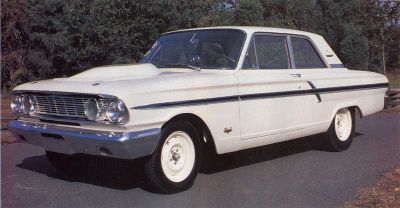
Fomoco’s answer to keep pace with the lighter and faster Chevys and Mopars of the day was to cram its biggest motor, the big-block 427, into one of its smallest models, the mid-sized Fairlane 2-door coupe. Major front-end frame modifications were needed to accomplish this, as well as a large hood bulge necessary to accommodate the hi-rise manifold and twin fours, with air induction routed through dummy headlight openings in the grill. But nonetheless it was a factory-produced car available to anyone from their local dealership, listing at $3,750. Even so, it was purely designed for racing, with plexiglass windows, fiberglass body panels, and a spartan interior that lacked armrests, sun-visors, mirrors, sound-dampening insulation, and was radio- and heater-delete. Imagine those kinds of shortcuts in comfort and especially safety features being allowed in this day and age. Truth be told, the Thunderbolt was not really suitable for everyday use. Perhaps that’s why only 100 T-bolts were sold in 1964. But beware; these cars could pull down mid 11s in the quarter mile!
8
1969 AMC SC/Rambler
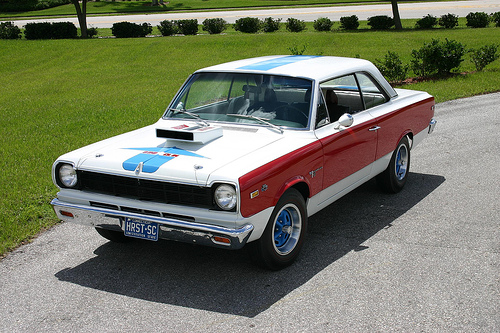
It is easy to forget that muscle cars (and cars in general) in the U.S. weren’t limited to the “Big Three” automakers. In 1969 American Motors Corp. joined forces the well known parts company Hurst Performance and surprised everyone with the SC/Rambler (aka “Scrambler”). The SC stood for “stock-car”, but this was a race-ready production vehicle. Maintaining the typical small-car-big-engine strategy, AMC stuffed their 390 cid 315 hp V8 power-plant into its light-weight Rambler Rogue hardtop coupe. This car could hold court with many of the more popular machines of the day, as stock vehicles regularly turned low 14s at the strip. No options were available (except an AM radio), which kept the price below $3,000. All cars had plain grey vinyl interior with bench seats and red white and blue headrests, carpeting, and a Borg-Warner 4-speed with a Hurst shifter. But perhaps the car’s most striking feature was its bold paint scheme and a large, functional “Ram Air” induction hood scoop. The first 500 units all were a base white with a wide red side panel running the length of the car, and had a blue stripe running front to back across the top of the car. An arrow graphic pointed towards the scoop and lettering noted the engine size. Additionally striking were the blue two-toned mag wheels. When these cars quickly sold out, AMC released a second batch of 500, this time with “B” trim, which was mostly white with narrow red and blue side stripes. A third batch of 512 units was later released which are thought to have gone back to the “A” trim, though this is a source of controversy among enthusiasts, as vehicle VIN codes do not differentiate between the two paint schemes. What is known is that of the total 1,512 SC/Ramblers built, the majority of surviving examples today have the “A” trim. The SC/Rambler is perhaps one of the least remembered muscle cars from the era.
7
1968 Dodge Charger R/T
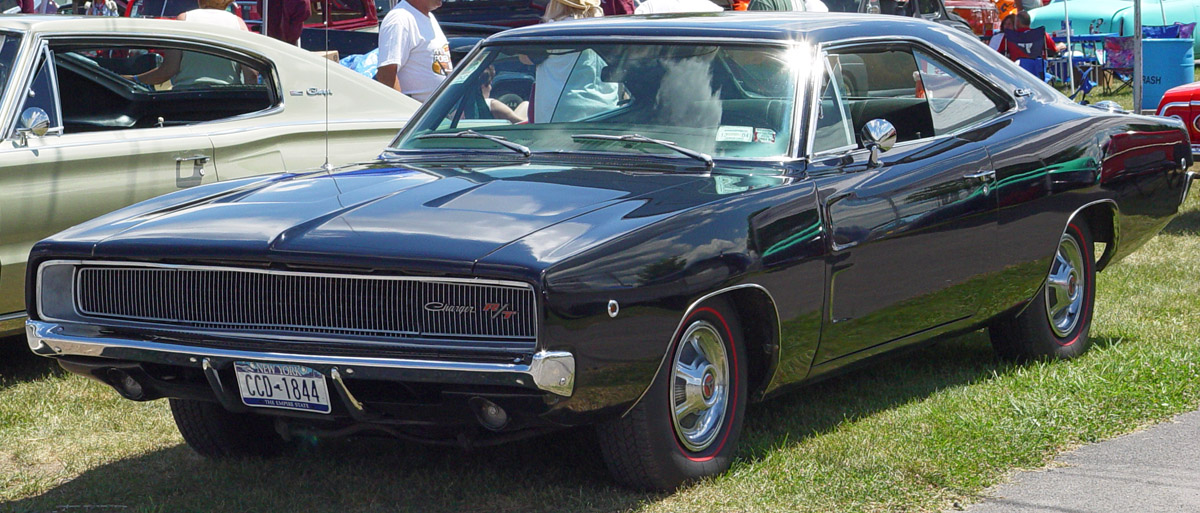
Sleek “coke-bottle” body styling and a mean-looking black-out front grill with hidden headlights sets the Dodge Charger apart from the competition. The R/T (road/track) designation is what Dodge used to denote a car equally suited for street performance or drag racing. Heavy duty suspension provided superior handling (compared to the typical muscle car), and with a powerful 375 hp 440 Magnum V-8, this car ran the quarter-mile in just under 15 seconds, and listed for about $3,500. Not good enough? R/T Chargers with a Hemi under the hood (only 475 produced) would cost you an extra $600, but dropped that quarter time down to the mid 13s. A total of 96,100 Chargers were built in 1968, with 17,000 of them having the R/T designation. Fans of the 1968 movie Bullit might recall that Steve McQueen’s nemisis drove an awesome black 440 Magnum R/T Charger in perhaps one of the best chase scenes ever put on film. You can watch it here.
6
1969 Ford Fairlane/Torino Cobra
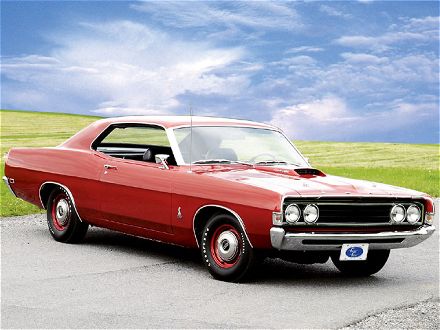
Officially, these are known simply as Cobras, according to period Ford advertising and sales brochures, and more importantly, the dealer winder-sticker. Really though, these are Fairlanes, as the Torino designation was an option package for the Fairlane body-code and was not yet a separate model line in 1969. Sometimes also referred to as the Torino GT or Fairlane Cobra, this naming convention generates some debate in collector circles. This line featured two body styles: the hardtop (aka “formal roof”) and the much more common “sports roof” fastback. The Cobra performance package included as standard the 335 hp 428 Cobra Jet V-8 with a Holly 4bbl. Optional Ram Air didn’t increase horsepower, but it boosted the performance peak to 5,600 rpm. Also included was a locking rear differential, which was exclusive to Ford. Quarter mile times were typically in the 14.5 second range. Exact production figures are difficult to come by, but it is estimated that about 14,000 Cobras were sold in 1969, with the vast majority of them being the fastback version. Naturally, I prefer the rare hardtop (pictured here), which number about 3,000.
5
1969 Plymouth Roadrunner
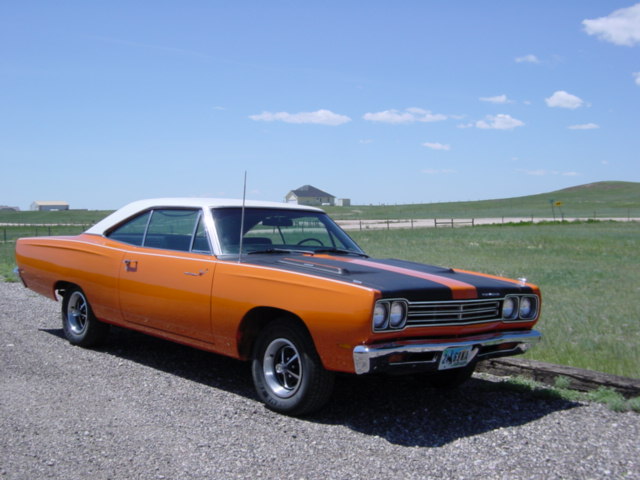
Mopar struck paydirt when it came up with the idea of capitalizing on the muscle car wave of popularity by offering the low-priced Roadrunner to the masses in 1968, with 1969 being a particularly stellar sales year. They were definitely marketing the younger audience with better affordbility, as well as licencing the Warner Brothers cartoon character as its namesake and mascot, including the well-known “beep-beep” sound for its horn. To keep the price down, Roadrunners were minimally appointed, but these cars weren’t toys, as performance and suspension features were not compromised. Base stickered at under $3,000, the price quickly went up when you started beefing it up with power options. Who wants the standard 383 cid mill when you could get a 390 hp 440 with a three-two “Six-pack”? Well forget even that; what you really wanted under the hood was the 426 Street Hemi. Featuring hi-po goodies such as Hemi heads, 10.25:1 compression and two fours, its rated output boosted to 425 hp at 5,000 rpm. It could run the quarter in 13.5 seconds and had a top speed of 140+ mph! Over 80,000 units of the various configurations were sold in 1969, with the “no-post” hardtops being the most desirable among collectors. But the real find today is the rag-top, of which only about 2,200 were produced.
4
1966 Oldsmobile 442
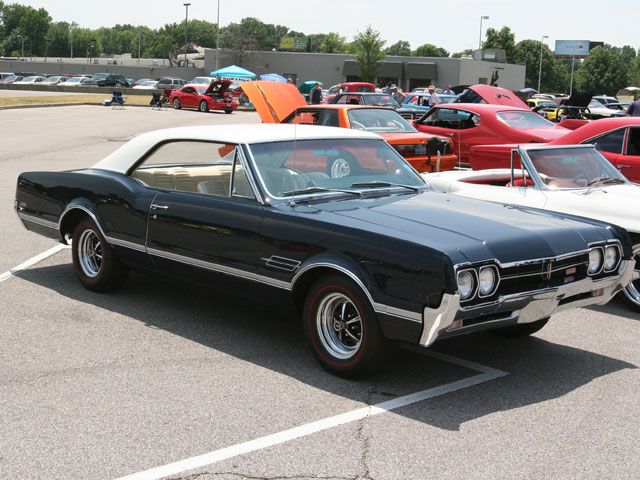
Technically, pre-1968 Olds 442s weren’t an actual model, but rather “442” was an option package available for the Oldsmobile Cutlass. The standard L78 400 cid engine incorporated a single 4bbl carburetor and was rated at 350 hp. The favored set-up for muscle car buyers was the upgraded L69, which was a one-year-only configuration that featured a hotter cam and a triple 2bbl carb “tri-power” arrangement, which helped increase the power rating by another 10 horses. Quarter-mile runs were as quick as 14.8 seconds. Rarest of the rare was the W-30 version of the tri-power motor, which also incorporated an air induction system via tubing from the front bumper. There were only 54 factory-released copies of the W-30, although another 97 were dealer-modified installations. Finding a W-30 442 today is next to impossible (at this writing, one is available on eBay for $70k!), but lacking that, the “regular” tri-power L69’s are most desired by collectors.
3
1969 Dodge Coronet R/T and Super Bee

I’m listing both versions of the ’69 Coronet muscle car here, because they are both very similar (and very cool), but each one has its own unique advantages. The R/T option designation was available on several Dodge models starting back in 1967, and signified “road/track” performance. In 1969, many Mopar fans opted for the slightly less expensive Coronet Super Bee (boasting its unique logo in the rear-end bumble-bee striping). This was Dodge’s equivalent to the Plymouth Roadrunner, and as such, was equally minus many luxury features, making it lighter in weight as compared to the R/T. Super Bees are also much more common, especially those equipped with the base 383 cid (over 24,000 units sold), which was not even available in the R/T. A few Super Bees came with either the bigger 440 six-pack or the 426 twin-four Hemi. The R/T was only offered with the 440 Magnum or the Hemi. These burners routinely ran the quarter-mile in the mid-13s. As for the R/T being the rarer of the two models, about 6,800 R/Ts were produced in 1969, 400 of which were the R/T convertible (all Super Bees were hardtops). Ten of those rag-top R/Ts had the Hemi, and only four of those left the factory with the four-speed tranny.
2
1966 Chevrolet Chevelle SS 396
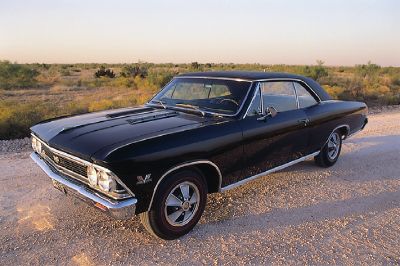
Chevrolet’s “Super Sport” option package was first introduced for the 1961 Impala and soon spread to its other model offerings including the Chevelle, which began life in 1964. The 1966 model year saw the Chevelle take on what I consider to be its best looking body style, with its most-recognizable feature, the classic forward-thrusting front fenders. The Super Sport version also included special wheel covers, red-line tires, and a black-out grill which showed off the SS badging to further compliment its bold appearance. Enginewise, the 396 was basically a de-stroked big-block 409, and was available in several configurations starting with the base-rated 325 hp version. The top option was the RPO L78 which was a mid-year release. Thanks to its 11.0:1 compression ratio, a hot cam, and other tweaks, this baby generated 375 hp at 5600 rpm, could go 0-60 in about 6.5 seconds and ran 14.5 second quarters. In 1966, Chevelle SS 396s with the L78 engine option numbered only about 100 units, and accordingly are highly prized today.
1
1967 Pontiac GTO
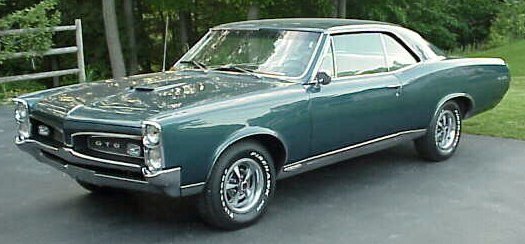
Many enthusiasts consider the “Goat” to be the first muscle car, and its classic split grill front-end design is among the most recognizable features of all muscle cars. Starting life as an option package for the 1963 Pontiac LeMans, the GTO became its own model series in 1966. Model year 1967 was the last year of this first-generation look with the stacked headlight design, and is showcased here. Standard equipment included bucket seats, a walnut-grained dash panel, duel exhaust, and a beefy suspension. A look under the hood found a bigger 400 cid motor than the prior year’s 389. Pontiac also went from a tri-power (three 2bbls) carb setup to a single 4bbl for the 1967 edition. The top performance option in 1967 was the 400 HO, rated at 360 hp at 5,100 rpm. Adding the Ram Air induction option slightly increased peak rpm. These GTOs typycally ran the quarter-mile in the low 14s. Almost 82,000 GTOs were sold in 1967, 13,872 of which had the 400 HO, with Ram Air installed in only 751 of these units.
bonus
1963 Plymouth/Dodge 426 Max Wedge
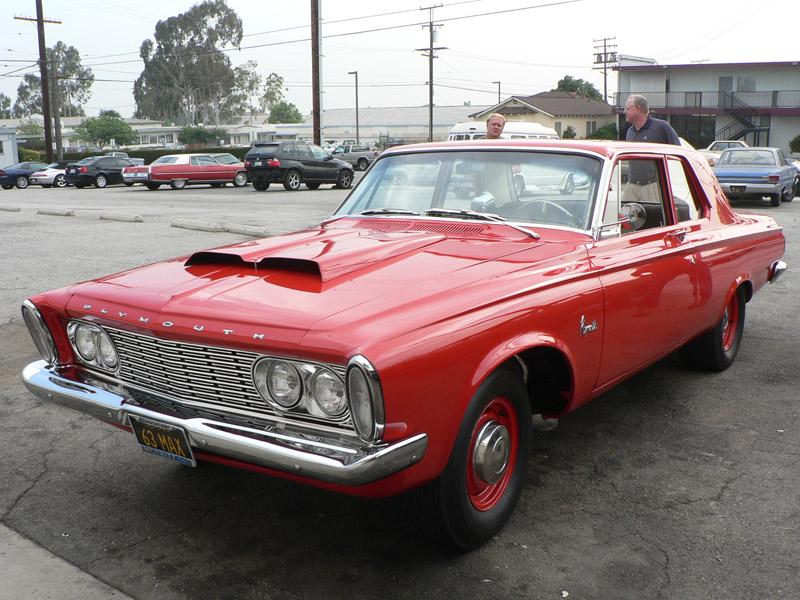
This entry is more about an engine, rather than a specific vehicle model line, hence the entry as a bonus item (plus, I couldn’t think of any other way to squeeze it onto the list!). The 426 RB Wedge (aka Max Wedge) was introduced by Mopar in 1963 as a factory produced “racing only” engine, and was sold through 1964, until it was replaced by the more famous 426 Hemi. According to sales brochures, cars ordered with the Wedge were “not a street machine” but were “designed to be run in supervised, sanctioned drag-strip competition”. The usual combo was to order it in Plymouth’s lightest weight model, the Savoy (pictured here), but it could also be found in the more luxerious Belvedere and Sport Fury models. The Dodge equivilent was typically found in the Polara, but in both marques, it could be ordered in any model offered (including wagons and convertables). 2,130 Mopar vehicles with this motor installation were produced in 1963. Boasting dual quads and 13.5:1 compression, this power-plant produced 425 hp at 5,600 rpm. Lightweight stockers with this motor flew down the strip in a blinding 12 seconds.
More Great Lists
 Top 10 Classic Books That Are Unreadable
 Top 10 Classic Cocktails And Their Histories
 Top 10 Fascinating Facts From Classic Comedies - 2020
 10 Moments In American History, As Seen From The Other Side
 10 Fascinating Facts About The American Flag
 10 Terrifying Lesser-Known Cases Of American Cannibalism
 10 Weird Historical North American Monster Sightings
 Top 10 American Conspiracy Theories That Are…
 Top 10 American Serial Killers
More Great Lists