
 Movies and TV
Movies and TV
Movies and TV  Technology
 10 Historical Inventions That Changed War Forever
 Humans
 10 Everyday Concepts That Are Shockingly Modern
 Animals
 10 Animals Everyone Gets Wrong
 Weird Stuff
 10 Bizarre Superstitions That Drive the Stock Market
 Movies and TV
 10 Films That Were Praised but Got History Wrong
 Our World
 10 Major Cities Being Swallowed by the Earth
 History
 10 Times Saying the Wrong Thing Became a Death Sentence
 Music
Music 10 Stars Who Secretly Wrote Hit Songs for Other Singers
 Weird Stuff
 10 Daredevils Who Treated Death Like a Suggestion
Movies and TV 10 Characters Who Never Forgot a Grudge
Technology 10 Historical Inventions That Changed War Forever
Humans 10 Everyday Concepts That Are Shockingly Modern
Who's Behind Listverse?

Jamie Frater
Head Editor
Jamie founded Listverse due to an insatiable desire to share fascinating, obscure, and bizarre facts. He has been a guest speaker on numerous national radio and television stations and is a five time published author.
More About Us
Animals 10 Animals Everyone Gets Wrong
Weird Stuff 10 Bizarre Superstitions That Drive the Stock Market
Movies and TV 10 Films That Were Praised but Got History Wrong
Our World 10 Major Cities Being Swallowed by the Earth
History 10 Times Saying the Wrong Thing Became a Death Sentence
Music 10 Stars Who Secretly Wrote Hit Songs for Other Singers
Weird Stuff 10 Daredevils Who Treated Death Like a Suggestion
Top 10 Worst Military Decisions In History
The effective prosecution of any war requires a load of decisions at all junctures. Many times, commanders will blunder through misinformation, faulty intelligence, or a misreading of the tactical or strategic situation. We, safely ensconced here in the future can play Monday morning quarterback with the decision of the past often without acknowledging the fact that the commanders in question lack our brilliant hindsight; however, some decisions are simple unconscionable. One has to think that someone, somewhere had to look at this choice and say “God, this is stupid!” This list represents, in chronological order, ten of what I consider to be the dumbest decisions anyone ever made. Each of these decisions either resulted in tremendously unnecessary loss of men and materiel or it resulted in the ultimate loss or needless prolonging of the war in which it took place.
10
Invading Russia
Napoleon Bonaparte (June 1812)
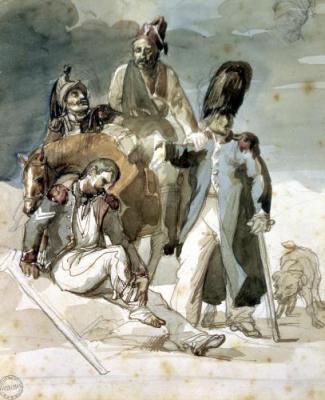
The only motivation I can fathom behind this idiotic blunder by a military genius is sheer boredom. To this point in his military career, Napoleon has known nothing but victory after victory. He’s conquered pretty much all of Europe that refused to ally with him and suddenly he was sitting around with the largest army ever gathered in Europe up until then with nothing to do. So Napoleon looks west, to Mother Russia.
We all know how it turned out but you have to think someone in that huge army knew it was a bad idea. In any event, he didn’t say anything and the rest is history. Napoleon invaded Russia with three quarters of a million men and didn’t fight much of a battle. The Russian retreated into the vastness of their country and burned everything in their wake. Result? Napoleon gets to Moscow only to find smoking ruins. Dejected at not getting to move his toy soldiers around on his big map, he turns the Grand Armee around and begins for home.
But then the real trouble began. Constant harassment by tiny, mobile Russian units. Constant hunger because the supply lines are cut in more places than Danish lace and, worst of all, winter sets in and the soldiers start freezing to death in droves. Three quarters of a million went in, but less than one in three would made it out.
9
The Alamo
Gen. Santa Anna (February 1836)
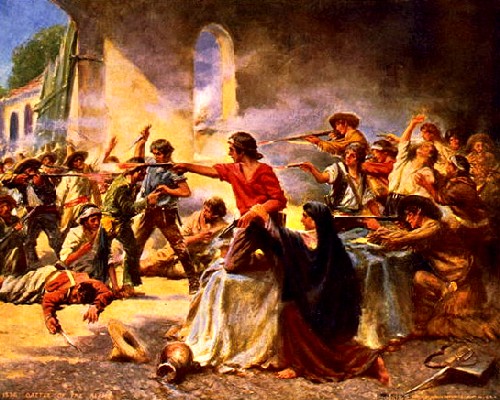
Someone has remarked that the Alamo seems to show up on nearly every military list. Well, it’s a great story. Not the least great part about it was it was so totally unnecessary. All the Alamo consisted of was a tiny adobe walled mission in the middle of a prairie. Basically, Santa Anna, aka Napoleon of the West, decided the tiny garrison in the tiny fort had to be taught a lesson about Mexican politics by his great big army.
One just has to think that someone, some hard campaigning Sergeant in the Mexican force had to look around at the wide open prairie on both sides of the Alamo and think to himself, “Why don’t we just go around? We can even shoot at them as we go by, but let’s get to the rebel capital and put down the rebellion.”
Instead, mainly as a result of Santa Anna’s pride, the main Mexican army spends days and days held up attacking this insignificant little outpost. This needless delay gives the Texas government time to get organized, gives people time to flee, and gives the main Texan army time to get reinforced and into better position. The end result was the Battle of San Jacinto where old Santa Anna got caught napping – literally – and the Republic of Texas was born.
8
Add Lard to Rifles
Some British Bureaucrat (May 1857)
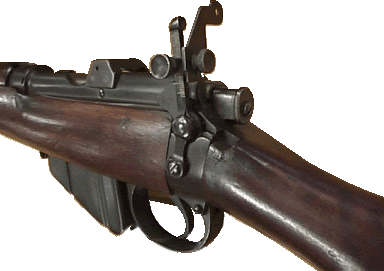
This one will be a little obscure to some, but in the grand scheme of things, it was a world-changing event. The cartridge in question was for the new Pattern 3 Enfield rifle that was to be issued to all the Empire’s troops and replace the older, less efficient models. On the surface this doesn’t seem like a big deal and to us, it probably wouldn’t be. However, in 1857, cartridges weren’t brass, they were paper, and to load them, one had to first BITE the end off the cartridge and pour the contained powder down the barrel of the muzzle loaded weapon. Again, no big deal, until one realizes one singularly important fact. The lubricating lard smeared on the cartridges was made from animal fat. This fat could be obtained from either pigs or cows. In and of itself, that doesn’t present a problem until one realizes that the vast majority of foreign troops in the British Empire were either Muslim or Hindu, especially in India. Now, pigs are unclean to Muslims and cows are sacred to the Hindus so the thought of putting a cartridge with lard into their mouths was anathema to both parties. It didn’t help matters much that the political climate in India was becoming a powder keg, but the lard cartridges proved the final straw – the match that blew the keg, so to speak.
What resulted is known to history as the Sepoy Rebellion or the Sepoy Mutiny. Basically, without going into the very involved, tense and delicate political situation, the Sepoys or Indian soldiers, refused to touch the cartridges which constitutes mutiny. When the first few were seen being punished by the British colonial overlords, the rest rose up and began a bloody rebellion that lasted 13 months and saw tremendous bloodshed and cruelty on both sides. The British severity in putting down the revolt – many leaders were tied to the mouths of cannon and blasted to bloody vapor — remained in the minds of the Indian people through the rest of the 19th century and through two world wars in the 20th. In many ways, the Indian Independence Movement lead by Gandhi can trace its roots to this one monumentally boneheaded decision.
7
Losing Your Battle Plans
Unknown CSA Officer (September 1862)
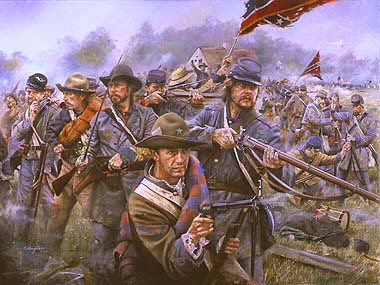
During the American Civil War, one of the qualities that made General Robert E. Lee of the Confederacy so effective was the mysteriousness with which he moved and operated. His troops seemed to appear, fight, and melt away with uncanny speed. Now in reality, this was nothing more supernatural than very detailed and well-executed battle plans. Imagine what the Union generals could have done if they had only possessed a copy of one of Lee’s battle plans. In a wildly providential moment, that is exactly what happened on the eve of the Battle of Sharpsburg in September of 1862.
Union General George McClellan’s 90,000-man Army of the Potomac was moving to intercept Lee, and occupied a campsite the Confederates had vacated just a few days before. While setting up their tent, two Union soldiers discovered a copy of Lee’s detailed battle plans wrapped around three cigars. The order indicated that Lee had divided his army and dispersed portions, intending to bring battle near Antietam Creek. Everything was there in writing. It was a colossal blunder by some Confederate officer.
The outcome would have been even more disastrous for the Confederates had not McClellan waited about 18 hours before deciding to take advantage of this intelligence and reposition his forces. As it was, the Battle of Sharpsburg (or Antietam) would be the single bloodiest day of combat in American history with 23,000 killed and countless wounded before the sun set.
All that saved Lee was McClellan’s indecision. Still, the battle sapped numbers of soldiers that the Confederacy could ill afford to lose. More importantly, though, was the fact that England had been teetering on the fence of coming into the war to aid their cotton supplying Confederates, but with the outcome of Antietam, they decided to sit back for a little while longer, thus robbing the Confederacy of help it desperately needed. A different choice of wrapping paper could have made all the difference in the world to the history of North America.
6
Not Following the Enemy
Gen. George Meade (July 1863)
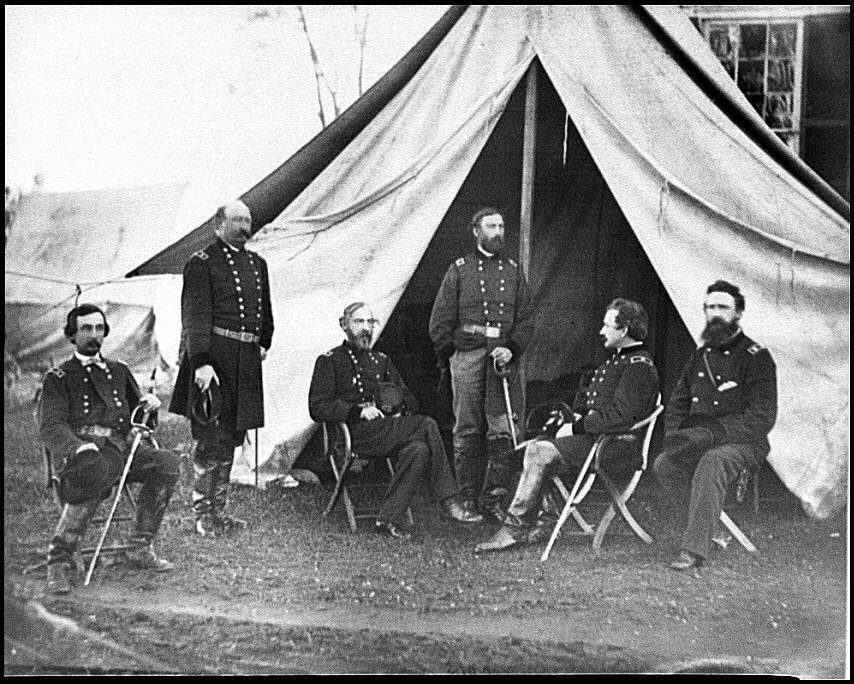
It sometimes looks like Lee did have some sort of guardian angel; either that or the Northern generals before Grant were all monumentally stupid. The former is more romantic, but the latter is easier to prove. In any event, Meade’s decision to let Lee slip back to Virginia is another example of Lee’s luck and an opposing general’s horrendous decision making ability.
The Army of Northern Virginia was done. Three days at Gettysburg had reduced the proud rebels to a shell of their former strength. Devil’s Den, Little Round Top, the Peach Orchard, and, at the last, Pickett’s Charge up Cemetery Ridge had produced the High Water Mark of the Confederacy. With all his reserves spent, Lee was gathering his badly mauled forces and trying mightily to make it back to the relative safety of Ol’ Virginy.
In his way was the rain swollen Potomac River. On his flanks were the persistent if largely ineffectual Union cavalry pickets. The roads were a quagmire of mud. In all, the stage was set for the final crushing blow to be delivered by the Army of the Potomac, which had several reserves that had seen little if any fighting. They would sweep down on the defeated boys in grey like an avenging blue tide. The Army of Northern Virginia would be crushed and the Civil War would be all but over. All that remained was for General Meade to give the order to attack.
Well, the order never came. For reasons that, to this day, are unclear Meade was reluctant to follow Lee. Instead, he gathered his forces in strength and waited. No one is quite sure what he was waiting for, but when President Lincoln found out that Meade had literally allowed the end of the war to slip through his hands, Honest Abe was incensed. It was largely Meade’s indecision that resulted in General Grant being called east from Vicksburg and placed in command of the Army of the Potomac. Had Meade attacked the defeated rebels at that opportune moment, the Civil War probably would not have drug on in a morass of attrition for nearly two more years. Countless lives, Union and Confederate alike, could have been spared and the Reconstruction Period would likely have looked much different.
5
Ignoring the Gatling
George A. Custer (June 1876)

It is generally held to be a good idea among most military men that, when the latest and greatest weapons are available, they should be used. The newly patented Gatling Gun was the earliest machine gun and had completed its trials. Custer had two to four of the guns and abundant ammunition available when he set out to uproot a “small Indian village” on the bank of the Little Bighorn River. Custer’s reasoning behind not using them was that the Gatling guns would impede his march and hamper his mobility. More importantly, he also is said to have believed that the use of so devastating a weapon would “cause him to lose face with the Indians.” Considering reports of Custer’s vanity, this is not hard to believe.
These problems do not change the fact that the Gatling guns would have been a decided equalizer in the face of what turned out to be overwhelming Indian superiority, and that elsewhere in the Indian wars, the Indians often reacted to new army weapons by breaking off the fight. Instead, Custer led more than 250 doomed men of the famous 7th Cavalry into the Montana hill country. If he had taken the then greatly improved machine guns with him the outcome of the much-discussed Last Stand would surely have been very different.
What could have been going through Custer’s mind as he stood, the breeze whipping his famous golden hair behind him, his loyal men dead all about him, and several hundred Sioux warriors galloping towards him intent on making him a human pincushion? Could it possibly have been, “I really could use those Gatling guns right about now.”
4
Invade Gallipoli
Winston Churchill (April 1915)
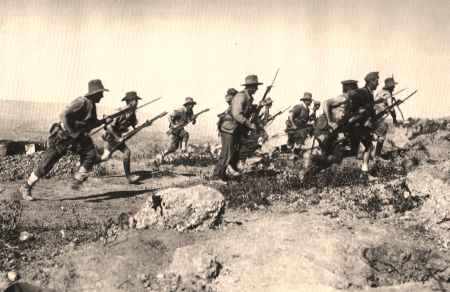
By the start of 1915, the Great War had ground to a halt. The trench lines stretched from Belgium through Italy and neither side was making progress. The war had devolved into mad suicide rushes across no man’s land into the teeth of the new Maxim guns. Predictably, casualties were mounting daily and the war that “will be over by Christmas” seemed to have no end in sight. To make matters worse, Russia was getting their mess kits handed to them all up and down the Eastern Front and the tsardom was beginning to look shaky. The German navy had cut all the usual supply lines to accessible ports and any port safe from the German fleet was either icebound or entirely too far away to be of any practical use. Something had to be done and quickly.
Enter Lord of the Admiralty, Winston Churchill. Now Churchill is well know for his personal bravery as well as his usually keen mind. He is also known for being a fan of a good stiff drink and apparently, he’d had several when he thought of this plan. Churchill proposed that a third front be opened up in the western Mediterranean. Specifically, he planned an attack on the Ottoman Empire held Dardanelles. The attack on what he termed the “soft underbelly of the Central Powers” would open up a warm water resupply depot for Russia and effectively turn the flank of the vast trench network. It was a great idea in theory and on paper.
The Gallipoli Campaign took place at Gallipoli peninsula in Turkey from 25 April 1915 to 9 January 1916. The intent was for a joint amphibian attack by British Empire and French forces up the peninsula to capture the Ottoman capital of Istanbul. To put it mildly, the attempt failed miserably with heavy casualties on both sides. The whole operation was botched from the beginning. The planned invasion was tipped off to the Turks who reinforced the peninsula with heavy guns and additional troops. Once the invasion began, it quickly stalled on the beachhead, thwarted by the Turkish occupation of the high ground.
To make a very detailed and long story short, the allied forces, the bulk of which were Australians and New Zealanders (who ultimately had the highest number of dead per capita of all nations in the war), were essentially trapped on the beaches in the open for months. No real progress was ever made inland despite several dogged attempts all around the peninsula. Promised naval artillery support was cut short as soon as the Admiralty found out – by the sinking of two battleships – that German U-boats were in the waters. The whole event was an unmitigated disaster. Conditions were unreal. In the summer, the heat was atrocious, which in conjunction with bad sanitation, led to so many flies that eating became extremely difficult. Corpses, left in the open, became bloated and stank. The precarious Allied bases were poorly situated and caused supply and shelter problems. A dysentery epidemic spread through the Allied trenches. Autumn and winter brought relief from the heat, but also led to gales, flooding and frostbite.
In the end, Churchill was sacked as Lord of the Admiralty, several generals saw their careers ended but most of all; tens of thousands of men on both sides were killed for absolutely no gain whatsoever. To this day, Gallipoli is remembered as ANZAC Day in Australia and New Zealand in honor of all the brave ANZACs who gave their lives for a stupid decision.
3
Soviet Invasion
Adolf Hitler, (September 1941)
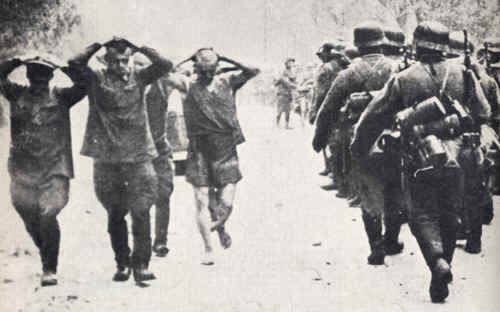
Honestly? See item 10. Replace “Napoleon” with “Hitler”, “Russia” with “Soviet Union”, and “Le Grand Armee” with “Wermacht” and you have the gist of the story. Operation Barbarossa was, without a doubt, the worst case of someone who failed to learn from history being doomed to repeat it. Adolf Hitler proved that it’s not only teenagers who think, “It can’t happen to me.”
2
Micromanaging the War
Lyndon B. Johnson (August 1964)
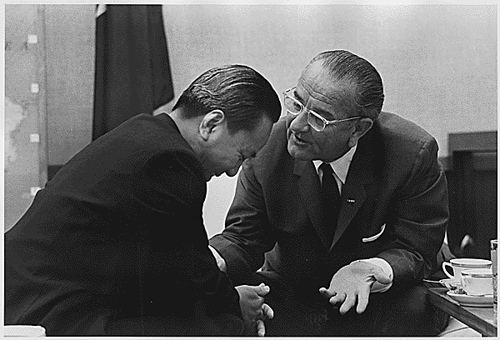
Wars are best run by the professionals. Lyndon B. Johnson was President, but he was not a professional soldier by any means during the Vietnam War. That did not stop him from blowing what was a small insurgency with American “advisors” into an all out “police action” that would claim the lives of nearly 60,000 American soldiers, sailors, and airmen before it ended two Presidents later.
Johnson expanded American involvement on the ground in Vietnam as soon as he took office after JFK’s assassination. Unfortunately for the troops, LBJ watched opinion polls and it is hard to fight a war if you watch opinion polls. Basically, field commanders couldn’t attack certain high value targets without Johnson’s say-so and, given the distances and the time it would take to brief the President on each given situation, the men were fighting one step behind at all times. He also took fire from the press who said he was too cozy with the defense businessmen and the war was justification for increased defense spending to make these businesses rich. That speculation, like Johnson’s supposed involvement in JFK’s assassination, is better left to the conspiracy theorists.
What is a fact, however, is LBJ’s insistence on being a hands-on Commander-in-Chief seriously handicapped American efforts in the jungles of Vietnam. Ultimately, his decision to try running a war based on opinion polls proved his undoing and he dropped out of the 1968 Presidential elections.
1
Invading Afghanistan
Yuri Andropov (December 1979)
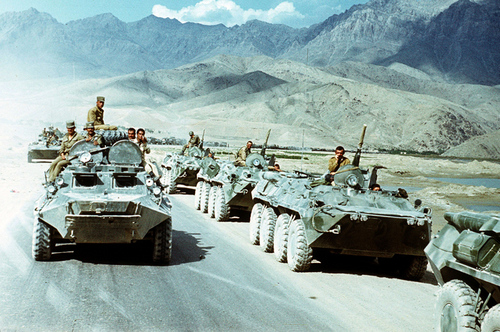
For centuries, countries outside of Afghanistan – from the Indian Mughals, to the British Empire, to the Islamic fundamentalists – have tried to impose their will upon the Afghan people. As a result, the Afghans are a hardy bunch and they can fight like devils. The are experts at guerilla warfare and it is always a safe bet to assume that whoever is invading them has enemies all to willing to supply the natives with effective weaponry. That is over 1200 years of history totally lost on the Soviets in 1979 when they sent in a massive number of troops to prop up the unpopular communist government in Kabul.
What followed was a ten year blood bath of death among the rocks. For years, Soviet Hind helicopters would hunt in the valleys for any of the Afghan fighters. Upon finding them, the guerillas would be mown down by cannon fire from the craft they called “The Crocodile”. Then the CIA saw a chance to return the favor the Soviets had played on the United States during its involvement in Vietnam and began supplying the Afghan fighters with Stinger surface to air missiles. So much for Soviet air superiority. Stingers shot down 333 Soviet helicopters in the course of the ten year war.
The saddest part is the Soviets had just witnessed the USA’s horrific ten year quagmire in Vietnam, but, like other groups in history, they figured it couldn’t happen to them. They were wrong. The Soviets lost 15,000 men and billions of rubles worth of equipment to Afghanistan and they got nothing in return. For the Afghans, the country was left devastated and ripe for a group called the Taliban to take over.
More Great Lists
 Top 10 Best Military Forces In History
 Top 10 Worst Times To Be Alive In History
 10 Worst Unsolved Mass Murders In US History
 Top 10 Worst Movies From The Top Genres
 Top 10 Military Bases Linked To UFOs (That Aren't Area 51)
 Top 10 Worst Instances Of Inflation
 Top 10 Worst Landlords
 Top 10 Worst Celebrity Adverts
 Top 10 Horrific Facts About Robert Black, Britain's…
fact checked by
Alex Hanton
More Great Lists