
 Movies and TV
Movies and TV
Movies and TV  Technology
 10 Historical Inventions That Changed War Forever
 Humans
 10 Everyday Concepts That Are Shockingly Modern
 Animals
 10 Animals Everyone Gets Wrong
 Weird Stuff
 10 Bizarre Superstitions That Drive the Stock Market
 Movies and TV
 10 Films That Were Praised but Got History Wrong
 Our World
 10 Major Cities Being Swallowed by the Earth
 History
 10 Times Saying the Wrong Thing Became a Death Sentence
 Music
Music 10 Stars Who Secretly Wrote Hit Songs for Other Singers
 Weird Stuff
 10 Daredevils Who Treated Death Like a Suggestion
Movies and TV 10 Characters Who Never Forgot a Grudge
Technology 10 Historical Inventions That Changed War Forever
Humans 10 Everyday Concepts That Are Shockingly Modern
Who's Behind Listverse?

Jamie Frater
Head Editor
Jamie founded Listverse due to an insatiable desire to share fascinating, obscure, and bizarre facts. He has been a guest speaker on numerous national radio and television stations and is a five time published author.
More About Us
Animals 10 Animals Everyone Gets Wrong
Weird Stuff 10 Bizarre Superstitions That Drive the Stock Market
Movies and TV 10 Films That Were Praised but Got History Wrong
Our World 10 Major Cities Being Swallowed by the Earth
History 10 Times Saying the Wrong Thing Became a Death Sentence
Music 10 Stars Who Secretly Wrote Hit Songs for Other Singers
Weird Stuff 10 Daredevils Who Treated Death Like a Suggestion
Top 10 Amazing Cities You Will Never Visit
For thousands of years cities have been the manifestation of humankind’s artistry, imagination, and instinct to succeed. They embody our strong social desires and longing to create grand masterpieces. London, Constantinople, Paris, New York, Ancient Rome, and Tokyo have been just a few of the dazzling trophies mankind has built. But there have been many cases in which someone’s vision for a better, more efficient, or more fantastic city collapsed into a heap of broken dreams. These are ten cities that were never built, ten cities you will never visit.
10
Dongtan
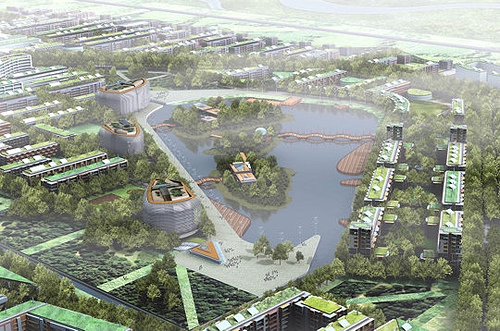
Just a couple of months ago it was reported that China’s planned city of Dongtan would not become a reality. It was highly publicized and anticipated since it was to be the first mega eco-city of its kind.
Slated to be twice the size of Manhattan, the site was an island near Shanghai and was to change the way humans interacted with their environment. The exodus of individuals from the countryside to cities in China, therefore creating more environmental waste, spurred a movement for more environment-friendly projects, and Dongtan was by far the most ambitious one.
The self-sustaining city would have produced its own energy from solar, wind, and bio-fuel power, and recycled city waste. Public transportation would have been powered by clean technologies such as hydrogen fuel cells, and a vast network of foot and bicycle paths would have substantially cut down on vehicle emissions. In addition, organic farming methods were to be used inside the city limits.
It was to be a green model for the entire world, but, like most projects of this scale, resistance and problems arose. Many considered it a pipe dream which was never really plausible, while others claimed China’s rapidly developing cities would negate any benefits Dongtan presented. When Shanghai’s mayor (the project’s biggest supporter) was arrested for property-related fraud in 2006, the plan fell into further disarray with permits lapsing and enthusiasm waning.
Eventually, the global recession all but sank the undertaking and the innovative ideas planned will have to be put on hold.
9
Triton City
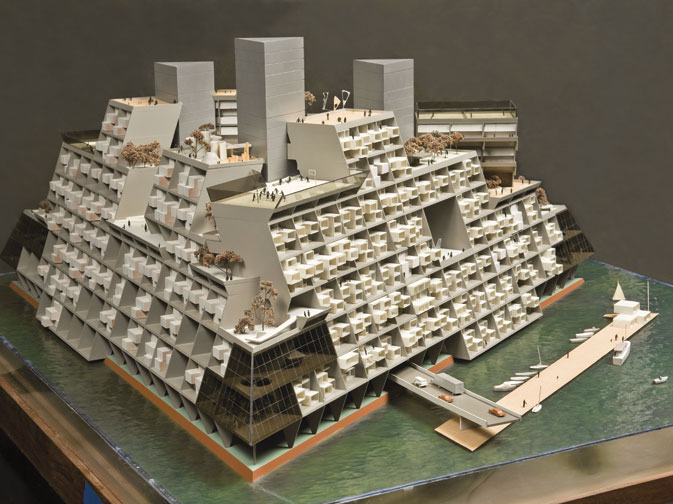
Buckminster Fuller was a brilliant visionary, scientist, environmentalist, and philosopher who, in the 1960s, developed a bold design. It was dubbed Triton City and was intended to be a floating utopia for up to 5,000 residents. His giant, floating city was designed to encourage people to share resources and conserve energy.
Fuller was initially commissioned by a wealthy Japanese patron to design a floating city for Tokyo Bay. He died in 1966, but astoundingly enough, the United States Department of Urban Development commissioned Fuller for further design and analysis. His designs called for the city to: be resistant to tsunamis, provide the most possible outside living, desalinate the very water that it would float in for consumption, give privacy to each residence, and incorporate a tetrahedronal shape which provides the most surface area with the least amount of volume. Everything from education to entertainment to recreation would be a part of the city. Fuller also claimed that the low operating costs would result in a high standard of living.
HUD eventually sent the plans to the U.S. Navy where they were dissected and analyzed even further. The city of Baltimore, upon hearing of the project, became interested and petitioned to have Triton City moored off of its shores in Chesapeake Bay. However, as municipal and federal administrations changed, the project languished and was never brought to light. Today, there are derivatives of Triton City, such as the artificial island Kansai and its airport in Osaka, Japan, but they pale in comparison to the scope of Triton City.
8
Broadacre City
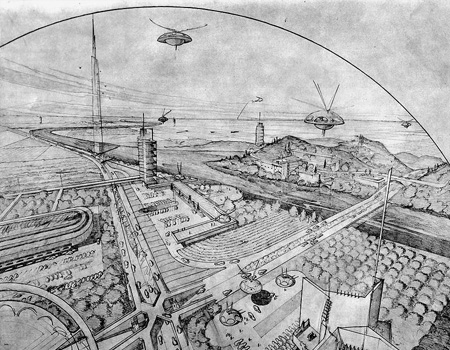
Originally designed by one of the most famous and respected architects in history, Frank Lloyd Wright, in 1932, Broadacre was meant to be a “New Town” utopia. It did not fit into its own category because it had many characteristics of a conventional city of the time as well as incorporating the principles of an agricultural nation which Thomas Jefferson championed. In essence, he wanted to abandon the crowded, machine-age, industrial city, but avoid a rural community.
Just like Jefferson believed every citizen should have their own “vine and fig tree”, Wright planned the city so that each denizen would grow their own food on their one acre plot of land. In what was a controversial characteristic, citizens of all social classes would intermingle much more than in any other city or town of the day. Wright also despised centralization so it was essential that the city be sprawling and widespread, which severely differentiated itself from a city. In Broadacre, homes, factories, offices, and municipal buildings would all be separated by large expanses of parks planted with lawns and trees. Cleanliness was paramount and there was to be only light industry and all utility wiring would be buried underground.
Opponents of Wright’s city were vociferous however. Because he believed that the automobile was “the advance agent of decentralization” he envisioned extremely little mass transportation which many city planners vehemently disagreed with. Wright’s vision never was realized, and the closest thing we have today are the sprawling suburban communities that blanket much of our planet.
7
Disney Resorts
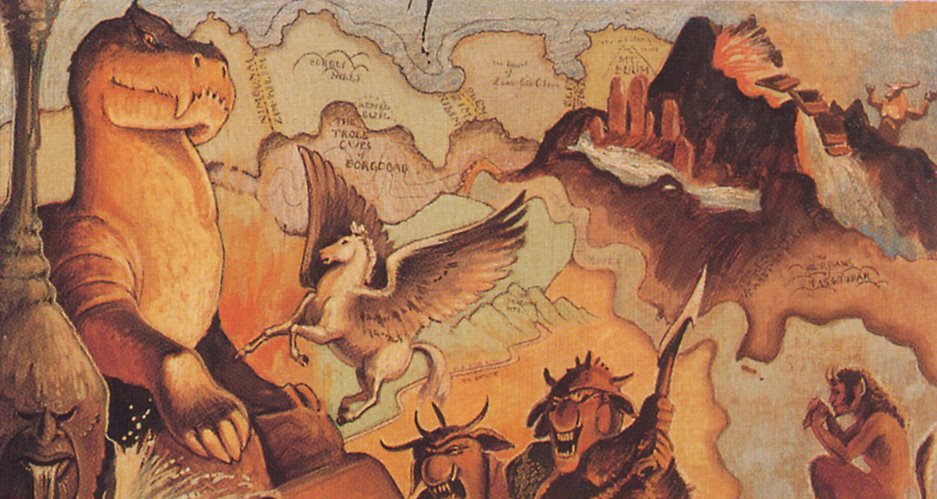
These are not cities by definition, but anyone who has been to a Disney resort knows that they are basically self-sufficient cities in their own right. Considering the amount of real estate the conglomerate already owns and operates it’s amazing how many other things they planned that never came to fruition. It’s also interesting to realize what we could have had from the world’s largest entertainment company since most of these would have been great places to visit:
Mythia: A Greek and Roman myths and legends-inspired park planned to be built near Disneyland.
WestCOT: A West Coast EPCOT Center planned for California.
Disneyland East: A large park to be built on the site of the 1964 World’s Fair in Queens, NY.
Port Disney: An American version of Tokyo DisneySea planned for California.
Disney’s Asian, Venetian, Persian, and Mediterranean resorts to be built near Disney World.
Disney America: A patriotic theme park that was to be built in Virginia.
Discovery Bay: A land inspired by Jules Verne‘s various works. Some ideas were later incorporated into Disneyland Paris.
Beastly Kingdom: A mythical beings land planned near Animal Kingdom in Florida.
Dark Kingdom (Shadowlands): A park near Disney Word that would have showcased all of Disney’s villain characters and be the antithesis of the Magic Kingdom. Maleficent’s Castle would have been in the center of the park.
Sci-Fi City: Planned for Tokyo Disneyland, this would have been an immense park with an endless amount of science fiction rides and attractions. If built it would have been the most extensive and impressive “tomorrowland” ever created.
Disney’s Snow Crown: A Disney-themed ski resort situated at the Mineral King glacial valley in northern California which was ultimately prevented by preservationists.
These are the biggest resorts and parks that were conceived by Disney but never built. There are hundreds more attractions, rides, restaurants, etc. whose ideas were put to paper but never became reality for a multitude of reasons.
6
Slumless, Smokeless Cities
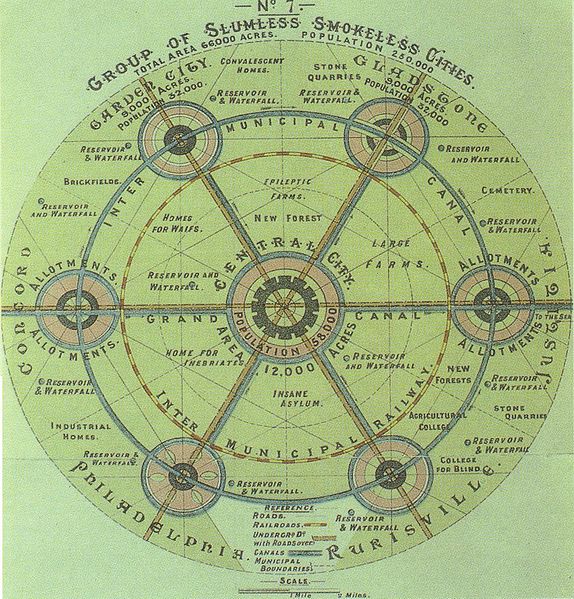
Sir Ebenezer Howard was the father of the garden city movement, which is a suburban town near a large, metropolitan city that is designed to not be reliant upon its bigger neighbor. Garden cities were intended to provide a pleasant environment with open public land while at the same time contain industry and agriculture. He succeeded in spearheading the building of many garden cities, beginning in the United Kingdom, to mixed results. But his vision of the slumless, smokeless cities model has gone unbuilt.
His design is very interesting, and if one is to peruse his self-drawn diagram, the aesthetics appear quite pleasing. A number of characteristics are notable. The entire design resembles a big wheel, with the Central City being the hub with six smaller, surrounding garden cities. Each city is surrounded by a circular canal, and one large circular canal, the Inter Municipal Canal, connects each of the six outer cities. Continuing with the canal theme, independent straight canals cut through all six cities and run directly into the Central City. Roads also ran along these straight waterways. Running inside the outer towns would be the Inter Municipal Railway. Inside the Railway, Howard planned for such things as farms, an insane asylum, reservoirs, an agricultural college, industrial homes, cemeteries, and a “home for waifs”.
The overall design was to relieve the huddled crowdedness and dirtiness of big cities but still have the feeling of connectivity. Since it would have been such a daunting project, and there wasn’t quite enough support for Howard’s plan, these connected cities never materialized.
5
California City
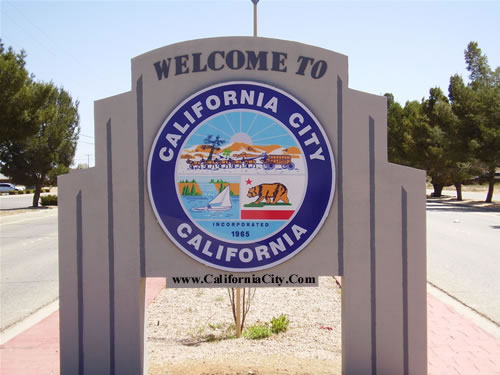
While this is a city that you can visit, you will never see its original plan fulfilled. Nat Mendelsohn was a developer who had a dream of developing a city that would rival Los Angeles in terms of grandeur. He ambitiously began building on a 320 square kilometer piece of land in the middle of California’s Mojave Desert complete with a huge park and artificial lake. If one were to look at a satellite picture of the city it may seem like Mendelsohn had at least come close to realizing his dream. However, if you are to look closer you would notice something conspicuously missing – houses.
Although hundreds of streets, complete with cul-de-sacs, crisscross in one continuous, gigantic grid, the network is just one, prodigious ghost town. But at least ghost towns have structures; these streets are lined with absolutely nothing, not even a telephone pole. It kind of looks like an intricate crop circle mysteriously made in the middle of the desert or threadbare hiking paths run amok twisting through the dirt and sand.
Mendelsohn had the same idea as many real estate developers of the time. He would buy a vast amount of land, divide it into thousands of home plots, then sell them to families who longed for a piece of property to call their own. The gamble did not pay off for him however, because 50 years later decaying streets still lie there empty. One reason is that dust storms are a common occurrence in the area, but he mainly overestimated demand.
The city is not empty though. It has a population of roughly 14,000 people comprising a small town. The entire town, however, only takes up a small corner on the outskirts of the boundless, barren grid. Although it’s a town with services, it will never be a large city the likes of Los Angeles that Nat Mendelsohn conceptualized.
4
Minnesota Experimental City
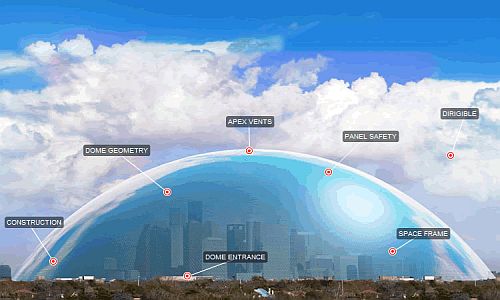
The Minnesota Experimental City (MXC) was the brainchild of a private partnership between the University of Minnesota and the Federal Government in the 1960s and would be intentionally open to observation and evaluation by urban studies experts. Like its name suggests, the city would be a combination of experimental ideas never before tried on such a large scale.
The city would accommodate about 250,000 people, and it would focus on open spaces such as parks, farms, and wilderness. Only one sixth of the area would be paved and the city would be partially covered by a geodesic dome (designed by Buckminster Fuller). This design is extraordinarily strong, is hurricane and tornado proof, and is widely used today. The city would be car-free, with cars parked at the edge and people-movers whisking people into the center of the city. A futuristic and highly advanced automated highway system, in which magnetic, driverless cars were used, would connect people to the outside world.
Perhaps the most drastic and controversial departure from conventional cities was that there would be no schools. Instead, the practice of lifelong learning would be practiced. Lifelong learning states that everyone is a teacher as well as a student and that education takes place through social interactions, observations, and joining groups and clubs among other things.
Budgetary problems as well as logistics quashed the city’s groundbreaking.
3
Welthauptstadt
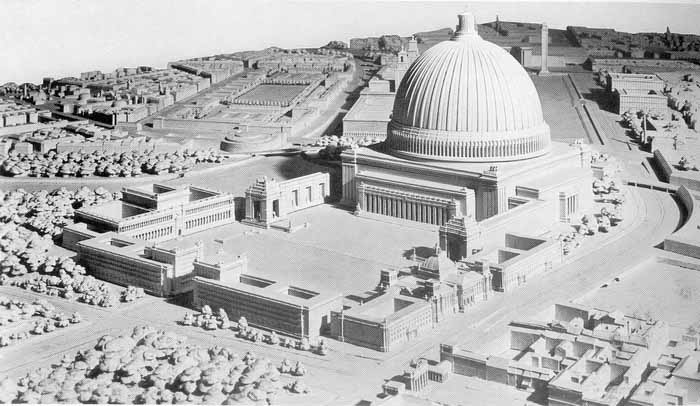
Welthauptstadt Germania (World Capital Germania) was to be the jewel of the Third Reich. Adolph Hitler, unmatched in his hubris, was convinced that Germany would become the center of Europe, and perhaps the world, and had begun to plan his capital city, which was a rebuilt Berlin, even before World War II began. His goal was to exceed the quality and splendor of other world capitals such as London, Paris, and Washington D.C.
Plans for this grandiose city included a stadium that could house 400,000 spectators, a Chancellery with a lavish hall twice as long as the one at the Palace of Versailles, the Triumphal Arch (based on the Arc de Triomphe in Paris but much, much larger), and a giant open square to be surrounded by large government buildings. The centerpiece of the new city would be the Volkshalle, or People’s Hall, which would include a humongous domed building designed by Hitler himself and chief architect Albert Speer. If this domed building was built it would still today be the largest enclosed space in the world, being sixteen times larger than the dome at St. Peter’s.
Even though the War began before construction could begin and put a halt to commencing building, all the necessary land was acquired and engineering plans were developed. Hitler’s plan was to win the war, finish construction on Welthauptstadt, hold an extravagant World’s Fair there in 1950, then retire. Needless to say, the crushing of the Nazi regime and Third Reich at the hands of Allied forces put an end to the future of the great city.
One humorous aspect of the planning of Welthauptstadt is that the marshy-like ground of Berlin never could have supported the monstrous structures Hitler wanted as the showpieces of his city.
2
Seward’s Success
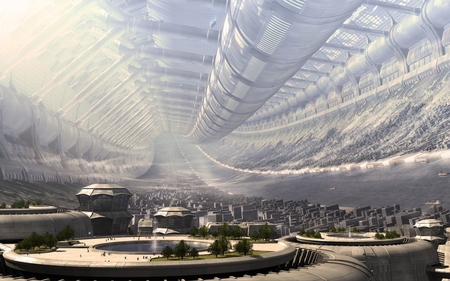
A planned city across the bay from Anchorage, Alaska, the name was a reversal on “Seward’s Folly” which was the name bestowed on the transaction that Secretary of State William Seward made when he purchased Alaska from Russia. It was to be a city unlike any in the world.
First and foremost, it was to have a colossal, glass dome covering it which made it completely climate controlled. The city would have amenities for 400,000 citizens including a sports arena, mall, schools, and petroleum center. Transportation would be quite innovative and included moving sidewalks and an aerial cable car line that would shuttle people around the city and to nearby Anchorage. Skylights and large windows would give people the sense of openness but would not compromise the climate-controlling properties of the dome. Cars would be nonexistent inside because it was a city “for people, not cars”, and all energy used in the city would be provided mostly by natural gas. Later, plans called for a subway under the bay that would also lead to Anchorage.
Failure to make lease payments on the land, and the impracticality of it all, ensured that Seward’s Success would, in the end, not be such a success.
1
BoozeTown
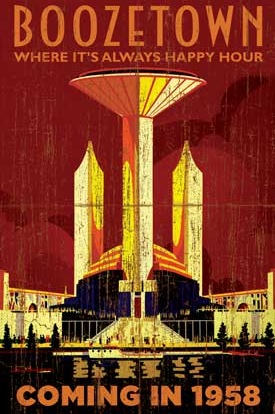
No, this was not an insincere idea concocted by someone just to garner attention. Back in the 50s it was the dream of one man who doggedly fought to make it an actuality. It was to be a resort city completely centered around the culture of drinking, where alcohol would be embraced, loved, and revered.
Mel Johnson loved to drink. As a young man he traveled the world to see the great drinking cities: Dublin, New York, Havana, Rio, Barcelona, New Orleans, and Paris. But the drinking culture of these cities just wasn’t enough for him; he wanted something more. He was a very intelligent man who dropped out of Harvard University and served in the armed forces, but after World War II he had his epiphany and set out to create BoozeTown.
His city would be comprised of dozens upon dozens of bars and nightclubs, all with different themes. He was meticulous in his planning and fleshed out every detail. Street names would allude to alcohol, such as Gin Lane, Bourbon Boulevard, and 21st Amendment Ave; there would be a moving sidewalk and an electric trolley system which would help escort staggering drunks home (or to another bar); much of the alcohol would be brewed or distilled inside the town which would produce revenue; every bar and liquor store would be open 24 hours a day, seven days a week; drinks would be allowed everywhere, even banks and places of worship; the city would have its own currency, BoozeBucks; there would be a police force, the Party Police, but instead of harassing drinkers they would be there to assist them; the BoozeTown Bugle would keep citizens abreast of the current news; and no children would be allowed inside. There would be a big daycare just outside city limits for visitors. Johnson figured that the permanent populace would consist of “retirees, artists, and goof-offs”, people who wouldn’t be responsible for children in the first place. He believed that famous artists, writers, and actors would in time flock to the city to live. In the middle of the city would be a towering building shaped like a martini glass in which Johnson would have his home and headquarters.
He scouted out areas for BoozeTown, such as somewhere in Middle America, northern Nevada, and an island off of the western coast of Mexico. Johnson had money from the death of his wealthy father but he needed much more capital and held numerous, lavish fundraisers in order to raise it. He printed up a plethora of trinkets such as maps, postcards, and matchbooks with BoozeTown’s logo on them to help persuade investors. At times, he believed he had enough money and set various opening dates for his city. However, very few people were actually serious about ponying up the money Johnson needed. This, added to the fact that he was acting increasingly more erratic and eccentric, and that the press was vilifying him, basically ended his dream of BoozeTown. In 1960 he gave up on the dream and was later committed to a hospital and diagnosed with paranoid schizophrenia. He died just a few years later.
You can almost picture yourself driving down an open stretch of road in the middle of nowhere then, suddenly, seeing a titanic martini glass pop up on the horizon beckoning you to come experience BoozeTown, “Where It’s Always Happy Hour”.
More Great Lists
 Top 10 Amazing Places You Can Visit (In Minecraft)
 10 Amazing Women You've Never Heard Of
 10 Amazing Castles In Europe You've Probably Never Heard Of
 10 Strange Cemeteries You'll Be Dying To Visit
 10 Forbidden Destinations That You're Not Allowed To Visit
 Top 10 Ghost Towns Inside Or Near Famous Cities
 Top 10 Deadliest Cities In The USA
 Top 10 Safest Large Cities In The USA
 Top 10 'Star Wars' Background Characters You Never…
fact checked by
Alex Hanton
More Great Lists