
 Our World
Our World
Our World  Creepy
 10 Instances of Lithobolia That Had People Running for Cover
 Politics
 10 of the Bloodiest Coups Ever Attempted
 History
 10 Astounding Ways Spy Agencies Hid in Plain Sight
 Weird Stuff
 Top 10 Famous Minds Changed by Psychedelics
 Creepy
 10 Little-Known Unsettling Urban Legends
 Creepy
 10 Books That Were Allegedly Written by Ghosts
 History
 10 Overlooked People Who Accidentally Changed the World
 Space
Space 10 Fascinating Explanations for Cosmic Mysteries
 History
 10 Insane Covert Operations from WWII
Our World 10 of the World’s Most Hated Buildings (and Why People Despise Them)
Creepy 10 Instances of Lithobolia That Had People Running for Cover
Politics 10 of the Bloodiest Coups Ever Attempted
Who's Behind Listverse?

Jamie Frater
Head Editor
Jamie founded Listverse due to an insatiable desire to share fascinating, obscure, and bizarre facts. He has been a guest speaker on numerous national radio and television stations and is a five time published author.
More About Us
History 10 Astounding Ways Spy Agencies Hid in Plain Sight
Weird Stuff Top 10 Famous Minds Changed by Psychedelics
Creepy 10 Little-Known Unsettling Urban Legends
Creepy 10 Books That Were Allegedly Written by Ghosts
History 10 Overlooked People Who Accidentally Changed the World
Space 10 Fascinating Explanations for Cosmic Mysteries
History 10 Insane Covert Operations from WWII
Top 10 Geniuses of 10 Fields of Human Activity
[Competition: This list contains a competition, see the first comment for details.] This is another list of human endeavors but it covers ten of the most important aspects of human life through all history – it is not specifically modern, or ancient. While most will agree with the selections, there may be some dispute – if so, be sure to tell us in the comments. I have chosen one book for each item on the list for further reading – this is also connected to the competition running on the list.
10
Politics
Gaius Julius Caesar Augustus
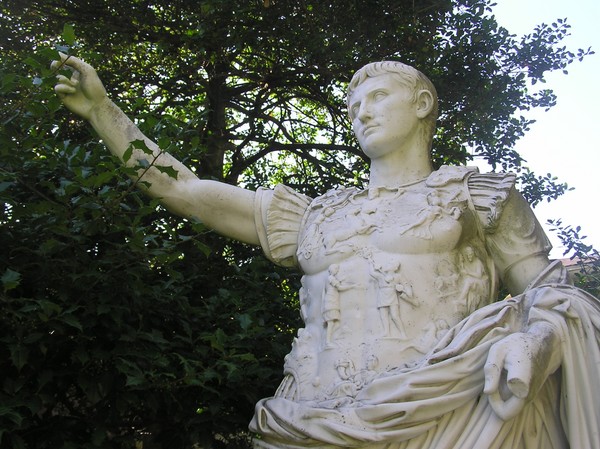
Runners-up: Alfred the Great, Suarez (theoretical), Benjamin Franklin, George Washington, Thomas Jefferson, James Madison, Abraham Lincoln.
He is, in this lister’s opinion, one of the very few decent leaders in history. He had his personal vices, among them that he was a womanizer who used his power to seduce any woman who took his fancy. There’s a Clinton joke in there somewhere.
But Augustus can be forgiven that sort of thing given that he was never a tyrant, never let his absolute power corrupt him absolutely, and worked tirelessly for some 42 years to make Rome the finest city in the world.
It may already have been the finest, but Augustus managed to make it even better. Consider that he seized power after Rome had been in continual war with itself for 200 years. The city was ripping itself apart by 27 BC, had just gone through the worst of its civil warring: the First Triumvirate, Caesar, Pompey, and Crassus; then the Second, Octavian (Augustus), Marc Antony, and Lepidus, and no one knew who was in charge. Not even the Senate had control. When Augustus proclaimed himself Emperor, all the bickering stopped. He very quickly made everyone love him.
His rule cemented the Pax Romana, a time from c. 130 BC to c. 180 AD, during which the Roman Republic/Empire was invincible, and no foreign power dared challenge it. Augustus showed up in the middle of it, when, right after that Second Triumvirate and civil war, the entire state was in danger of imminent collapse from within. Augustus pulled it all back up and held it together. He instituted Rome’s first official fire fighting force of between 500 to 1,000 men in 14 districts throughout the city. He instituted the first official police force, and now, without having to fight the foreigners, he was able to establish a standing army for Rome, c. 170,000 well trained soldiers. He repaired, then greatly advanced the technology of the roads throughout Italy.
He abolished private tax farming, and turned it into a civil service, bringing food to the masses more cheaply, instituted the first official census, the flat-rate tax, with each province’s citizens paying an established annual tax.
None of this mentions all the magnificent buildings he had constructed.
He brought all state finances under control, since the civil wars had caused the values of most things to fluctuate violently. He donated 170 million sesterces (an enormous amount) to establish a trust fund for the active a retired soldiers throughout the empire. This made the soldiers love him more than anyone, and a coup impossible. But then, even the citizens loved him. The senators. Almost everyone loved him. He proved Machiavelli’s maxim that the best ruler is the one who rules by love, and slightly inferior to him is the one who rules by fear. The worst ruler is the one whose people hate him, and there have been plenty of the latter two.
He may have been the greatest benevolent dictator the world has ever seen.
Further Reading: Augustus: The Life of Rome’s First Emperor

9
Applied Mechanics (Inventing)
Leonardo di ser Piero da Vinci
Runners-up: Nikola Tesla, Thomas Edison.
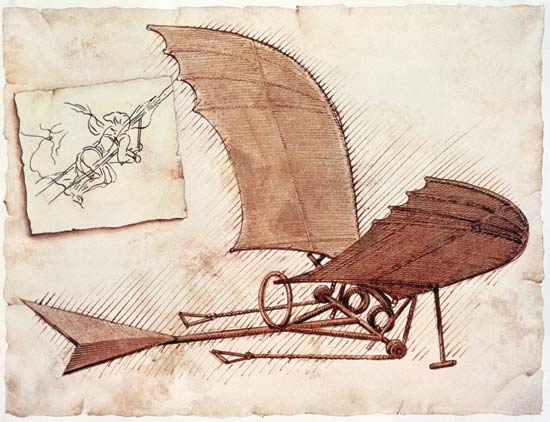
No introduction is necessary. Suffice to say the man invented the precursor to the robot (and the actual, artificially intelligent robot hasn’t been invented yet). Da Vinci’s idea was for a small cart powered by a very strong spring. The whole thing was made of wood on the outside, with steel framework, and he used several of these, all the same size and shape, to roll around the inside of his house serving drinks and food to guests. The carts turned at the proper doorways by means of various wood disks that da Vinci placed inside. Each disk had different holes that struck the teeth of different cogs and gears on the inside, and thus turned the cart at different times, in different directions. The drinks and food were placed on the flat tops. Replicas have been made based on his extremely detailed drawings and notes, and they really do work.
He invented the first successful parachute, made of a balsa wood frame, and silk fabric, shaped like a hollow pyramid. He never had the nerve to try it out, though. No one did, until 2000, when a skydiver named Adrian Nicholas tested it, and it worked. Nicholas died 5 years later when his modern parachute didn’t open.
Da Vinci invented the sniper scope for rifle arms (muskets in his day), which was simply one of his smaller telescopes bolted onto the top of a musket. He invented pivoting scissors, all earlier designs being single flexing pieces of metal using spring action. The spring design had the drawback of bending out of shape if squeezed too hard, and no longer flexing properly. The pivoting scissors operate as two pieces of metal around a bolt. Da Vinci’s design has changed very little. He invented the first successful hang glider, based on the operations of birds’ wings, for which Bernoulli was not alive to come up with a principle until 200 years later.
He invented the tank, made of thick oak and powered by four to six men turning iron wheels via an iron crank shaft, while four other men inside loaded and fired cannon at the enemy foot soldiers. There is no record of the tank being used in battle, but had it been, it would have been impregnable against the arrows, axes, and swords of the day. It could have been set on fire, but it would have terrified anyone who saw it long before they worked up the nerve to approach it. It was the equivalent of the tripods in H. G. Wells’s The War of the Worlds.
He almost invented the helicopter. He just needed a sufficient engine to hold it in the air, and the combustion engine was a long time coming. He invented the steam cannon, which was almost as powerful, and much faster and cheaper to reload, than the gunpowder cannon. He modernized hydraulic pumps, and invented the stabilized artillery projectile. We know it as a rocket, which has stabilizing fins, as opposed to a cannon ball or simple conical shaped projectile. He invented thousands of other things.
Further Reading: How to Think Like Leonardo da Vinci: Seven Steps to Genius Every Day

8
Sculpting
Michelangelo di Lodovico Buonarroti Simoni

Runners-up: Bernini, Donatello.
Da Vinci was a master of just about everything of the day, including sculpting, but when it came to sculpting, he deferred to the young upstart Michelangelo. The story goes that a 13-foot high block of marble was excised from the Carrara quarry, about 60 miles up into the Appennine Mountains from Florence, and transported there to be carved into some Old Testament figure. Agostino, the student of Donatello, was commissioned for the work, but after roughing out the legs, and knocking a hole between them, he gave up. Donatello died, and the block sat weathering away in the rain, outside a Florence cathedral. The Operai, who were the old men who commissioned artists to sculpt marble blocks into works worth posting around the city, pleaded with da Vinci to do something with the block, before it eroded to dust, since marble was very expensive to cut and move. Da Vinci refused, complaining that the stone was now full of cracks, and much shorter from erosion than when Agostino had intended to make it into a statue. Whatever figure chosen would thus be too short.
He then suggested that they give it to the young Michelangelo, who had shown himself, with his Pieta, to be good at sculpting. He was 26 years old, took the much-needed money, and 4 years later, he had made David.
His other most famous sculpture, the Pieta, is a depiction of the Virgin Mary holding the body of her dead Son, who has just been crucified. He produced many other sculptures, painted occasionally, and also designed the dome of St. Peter’s Basilica.
Further Reading: The Agony and the Ecstasy: A Biographical Novel of Michelangelo

7
Rhetoric
Marcus Tullius Cicero
Runners-up: Quintilian, Thucydides, Thomas Jefferson, Abraham Lincoln, Sir Winston Churchill, Adolf Hitler, Martin Luther King, Jr.
Every high school or college Latin student is familiar with the structure of a Ciceronian sentence. He almost always wrote in what we call a periodic sentence. The main verb is at or very near the end, no matter how long, and Cicero’s sentences are frequently VERY long. The subject is at or very near the beginning. Everything in the middle is a dependent clause modifying the subject or the main verb, or a modifier of a modifier. The sentence can go on ad infinitum. When translating, especially into English, it is often impossible to leave the main verb at the end, because the ear demands it more and more, until the subject is forgotten.
But anyone today who pursues a college degree in rhetoric, no matter his or her language, Cicero’s sentences are sure to be required reading. Political science majors, and especially lawyers, are trained to compose sentences like this. Not trained well enough anymore, granted, since there seems to be a bit of a drop off from Abraham Lincoln’s speeches to George W. Bush’s speeches. If you ever find yourself wishing the speaker sounded more intelligent, you should invoke the name of Cicero above all others.
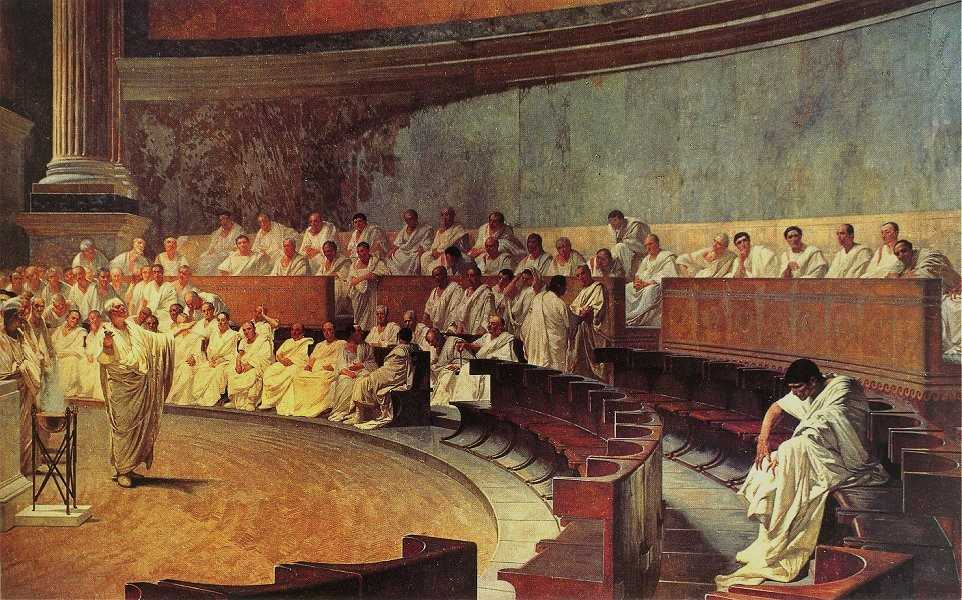
He mastered the techniques of his day, which were passed down from Ancient Greek, most notably Thucydides’s Funeral Oration of Pericles. It is impossible to know whether Pericles himself actually composed the speech in the form in which Thucydides records it, or Thucydides actually composed some or most of it in his own style. It is very complicated Greek, but very rewarding to the rhetoric student, as Cicero showed amply in his famous Catilinarian Orations, a series of speeches made in the Roman Senate to denounce and vilify Lucius Catilina, a corrupt senator who tried to overthrow the Roman Republic. Cicero actually succeeded in ousting Catilina from power, ultimately resulting in Catilina’s death in a rebellion. Cicero did this solely by means of his prose mastery.
Here is an excerpt, from his First Catlinarian Oration:
“Just how long, O Catiline, do you intend to abuse our patience? How long is that madness of yours still to mock us? When is there to be an end of this unbridled audacity of yours, swaggering about as it does now? Do not the night guards set on the Palatine Hill — do not the watches posted throughout the city—does not the alarm of the people, and the union of all good men — does not the precaution taken of assembling the senate in this most defensible place — do not the looks and countenances of this venerable body here present, have any effect on you? Do you not feel that your plans are detected? Do you not see that your conspiracy is already stopped and made powerless by the knowledge which every one here possesses of it? What is there that you did last night, what the night before — where is it that you were — who was there that you summoned to meet you — what design was there which was adopted by you, with which you think that any one of us is unacquainted?”
Further Reading: Cicero: The Life and Times of Rome’s Greatest Politician

6
Geometry
Archimedes
Runners-up: Euclid, Rene Descartes.
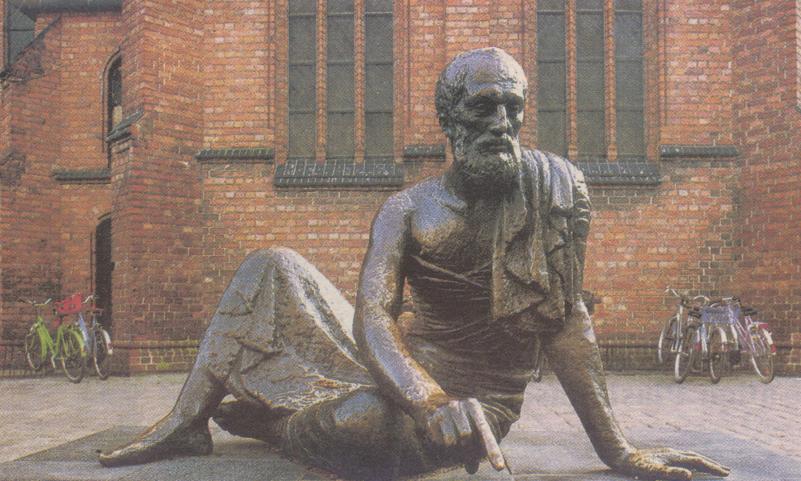
Archimedes is typically in the top four of history’s mathematicians, but it was his practical applications of geometry that will make his name last forever. He invented the Armichedes Screw, which is still an efficient means of carrying water from a low place to a high place quickly. It’s simply an inclined plane inside a tube. One end of the tube is set in the water, and the tube is leaned against something. Turn the tube and the water rises on the inclined plane to the other end and out. He told his employer, the king of Syracuse, “Make me a screw long enough and I’ll empty the ocean.”
The king of Syracuse, which was a walled city on the shore of Sicily, employed him to make the city safe from siege, and he did this by drawing up plans for various machines, notably a huge ballista that could fire 1,000 arrows at once through small slits in the walls. It could devastate an entire regiment approaching the walls. He designed larger and larger catapults to hurl larger and larger stones farther. His most famous inventions, all based on geometry, are his Claw and “Heat Ray.” The claw was a device he envisioned to swing out from the top of a wall, into the side of a wooden ship attacking the harbor. The claw would puncture the ship, then men would hoist it up by means of a huge lever, and overturn the ship, or even upend it, and sink it in a matter of minutes. He told his king, “You give me a lever long enough and I’ll move the earth.”
The Heat Ray was simply a line of soldiers with highly polished shields angled to catch the sunlight and direct it to an enemy ship in the harbor. One shield’s reflection of the sunlight was insufficient to cause wood to burn, but 100 of them magnified the sun’s heat 100 times into a small spot, and did indeed, cause the ships to reach their flashpoints, bursting into flames where they floated.
He mastered the geometric mechanics of the simple machines. He roped up a system of about 50 pulleys of various sizes, some as small as a hand, some as large as an SUV tire, then tied one end of the rope to one of the king’s galleys, a huge ship, and wrapped the other end in his hands, and proceeded to pull the entire ship out of the harbor onto the ground by himself. The pulleys lessened the weight.
He discovered hydraulics when he got into his bath one night and the water overflowed the tub. He saw that the amount of water displaced equaled his weight and ran screaming naked through the streets, “Eureka! Eureka!” which means, “I have found it! I have found it!” This discovery enabled him to measure the volume and density of an irregular object, such as the king’s crown, by submerging it in water, and measuring the amount displaced.
The story of his death goes that he was so engrossed in his geometrical experiments and drawings that while the siege of Syracuse was going on, a Roman soldier shouted to him to freeze in the street. He was carrying an armload of his gadgets and looked like a looter. He ignored the soldier, and the soldier stabbed him to death. His last words are said to have been, “Don’t disturb my diagrams.” He had been drawing them in the dirt. Marcellus, the Roman general, gave strict orders that he was to be spared, because he respected himso much. He lamented during the siege, “I have 10,000 men. They have Archimedes.”
Further Reading: Archimedes and the Door of Science

5
Modern Physics
Albert Einstein
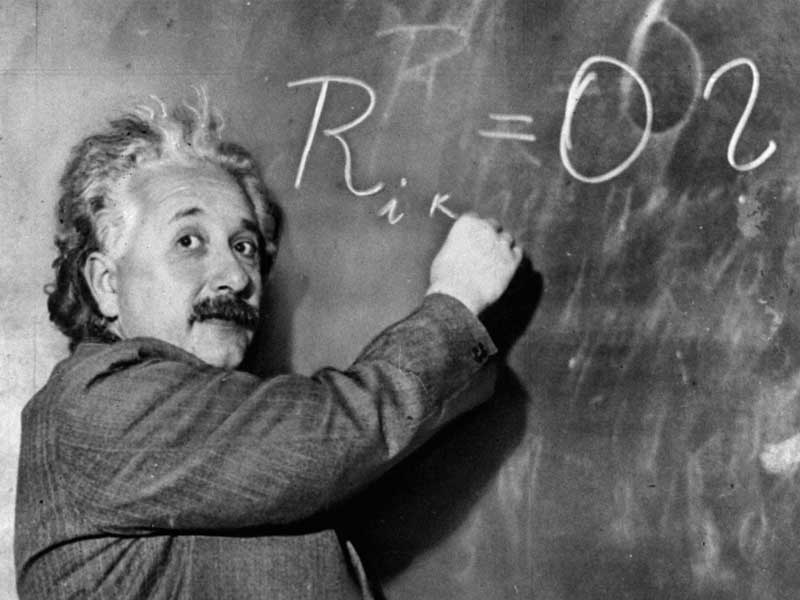
Runners-up: Christiaan Huyghens, #2 on this list, Max Planck, Niels Bohr.
Einstein has become a byword for genius. He, along with Archimedes, is one of the four greatest mathematicians of all time. He revolutionized physics in all its fields, from nuclear physics to quantum physics, to thermodynamics, and of course, relativity. He discovered that when you deal with something as gigantic as the Universe, strange things are going to happen with time itself. He theorized that time and space are themselves inseparable, and act together as a sort of fabric, that stretches and distorts the same way that a piece of cloth does when stretched tight and objects are placed on it. The heavier the object, the deeper the impression. It works the same with gravity and the void of space. Time itself slow down when passing through any gravitational field. Usually the difference is negligible, but this is a serious matter when concerning black holes. Time itself stops when entering a black hole.
To his contemporaries, Einstein sounded like he was off his rocker. Not only was he rewriting the established physics of the last 300 years, he was actually predicting specific events based solely on the equations he scribbled out on paper. His physics stated that light itself bends when encountering gravity, and this was something the scientific world could and intended to prove. An upcoming solar eclipse on November 7, 1919, would be the perfect chance. And Einstein was right. The light from a star bent noticeably as it passed around the edge of the sun’s coronal disk during the eclipse. This remains one of the very rare times when physics has predicted anything specific and measurable, and more astoundingly, when that prediction was proven correct.
Einstein worked on everything in the realm of physics, including a Unified Field Theory, which is a theory of everything. It would explain, most importantly, the interaction of the four forces of the Universe at the moment of the Big Bang, and even before that moment, thus before time itself was begun. Scientists still haven’t cracked the theory, but Einstein is the man who has gotten us closer to the solution than anyone.
Further Reading: Einstein: His Life and Universe

4
Literature
William Shakespeare
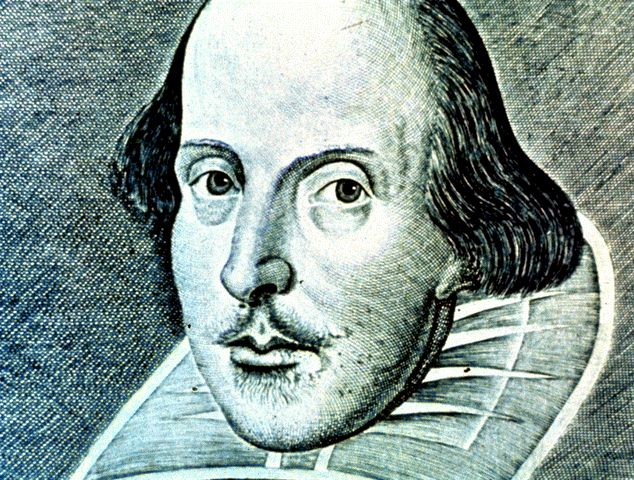
Runners-up: Homer, Dante Alighieri, Cervantes
Very few people can claim universal mastery throughout the world in one discipline. Literature isn’t even one discipline. Poetry, prose, fiction, non-fiction, literature is comprised of many subcategories that each have their masters, and these masteries do not frequently overlap. Shakespeare, however, is almost universally acknowledged as the absolute master of drama, dramatic poetry, sonnets, fiction, and dramatic non-fiction. He has been translated into more languages than any other writer of anything in history (unless you count God as a writer). Everyone wants to see the master at work, to see how he does it. What makes Shakespeare so great?
His works have an overriding tone of cynicism. He always deals with human foibles, and his works give the audience the sense that humans are, beneath it all, really pathetic. There are no flawless heroes in his works, because there are none in life, as he saw it. There are plenty of villains. His tragedies always end with all or almost all of the main characters dead by one another’s hand. They always fall apart from within, brought down by human weaknesses. His comedies are actually a lot of the same, except that in the end, all or almost all of the main characters get married. His comedies have been called the first modern sitcoms, in which the characters hurl lighthearted insults at each other.
And no matter how well you frame the plot in your next short story or novel, no matter how bizarre, how unique, you make your characters, Shakespeare did it before you. He might not have been the first to do anything, but he modernized drama more than any other writer. And that’s not to mention the philosophy inherent in his sonnets, which are, besides the content, the premiere closed-form poetry canon in English. His works are quoted, performed, and parodied more often than those of any other writer, and this is especially impressive given that they’re 450 years old. His two most powerful tragedies, Hamlet and King Lear, are more than just drama and poetry. They’re in-depth, psychological analyses of the minds of those suffering mental and emotional anguish, and how they cope with it.
Further Reading: Shakespeare: The Biography

3
Philosophy
Aristotle
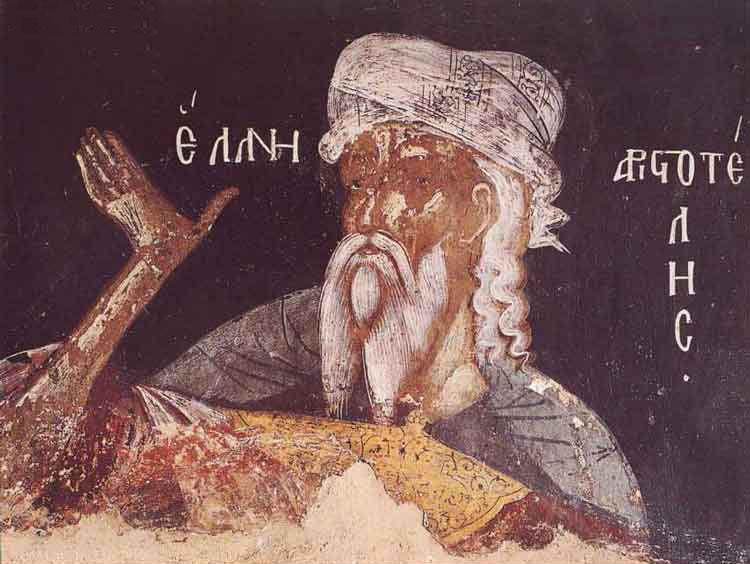
Runners-up: Socrates, Plato
Even today, after such great minds as Immanuel Kant, Friedrich Nietzsche, Hume, Descartes, et al., all modern philosophy is founded on the principles and methods of Aristotle. He learned from Plato, who learned from Socrates, the three greats of the ancient world, but Aristotle’s legacy is that he constructed theories on everything from biology to ethics, logic, politics, poetry and physics. He was the first to distinguish aquatic mammals, such as whales and dolphins, from fish. He was the first to describe the hectocotyl arm of the cephalopod. There many kinds of cephalopods, namely the octopus and squid, but also many species that live in shells. Most of them have a hectocotyl arm, which is a combination tentacle and penis, housing the spermatophores, and inserted into the female then broken off. The male grows a new one about every season. It was not rediscovered until the 1800s, and it was tracked down by biologists reading Aristotle’s description of it. They couldn’t believe that he was right about what it does.
He practically invented the scientific method, which has hardly changed at all throughout the last 2,300 years.
Aristotle was the first to systematize logic into a formal study, and Kant noted his work as the core of all deductive reasoning. If you have ever deduced anything, and you have, you have used a method Aristotle was the first to formalize. On the subject of ethics, he argued quite reasonably that the human being should work to make itself happy, since in so doing it would fulfill nature’s goal in creating it. And the highest form of happiness, he argued, was to learn, since that is what humans do most naturally. In so learning, humans will inevitably become the best that nature has intended of them, wise and good.
He argued that the intent of any political system should be to provide the best possible well-being for the public. In his opinion, there were 3 basic kinds of political systems: a constitutional government, an aristocracy, and a kingdom or empire. Because of the nature of humans to devolve in everything, these three forms would “pervert” into a democracy, an oligarchy, and a tyranny, respectively. Thus, he argued, the constitutional government is the best choice, and the one every political state should choose. Modern democracies have progressed very little beyond Aristotle’s vision of what one should be.
Further Reading: Aristotle for Everybody

2
Mathematics
Sir Isaac Newton
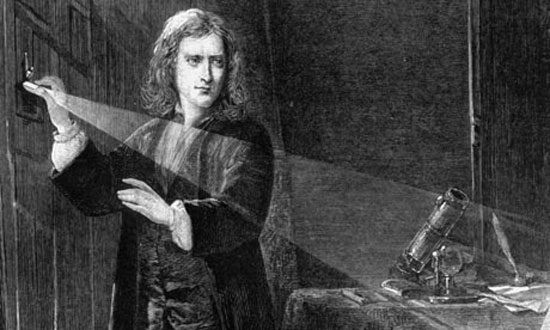
Runners-up: #6 on this list, Carl Friedrich Gauss, #5 on this list.
If humankind ever sets foot on another planet with a species of comparable or superior intelligence, we will do so not in the name of God, or peace, but in the name of Isaac Newton. He discovered and methodized classical mechanics, with which the world worked on almost all scientific problems for the next 300 years, until Einstein finally modernized his theories and laws. He invented the reflecting telescope, which uses mirrors instead of lenses. He also invented the modern concept of the car, except for the engine. His design, which he made for fun when he was about 13, had a wood chassis, four wood wheels on two axles, all connected to the steering shaft. The steering wheel was a solid wood disk that turned all four wheels, enabling the car to travel sideways as well as forward and backward. The car was powered by a very strong spring that unwound over the course of an hour, enabling him to drive from his mother’s country home into nearby Woolsthorpe and Colsterworth, two small villages. It traveled about 10 mph.
His contributions to the fields of physics, mathematics, science, and even theology are beyond belief. Mathematicians today call him “Superman.” During 18 months, 1665-6, he asked himself the question on every scientist’s mind at the time, “What in the world is holding the moon up in the sky? Why isn’t it falling to Earth right now?” He used all the mathematics of the day to address this problem, discovering the generalized binomial theorem in the process. Then the mathematics no longer made any sense with the material he was working with. So he effectively invented differential and integral calculus to keep on the trail of the solution. In the end, he succeeded, and discovered the law of universal gravitation, and the 3 universal laws of motion, also known as Newton’s Laws. All this at the age of 23. Modern mathematicians still regard it as superhuman.
First Law: An object in motion will stay in motion, unless an outside force acts upon it.
Second Law: A body will accelerate with acceleration proportional to the force and inversely proportional to the mass.
Third Law: Every action has a reaction equal in magnitude and opposite in direction.
These 3 laws laid the groundwork for all physics until Einstein, whose relativity theories allow for more fine-tuned, microscopic examinations. Newton also postulated a theory of colors, stating that objects do not possess color of themselves, but are acted upon by the colors innate in light, which can be separated and integrated with a prism. This is how he came up with the idea for the reflecting telescope. Gottfried Leibniz also discovered the differential and integral calculus about the same time, independently, and gave it its name, whereas Newton called it “the method of fluxions and fluents.” It can be said that Leibiz discovered infinitesimal calculus, but just to satisfy his curiosity of what it could do; Newton invented it, for the express purpose of solving a problem he was working on.
Newton distinctly advanced every single branch of mathematics in use today.
Further Reading: Isaac Newton

1
Music
Johann Sebastian Bach
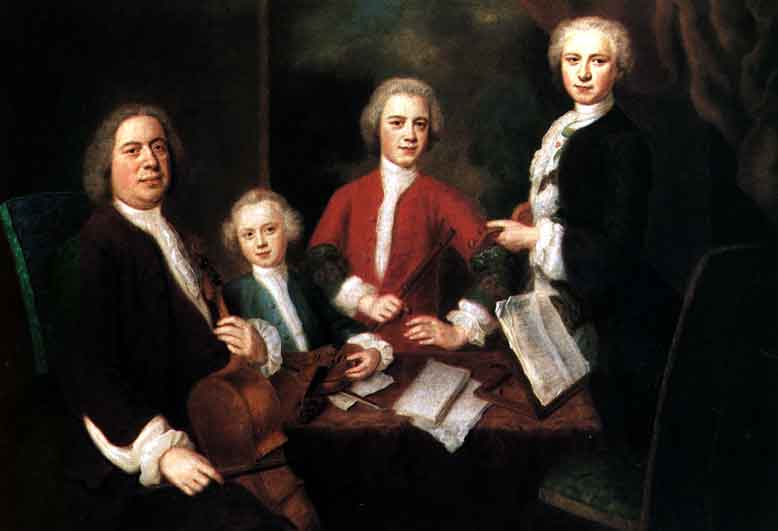
Runners-up: Palestrina, Renaissance Music; Wolfgang Amadeus Mozart, Classical music; Ludwig van Beethoven, Romantic music.
This lister wrote another list, solely of composers, which Bach crowned. He is not intended to crown this one. The ten field of this list are independent and unranked with regard to importance.
Bach is one of only two people who managed to perfect an entire system of liberal arts. His system was Baroque music, which began long before he was born. By the time he reached his creative pinnacle, Baroque was going out of style because most of his contemporaries considered it to have been exhausted.
Bach proved them wrong, even if they did not admit it. History has borne him out as the perfecter of the Baroque style of music. He did not invent any new forms, whereas Franz Joseph Haydn virtually invented the modern symphony. But Bach wrote absolute masterpieces in every form of his day: fugue, sonata, cantata, concerto grosso, mass, sinfonia (the precursor to the symphony), etc.
He was the first to devise a system for tuning any keyboard instrument, especially the harpsichord, and its variants. His Well-Tempered Clavier is two books of 24 preludes and fugues each, in all the major and minor scales, and he intended one of these to be played before a performance, in order to tune the keyboard. By using music, the ear is able to discern harmonics and thus a context of each tone, without which, the performer may tighten a string until it pops.
No one before or since has been able to compose contrapuntal music (two or more melodies harmonizing with one another) so frequently, so monumentally, with such grandeur, complexity, richness, and technical brilliance as Bach composed. He could improvise fugues for 2 hours at a stretch at the organ. He would sometime write them down afterward from memory.
He understood contrapuntal music as intimately, as naturally, as Newton understood mathematics, or Aristotle understood logic.
Further Reading: Johann Sebastian Bach: The Learned Musician

+
Theology
St Thomas Aquinas
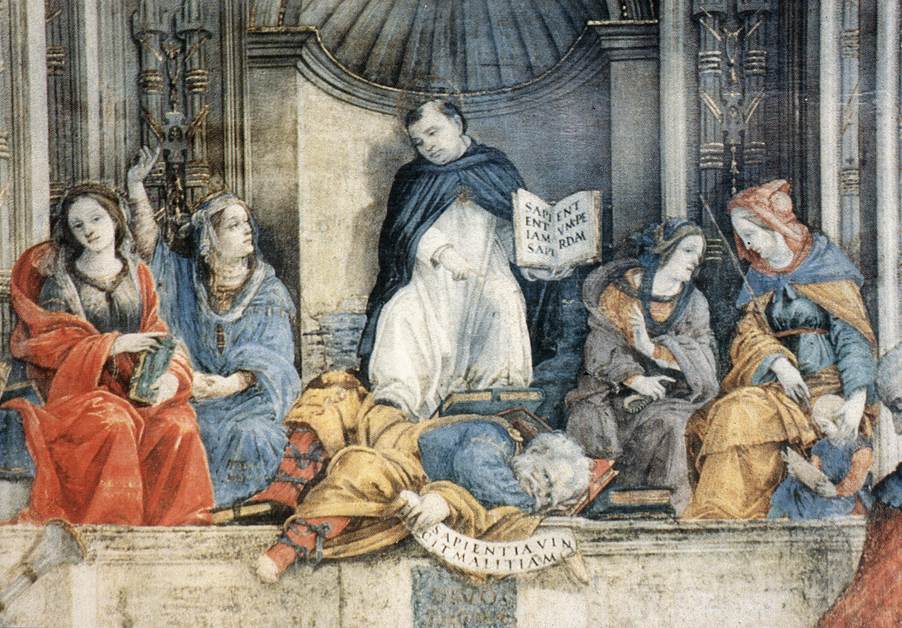
Runners-up: St Augustine, St Albert Magnus (St Thomas’ teacher)
Theology is the study of God through divine revelation (as opposed to metaphysics which is the study of God according to natural reason). St Thomas Aquinas was a Dominican priest in the 13th century who was, ironically, called “The Dumb Ox”. But during the course of his career as a teacher it became increasingly clear that he was anything BUT a dumb ox. St Thomas was the first man to successfully unite faith and reason using Aristotle as a starting point (as opposed to some like the Muslim scholar Averroes who failed in his attempt and came up with a theology that gave a twofold “truth” – one for matters of faith, and another for matters of philosophy; St Thomas combined the two completely without contradiction).
St Thomas’ most famous theological work is the Summa Theologica – a five volume set of questions and answers on all matters of faith. Based strongly on the principles of Aristotle and formal logic, the summa is a water-tight exposition of everything you could want to know about the world beyond this. Some of the subjects dealt with are whether animals have souls, the manner in which the bodily “resurrection of the dead” will take place, and a variety of topics relating to justice (whether lying is a sin, etc).
The impact St Thomas had on the world was far greater than any theologian before him. He became known as the “Angelic Doctor” – a far cry from the dumb ox – and his writings were all but canonized with virtually all Popes after his time requiring that St Thomas’ writings be the foundation of seminary study for all priests – this is still the case today in all Catholic seminaries in obedience to Rome.
Further Reading: Saint Thomas Aquinas: The Dumb Ox

More Great Lists
 Top 10 Fascinating Facts About Magnetic Fields
 8 Alien Abductions That Suggest Underwater Alien Activity
 Top 10 Stomach-Churning Recipes For Human Flesh
 Top 10 Bizarre Abilities Of Human Vision
 Top 10 Fascinating Feats Of The Human Voice
 Top 10 Times A Monkey Took A Human Life
 Top 10 Gross Things About The Human Body
 Top 10 Horrifying Uses Of Human Branding 2020
 Top 10 Complex Human Languages - 2020
fact checked by
Alex Hanton
More Great Lists