Paradoxes have been around since the time of Ancient Greeks & the credit of popularizing them goes to recent logicians. Using logic you can usually find a fatal flaw in the paradox which shows why the seemingly impossible is either possible or the entire paradox is built on flawed thinking. Can you all work out the problems in each of the 11 paradoxes shown here? If you do, post your solutions or the fallacies in the comments.
The paradox states that if the being can perform such actions, then it can limit its own ability to perform actions and hence it cannot perform all actions, yet, on the other hand, if it cannot limit its own actions, then that is—straight off—something it cannot do. This seems to imply that an omnipotent being’s ability to limit itself necessarily means that it will, indeed, limit itself. This paradox is often formulated in terms of the God of the Abrahamic religions, though this is not a requirement. One version of the omnipotence paradox is the so-called paradox of the stone: “Could an omnipotent being create a stone so heavy that even that being could not lift it?” If so, then it seems that the being could cease to be omnipotent; if not, it seems that the being was not omnipotent to begin with. An answer to the paradox is that having a weakness, such as a stone he cannot lift, does not fall under omnipotence, since the definition of omnipotence implies having no weaknesses.
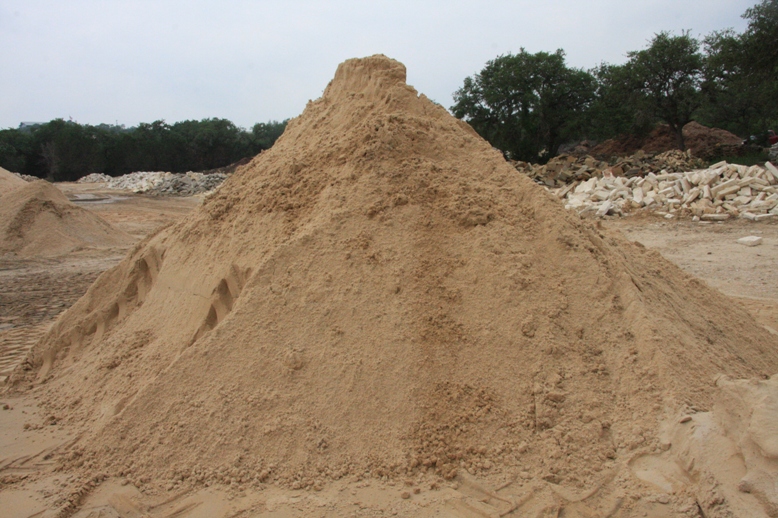
The paradox goes as follows: consider a heap of sand from which grains are individually removed. One might construct the argument, using premises, as follows:
1,000,000 grains of sand is a heap of sand. (Premise 1)
A heap of sand minus one grain is still a heap. (Premise 2)
Repeated applications of Premise 2 (each time starting with one less grain), eventually forces one to accept the conclusion that a heap may be composed of just one grain of sand.
On the face of it, there are some ways to avoid this conclusion. One may object to the first premise by denying 1,000,000 grains of sand makes a heap. But 1,000,000 is just an arbitrarily large number, and the argument will go through with any such number. So the response must deny outright that there are such things as heaps. Peter Unger defends this solution. Alternatively, one may object to the second premise by stating that it is not true for all collections of grains that removing one grain from it still makes a heap. Or one may accept the conclusion by insisting that a heap of sand can be composed of just one grain.
Claim: There is no such thing as an uninteresting natural number.
Proof by Contradiction: Assume that you have a non-empty set of natural numbers that are not interesting. Due to the well-ordered property of the natural numbers, there must be some smallest number in the set of not interesting numbers. Being the smallest number of a set one might consider not interesting makes that number interesting. Since the numbers in this set were defined as not interesting, we have reached a contradiction because this smallest number cannot be both interesting and uninteresting. Therefore the set of uninteresting numbers must be empty, proving there is no such thing as an uninteresting number.
In the arrow paradox, Zeno states that for motion to be occurring, an object must change the position which it occupies. He gives an example of an arrow in flight. He states that in any one instant of time, for the arrow to be moving it must either move to where it is, or it must move to where it is not. It cannot move to where it is not, because this is a single instant, and it cannot move to where it is because it is already there. In other words, in any instant of time there is no motion occurring, because an instant is a snapshot. Therefore, if it cannot move in a single instant it cannot move in any instant, making any motion impossible. This paradox is also known as the fletcher’s paradox—a fletcher being a maker of arrows.
Whereas the first two paradoxes presented divide space, this paradox starts by dividing time – and not into segments, but into points.
In the paradox of Achilles and the Tortoise, Achilles is in a footrace with the tortoise. Achilles allows the tortoise a head start of 100 feet. If we suppose that each racer starts running at some constant speed (one very fast and one very slow), then after some finite time, Achilles will have run 100 feet, bringing him to the tortoise’s starting point. During this time, the tortoise has run a much shorter distance, say, 10 feet. It will then take Achilles some further time to run that distance, by which time the tortoise will have advanced farther; and then more time still to reach this third point, while the tortoise moves ahead. Thus, whenever Achilles reaches somewhere the tortoise has been, he still has farther to go. Therefore, because there are an infinite number of points Achilles must reach where the tortoise has already been, he can never overtake the tortoise. Of course, simple experience tells us that Achilles will be able to overtake the tortoise, which is why this is a paradox.
[JFrater: I will point out the problem with this paradox to give you all an idea of how the others might be wrong: in physical reality it is impossible to transverse the infinite - how can you get from one point in infinity to another without crossing an infinity of points? You can't - thus it is impossible. But in mathematics it is not. This paradox shows us how mathematics may appear to prove something - but in reality, it fails. So the problem with this paradox is that it is applying mathematical rules to a non-mathematical situation. This makes it invalid.]
This is a figurative description of a man of indecision. It refers to a paradoxical situation wherein an ass, placed exactly in the middle between two stacks of hay of equal size and quality, will starve to death since it cannot make any rational decision to start eating one rather than the other. The paradox is named after the 14th century French philosopher Jean Buridan. The paradox was not originated by Buridan himself. It is first found in Aristotle’s De Caelo, where Aristotle mentions an example of a man who remains unmoved because he is as hungry as he is thirsty and is positioned exactly between food and drink. Later writers satirised this view in terms of an ass who, confronted by two equally desirable and accessible bales of hay, must necessarily starve while pondering a decision.
A judge tells a condemned prisoner that he will be hanged at noon on one weekday in the following week, but that the execution will be a surprise to the prisoner. He will not know the day of the hanging until the executioner knocks on his cell door at noon that day. Having reflected on his sentence, the prisoner draws the conclusion that he will escape from the hanging. His reasoning is in several parts. He begins by concluding that the “surprise hanging” can’t be on a Friday, as if he hasn’t been hanged by Thursday, there is only one day left – and so it won’t be a surprise if he’s hanged on a Friday. Since the judge’s sentence stipulated that the hanging would be a surprise to him, he concludes it cannot occur on Friday. He then reasons that the surprise hanging cannot be on Thursday either, because Friday has already been eliminated and if he hasn’t been hanged by Wednesday night, the hanging must occur on Thursday, making a Thursday hanging not a surprise either. By similar reasoning he concludes that the hanging can also not occur on Wednesday, Tuesday or Monday. Joyfully he retires to his cell confident that the hanging will not occur at all. The next week, the executioner knocks on the prisoner’s door at noon on Wednesday — which, despite all the above, will still be an utter surprise to him. Everything the judge said has come true.
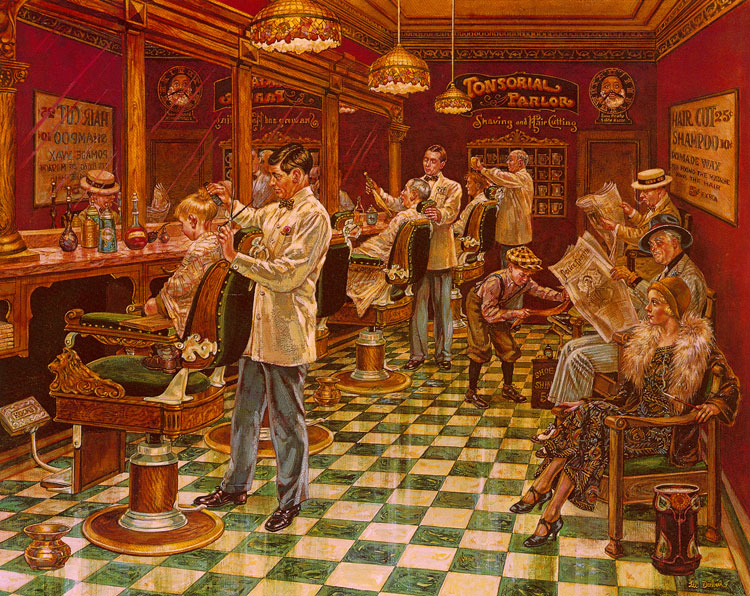
Suppose there is a town with just one male barber; and that every man in the town keeps himself clean-shaven: some by shaving themselves, some by attending the barber. It seems reasonable to imagine that the barber obeys the following rule: He shaves all and only those men in town who do not shave themselves.
Under this scenario, we can ask the following question: Does the barber shave himself?
Asking this, however, we discover that the situation presented is in fact impossible:
- If the barber does not shave himself, he must abide by the rule and shave himself.
- If he does shave himself, according to the rule he will not shave himself
This paradox arises from the statement in which Epimenides, against the general sentiment of Crete, proposed that Zeus was immortal, as in the following poem:
They fashioned a tomb for thee, O holy and high one
The Cretans, always liars, evil beasts, idle bellies!
But thou art not dead: thou livest and abidest forever,
For in thee we live and move and have our being.
He was, however, unaware that, by calling all Cretens liars, he had, unintentionally, called himself one, even though what he ‘meant’ was all Cretens except himself. Thus arises the paradox that if all Cretens are liars, he is also one, & if he is a liar, then all Cretens are truthful. So, if all Cretens are truthful, then he himself is speaking the truth & if he is speaking the truth, all Cretens are liars. Thus continues the infinite regression.
The Paradox of the Court is a very old problem in logic stemming from ancient Greece. It is said that the famous sophist Protagoras took on a pupil, Euathlus, on the understanding that the student pay Protagoras for his instruction after he had won his first case (in some versions: if and only if Euathlus wins his first court case). Some accounts claim that Protagoras demanded his money as soon as Euathlus completed his education; others say that Protagoras waited until it was obvious that Euathlus was making no effort to take on clients and still others assert that Euathlus made a genuine attempt but that no clients ever came. In any case, Protagoras decided to sue Euathlus for the amount owed.
Protagoras argued that if he won the case he would be paid his money. If Euathlus won the case, Protagoras would still be paid according to the original contract, because Euathlus would have won his first case.
Euathlus, however, claimed that if he won then by the court’s decision he would not have to pay Protagoras. If on the other hand Protagoras won then Euathlus would still not have won a case and therefore not be obliged to pay. The question is: which of the two men is in the right?
The Irresistible force paradox, also the unstoppable force paradox, is a classic paradox formulated as “What happens when an irresistible force meets an immovable object?” The paradox should be understood as an exercise in logic, not as the postulation of a possible reality. According to modern scientific understanding, no force is completely irresistible, and there are no immovable objects and cannot be any, as even a minuscule force will cause a slight acceleration on an object of any mass. An immovable object would have to have an inertia that was infinite and therefore infinite mass. Such an object would collapse under its own gravity and create a singularity. An unstoppable force would require infinite energy, which does not exist in a finite universe.
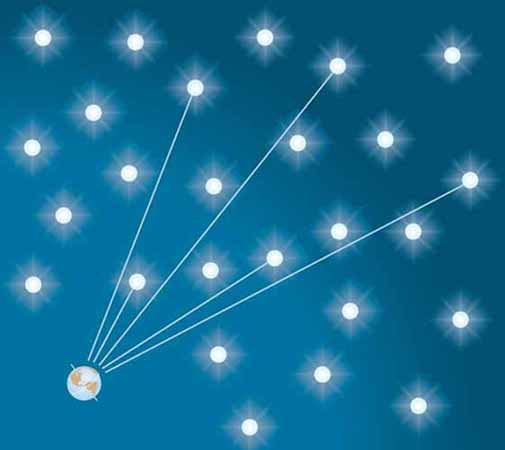
In astrophysics and physical cosmology, Olbers’ paradox is the argument that the darkness of the night sky conflicts with the assumption of an infinite and eternal static universe. It is one of the pieces of evidence for a non-static universe such as the current Big Bang model. The argument is also referred to as the “dark night sky paradox” The paradox states that at any angle from the earth the sight line will end at the surface of a star. To understand this we compare it to standing in a forest of white trees. If at any point the vision of the observer ended at the surface of a tree, wouldn’t the observer only see white? This contradicts the darkness of the night sky and leads many to wonder why we do not see only light from stars in the night sky.
Text is available under the Creative Commons Attribution-ShareAlike License; additional terms may apply. Text is derived from Wikipedia.




i love this list, *except* for the entrys that are semantically misleading — those few that just seem to be written in an arguminative manner to throw us off — i hate those.
Which ones did you find semantically misleading? Just wanted to read them and see exactly what you mean.
its all of them — but each in their own unique way — so where some appear to be clever, some appear smart-assy, and some confusing — will be different for different interpretations
im not sure that youll see exactly what i mean, because the nature of what i said requires some amount of personal interpretation. even as i wrote that comment, i imagined other people would relate, but perhaps would have different interpretations
start with 11, 10, 8, and 5
this intensedebate software is still chopping some of my comments up, so for the sake of continuity, ill give you a few examples, as you are reading……….check back
just for the record — good job raul — youve already got people thinking
— nice list
ok—-let me start with the sand one–
raul lays out a fine set of deductive logic premeses — a million grains of sand is a heap. great. now, take one away 999,999 grains of sand is a heap. fine. keep going with this and 1 grain of sand will be a heap. no nonono.
semantical ambiguity here — we havnt defined heap.
this works with other ambiguous units of measurments — if i have a carton of cigarettes, i have 200……if i have 171, i have 8 packs, and 11 looseys. if i have a pile of cigarettes, and i smoke one, i still have a pile.
a pile is like a heap
only semantically misleading is you take it to the point of raul's example, because if you have one grain of sand, you have a grain of sand, not a heap. hell 19 grains of sand isnt really a heap either, based on the connotation of the word heap — but where does it change to being an acceptable representation of the word?
I thought that was exactly the point of the paradox. There is no one point that a heap becomes less than a heap- i.e there is no amount at which a heap becomes a pile or a pile becomes a mound. Obviously one grain of sand is not a heap, but when taking away one grain of sand at a time you cannot decide a specific point at which it changed from a heap to not a heap.
I hope that makes sense.
I would define a heap as too many to count at a glance. If you could count it at a glance then you wouldn't call it a heap, you would simply say how many there are. By that logic it would cease to be a heap at the moment you could tell how many there are by simply looking at them. It could also mean that when you know the number it ceases to be a heap meaning that it ceases to be a heap when you know there are a million grains of sand.
im not totally sure i could look at 23 grains of sand, and count them at a glance. i do believe i could look at 23 dead bodies, and count them at a glance. this is a whole different can of worms, because now, 23 is a heap *of some things*, but not others. in addition to that, even though i couldnt count 23 grains of sand, i wouldnt consider it a heap — 23 bodies, on the other hand, just may be a heap. now it starts to become individualistic as to what gets characterized as what, and why.
thats actually why these paradoxes are so thought provoking.
The reasoning is great, keep it up guys and Raul achieved his goal with the list. But why did you use dead bodies as an example?!?
Lol, very interesting…
way ahead of ya
and yep — love it love it
so many different reasons different people like different lists…….
and the dead body comment?
i had been watching snatch, and that scene was on when brick top was talking to turkish in the pig sty — as i was writing the message, the monologue about removing the teeth and hair from a dead body before disposing of it by feeding it to the pigs, who can devour an entire body quick — telling statham that teeth and hair or nails (or whatever it was) are undigestable
"of course you dont have to remove them, but you don't wanna go sifting through pig *****, now do ya?"
and i thought — great example
either that or a fascination with working dead bodies into an *****ogy at least once a week
take your pick
i sent 2 or 3 examples….i think the other/s is/are held up in moderation…..as for this one, im looking at it backwards from the way you are. the paradox seems to preassume that a heap is a definable measure. where you say there is no amount at which a heap becomes a pile, then my question to you is: why are we trying to quantify these abstract measurments?
what you said makes perfect sense. but so does this: i have ten amounts of sand on my porch, the smallest consists of 1 grain, the largest consists of 999,999 of them. how many piles do i have?
cont'd……………………….
……………………cont'd
the paradox is mostly in semantics itself. i think i have 7 heaps, and you say i have 5. why are we of differing opinions, and what causes me to see 1000 grains as a heap, but disallows you to see that as anything other than a mound. some of these paradoxes cease to occur if you quantify the measurments — which is why, when i take you to the back porch, and i have ten different amounts of eggs, you can readily identify them as a pair, a dozen, a baker's dozen, and a gross of eggs etc., the thing is, out of the 11 examples, some are explained succintly, whereas others are shrouded in undefinable and abstract semantic terms.
I took the the meaning the same way that trinity did. But here was what what I was wondering. If you accept that the grains of sand will eventually end at one and you haven't at any point stopped calling the heap, a heap, then would each little grain removed be considered a heap?
being a heap or not has more to do with it’s apparent structure , i.e how to grains of sand are group together to form a mound than anything else. you wouldn’t call a million grain of sand laid out flat on a surface a heap would you, like in the case of a beach? The definining point at which it cease to be a heap would be when the amount of sand is reduced tp a point that it could no longer form a triangular structure and this point differs between the type of sands and is dependent on various factors like humidity.
JFrater's comments on Achilles and Tortoise were utterly misleading because they were completely wrong and demonstrated a complete lack of comprehension regarding the paradox. It is a mathematical problem. It makes perfect sense when formulated mathematically. I just doesn't make sense if you are duped into thinking about it non-mathematically. The problem is the ridiculous assumption that in the time it takes for achilles to reach the point where the tortoise was, the tortoise would still be ahead of him! This algorithm would find the point at which they cross, and has nothing to do with finding the relative distances they have travelled in a given time frame.
If you say or even think you're an open minded person, you create a prejudice of your own freedom of though, which is a paradox.
That's dope.
right — of course, if you think youre closeminded, you create an antiprejudice of your own lack of freedom of thought,
it is here, where we have entered the realm of loophole jumping, where it becomes possible to justify almost anything — to the limits of mediocraty — sufficiently, but impossible to delve to depths of certain capacities due to inherent esotericism surrounding deeper *****ysis and idea construction.
that's dope as *****, true dat
also, the grain of sand heap thing is a load of crap. It obviously just depends on what your definition of a 'heap' is. For example, my definition of a heap is the shape. If it is no 'heaped' (e.g. was flat) it would not be a heap. The number of grains is fairly irrelevant. In my definition the miniumum to be a heap would be the minimum you can stack to still make a heap shape. What's your definition of a heap? As soon as you know what it is, there is no paradox. rubbish.
5 (hanging) is also rubbish because obviously his logic only applied to the Friday yet he tried to apply it to all the other days … this isn't a paradox, this is a standard format for jokes. This is a joke not a paradox (literally).
Olber's paradox … has paradox in the name because historically it was believed that the universe is infinite. So the resolution is: the universe isn't infinite … well, there's a surprise for everyone born in this century!!
MY BRAAAAIN!!
I thought I would be the first to post a comment, but then I thought that even if I dont, this still would be me first post for this list. And then, the second one posting after me would feel the same, extending to infinity. The truth may however be, that _)(#)($_LJLJDFLJ@#*(!()@_#()!_@#()!@(#_)!(CJLKJ
oh what a nice list. It hurts my brain.
I think I just had a subdural hematoma. O_O
Very interesting list though.
Fantastic list. As to number 6, I have a mental fix since we do encounter this paradox in everyday life.
Do I go right, left or straight ahead?
Many of us can't decide and resort to flipping a coin or something to force an action.
I encountered it young while playing videogames.
You're running through caves in a game and they fork. which way do you go?
My answer is left. Always go left first, explore what is to be found then turn around and take the next left, thereby going everywhere.
Actually it's more like "follow the left wall."
that will also get you out of a maze.
I always go the way I think will end in a dead end. There is usually something to signal this near the beginning of the tunnel but if there isn't any in the first tunnel then I head down the second one given that when I travel down the second one I either see something that implies it's a dead end or it doesn't and then I can't be bothered to try the second one again.
except if you find the end of the cave before having seen all of the cave, so if there is another way out from the cave, then it is locically impossible for you to have seen all of the cave…;-)
Very interesting and confusing at the same list! Good job 7raul7.
Alot of think thinking involved in this list well done . Only ever heard of the bonus in a physics book once . However not my cup of tea . Find the subject boring ( i'm probly just too dumb and lazy though) Think this is definatly up JFraters alley .
Oh cool list…
nice one again!:)
One of the best.haha
Nie list! I suppose you could also say for the unstoppable force paradox that if the universe contains an unstoppable force then by definition it cannot also contain an immovable object or else the force could not be defined as unstoppable. The two terms are mutually exclusive. Just saying.
Really interesting. Took me a couple of seconds and maybe a re-read to get some of them, but I liked it- tax my brain more please!
For the Buridan’s ass paradox, if the two piles are the same then just start with any pile, or each one bite from one then from another. Why would you starve to death thinking about which one to eat? I mean if you are starving, presumably your aim would be to feed yourself, and not think about "how best" to feed yourself (that's only something you think about when you are not that hungry, and hence is able to think about other things), so it wouldn't matter which pile you eat from, whether they're bigger or smaller etc. as long as it can fill you right? Or maybe I think in too simplistic a manner.
Ouch, I think I just sprained my brain. Nice list though
I agree with you. This paradox seems to only work for completely logical beings and no living being is completely logical. If a computer faced this problem however (and didn't have a failsafe built into it to circumvent such a dilemma) then I'm pretty sure it would be stuck like that forever. I'm guessing this paradox was popularized by those that favored the idea that the man worked like a machine circa 1748.
I read an account once of a man who was "too logical". This was real, he was in an accident or had a brain tumor. Anyway, it actually look him ages to make simple decisions, like picking a breakfast cereal. There is a podcast that has a section about him at Radiolab NYC.
isnt there an iphone app for that?
the decision between coco pebbles and count chocula shouldnt ever be that hard.
do i want marshmelllows or no marshmellows? where the hell is my fone?!?
The second paradox is that a completely logical being would think "hmm, probably best I don't starve to death here" and start munching on either pile.
The logical thing is to stop thinking about logic
think of the piles as a kind of sweet that you can only eat one of , when you have eaten that sweet then you are full. if you equally want both sweets and can't save the other one, then you wouldn't be able to chose wich one to eat because you want them equally much.
It’s an interesting argument, but I think Aristotle’s paradox about the man who is as hungry as he is thirsty explains it better. If we imagine he has an ‘equal’ desire for both the food and the drink. The drink is exactly 20 miles away to his left and the food is exactly 20 miles away to his right, then he will spend a lot of time debating with himself which way he will go… until he takes a coin from his pocket and debates which way is heads and which way is tails.
in my opinion paradox's are things men have thought up in order to complicate things despite the fact that even with a simple bit of logic they could have an answer. for example The Buridan’s ass paradox. if both bales are identical the donkey would likely eat both bales.
But if we were to add that once the donkey has chosen a bale the other is taken away?
the question is rather, what pile would he eat FIRST?
The flaw in the paradox is the implication that one of the two choices is wrong and would have negative consequences. Since neither of them are wrong, then either pile can be chosen at random. If you can’t make a random choice on your own, then simply use a device (such as a coin flip) to do it for you.
but what coin do i use??
while some of the other one are very intersting- the donkey one is pointless because- if a donkey was hungery obviously it wouldn’t think- oh these too hay bales are both equally appatizing i will wait to ponder that- no- its an animal it would just eat whatever. also, the tortoise race is interesting to think about but obviously if your going faster than someone you will pass them. and for the sand pile one- a heap is a heap- that one is just based on the fact that the actual word ‘heap’ has a very loose defanition.
….
besides that – I found them extremly intersting and my brain kinda hurts to think about some of these things. but that’s the point of a paradox right? haha cool list
i'm keeping a copy of this somewhere i can find it later, because if i ever decide to go the route of professor, rather than researcher, these are about the best damn examples of busy work i think ive ever seen
***** off in my class?
fine
write a 25 page paper on the smallest possible heap of sand
Love that idea.
If I assume space is infinate then there are infinate possibilities. If there are infiniate possibilities then it is possible for something to be impossible. If something is impossible there are not infinate possiblitites.
I don't think that having infinite possibilities makes the impossible possible. But in any case, having something that is impossible doesn't make the possibilities finite, just infinity minus one, which is still infinity.
@Fayekename
What you're saying is that "EVERYTHING is possible" (infinite possibilities) also means that the impossible is included in that everything.
If you think about it, you realize that the impossible is simply NOTHING. It's just not possible, therefore it doesn't exist, it's nothing. Everything for sure doesn't include "nothing" because in the range of "everything" (means all that does/will exist, all that is possible) there's no space for nothing (impossible). Nothing simply doesn't exist in everything. Nothing impossible exists. Not even in a space where everything is possible.
The point is that were talking about possibilities here. A possibility is something that can actually exist and happen. Impossibilities can't be included in "possibilities", not even in endless possibilities. You then only had a huge load of possibilities, including everything ever possible, but not the impossible. Even if you somehow managed to add an impossibility to that many possibilities, you couldn't notice it, it wouldn't affect anything, it would just do nothing, it wouldn't even create a paradox, simply because it is not possible.
PS: You will also never see something impossible being actually created. Else it would be possible, rite? And only then it would count into "infinite possibilities".
I love it when people refer to real things as impossible or supernatural given the implications.
Wuff, your argument sounds logical. Imposible is not in the range of possibilities. But if everything is possible, will these never clash ? Indeed they will therefore ''I am black'' and ''I am white'' are both possible? If I am black it is impossible for me to be white? Everithing hase it's oposition. So only 50% of thing will be posible. Also the existence of possibility creates imposibility which it has to relate to it order to exist. Is it therefore possible for the impossible to be possible ? If possibility exist in the way you say it does there's no impossible at all, so it is impossible for something to be impossible ??? Here we goo again… can't get to an end of all this argumentation. Why? because is IMPOSSIBLE
)
I actually had the same thoughts running through my mind for a while: Do endless possibilities include impossibilities? But it's still very hard to argue that infinite possibilities include impossibilities, because you're talking about an endless amount of things that CAN happen/exist. And impossible things just don't happen and exist
"So only 50% of thing will be posible." Actually, in a space with infinite possibilities, everything that can somehow be, will be. If you say that 50% of all things will be possible because their oppositions will automatically impossible, I'd say that you could have one thing on one side of the space and their oppositions on the other side. Why not? As long as they don't cancel themselves out like an immovable object and an irresistible force do ^^
You're thinking kind of backwards. You're starting from concepts and trying to 'get at' reality and this is backwards: in reality, reality informs concepts.
IOW concepts – such as 'possible' – are simply descriptive elements. They are essentially temporal, impotent, malleable.
The 'possibility' of you being either black or white is not a function of reality – in reality, only one of these "possibilities" is "possible" and the other is strictly "impossible" – but rather a function of my ignorance.
In reality there is simply "what is"… and what is not, is impossible. We could entertain the "possibility" of the impossible being possible… but we'd simply be wrong.
It means that 'possibility' and 'impossibility' do not *exist*; they are crude attempts at describing that which exists.
The realization that all of language and conception is only a remembered impression of a perception of reality – rather than being prescriptive of it in any way or 'real itself' – is the solution to most of these paradoxes.
Wait…what?
Both possible and impossible can exist..just not together. Its like yodas saying “do or do not there is no try” so its either possible (do) or its impossible (do not)..never both (there is no try).
If the universe is infinitely large then there will be a solar system exactly like ours, with an earth exactly like ours, with a you exactly like you. Only black. Then you’re black and white at the same time.
nice…
Good list. i knew it was in the waiting for quite a while (since the beginning of listverse)
Kind of amazing to see how many paradoxes can appear from not knowing the physical reality or a proper mathematical definition.
Physically it is impossible to divide time/space into infinitely small parts. After a certain division of space we get Heisenberg's uncertainty principle. If you know the precision you dont know the momentum and vice versa. So the rules that define the "world of the large" brake down when we reach quantum levels. The math used isnt the same. You start using probabilities, and you begin to discover that the "world of the small" isnt deterministic.
But a more serious statement i guess is jfrater's :"So the problem with this paradox is that it is applying mathematical rules to a non-mathematical situation." I dont understand it. Does it mean there are physical situations that can be resolved without using math? Doesnt this statement seem dangerous to you? Zeno just used the wrong math (he didnt know the modern definition of a limit -cauchy's definition-) and the wrong physics. One CANNOT learn/do physics without math. It cannot be done.
The surprise hanging: the judge meant that all days had an equal probability not that the day would actually be unknown to the prisoner (also some knowledge of conditional probability is needed).
Olber's paradox: well physics can explain that i imagine: absorption, diffraction etc.
PS: i am aware that the purpose is not to solve the paradoxes but once you started to apply rigour you can drax some conclusions.
another much more fun paradox would be the monty hall one- it deals with conditional probabilities.
Yeah the one about Achilles and the rabbit is more about strange logic. I even remember learning a mathematical equation dealing directly with one moving object catching up to a slower moving object and how to calculate that.
Actually the answer is that Achilles&Tortise Paradox and Arrow Paradoxes are not paradoxes, because they are wrong in their assumptions. They define a 'point'. In truth, in either Space OR Time, there is no such thing as a single 'point'. We use the word 'point' as being defined by "the smallest unit of measure we can comprehend"- be it space OR time. Reality does not have a smallest unit of measure- not a mathematical one.
As soon as you can accept the fact that a single point can not exist- you can realize that they are not paradoxes, but incorrect logic puzzles. Example: which is faster- a bullet or a wuzzit? Well, a wuzzit doesn't actually exist- there is no such thing, so there is no answer- not even 'bullet' because it is asking for a comparison, and you can not compare a single object.
The #8 paradox is base on the false asumption that Time is composed of instants… It is not… there is no such thing as an instant.
A duration is not composed of instants. It's composed by smaller durations…
The idea of a succession of instants is false because by definition, between two instants there is an infinity of instants. So the idea of a "next" instant doesn't make sense.
It is the same for a line. A line is not composed of a succession of points. The notion of "next" point is false because between two points there is always an infinity of points. Therefore a line is composed of line segments… not of points.
That depens actually. If you say line and you mean the actual line drawn by a pencil: then a line is a succesion of graphite atoms on a celulose fibers.
If you mean the mathematical model: then a line is a succesion of points only it depends on what type of topology you use on that line. You can say its made up of points (and segments and any reunuion of segments and whatever you want) or you can say a line us just that the line its self and also nothing at all. You need to make a distinction between succesion: the fact that we can say that for example 1<2(here you are wrong) and succesion as in next- here you are right there is no next thats why in *****ysis we use the notion of neighborhood.
But a line is made up of points since you can extract on point and look at it and put it back
ps: when talking about infinity you should be careful and check exactly what type of infinity you are refering. Check Cantor to see what i mean.
I disagree… It's kinda OK to say that a line is made of points, but a line is not a "succession" of points. Because succession means that if you choose a point, there is a "next" point, and then another "next" point, etc…
But that's not true, mathematically speaking.
That's the flaw in Zeno's "theory"… He assumes that the arrow exist in an "instant" of time, that can be followed by the "next" instant. Actually the arrow can only exist in a duration, inside which there can be motion…
I see the flaw in it, definitely. But I like the idea it creates in my head. A 2-dimensional model of time, which is itself a dimension – now that's something I find hard to get my head around. What makes time a dimension anyway?
Time is theorised to be in the 4th dimension, as explained in this theoretical video: http://www.youtube.com/watch?v=JkxieS-6WuA. As i believe we all agree there are at least 4 dimensions, as there exists four dimensional objects, the theory explained in this video seems very plausible
Right. Conception is descriptive, not prescriptive. The action of the arrow precedes our conception of it.
Well nobody defined a line as a succession of points in the sense point 1, point 2 so on and so forth. That is impossible because like Cantor said there are an infinitely types of infinity. I can count all the rationals in a given segment and i CAN point to you what that number is. Lets say you pick numer 1,37953 i can tell you whats the next rational number but i cant tell you whats the next real number.
. You cant say what segment is segment number 2 and what segment is segment 3. Check some math books on set theory and a curious example would be the cantor set and fractals in general.
There isnt a bijection between the natural and real set.
But mathematically when i say succesion of points i think of an ordered set. Mathematically its all straight forward. Ive checked merrian webster for a propee definition of succession and it said to follow in order. Well the line is ordered so for me its a succesion of points. You want to count them. Well its uncountable.
You use a definition of segments that ISNT correct because even those segments are uncountable
About time well if you define it like a line its the same as any other line. If you are searching for a physical definition, i think its descrete but i dont know exactly. Just a guess here.
Actually…. That is the reason why we have differential calculus. Infinite amounts of nothing equals something.
adding to that, motion is a function of both distance and time, to break it down further is just instantaneous displacement and time elapsed, basically, the person who made that paradox didn't know anything about elementary physics
Traversing the infinite is possible, it's only a matter of how your increments are sized. There is no contradiction with the tortoise example. And there is no need to make conclusions on the nature of mathematical proof.
In fact it isn't in physical reality – if it were possible – the paradox would prove that one would never move. But in reality, Achilles does pass the tortoise. Maths describes many things that are impossible in reality and this is a case of that. Here is another example: -2. Show me an example of -2 in physical reality. You can't.
-2 coulombs (as a charge), -2 can be a spin. You have to see the integers and the operation plus as a group so in this light -2 is the opposite of two. I remember you taking physics at a course. You have to be open to understand group theory and many more abstract notions. To do physics you have to do math there is no other way around it. And arguing about it is dangerous and refusing to do it will get you nowhere. Behind a mathematical equation there is a physical reality and that physical reality has to be understood.
Your argument seems to be that since Achilles passes the tortoise, and you cannot pass an infinite set of points, it means that he must have traversed a finite set of points. Your second premise is untrue. Even if the points are infinite, they can still converge to a finite distance. It's simply a matter of taking smaller and smaller increments. In the example, Achilles does in fact cross an infinite number of points, which converge as he passes the tortoise.
To be honest, I don't see the paradox at all, mostly because it's simply an illustration of a geometric series. Now if Achilles were to cross an infinite number of fixed lengths, say cms, then I'd be impressed.
Show me an example of -2 in physical reality. You can't.
I wish I could use that logic to explain to my bank why my credit card bill doesn’t exist. Seriously, can “debt” be considered a physical manifestation of a negative number? Perhaps the counter-argument is that “debt” is a concept, and is not physical. I dunno man, whenever I tally up my debts, I become physically ill…
i actually saw this from the opposite standpoint.
i will admit, when i read jamie's comment i tried to think of a way to refute it, just for the sake of argument.
however, as for debt if — you owe the bank 5$ you said that you have -5 dollars in the account.
im more inclined to believe that its more logical to look at it like this:
if you have 25$in the bank, you have 25$
if youre overdrawn by 5$, you do not have -5$ — you have 5$, albeit , in debt — or *they* have 5 of your dollars lent out in an unwritten iou, or however you want to rationalize that
its the description of the noun to which you are assigning a number
and i think jamie has a point there.
if you are in the black, you have money in the bank.
if youre in the red, i dont see where you have negative money, cause that doesnt make any damn sense — the integer is positive, its just attributed to something that justifies its absence, instead of something that justifies its presence.
but if you have any luck with your creditors, wirte a list…."the top 1 thing you can tell your credit card company that will come across as '***** off — not paying *****' "
If you dig a 2 ft deep hole, you can both trip over the “+2” ft high pile of dirt removed from the hole and you can also fall into the “-2” ft deep hole. Both the dirt pile and the hole exist in physical reality.
I agree with Maggot here. -2 can describe anything opposing that which we set to be our route by 2 units. For example, going from A to B and ending up farther from B than A, we have arrived at a negative point in our system. Mathematics is inherently abstract, that is it's purpose. But it's abstractions are that of the real world, and represent the symmetries and patterns we see everyday. Again, there is no need to question the validity of maths from such a trivial example.
I don’t think maths is being questioned – it has its place for sure. But, not all of maths represents reality – and your example still doesn’t. Hand me -2 marbles. By your reasoning, giving me two when I ask for four is showing -2 – but that is not at all true. You can’t physically have -2 because “minus” is privation. In the same way that a doughnut hole doesn’t exist – yes, a doughnut exists and it is shaped in such a way that it has a “hole” in the middle, but you can’t actually give me the hole from the doughnut. “Hole” is a sign that describes the absence of something – and if it is absent you can’t give it. The age old axiom still remains true: you can’t give what you don’t have.
yeah…that ^^^^
what he said.
I cannot give you a minus just as I cannot give you a plus. Nor can I give you a doughnut, through that logic. The word "doughnut" is just as much convention as a minus or a plus, it's just a language. Giving you "2" marbles is just a representation of what I'm doing. In reality of course, I am giving you something, but the expressions I can use to communicate this exchange remains in my discretion, and are all equally valid as long as the maths is accurate. Just as you say that it doesn't make sense to have negative quantity because it's just a positive quantity backwards, I can say that it doesn't make sense to have a positive quantity, because it's just a negative quantity backwards.
-2 isnt a privation, -2 is the opposite of something. its like you are saying that the charge of a body composed of 4 electrons and 2 protons is +6 cuz you 'always' have to add.
of course its a model and of course some things dont make sense like infinity (when you have to eliminate it from equations) but your example is wrong. i would have chosen other examples: show me something that has the lenght PI or show me a fractal.
freema dyson is a great scientist that pointed the faults of the model.
i know i know……..math is abstract —- and im not trying to get you to realize something you dont already know. its just wording.
things extend (positively) in one direction or another — according to an old prof..
the example in my class was that if you are at the equator, if you go 3 miles north, you are at +3(north) — if you go three miles south, you arent at -3 miles north, you are at +3 miles south.
so if the level ground is the planar equivalent of the equator, +3 foot pile, +3ft hole.
the point was further justified by pointing out that if the ground is 100 ft above sea level, your 3 ft hole is 97 ft above sea level.
and…
thats as far as i can take it, because tthen i asked him about new orleans lying below sea level……and i stumped him for a little while — he came back with some nonsense about
+3 above and +3 below
had this been today after reading this list, i would have pushed, but it was a few years back…..and i didnt care *that* much
Haha, no no… My post referred to the tortoise example and Jamie's reply. Your right, anything that can be expressed as a negative integer can be expressed as a positive, it's just a matter of setting your conventions. but assigning negative values makes just as much sense as setting positive values. We're just not used to counting backwards, that's all.
true that
@maggot: well you are right. In the physical world you have things that move in one direction and other things that move in the opposite direction. Things that turn in one direction and things that turn in another. To establish this correctly you need a coordinate system. Whats a coordinate system basically a line and an origin. In your case the origin is the state of your bank account when you open it. Then you add money to it, or you substract money(debt). Also another example would be the wheel of fortune. Lets say it all starts at your birth. Well for you the wheel of furtune is turning in a negative way. Thats what people would call “tough luck”
Maggot what if you spread the dirt accros the surface of the earth (or send it in space). Will it still be a heap. Or will it transform in a black whole that absorbs turtles?
The #3 paradox is much simpler…
By saying "every creten is a liar", Epimenides only proves that there is at least one creten (not him) who is not a liar.
That's because the opposite of "everyone is a liar" is not "everyone is truthful". The opposite actually is: "not everyone is a liar", that is "there is at least one who is not"…
For some reason my mind refuses to accept such a simple answer, but maybe you're right… There's no real flaw in your argumentation.
This is a lie: All Cretans are liars.
Then this is the truth: Not every Cretan is a liar.
If not every Cretan is a liar, the first statement actually was a lie. No more paradox
Although a classic tale, the more accurate paradox would be "I am lying", used by Mr Spock in the episode "I. Mudd" .
Totally agree. If I were to say that everyone on the Titanic was left-handed it would obviously be a lie (what conspiracy theorist would let that slip by him) but it wouldn't mean that everyone on the Titanic was right-handed either.
There is more than one opposite in this sentence "every creten is a liar".
One opposite is – None of cretens is a liar A.K.A Every creten is truthful.
The other opposite is – Not all cretens are a liars.
You see, we can choose, to what word we want the opposite to be. The first opposite was chosen to the word "liar". And the other opposite ( your opposite ) was chosen to the word "every".
In my conclusion the two opposites are equal, so I dont know which one of them is true. Thats my idea…
Great list, the best for a while!
this is probably my favourite list on Listverse yet.
i love paradoxes! yet if i start a paradoxical discussion with my friends, they usually disses me off for 'thinking too much' and just 'do what's easy and simple to understand'.
especially those related to theology. they even say it's dangerous.
for me, it is not about finding a definite answer. i am not seeking to be right.
it is about thinking.
I think that if you don't think regularly you start to lose your ability to do so. That might sound stupid but think of all those that you hear about that seem to be incapable of simple logic, I think they simply do not bother to employ it.
this is just mind boggling than what i use to believe. Empirically we are subject to unseen laws like laws of nature that we are still being awed by the mystery behind it. i think we should respect this laws because we are just speck in this universe.
The Buridan’s ass paradox, why not just combine the two stacks? problem solved.
great thought provoking list. keep more lists like this and blogball's coming.
dammit, that was my solution, I was just checking if someone hadn't mentioned it yet…
Good job..
True but you cant exactly combine anthing. what if it was two roads or two houses
it becomes a different paradox, with different factors and different logical solutions
anything that donkeys would eat, can be combined
unless they eat water and oil —
the universe isnt infinite.
mathematically or physically?
and how do you know it isn't infinite? have you been to the boundaries?
But it is proven that the universe is finite!!
I may just be being stupid, but I would have thought a lot of these paradoxes are obviously flawed.Number 3 as Arnaud has described – just because one man is incorrect in saying all Cretens are liars, does not therefore mean all Cretens have to be liars or truthful people; it is possible for some to be liars and some be truthful. Number 1 – logic would imply there cannot be both an immovable and unstoppable force on a collision course. Their unstoppability/immovability would become altered as soon as they meet and one would have to give way. For the hanging paradox (5), all that did was prove the judge was right in there was no way the prisoner could anticipate what day he would be hung – it was out of his power. He could only use his own logic but as soon as he had eliminated one day from possibility, it would always be a surprise to be hung on that day. For number 10, you could argue that a heap of sand needs to have so many grains in it before it is defined as a heap – it's just no one has specified what that number. If they did though, it would easily solve the problem.
Am not fully understanding all of the paradoxes but in answer to you response to no 5- its not so much about proving the judge right as it is that he had a logical solution to deciding which days he would not be executed on but in creating the solution he allowed the ability to be surprised to exist- as soon as he decided there was no day he could be executed, a hangman arriving would surprise him and therein lies the paradox.
The grain of sand one works precisely on the fact that there is no number for a heap it is an abstract idea really. If you removed sand grain by grain there is no point at which it stops being a heap and therefore you have to continue until there is one grain of sand there as the term heap is not definitive.
The liars one really does just depend upon your interpretation of it.
I realy don't know enough about physic to comment on the collision one.
I see how the hangman story is a paradox, and it is clever, however it isn't an impossible dilemma – a prisoner could wake up every day expecting to be executed and not be surprised on the day he is, or like the one in the story, have his own system of logic and then be surprised when it does not follow his system. The story is just an example, not an impossible dilemma.
With number 10, I don't think think it is a paradox. 'Heap' is defined as 'a group of things placed one on top of the other'. A group is defined as 'any number of entities consisting as a unit'. So a heap would be 'any number of entities consisting as a unit placed one on top of the other', which would require a minimum of two. So by definition, a heap could be classified as two items, so technically anything more than one grain of sand could be classified as a heap.
I stand by the other two, they appear (to me at least) to be flawed.
It depends on your perspective as even if you class a heap as two things on top of one another, I wouldn't class two grains of sand as a heap.
The Cretians really is just a case of opposites and is one that comes up time and again in different contexts the simplest versions I've just stolen from Thomjah's comment a couple below
"This statement is not true."
Or the two sentence version:
A: "Sentence B is true."
B: "Sentence A is false."
Surely the examples are slightly different.
If a Creten says, "All Cretens are liars", is he lying? He has to be, because in order for his statement to be true, he would have to be a liar, which doesn't work. He could be lying of course, and every other Creten in Crete could be honest and that would work.
The statement, "This statement is not true" is much more of a brain twister. Is it true or false? It doesn't appear to be either.
I think the heap of sand puzzle does depend on your perspective, but if it's a subjective matter, can't the individual decide for themselves at what point the sand ceases to be a heap? I also wouldn't call 2 grains of sand a heap, but looking at exact definitions, it could technically be defined as that.
Interesting list though, it does set the mind working!
It depends on your perspective as even if you class a heap as two things on top of one another, I wouldn't class two grains of sand as a heap.
It doesn’t depend on your perspective. Just because you reject the known definition of “heap” by not classing two grains of sand piled one on top of the other as fitting the definition, doesn’t mean it is not a heap. By definition, it is, like it or not. The flaw in this paradox is in assuming that “heap” equates to quantity (or size), which it does not. Consider those same 1,000,000 grains of sand as instead being spread out over the entire surface of the earth. They are no longer in a heap, and yet you haven't removed any. A “heap” clearly means “position of an item in relation to the other(s) in the group”. It is not simply just the quantity of said item.
ladies and gentlemen, may i please have your attention.
for today's performance, the role of "random contrarian" will be played by k.w.oliver
–house lights go down–
ok–from collins unabridged dictionary:
"a collection of articles or mass of material gathered together in one place"
from the dictionary of nouns:
a pile or mass; a collection of things thrown together; a crowd; a large number.
sarah's was from american heratige
anyway, the known definition has changed, and you are now at the mercy of contradictary 'known' definitions, and we are back to 'heap' equating to quantity once again.
you still cannot have them spread out arbitrarily across the earth, but you really cant have 3 stacked on top of each other either
–unless youre cool with a mass or pile or collection consisting of 3
collection i can see……
3 pennies on top of each other isnt a heap or a pile — its a stack
You’re reaching, man. First, I am hard-pressed to find a dictionary definition of “heap” that does not include a reference to “one on top of another” or “pile”. That includes Collins (online), though I cannot find this so-called dictionary of nouns that you refer to, but even in your reference, it says “pile”.
Second, in your stack of pennies example – “heap”,”pile”, and “stack” are all synonyms. http://thesaurus.com/browse/stack
So no, the known definition has not changed and we are not back at equating “heap” with quantity, other than it having to comprise of “more than one” to be considered a heap, pile, or stack. Stack two grains of sand one on top of the other, and by definition, it’s a heap.
of course im reaching — stating concrete info isnt any fun…….sometimes.
first — i did a poor job of referencing…..they were both direct quotes, but i *****ed up both names.
–collins english dictionary – complete and unabridged — "a collection of articles or mass of material gathered together in one place" is the direct quote — and by that definition, three grains sitting side by side is a heap.
the other one is called:
Dictionary of Collective Nouns and Group Terms. Copyright 2008 The Gale Group, Inc. All rights reserved. — that direct quote is the one about a collection or mass….etc. http://www.thefreedictionary.com/heap
sarah's def from american heratige is there too.
at any rate — i think this is the point where i tell you i dont necessarily think youre wrong — i was just pointing out another way of looking at it that i hadnt seen in the comments yet. now dr. pound would think you are wrong, but he's rapidly approaching senility anyway
now dr. pound would think you are wrong
I would tell him to pound sand. A great big heap of it.
#5 – The judge could have also done it on Saturday. Surprise! Really though, reverse logic doesn't always apply when moving forward.
Grains of sand: when you remove a grain, place it in pile #2. Once pile #2 becomes a heap, you have, by your own definition, the number at which pile #1 ceases to become a heap.
All Cretens ARE liars. About what, I have no idea.
Pa…ra…dox…para…dox…p…a…r…a…d…o…x……. Nevermind, where’s the list about bad popes.
Am I the only one caring about #2? ^^
no
its actually one of the more interesting ones
but i have to goto work in 5 min., and intensedebate, my motorola, and sprint are in a paradoxical love triangle, where — when one works, another always does, but not always the same one, and the third never does, but never for the same reason.
see ya in 11 hours……..
Number 3 can be summed up in one single sentence:
"This statement is not true."
Or the two sentence version:
A: "Sentence B is true."
B: "Sentence A is false."
For #4: What if the barber were a woman?
Then she has hormonal issues and grows a tash.
Hey Bethany: You just got the answer to an old riddle based on this paradox.
It goes something like: There is a small where there is only one barber in the whole town. Furthmore there is a rule where all men must be clean shaven and no man can shave himself : only the barber can perform shaving duties. So if no one can shave himself and only the barber can perform shaves and yet the is clean shaven, who shaves the barber?
The answer: No one, because the barber is a woman.
Also, the way the paradox in worded in the post above makes it so that it is not a paradox anymore. It says that it "seems reasonable to imagine that the barber obeys the following rule: He shaves all and only those men in town who do not shave themselves." The paradox is phrased to say that men have a choice to either shave themselves or go to the barber: therefore the barber can simply shave himself and therefore avoid the paradox. the Paradox only comes into play the way I have phrased it.
I don't think number one IS a paradox at all.
We know it cannot exist in reality but I also think it cannot exist hypothetically.
Reason being is that it's nonsense, which isn't the same as a paradox.
Consider these simultaneous equations:
A + B = X
A = 2B
B = 2A
It's nonsense.
In the same way, the unmovable-object/unstoppable-force paradox is nonsense. The hypothetical existence of an unmovable object requires the non-existence of an unstoppable force. The reverse is also true. This make the two premises of the so-called paradox nonsense.
Premise 1: The existence of an unmovable object (non-existence of an unstoppable force) .
Premise one requires that there is no unstoppable force, but that happens to be premise two. Logically you get
Premise 1 = Premise 1 + -Premise 2.
Premise 2 = -Premise 1 + Premise 2.
It's like trying to define a word by using the word you are defining in the definition itself. But times two for two premises.
Actually your equations do have a solution. A = 0, B = 0. Therefor X = 0
Once again, Mathematicians take all the fun out of paradoxes. Great list, really, but number 6 was dumb. It wasn't a paradox, just a stupid, indecisive person (or ass). It didn't have any implicit contradictions or anything. But still, great list. I love paradoxes.
I would have thought the Grandfather Paradox would have been on this list.
If a man builds a time machine and goes back in time to kill his grandfather before he ever met his grandmother, what would happen? The grandparents would have never met, thus one of the man's parents is never born, thus he is never born. But if he is never born then he can never go back in time to kill his grandfather which means that one of his parents WILL be born, thus he will ALSO be born, which means he can go back in time and kill his grandfather.
It just goes on and on forever.
Another alternative is if the man goes back in time and prevents (through murder or any other way really) his past self to invent the time machine… What the actual hell happens? you figure it out.
It creates a parallel timeline. Star Trek already said so, thus it must be fact.
Really, if I go back and kill my grandfather, then that act MUST happen, regardless of what happens next. The only problem I have is when, in this new timeline, grandpa's grandson (not me) goes back in time and stops me from killing my/his grandfather. Would HE cease to exist?
Well, that's only if you believe that time exist as, essentially, one line. By that logic you would also be saying that there is no such thing as free will. Because the grandfather paradox is essentially saying that you can't change history because if you did go back in history and changed something, that change would have happened as part of history, so in which case you did not change history (there, another paradox).
But if you think of time as a plane (or maybe as possibility tree-ish thing, where each node is your decision), then you could easily solve that paradox. You could logically go back in time to kill your grandfather and still exist, but the "grandfather" you killed wouldn't be your grandfather anymore, since for you to exist you would have been born to someone else.
Of course, then there is the question of whether you are still "you" if you're not really "you" anymore, since you are technically not the same person as you were. Then you could go on to question what makes "you" "you", but then that would be a philosophical question of identity, which I don' t think anyone has an answer to, and is not really that relevant to the paradox.
The Grandfather Paradox actually PROVES that time travel is impossible. So if you rightfully remove this impossible premise from consideration, then you have no paradox.
Not quite, but that's only if you buy into the 'multiple timeline' theory.
'multiple timeline' theory
No such animal. You’ve been watching too many episodes of “Lost”.
The Grandfather Paradox isn't a paradox, really. Neither are most Time Travel paradoxes. The simple answer is all things that have happened will ALWAYS happen, even if one were to travel back in time. If they did travel back and try to change the past (unknowingly or not) then they will have just played their part in history as we know it. The other states that the moment any change in time occurs, it negates the future events causing that change. Thus, it is IMPOSSIBLE to change the past in anyway. The moment the grandson tries to kill the garndfather, he negates the events that lead up to it, and thus, it is an impossibility.
There is also the Time Loop Paradox. The example is, you lock yourself out of your house. Five minutes later, you are given a spare set of keys by yourself. You use them to open the door, where you see the original keys on your counter top and a time machine. You use the time machine to go back in time and give your past self the spare keys you just got, thus ending the loop. The Time Loop fails because it destroys the origin of the spare set of keys. Where did they come from? Out of thin air? Since it is a time loop, even IF you went back ten minutes and got the spare set made, you've destoryed that possibility with the time loop. And since there is no origin for the spare keys, the loop collapses on itself, thus failing. There is also the possibility that after a finite amount of times, the keys would wear down, through infinite trips. Once this happens, the loop is also destroyed.
This is also known as the Time Machine (novel) Paradox. If the protagonist build a time machine to go back to save his dead wife and succeeded, then he would have no need to invent the time machine in the new reality. And thus, would have never gone back to save his wife from death.
Another less-popular theory states that since everything that was meant to happen has and will happen and that there are no such things as "alternate realities," that no matter what action you do, the timeline will find a way to fuix/heal itself back to the one known. Like, if you went back to kill baby Hitler, another person would become Hitler, regardless, because it is meant to happen. Or rather, if you DID manage to kill baby Hitler, you would have erased him from history and made him not exist. If he never existed, no one would ever have gone back to kill him (or had any memories of him to do such a thing). The fact that does exist states that it, in that sense, thereby cannot not exist. In fact, this destroys the entire premise of the movie Terminator. The fact that the Terminators exist in the future only proves that it is IMPOSSIBLE (as anyone in their existence knows) to kill them in the past or change past events.
There is no such thing as a paradox that can't be solved. Most of it just involves a non-solution. Or rather, one part has to be wrong. Or even, the answer is simplier than the paradox implies.
id rather the split timeline/parellel universe theory
cause it works for me
because there fore if you did kill baby hitler
then tht is changing the past therefore someone esle would become the baby you killed. but that person would suposedly become erased/someone else
but who would that person there now be?
that theory creats a paradox
You forgot the Grandather Paradox and several other Time Travel Paradoxes….
Number 10 – the heap of sand – is similar to a logic problem posed to us in Catholic high school, i.e., the Fallacy of the Beard.
We all (presumably) can agree that one facial hair does not make up a beard. We all can agree that 10, 000 hairs do. At what point along the continuum bewtween 1 and 10,000 does it cease being a beard?
To me the point of the exercise is simply that there are some things which do not lend themselves to numerical quantification.
I'd rather say that the idea of a heap is a spacial idea, that is, defined by dimensions and not a quantifiable amount. If you say, for instance, that a 'heap' is at least 3 feet tall, than that is easily definable, and there is a limit to the definition.
It all depends on your definition of a heap. If even one grain of sand can rest on top of another, that can be defined as a heap. Only one grain of sand cannot be defined as a heap.
The 'interesting numbers' one made absolutely no sense to me – I've never heard of interesting or uninteresting numbers!
Well i think it means interesting positive integers. Take 0 its interesting cuz if u add any number to 0 u get that number. 1 is interesting cuz if u multiply any number by 1 u get the same number. 2 is interesting cuz its the first prime number. 3 is interesting cuz the couple 2,3 is the only couple of prime numbers that are immediatly one after the other. 4 is interestin cuz you can write it as 2 2 and as 2*2. 5 is interesting cuz you can write it as a sum of all the primes before of it.
Its a mathematical game. Ofcourse by the time you get to 1729 it gets a bit difficult to see why a number is special.
For anyone interested id suggest the wikipedia article of Rahmanujan. He had quite a skill with these things.
This is your line of business isn’t it JFrater?
Somebody please….please….explain in layman terms what is going on in no 8 and 7.
And to the author how do you rate the paradox to give them a top 10? Cuz i dont think the unstoppable force paradox deserves number one.
The Xeno's arrow is basically about breaking down time into fractions. Imagine that you fire an arrow while suspending an stationary arrow in the air. Now you imagine that you freeze time. Both arrows would remain perfectly still. But if the moving arrow is still in an instance of time, how can it be moving when time is flowly normally? And how would you tell the difference between the moving and non-moving arrow?
I dont like this list because these arent really paradoxes, they are just word games constructed to fool the reader. Real paradoxes are for example The Monty Hall problem, where the scenario can be precisely defined, and the outcome is counter intuitive.
11. Omnipotence doesnt exist in reality, its just a mental idea. It is easy to come up with similar silly ideas, but this doesnt make them paradoxes or interesting. It just proves that we have an imagination that goes beyond reality. “A white dot that turns black when you look at it. Which color is it?”, etc.
10. The premise is wrong. Not all heaps of sand minus one grain is a heap of sand. Isnt this very easy to see?
9. This is just a word game / poorly defined set of numbers. Define exactly what an interesting / non interesting number is first, and this paradox will not exist.
8. Nothing is moving in an instant of time, so the premise is wrong.
7. Easily proven using elementary Calculus. There is no paradox involved here, its just a word game.
6. Must be the sillies word game Ive ever heard.
5. At the time of sentence the day of hanging is unknown, not later as time passes. The prisoner misrepresents what the judge said.
4. A simple word game, many similar can be constructed. This is just due to imprecise language, there is no paradox involved.
3. Same as number 4.
2. Same as number 4.
1. Same as 11.
When unsure or unable to comprehend, just call it a silly word game!
Wow, you sure are smarter than 3000 years of philosophers. Congratulations.
hahaha
7raul7 … ? isnt that me ? Yet I havent submitted this. Hey Jamie, help me out.
the plot thickens….
Dun DUN DUUUUUUNNNNN!!!! (sung to the tune of the "Dramatic Chipmunk" meme)
There are only two explanations to this :
1) You were sleep-submitting this list
OR
2)This was submitted by your time-traveling future self
A new kind of trolling. List submission trolling. Instead of posting comments under the name JFrater that say "I'm a stinky ass wiener" followed by something anti-Semitic, the trolls now submit lists about paradox's under 7raul7's name… They are evolving.
I'm quite serious & I don't find anything funny with this *****. Either I know how my name got up there or they tell me that I submitted theis a long time ago & it wasn't published at that time.
classic.
and on the list of paradoxes no less……
I think I should've waited till I'd been awake longer to read this list lol, my brain is all wonky now hehe.
My head hurts…thanks
Wow my brain just exploded when I reading these Lol Awesome list
I applaud your reasoning and I hope that you will have a great feeling of superiority for the rest of the day.
Omnipotent being paradox.
If you were to say that the o.b. can create an object so heavy they themselves cannot lift it, then you are stating that this action does not negate the fact that the o.b. is all-powerful.
Let me rephrase this.
If I can grow a hair that cannot be cut, can I no longer cut a hair?
Xeno's arrow paradox is solved by Einstein's theory of relativity; where speed changes the colour and slowsdown time, warping the space around the arrow. Effectively, the solution to the problem lies not from viewing the arrow externally but from the arrow's viewpoint.
To people who keep saying their brain hurts or was injured in the process of reading this list please stop it. It has been done a lot of time and is no longer funny and it is very annoying.
What if the stacks (or the food -vs-water) are 10 miles apart? With all things being equal, does it really matter?
We endure this everyday in business; do we ***** off and lose the customer in order to follow the boss' orders, thereby making our boss happy…but will it make our boss unhappy to lose that customer by following the boss' orders?
If the stacks are 10 miles apart the donkey doesn't see them and eats its owner instead.
i suppose — its semantically confusing which is all i meant in the first place, but i suppose you could argue it around to that conclusion
I like it when we have lists that we can discuss or even argue about without it becoming personal etc- its far more civilised.
Did you decide the others you mentioned weren't as bad? I think sometimes with things like this you do just have to try and look at the from a different perspective to understand them.
Now if anyone would care to explain the one with numbers I'd be most grateful- are natural numbers any tyoe of numbers in particular?
lists like this are fantastic.
tyb's animal lists are fantastic, and blogball's ….well, *****…..all of his are fantastic.
and people compliment jafe too….sometimes its more warranted than otther times, but in this case, having a list we can discuss is great……and a nice contrast to the previous lists — blogball's from yesterday, that is so rooted in facts and history, debating it isnt really an option — and the one before that, (apologies) where damn near everything can spark a high level discussion rooted in ethics and p.r.
as for your other question — i just got home from work, and i dont want to be redundant and say somehting that someone said 7 hours ago, that i have not seen — let me catch up………………………………….
For the Omnipotence one, say the Omnipotent Being (OB) could not create a stone that it couldn't lift, because it could lift anything. How do you disprove that? I read that somewhere and I'm too tired and sick to think properly. Someone please disprove that.
Wait don't worry. Because if it can't create a stone that it can't lift it isn't omnipotent and yadda yadda yadda. Man. That was dumb of me.
Euthalus could still not pay if he hired another lawyer to represent him in the lawsuit and the judge found the agreement to be legit. Since he still hasn't taken on a client (himself) and won (his lawyer won for him), he still wouldn't have to pay.
"Yields a falsehood when appended to its own quotation" yields a falsehood when appended to its own quotation.
Best list ever!
Truly fascinating.
What about the Pinocchio paradox, wherein Pinocchio says, "My nose will grow now."
His nose will only grow if he's lying, but if his nose grows, that means he was telling the truth, but if he tells the truth, his nose will not grow, and if his nose doesn't grow then that means he's lying etc.
Dang!
Maybe, "the nose" take a while to think if this pino is lying or not,.and then the nose start growing (because he's lying),.and then the nose suddenly stops because he's telling the truth!
yeah!(excuse my english)
Okay, this is how it ends:
Pinocchio’s nose has a mind of its own, which is only capable of telling a lie from the truth. Pinocchio has no way to control his nose’s growth through his own mind, so his nose controls itself. But when Pinocchio said that his nose will grow, his nose will constantly think whether that statement was a lie or the truth. So, through repeated thinking without rest,
Pinocchio’s nose will explode.(Or whatever happens to our brains when we think a lot without rest, to the point where it goes beyond the worst headache possible.)
yeah!
Saying "My nose will grow now" is an assumption. And if he ever does eventually lie at least once in his lfie afterwards, then it will have turned out to be a truth, regardless of how he meant it. (But your definition of how soon "Now" is my change that.)
And if he meant it as a lie, it doesn't matter because the real answer is that if it then DOES grow, it is the factual truth. Just not HIS truth. In other words, he was lying but just didn't know that that would happen, anyway, because he meant it as a lie. And if he meant it as a lie, he would only HAVE to assume it would not happen, otherwise he would know himself that he is telling the truth, and thus, negate it from growing. That doesn't make him a liar, it just makes him incorrect in that scenario. The results do not change his motives.
And if he said it as a blank statement, not knowing either way, it would not grow, as a statement is not a lie. (Nor is it really a truth, but his nose only grows when he is lying.)
Wow fantastic stuff! Best work of 7Raul7 till now..
Love the list. A great way to get my brain thinking (and give it a headache j/k). I love to ponder stuff like this so I'm going to work on these for a while.
Good work.
"This paradox seems to only work for completely logical beings and no living being is completely logical."
Exactly! This is how the crew of the Enterprise was able to defeat Harry Mudd's androids.
You forgot the 'Chicken or the egg' paradox
Awesome list by the way
i was thinking the same thing. one of the simplest paradoxes we are told about as kids.
but what seems to be a paradox actually has a logical answer.
i know, this should have been the bonus
the world is simple, it's just people who complicate it.
and of course, you do know the answer don't you?
In case anybody is still wondering:
http://newsfeed.time.com/2010/07/14/the-chicken-a…
That works, I was just going to say that as stated it would be the egg because a chicken evolved from an egg-laying non-chicken at some point (wherever one decides to draw the chicken/non-chicken divide) but if you want to know if the chicken or the chicken's egg (as in "created by a chicken" ) came first, then obviously it would have to be the chicken, it's really just down to which question is being asked.
Not a paradox, and even as a child I knew this was a truly dumb question.
That's the easiest one of all! The egg was first laid by a non-chicken species, thus giving birth to the first chicken. The egg came first, in any scenario.
but what if the species evovled via body changes and not reproducing
therefore the chicken would be first
so really there is no awnser
Bzzzzzztttt!!! My brain just short circuited…
Love the heap of sand (The Sorites’) paradox…
Btw, is "paradoxes" really a word? I'm conflicted.
Hmm. Thinking about it, I reckon the plural should be paradoces, which sounds like an ancient Greek warrior.