There are so many astounding science fiction books out there that this has been one of the hardest lists for me to put together. I have added and culled but finally I have a list of the most important 15 Science Fiction Books of all time. I realise that not everyone will be satisfied with this list – so please use the comments to add the books that I couldn’t due to space and time. In no particular order…
1. The Time Machine H G Wells
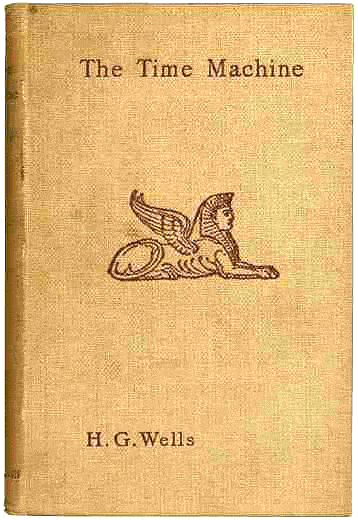
The Time Machine was first published in 1895, making it the oldest book on this list. Considered by many to be one of the greatest science fiction novels of all time, this book coined the term “Time Machine” which is almost exclusively used to refer to any device that allows humans to move through time. The book’s main character is an amateur inventor who lives in London. He is never identified, instead being referred to simply as “The Time Traveller”. Having demonstrated to friends that time is a fourth dimension, and that a suitable device can move back and forth in this fourth dimension, he completes the building of a larger machine capable of carrying himself. He immediately sets off on a journey into the future.
2. Stranger in a Strange Land Robert Heinlein
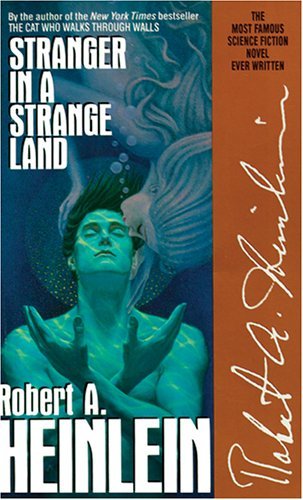
Stranger in a strange land tells the story of Valentine Michael Smith, a human raised by Martians on the planet Mars, upon his return to Earth in early adulthood. The novel explores his interaction and transformation of Earth culture. Typically of Heinlein, this book cover a variety of human taboos, including homosexuality, nudism, and cannibalism. The book introduces the character of Jubal Harshaw who is a central figure in many later books by Heinlein. It won the 1969 Hugo award and has not been out of print since the first publication. Eventually Stranger in a Strange Land became a cult classic, attracting many readers who would not normally have read a work of science fiction.
3. The Lensman Series E E “Doc” Smith
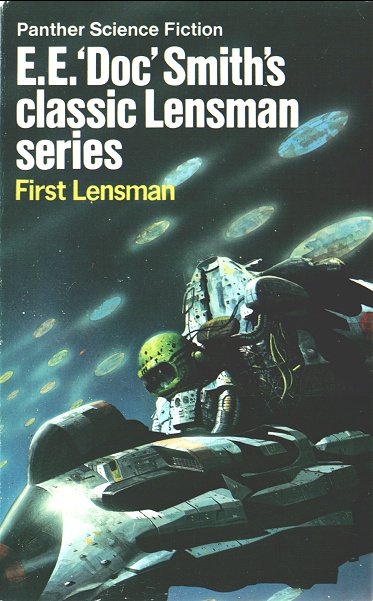
I remember one summer in my childhood when all the other kids were busy hanging out at the movies and playing video games, that I spent every day lying in the backyard all day reading every book that E E Smith wrote (luckily my dad is a keen Sci-Fi fan so he had them all). Doc Smith was my introduction to Science Fiction – and what an introduction it was! The Lensman series was the first set of science fiction novels conceived as a series. It was also the original source which introduced many innovative concepts into science fiction, and a variety of ideas newly introduced in the series later were taken and used to solve non-fictional problems. In this sense the series was ground-breaking and defined an entire genre.
4. 2001 – A Space Odyssey Arthur C Clarke
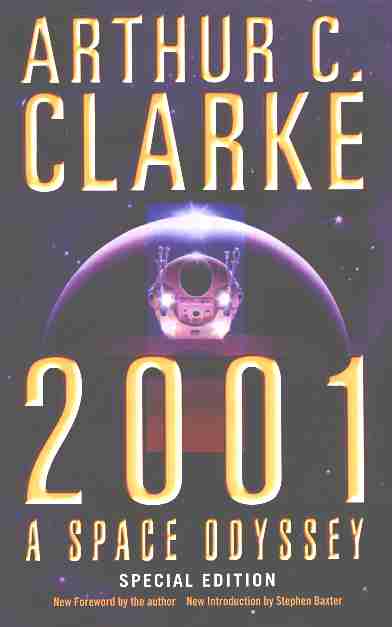
Interestingly, this book was developed concurrently with Stanley Kubrick’s film and published after the release of the movie. In the background to the story, an ancient and hidden alien race uses a mechanism with the appearance of a large crystal Monolith (black in the film) to investigate worlds all across the galaxy and to encourage the development of intelligent life. This novel was followed by three others: 2010 (also made into a movie), 2069, and 3001. As yet no plans exist for the remaining two to be made in to films.
5. Fahrenheit 451 Ray Bradbury
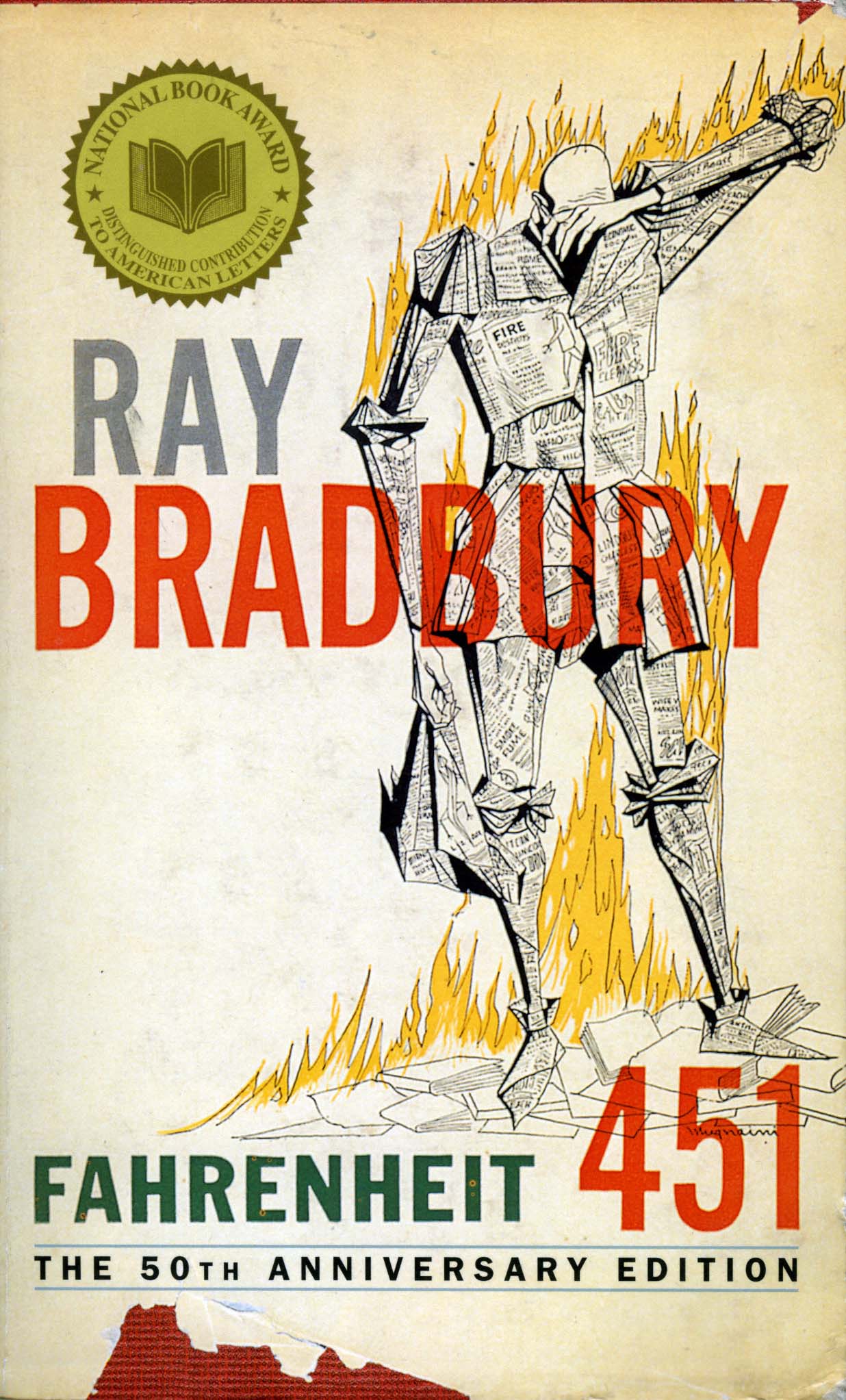
The novel presents a future in which all books are banned and critical thought is suppressed. The central character, Guy Montag, is employed as a “fireman” (which, in this case, means “book burner”). 451 degrees Fahrenheit is stated as “the temperature at which book-paper catches fire, and burns …” It was originally published as a shorter novella, The Fireman, in the February 1951 issue of Galaxy Science Fiction. Fahrenheit 451 takes place in an unspecified future time in a hedonistic and rabidly anti-intellectual America that has completely abandoned self-control and bans the possession of books. People are now only entertained by in-ear radio and an interactive form of television. The protagonist, Guy Montag, is a fireman, certain that his job—burning books, and the houses that hold them, and persecuting those who own them—is the right thing to do.
6. The Foundation Series Isaac Asimov
The term ‘Foundation Series’ is often used to include the Robot Series and Empire Series, which are set in the same fictional universe. In total there are fourteen novels and dozens of short stories written by Asimov, and six novels written by other authors after his death. The series is highly acclaimed, deservedly winning the one-time Hugo Award for “Best All-Time Series” in 1965. The premise of the series is that scientist Hari Seldon spent his life developing a branch of mathematics known as psychohistory, a concept devised by Asimov. Using the law of mass action, it can predict the future, but only on a large scale; it is error-prone for anything smaller than a planet or an empire. Using these techniques, Seldon foresees the fall of the Galactic Empire, which encompasses the entire Milky Way, and a dark age lasting thirty thousand years before a second great empire arises. These books are captivating and if you start book one, you won’t stop until you finish book fourteen.
7. Slaughterhouse-Five Kurt Vonnegut
Slaughterhouse-Five; or, The Children’s Crusade: A Duty-Dance With Death is a 1969 novel by Kurt Vonnegut. Widely regarded as a classic, it combines science fiction elements with an analysis of the human condition from an uncommon perspective, using time travel as a plot device and the bombing of Dresden in World War II, the aftermath of which Vonnegut witnessed, as a starting point. A disoriented and ill-trained American soldier named Billy Pilgrim is captured by German soldiers and is forced to live in a makeshift prison. Billy has become “unstuck in time” for unexplained reasons so he randomly and repeatedly visits different parts of his life, including his death. He meets, and is later kidnapped by, aliens from the planet Tralfamadore, who exhibit him in a Tralfamadorian zoo with Montana Wildhack, a pornographic movie star.
8. The Hitchhikers Guide to the Galaxy Douglas Adams
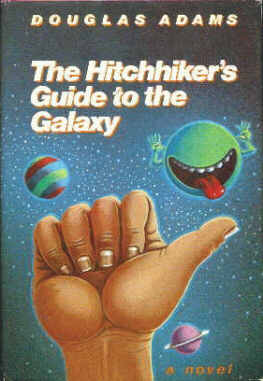
The Hitchhiker’s Guide to the Galaxy is a science fiction comedy series created by Douglas Adams. The series follows the adventures of Arthur Dent, a hapless Englishman who, with his friend Ford Prefect, an alien from a small planet somewhere in the vicinity of Betelgeuse, escapes the demolition of Earth by a bureaucratic alien race called the Vogons. Zaphod Beeblebrox, Ford’s semi-cousin and part-time Galactic President, unknowingly saves the pair from certain death. He brings them aboard his stolen spaceship, the Heart of Gold, whose crew rounds out the main cast of characters: Marvin, the Paranoid Android, a depressed robot, and Trillian, formerly known as Tricia McMillan, a woman Arthur once met at a party who he soon realises is the only other survivor of Earth’s destruction. After this, the characters embark on a quest to find the legendary planet of Magrathea and the Question to the Ultimate Answer.
9. Dune Frank Herbert
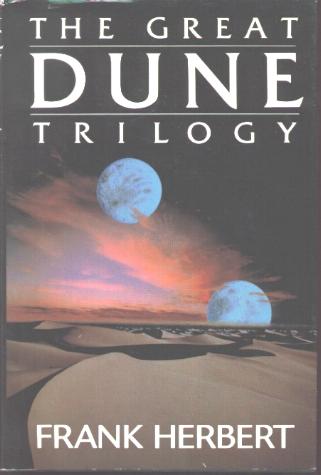
Dune is a science fiction novel written by Frank Herbert and published in 1965, and is frequently cited as the best-selling science fiction novel in history. Dune is set far in the future amidst a sprawling feudal interstellar empire where planetary fiefdoms are controlled by noble Houses that owe allegiance to the Imperial House Corrino. The novel tells the story of young Paul Atreides as he and his family relocate to the planet Arrakis, the only source of the spice melange, the most important and valuable substance in the universe. In a story that explores the complex interactions of politics, religion, ecology, technology, and human emotion, the fate of Paul, his family, his new planet and its native inhabitants, as well as the Padishah Emperor, the powerful Spacing Guild, and the secretive female order of the Bene Gesserit, are all drawn together into a confrontation that will change the course of humanity.
10. Neuromancer William Gibson
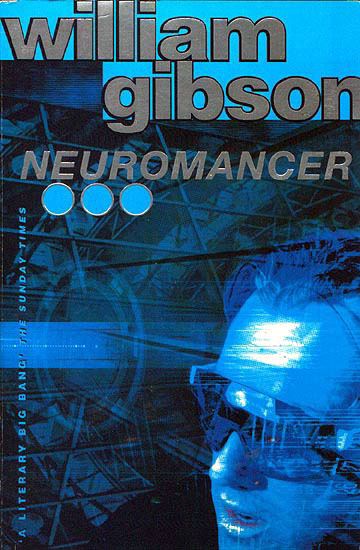
This ’80s novel caused a sensation when it was published. Set in a near-future world, this novel helped to popularize the cyberpunk genre. The novel uses visual power and imagery it’s predecessors were not able to achieve. The main character of Neuromancer is Case, a console cowboy, who, by linking his brain directly with computers, pirates data kept in the cyberspace matrix. This is simulated by a worldwide database with a crippled nervous system. With the aid of Molly (who has concealed cybernetic weapons), they embark on a violent adventure.
11. Do Androids Dream of Electric Sheep? Philip K Dick
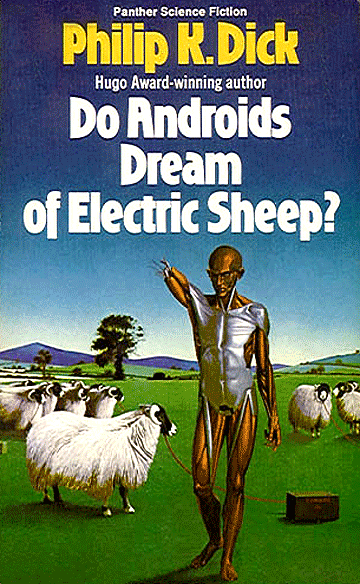
Published in 1968, this novel, even today, is years ahead of its time. Set in the future, the World War had obliterated millions with entire species extinct. This causes the humans to look for a new home planet. However, large corporations build artificial animals, which look extremely realistic, and are successful in creating artificial humans, used for slave labor. This causes great fear amongst the human population and the androids are subsequently banned. The androids are on the run, and Rick Deckard is brought in to hunt down the escapees to “retire” them. This book was the inspiration for Blade Runner.
12. Gateway Frederik Pohl
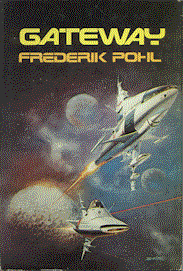
Winner of both the Hugo, and Nebula Awards, Gateway is the story of the ultimate futuristic goldrush! Set in the 21st century, Gateway – a large asteroid – has been found; containing hundreds of ancient space ships. All of these ships have pre-programmed courses set. Little is known about the builders of these ships, the Heechee. The curious humans explore the destinations that are preset which result in either vast wealth, or death. The two main characters are Robinette Broadhead, who becomes a prospector, and Sigrid, his digital psychotherapist. Much of the novel consists of Broadhead’s conversation with Sigrid, interspersed with his memories of Gateway and the journeys he has taken in the Heechee ships. A slow moving thinking person’s novel which builds to an amazing crescendo.
13. Ender’s Game Orson Scott Card
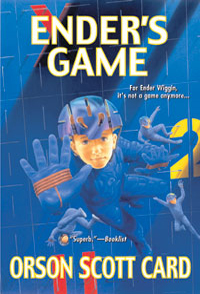
Taken from home at the tender age of 7, surrounded by enemies, with no hope and impossible odds, he is Earth’s last hope. Ender excels in the field of combat. The invasion of the alien insects ‘buggers’ looms over the Earth. Ender is put to the test when he leads Earth’s defensive and retailitory attack against the aliens. The dialogue, visuals, and details bond you to the characters and make this story incredible.
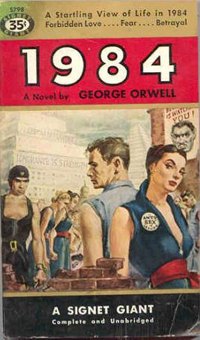
14. 1984 George Orwell
George Orwell wrote 1984 a year before his death to show the world the grim and bleak future of a society subject to totalitarianism. It’s a disturbing and chilling story of Big Brother, where sex is frowned upon and only to be used for reproductive purposes. It was written in 1949, four years after the end of WWII and the paranoia and fear that arose from that time, as well as the threat of communism, gave birth to 1984. In the novel the world has been grouped into three opposing forces: Oceania, Eurasia, and Eastasia. Winston Smith, of Oceania, is living in London, a society where you are monitored constantly through telescreens which are in every room. Even if you are physically alone, you are always being watched and individualism is forbidden. The government provides the ‘entertainment’: movies and music. Crime is monitored by the Thought Police, an elite and secretive government organization that can erase you and all records of your existence.
15. Brave New World Aldous Huxley
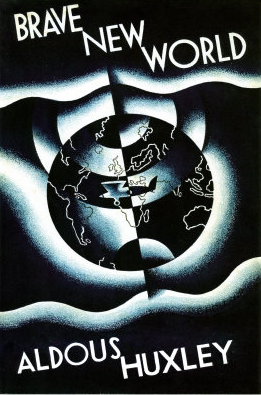
Huxley is one of my favourite writers. Brave New World is set in a dystopian future which anticipates developments in reproductive technology, biological engineering, and sleep-learning that combine to change society. The world the novel describes is a utopia, though an ironic one: humanity is carefree, healthy and technologically advanced. Warfare and poverty have been removed and everyone is permanently happy. The irony is that all of these things have been achieved by eliminating many things that humans consider to be central to their identity — family, culture, art, literature, science, religion, and philosophy. It is also a hedonistic society, taking pleasure from promiscuous sex and drug use, especially the use of soma, a powerful drug taken to escape pain and bad memories through hallucinations.
I must, of course, give a tip of the hat to Jules Verne who should be on the list but I just couldn’t decide who to cut in his favor.
Contributors: Ryan Sweeney, and Fritha Keith


Let me just say, this site is definitely one of my favorites. I love the constant updates to keep me from doing more important things! Keep up the good work! Nice list, too.
Great list. I’ve been a big fan of sci fi since I was a kid in the 80s. I’d love to see an expanded list – say top 50 or 100 best books. I’ve read many of the books here – Foundation series, Gateway, Stranger in a Strange Land, etc., but I also have other favorites that didn’t make it – but still think are mind-expanding examples of Sci Fi.
I’d include The Forever War (Joe Haldeman), Ringworld (Larry Niven), Cities in Flight (James Blish), Eon (Greg Bear), and Earth (David Brin).
“Earth” is perhaps my favorite – having read it in 1990 just before the explosion of the internet. Brin includes the “Net” as a character in the book, predicting the coming global connection of all people in real time. When the internet took off in the mid 90s, everything Brin predicted came to be, I was awed by ability of sci fi to predict things to come. Fantastic novel.
When I saw the title of your article, I thought ” not another ignorant cyberpunk who’s world began in 1980″ You have created a list for true fans of SCIENCE fiction. It borders on brilliance and speaks of a well rounded education.
Thank you for giving me hope for the future when you youngsters recognize the totality of historic existence.
Leaving Jules Verne off is a judgment call. Don’t feel bad, give him the lifetime achievement award as the instructor of all who followed.
Thank you for not including the “dragon magic spell” genre.
The book that introduced me to science fiction was Bob Heinlein’s… Tunnel in the Sky… at the age of 12 it bounced my brain into places from which it has never returned.
As a modern reference you might give hororable mention to Haldeman’s “The Forever War”. It made the rounds of my platoon just back from Vietnam and opened more than a few eyes. Maybe we can ship some copies to Iraq, or Congress.
Excellent list.
While I truly do appreciate that essentially everything here is a timeless classic (as befits a relatively small list — you’ve got to pack in the best), I agree that someone, somewhere should do an expanded list of 50 or more (not me, I don’t have that kind of time… I’ve got blogs to read, dammit), which among other things would allow for some of the classics that fell by the wayside (like Verne), as well as give room for a few more recent gems.
personally, as far as the recent gems go, Hyperion is one of the best sci-fi books I’ve read in a long time… elegantly crafted, tying together politics, science, language, philosophy, religion, and a host of other elements into an intense narrative. It also manages to fold a bit of cyberpunk and even a little detective noir into the interstellar-empire-space-opera-y storyline. Classy.
agnerrah: isn’t Heinlein a miracle worker when it comes to words? And Verne definitely deserves the lifetime award – my dad loves him and made me read his stuff from very early on (thank God). Thanks for the addition of Handleman – you have no idea how much of a struggle it was to take only the top 15. I could easily do a top 100 (take note seapixy).
Dan: I appreciate what you have said – it is comments like that that makes me sit down every morning with my cup of tea to write a new list!
Seapixy: thanks for the extras. My amazon wishlist is getting so full that it is going to take a lottery win to buy all my desired books!
The quartet of Dan Simmons books: Hyperion, The Fall of Hyperion, Endymion and The Rise of Endymion, often referred to as the Hyperion Cantos, is without equal for scope, beauty and sheer creative genius. No SF list should be without at least one of these books.
there aren’t many lists on this site yet so I assumed that it was new. this site was a very good idea and way to gain exposure to interesting information; i think it will be really popular in the future. i just hope that we don’t start getting charged to use it. i am starting my freshman year of college in two weeks (LSU) and that is why quick exposure to new ideas is important to me. after i learn how to make hyperlinks maybe i will make a list.
i had to read Ender’s Game in high school english class (our teacher was into sci-fi). i have read more of the books on this sci-fi list than on the list of banned literary classics.
thanks for the lists, jf.
i’ve heard that the Manifold Trilogy by Stephen Baxter is mind-expanding. it is classified as hard science fiction (as opposed to soft)- the difference being that hard sci-fi deals more intensively with scientific concepts whereas soft sci-fi is basically an interesting yarn that takes place in the future.
Good list — I’d have pushed pretty hard to include “Startide Rising” by David Brin, which I think is one of the singularly excellent science fiction books of the last thirty or so years. Problem is, I can’t figure out which of the books on the list I’d kick out for it.
brennan: I promise I will never charge people to use the site. I have lots of ideas for the future and charging people is definitely not one of them. The site is two months old so you are right – it is quite young. Welcome aboard!
“Stranger in a Strange Land”? Ugh. That wasn’t a novel, it was badly-written wish-fulfillment. Let’s start with the author character: a rich super-talent jack (and master) of all trades who has a harem of live-in hotties who do his work for him. Mary-Sue much?
Then the main character picked up enough Martian Skillz to teach all the women who later join his religious cult-harem how to manipulate their own bodies so they all become grade-A Playmates. Oh, and part of this religion is rampant ***** with everyone all the time. (How did he even finish the book while masturbating between every page?)
The book itself levels the same charges against humanity (They’re mean! They’re greedy!) that every other sci-fi book falls back on when it’s run out of other ideas, and after awhile the whole thing dissolves into a bizarre religious screed. Plus, a superhuman infallible main character, free of any personal, physical or mental flaws, is just plain bad writing.
the Shrike: thanks for the addition – even though I couldn’t include everything I wanted to in the list, the comments make up for it
Hibryd: I am mortally offended! That book is one of my favourites! Get thee behind me! Thanks for the comment anyway
Enders Game!!!!! Yea, It made the list, Ive got everything in the series save one, And Im trying to get them all In hard back. Im that Hard Core about it. It’s a shame I dont own more of these, I know I should. The girlfriend(such an archaic term), would love the list. I got myself so worked up I cant remember what Iv’e read.
Check out Book of the New Sun by Gene Wolfe. Once you read it, you’ll wish you had put it on this list. (It was originally published as four books starting with Shadow of the Torturer. The version I have is in one book, and I think the current edition is two books, starting with Shadow and Claw.)
Crimanon: hah nice comment – it is good to be passionate about things
Jonah: can you tell us a bit about the book?
I have read just Brave New World and The Hitchhikers Guide to the Galaxy. :/
Dating Tangent:
girlfriend is not only an archaic word, Crim, it is an archaic concept. intelligent young people of the opposite ***** are not able to relate to each other in that old way anymore. it is so bizarre. every couple i know is a rapid on-and-off oscillation interspersed with jealous possessiveness and fear. i don’t know how long it has been like this but it seems like a widespread trend headed in a spooky direction.
hesitation, indecisiveness, and insecurity are the hallmarks of the New Dating.
p.s. from now on, all tangents shall begin with (Subject) Tangent. not really, but that would be cool.
Great list!
I’d personally add Kim Stanley Robinson’s Mars Trilogy (Red Mars, Green Mars, Blue Mars) and Madeleine L’Engle’s Time Quartet (A Wrinkle in Time, A Wind in the Door, A Swiftly Tilting Planet, Many Waters).
Bren:If you can think of something that will get the point across I’m all up for it. “Im divorced and I have a girlfriend.” sounds Imature. I’m all up for suggestions.
Esther: If youv’e ever read any of the interveiws with OSC. You would know that he considers it one of his Worst works. Compare my likes of a book to Scat, fine thats your thing. Far be it for Me to hate on anyone with a taste different than my own.
Ender’s game is…”immature” – i have no better word to describe it right now. It is (in my opinion) a prelude to Speaker For The Dead and Xenocide both of which display the interactions between people in a more realistic, believable, (dare I say it?) human way. I would have a lot more to say but this isn’t a book review site.
Gene Wolfe’s “Book of the New Sun” should definitely be on this list. It’s easily as thrilling and complex as Dune or the Foundation series covering all the topics mentioned in the above entries (interaction of politics, religion, ecology etc.) but also muses on the nature of identity, memory and the art of storytelling itself.
It’s set in a very distant future ( it’s never said how far, but humanity has had time enough to conquer the stars and then fall gradually back into a state of feudalism). It follows the adventures of Severian, a former apprentice to the guild of Torturers, as he winds his way through a very alien, but strangely familiar society.
These books are highly recommended. Gene Wolfe is storyteller of the first order, maybe the best living writer in the English language, no hyperbole intended. But they are not an “easy” read like some of the other entries on this list (“easy” does not mean “bad”. I’ve read all of these, save E.E. Smith, and they all deserve the status they’re given here). Wolfe challenges you with a highly subjective, somewhat untrustworthy narrator of questionable sanity. I’ve read the series three times now, and I still feel like there is more to be discovered.
I realize I must sound like I’m in a Wolfe cult to the uninitiated, but give it a try. You won’t regret it.
Let me 2nd Jonah’s recommendation of Gene Wolfe’s Book of the New Sun series. It’s difficult to describe in any way that does justice, as it’s definitely more about the way it is written (“narrative structure” one might say) than the plot. But in short, its the story of a torturer who becomes of the king of a far future “dying earth”.
…and I’d agree that Ender’s Game is more children’s lit than sci-fi.
What about Kim Stanley Robinson’s “The Mars Trilogy”: “Red Mars” (1992), “Green Mars” (1994), “Blue Mars” (1997) ??
Winners for the Hugo and nebula awards, these books are considered to be the best literary science-fiction novels.
http://en.wikipedia.org/wiki/Mars_trilogy
Ender's Game is a dreadful book. It's one of the most emotionally stunted, yet cleverly manipulative things I've ever read. I love literature, and good science fiction as part of literature, and can't help noticing that the genre is held back by some of the absolute crap lionized by the science fiction community. Light by M. John Harrison is a better book than Ender's Game, but not nearly as quirkily satisfying to resentful children with pathological neurotic revenge fantasies. Not that there's anything wrong with that. Loving Ender's Game is not more disgraceful than being a fecalphiliac, but also no more noble.
As for the rest of the list, I wouldn't have Heinlein or Azimov. I could name another dozen P.K. Dick novels that are better than much of the list. 224 and Camp Concentration are also better than most of that which you've included. In thirty years some of Egan's work is going to be seen as worth being here, and probably something by Stross. Octavia Butler, Samuel Delaney and Ursula Leguin also produced some great works that belong here.
I completely agree, Ender is the most overrated piece of ***** ever praised as ‘sci-fi’, and even if I can understand why people would enjoy that story (mostly socially incompetent rejected teens), it’s impossible not ot acknowledge the 3rd grade level of literacy of the author (or whoever wrote it for him)
Yikes.
Hey, Esther you retard dont even spell Isaac Asimov’s name correctly and how in the world can you judge him. Just go to hell, you moron.
#
20. Crimanon | August 18th, 2007 at 11:36 pm
Esther: If youv’e ever read any of the interveiws with OSC. You would know that he considers it one of his Worst works. Compare my likes of a book to Scat, fine thats your thing. Far be it for Me to hate on anyone with a taste different than my own.
Sorry, it just struck me as a funny line.
Crim: “I’m divorced and I’m lovin’ this ***** Tina.”
Bren: Nice, still too tactless for my taste.
Esther N.:
Nobody is impressed nor fooled by your laughable elitism. Hey, you’ve got opinions about sci-fi books, and you’ve lost all perspective on the matter. Good for you!
Too much recent garbage: Instead, try:
The Demolished Man by Alfred Bester
The Stars my Destination by Alfred Bester
The Midwich C. by John Wyndam
Anton York Immortal by E.O. Binder
Voyage to Arcturus
Odd John by Olaf Stapleton
The Skylark of Space Trilogy by Doc Smith
Slan
Brainwave by Poul Anderson
Frankenstein by Mary Shelley
Time is the Simplest Thing by Clifford Simak
More than Human by Ted Sturgeon
Donovan’s Brain
Not to mention:
Childhood’s End by Arthur Clarke
War of the Worlds by H.G. Wells
Ender’s Game is thought by some to be an apologia for Hitler. The series itself is both Mormon and socialism propaganda.
jon: You and an old roommate of mine have both said the same thing, and I think you’re both reading into it too much. Who cares Its Sci-Fi…Fi=Fiction. FICTION. You don’t have to like it to read it. Use the book however you want it. Just as long as you Learn something from it. Good or bad, you still learn things about the Human element from it. We are Cruel, Xenophobic, and Disturbing. I knew that before I read it.
However, no matter how bad my life got, all I had to do was read Enders Game and I’d realize, “I’m glad I”m not him.”
What about C.J.Cherryh? Her Foreigner series is utterly wonderful.
I would also add my (considerable) weight to the argument for Gene Wolfe’s “Book of the New Sun” to be included. Wolfe’s writing is possibly the best you could ever read; the story is gripping, amazing and just plain incredible; and the language is so good it is challenging.
Another book mentioned in previous comments is “The Demolished Man” by Alfred Bester. If you haven’t read it then you ought to. It is a great story combined with cutting edge typography for it’s time.
I would also suggest Neal Stephenson’s “Cryptonomicon”, “Quicksilver” and “Byzantine” as well. Once again they provide epic story-telling, combined with great ideas and fantastic language. An alternative suggestion would be “Stand on Zanzibar” by John Brunner, as this was innovative in it’s use of factual chapters to gice background to the narrative sections.
If you need to drop anything from your list then “Ender’s Game” should be first to go, as it’s a good read whilst you are a teenager, but it’s hardly a classic. Then you could always lose “Slaughterhouse 5″ and “Fahrenheit 451″ as they are not very readable, and if you really need to lose another then I’d suggest “Brave New World”.
I love Hitchhiker’s Guide (in fact I own it in leather), but it’s not really science fiction. It’s comedy which uses SF conventions as a platform for laughs, in the same way Pratchett’s Discworld series does with fantasy.
As a substitute from the seventies, let me suggest Niven’s Ringworld.
The rest of the list is good, although I think Asimov’s Robots of Dawn is probably the best example of his work; it’s the first true link between the Robot and Foundation books and was written at the height of his skills, and just before he lost his mind and characterized the Seldon Plan as a backup to Gaia.
Similarly, I am on the side of those who think Heinlein wrote much better stuff than Stranger. How about… Moon is a Harsh Mistress?
Ooops!! I forgot about Iain M. Banks!
I’d nominate “Excession” as probably his finest, but “Use of Weapons” is close, and “Player of Games” is not far behind.
I’d agree with Wes on “Ringworld” as well.
Wow, great list. I was thinking of checking out Orson Scott Card – never read him. Really like most of the others. Would have put Slan on there though.
Usually, I hate these “best-of” lists, like those AFI Best 100 Movies, etc., type lists. There is alway at least one entry that makes me go, “what?” You can’t be serious! Like putting “Forest Gump” above “Psycho” or something equally awful.
However, I didn’t have that reaction with this list. I’ve never read “Gateway,” for example and am going to get a copy. Though I wish that DUNE were higher and that “Have Space Suit, Will Travel” was on the list. This was the first SF story I read and loved and that turned me on to the genre). Overall, though, I think that the authors’ choices are valid ones.
But I have one sort-of question:
As I notice that the authors have tried to put “firsts” on the list, shouldn’t FRANKESTEIN by Mary Shelley be on the list? She published it in her own name in 1831 (there was an earlier Anonymous publication).
I guess one could consider it “horror” or “fantasy,” but I think that one could argue that it is really SF. The events hinge on the application of tech, and the story itself considers thing like consciousness, etc.
Okay, I’m going to end with my own personal TOP 15 (or so) list:
“A Door into Ocean” by Joan Slonczewski
“The John Varley Reader”
“Mrs. Frisby and the Rats of NiMH”
“Dune” by Frank Herbert
The Foundation Books
The 2001 books
“Have Space Suit, Will Travel”
“Frankenstein”
“Stranger in a Strange Land”
“Great Sky River”, “Tides of Light”, and “Across the Sea of Suns” by Gregory Benford
Hitchhiker’s Guide, etc., by Douglas Adams
“Vermillion Sands” by JG Ballard
A great and thoughtful list (leaning toward the classics). If there were room for one slightly more contemporary title, I would have included Neal Stephenson’s “Snow Crash.” Some sci-fi has great writing, some sci-fi has great ideas and some sci-fi has both. The latter is rarest. I was weaned on Bradbury. In the ’60s we bought TAB (Teenage Bookclub) paperback books at school. Sounds archaic now. LOL I’m also very fond of a Clifford Simak book called “City.” I reread it ever few years. It falls into the catagory of Great Ideas. A far future where all that’s left on Earth are sentient dogs and robots who debate about whether there was ever Man. Love this site and please keep at it. Cheers.
Afterthought: There are no women writers on the list, and IMHO women infused sci-fi with new life in the last half of the old century. Ursula K. Le Guin’s “The Lathe of Heaven” and “The Left Hand of Darkness.” James Tiptree Jr. (Alice B. Sheldon) “Her Smoke Rose Up Forever.” And on and on. And see “latter is rarest” above.
I agree with most of your list, but 2001…yuck!–Childhood’s End would have been a MUCH better choice by Clarke. I would also expand your list to include: Frankenstein (since it’s the first science fiction novel ever written), Richard Matheson’s I Am Legend, Heinlein’s The Moon Is A Harsh Mistress, Bradbury’s The Martian Chronicles, LeGuin’s The Left Hand Of Darkness and other’s I’m too tired to think of right now.
Oh, I hate finding things like this – now I’ve added several more books to my “To Read” list. Although I’ve read and own many of them…
great list, but where is the classic book called WE?
you know the Russian book that was written before and may have inspired 1984?
I must admit that I wouldn’t have Stranger in a Strange Land on a list of Most Important SF (and remember, people, ‘Most Important’ is a different animal than ‘Best’; I’m not an H. G. Wells fan, but he has to be represented here, as does Jules Verne, who is missing.) The problem is, Heinlein is the most influential SF writer of all time, excluding Wells and Verne, but not because of a single book. I suppose I’d cheat and say “all of his juveniles”, which introduced generation after generation to the genre.
As for the total list, I have to go along with Penny (post 28).
I agree with Owlathome; women underrepresented.
Jubal Harshaw was not a “central figure in many later Heinlein novels.” Apart from Stranger, he shows up as a minor character – basically a cameo – in To Sail Beyond The Sunset. I think that the list author is confusing Jubal Harshaw with Lazarus Long, who is a central figure in several later Heinlein novels. Note that Long makes no appearance in Stranger.
Cormac McCarthy’s “The Road” is as good or better than everything on the list.
Asimov’s “I Robot” is a shocking absence.
“More Than Human” by Theodore Sturgeon certainly speaks directly to the new collaborative cyberculture and again a worthy contender.
Kit – You are right – I did overinflate his place in other novels (though he was also in The Number of the Beast, and the Cat Who Walks Through Walls). Something makes me think he was also in Friday but I can’t remember for sure and my copy of that book is not with me at the moment.
Thanks everyone for your comments incidentally, they are all great inclusions and I will certainly use these comments as a source if I am looking at another 10 great sci fi novels.
For the person who mentioned the lack of Jules Verne – I did at least give Verne a tip of the hat at the bottom of the article
Since several people spoke of Juvenile Sci Fi,
here is a list for that:
A Wrinkle in Time by M.D’Engle
The Time Traders By Andre Norton
Flatland by Abbot
The Tom Swift Series
Galactic Derelict by Andre Norton
Starman’s Son by Andre Norton
Chldren of the Atom by Willmar Shira
The Tripod Series by John Wyndam
Chocky by John Wyndom
Against the Fall of Midnight by Arthur Clarke
The later Oz books ( which are science fiction) by
L.F. Baum
The Phantom Tollbooth
The Heinlein’s have already been mentioned.
I especially loved “Podkayne of Mars”
and I identified strongly with Peewee in
the ( already mentioned) “Have Spacesuit will
Travel”. But Asimov also had Juveniles!
Andre Norton was a famous mainstream children’s author under her real name.
Though I rarely read sci-fi, I have to add my vote for Mary Shelley’s ‘Frankenstein’. I also have to comment that the lack of Jules Verne borders on a crime. He deserves more than a tip of the hat.
‘Farhenheit’ is one of the few things I can stomach from Bradbury and though I have only read ’1984′ and ‘Brave New World’ once, they left lasting impressions.
Very subjective list. In ex. I don’t like The Hitchhiker’s Guide, at all. For me it is a different category book for it (comedy). Twice better was Terence David John Pratchett – Discworld series !!! Also very good one was Jack Finney – The Body Snatchers
Strange that You didn’t mention about Stanislaw Lem or Janusz Zajdel.
My favor is :
Janusz Zajdel – Limes inferior
regards
Loku
a few others of merit…dhalgren`.. giles goatboy,,,,sirius…gormenghast trilogy
Hm, my 2¢ worth, from a snobby point of view:
Frankenstein
The Time Machine
Voyage to Arcturus
Starmaker
Solaris
Fahrenheit 451
1984
The Stars my Destination
The Left Hand of Darkness
Riddley Walker
The Man in the High Castle
A Canticle for Leibowitz
Xenogenesis (trilogy)
Mars trilogy
Stars in my Pocket Like Grains of Sand
There… YMMV.
“I agree with most of your list, but 2001…yuck!–Childhood’s End would have been a MUCH better choice by Clarke.”
100% agree! Childhood ends >>>> 2001.
I would also agree with some of the ‘meh’ sentiments about stranger.
Other than that it’s a really nice list.
A few novels no-one has mentioned yet:
Samuel R Delany – Triton
Thomas M. Disch – Camp Concentration
My favorite PKD – Now Wait For Last Year
Akady & Boris Strugatsky – Roadside Picnic
I would also second the people who recommended Gene Wolfe’s book of the new sun.
It seems, you forgot Stanislav Lem. In my opinion one of the best science-fiction authors ever. Try for example Solaris or the Cyberiad.
But nevertheless it’s a nice good list.
@jfrater: I stand corrected. He does appear in Number, and that was the appearance I was thinking of, not Sunset.
Where does he appear in Cat?
Kit: you were correct about sunset as well – he appeared in three other novels in total (Wikipedia) – I have not read Cat so I am unsure where he appears in it.
Good and interesting list. I would definitely add neal Stephenson’s Snowcrash on there. Although Cryptonomicon’s probably a better book, Snowcrash is just so influential in terms of the web. I would also add my voice to the clamour for Gene Woolfe’s Books of the New Sun and LeGuin’s Left Hand of Darkness – both seminal. I’m surprised that nobody’s mentioned Michael Moor*****– hugely influential and very prolific. The Pyat cycle, the Dancer’s at the End of Time, and the Blood books are all amazing, if a little strange.
melmoth’s list meets more of my criteria for excellence, so I vote for melmoth.