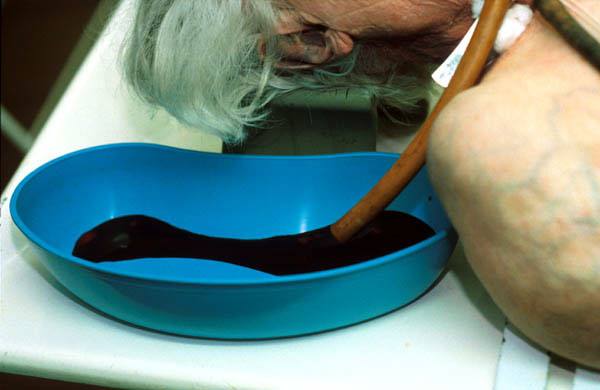
[WARNING: Contains disturbing images] Okay – this is a fairly morbid topic but a very interesting one. Embalming is not required by law in many countries, but it is often performed for the benefit of loved ones. An embalmer has the very responsible task of ensuring that family members are not left with an undesirable last memory of their loved one. These are the five steps involved in the embalming process.
1. Pre-Embalming
At anytime, day or night, the funeral professional may be called upon to do his or her job. People have a tendency to die at the most inconvenient times, and a mortician cannot wait until later to retrieve a body. This means lots of getting up at 1 AM and having to work on holidays.
When someone dies and once authorization has been granted by the family, doctor, and/or by the medical examiner, the embalmer is called to make the “removal” of the body. After filling out the appropriate paperwork the embalmer takes the body to the funeral home, and if embalming is requested or required, begins the process.
An embalming report is filled out that logs all jewelry and personal items on the body; details any discolorations, cuts, bruises, etc. on the body; and documents the procedures and chemicals used during embalming. This report can become very valuable if a deceased’s family bring a lawsuit against the funeral home.
All clothing, bandages, IV needles, catheters and such are removed. A strong disinfectant spray is used to clean the skin, eyes, mouth, and other orifices. If rigor mortis (the stiffening of muscles after death) has set in, it is relieved by moving the limbs and head about and massaging the muscles. If the decedent is a man, he is normally shaved at this point. Razor burn (yes, not even death can save you from this) is less likely before the arterial chemical firms the skin of the face. Even women and children are shaved to remove the fine “peach fuzz” we all have on our faces. This is done to avoid the makeup from collecting on the hair and making the makeup more noticeable.
2. Feature Setting
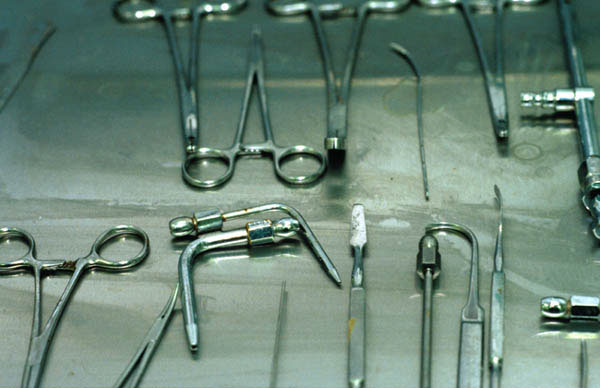
Next begins the process of placing the facial features and the body itself in the position it will remain in the casket for viewing. This is done before arterial embalming, because the body will be truly “set” – firmed in position once formaldehyde reaches the tissues.
Great care is taken to close the eyes. The traditional method for doing this involves placing a bit of cotton between the eye and eyelid. Many times after death the eyes sink back into their sockets, so small plastic “eye caps” are placed on each eye ball. A small amount of stay creme is placed on the eyecap to avoid dehydration of the eyelids. Contrary to popular myth, the eyelids are never sewn shut, but in some cases that may be glued together to prevent separation.
The mouth is closed either by tying the jaw together with a piece of suture string or by a special injector gun. With the suture method, a curved needle with a piece of suture string is threaded through the jaw below the gums, stuck through upper jaw into to the right nostril, threaded through the septum of the nose into the left nostril, and then passed back down into the mouth. The two ends of suture are tied, careful not too tightly, so that a natural appearance of the mouth is created.
To finish closing the mouth, many times a mouth former is used. A mouth former is similar to an eyecap as it has a textured side that grips the lips, but it is shaped like the mouth. A small amount of stay creme is also used on the mouth to avoid dehydration and help hold the lips in place. The mortician may also squeeze inside the mouth a little mastic compound, a paste kind of like caulk to give the mouth a better and more pleasing shape.
3. Arterial Embalming
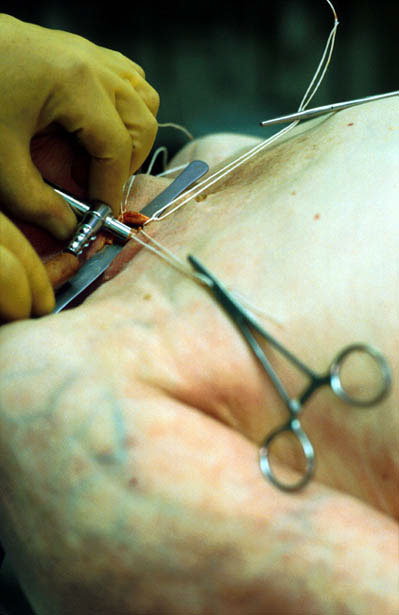
Arterial embalming is begun by injecting embalming fluid into an artery while the blood is drained from a nearby vein or from the heart. The two gallons or so needed is usually a mixture of formaldehyde or other chemical and water. In the case of certain cancers, some diabetic conditions, or because of the drugs used prior to death (where body deterioration has already begun), a stronger or “waterless” solution is likely to be used for better body preservation. Chemicals are also injected by syringe into other areas of the body.
Once the embalming fluid begins to flow into the arterial system, pressure begins to build up in the entire vascular system. This helps the fluid reach all parts of the body and penetrate into the tissues. Evidence of this can be seen in bulging veins throughout the body. The jugular drain tube is opened periodically (it is normally closed) to allow blood to escape and prevent too much pressure in the vascular system which could cause swelling. The blood drains directly into the sewer system, which sounds gross, but in reality much worse things go into our sewers.
Once arterial injection has been completed, the arterial and jugular tubes are removed, the vessels are tied closed, and the incision used to access the vessels is sutured closed and sealed with a special chemical.
4. Cavity Embalming
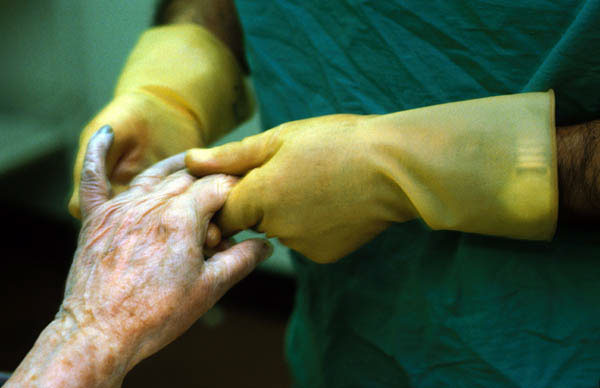
Arterial fluids mainly treat the skin, muscles, and organs themselves. What’s inside the organs (such as urine, bile, etc.) begins to decompose. Gases and bacteria can build up and cause distention, odor, and purge (such as brown fluids coming out of the mouth – not exactly the way you want to remember grandma). These bacteria can sometimes spread to other parts of the body, even after arterial embalming, causing decomposition problems (and then sometimes legal problems for the funeral home).
Cavity treatment starts with aspirating (suctioning) fluids out of the internal organs in the abdomen and thoracic cavity. This is accomplished this with the use of a trocar. The embalmer uses it to puncture the stomach, bladder, large intestines, and lungs. Gas and fluids are withdrawn before “cavity fluid” (a stronger mix of formaldehyde) is injected into the torso. The anus and vagina may be packed with cotton or gauze to prevent seepage if necessary. (A close-fitting plastic garment may also be used.)
These steps apply only to a body that has not been autopsied. During autopsy all the internal organs are removed and inspected by the medical examiner and then placed back inside the body or sometimes incinerated. At the funeral home, the mortician removes the viscera and places it in a plastic bag called a “viscera bag” and allows it to soak in cavity chemical. The inside of the body cavity is aspirated with a special instrument and then coated with an embalming gel and/or an embalming powder. The treated organs are then placed back inside the body or the bag full of organs gets placed at the foot end of the casket (so never try to admire a deceased’s shoes!)
5. Post-Embalming
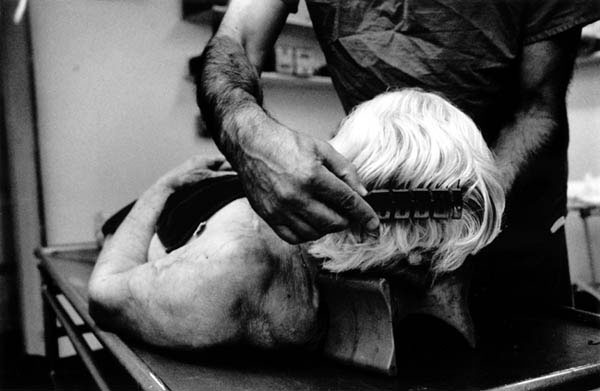
The body and hair are washed once more to remove any blood or chemicals and then thoroughly dried. Any restorations are done now, such as rebuilding features, masking sores or abrasions, etc. Makeup gets applied to the face, neck, and hands. Either a translucent makeup is used in normal cases or an opaque makeup is applied if the skin is discolored. In either case, the effect should be a subtle as possible to avoid Uncle Roger looking like Aunt Rose. The fingernails are trimmed. The hair is styled, either by the embalmer or by a professional hairdresser or barber.
The remains are dressed in the outfit chosen by the family. This outfit almost always includes underwear, shoes, and socks. In the case of autopsy or other difficulties, plastic undergarments are placed on the body to prevent leakage.
Finally comes casketing. The body is placed into the casket and posed in the proper position. The family normally views the body at this point and decides on any changes that need to be made. During the viewing period (which can sometimes last for several days) the embalmer will periodically check the body for signs of decomposition and takes any corrective action.
Source: Everything you ever needed to know about Embalming. Images are copyright Edmond Terakopian


wow i don't think i could do that for a living
im really intrested my boyfriend died in march and since that its really the thing for mee
yea same here it looks creepy and werid!!!!:(
I wonder what kind of training this would require, Medical background, etc. I have always been interested in doing something like this(not not some morbid fascination, just a fascination).
Most states only require a two-year mortuary science program which will give you an AAS in Mortuary Science. The first year is normal prerequisites; the second year is usually total immersion in the mortuary science program only.
in NJ Mercer County Community College has a one year program that is just your funeral service requirements! its a good profession
It varies from state to state on the training. I am currently in the process of going to school to become a mortician. I live in Illinois and you have to have 30 credit hours of electives, receive your associates degree before attending mortuary school. When you start mortuary school that's another 6 months in class and 6 months of working at your city's morgue. I'm very excited about it!!
There are mortuary colleges, and you must attend and complete embalming, chemistry, anatomy, also merchandising, accounting, law classes, ethics classes, microbiology. You need also your basic college courses. Most mortyary schools are either 2 or four years, then you do an apprenticeship in a local mortuary, embalming 100 deceased in 2 years. At that point you are ready to take the embalmers exam. I have been in the business for years and find it very rewardng to be able to make a difference for the families.
Please note that every state is different in its requirements for the amount of embalmings that need to be done during internship or apprenticeship. Some states also require certification before internship can even begin, so do your homework for the state in which you wish to work. Thank you.
I was actually quite interested in it at High School but now – no – definitely not for me.
pretty gross but extremely interesting. i never really thought about what happens to granny between the old folks home and the cemetary.
how do you know all of this stuff? are you a mortician?
p.s. “stay creme” is this a nice word for glue?
stay creme is just like vaseline that allows for things to stay together and is not like glue at all
a question that comes to my mind when I that the blood goes into the sewer system is what happens if the person had AIDs or other communicable disease? Does that blood get treated any differently?
No
wow, real compeling stuff. the amount of care taken just to provide a piece of mind for the family is really something. you have to respect a profession like that.
DiscHuker: yes – I think stay creme is a cosmetic glue
xdarkhor*****: that is a really good point actually – though I think HIV can’t live outside the body so that is possibly not a danger – but I am not sure about other diseases like Hepatitis. I am really surprised that there is not some requirement to purify before dumping.
zombiejorge: totally – and for the most part their work is appreciated for only a few days then lost.
But those few days create memories that last a lifetime. Trust me on that one.
I’ve been to quite a few open-casket funerals…all for relatives of my best friend, sadly, and the work they do is amazing, considering how they’d normally look a few days or weeks after death.
Ahh I have found the answer to my own question at http://www.ccohs.ca/oshanswers/diseases/aids/embalming_procedures.html
Treat blood, body fluids and aspirated contents with a 5.25% sodium hypochlorite solution for 30 minutes before flushing directly into sewer.
one other fascinating way of preparing the body for the morbidly inclined is plastination.
you don’t necessarily need a medical background, however you have to take an embalmer’s course and be licensed. (I looked into it also when I was younger)
I dated a girl in college whose ambition it was to become an undertaker. I believe she did it too. Creeped me out then, creeps me out now. Though of course this is one of those “facts of life” (or death) things that have to be taken care of. Nevertheless…
…….ew!
It really sounds like an art though, so many subtleties. Unusual, but interesting nonetheless.
TerranRich: I have been fortunate enough to have not seen a single dead person – but your comment makes me think – maybe we should have an annual embalmers day – to appreciate the work they do – instead of all of the glitzy money making holidays that the media and advertising companies get us in to.
xdarkhor*****: thanks for that link – fascinating! Thought one of their points confuses me a little:
Why? In case you infect the next corpse with aids? Also – that list is really scary – if that is what you have to do for a person with AIDS, imagine the procedure for Ebola!
Also xdarkhor*****, how long is an embalmer’s course?
Randall: I was interested in high school too – but the interest waned and I ended up in IT.
from darkhorse’s link … “Spit out immediately blood or body fluids splashed in the mouth. Rinse mouth with water.”
that’s one of the most disturbing visuals i’ve ever had
**shiver**
you know what is weird? i was just watching a show on embalming last night on the health network..and this morning i log onto here to see a list for embalming. creeepy.
DiscHuker: yeah – how often does that happen? Any remnant of an interest in the job went out the window when I read that.
dvhann: ooooh – maybe you are destined to be an embalmer!
I wonder how much an embalmer makes, does he get paid by the body or hourly?This would be a good episode for good ol Mike Rowe and Dirty Jobs.
Embalmer salaries generally start in the low 20,ooo's, but with experience and time in the funeral profession, they can be as high as 60-70's. Also embalmers usually work for one funeral home, but there is such a thing as "freelancing" so to speak, in the profession they're called trade embalmers. Hired by several different FH's just for embalming. You negotiate your own price for your services.
in most funeral homes the embalmer does other jobs as well.
I do believe that there are several different types of courses you can take, ranging from 6 months to 2 years.
It is definatly incredible how painstakingly the embalmer does his/her job. It was something I thought about when I was in school. bah
I cannot stand open casket viewings; I hate them with a passion. I’ve been to coworkers’ and friends’ family members viewings; they always insist upon taking you over to view the body of some person that you didn’t know – I always have a horrible urge to pick up the corpse’s hand, shake it and say “Nice to meet you”. Then there’s the obligatory comments about how “peaceful” they look. They don’t look peaceful, they look DEAD! And usually, kind of orange. And then everyone starts seeing their relatives and old friends and laughing and telling stories, so the whole thing turns into an interesting atmosphere of a cocktail party. You know, if you have the kind of cocktail parties where a dead person is the centerpiece.
Worst of all is when the family decides to have an open casket viewing and the body is not at all in a condition which is suitable for it. I went to the viewing of one of my coworkers who died in a car accident and was appalled when I realized (and realized too late to discreetly escape) that it was an open casket viewing. We’re talking wood putty. It was just horrible; I had nightmares for months. It was not the way that I wanted to remember that person at all. I know that the undertakers try very hard to make the body look as good as they can but there is only so much that they can do.
Mathilda- I think perhaps you should not attend any more funerals if you regard them with such distaste. I believe your words of consolation (i.e. “he looks so peaceful”) would be greatly appreciated by the family, however if it is such a chore for you perhaps you should say nothing, make your excuses, sit down and just wait for the service to begin. I would not advise shaking the dead person’s hand and your lack of empathy for the relatives is shocking.
At funerals families find it comforting to exchange anecdotes and stories about their loved one as a way of clearing the atmosphere- so try not to judge. People deal with grief in all kinds of different ways, and if it were me I know I’d rather have everyone having a laugh and a drink instead of being sobre, but then again, everyone’s different.
And as for the experience with the ‘bad’ reconstruction- perhaps the family wanted to have an open casket, to say goodbye, to have closure.
Remember, the funeral is all about the family having closure and remembering their loved ones, not a business meeting which you have to huff and puff your way through.
Well, alot of that depends on the quality of work done my the mortician/funeral director. at my funeral home- the largest in the city- we have several companies that hold us accountable for things like that. and after we embalm a body, all of the other directors/embalmers come look to see if anything needs correcting. the orange color that you speak of sounds like the embalmer just got in a rush. it depends on the deceased’s skin tone. the actual embalming fluid comes in about 7 different shades of pink. a good mortician can take a horrible looking corpse and make them look awesome.
I’ve seen dead bodies (my grandmother, my mother, pets) but I’ve only been to one open casket funeral. I didn’t know the woman (very elderly grandmother of a friend) and I was thoroughly creeped out by everyone standing around talking with this dead body sitting there. Maybe its my Jewish upbringing (funeral within 1-2 days, no embalming, no open casket) or the fact that my mother was cremated. But then funerals are for the living, so if it makes the family feel better, to each his own. This was interesting to read though.
this just reinforced my decision to get cremated. i do not want people shoving cotton in my ass or in my vag. let me rest in peace.
Mathilda: very well said (and even funny in a bizarre way!) – I am not keen on the idea of open casket funerals.
Because of scheduling, my grandfather’s viewing was delayed, by the final viewing some decomposition was appearing. He was starting to look a little gruesome. (grayish skin, distortion.)
I didn’t get a good look at my grandmother because on the same day she died I had an accident with ammonia that splashed and burned my eyes. I have this slight feeling that I didn’t get to fully say “Good Bye” because my vision was blurry and I didn’t get a good look at her in the casket. (My vision cleared up 2 weeks after she was buried.) In the case of my cousin who was killed and mangled in a car accident. The mortician had to convince his mom to have a closed casket because he wasn’t able to reconstruct or undo the damage done to Gary’s face. (Yuck) I think I want to be cremated.
As much as I feel that the way my grandfather looked in his open casket was just out of character for him (He was a very lively fellow with a smile, and in the casket he was well, very dead -even for a dead man- and looked as if they sucked everything out of him and gave him a pseudo-expression on his face), it was the only real time to say farewell to him besides the burial.
That alone, warrants my embalming when I die. Maybe after they all say farewell then I can get cremated myself!
I can say the same thing about my grandfather (that Brian Moo just said about his). Also, They tried to recomb his hair because my grandma fussed about how “His hair isn’t right!”
my grandmother passed away a few months ago. i was extremely close to her. she was always a well kept woman. even battling cancer, every hair had to be in place, and makeup done daily! she knew she was about to pass, and told me that she wanted me to do her hair and makeup. i kept to those wishes. it was so surreal to walk into the room and see her on the metal table. she was completely nude, so i had to request a sheet to cover her. he was extremely respectful, other than him allowing me to see her nude. he prepared the hair tools, and all of the makeup. he even plugged in the tools for me. doesn’t sound like much, but in the moment, it meant the world to me. i never took the time to say thank you, as i’m sure others don’t either. it’s def. not a career you go into for the glory, but it’s also so overlooked.
grammagirl: I am sure that he would have known you were thankful – he is used to dealing with people under those difficult circumstances. And what a great thing you did for your Grandmother – I don’t think I have the courage to do that. Good on you.
Wow! I’m so thankful I live in a country that is super “clinical” if you will, about dead bodies. I’m definitely not a fan of open casket funerals, but I would take them any day over some cultures where the body is laid out in the house for days on end with large family meals and gatherings going on around them (Russia comes to mind…).
Well, I thought this was amazing… because I am a 2nd year student to be an embalmer in Montreal, Canada… and this article is really pretty accurate! it’s a 3 year course, that only accepts 40 ppl a year. It’s HARD… and only in french (Vive le Quebec!). Only 10-20 of those 40 students will graduate. I mean, the actual embalming isn’t the most dificult thing in the world… what’s hard? The law course… all the different biology courses we do… the chemistry, physics, reconstruction, pathology, microbiology… it goes on!! Law’s the hardest. And to answer your questions about why we thow out shaving tools? Well… according to our biomedical laws (which are different everywhere) anything that is a non anatomic biomedical waste (anything that has been in contact with bodily fluid), has to be incinerated, if it can not not be disinfected. So, while the home COULD use reusable razors, which have to be thrown out anyways and rust over time, it’s better to make it biomedical, and have it picked up by the local hospital, who treat that stuff like they do to the hospitals own biomedical waste (incineration)
A lot of places don`t offer this program, and becoming an embalmer is often like taking a trade… just go into apprentice. But having a real 3 year college course teaches us EVERYTHING we`ll ever need to know, to work in any aspect of the “death industry”… not just embalming. And usually, they are nice people… I mean, you wouldn`t know it`s what I do by seeing me on the bus… Im a normal 19 year old girl.
Anyways, the whole point of open casket funerals is to give the family a chance to say goodbye (thank you, psychology course!)… so we embalm to stop the spreading of diseases.
And Grammagirl, that does take a lot of courage. It is incredibly frightening to witness something so “taboo” in our society… especially while you were mourning. The only thing wrong with that situation is that her privates, at least, should have DEFINITLY been covered. We are taught that for 2 reasons:
1. Not only embalmers work in the lab… a funeral director or a janitor might be walking by, and be really curious, so they peek. It’s not their place to see this, and it’s our job to ensure that.
and
2. Maybe in life, this person was embarrassed/shy/whatever, and it is not up to us to expose them, and go against their wishes. We believe people would rather know that they’re going to be respected.
I absolutely could never be a mortician. I don’t go to funerals anymore, been to three, can’t stand them. “They” aren’t there, anyway, and there are other ways to show respect to the family. BTW, I will be cremated, can’t bear the thought of someone massaging my dead muscles and sewing closed my jaw. Yeah, I know, I won’t be there to experience it. But still. Ye ghods. As for the prep of the body, had a friend who was murdered, stabbed in the throat so many times her head was almost off. They had to cover her sewn up wounds with crepe-like paper that matched her dress color. Really drew attention to what happened. And everyone said, doesn’t she look peaceful, look pretty. NO. SHE DIDN’T. BLEH.
You will probably be embalmed before you’re cremated, anyways, unless it’s different in your country.
Wow, thanks for posting this. I plan on becoming a mortician so this is actually useful for me:)
I had the fortunate experiance(or unfortunate for some) to be buddies with a college professor who taught crime scene investigation. Whenever he had a class trip to the morgue he always brought me along.
I will tell you this, I have seen the before and afters of some corpses and these men and women do some damn fine jobs. Yes the wood putty is a bit creepy to look at but what the person looked like before was horrible(they had a fleshing eating disease, ’nuff said)
Great list though!
I cant believe that they actually sew the mouth shut i always wanted to be buried but now after reading this, i am not so sure about this and i do not want people that i do not know doing stuff to by butt. I really do not want my insides to be at the bottom of the casscete.what if my friends and family wanted to see all of me, and they did not know about it, and then they see that? what would the family say? I would feel stupid saying all of that.
My cousin was thinking about becoming a hair person for the dead, and if that was me i really would think about getting a new career. the #1 thinkg that i really do not want to happen is that they stick the needle thing in through my jaw and up to my nose, then go back down. to me that is just gross!!!!
Yeah, i understand that they are trying to make you look good, but that is just the weirdest thing. Another thing, i like *****s when i am living, but not when i am dead, not that i have ever had a ***** when i am dead, but i would like to enjoy it.
My grandpa died 2 years ago and if i would have know this then i would look at it all differently. i would have been a little nosym and looked at the bottom of his chin, yeah that would be alittle weird, but i would be curious.
thanks for all of the info.
Great info- loved the humorous tone. I am trying to do research for a novel and need some of the more technical, nitty gritty, gruesome details involved in restoration. so far you have given me the most- but I want more! Where did you get most of your info?
kelly: google
Long time reader first time poster haha. I am in school to become a Funeral Director/Embalmer. This list is put together so well! Oh, and just to put one thing to rest, Funeral Directing and Embalming aren’t morbid jobs for morbid people. It is a a very professional and science based profession. It is grounds for termination if you curse in front of a body and somebody finds out.
Im studying autopsy right now, and amazingly this list is accurate
i may b a bit odd but i wud lov 2 do wot u do its the last thing u can do 4 anyboby and as awful as it is its nessessary i mean no thy dont luk like thy did but imagine nt doing anythn 2 the body??? i hav lost lots ov family including my 16yr old sister and if this wasnt done we wudnt ov had the last 5 days b4 the funeral 2 say goodbye and c her.even now 7 yrs later i rememba her in har coffin……..awful yes bt am grateful 4 the chance 2 say gudbye.
When I was in year 10 at school (that’s 4th year secondary school) I had my work experience in an undertakers. People said I was stupid and disgusting, but, I just think I had guts and have never had such a good time and great experience as that gave me.
I am now in my first year of college on a two year medical course, and after this will go onto university to do a course in funeral directing or pathology. I cant wait to qualify and give the dead the respect they want after there death.
I’m just a little unsure on how I will afford to qualify – I guess I will find that out when the time comes!!
this is the job i wanna do….i feel that ppl shud see there lost ones before they are buried,but see them how they looked before they passed away and not looking dead so to speak.
hi i am really interested in embalming as an occupation but i am at a loss as to where to start is there anybody who can help me and tell me where to start looking for training i.e courses and stuff.I live in newcastle (england)thank you
They do courses in Wiltshire and London every week, you should google around!
My Mum got embalmed today.. I just looked up the site as I wanted to know what had been done to her…She looked beautiful in her coffin.. Like she was just sleeping..
I a m on this site for the same reason you spoke of . My mom died last week and that was m y best friend. I wanted her handled with care. I browsed every website to find out just what they would do to her. End result after they finished the embalming procedure I wanted to see my mom, she looked better then than she had in a long time. The owners of the funeral home were close family friends and knew what i expected or my m om wouldn't have been viewed. Because she was particular who did her hair in life(me), I chose to do it. That was something I never dreamed i coild do, being that i was afraid of the dead. All of my fears disappeared and i talked to my mama like i always did when i would do her hair. I thanked god that the last time i would ever see my mama here on earth was as good as it was. Never say Never !!!
I found everyones comments very interesting. I should have gone into this field. I missed my calling. As a seventh grader (a very long time ago) I took a test to see what I should do for a living. My test said I should go into the funeral business. I was shocked and never took that seriously. Now, I wished I had. I am 47 years old now, too late for me but, those of you that have the interest and the drive please don’t do what I did and pursue your passions. I’m sure I would have done very well if not for those friends and family members that thought I was morbid. This is something that is necessary and a highly respected proffesion. Good luck to those who follow through and to the girl that did your grandmas hair and make up, good for you not everyone can do that. I would have for my grandma she, like your grandma was a wonderful woman. I would have found the strength to go in there and get the job done. Tearfully perhaps but, done just the same.
It’s too bad that some people are saying “it’s too gross being sewn shut” or “being *****d is weird”… but they have to understand that as a mortician, I don’t do it for fun… every step is crucial to having a great finished result. And all of it to benifit the family psychologically. The whole reason we embalm is so people can have the chance to say goodbye and see how beautiful they look, while staying healthy (the human body is a vessel for disease… we wanna make sure no one gets sick at the funeral!)
People don’t pass away like they do on tv… eyes remain open and so does the mouth. If we don’t close them, and sew them to keep them permanently closed… Imagine the reaction of the mourning family when the deceased starts blinking or opening his mouth.
We ***** because when some one dies, their blood isn’t the same consistancy as it used to be, and there has been sweling… there’s clogs… and the fluid we inject has a dye in it, so the body takes on the natural colour. But if we don’t *****, not only does the body look skiff and unreal, but the body could end up having discolourations and not be preserved in places where the fluid didn’t reach. Honestly, as you *****, you see the colour change back to pink. It’s really an amazing thing.
Basically, people forget that we’re animals like any other… when we die, we’re not prettier then a dog would be when he dies… and the whole point of embalming is to stay pretty and CLEAN so the family can see them as they remember them… and can continue to remember. And Kelly… if you want more info, I’ll be glad to help.
Kathryn,
How can I get in touch with you for help and advice? It says this was posted over 100 weeks ago but I just found it now.
Also! I forgot! Ryan… I spoke kind of blatantly here, because I’m kinda just mentioning WHY we do it… but in reality, it’s incredibly respectful. Yes, it’s invasive… but we are taught by other professionals before anything else about respect for the body. And a good professional will never leave the family without guidance… so if I saw the family going to open the casket, not only would they already know about the box at the bottom, but I would assist them in viewing the open casket.
Some people find this information to be too much… and I can understand why… but nothing is worse then being informed halfway and being disturbed by it, without even really understanding it.
People are always going to have preferances… that’s why embalming is not the only option… but legally, to have an open casket, you HAVE to be embalmed. It may seem terrible to some… but it’s so much safer.
Kathryn: thanks very much for your comment – it is nice to hear from a person involved in the industry. I have removed your email address because it is likely to get picked up by spam bots. If people want to communicate with you more than can leave a message here and I can provide them with your address. Thanks again!
what a job to do i dont think i could do this to my worse enemy lol
Thanks jfrater! I worried about it, but I figured… it’s all over the internet anyways lol. Do you work in the industry? Or are you just interested by it?
Someone has to do it, and the best people to do the job will be those who is a caring person, willing to mourn with those that mourn, comfort those who stand ineed of comfort.
went to visit elderly aunt who had been although badly emaciated from leukaemia, an animated person, with a ready smile and nicely kept dyed blond hair. She was 89, an had a tremedous spirit. I simply wanted to pop a poem in her coffin.
I was met with the most terrible grey, grotesque looking thing that frightened me to death. Shot out of funeral home in fright. Not the way i wanted to remember my husband’s auntie
Aww that is so sad Carolyn! Some one there should have warned you… but you should also ask for assistance!
The reason your aunt was less than presentable, was because she had not been embalmed… the law says that only open caskets require it, and if the casket was closed, then she had not been treated. I’m really sorry that you had to see her like that… but don’t remember her for it. If she was a lively woman with a fantastic smile… then please remember that.
It was no one’s fault that that happend, but don’t let her legacy be only for one moment of uneasiness! And PLEASE… next time, ask for help… not only so you can get the best service and memories, but so your outlook itself can stay untarnished… that’s rly important!
Also… if it bothered you terribly… don’t hesitate to visit that funeral home, because they are there to take care of you. Tell them what happend… they are trained to let you know and explain so that you can have peace of mind.
Good luck to you!
I am in school now working on my Master’s degree in Professional Counseling with a desire to be a bereavement therapist. I work part-time at the Central Care Center in Atlanta, GA. It is a large funeral home that does a lot of prep work for the local area’s funeral homes. I LOVE MY JOB! I read this write-up, and I was extremely impressed with the detail and accuracy of the info. Great job to the author, and good luck to anyone aspiring to be a Funeral Director/Embalmer. It’s a fabulous profession, and I support anyone with the passion or “calling.” -Elliot of Atlanta, GA.
Phewwwww what a day%-)
nice. but i was expecting more ‘morbid’ pics.
too conservative i guess…
My boyfriend does this for a living. I never realized how much work it was. He told me each boy takes 2 1/2 to 4 hrs and I never understood why. Now I see and will stop complaining about the late nights at work..
My mum was embalmed after she died last year. We saw her and she did not look like my mum although I know the funeral directors had done their best. What upset me most was that by day 3 of mum being at the funeral directors they rang us to say that mum’s body had “deteriorated” and they did not advise any more open coffin viewings. I had wanted to see my mum again to put some personal items in her coffin. My grandad who lives away did not get the chance to see his daughter and was understandably upset by this. I have always wondered what happened to my mum in that within 3 days she had got so bad that we couldnt see her again. Are the bodies not kept refridgerated to prevent rapid deterioration?
Marie, embalming does not cease decomposition, it can only slow it down for a time. Dependent upon the initial condition of the body, time invested and skill of the embalmer will determine the time frame.
If a body ends up getting what is known in the trade as “Tissue Gas” which is an off gas due to the blooming of a certian types of bacteria, the body will repidly decompose. The body will look like a road map with decomposition of the remaining blood in the body. The bacterias wastes are gaseous and stink like nothing pleasant. Once the gasses reach the surface of the body the tissues will look and feel like bubble wrap as the travel in the interstitial spaces.
Not a pleasant sight. It is pretty much impossible to stop this action after cavity embalming has take place due to damage to the circulatory system during the process.
Once a body is in a casket, it is not wise to refrigerate the casket and body because, once removed from the chill air, there will be condensation problems. Remove a nice cold bottle of beer from the fridge, you get droplets of water on the bottle forming. Its nice with beer, but not on your loved one.
Hope that helps.
I was just wondering about what all is involved with embalming. My Dad died, I had to go and say if he was fixed right. I did go, I loved my Dad, and he looked perfect, just like he could open his eyes and wake up. But I got in trouble with the Embalmer because i was heart broken. My Dad was gone, so I was rubbing his hair & the Embalmer came out & jumoed all over me. I wasn’y trying to mess him up, I was just loving him a goodbye.Thanks, Pam