
 Music
Music
Music
Music  Misconceptions
 10 Things That Exist (But Not in the Way You Think)
 Movies and TV
 10 Film Franchises That Never Fixed Their Biggest Problems
 Technology
 10 of History’s Most Expensive Megaprojects
 Mysteries
 10 Secrets That Vanished with the Last Person Who Knew Them
 Weird Stuff
 10 Historical Status Symbols That Seem Absurd Today
 History
 10 Speeches That Helped Push Nations Into War
 Politics
 10 Wild Campaign Promises That Became Political Legends
 Mysteries
 10 Fresh Clues That Might Crack Old Mysteries
 Weird Stuff
 10 Weirdly Specific Conspiracy Theories from the 1990s
Music 10 Women Who Changed Rock and Metal Forever
Misconceptions 10 Things That Exist (But Not in the Way You Think)
Movies and TV 10 Film Franchises That Never Fixed Their Biggest Problems
Who's Behind Listverse?

Jamie Frater
Head Editor
Jamie founded Listverse due to an insatiable desire to share fascinating, obscure, and bizarre facts. He has been a guest speaker on numerous national radio and television stations and is a five time published author.
More About Us
Technology 10 of History’s Most Expensive Megaprojects
Mysteries 10 Secrets That Vanished with the Last Person Who Knew Them
Weird Stuff 10 Historical Status Symbols That Seem Absurd Today
History 10 Speeches That Helped Push Nations Into War
Politics 10 Wild Campaign Promises That Became Political Legends
Mysteries 10 Fresh Clues That Might Crack Old Mysteries
Weird Stuff 10 Weirdly Specific Conspiracy Theories from the 1990s
Top 10 Most Amazing Elements
It’s hard to think of elements being, of all things, ‘cool’, but the basic building blocks of every thing that has come into common use in the world is comprised of the elements. From the very air we breathe (oxygen, nitrogen, and other trace gases) to simple medications we take (comprised of many things including calcium, magnesium, copper, potassium), all are found, or in a few cases, created, here on Earth. Though many of the elements found in gaseous forms can be considered toxic, many in liquid and solid forms can be equally as deadly: argon, gallium, and chlorine to name just a few. There are many that stand out because of their use, visible state, or exceptionally short life spans. Here are but ten (and, of course, a cool bonus).
10. Mercury – Hg
Mercury also called quicksilver, is an element that has the symbol Hg (Greek: hydrargyrum, meaning watery or liquid silver) with an atomic number of 80. A heavy, silvery metal, mercury is one of the elements that are liquid at or near room temperature. Mercury is used in thermometers, barometers and other scientific apparatus, though many concerns about the element’s toxicity have led to said thermometers being largely phased out in favor of alcohol-filled or digital. It remains in use in scientific study and research applications, and in dentistry. Mercury is mostly obtained by reduction from cinnabar, a mineral. Mercury occurs in deposits throughout the world and it is harmless in an insoluble form, such as mercuric sulfide, but it is poisonous in soluble forms such as mercuric chloride or methylmercury. Watch the video clip above for great footage of mercury vapor.
9. Magnesium – Mg
Fire and Flame 39 – Magnesium Burning in Water

Magnesium is the eighth most abundant element in the earth’s crust, though not found in nature in its elemental form. It is a Group 2 element, called an alkaline earth metal. Magnesium tarnishes slightly in air, and finely divided magnesium readily ignites upon heating in air and burns with a dazzling white flame. Normally magnesium is coated with a layer of oxide that protects magnesium from air and water. Magnesium is needed for more than 300 biochemical reactions in the body. It helps maintain regular muscle and nerve function, keeps heart rhythm steady, supports a healthy immune system, and keeps bones strong. Magnesium also helps regulate blood sugar levels, promotes normal blood pressure, and is known to be involved in energy metabolism and the synthesis of protein. Rather than including an image, I thought you might enjoy this incredibly awesome little experiment video in which burning magnesium is combined with carbon dioxide.
8. Krypton – Kr

Krypton is present in the air at about 1 parts per million. The atmosphere of Mars contains a little (about 0.3 ppm) of krypton. It is characterized by its brilliant green and orange spectral lines. Under normal conditions krypton is colorless, odorless, fairly expensive gas. Solid krypton is a white crystalline substance with a face-centered cubic structure, which is common to all the “rare gases”. In 1960 an international agreement changed the definition of the meter in terms of wavelengths of light emitted by the krypton-86 isotope. This agreement replaced the much-older standard ‘meter’ located in Paris which was a metal bar made of a platinum alloy (the bar was originally estimated to be one ten millionth of a quadrant of the Earth’s polar circumference). Many window companies now use Krypton to fill sealed panes in order to reduce energy waste, and the gas can also be used to detect leaks in industrial sealed containers.
7. Curium – Cm

Named for famed physicist Marie Curie, curium is made by bombarding plutonium with helium ions. So radioactive it glows in the dark. Several kilograms of curium are produced each year. As curium is only available in extremely limited quantities, it has few uses; however, it was used on a Mars mission as an alpha particle source for the Alpha Proton X-Ray Spectrometer. Curium is potential isotopes power source as it releases three watts of heat energy per gram gram. Most normal individuals will never normally encounter curium as it does not occur in nature and is only produced in limited quantities. Louis Werner and Isadore Perlman created a visible sample of curium-242 hydroxide at the University of California in 1947 by bombarding americium-241 with neutrons.
6. Strontium – Sr
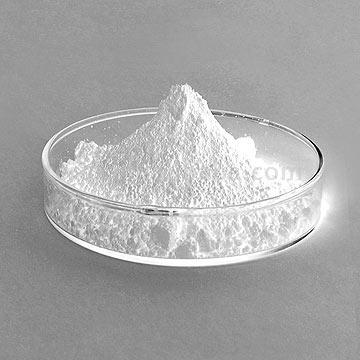
Strontium is found chiefly as celestite and strontianite. The metal can be prepared by electrolysis of the fused chloride mixed with potassium chloride, or is made by reducing strontium oxide with aluminum in a vacuum at a temperature at which strontium dissolves off. Strontium is softer than calcium and decomposes in water more vigorously. It does not absorb nitrogen below 380oC. It should be kept under kerosene to prevent oxidation. Freshly cut strontium has a silvery appearance, but rapidly turns a yellowish color with the formation of the oxide. The finely divided metal ignites spontaneously in air. Volatile strontium salts impart a beautiful crimson color to flames, and these salts are used in pyrotechnics and in the production of flares. Natural strontium is a mixture of four stable isotopes. The primary use for strontium compounds is in glass for color television cathode ray tubes to prevent X-ray emission.
5. Lutetium – Lu
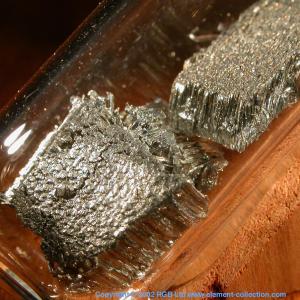
In 1907 Georges Urbain was credited with the discovery of the element and won the right to name them, although chemists later changed the spelling of lutecium to lutetium. Today, lutetium is primarily obtained through an ion exchange process from monazite sand ((Ce, La, Th, Nd, Y)PO4), a material rich in rare earth elements. Lutetium is one of the most difficult elements to prepare and has no large scale practical uses, although some of its radioactive isotopes can be used as a catalyst in the cracking of petroleum products and a catalyst in some hydrogenation and polymerization processes. Lutetium-176 has been used to date the age of meteorites. Lutetium Aluminum Garnet has been proposed for use as a lens material in high refractive lithography.
4. Chlorine – Cl
We all know never to mix chlorine with ammonia, right? Well, besides that potentially devastating fact, chlorine is widely used in making many everyday products. It is used for producing safe drinking water the world over. Even the smallest water supplies are now usually chlorinated. It is also extensively used in the production of paper products, dyes, textiles, petroleum products, medicines, antiseptics, insecticides, food, solvents, paints, plastics, and many other consumer products. Most of the chlorine produced is used in the manufacture of chlorinated compounds for sanitation, pulp bleaching, disinfectants, and textile processing. Further use is in the manufacture of chlorates, chloroform, carbon tetrachloride, and in the extraction of bromine. Organic chemistry demands much from chlorine, both as an oxidizing agent and in substitution, since it often brings many desired properties in an organic compound when substituted for hydrogen, as in one form of synthetic rubber.
3. Aluminum – Al

Remember the boom of aluminum siding back in the day? Well this stuff has thousand-and-one uses from soda cans to kitchen utensils, outside building decoration, and in thousands of industrial applications where a strong, light, easily constructed material is needed. Although it’s electrical conductivity is only about 60% that of copper, it is used in electrical transmission lines because of its lightweight. Pure aluminum is soft and lacks strength, but alloyed with small amounts of copper, magnesium, silicon, manganese or other elements impart a variety of useful properties. These alloys are of vital importance in the construction of modern aircraft and rockets. Aluminum, evaporated in a vacuum, forms a highly reflective coating for both visible light and radiant heat. These coatings soon form a thin layer of the protective oxide and do not deteriorate as do silver coatings. They are used to coat telescope mirrors and to make decorative paper, packages, and toys.
2. Zirconium – Zr
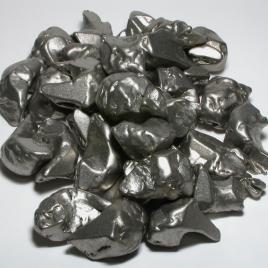
It is used extensively by the chemical industry where corrosive agents are employed. Zirconium is used in vacuum tubes, as an alloying agent in steel, in surgical appliances, photoflash bulbs, explosive primers, rayon spinnerets, lamp filaments, etc. It is used in poison ivy lotions in the form of the carbonate as it combines with urushiol. With niobium, zirconium is super-conductive at low temperatures and is used to make super-conductive magnets, which offer hope of direct large-scale generation of electric power. Zirconium oxide (zircon) has a high index of refraction and is used as a gem material. The impure oxide, zirconia, is used for laboratory crucibles that can withstand heat shock, for linings of metallurgical furnaces, and by the glass and ceramic industries as a refractory material. Its use as a refractory material accounts for a large share of all zirconium consumed.
1. Elements 112-118 Ununbium, Ununtrium, Ununquadium, Ununpentium, Ununhexium, Ununseptium, Ununoxium

Relatively new to the Periodic Table (they weren’t even heard of when I was in High School), elements 112-118. They are completely man made by bombarding specific atoms of one element with specific atoms of another thereby separating each into an entirely new element only stable (though not necessarily visible) for a fraction of a fraction of a second.
Ununbium was first created on Feb. 9th, 1996 in a lab in Germany. This element was created by fusing a zinc -70 nucleus with a lead-208 nucleus by accelerating zinc nuclei into a lead target in a heavy ion accelerator. The two ununbium nuclei so produced had a mass number of 27. On Feb. 1, 2004 the discovery of ununtrium and ununpentium were reported by a team composed of Russian scientists and an American scientist at the Lawrence Livermore National Academy. Most of the others were created or discovered much in the same fashion in different parts of the world since then. As of yet, since none of these have been witnessed for more than a second, their inclusion remains suspect and under investigation.
Bonus: Helium
Ben Miller experiments with superfluid helium – Horizon: What is One Degree? – BBC

It would be unforgivable to do a list of amazing elements without including Helium. First of all, it is the most popular element in parties – by inhaling the helium used to fill balloons, you can make your voice sound like Donald Duck. This is particularly fun when drunk. But, that is nothing compared to what helium does when it is dramatically cooled (-271c) – this is called the lambda point. At this stage (as a liquid) it is known as Helium II. Hellium II is a superfluid. When it flows through even capillaries of 10?7 to 10?8-m widths it has no measurable viscosity. In addition, it will creep up a container (as it seeks out a warmer area) seemingly against the effects of gravity. Just watch the clip above and be amazed!
And just when you thought it couldn’t get better, here is a link to YouTube to listen to:
Bonus 2: The Element Song
Tom Lehrer – The Elements – LIVE FILM From Copenhagen in 1967

As this is a science related list I thought we could have a Bonus 2 rather than just a boring old Bonus 2. This is a song by Tom Lehrer called the Elements Song. If that wasn’t enough for you, here is a young future scientist singing it at school in a talent quest.
More Great Lists
 Top 10 Bizarre Elements Of The Elisa Lam Case
 10 Real Counterparts of Comics' Particles, Elements…
 Top 10 Amazing Hidden Histories From The World's…
 Top 10 Amazing Scientific Phenomena Caught On Video
 Top 10 Amazing Prehistoric Creatures With Unexpected…
 Top 10 Amazing Places You Can Visit (In Minecraft)
 Top 10 Amazing Inventions Of The 1900s
 Top 10 Amazing Women Of The Ancient World
 Top 10 Amazing Flea Market Finds Worth A Fortune
fact checked by
dickensgirl
More Great Lists