This list is in response to all the suggestions in the comments on the Top 10 Sci Fi Inventions that Shouldn’t be Invented. While there are tons of inventions that have various dangerous aspects there are many that would benefit the human race with hardly any dangers.
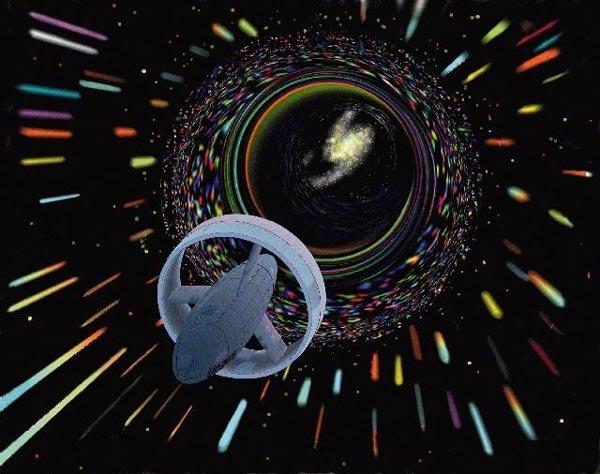
Interstellar space travel is unmanned or manned travel between stars. The concept of interstellar travel in starships is a staple in science fiction. Interstellar travel is tremendously more difficult than interplanetary travel due to the vastly larger distances involved. Imagine being able to travel to distant worlds, discover new horizons and colonize space, all in the blink of an eye.
Can it be done? The NASA Breakthrough Propulsion Physics Project identified two breakthroughs which are needed for interstellar travel to be possible:
A method of propulsion able to reach the maximum speed which it is possible to attain
A new method of on-board energy production which would power those devices. [Wikipedia]

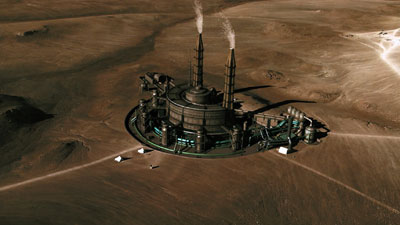
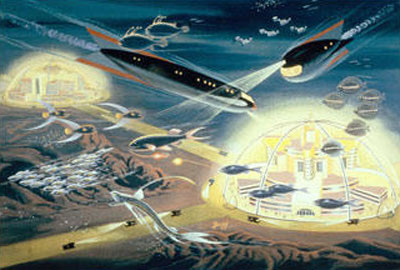
Terraforming (literally, “Earth-shaping) is the hypothetical process of deliberately modifying its atmosphere, temperature, surface topography or ecology to be similar to those of Earth in order to make it habitable by humans. This must become a reality if there is to ever be interstellar colonization. But isn’t the ultimate dream for humans to propagate and colonize the entire galaxy?
Can it be done? Well, in theory, yes. Here’s how:
Ecosynthesis. This is a term used to describe the use of introduced species to fill niches in a disrupted environment, with the aim of increasing the speed of ecological restoration.
Paraterraforming: This is the construction of a habitable enclosure on a planet which eventually grows to encompass most of the planet’s usable area. [Wikipedia]
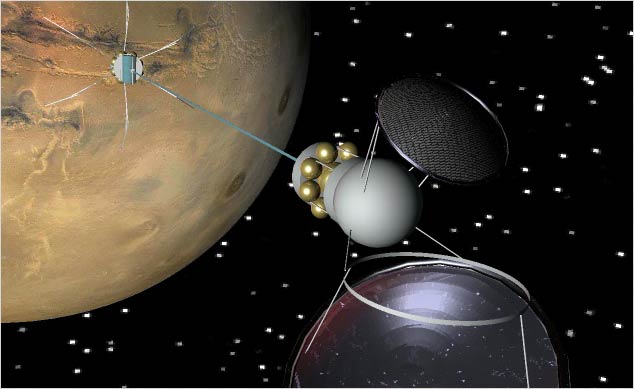
A space elevator is a proposed structure designed to transport material from a celestial body’s surface into space. The term most often refers to a structure that reaches from the surface of the Earth to geosynchronous orbit (GSO) and a counter-mass beyond. This device would facilitate construction in space, launching of satellites and space travel (via the “slingshot effect”).
Can it be done? Absolutely. The most common theory is a tether, usually in the form of a cable or ribbon, spanning from the surface near the equator to a point beyond geosynchronous orbit. As the planet rotates, the inertia at the end of the tether counteracts gravity, and also keeps the cable taut. Vehicles can then climb the tether and reach orbit without the use of rocket propulsion. [Wikipedia]
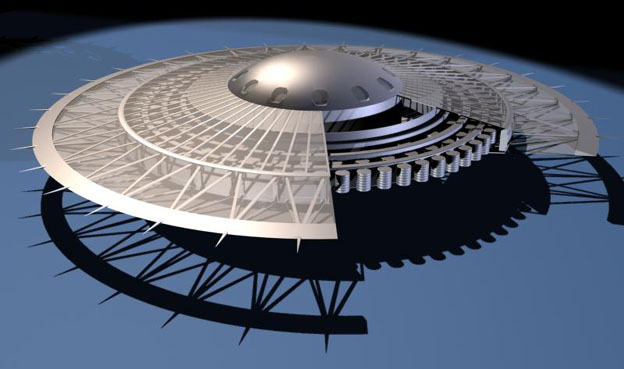
Typically, energy shields are some form of force field designed to protect against weapons or elements by deflecting or absorbing their impact. The field is projected along the surface of, or into the space around an object. They usually work by absorbing or dissipating the energy of the incoming attack; prolonged exposure to such attacks weakens the shield and eventually results in the shield’s collapse, making the protected area vulnerable to attack.
Can it be done? This one is a toughie. Scientists are toying with the possibility, but a number of obstacles must be overcome before it could ever be conceived.
Energy. The cost of the projection of such a shield would be phenomenal, to say the least.
Technology. It all comes down to projecting energy into a solid form. Once we can do that, the rest is history. [Wikipedia]
The panacea is a remedy that would cure all diseases, and prolong life. It is the ultimate cure for cancer, aids, viruses, everything. For millennia it has been thought of as simply a pipe dream, but as medical science advances the idea of a panacea is coming far closer to reality.
Can it be done? In theory, yes. The advances of medical science in genetics (specifically the interplay of inherited genes and the environment), and the immune system are lending more credibility to this idea every year. It is certainly imaginable within the lifetime of the current generation. [Wikipedia]
Antigravity is the idea of creating a place or object that is free from the force of gravity. It does not refer to countering the gravitational force by an opposing force of a different nature, as a helium balloon does; instead, anti-gravity requires that the fundamental causes of the force of gravity be made either not present or not applicable to the place or object through some kind of technological intervention. The practical applications of antigravity range from reduced transportation costs, to gravity manipulation in space.
Can it be done? The short answer to this one is no. However, there are theories that seem to indicate the existence, or at least possibility of antigravity. One of the most common is the Biefeld-Brown effect. This effect is not technically antigravity, however it duplicates the effects. Basically, a cloud of positively charged ions are attracted to a negative smooth electrode, where they are neutralized again. In the process, thousands of impacts occur between these charged ions and the neutral air molecules in the air gap, causing a transfer in momentum between the two, which creates a net directional force on the electrode setup. [Wikipedia]

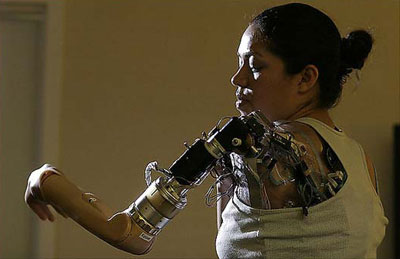
Bionics is a term which refers to flow of ideas from biology to engineering and vice versa. Hence, there are two slightly different points of view regarding the meaning of the word.
In medicine, Bionics means the replacement or enhancement of organs or other body parts by mechanical versions. Bionic implants differ from mere prostheses by mimicking the original function very closely, or even surpassing it.
In technology, Bionics refers to the development of specific technologies which mimic biological adaptation to the environment. Examples include a ships hull that mimics the thick skin of a dolphin, or sonar, radar, and medical ultrasound imaging imitating the echolocation of bats.
Can it be done? Yes. This technology has been in development for a number of years and, while still in the early stages, has already produced many devices. Examples of technological bionics include Velcro and Cat’s eye reflectors. Examples of medical bionics include artificial hearts and the cochlear implant. [Wikipedia]

Municipal Wi-Fi is the concept of turning an entire city into a Wireless Access Zone, with the ultimate goal of making wireless access to the Internet a universal service. This is usually done by providing municipal broadband via Wi-Fi to large parts or all of a municipal area by deploying a wireless mesh network. The typical deployment design uses hundreds of routers deployed outdoors, often on utility poles. The operator of the network acts as a wireless internet service provider.
Can it be done? Actually, this technology already exists in many cities throughout the world. However, it is not common enough to be considered mainstream. Usually, a private firm works closely with local government to construct such a network and operate it. Financing is usually shared by both the private firm and the municipal government. Once operational, the service may be free, supported by advertising, provided for a monthly charge per user or some combination. [Wikipedia]
A transatlantic tunnel is a theoretical tunnel which would span the Atlantic Ocean between North America and Europe and would carry mass transit of some type—trains are envisioned in most proposals. Using advanced technologies, speeds of 300 to 5,000 mph (500 to 8,000 km/h) are envisioned. The implications of such a tunnel are massive. Imagine being able to go from New York to London in less than an hour. Or shipping goods overseas at a fraction of the cost and time.
Can it be done? Plans for such a tunnel have not progressed beyond the conceptual stage, and no one is actively pursuing such a project. The main barriers to constructing such a tunnel are cost—as much as $12 trillion—and the limits of current materials science. A Transatlantic Tunnel would be 215 times longer than the longest current tunnel and would cost perhaps 3000 times as much. [Wikipedia]

Ocean colonization is the theory and practice of permanent human settlement of oceans. Such settlements may float on the surface of the water, or be secured to the ocean floor, or exist in an intermediate position. Advantages of ocean colonization include the expansion of livable area and expanded resource access. Many lessons learned from ocean colonization will likely prove applicable to space colonization. The ocean may prove simpler to colonize than space and thus occur first, providing a proving ground for the latter.
Can it be done? Yes, but the economic realities must be considered. To become self-sustaining, the colony must aim to produce output of a kind which holds a comparative advantage by occurring on the ocean. While it can save the cost of acquiring land, building a floating structure that survives in the open ocean has its own costs. One of the most realistic possibilities is the export of electricity from tidal energy. [Wikipedia]
This article is licensed under the GFDL because it contains quotations from the Wikipedia articles cited above.
Contributor: Mystern


Crimanon: yeh, you could say this site- among other things is a poetic outlit for me. a dada-istic enjoyment.
p.s. english? what's that?
oh p.s. Crimanon: Do you always juggle among the party with questions and comments. I know you do. That's a good trait to have.
Mom424: Hydrogen? As an alternative to fossil fuel? You must be joking. Hydrogen is a pipe dream. Anyone who has done any amount of substantial research into alternative fuels knows that electricity is cheaper, more stable and overall better than any other. Not only do we have the political issues with hydrogen, like you mentioned, but there is the technological aspect. Hydrogen cells are far from even being out of the test phases and it costs enormous amounts to even make a hydrogen engine. Electricity has been around for over a century. It's cheap, stable and we understand it. The government pours loads of money into hydrogen research because they do not want an alternative. They know that a mainstream hydrogen engine is 25+ years into the future. And all during those years the oil companies get rich on the western worlds addiction to black heroin.
Diogenes: A poetic outlet? Wow, I never thought about it like that, I thought it was just called gay.
Mystern: I don't know, hydrogen is a possibility in the next 20 or so years, which will greatly effect my generation. Might happen might not, but it would take a lot of electricity to power over 4 billion cars across the world, that's after we replace all the gasoline powered ones though. A lot of that would be produced through fossol fuels, ergo, more global warming. So hydrogen seems like the best alternative, that or solar power.
Csimmons: aww! ouch. .
. you got me. and i thought you were my friend!?
this hellish sort. what's to be done?
I suppose my answer should be: ***** you.
but I know you just want luvin–so I couldn't be so harsh.
you'd be right, not that way though
diogenes: in my dorm in college, if you weren't going to at least the 4th floor you were physically removed from the box.
a pet peeve of mine in the same vein is when perfectly normal people with open arms push the handicaped button to automatically open a door so they don't have to expend the energy to pull the door.
america at its finest and laziest. http://www.norcalblogs.com/bullfight/archives/fit…
I guess this one should qualify in the next list of inventions that must be invented:
a medicine that enables amputated/cut/broken body parts to grow back normally. (I don't know if this is true, but it has been said that scientists have been studying a lizard's tail to find out what is the stuff that enables lizards to grow back their tail, so that this "stuff" can be used to allow amputated/cut/broken body parts to grow back. I haven't done much research on the matter yet, but it could actually be possible.)
Or this. An vehicle engine that uses polluted air as fuel and gives off clean air as a by-product. This may be downright impossible however.
Mystern; we're talking in the future when we run out of fossil fuels. We have 25 years or more, not lots more, but more. Electricity is grand for stationary applications; houses, industry, permanent rail lines etc; pretty much useless for anything off the grid. Batteries have a finite range, recharging is time consuming and extension cords are only so long. Most electricity is still produced by burning the fossil fuels we are running out of, burning of bio-fuels to produce electricity is not much better for the environment and photo-electric cells are not efficient enough. Personally I think a combination of Nuclear/Geo-thermal/Wind is the way to go. I already know quite a few farmers with private windmills hooked up to the grid. They receive credit when they have a surplus of power and of course are still wired in for when there is no wind or require more power than they can supply. Hydrogen can be produced with little cost to the environment (only by using electolysis, the other ways to process hydrogen use fossil fuels/methane) and you can take the fuel with you. Like I said, it's working in Denmark and it is renewable.
SlickWilly/DiscHuker: One of my biggest pet peeves as well is people going up just one floor on the elevator! It's infuriating.
The only time I do that is at my doctor's office where there are just these big elevators and I cannot for the life of me find where the stairs are, I've looked every time haha.
Ever since I heard of the concept of a transatlantic tunnel, I've imagined an accident or terrorist attack trapping people inside. Could make a good movie!
Mom424: You are correct in saying that batteries have a finite range. This is the biggest obstacle electric powered vehicles have. A combustion engine will get perhaps 400 miles to a tank of gas, whereas it used to be that an electric car could get 70-80. However advances in battery technology have come from a not so surprising place recently, cell phones and laptops. The furthest distance an electric car currently in production can travel is 200-250 miles. I'll be the first to admit that there are some days where I do drive more than 200 miles, but it's not often. With a 4 hour charging time, that ain't bad. There are so many obstacles that hydrogen must overcome that it would be far more economical to put that research into electricity. Already in the test stages are batteries that last twice as long and are half the size of current Lithium-Ion batteries, and have a charge time of 10 minutes. For a long haul, electricity would not work, that's simple fact. But electric vehicles could immediately replace 80% of the combustion vehicles in the world this very instant and nobody would notice a single difference.
On the note of electrolysis. It seems great but I've asked a number of experts on the subject and they all said the exact same thing, it's not worth it. It takes more energy to separate the hydrogen/oxygen than the hydrogen has stored. The technology has been around for decades, and if it were a viable source of hydrogen, believe me, it would be more common.
And as a last note, 2 things. 1. I would like you to find me a link to what you are referring to in Denmark, because I am not familiar with it. 2. Perhaps this man has the answer >http://www.youtube.com/watch?v=ejHXMqPfytw
Diogenes; English, a language that people equate with both Intelligence and stupidity.
And Always.
I honestly believe that Interstellar travel will not be achieved in this millennium.
Mystern; just google it, Iceland is doing it too. Wikipedia has an article and so does the danish tech institute. I did misspeak, in Denmark they are using wind power not nuclear to make hydrogen fuel cells. You are correct about the prohibitive cost of processing hydrogen, but if oil continues its climb, it won't seem so outrageous. Kind of like the Tar Sands in Alberta; we've known about it for years, but it took higher prices of crude to make it economically viable to separate the oil from the sand.
I imagine what will eventually happen is that we will have mostly electric everything (of course barring some brand-new technology)with hydrogen fuel cells for some transport/cartage functions. For when you have to venture "off grid".
I also forgot to mention the biggest, best renewable resource. Hydro electric power. We have tons of it in Ontario, in fact our utility is named Ontario Hydro. Utilizing tides (I think we're doing it in the Bay of Fundy) is the next step.
DANTE: You're probably right, I hope it does though, but it is very unlikely, maybe next century though, you never know.
Nikola Tesla created the Anti-Gravity thing in near 1900
Mortz: Let's see your Anti-grav "Thing"
That's a big Negative on anti-grav,
http://wiki.answers.com/Q/How_does_Nikola_Tesla&#…
Take some tech courses.
i want a freakin time machine.
most of these sound dangerous.
panacea sounds the most dangerous..or maybe it seems dangerous cause i watched I Am Legend too much.
So maybe interstellar travel will help us with time travel somewho?..like something out there…
but even that is dangerous..but its such a nice idea
but i read too many books on the possibilities of time travel
and watched donnie darko too much
Nikola Tesla did the mosts impressive inventions of the history of humanity. In 1900 he did WHAT WE JUST DON'T KNOW HOW-TO-DO TODAY !
One of the most impressive things he did, after Anti-grav stuff, is the Death-ray. When he tested it, 900km of area were instantly destroyed and nobody knew why. He disseambled it because he thinked it was too dangerous.
*****ing Genius.
Motrz: You don't read the comments do you? There was no Anti-grav.
Do some research, Find Proof of the "Peace Ray" and not just a bunch of "We Think" BS.
Wow, if all those filims will come true, i wonder what will the science fiction movies of tomorrow will show. hehehe, just a thought.
http://www.inquisitiveworld.net
When I was a kid I wanted a medicine that would cure anything.
I think the cure-all would be grand…
I mean, sure it's great for people to die and such, but try telling somebody with Cancer or AIDs that disease is a great way to control the population…
If you haven't read "timeline" by Michael Crichton, please do. It puts time travel in a whole new prospective, and how he addresses quantum physics really gives you something to think about.
or is that perspective?
I like #2 and #3 the rest are not attractive. I love to hear the development of wireless electricity by Tesla.
http://www.braincourse.com/wirelessa.html
A Panacea (#7) does not exist in pill form, but we already have it. There are chimpanzees today that have knowledge of medicinal plants. Our collective memory is millions of years old, and can be re-learned. Everyday foods are very good for us. Example: yogurt, just ask Bulgarians. Check it out. By combining the things that work now, we can achieve this one the easiest.
I love this list of inventions. Living in the oceans would be awesome.
On the subject of Global Warming. Someone said 95% of scientists believe in anthropomorphic or man-made Global Warming. This is not true. Most of them are afraid of losing funding if they speak out against man-made global warming. Others want to jump on the band wagon and write a book and make a name for themselves. 36000 scientists just signed a petition saying they think it is premature to say, categorically, that man contributes to Global Warming. Also, what is causing the other planets' global warming such as Mars, Saturn and Jupiter? No SUVs there! Also, heat increases Co2 levels not the other way around. Deep-Sea sensors show the Oceans are cooling not warming up. And, many Solar Scientists are saing the Sun has begun a cooling phase and that we should expect a cooling period is imminent for the Earth.
I like how on #3's picture, Cnaberra Australia is lit up
Gods, I love this site.
GOOD LIST. HOW ABOUT THE MILK THAT DOESN'T SPILL IN THE OVEN? THAT WOULD BE A GREAT INVENTION!
.. where's non-cling saran wrap?
The next class of drugs won't allow the virus/bacteria to mutate, each drug will be engineered to destroy a particular microbe by recognizing it's receptor sites and then will do it mechanically with a series of microscopic spikes, they're already doing serious research in this, it wouldn't be nanites either just micro-engineered particles. A microbe adapting to this kind of medication would be like a human growing bullet-proof skin.
Research with stem cells has already yielded transplantable organs, growing limbs might not be more than 30 years off.
If we saw interstellar travel within our lifetimes I feel it would be catastrophic. I like to think positively but the odds of us finding something that we really don't want to find is probably pretty high. According to Professor Issac Asimov there could be hundreds of thousands of inhabited planets in the galaxy, just based on our own chemistry. I don't feel we're even close to ready to comprehend things outside our own solar system that closely especially given the aggressive nature of all the plants and animal on our own planet not to mention things that go beyond our ability to *****ytically understand with any accuracy.(no I don't believe "UFOs" crash landed and people get probed while they sleep because the distances between these inhabitance is so great it's not likely we'll ever contact any of them ever, unless we find something that causes us to rewrite physics.)
A space elevator is a fantastic idea and solution but it also requires that we have material that won't fail when it's subjected to that kind of tension, which we don't have as of yet.
Terriforming on a planet size scale wouldn't work unless the planet is roughly the size of earth or all the atmosphere would bleed away into space, so mars wouldn't work like that, we could use domes and such things though.
Ocean colonization isn't a very good idea underwater, yes your extending the area you can live but at probably 20 times the cost and 40 times the danger.
number 1 sounds like Bioshock…creeeepy
Wonder how they fend off space debris away from the space elevator.
another invention would be a scan of all the atoms in a set area the result wich would require several advancements in nano-technology would include teleportation, terraforming, paraterraforming, and so much more just imagine it!
cheese
I dont think we should have Ocean Colonization in our future since we tend to destoyed alot of things. but then again could be interesting to see what it like to live underwater.
I would like to see you take this a step further. 10 Technologies that Would Destroy the World Economy and lead to millions of dead. I know it's dark but hey. For example:
1) Food Replication. Assuming ti requires no raw material, suddenly the demand for grown vegetables and animals goes away almost immediately. Millions world wide lose their jobs, homes and farms. Transportation, refrigeration, boxing, processing, rtc. All lead to a massive failure of the economy
There should be some advances in ethics or moral codes. Science has advanced quite a bit already, we need to figure out how to keep up or even get ahead of science in our belief system. For example; stop wars, stop greed and monetary meltdowns, etc. First to do that there should be some way to measure pain, suffering, happiness,etc.
When science started to advance they began with alchemists who tried to make gold. They had to figure out the periodic chart to determine that gold was a base element and could not be made except maybe by some galactic explosion.
We have to invent some sort of periodic chart for our beliefs and emotions so to determine what can and cannot be done to contain / or advance human reason.
Many people have commented about economic failure…
They are valid and moral comments, though are short-sighted.
Economics always adapts to the situation, and if millions of people lose their jobs due to these inventions, they (or future generations) will be directed towards new types or areas of employment.
For example, they could be directed towards food replication industries.
I understand the moral complexities though of millions of unemployment.
I haven't read all of the comments, so inagine this one has already been suggested, but how about a global translation device. In the shape ofa a yellow fish that fits into the ear, of course
Love the blog layout!
I don't know how I feel about colonizing the oceans. After all we already have land and even though its gonna run out pretty soon its still going to be here for a long ass time. And fish live in the *****ing ocean. NOT US
a time machine would be nice
In response to the people saying a panacea would lead to over-population: well that's what the terraforming and space colonization is for. By the time we find a cure-all, we'll probably be in the process of developing a way to colonize space.
And ocean colonization seems rather pointless. Its just as dangerous as space is, only in space there is A LOT more room and we'll need to get up there anyway, so why bother with the ocean.
What about a colony on the Moon?
I want to make an invetion called the PONCHORELLA the steps are a :umbrella,poncho curtain and some little clips.
I think ocean colonisation could be quite dangerous; we don't know enough about it to do it safely, and we'd end up destroying the ecosystems in the oceans, not just on land.
This is, to my mind, rather human-benefits-now orientated; there are possible future dangers to the human race from several of them (though I do understand you can't have progress without risk) and also to other species/possible aliens.
My suggestion for a great invention would be cold fusion (yes, I know other people have suggested it, but it would be a great benefit, what with its very small environmental impact and very large energy output).
Also, someone suggested direct mind-to-computer contact. That has actually already been invented; someone (perhaps in 2006?) got a brain implant that allows them to communicate directly with a computer, because they were paraplegic. I can't remember any sources, but have a look!
what about time travel and teleportation?
problem in #1 is the displacement to the water.
As we increase space in the ocean we also decrease in lacd space. So we turn to be water species?!
I dont agree with #8.
The danger there is the asteroid impacts.
There would be a lot of accidents with it.
the water pollution also increases due to lack of discipline to people.
I disagree with #1.
I mean, have you played Bioshock?
Figure out anti-gravity propulsion, and you’ve just solved 7.5 of environmental issues.