Cars have become an essential object for most people these days – and there are probably few (if any) people still alive who remember the days before automobiles were on the roads. This list takes a look at some of the interesting “firsts” in motoring.
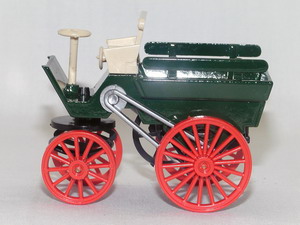
In 1883, 27 year old Edouard Delamare-Deboutteville built the very first petrol driven automobile. The motivation for doing so was to find a good alternative to horse transport for his father’s cotton mill. He was helped by his father’s mechanic, Charles Malandin. They modified an 8HP stationary gas engine for use with petrol as a fuel and fitted it to a four wheeled hunting-brake. [Image: a small scale model of the car built by Delamare-Deboutteville and Malandin]
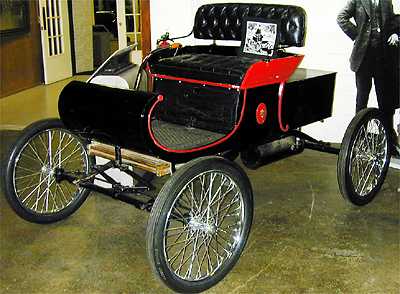
The first instance of mass-produced petrol driven motorcars occurred in the USA. The car in question was the curved-dash Olds. It was the first car to be produced in quantities greater than 10 per week, making its appearance in public in April 1901. By the end of the year the total number of cars made was 433, and this number rose to 5,508 per year in just three years. The car retailed at $650 – significantly less than other cars at the time. [Image: 1901 curved-dash Olds]
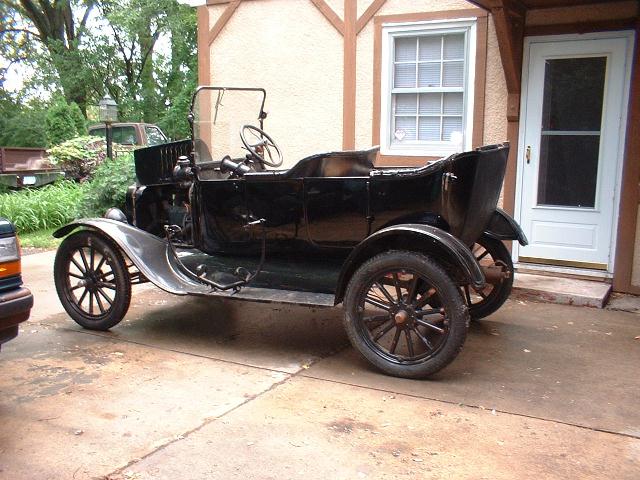
The first car radio was fitted to the passenger door of a Ford Model-T by 18 year old George Frost, president of the Lane High School Radio Club in Chicago in May 1922. In November that year, the first radio was installed in a Daimler limousine by the Marconi-phone company and displayed at the Olympia Motor Show in London, England. [Image: 1922 Ford Model-T]
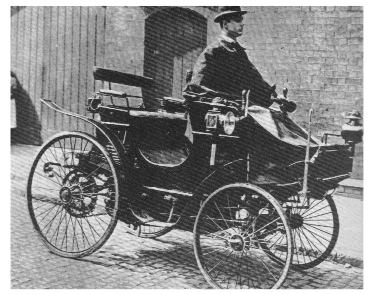
The first car theft in history occurred in Paris, France, in June 1896, when Baron de Zuylen’s Peugeot was stolen by his Mechanic from the manufacturers where it was undergoing repairs. Fortunately for Baron de Zuylen, both the thief and the car were found later at the nearby town of Asnieres. [Image: 1896 Peugeot]
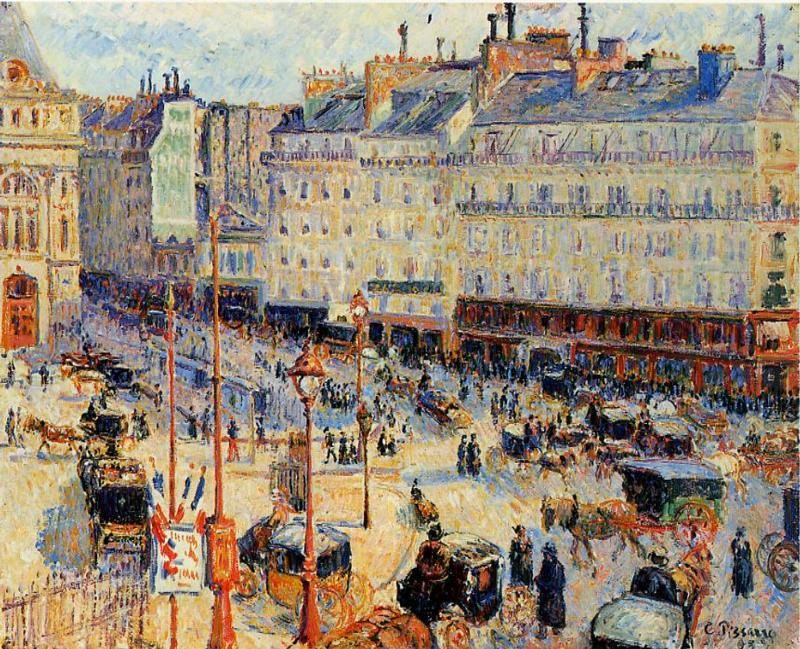
The first vehicle registration plates were introduced in France by the Department of the Seine under the Paris Police Ordinance of 14 August 1893, which stated: “Each motor vehicle shall bear on a metal plate and in legible writing the name and address of its owner, also the distinctive number used in the application for authorization. This plate shall be placed at the left-hand side of the vehicle – it shall never be hidden.” In a general decree of 30 September, 1901, this rule was extended to include the rest of France. [Image: Camille Pissarro's The Place du Havre, Paris, 1893]
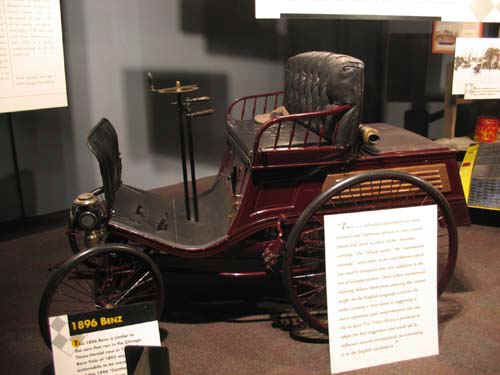
The first death by motoring happened on August 17, 1896, at the Crystal Palace, London, when Bridget Driscoll of Croydon was run over and her skull fractured by the wheel of the offending car. The driver (Arthur Edsell) was employed to give joy rides in a Rogers-Benz on the terrace of the Crystal Palace. Driscoll was crossing the road when she saw the automobile hurtling toward her at the speed of 4 mph. She took fright and stood still in the path of the oncoming car. The death was ruled accidental. [Image: 1896 Benz]
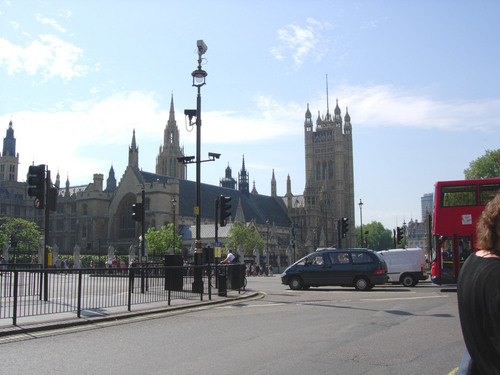
The first traffic lights were installed on a 22ft cast iron pillar at the corner of Bridge Street and New Palace Yard off Parliament Square in London and began operating on 10 December 1868. The installation was made at the direction of the Metropolitan Police in order to make it easier for politicians to enter the Houses of Parliament. The lights consisted of a revolving lantern and a red and green signal. The lantern was turned by hand. The sign was (not surprisingly) not popular with the general public, and one man is quoted as complaining that it was “another of them fakements to wex poor cabbies”. It remained the only traffic light in London until its removal in 1872. Traffic lights were not re-introduced to London for another 50 years. [Image: site of the world's first traffic light]
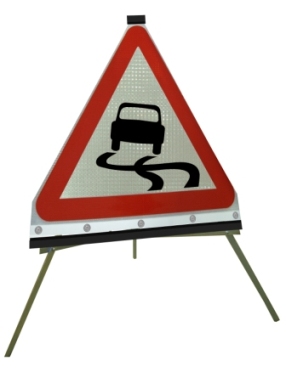
The first traffic signs were erected in Britain in December 1879. They were installed by the Bicycle Union and consisted of a wooden post with an enameled iron plate bearing the warning: “To cyclists – this hill is dangerous”. In 1901 the first signs directed specifically at motorcar drivers were introduced in Gloucester. The first internationally standardized signs (a red triangle surrounding a plate with an agreed symbol) were agreed upon in 1909 in France. [Image: first motoring traffic sign design, still in use today]
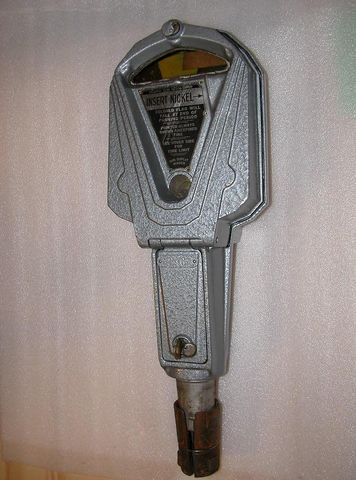
The first parking meter was devised by Carlton Magee, the editor of a leading Oklahoma City Newspaper. Magee was the chairman of a committee set up in 1933 to inquire into methods of imposing stricter parking controls in town. Magee created the Dual Parking Meter Company (so called because of the fact that the meters served two purposes: parking control and revenue generation). The first meters came in to service on July 16, 1935. [Image: Magee's parking meter - the first in the world]

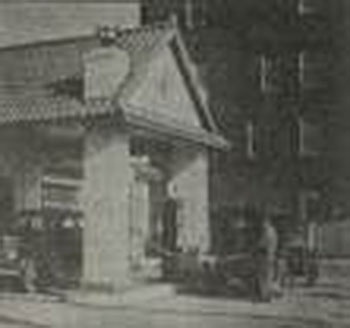
The first bulk-storage petrol filling station was operated by the Automobile Gasoline Co., founded by Harry Grenner and Clem Lessing at St Louis, Mo. in 1905. The petrol was dispensed through a garden hose connected to a gravity-feed tank. The first station with a forecourt and projecting canopy (the form mostly in use today) was opened by Standard Oil of California in Seattle, Washington, in 1907. [Image: the first gas station - best quality copy available on the internet]
Contributor: Maman


Hahaha 4 mph!!!! I seriously doubt that's possible….being crushed at 4 mph…
Let’s do the math: 100 pound girl, 1500 pound vehicle with torque and made of metal. Figure it out.
fascinating list! that first death was so sad.
Lol..she got scared of a vehicle coming at her a 4 mph….omg how times have changed….ill step into traffic while cars are comin at me at 60 mph…hahahaha
Great list, these are really interesting.
Louis: You’ve got to remember that back in those days cars were not common at all, and seeing one for the first time, especially coming straight towards you, would have been terrifying for some people.
4 mph isn’t that much faster than walking pace. You can be crushed at any speed if the other thing is bigger and more solid than you.
The inquest coroner said he hoped that “such a thing would never happen again”. Fat chance.
HAHAHA… great list. Very original idea, this site gets better and better every day!
BTW, I woke up at 6 am to try and be first… what a waste of a Saturday morning
Phender_Bender: What an appropriate name you have for this list!
nice list..funny how many of these things are taken for granted these days..
Great list. I learned that a lot of the firsts occured in places other than the U.S.
*occurred*
Not my kind of list. But I still liked to learn about the first car theft.
This is an interesting and unique list! It makes me want to visit museums today. I am always fascinated with
This is an interesting and unique list! It makes me want to visit museums today.
oops… my dog jumped on my laptop…
That first fatality- just like that scene in Austin Powers with the steam roller. Pure comedy. It’s ok to laugh at it if it’s been 112 years, right?
Louis: I guess it doesn’t matter how fast – if you are in the way of a moving object you can die – as this lady did!
Logar: that was the exact same thing I pictured in my head when I read that!!!! That’s halarious!! I guess reflexes have evolved along with cars, I’ve personally can say I have avoided cars coming at me wayyyyy faster than that in my lifetime. Awesome list….I like to see more of these kinda of lists.
JOE BLACKK: there will be many more of this kind I am sure
I am glad to see an automotive list that doesn’t include many of the big companies and shows how it wasn’t all about American innovation of automobiles like many history books slant towards.
Also the images come up at random and I have yet to see all ten on this list or the last list at the same time. I keep refreshing the page but to no avail.
Great list. I didn’t think an automotive list would be interesting to me at all, but this one was was very cool.
This is a great list! It’s cool to see how things develop and change.
jfrater,
I’ve not looked at this list yet, but saw you in the recent comments. I’m blocked out of a list, or cannot get into it. It came and went for a bit and is now completely out. I tried to contact you without success on your given e-mail. If you read this and can be bothered, you know mine.
O.K. Line clear for Maman’s topic again now.
#8 I believe it is Lane Tech High School. Lots of my students go there. Tech (Technical)
Gas prices, a topic of discussion on everyones mind of late, comes with this.
I took a photo while in a Uni class, of an old filling station (still in business at the time), with a sign advertising Ethyl at 35 cents!
Wonderful list, Maman. You managed to find information from diverse countries, and on topics one might not ordinarily think of.
Thumbs up!
Damn, pretty interesting list. But seriously how do you get run down by a 4 mph car?
#5 Wasn’t the Edsel the huge Ford failure. Too funny.
Oh, I forgot. Weren’t there elecric cars before gas?
I’m pretty sure the Egyptians had some type of traffis signs or signals. Way before the western world.
“traffic”
There is an interesting variation on place indication signs during a period when they existed virtually exclusively for motorists. (Obviously they were around long, long before the advent of the internal combustion engine.) I can only speak for Britain, but during the Second World War, a lot of the major, important ones were removed. This was so that they could not be used as a guide if the Germans invaded. It is also said, I don’t know whether with any truth, that when the danger of Operation Sealion was imminent, some were deliberately left, but pointed in wrong directions to add confusion to enemy transpor officers working from their Baedeker guides.
Apropos. There was a strong rumour going around that groups of German paratroopers disguised as nuns were the vanguard. They were said to be identifiable by their jackboots! We Brits may have interned luckless German-Jewish refugees, but at least we didn’t round up the good ladies of the Roman Catholic church on that score.
mike,
Unlikely, but I believe there is quite a list of fatalities due to being run over by bicycles, including a well-known French composer. I suppose in this case an unlucky fracture on hitting the ground after being knocked off balance. That can happen by a simple fall anywhere, any time.
Vera Lynn: Do you mean that the Egyptians invented traffic signs BEFORE there was traffic?
Wow, they were incredible visionaries!
May I add another incredibly important one?
I’d been told the story before on several occasions, but needed to repair to Wiki to brush up on the facts, names. and figures.
In 1933 Percy Shaw of Halifax, Yorkshire, England, invented the cat’s eye reflector system. The apocryphal story has it that he was driving home after a party and saw the eyes of a cat shining at him from the side of the road, which inspired him. Wikipedia gives a more prosaic origin. It says he used shining tram-lines (trolley-lines: USA)in the street at night as a guide. When these were removed the idea of the reflective cat’s eye occurred to him. I understand the road cat’s eye can be made up of a translucent matrix filled with innumerable tiny reflective glass balls, or is simply one large reflective sphere.
Shaw is said to be one of those rare inventors who actually significantly benefitted from the profitability of his patent. I sincerely hope so.
Segue; Thank you so much for making me feel my age. When I was a little kid (my father was driving a 57 Chev Bel Air at the time) my daddy would always make us do math problems in our heads. If we are traveling 100 miles and gas is 34 cents a gallon, how much money will it cost to go to the lake? I distinctly remember gas at less than the cost you cited in the “old” picture. As we got older the math problems increased in difficulty and complexity. We all dreaded the long drive to the cottage, and privately cursed our father for it; but to this day we are all quite capable at math, with or without paper and pencil.
Great list, Jamie’s mom! (I’m surprised noone’s mentioned that yet.) I got a chuckle out of the 4 m.p.h. death because sometimes I can have a morbid sense of humor. It reminds me of, among other things, a scene from Invader Zim when Zim was crushing the Earth with Mars. It very slowly approached Earth and there was one guy screaming and yelling, but it was travelling so slowly that it was funny that it just ran on and on. Okay, maybe that was one of those “you had to see it” funny things, but I liked it.
Great List, but for some reason on this list and the list before it, not all of the pictures are showing up. On this list only one picture showed up, I refreshed and a couple more showed up, but not all of them.
interesting. or should i say fascinating
Maman – a very interesting (and unexpected) list!! Re #4..I’ve driven through there many, many times and didn’t have a clue about its history
Love the list, but I can’t see most of the pictures? This was so interesting! I’m glad I wasn’t the only one who thought of Austin Powers while reading about the first fatality. Poor thing…
One first I didn’t see was the first speed limit. Anyone know when that came around? That would be fun to know.
Nice to know it was someone from my home state who created parking meters…that’ll be an interesting bit of trivia when I am at work.
The first automobile theft amuses me.
Not quite what I had expected by good none the less.
image problems should be fixed now.
****
34. Mom424
Segue; Thank you so much for making me feel my age. When I was a little kid (my father was driving a 57 Chev Bel Air at the time) my daddy would always make us do math problems in our heads. If we are traveling 100 miles and gas
is 34 cents a gallon, how much money will it cost to go to the lake?
****
Always happy to lend a hand where needed, Mom424
When my son was in Math competitions, I was usually one of the parent supervisors; this pretty much meant I drove a group of kids to and fro, and,at the competition site, keeping them in eye-sight at all times. While on the drive to the competition site, I’d have them do math problems in their heads using the last three numbers of the license plate ahead of us, using any form of math, to finally equal the single digit which came first. For example, a CA plate might read 4ABC736.
One of the kids would sit out each problem, to check the veracity of the answer based on the math involved.
It was always pretty funny.
I would have failed your father’s yearly trip-test, as I have said before, my math skills are very selective. They’re astounding for what they are, but useless elsewhere.
What? no nuclear powered car?!
Nelia (39),
I don’t have the data, but in the early days of motoring in Britain there was a period when you were obliged by law to have a person with a red flag WALK in front of your car to warn the public. That was not enacted in time to save poor Bridget Driscoll, it would seem. Or was she the reason for it? I presume it came after her accident.
wow, that poor lady killed at 4mph. but pretty funny though.
i guess that if i saw someone flying around on their dinner table at 100ft high, even if it was only at 4mph, i would probably stop and stare and might even be frightened (they are obviously into the “dark arts”)
One of the things this list did was get me to thinking about another loss my illness has handed me.
I no longer drive.
This is my own decision. I have a perfectly valid drivers license, but the last time I drove I totaled two cars…the one I was driving, which belonged to a friend, and the one I ploughed into.
When the Highway Patrol arrived, he asked a few questions. I was absolutely frank about being at fault. I was driving a car unfamiliar to me, and I had looked down to find the air-conditioning switch. In the split-second that took, the traffic ahead of me came to a dead stop, and my dulled reactions just didn’t respond. (Although “dulled reactions” didn’t make it into the statement).
He asked me if I had been drinking.
“No”
He asked if I had taken any drugs.
“Just my prescription Oxycondon”
He looked as if he’d just come across the kingpin in a drug cartel, and this was his chance at a promotion. He slapped cuffs on me, threw me into his car, and drove me off the freeway. Down on the sidewalk, he administered a DUI test, all of which I passed except the heel-to-toe walk which, as I explained to him, I couldn’t do in my neurologist’s office, either.
Back went the cuffs (behind my back, of course, which made the pain so much worse I eventually was crying), and to the station. I was held for 6 hours, retested every 30 minutes with identical results. At some point he took me to a nearby hospital to have blood drawn, which resulted in a bruise half-way up and down my arm.
When it became clear, even to him, that I had been honest from the get-go, he released me, even taking me to where my daughter was picking up my dog.
I had been ticketed for the accident, but both my neurologist, and my friend’s daughter ( a lawyer ), told me to go to court, because it was unavoidable and the drug played no part.
I had to have a court appointed attorney, which raised grave doubts in my mind, but she was dynamite! Not only did she get the ticket dismissed, the entire event disappeared from my record as if it never happened.
Still. I know, in my heart and in my soul, that I am not fit to drive.
Another loss.
Maybe I should take the attitude, one less thing to worry about…but it’s the loss of freedom I mourn.
The loss of freedom.
I have a cousin who was a victim of an early auto-accident. She died a few months later.
My question is this: what was Arthur Edsell doing that whole time? At that speed, he could have stepped out *while it was still rolling*, walked briskly to the lady, pushed her out of the way, had some fish & chips, then jump back in.
^Exactly
Hot from Wiki, I can come up with a bit more context for the
Arthur Edsell case.
There was no mandatory driver’s licence in Europe until the start of the 20th century (USA, in 1910).
The only history obtainable on driving tests was for Great Britain, where it was introduced in 1934. My paternal grandfather first bought a licence for my dear old dad, I think in about 1926 when he was just 18 (no test needed then, of course). On the same day grandad bought a large Peugot saloon, which dad drove away from the showroom, never having been in a car before in his short life. The following day, with dad as sole driver, eight others of the family piled in and they drove from London to Cornwall. Then back the following day.
So obviously Edsell needed neither licence or test, just enough money to buy the vehicle and enough guts to drive it, even at that crawl. It may be that he too was driving it straight from the showroom and was not experienced enough to react, even at 4 mph. I still remember the feeling of confusion my first day behind the wheel, of being all legs, arms and knees, all fumbled and clumsy actions. Anyway, if he saw the lady looking straight at him and he was only creeping along, he probably quite reasonably supposed until too late that she would simply step out of the way. He didn’t have my instructor to bang on his windscreen (if there even was one) and make him stamp on the anchors in an emergency stop.
Hey looks like at least one other person noticed the name Edsell and thought of the failed Ford project. Not a good name for automobile history
Come on people, stop making fun of the poor lady who died, it’s really in very poor taste. So what if the car was travelling only 4mph.
Sure, we could step into traffic with cars doing 60mph today because of things like ABS brakes and vehicle stability control systems. I’m sure that cars back then had brakes like those found on bicycles, she may not have had a chance.
Shame on all of you who make fun of the dead!
Oh, btw, a great list. Very interesting facts. I must go see the site of the world’s first traffic light the next time I’m in London.
Tomo: Don’t try and bluff your way through braking mechanics. You clearly haven’t done your research.
Keep in mind this wasn’t an episode of the Flintstones, brakes, even in the eighteen hundreds, were not that crude.
Loosen up a bit you may have more fun, I can’t think of a post where you didn’t complain.
She was an idiot, plain and simple. Don’t be a Driscoll, stay in school.
All you lot involved in the Bridget Driscoll/Arthur Edsell debate/spat, please go to Mary Ward (scientist) Wikipedia and Bridget Driscoll Wikipedia. Then come back and continue.
Mary Ward, an extremely interesting and well-known lady in her own right aside from the event of her death, is considered to be an alternative and probably more likely candidate for the first motoring fatality, although her death was not ‘in public’.
I also discovered there that The Red Flag Act came into being in 1865 in Britain, imposing a speed limit of 4 mph in the country and 2 mph in towns. In 1896 this was raised to 14 mph for lighter vehicles. 1896, of course, was the same year as Bridget’s accident. The question arises as to whether she was killed before or after, since there is dispute as to whether Edsell was in fact travelling at only 4 mph, as he claimed (don’t they all?). Some onlookers stated that he was ‘driving recklessly’. He was, by the way, giving joy rides, so was clearly an experienced motorist. Bridget was crossing with her young daughter, so we may reasonably speculate that concern for the girl may also have added or led to her heistant state of mind. Circumstantial evidence rather suggests the Red Flag Act may have been modified before the accident.
At all events I think we would need to know more about the situation before entering Bridget for the Darwin Awards as the first pedestrian dill in history to get herself run down by a motor (Mary fell out of hers on a bend).
Aa a consolation, at least that made her perpetually famous, even if she would have preferred to go on living as a nobody.
Okay, I’ll give it to you. The guy wasn’t moving at a fast walk, He was running full speed. That doesn’t change the fact that she still didn’t move. Some guy comes tear assing around the corner at full speed I’ll move out of the way, Quickly even. I don’t feel the need to be run into, I have enough problems with personal space and aggressive behaviors. Unless someone yells “Trip that Fool!” I’m out of it.
It took me all of five minutes to find and read six articles, all saying the same thing.
Summation stands as: Idiot.
OK Crim, Living up to my name, here are a spanner or two.
How do you know she was standing stock still when hit?
Where did you read that? Wikipedia says “crossing the road”.
What makes you so sure she was actually looking towards the car or even saw it when it hit her?
Cars were pretty rare beasts at that time. Most pedestrians got killed by horses which you would know were coming from behind because they went clop, clop, clop; but even then only on a hard surface.
Up until that very year everyone knew that someone must walk 60 yards ahead of any self-propelled vehicle warning those in its path.
Give me proof she was standing stock still, looking straight at the car and that it wasn’t concealed in any way from her vision before it was too late and I’ll accept your summation.
Defence council for Bridget’s reputation rests.
#1 left me wondering, how much per gallon of petrol in 1905?