
 Politics
Politics
Politics  Mysteries
 10 Fresh Clues That Might Crack Old Mysteries
 Weird Stuff
 10 Weirdly Specific Conspiracy Theories from the 1990s
 Movies and TV
 10 Characters Who Never Forgot a Grudge
 Technology
 10 Historical Inventions That Changed War Forever
 Humans
 10 Everyday Concepts That Are Shockingly Modern
 Animals
 10 Animals Everyone Gets Wrong
 Weird Stuff
 10 Bizarre Superstitions That Drive the Stock Market
 Movies and TV
 10 Films That Were Praised but Got History Wrong
 Our World
 10 Major Cities Being Swallowed by the Earth
Politics 10 Wild Campaign Promises That Became Political Legends
Mysteries 10 Fresh Clues That Might Crack Old Mysteries
Weird Stuff 10 Weirdly Specific Conspiracy Theories from the 1990s
Who's Behind Listverse?

Jamie Frater
Head Editor
Jamie founded Listverse due to an insatiable desire to share fascinating, obscure, and bizarre facts. He has been a guest speaker on numerous national radio and television stations and is a five time published author.
More About Us
Movies and TV 10 Characters Who Never Forgot a Grudge
Technology 10 Historical Inventions That Changed War Forever
Humans 10 Everyday Concepts That Are Shockingly Modern
Animals 10 Animals Everyone Gets Wrong
Weird Stuff 10 Bizarre Superstitions That Drive the Stock Market
Movies and TV 10 Films That Were Praised but Got History Wrong
Our World 10 Major Cities Being Swallowed by the Earth
Top 10 Fantasy Worlds In Literature
Throughout the history of English literature, hundreds of writers have created fantastic worlds for their plots and characters to play out in. This is sometimes done for reasons of satire (under oppressive governments) or just for outright pleasure. This is a selection of the ten best fictional lands in English literature.
10
Dreamlands
H. P. Lovecraft
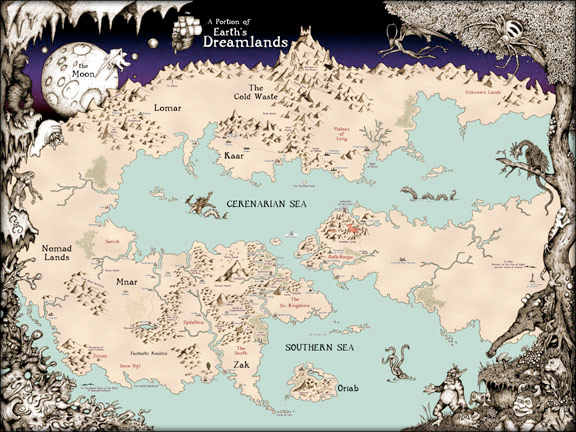
The Dreamlands is a fictional location in the Dream Cycle of H. P. Lovecraft. It is also the setting for a number of pastiches written by other authors. The Dreamlands is a vast, alternate dimension that can be entered through dreams, similar to astral projection or lucid dreaming. Experienced dreamers are among the most powerful inhabitants of the Dreamlands and may become its permanent residents after their physical deaths. The Dreamlands can be entered in other ways, including physically. This usually requires passing through very dangerous areas of both the waking world and the Dreamlands. Consequently, real death becomes a risk. However, the visitor does receive the prolonged lifespan of a native of the Dreamlands, so the traveler’s time there is no longer limited to the duration of a night’s sleep on earth. Though the term Dreamlands typically refers to the dimension accessible by human dreamers, other inhabited planets may have their own dreamlands. Reaching these other realms from the terrestrial Dreamlands is possible but difficult. Time flows at a different rate in the Dreamlands — each hour on earth represents a week or more there. Consequently, a traveller can spend months in the Dreamlands during a single night’s sleep on earth. Fortunately for dreamers, inhabitants of the Dreamlands are either long-lived or immortal, provided they avoid injury or disease. [Source]
9
Pellucidar
Edgar Rice Burroughs
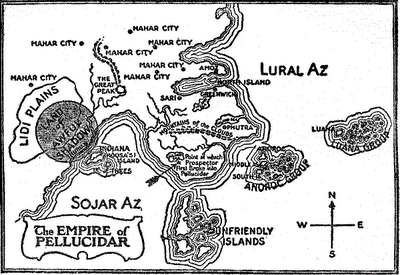
Pellucidar is a fictional Hollow Earth milieu invented by Tarzan creator Edgar Rice Burroughs for a series of action adventure stories. In a notable crossover event between Burroughs’ series, there is a Tarzan story in which the Ape Man finds his way into Pellucidar. The stories initially involve the adventures of mining heir David Innes and his inventor friend Abner Perry after they use an “iron mole” to burrow 500 miles into the earth’s crust. Later protagonists include indigenous cave man Tanar and additional visitors from the surface world, most notably Tarzan. Primitive people and prehistoric creatures, notably dinosaurs, populate Pellucidar. The region in which Innes and Perry initially find themselves is ruled by the cities of the Mahars, intelligent flying reptiles resembling pterosaurs with dangerous psychic powers, which keep the local tribelets of Stone Age human beings in subjugation. Innes and Perry eventually unite the tribes to overthrow the Mahars’ domain and establish a human “Empire of Pellucidar” in its place. While the Mahars are the dominant species in the Pellucidar novels, they seem confined to their handful of cities. Before their overthrow they use the Sagoths, a race of gorilla-men who speak the same language as Tarzan’s apes, to enforce their rule over the human tribes within the area which they rule. [Source]
8
Neverland
J. M. Barrie
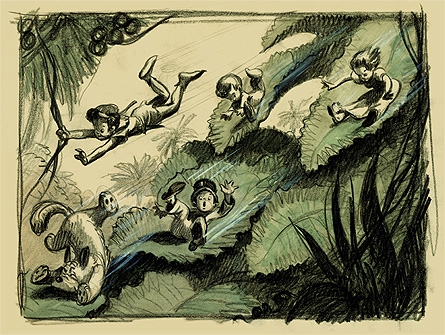
Neverland (also called Never-Never-Land, Never Land and other variations) is the fictional island and dream world featured in the play Peter Pan, or The Boy Who Wouldn’t Grow Up by Scottish writer J. M. Barrie, his subsequent novel Peter and Wendy, and later works by others. While sojourning in Neverland, people may cease to age; therefore, Neverland is often seen as a metaphor for eternal childhood (and childishness), immortality, and escapism. The 1911 novel explains that Neverlands are found in the minds of children, and although they are “always more or less an island”, and they have a family resemblance, they are not the same from one child to the next. For example, John Darling’s “had a lagoon with flamingos flying over it” while his little brother Michael’s “had a flamingo with lagoons flying over it”. In the world of Neverland, they say either the Crocodile’s clock or the suns and moons tell that time. It is mentioned in the novel Peter Pan that there are many more suns and moons there than in our world. According to Peter Pan in Scarlet, Neverland resides in a sea known as the Sea of One Thousand Islands. In the book, Peter explores some of this sea, passing by islands of various sizes. The most amazing thing encountered on this adventure is Lodestone Rock: a magnetic rock that destroys the Jolly Peter and the SS Starkey along with it. [Source]
7
Shangri-La
James Hilton
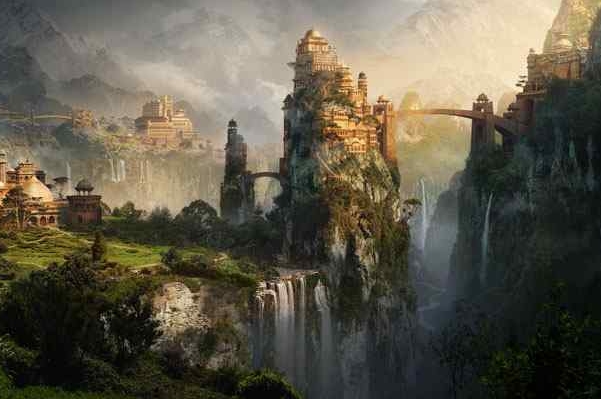
Shangri-La is a fictional place described in the 1933 novel Lost Horizon by British author James Hilton. In the book, “Shangri-La” is a mystical, harmonious valley, gently guided from a lamasery, enclosed in the western end of the Kunlun Mountains. Shangri-La has become synonymous with any earthly paradise but particularly a mythical Himalayan utopia—a permanently happy land, isolated from the outside world. In the novel Lost Horizon, the people who live at Shangri-La are almost immortal, living years beyond the normal lifespan. The word also evokes the imagery of exoticism of the Orient. The story of Shangri-La is based on the concept of Shambhala, a mystical city in the Tibetan Buddhist tradition. There are a number of modern Shangri-La pseudo-legends that have developed since 1933 in the wake of the novel and the film made from it. The Nazis had an enthusiasm for Shangri-La, where they hoped to find an ancient master race, similar to the Nordic race, unspoiled by Buddhism. They sent one expedition to Tibet, led by Ernst Schäfer in 1938. Shangri-la is often used in a similar context to which “Garden of Eden” might be used, to represent a perfect paradise that exists hidden from modern man. It can sometimes be used as an analogy for a life-long quest or something elusive that is much sought. [Source]
6
Narnia
C. S. Lewis
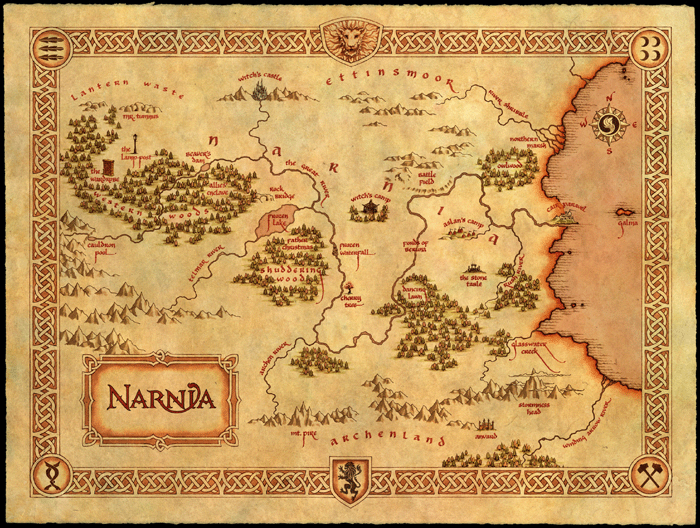
Narnia is a fantasy world created by C. S. Lewis as the primary location for his series of seven fantasy novels for children, The Chronicles of Narnia. The world is so called after the country of Narnia, in which much of the action of the Chronicles takes place. In Narnia, some animals can talk, mythical beasts abound, and magic is common. The series tracks the story of Narnia when humans, usually children, enter the Narnian world from ‘our world’, or Earth. According to the mythology of the series, Narnia was created by the great lion, Aslan, and is filled with talking animals and mythical creatures. C. S. Lewis may have taken the name from the Italian town of Narni, whose Latin name was in fact, Narnia. The landscape of Lewis’ native Northern Ireland played a large part in the creation of the Narnian landscape. In his essay On Stories, Lewis wrote “I have seen landscapes, notably in the Mourne Mountains and southwards which under a particular light made me feel that at any moment a giant might raise his head over the next ridge”. The world of Narnia is a flat world in a geocentric universe. Its sky is a dome that mortal creatures cannot penetrate. Narnia’s stars are burning humanoid beings. Its constellations are the result of a mystical dance upon the sky, performed by the stars to announce the works and comings of Aslan, Narnia’s creator. The stars also arrange themselves to allow seers to foretell certain future events. [Source]
5
Utopia
St Thomas More
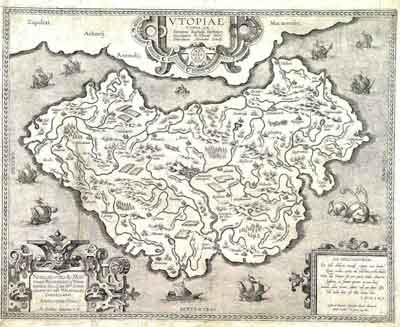
Utopia is a name for an ideal society, taken from the title of a book written in 1516 by St Thomas More describing a fictional island in the Atlantic Ocean, possessing a seemingly perfect socio-politico-legal system. The term has been used to describe both intentional communities that attempted to create an ideal society, and fictional societies portrayed in literature. “Utopia” is sometimes used pejoratively, in reference to an unrealistic ideal that is impossible to achieve, and has spawned other concepts, most prominently dystopia. The word comes from Greek: ??, “not”, and ?????, “place”, indicating that More was utilizing the concept as allegory and did not consider such an ideal place to be realistically possible. It is worth noting that the homophone Eutopia, derived from the Greek ??, “good” or “well”, and ?????, “place”, signifies a double meaning that was almost certainly intended. Despite this, most modern usage of the term “Utopia” incorrectly assumes the latter meaning, that of a place of perfection rather than nonexistence. [Source]
4
Gulliver’s World
Jonathan Swift
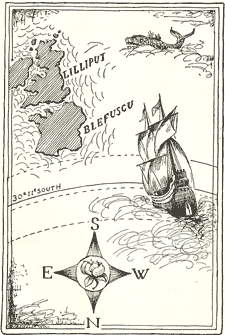
Lilliput and Blefuscu are two fictional island nations that appear in the 1726 novel Gulliver’s Travels by Jonathan Swift. Both are portrayed as being in the South Indian Ocean and are inhabited by tiny people who are “not six inches high”. A channel separates the two eight hundred yards wide. The tiny people of Lilliput and Blefuscu contrast with the giants of Brobdingnag whom Gulliver also met. In the novel, Gulliver washes up on the shore of Lilliput and is ‘captured’ by the inhabitants while asleep. He discovers that Lilliput and Blefuscu are permanently at war because of differences over the correct way to eat a boiled egg – from the rounded end according to the Blefuscudians, or from the sharp end according to the Lilliputians. Additionally, Gulliver’s Travels also includes the land of Brobdingnag; the people of Brobdingnag are described as giants who are as tall as a church steeple and whose stride is ten yards. All of the other animals and plants, and even natural features such as rivers and even hail, are in proportion. The rats are the size of large dogs and the flies are the size of birds, for example. [Source]
3
The Land of Oz
L. Frank Baum
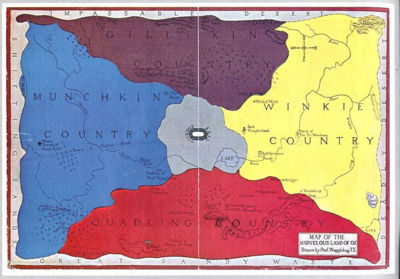
Oz is, in the first book The Wonderful Wizard of Oz, distinguished from Dorothy’s native Kansas by not being civilized; this explains why Kansas does not have witches and wizards, while Oz does. In the third book, Ozma of Oz, Oz is described as a “fairy country”, new terminology that remained to explain its wonders. Oz is roughly rectangular in shape, and divided along the diagonals into four countries: Munchkin Country (but commonly referred to as ‘Munchkinland’ in adaptations) in the East, Winkie Country (called ‘The Vinkus’ in Gregory Maguire’s Wicked and its sequel Son of a Witch) in the West, (sometimes West and East are reversed on maps of Oz, see West and East below) Gillikin Country in the North, and Quadling Country in the South. In the center of Oz, where the diagonals cross, is the fabled Emerald City, capital of the land of Oz and seat to the monarch of Oz, Princess Ozma. Oz is completely surrounded on all four sides by a desert, which insulates the citizens of Oz from discovery and invasion. In the first two books, this is merely a desert, with only its extent to make it dangerous to the traveler. [Source]
2
Alice’s Worlds
Lewis Carroll
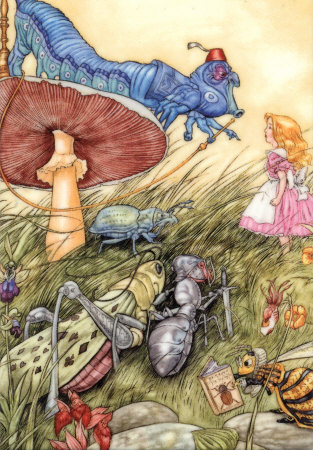
Wonderland (from Alice’s Adventures in Wonderland) is a strange and seemingly crazy world that is entered by dropping into a rabbit hole. Animals act as normal people. Physical size as well as time is relative. However, the story also partly takes place in our ‘real’ world, where Alice starts by sitting next to her sister, and wakes up in it. In the story, Wonderland is a dream world. However, thematically, Wonderland is not really another world. It is in fact our own world, only seen through the eyes of a child. The Looking Glass world resembles Wonderland. Strange creatures also inhabit it and weird things keep happening. This world can be entered by passing through the mirror above the chimney in Alice’s house. Therefore, everything in Wonderland is reversed; books are in mirror writing and when you want to go to a certain place, you have to walk in the opposite direction. The land is laid out like a huge chessboard, with little brooks to mark the edges of the squares. The rules of chess apply when the inhabitants try to move from one square to another. The creatures in Looking Glass world seem to be a little less crazy than the creatures in Wonderland. In the end, Looking Glass world turns out to be a dream world as well, and can also be seen as a metaphor for our own adult world.
1
Middle-Earth
J. R. R. Tolkien
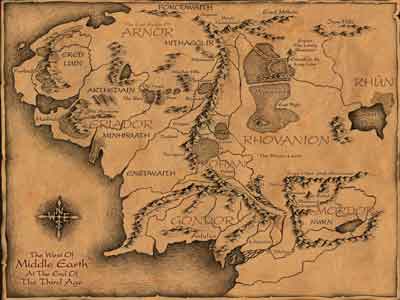
Middle-earth refers to the fictional lands where most of the stories of author J. R. R. Tolkien take place. Tolkien’s stories chronicle the struggle to control the world (called Arda) and the continent of Middle-earth, between the angelic Valar, the Elves and their allies among Men; and the demonic Melkor or Morgoth (a Vala fallen into evil) and his minions, mostly Orcs, Dragons and enslaved men. Tolkien prepared several maps of Middle-earth and the regions of Middle-earth in which his stories took place. Some were published in his lifetime, though some of the earliest maps were not published until after his death. The main maps were those published in The Hobbit, The Lord of the Rings and The Silmarillion. Tolkien said that his Middle-earth is located on our Earth, but in a fictional period in the past, estimating the end of the Third Age to about 6,000 years before his own time. He was later to refute this notion, and state that Middle-earth was not at a physically distant time, but rather “at a different stage of imagination”. [Source]
Notable Omission: Discworld
This article is licensed under the GFDL because it contains quotations from the Wikipedia articles cited above.
Contributors: Beranabus, JFrater
More Great Lists
 Top 10 Fantasy Places That Would Suck In Real Life
 Top 10 Top-Level Domains That Caused Controversies
 Top 10 Best Movies From The Top Genres
 Top 10 Worst Movies From The Top Genres
 Top 10 Ridiculously Over The Top Horror Movie Deaths
 Top 10 More Bizarre Beliefs Held By Top Celebrities
 Top 10 Amazing Feats And Facts About Glass
 Top 10 Interesting Things About The People Of Pompeii
 Top 10 Bizarre Costumed Street Characters And Performers
fact checked by
Alex Hanton
More Great Lists