Psychology is a relatively new science which gained popularity in the early 20th century with Wilhelm Wundt. In the zeal to learn about the human thought process and behavior, many early psychiatrists went too far with their experimentations, leading to stringent ethics codes and standards. Though these are highly unethical experiments, it should be mentioned that they did pave the way to induct our current ethical standards of experiments, and that should be seen as a positive. There is some crossover on this list with the Top 10 Evil Human Experiments. Three items from that list are reproduced here (items 8, 9, and 10) for the sake of completeness.

The Monster Study was a stuttering experiment on 22 orphan children in Davenport, Iowa, in 1939 conducted by Wendell Johnson at the University of Iowa. Johnson chose one of his graduate students, Mary Tudor, to conduct the experiment and he supervised her research. After placing the children in control and experimental groups, Tudor gave positive speech therapy to half of the children, praising the fluency of their speech, and negative speech therapy to the other half, belittling the children for every speech imperfection and telling them they were stutterers. Many of the normal speaking orphan children who received negative therapy in the experiment suffered negative psychological effects and some retained speech problems during the course of their life. Dubbed “The Monster Study” by some of Johnson’s peers who were horrified that he would experiment on orphan children to prove a theory, the experiment was kept hidden for fear Johnson’s reputation would be tarnished in the wake of human experiments conducted by the Nazis during World War II. The University of Iowa publicly apologized for the Monster Study in 2001.

South Africa’s apartheid army forced white lesbian and gay soldiers to undergo ’sex-change’ operations in the 1970’s and the 1980’s, and submitted many to chemical castration, electric shock, and other unethical medical experiments. Although the exact number is not known, former apartheid army surgeons estimate that as many as 900 forced ’sexual reassignment’ operations may have been performed between 1971 and 1989 at military hospitals, as part of a top-secret program to root out homosexuality from the service.
Army psychiatrists aided by chaplains aggressively ferreted out suspected homosexuals from the armed forces, sending them discretely to military psychiatric units, chiefly ward 22 of 1 Military Hospital at Voortrekkerhoogte, near Pretoria. Those who could not be ‘cured’ with drugs, aversion shock therapy, hormone treatment, and other radical ‘psychiatric’ means were chemically castrated or given sex-change operations.
Although several cases of lesbian soldiers abused have been documented so far—including one botched sex-change operation—most of the victims appear to have been young, 16 to 24-year-old white males drafted into the apartheid army.
Dr. Aubrey Levin (the head of the study) is now Clinical Professor in the Department of Psychiatry (Forensic Division) at the University of Calgary’s Medical School. He is also in private practice, as a member in good standing of the College of Physicians and Surgeons of Alberta.

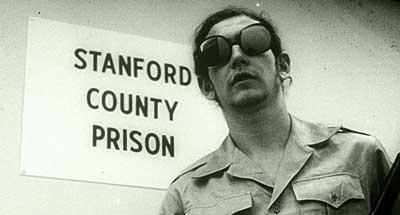
This study was not necessarily unethical, but the results were disastrous, and its sheer infamy puts it on this list. Famed psychologist Philip Zimbardo led this experiment to examine that behavior of individuals when placed into roles of either prisoner or guard and the norms these individuals were expected to display.
Prisoners were put into a situation purposely meant to cause disorientation, degradation, and depersonalization. Guards were not given any specific directions or training on how to carry out their roles. Though at first, the students were unsure of how to carry out their roles, eventually they had no problem. The second day of the experiment invited a rebellion by the prisoners, which brought a severe response from the guards. Things only went downhill from there.
Guards implemented a privilege system meant to break solidarity between prisoners and create distrust between them. The guards became paranoid about the prisoners, believing they were out to get them. This caused the privilege system to be controlled in every aspect, even in the prisoners’ bodily functions. Prisoners began to experience emotional disturbances, depression, and learned helplessness. During this time, prisoners were visited by a prison chaplain. They identified themselves as numbers rather than their names, and when asked how they planned to leave the prison, prisoners were confused. They had completely assimilated into their roles.
Dr. Zimbardo ended the experiment after five days, when he realized just how real the prison had become to the subjects. Though the experiment lasted only a short time, the results are very telling. How quickly someone can abuse their control when put into the right circumstances. The scandal at Abu Ghraib that shocked the U.S. in 2004 is prime example of Zimbardo’s experiment findings.
While animal experimentation can be incredibly helpful in understanding man, and developing life saving drugs, there have been experiments which go well beyond the realms of ethics. The monkey drug trials of 1969 were one such case. In this experiment, a large group of monkeys and rats were trained to inject themselves with an assortment of drugs, including morphine, alcohol, codeine, cocaine, and amphetamines. Once the animals were capable of self-injecting, they were left to their own devices with a large supply of each drug.
The animals were so disturbed (as one would expect) that some tried so hard to escape that they broke their arms in the process. The monkeys taking cocaine suffered convulsions and in some cases tore off their own fingers (possible as a consequence of hallucinations), one monkey taking amphetamines tore all of the fur from his arm and abdomen, and in the case of cocaine and morphine combined, death would occur within 2 weeks.
The point of the experiment was simply to understand the effects of addiction and drug use; a point which, I think, most rational and ethical people would know did not require such horrendous treatment of animals.
In 1924, Carney Landis, a psychology graduate at the University of Minnesota developed an experiment to determine whether different emotions create facial expressions specific to that emotion. The aim of this experiment was to see if all people have a common expression when feeling disgust, shock, joy, and so on.
Most of the participants in the experiment were students. They were taken to a lab and their faces were painted with black lines, in order to study the movements of their facial muscles. They were then exposed to a variety of stimuli designed to create a strong reaction. As each person reacted, they were photographed by Landis. The subjects were made to smell ammonia, to look at pornography, and to put their hands into a bucket of frogs. But the controversy around this study was the final part of the test.
Participants were shown a live rat and given instructions to behead it. While all the participants were repelled by the idea, fully one third did it. The situation was made worse by the fact that most of the students had no idea how to perform this operation in a humane manner and the animals were forced to experience great suffering. For the one third who refused to perform the decapitation, Landis would pick up the knife and cut the animals head off for them.
The consequences of the study were actually more important for their evidence that people are willing to do almost anything when asked in a situation like this. The study did not prove that humans have a common set of unique facial expressions.

John Watson, father of behaviorism, was a psychologist who was apt to using orphans in his experiments. Watson wanted to test the idea of whether fear was innate or a conditioned response. Little Albert, the nickname given to the nine month old infant that Watson chose from a hospital, was exposed to a white rabbit, a white rat, a monkey, masks with and without hair, cotton wool, burning newspaper, and a miscellanea of other things for two months without any sort of conditioning. Then experiment began by placing Albert on a mattress in the middle of a room. A white laboratory rat was placed near Albert and he was allowed to play with it. At this point, the child showed no fear of the rat.
Then Watson would make a loud sound behind Albert’s back by striking a suspended steel bar with a hammer when the baby touched the rat. In these occasions, Little Albert cried and showed fear as he heard the noise. After this was done several times, Albert became very distressed when the rat was displayed. Albert had associated the white rat with the loud noise and was producing the fearful or emotional response of crying.
Little Albert started to generalize his fear response to anything fluffy or white (or both). The most unfortunate part of this experiment is that Little Albert was not desensitized to his fear. He left the hospital before Watson could do so.
In 1965, psychologists Mark Seligman and Steve Maier conducted an experiment in which three groups of dogs were placed in harnesses. Dogs from group one were released after a certain amount of time, with no harm done. Dogs from group two were paired up and leashed together, and one from each pair was given electrical shocks that could be ended by pressing a lever. Dogs from group three were also paired up and leashed together, one receiving shocks, but the shocks didn’t end when the lever was pressed. Shocks came randomly and seemed inevitable, which caused “learned helplessness,” the dogs assuming that nothing could be done about the shocks. The dogs in group three ended up displaying symptoms of clinical depression.
Later, group three dogs were placed in a box with by themselves. They were again shocked, but they could easily end the shocks by jumping out of the box. These dogs simply “gave up,” again displaying learned helplessness. The image above is a healthy pet dog in a science lab, not an animal used in experimentation.

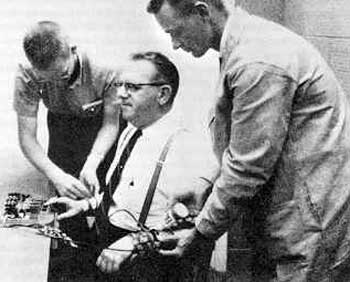
The notorious Milgrim Study is one of the most well known of psychology experiments. Stanley Milgram, a social psychologist at Yale University, wanted to test obedience to authority. He set up an experiment with “teachers” who were the actual participants, and a “learner,” who was an actor. Both the teacher and the learner were told that the study was about memory and learning.
Both the learner and the teacher received slips that they were told were given to them randomly, when in fact, both had been given slips that read “teacher.” The actor claimed to receive a “learner” slip, so the teacher was deceived. Both were separated into separate rooms and could only hear each other. The teacher read a pair of words, following by four possible answers to the question. If the learner was incorrect with his answer, the teacher was to administer a shock with voltage that increased with every wrong answer. If correct, there would be no shock, and the teacher would advance to the next question.
In reality, no one was being shocked. A tape recorder with pre-recorded screams was hooked up to play each time the teacher administered a shock. When the shocks got to a higher voltage, the actor/learner would bang on the wall and ask the teacher to stop. Eventually all screams and banging would stop and silence would ensue. This was the point when many of the teachers exhibited extreme distress and would ask to stop the experiment. Some questioned the experiment, but many were encouraged to go on and told they would not be responsible for any results.
If at any time the subject indicated his desire to halt the experiment, he was told by the experimenter, Please continue. The experiment requires that you continue. It is absolutely essential that you continue. You have no other choice, you must go on. If after all four orders the teacher still wished to stop the experiment, it was ended. Only 14 out of 40 teachers halted the experiment before administering a 450 volt shock, though every participant questioned the experiment, and no teacher firmly refused to stop the shocks before 300 volts.
In 1981, Tom Peters and Robert H. Waterman Jr. wrote that the Milgram Experiment and the later Stanford prison experiment were frightening in their implications about the danger lurking in human nature’s dark side.

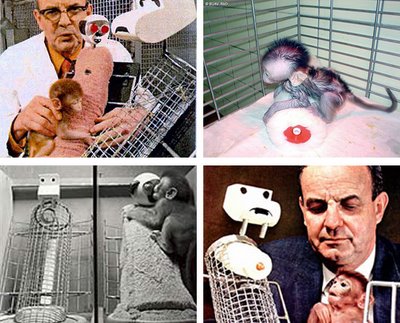
Dr. Harry Harlow was an unsympathetic person, using terms like the “rape rack” and “iron maiden” in his experiments. He is most well-known for the experiments he conducted on rhesus monkeys concerning social isolation. Dr. Harlow took infant rhesus monkeys who had already bonded with their mothers and placed them in a stainless steel vertical chamber device alone with no contact in order to sever those bonds. They were kept in the chambers for up to one year. Many of these monkeys came out of the chamber psychotic, and many did not recover. Dr. Harlow concluded that even a happy, normal childhood was no defense against depression, while science writer Deborah Blum called these, “common sense results.”
Gene Sackett of the University of Washington in Seattle, one of Harlow’s doctoral students, stated he believes the animal liberation movement in the U.S. was born as a result of Harlow’s experiments. William Mason, one of Harlow’s students, said that Harlow “kept this going to the point where it was clear to many people that the work was really violating ordinary sensibilities, that anybody with respect for life or people would find this offensive. It’s as if he sat down and said, ‘I’m only going to be around another ten years. What I’d like to do, then, is leave a great big mess behind.’ If that was his aim, he did a perfect job.”
In 1965, a baby boy was born in Canada named David Reimer. At eight months old, he was brought in for a standard procedure: circumcision. Unfortunately, during the process his penis was burned off. This was due to the physicians using an electrocautery needle instead of a standard scalpel. When the parents visited psychologist John Money, he suggested a simple solution to a very complicated problem: a sex change. His parents were distraught about the situation, but they eventually agreed to the procedure. They didn’t know that the doctor’s true intentions were to prove that nurture, not nature, determined gender identity. For his own selfish gain, he decided to use David as his own private case study.
David, now Brenda, had a constructed vagina and was given hormonal supplements. Dr. Money called the experiment a success, neglecting to report the negative effects of Brenda’s surgery. She acted very much like a stereotypical boy and had conflicting and confusing feelings about an array of topics. Worst of all, her parents did not inform her of the horrific accident as an infant. This caused a devastating tremor through the family. Brenda’s mother was suicidal, her father was alcoholic, and her brother was severely depressed.
Finally, Brenda’s parents gave her the news of her true gender when she was fourteen years old. Brenda decided to become David again, stopped taking estrogen, and had a penis reconstructed. Dr. Money reported no further results beyond insisting that the experiment had been a success, leaving out many details of David’s obvious struggle with gender identity. At the age of 38, David committed suicide.
This article is licensed under the GFDL because it contains quotations from Wikipedia.
Contributor: Maggie


September 8th, 2008 at 2:44 am
nice list
September 8th, 2008 at 3:12 am
meh!
September 8th, 2008 at 3:14 am
#1 is fucked up. Also, I heard he had a twin brother.
September 8th, 2008 at 3:18 am
Mister Frater you are sapping my moral. Enough heavy duty lists already. Gimme something lighthearted and fun. Please sir.
September 8th, 2008 at 3:19 am
emmstein- I believe he was.
September 8th, 2008 at 3:20 am
glittershrooms: from your comment should I presume you don’t consider ethics important in experimentation?
September 8th, 2008 at 3:20 am
glittershrooms: okay – tomorrow I will do a happy list
September 8th, 2008 at 3:21 am
His birth name was Bruce, and his twin brother was Brian.
September 8th, 2008 at 3:22 am
glittershrooms: what subject do you want me to cover?
September 8th, 2008 at 3:26 am
Jamie, ethics are really important to me. It is beside the point. When I log on, I expect to be entertained and not depressed. Sorry but I guess I only enjoy the fun lists. I apologize.
September 8th, 2008 at 3:27 am
Jamie dear, you are doing a great job. Do not listen to me, I’m a lil grumpy.
September 8th, 2008 at 3:33 am
flowers for algernon could be a bonus, eventhough its fiction
September 8th, 2008 at 3:50 am
I’m depressed.
September 8th, 2008 at 3:56 am
interesting list
but you forgot one the most controvertial ones:
project MKULTRA
http://en.wikipedia.org/wiki/Project_MKULTRA
but I don’t know if it belongs here because seems more a psychiatric than psychological experiment
September 8th, 2008 at 3:58 am
okay – maybe sad lists and mondays don’t mix well.
September 8th, 2008 at 3:58 am
Stanford Prison Experiment lead to the german Das Experiment movie by Oliver Hirschbiegel. A good one to be seen
September 8th, 2008 at 3:59 am
JB: that is on the list I mention in the opening statement of this list.
September 8th, 2008 at 3:59 am
JB: das experiment is a brilliant film – I totally agree!
September 8th, 2008 at 4:18 am
(about #1)
Didn’t the Reimer’s seek the opinion(s) of other professionals? Didn’t they consider alternatives, like reconstruct the penis? I think it’s ridiculous that they went along with the sex change.
I hope my comment makes sense. My nerves are shot because I’m sitting here with my very sick 19 year old cat.
September 8th, 2008 at 4:19 am
cool
September 8th, 2008 at 4:34 am
drogo – I agree completely but from what I read about the case the parents were disfunctional alcoholics (some alchies are functional) and the doctor had them convinced that gender reassignment was the right (and only viable) choice. Despite the trauma the poor boy suffered in puberty, the doctor considered his “experiment” a success and believed he proved that nurture determined gender, not nature.
September 8th, 2008 at 4:44 am
it’s horrific to see what lengths people would go through to get their points across.. cruelty to all livings things should be absolutely condemned. Most of the times these experiments don’t even produce a conclusive result, all they leave behind is a lasting effect on the psychology of the subjects.
I think David Reimer’s story was used in one of ‘Law & Order: SVU’s episodes.
September 8th, 2008 at 4:45 am
uups!
I saw it right now,
thanks
September 8th, 2008 at 4:46 am
This lists seems familiar… is there one like it already?
September 8th, 2008 at 4:53 am
David Reimer and his twin both went in for circumcision; because David’s was botched, his brother’s was never done. Dr. Money was considered to be an expert in his field, and the parents were probably intimidated by him and put their whole faith in him. Years ago, people didn’t tend to question professionals. David was raised in dresses and hated them; it was only when Dr. Money wanted to perform a second surgery that David severely protested and his parents finally broke down and told him. He immediately began dressing as a male, and eventually had reconstruction. He did marry but the depression and anger were too great. There’s much more to the story, but it’s depressing – a book was published on his interviews.
September 8th, 2008 at 5:17 am
great list :] though id just like to mention that after milgrams study, though it was unethical, the participants were introduced to the ‘victim’ and told that they were fine and their behaviour was normal, so that they didnt leave scarred for life. Id hate to be in their position and never knowing if id killed someone or not!
September 8th, 2008 at 5:20 am
I love the list. It makes me a little sad because it reminds me that there are monsters out there that look like normal people. Our government is full of them. I also wonder sometimes if we ever unknowingly reap any benefits from these “experiments”. Not just stricter codes of ethics, but helpful treatmnts or medicines.
September 8th, 2008 at 5:35 am
I’ve never thought the Milgram experiment was THAT unethical…. but I don’t know what the impact on those studied was. Fascinating experiment all the same, as was the Stanford one (the Stanford one was pretty unbelievable by the end of it)!
September 8th, 2008 at 5:38 am
Very Interesting.
September 8th, 2008 at 6:00 am
Surprise the Tuskeegee Syphilis Experiments wasn’t on the list.
September 8th, 2008 at 6:02 am
Poor,poor, poor David.
September 8th, 2008 at 6:03 am
mcsquida: you need to watch the video to get a grasp for just how distressing the screaming and wall-banging was. it was pretty brutal.
September 8th, 2008 at 6:06 am
And I thought medical ethics were bad today…..
September 8th, 2008 at 6:27 am
number 1 is just pure evil and selfishness.. after i finished reading it my face was like =.=” its amazing what goes on people’s minds when they follow through their dark side..
September 8th, 2008 at 6:29 am
for the milgram study, go to google video and type in “milgram study”. it is the second choice.
they have the entire 45 min video.
September 8th, 2008 at 6:51 am
I think this list is in itself a cruel psychological experiment to see how depressed a person can get about humanity.
September 8th, 2008 at 7:39 am
NestorV: The Tuskegee Syphilis Experiments were physical, not psychological.
On the Stanford Prison Experiment: The official website, http://www.prisonexp.org/ , really helps show how it all went. Even the researchers got drawn into it. They worked to avert a planned ‘breakout’, forgetting that it was all fictional and that they were observers, not wardens. It was scheduled to last two weeks, but was, fortunately, cut short.
September 8th, 2008 at 7:41 am
Substantial overlap with this list
http://listverse.com/crime/top-10-evil-human-experiments/
September 8th, 2008 at 8:11 am
CRAZY, I’ve actually met Dr. Levin from #9…I used to work for a financial advisor, and Aubrey and his wife were my boss’s clients. He was very polite, well-spoken, and extremely wealthy…I had no idea he would be capable of something that horrendous.
September 8th, 2008 at 8:52 am
wow, what an amazing intresting list. Very Disturbing stuff, but very interesting
September 8th, 2008 at 8:53 am
I have a degree in psychology and have heard of most of these before. I do want to say that in order to conduct ’studies,’ or ‘experiments’ now, you have to go through a lengthy application process, which is approved or denied by a board. These stories are unfortunate, how someone who studies the human mind can subject others or animals to these terrors is beyond me. The prison study is the most fascinating, it goes hand in hand with # 3. Generally, people are very obedient and will follow instructions and do what they are told. The human mind is more suggestible than a lot of people realize.
September 8th, 2008 at 8:54 am
I’m not a big mistake pointer-outter but on # 6 it said 1/3 did it and then said 1/3 refused and had it done for them..or maybe I’m reading it wrong.
At any rate, this was a really interesting list. The animal ones were really sad.
September 8th, 2008 at 8:56 am
There was an episode of law and order that is like #1 It’s terrible what some people call a success.
September 8th, 2008 at 9:02 am
Milgrams study is not unethical, the participants could stop at any time. The first is very twisted but it did seem to work until he hit puberty.
September 8th, 2008 at 9:09 am
i get so curious and fascinated by lists like this. Excellent job!!!
September 8th, 2008 at 9:12 am
Number 9…that’s truly an abomination. Of course that’s probably because it hits too close to home for me. I don’t even know what I would do if my command one day told me I suddenly had to be a chick…
September 8th, 2008 at 9:22 am
yay! nature 1 nurture 0
September 8th, 2008 at 9:46 am
Nice list again but It would be nice to lift the gloomy clouds a wee bit now and again.
#24 deepthinker is correct – a saw a web site not so long ago about human torture and most of them are on their site.
September 8th, 2008 at 10:14 am
Wow, this is an intense list. It was hard to read a few of those descriptions all the way through.
I do think #8 and #3 were important in regards to the exposure of human/group mentality etc. I don’t think the experiments in themselves were necessarily unethical.
September 8th, 2008 at 10:14 am
on #1, unless my eyes just skipped it, you forgot an important fact. David had an identical twin brother. The psychiatrist wanted to conduct a Nature vs Nurture experiment. He had wanted to know if he could raise two people who were exactly alike, in very different ways. Hence, raise one brother as a boy, and raise one as a girl, and see what took over, nature or nurture. His theory was that nurture would overcome nature. All throughout Davids childhood, he would try to convince him to undergo another sex change operation (either the first one wasn’t performed, or it was botched, I don’t remember which) by telling him his genitals were deformed, and they could fix it with reconstructive surgery so he would look just like all the other girls. He even brought transexuals into the therapy sessions to tell him how much better he would feel after he had surgery, since he would then look like all the other girls. David never wanted further surgery to make his “vagina” look normal, which was a great frustration to the doctor.
The experiment wasn’t about raising a boy as a girl, and seeing if it would be a success, it was about Nature vs Nurture. He wanted to prove that even though someone was born a boy, they could be raised as a girl, and lead a very healthy, productive feminine life, and never know the difference, because gender was not determined by whether someone was born with a penis or vagina, but by the way they were raised. He needed identical twins for the experiment though, and can you imagine how overjoyed he was when he heard of the botched circumcision, and he finally had a chance to carry out his “experiment”?
His experiment wouldn’t work if David was a single child and not a twin, because David might have grown up to be a transexual anyway, so he needed a set of twins, because of course, twins are exactly alike, and if one is straight, the other will be straight to. He needed to make sure that David being a girl was a product of how he was raised, and not something that would have happened anyway. So he had to do his experiment with twins.
I think it’s very sad that even after the experiment failed, the doctor still published it as a success, denying that he was wrong in any way at all. He felt absolutely no remorse for what he did to that family.
neflite—you summed it up perfectly!
September 8th, 2008 at 10:27 am
Fascinating. The only thing that really bottles the mind is the fact that the test subjects in some experiments are aware and can choose to react anyway to the experiment, rather it be totally irrelevant or not. For example, if one were being shocked by volts of electricity to enforce behavior on a misbehaving subject, but the misbehaving subject was aware of the purpose of the experiment and chose to act a certain way that wasn’t his/her true reaction….again…fascinating.
September 8th, 2008 at 10:31 am
Oh! I haven’t read through it all yet – but I just love reading the strange experiments people put themselves through and such. Humans are strange…
September 8th, 2008 at 10:35 am
Maggie, although I’d read about many of these “tests”, a few were new to me. All were atrocious.
That mankind can perform these kinds of horrors on other beings, both human and nonhuman, for reasons of psychological testing (usually where the answer is known beforehand), is outrageous.
As you all know, I support animal testing when it comes to new drugs, but this is completely different. This is just horrendous.
September 8th, 2008 at 10:51 am
Sandra: I disagree with your comment “he needed a set of twins, because of course, twins are exactly alike, and if one is straight, the other will be straight to.” I know a set of identical twins, one who is straight (and getting married soon) and the other a lesbian. I don’t think being a twin pre-determines one’s personality and sexual preference.
September 8th, 2008 at 10:55 am
These are a little out of order. #9 and #10 s/be higher, they are very disturbing. #8 and #3?…meh, I’ve heard o’ worse. #7 and #2 s/change places. Physical torture of an animal is just as bad as physical torture of a human. They feel physical pain the same as we do. I doubt they feel psychological pain as much as we do,..they’re incapable of abstract thought. #6 is about where it s/be. #5 sounds like “A Clockwork Orange.” #4, learned helplessness,…sounds like what I was taught in Catholic school,…I can relate to that third group of dogs. #1? very appropriate choice. You were correct to leave out “The Tuskeegee experiment.” It does not belong on this list, unless you want to replace #2 with it. There’s an urban myth that those men were INJECTED with syphillis, in which case it s/be #1 here. The fact is, they already had it, but were left untreated and told they were being treated. That’s a sick experiment but it would have been 1000 times worse if HEALTHY men were injected with it outside of their knowledge. Please don’t insult anyone’s intelligence, including your own, by asking what makes the two scenarios are different.
September 8th, 2008 at 11:01 am
Brittany112: despite what you’ve heard, being born gay has never been sufficiently nor necessarily proven scientifically but only been said in theory to feed a much asked question. Twins are exactly alike, even their DNA.
September 8th, 2008 at 11:03 am
Brittany– My comment about the twins was not a fact. It was the doctors belief that twins were alike. Maybe i should have added that somewhere in my comment. Sorry!!I was trying to show how stupid the doctor was, and ended up making MYSELF look ignorant.
September 8th, 2008 at 11:05 am
Were any of these so called doctors arrested or punished in some way?
September 8th, 2008 at 11:24 am
Those Canadians . . .
September 8th, 2008 at 11:27 am
Some of those are effed up.
I don’t understand how some people can be so SICK.
Number 4 and 2 are the worst I think. I love animals =[
September 8th, 2008 at 11:38 am
#2 almost made me cry. Those poor monkeys, being left in a cage in complete social isolation. That doctor was an absolute monster!
September 8th, 2008 at 11:59 am
Love the list. Studying psychology at the moment – interesting how standard psychological protocol seems to be to ignore the disturbing nature of such experiments as “Little Albert” and to focus on the more positive outcomes. I think I should point out, however, that Dr Watson did cure Albert of his phobia of rabbits, and that his methods are still being used to great success today.
September 8th, 2008 at 12:02 pm
Maggie, in your preface, you should probably have said mid to late 19th century, not early 20th century…
I don’t think #7 fits in this category – it’s more of a medical drug addiction/behavioral analysis trial.
#6 was not unethical in its own right. The only questionable aspect was the beheading of the rats (BTW your 1/3’s are off by 1/3
), but that does not make the entire experiment unethical.
#5 is also not unethical in its own right – only the fact that the researcher did not desensitize the child after the research was complete (even then, it may have been his intent to do so, and he did not have the opportunity, in which case the ethics question is moot).
Numbers 1 and 2 truly were unethical – number two mostly after the researcher continued after expected results were found to be obvious and consistent.
September 8th, 2008 at 12:20 pm
i love lists like this
September 8th, 2008 at 12:39 pm
the full 45 minute Horizon programme about
David Reimer can be watched here on google video. it includes interviews with david himself as well as his mother
September 8th, 2008 at 12:39 pm
sorry forgot the link
http://video.google.com/videoplay?docid=3767337480016853964&ei=YX3FSPjBNI62iAKu6qy9BQ&hl=en
September 8th, 2008 at 1:38 pm
David’s twin brother also died. He was severely depressed because of the whole situation, and thought to be schizophrenic. He died of a drug overdose I think
September 8th, 2008 at 2:06 pm
The Murray experiments come to mind, of which the excellent book “Harvard and the Unabomber” discusses, because Ted Kaczynski happened to be one of the “stress” studies.
here’s a good article from The Atlantic, by Alston Chase:
http://www.theatlantic.com/issues/2000/06/chase.htm
September 8th, 2008 at 2:53 pm
Shit man, this made my day! I love this website. One day we’re talking about shitty movies, the next this kinda stuff. You guys rock!
September 8th, 2008 at 3:02 pm
Anybody who has worked in a repressive environment will recognise the Stanford Experiment, usually by someone who can’t do their job and resorts to bullying to do their job but cannot see anything wrong with what they’re doing (and are normal, nice people away from that situation).
Suffering from it at the moment, maybe the bosses are conducting an experiment!
September 8th, 2008 at 3:08 pm
An extremely good book on David Reimer is “As Nature Made Him” by John Colapinto. I’ve read it several times. Sadly, I did not realize he had committed suicide.
September 8th, 2008 at 3:23 pm
Number 1 is so sad. What a waste.
September 8th, 2008 at 3:51 pm
yah i dont queit get why the milgram experiment was unethical..
September 8th, 2008 at 4:02 pm
These doctors have no ethics, no morals, no conscience! Very disturbing information. Good list, Maggie.
September 8th, 2008 at 4:03 pm
What the hell, why are they always experimenting with babies and animals? And why didn’t they just leave poor Brian alone, he didn’t want to be part of an experiment! Jeez, the things humans do for the name of pyschology can be so dumb it get me angry!
September 8th, 2008 at 4:05 pm
Why oh why: That documentary was fascinating thanks for posting it. I just watched it and it definitely unveils a lot about what really happened. I feel bad for the parents because at the time of the botched circumsion they were told by multiple doctors and experts that this would be the best thing to do. How were they to know?
Did anybody else watch the video?
September 8th, 2008 at 4:09 pm
i saw a program about David Reimer. Poor guy and stupid parents.
thats why im a vegetarian. good list, sad, but good.
also sad about animal testing
September 8th, 2008 at 5:02 pm
you forgot to mention that little albert also became afraid of santa clause because of santa’s big white beard
September 8th, 2008 at 5:12 pm
Nice and interesting list but on the sad side though. Its incredible how David handled the situation of him (her) being what she (he) is not and at the same time his(her) brother completely broke down in that situation, of course he could not take it for very long though.
September 8th, 2008 at 5:15 pm
An awesome list!
Sort of icky and yicky and depressing, and absolutely horrid, but an awesome list nonetheless..
September 8th, 2008 at 5:45 pm
Great list mate, very interesting read. Got me thinking about ethics quite a bit (as did the top 10 evil human experiments list). Really makes you wonder when the end starts to justify the means – for this list I’d say none of the “ends” justified what was done.
But what if one of the experiments led to a cure for depression? Would it still be unethical? Similarly, what if one of the top 10 evil human experiments led to a cure for cancer? Would it still be evil? To quote Dostoevsky:
“Imagine that you are creating a fabric of human destiny with the object of making men happy in the end… but that it was essential and inevitable to torture to death only one tiny creature… And to found that edifice on its unavenged tears: would you consent to be the architect on those conditions? Tell me, and tell me the truth!”
Maybe you could post that as a “Your view” question?
September 8th, 2008 at 6:26 pm
I feel that the David Reimer case seems to strike people more strongly in a sense that he knew from his young childhood something was wrong. This is a follow up comment to some of those in the “Men Who were Actually Women” list. This is exactly how trans people feel. This is another point on nature vs. nurture because many trans people are brought up to follow their own gender yet hate it and end up changing when they find out what they can do about it. But, suddenly if David Reimer decides he wants a penis again he’s considered a hero….I dunno I just think they’re such similar cases yet people seem to be more supportive of this one.
September 8th, 2008 at 6:27 pm
David’s twin also committed suicide, before David. Their parents lost both their children.
September 8th, 2008 at 6:32 pm
When little albert turned 14, he shaved his pubes constantly.
September 8th, 2008 at 7:26 pm
Someone mentioned the Tuskegee Study but completely forgot the Willowbrook Studies, however both are physcial, so if there is ever a list of physical unethical experiements they should be about 2 and 3, right after the Nazi experiments. Unless I am forgetting some other horrific study.
September 8th, 2008 at 7:26 pm
These lists have been really nice lately. I have found some to contain things I didn’t already know! Keep up the good work and keep me thinking! ^_^
September 8th, 2008 at 7:28 pm
I would like to console myself with the hope that if there is some kind of existence after death, these monsters will have to undergo their experiments as victims themselves for the rest of eternity.
September 8th, 2008 at 7:49 pm
after No. 7 it took me some will to finish it, Amazing on how some people can be this cruel
September 8th, 2008 at 8:09 pm
johandus: #81…this is the perfect question when considering ethical questions in the realm of psychology. in a social psych class i took in college, we did a whole series about borderline ethics.
for those that are horrified but what you have just read, what would you sacrifice for a cure for cancer?
i’d bash a monkey’s head in with a hammer in a class of preschoolers if it could rid the world of that disgusting menace.
September 8th, 2008 at 8:31 pm
dischuker – I’d also do away with the monkey to achieve that goal, but would you do the same thing if it was one of the preschoolers you had to hammer in front of his/her peers?
I guess it all comes down to who’s doing the hammering, and what they consider to be the right decision.
Are certain types of people more likely to react one way or the other? I don’t have enough knowledge of psychology to answer that.
September 8th, 2008 at 8:44 pm
where is the tipping point?
surely, hopefully, everyone would exchange one life for the abomination of cancer.
what if you had to kill a million in order to save two million?
September 8th, 2008 at 9:14 pm
i wanna do this when i grow up!
September 8th, 2008 at 10:07 pm
dischuker- I’ve had this discussion with my girlfriend quite a few times. She is all for torture of terrorists, if information gleaned “helps save lives.” I always say, why stop there? Why don’t we torture the terrorists wife/children if it makes him talk? It might save lives! We don’t do that because it’s unethical. So why do people think any kind of torture is ethical? I just don’t get it.
Point is, I guess- the ends don’t justify the means.
September 8th, 2008 at 10:24 pm
This may have already been mentioned…but I saw a special recently about David and his twin committed suicide as well. In the end, their parents were completely ruined by the entire situation. At the time, they completely trusted Dr. Money and thought they were doing what was best for their son (considering the accident). They just wanted to give him the easiest and happiest life possible (just as any parent would). Unfortunately, Money’s ambition and what David went through, tore their entire family apart.
On another note, there needs to be an alternative to animal testing- especially considering the atrocities listed above.
September 8th, 2008 at 10:45 pm
Anything that can be done to a rat can be done to a human being. And we can do most anything to rats. This is a hard thing to think about, but it’s the truth. It won’t go away because we cover our eyes.
That is cyberpunk.
Bruce Sterling
September 8th, 2008 at 11:20 pm
jasontimmer- What if you had to torture someone in order to save the lives of every human being on the planet? (Don’t ask me what kind of situation would lead to that, it’s a hypothetical). In either case the person you are torturing will die, but in one case everyone else will live. Which case is then the most ethical?
I agree though that torture is unethical when it “might” save lives, to use your words. When torture will DEFINITELY save lives (hypothetically again), the question of whether or not it is ethical becomes more complicated. As dischuker said, where is the tipping point?
September 8th, 2008 at 11:43 pm
I cant bear to think how evil and inhumane people can be for their own selfish gains…
But hey,i believe in sth called karma.
September 8th, 2008 at 11:49 pm
@96
There will surely be some other way of solving the problem and im sure this situation is very unlikely to happen to us.
But if it does happen,i dont think violence is gonna solve it.it may create more problems!
September 9th, 2008 at 12:07 am
Johandus Maximus- “where is the tipping point” is a very good question to consider. Of course, given your (albeit absurd) situation, the decision would be easy. But if we keep on the path of throwing out ethics because “the ends justify the means”, it sets a dangerous precedent for people to just go ahead and do whatever the hell they want. Take the Iraq war for example, what with the “preemptive strike” that killed how many hundred of innocents, in order to find WMD’s that didn’t exist. Hate to bring it up, but the Joker in the Dark Knight had a really good point- no one cares much as long as all the killing is “part of the plan.”
September 9th, 2008 at 12:23 am
Haha yeah I’m trying to steer clear of the situations in the Dark Knight while thinking about this too.
I guess the point I’m trying to make is that everyone would have a breaking or tipping point when it came to ends justifying means. Just what that tipping point is must depend on that individual’s own beliefs.
I think we can all agree that for whatever reason the people in the above list believed the “end” justified their actions. Hence, they are considered unethical based on what a “normal” person would reasonably be expected to do.
September 9th, 2008 at 12:24 am
Shocking list. Dr. Bruckhauser is yelling, I have to go back to my cage. Bye!
September 9th, 2008 at 1:19 am
what kind of indescribable monster uses animals in psychological experiments? what kind of monster uses animals for any kind of experiment, for that matter? it just makes my heart shatter, to hear about these foul crimes being committed against creatures that have no choice in the matter. isn’t this wha we have prison inmaes for? oh wait, they have rights, because even though they steal, and rape, and murder, and destroy lives, they’re human and are therefore infinitely more important than some stupid, furry thing. right?
also,#1 is a perfect example as to why circumcision should be outlawed.
September 9th, 2008 at 1:20 am
hmm i’ve actully wrote a paper on number 3
September 9th, 2008 at 5:00 am
Good List, depressing topic.
#1 is truly horrible but not unique by any means. As late as the 70’s children born as hermaphrodites or with ambiguous secondary sexual characteristics were often physically altered and raised as whatever sex was easiest. The children were often not informed and were never consulted. How many tortured souls have been created? Even today there is pressure for parents to do the choosing instead of allowing the child to mature and figure it out for themselves. There is an excellent BBC documentary on this subject that I’m sure if you’re interested in you could ferret out.
DiscHuker: Some things are always wrong. The end will never justify the means. I’m not talking about bashing a monkey over the head to cure cancer either.
September 9th, 2008 at 5:29 am
mom424: the ends always justify the means. it is just a question of whether or not you agree. each psychologist above made a decision to conduct their experiment the way they did. they could have all been more torturous, more evil, less “scientific”. however, they choose to stop where they did. a “this far and no further” attitude.
the reason we have these discussions about what is ethical is because, as johandus has pointed out, the line of justification slides about.
how many people would you kill if it promised to cure cancer?
September 9th, 2008 at 5:56 am
Interesting list, although it shamefully shows humans darker side!
I agree with Mom424, the end never justifies the means.
September 9th, 2008 at 5:58 am
@ Dischucker
how many people would you kill if it promised to cure cancer?
None. Cancer is a natural disease. I’m all for alleviating pain and suffering but if we manage to cure all diseases across the planet what will happen to the population as a whole? will we have enough food to feed all the extra people? will people instead suffer from starvation and thirst? what would happen to the millions in Africa that are starving if there was no disease and their numbers were increased tenfold? Illness and disease keep the population naturally in check, without it I fear we may all die as a race lot sooner
September 9th, 2008 at 6:12 am
tom: you are missing the point. i don’t ask that question so that we can ponder the consequences of a disease free earth.
the point of the question is to show that, at times, the ends truly do justify the means.
September 9th, 2008 at 6:21 am
dischucker, i get what you mean, I was just answering the question and giving my reasons why.
I would be quite happy to kill someone who threatened to kill my daughter or torture with relish someone who harmed her, how far I would go for other members of the family or friends though I don’t know.
September 9th, 2008 at 6:25 am
dischuker, the argument that the ends justify the means depends on a black and white, exchange model of what it means to live in the world, which is a distortion and an incomplete view, a view that creates its own problems.
September 9th, 2008 at 6:27 am
I just went from here to the BBC and read this http://news.bbc.co.uk/2/hi/uk_news/england/london/7606190.stm those three are prime candidates for being tortured very slowly for a very long time
September 9th, 2008 at 8:29 am
It seems you have totally ignored the high value that was acquired from some of these experimentations.
They might be considered unethical, but if the milligram study was not conducted or some other studies we might not have the insight to some, maybe rather important, human behaviour.
Your list seems more of umm “scaremongering”.
It would have been nice if in the opening you tried to strike a balance between ethics and the value acquired, and also it might have been nicer if in each experiment you gave greater details of what was learned from such experiments.
September 9th, 2008 at 9:17 am
107. Tom…I’m all for alleviating pain and suffering but if we manage to cure all diseases across the planet what will happen to the population as a whole? … Illness and disease keep the population naturally in check, without it I fear we may all die as a race lot sooner.
****
As someone who is alive solely because of medications and machines which keep me breathing while asleep, it’s heartwarming to know how little value you place on my life.
Just think! If only I had not selfishly insisted on living, someone else, perhaps a relative of yours, might have a fuller plate!
How thoughtless of me.
September 9th, 2008 at 10:37 am
Okay, I read through them – the number one is horrible. I think I’ve heard of it before, though. A few of them I’ve known of. That elecro-shock one, it’s crazy what people will do. I wonder if I was part of the experiment what I would do… I’d like to think that I’d stop *long* before a lethal zap (I have a rebellious streak), but who knows?
September 9th, 2008 at 12:56 pm
the guy for the standford experiment wanted to finsih thes week as he had planned but his girlfriend told him that if he continued she would break if off with him
September 9th, 2008 at 3:29 pm
Studies like this make me depressed…beginning to see more and more that humans are far from the rational thinkers I once thought they were
September 9th, 2008 at 3:37 pm
Hi, i wrote this list…. Some of you are saying it’s really depressing, but I wrote it because I thought, as someone with a degree in psych, that others might find it interesting. Yes, it’s depressing, I completely agree, but these are some of the basic experiments they teach psych students when they talk about ethics. So most us know about them.
Sorry for those of you who are saddened by them. I also wrote the list because it shows the mistakes humanity has made and learned from. Also, the Tuskegee study was not a psychological study.
Oh yeah, and jfrater combined some of my list with the Top Evil Experiments. I originally only had the last five, + the Stanford Exp., so that was the only overlap.
Glad you guys found it interesting. Next time I’ll make a more light-hearted list.
September 9th, 2008 at 3:39 pm
Fantastic List. I love Psychology and just got into an A2 course. Of course, Animal cruelty upsets me more than most people, but I love this stories of the experiments that escaped ethics.
And of course, As an added bonus, Psych is the declared enemy of scientology, so I can study what I love and oppose what I hate.
September 9th, 2008 at 3:42 pm
Thanks for the list Maggie. I’d love to see more psych based ones in the future, you could easily write a whole list on freud.
September 9th, 2008 at 4:01 pm
haha I didn’t learn much about freud actually. We didn’t have enough time to cover him in history of psych!
September 9th, 2008 at 4:42 pm
About #1, if anybody wants the whole story along with photos, a book titled “As nature made him” by John Colapinto has all the details. I read that book and must say, there are pages that could make you cry. Let’s all be happy that we don’t have to go through what David had.
September 9th, 2008 at 4:48 pm
In #6- maybe I’m just not seeing it, but what did the other “one third” do? I only see two groups of “one thirds” regarding the rat
September 9th, 2008 at 5:36 pm
this list makes me sad
September 9th, 2008 at 6:48 pm
Just been reading the “Top 10 Moral Dilemmas” list and I think it makes a good companion list to the whole question of ethics and ethical decisions.
It’s enough to make you go cross-eyed really, if you think about things too much
September 10th, 2008 at 4:43 am
Who’s the guy on the David Reimer item?
I knew you’d include the guard and prisoner thing- it’s so famous!
September 10th, 2008 at 6:07 am
I’m surprised no one caught the error in the first paragraph. I know it’s a technicality and all, but Wundt “officially” founded psychology in 1879, not the early 20th century.
Also, a note on Harlow…The photos are from a more ethical experiment of his, where he took infant monkeys before they had bonded to their birth mothers, and tested to see which artificial surrogate mother they would prefer to bond with…a cloth covered one, or a wire one. Even when only the wire one provided milk, the monkeys would go over to them only to feed, and then return to the cloth mother.
September 10th, 2008 at 9:05 am
I don’t always trust as much as you believe
September 10th, 2008 at 7:44 pm
The day after I read this,
we had a true or false test in my psychology class to test our knowledge.
and one of the questions was something alone the lines of,
“the majority of people would administer fatal electric shocks if told to do so”
i was the only person that put true :].
haha, listverse helps me pass class.
September 11th, 2008 at 7:02 pm
They may be “unethical,” but I believe we learn things we would never have known otherwise. Can you think of a humane way to do the nature vs. nurture on raising as a male or female? Or if someone will kill if an authority figure presides over them? It may be unethical, but it gets results.
September 12th, 2008 at 3:20 pm
The Well of Despair is weird.
For reference, the “rape rack” was a device that Harry invented in which he would set up a female monkey to be impregnanted and then see how she would behave to her offspring.
September 12th, 2008 at 4:45 pm
Raldan- so it gets results, and that means it okay to do? So with that logic, as long as anything is productive, it doesn’t matter who or what suffers in the process? Plan on voting McCain in November?
September 16th, 2008 at 3:50 am
I would like to comment on the The Aversion Project. I was in the South African National Army and did my basic training in 1987. Most of my friends in the army were gay. I myself experimented with lesbian sex and was caught and punished, but never have I ever heard about the things you say here. I contacted some of my friends who worked in 1 Military Hospital in Pretoria and they are not aware of it either. So I would love to know where this story originate from.
I’m not saying its not true, but it must have been top secret then and only for a selected few. Most of the gay men I knew ended up sjefs or medics.
September 19th, 2008 at 4:54 am
I guess I was luck when I volunteered as a test subject that they didn’t do any wacko experiments on me.
What I did was a simple evaluation. They used a number instead of my name. Basically I portrayed(so to speak) a person whose mental status needed to be evaluated to see if a mental health issue contributed to them being involved in a crime, or being homeless, etc.
September 19th, 2008 at 7:21 pm
You need to refine this list. It confuses case studies with experiments [a very big distinction in psychology]. It also confuses psychologists with psychiatrists. And, it is poorly informed. Take for example, the learned helplessness studies. Are you aware that much of modern cardiology is based on dog studies, because the dog heart is so similar to that of humans? Each and every one of those animals are purchased from dog pounds and die as a result of the experiments.
Also, since you are mixing psychiatry and psychology, I would suggest you include frontal leucotomy (known as lobotomy) for which Moniz won a Nobel prize in 1949.
September 22nd, 2008 at 6:47 am
i feel so bad for brenda/david. his parents were assholes. and i hope hes happy now.
September 22nd, 2008 at 2:10 pm
Uh, Barbie…David’s dead. He’s not feeling much of anything right now.
September 22nd, 2008 at 3:36 pm
psychology in the early part of last century shows why the medical community needs to be regulated, they have no ethics where life is concerned and is why the new field of genetic manipulation needs to be regulated heavily.
September 22nd, 2008 at 5:29 pm
I fail to see the direct link between the field of Psychology of the nineteenth and twentieth centuries, and field of genetics in the twenty-first century.
In fact, there is no link between Psychology and genetics at all.
If your argument, i dunno, is that of medical regulation, well, that already exists.
Basing your argument on a different field in a different century, is nonsense. No one could disagree that genetic manipulation, by which I can almost deduce you are referring to cloning or stem cell research (your sentence is unclear), requires oversight, but that oversight *HAS* to be done by the medical community, not the government.
September 29th, 2008 at 7:16 pm
Whoa, this is interesting, but pretty disturbing…
October 2nd, 2008 at 10:21 am
This is why there are now ethics boards that oversee research … what is somewhat horrifying is that people on their own couldn’t see how horribly inhumane and unethical they were being. People actually need an ethics board to let them know that physical and psychological torture may be a tad unethical.
October 2nd, 2008 at 10:36 pm
These experiments are horrific!
Especially the ones done to animals. They aren’t able to speak up for themselves! That is just CRUEL. I felt a mix of emotions after reading these articles. Anger and Sadness were the main two. The poor dogs, monkeys, rats, and other animals being used for NO reason. Information and new research CAN be done without animal testing. It is unethical. Animals (and humans for that matter) weren’t put on this earth to be harmed on purpose, or used for scientific data that will eventually lead to their death (Ex: David or “Brenda.”)!
November 26th, 2008 at 12:49 pm
Davids/Brendas parents wanted the best for him at a time when not a lot was known about the psychological / sociological development of gender. I don’t think they were ‘assholes’ at all, they have suffered terribly. I saw a documentary about it and it showed him living relatively happily as a guy with a partner and looking after some kids. Sad to learn it got too much for him.
The Milgram experiment is unethical on so many levels, not least being deception. If you read more into it you will understand how distressing it is. Modern psychology guidelines practice protection for participants which means every participant should leave a psychological experiment as they entered it, which I doubt very much these people did.
The thing is most of these experiments were done before ethical guidelines were introduced. If Zimbardo tried to do this again now he’d probably be put in prison. (a real one
)
November 30th, 2008 at 12:08 pm
Just to let you know, http://www.soweirdo.com/2008/11/most-unethical-experiments.html ripped this list off for their website.
December 1st, 2008 at 3:50 pm
*Robert Plant*
DOES ANYONE REMEMBER THE TUSKEGEE EXPERIMENTS?!
December 1st, 2008 at 7:21 pm
David’s birth name was Brian, not David.
December 27th, 2008 at 5:21 pm
Very scary. I hope to go into the Phychology field when i grow up.. but nothing even close to this. This is why i am a vegitarian. I feel so bad for David, he must have been confused his whole life and the doctors just sat back and said ‘hmm.. that is interesting’ Personally i would sew if a doctor compleatly burned off my sons private parts. And taking an orphan and telling them how bad they are at talking… how horrible. taking a child in general and saying something like that.. or making them scared of anything white and soft how could someone do that? and the adults in this situation.. decapitating a rat or… letting shock happen (even though it was fake) it makes me think would i do that? ofcourse now i say no i would never do that.. but i bet those people would be thinking that too before it happened.. what made them keep going. even though they heard the screams and banging why didnt they just say enough and be done with it? its amazing how the human mind works.
December 31st, 2008 at 12:19 pm
I think you left off the Tuskeegee experiments! Those were horrid!!
January 8th, 2009 at 12:28 pm
WOW. i didnt know that psychology and specially psychologists can turn to be so sadistic. these experiments truly unveil the darker side of curiosity but what is worse- the darker side of human nature.
number 1 tho got really f**k up.i wonder what happened to the psychologist. what a name Mr Money. wonder if he commited suicide too. but for the last 5 or so, they have been published and recognized for their findings all over psych text books, wonder why the where put on this outrageous list
February 9th, 2009 at 9:19 pm
I find these kinds of experiments, though sadistic, extremely fascinating. If anyone is interested in more experiments like these, there is a book called ‘Elephants on Acid’ and it gives detailed descriptions of unethical experiments. I highly recommend it.
April 2nd, 2009 at 7:40 am
David/Brenda how very,very sad no wonder the poor man killed himself what a messed up life he had. shame on the parents who allowed this to happen.
April 16th, 2009 at 3:36 pm
I don’t think number 10 is that bad. If anything, it proves that parents can leave negative psychological and physical (speech) marks just by belittling their children.
So, parents, don’t belittle your children.
As to number 1: Why couldn’t the penis be reconstructed when it was first burned??? What the heck!
April 30th, 2009 at 6:02 pm
Its very telling how when not supervised, and without retrictions, professionals can overstep their boundaries. This is tantamount, to ALL professions!!!! There HAS to be rules governing individuals whom hold this type of power in their hands.
I have to agree with one of the previous comments that not all on the list are actual experiments, but we have certainly produced scientifics results that, in this day and age, could never have happened!!!
April 30th, 2009 at 10:39 pm
152. NsaneNtellect: Psychological adults, those with ethics and morals either learned or built-in, do things the right way, the moral way, whether or not someone is looking.
Only children and damaged adults require guidance or a monitor constantly watching their every move to behave anything approaching ethical behavior.
Our society has a lot to do with this phenomena, but it’s not entirely to blame. This has been true for centuries, for millennia, it’s probably just part of human nature, but is easier to spot and spread now with all of the media at our fingertips.
No matter what, though, the percentage of naturally moral, ethical people will continue to remain the same, perhaps even grow, now that the circumstances require us to be better human beings.
May 16th, 2009 at 3:10 am
I find it kind of sad that a list like this can be published with so little research, and that so many people take what’s said at face value without critical thought.
How was the milgram study unethical?
Considering #9 a psychology experiment seems quite a stretch.
June 6th, 2009 at 6:26 pm
Much of Peter Gabriel’s music was inspired by the Milgram Experiment, including his fascinating song ”Shock the Monkey.”
June 11th, 2009 at 4:48 am
Unfortunately, the most unethical studies are some of the most important. 7 out of 10 of these are key studies in Psychology.
Also, David Reimer’s original name was Bruce, he changed it to David after he found out.
July 13th, 2009 at 5:40 pm
Erm – The Milgram experiment was unethical as it allowed the particpant to believe they were giving sever electric shocks to another human being! And if you were one of those in the study who went all the way to the highest setting – and then in the debrief were told it was all a lie – than you would have to live with the fact that you would have knowingly given high voltage FATAL shocks to someone. That could screw you up for life…Definitely unethical.
July 24th, 2009 at 5:28 am
Wow, the top 10 most unethical experiments eh? Im learning a few of ‘em for my IB course for my diploma atm. And they sure weren’t pleasant.
July 25th, 2009 at 9:07 am
This is why doctors and psychologists are supposed to follow the code of ethics. SO THAT THINGS LIKE THIS WILL NEVER HAPPEN AGAIN.
September 4th, 2009 at 4:45 pm
#4 doesn’t say why the learned helplessness experiments are unethical-is it because dogs were used? Because they were shocked?
You also don’t report that learned helplessness is a model that has been used time and again to determine the effectiveness of antidepressant drug treatments. It’s not generally used in dogs anymore, but it is used in rodents such as rats and mice and is quite effective as a model of depression.
September 14th, 2009 at 3:17 am
crack heads
September 14th, 2009 at 3:18 am
WHAT A PILE OF SH*TE!
September 14th, 2009 at 3:19 am
Yow dis list iz sik blud. i wud nver let no man burn my cck off.
September 14th, 2009 at 3:21 am
I like this list.
September 14th, 2009 at 3:22 am
YOOOOOOOOOOOOOOOOOOOOOOOOOOOOOOOOOOOOW DDDDAWG! DIS IZ FFFFFFFFFFFFFFCCCCCCCCCKKKKKKKKKKKKKEDDDDDDDDDDDDDDDDDDDDDDDD
September 14th, 2009 at 3:23 am
HAROOON GOT A MASSSSSSSIVE NOSE BLUD!
September 14th, 2009 at 3:25 am
Yow maya pea head yh?
September 14th, 2009 at 3:26 am
THIS SH*T IS PENG TING, WHY WOULD DEY TRY DIS SH*T, I SWEAR DOWN, WHO DO THEY THINK DEY ARE, DIS ACUALLY IS LIKE F**CKED UP. DESE BLOODCLUTS NEED TO KEEP THE P**SY HOLES IN DER REACH. ITE DEY R ALL BUMBAS.
DRAW FOR THE SKENG.
XxXxXxXxXxXxX
September 14th, 2009 at 3:27 am
ARE YOU FUCKIN DUMB JAM JAM
DONT BAIT OUT GYALS NAME ON DIS TING YOU LITTLE VAGINA
September 14th, 2009 at 3:28 am
haroons a nob and im a comunist
September 14th, 2009 at 3:29 am
I Like this list epescially the penis one, i wish i could have mine burned off.
September 14th, 2009 at 3:32 am
i’d happily burn off haroons penis
October 13th, 2009 at 1:53 pm
sounds like typical NEW WORLD ORDER experiments > try out the present ones that are legal > Chemtrails , H.A.A.R.P ,
artificial sweetners like ASPATRAME E951 ( sweet poison ) in all diet drinks etc chewing gums , read about the latest experiment AGENDA 21 , nearly in place by 2012.
I think these times r a changing
October 13th, 2009 at 3:38 pm
I love it when I find a new list and this one was incredibly interesting. The two that fascinate me the most are the Milgram/Stanford Prison studies. The deep, dark recesses of the human mind. We are a lot more susceptible than we realize.
October 13th, 2009 at 4:12 pm
this is really disturbing to read. i find animal testing an absolute disgrace when it is utterly unneseccary,but to do those kind of things to people(and most of all babies and young children) is appalling.
November 21st, 2009 at 10:38 pm
AWESOME LIST.
December 15th, 2009 at 1:52 am
Wow, and we wonder why the psychology profession is not always talked about in a good way. These people have helped ruin the good intentions of psychology.
December 23rd, 2009 at 11:13 pm
#1 is tragic.