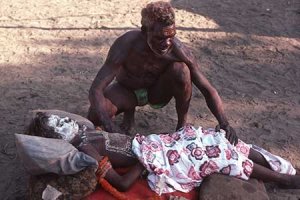
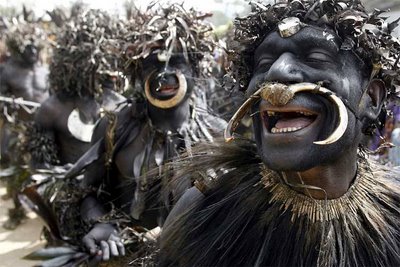
Rites of passage in adolescence are a cross-cultural phenomenon. They have existed throughout human history and may be a significant factor in the development of a stable adult personality. In Western culture, we are familiar with such rites as the Bar Mitzvah, Sweet 16 parties, and Quinceañera. In tribal cultures, coming of age ceremonies are, in many cases, much more elaborate and can be truly terrifying.
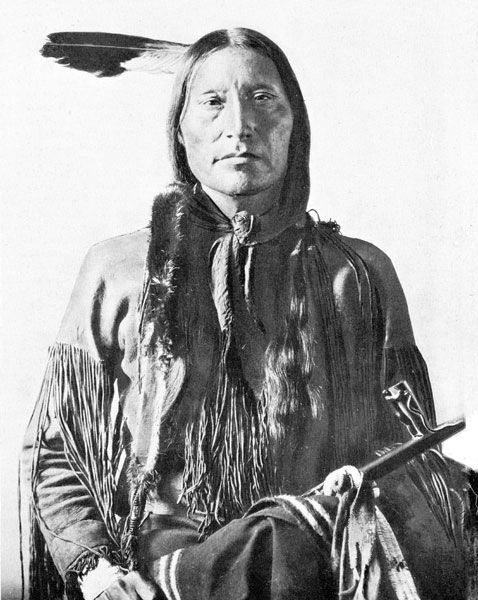
Boys of the Algonquin Indian Tribe of Quebec were brought to a secluded area, often caged, and then given an intoxicating medicine known as wysoccan, an extremely dangerous hallucinogen that is said to be 100 times more powerful than LSD. The intention of the ritual was to force any memories of being a child out of the boy’s mind. Unfortunately some boys also suffer memory loss to the extent that they lose memory of their family, their identity, and even the ability to speak. Some boys who showed recognition towards their childhood after returning to the village were then taken back and given a second dose and forced to attempt to cheat death a second time.
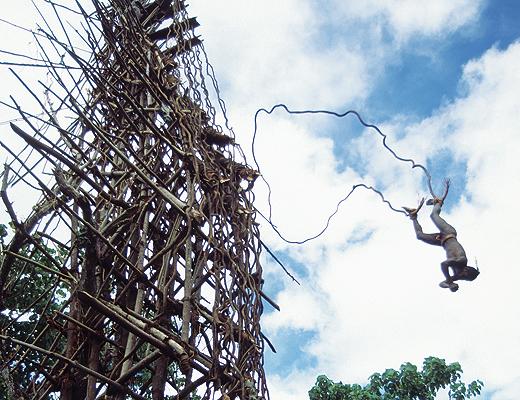
Both a harvest ritual and a rite of passage amongst the tribes of the small pacific island of Vanuatu, land diving is now a tourist phenomenon. The men who live on Pentecost Island in Vanuatu, climb a rickety 98-foot-tall (30-meter) tower, tie vines to their ankles and dive to the ground, falling at speeds around 45 mph (72 kph). When a dive goes correctly, the person gets close enough to touch his shoulders or his head to the earth. However, unlike bungee jumping, these vines aren’t elastic and a miscalculation in vine length could lead to broken legs, cracked skulls, or even death. Boys once they have been circumcised at about age 7 or 8 begin participating, though they usually are permitted to jump from a shorter tower. As a boy makes his first dive, his mother holds an item representing his childhood. When he jumps, she throws the item away. Divers also refrain from sex the day before they jump — legend says it will cause the jump to go badly.
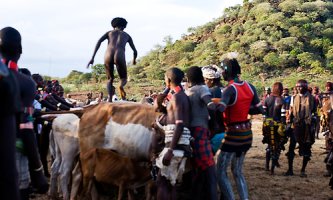
This rite of passage for men coming of age must be done before a man is permitted to marry. The man-to-be must “jump the cattle” four times to be successful and only castrated male cattle and cows may be used to jump over. This test is performed while naked (except for a few cords bound across the chest) as a symbol of the childhood he is about to leave behind him. On completion of this test, the young man joins the ranks of the maza – other men who have recently passed the same test and who spend the next few months of their lives supervising these events in villages throughout the Hamar territory.
Their rite of passage ceremony is similar for girls and for boys, ages 14 to 16, though the genders are initiated separately. The initiates are first ceremonially circumcised or excised. After this, they live in seclusion from adults of the opposite sex for four to 24 weeks. They paint themselves with white clay and charcoal in order to appear as wild creatures (cemaasiisyek). Certain secret knowledge is imparted by same-sex elders. The most important knowledge concerns the cemaasiit – a mythical beast that haunts the initiates during their time in seclusion. At night its roar can be heard, and the initiation is complete when each youth has seen and held the instrument used for producing the roar and then produced the roar themselves.
Festa das Mocas Novas is an initiation into womanhood traditionally performed by the Tukuna people of the Northwest Amazon. It begins with the onset of menstruation, and over the next 4 to 12 weeks, the initiate remains in seclusion in a small chamber constructed within the dwelling of the family for this purpose. During this period, the initiate is thought to be in the underworld and in ever-increasing danger from demons known as the Noo. For the climax of the rite, guests arrive and some don masks, allowing them to become incarnations of the Noo. For two more days the initate remains in the seclusion chamber, her body painted with black genipa dye as protection from the Noo. On the morning of the third day, she emerges from the chamber. Surrounded and protected by relatives, she is led out into the festivities. The family dances with her until dawn, at which time the dancing stops. The initiate is then given a fire brand by a shaman and instructed to throw it at the Noo. This done, the power of the Noo is broken, and the Tukuna female is safely entered into womanhood.
The Iria is a rite performed by the females of the African Okrika tribe. Girls from the ages of 14 to 16 enter into “fatting rooms” where they are fed rich local foods to make the body “come out.” They are taught by the elderly women of the tribe to sing the traditional Iria songs. It is believed among these people that young girls form romantic attachments to water spirits. Before they are considered marriageable and allowed to receive mortal suitors, they must first free themselves from these attachments. This is accomplished by the coming together of the girls at the river on successive dawns to sing the songs they have learned. On the final day, the initiates return to the riverbank and the water spirits are expected to attempt to seize the girls by force. This can be prevented by the Osokolo, a senior male member of Owuper society who strikes the girls with sticks, driving them back to the village, ensuring both their safety and future fertility.
When a young man becomes of age, his tribal elders lead him into seclusion. The men will lay down surrounding the boy facing away from a fire. An assistant will sit on the boy’s chest, while another elder will pull and twist the boy’s foreskin and proceed to slice it off. The men will take the boy to kneel upon a shield over a low-lit fire and made to eat ìgood meat.î Essentially, the meat is the boy’s own foreskin. He must swallow without chewing it, and once he has succeeded, he as eaten his ìown boy,î and become a man. When the circumcision heals, the young man will go through a subincision. His penis will be sliced on the underside, sometimes to the scrotum. The man is then made to stand over a fire to allow the blood to drip into it and purify it. Apparently men do this to sympathize with their female counterparts. And although they will now have to squat to urinate because of these incision, when they become married, some men will often times repeat the same blood-letting process.
This Amazon tribe performs an initiation ritual where young men really place their hands into mittens filled with hundreds of bullet ants. The bite is approximately 20 times more painful than being stung by a wasp. The tribal men will gather the ants and submerge them into a solution that temporarily knocks them out. The ants are then woven into the mittens. Upon waking up, the men will place their hands into the mittens and dance for 10 minutes. The ant’s sting prevents the body from protecting itself from pain. The body begins to convulse, and the pain can last up to 24 hours. The crazy thing is, many men will repeat this ritual many times to prove their manhood.
For a man to prove himself worthy to hunt in the Matis Trial in Brazil’s Amazon jungle, he must undergo 4 trials. The first stage involves dumping bitter poison directly into their eyes allegedly in order to improve their vision and enhance the senses. The next series of trials includes beating and whippings. The trial concludes with inoculation of the Phyllomedusa bicolor, a small poisonous frog. After burning an area of the skin, the frog toxin is injected with the use of a wooden needle. The poison is said to increase strength and endurance, however, these enhancements must come after the unbearable lightheadedness, vehement vomiting, and violent relieving of the bowels.
Once the boys prove themselves able to withstand these trials, they are treated to performing them before every future hunt they partake in.
Initiation for this tribe begins at the age of seven, when boys are removed from their maternal figure and all females, and placed in a special house in which they subsist with other males for the next ten years. During the first stage the uninitiated boy’s skin is pierced as a way of discarding any external contamination from women. The boys are required to engage in heavy nose-bleeding. They are also forced to consume sugarcane to stimulate vomiting and defecation, as a way of internally cleansing their body. Once the boys are cleared from any contamination, they are required to ingest semen, which is considered vital to ignite masculine growth, and strength.
Throughout the initiation process, the youths are informed of the impurities that women bring and how harmful they might be to them. In the next stage, the fifth-stage initiation, the youths are taught purification techniques. Once married and engaged in heterosexual activity men must purify themselves of any contamination that might have been brought upon them by their wife. To do so they engage in heavy nose-bleeding, brought up upon themselves, following each of their wives’ menstrual periods. Near the end of the third initiation, the boys are taken to the forest, where they are pointed towards a structure facing a tree. They are told to remove a pubic hair and hand it to one of the men who then, places the hairs into the trunk of a pandanus tree. The boys are told a story about a Jew’s harp and everything it signifies. During this lesson they are forewarned that they are not to be promiscuous during their heterosexual relationships otherwise they will be killed.


Is anyone else wondering what the story of the jew’s harp is all about? I didn’t know they had jews in Papua New Guinea…
#8 “Harmar Cow Jumping” is filmed and performed by Bruce Parry. Have a look at it:
Take some time to view some more films from Bruce Parry too, its worth it.
Thanks for reminding me of another thing to be thankful for.
And btw, lists about bizarre stuff (and also scientific ones, like about dreams and brain) are my favorite. Great List.
In my area, when a boy was 15 or 16 years old, he was bound to play hours of video games followed by a rock concert where he was forced by peer pressure to ingest grain alcohols and smoke the leaf of the cannibus. Later he would fornicate with a fat, ugly chick who’s hyman and heart you would break. All in good fun.
Forgot to mention, my initiation rite included you*****.
It’s a cold day here in the desert, but this list has given me the shivers.
I’m glad I haven’t had to hand over any of MY kids to the tribal elders. Although I suppose that if I were a member of any of these tribes it would be shameful to NOT have my kids participate. (And pass.)
But still I’m glad my kids are safe here.
Bar Mitzvahs are Pretty Weird and Bizarre ..
I have a strange urge to cross my legs.
I was eating when I learned that some people must eat they’re own foreskin in order to be accepted… then I began to scream in horrow.
And digesting semen sounds just as lovely…
@deeeziner (68): yup your kids missed on being forced to eat sperm and perform oral ***** on some bastard(thats related to #1 and ive just read it on a blog) or maybe even getting killed. I know the common opinion is not to judge if im not part of that community, but still. Being forced to do certain things while you cant protect yourself, should be illegal, no matter what culture you’re part of. And we shouldnt just step back and say “oh thank god im not part of that”. Dont we have a universal declaration of human rights.
Ps: i dont think im such a big ass on this one
The only one I’d heard of before was number 3, the Satere-Mawe Trive initiation rite, having seen it done in a documentary. I found it horrifying then, and find it horrifying now.
I find all of these initiation rites horrifying.
Of course, this attitude is coming from someone raised in a modern, industrialized nation, not some third world tribe with little to no real interaction with the world outside their own. These rites have probably been part of their culture for too many generations to count. These rites, to them, are perfectly normal. They would, undoubtedly, find aspects of our culture horrifying.
To me, personally, it all sounds like serious child-abuse. I can’t understand a mother allowing her 7 year-old son to be taken away from her to live with the men from then on. It sounds like kidnap and rape.
But, again, it’s a cultural thing. I don’t understand it. It’s repulsive to me. I can only be glad that as the world shrinks, these tribes will be incorporated into the mainstream and the more hideous of their practices will die out.
@Arsnl (72): I have one adult child, age 27, and I can’t say what she may or may not do.
But I think the key word here is that she’s an ADULT, and viva freedom of choice.
I do wonder how many of these (and probably other more “bizarre”) rites are still being followed as a matter of course in these tribes.
Or has the modern age skewed these tribes and their traditional activities. Is it fair to judge a people through the eyes of a distant “civilized” culture’s standards?
Let me add that I have three kids, two are in their teens.
And I’m still glad that I don’t have to stand by while they are initiated. I dread the driver’s license affair and all the things that come with THAT rite of passage.
What about the Klingon rite of passage, being prodded with pain sticks seems kinda fun.
Btw good list, have heard of a few of them but #1 takes the biscuit.
I’m not even male, but #4 made me hurt. OUCH.
I didn’t have to do anything, okay I got a driver’s license and the rite to vote. My culture sucks.
@deeeziner (76): ohh sorry i directed my comment towards child abuse in general, sorry if i included your kids. Didnt mean to. I zeroed in a bit in your comment cuz it has the “thank god im not part of that idea”. Me culpa.
) and that menstruation is natural and that it doesnt spoil you, things will be better)
For me children shouldnt be taken advantage of even if their “culture alows it”. Personally, the universal declaration of human rights is,well…drum rolls… universal. To some extent these things may be permited but once the well being of that child is affected well someone must step in. I think i broken neck (#9) is a broken neck no matter what culture you live in. Its a long discusion (who has the right to judge who and how can this judgement be fair) but sometimes for the good of humankind some sort of globalization is needed and some practises must be banned. If people care so much about freakin animal abuse, well what the hell is that stuff happing to children all over the world.
And are some of these rites a tradition that conveys an identity to those kids or can we also agree that the lack of educations plays a role in all this (i think that if someone explains to those guys at #1 that women arent “that” evil ( lets not argue here about the quantity of evilness in women
Ps good luck for you teenagers
What a piece of work is man.
i can feel their pain! great list though!
#9 is a tourist attraction ? I’m appalled !
By the standards set by the other items on this list, #8 and #5 seem to be pretty okay. Not that I’d like to jump naked among castrated cattle or be fattened and then beaten with sticks, but the rest of the list puts Medieval torture schemes to shame.
The difficult question that comes up here is this. Should modern laws apply to peoples who have a very different world view from ours ? From our perspective, several items on this list are obviously illegal and would become media frenzies overnight if they happened in a city like New Delhi, Tokyo, Berlin or Toronto. For those of us who believe that these traditions should be permitted to go on, how about laws regarding murder ? Should ancient peoples be permitted to kill members of their clans based on their convictions or should there be intervention ?
I am of the opinion that if the cultural activity in question violates the fundamental laws of modern civilization such as murder, mutilation, forced *****ual activity, animal rights violation or forcible life threatening tasks then no matter how “White Man’s Burden”-like it might seem, these should be stopped.
… of course that leaves circumcision and capital punishment open to major scrutiny.
Also, if even one individual in a tribe dies because he/ she was convinced that the voodoo/shamanic/tantric treatment on offer was the only cure and was not taken into modern medical treatment by force, and the govt in power knowingly avoided intervening then it’s a shame for the government in question.
lucifersam (82) How noble in reason.
Davy (74) I was in Wyoming in 1990. I LOVED it. It was beautiful and interesting, and everyone was so nice. And the stars at night? Wow. Youre lucky. It gets cold here too (Chicago) but kind of devoid of true natural beauty. Except for the lake.
lucifersam (82)
I will tell you why; so shall my anticipation
preuent your discouery of your secricie to the King and
Queene: moult no feather, I haue of late, but wherefore
I know not, lost all my mirth, forgone all custome of exercise;
and indeed, it goes so heauenly with my disposition;
that this goodly frame the Earth, seemes to me a sterrill
Promontory; this most excellent Canopy the Ayre,
look you, this braue ore-hanging, this Maiesticall Roofe,
fretted with golden fire: why, it appeares no other thing
to mee, then a foule and pestilent congregation of vapours.
What a piece of worke is a man! how Noble in
Reason? how infinite in faculty? in forme and mouing
how expresse and admirable? in Action, how like an Angel?
in apprehension, how like a God? the beauty of the
world, the Parragon of Animals; and yet to me, what is
this Quintessence of Dust? Man delights not me; no,
nor Woman neither; though by your smiling you seeme
to say so
I have gone through a rite of passage where I cut my penis and stuck in a mitten full of bullet ants for ten minutes, had poison dropped in my eyes, all the while eating sperm.
my rite of passage was vodka
These seem a cinch compared to constant attacks on self-esteem, self-worth, purpose and *****ual attraction that I’ve faced since 16 years of age.
@segues (73) “It sounds like kidnap and rape.” Sorry, what? Where was the rape? I don’t think you should be throwing such labels at customs you don’t understand.
glad i’m in europe http://alturl.com/de3s
@Arsnl (81): No worries Arsnl, I never felt that my comments were being poo-pooed by yours.
As a matter of fact, I could see a bit of support from you, in the words you shared.
But I do have to disagree with the view that these rites are “abuse”. Rites of passage are exactly that. An event or experience that the community has accepted as a norm. Nay more than that. Oftentimes they are the yardstick by which future leaders in these small societies are measured.
I’m a resident of a rural area of Arizona. I have spoken with members of the Child Protective Services agencies of my area. Even agencies like these recognize that in some cases the “civilized” norm is not actually valid in all situations.
Case in point, part of the AZ State strictures regarding the provision of adequate and hygienic housing for children precluded dirt floors in a home. Strict adherence to these strictures were REQUIRING that children in traditional Native American housing be removed from their family because of nothing more than the fact that these homes had hard pack floors. No physical or mental abuse, proper clothing, schooling etc. Just the fact that the floor was dirt. As it had been for generations. It took quite a lot time and effort, not to mention the emotional damage to the children and their families from the forced separation before state statutes were modified to allow for Native American tradition.
Although my example does not involve anything as extreme as the rites from this list, it does convey the concept that not ALL situations can be properly governed by a blanket set of laws/rules.
As a citizen of a Western culture I could never condone these actions against children of My society. But I also cannot in good conscience demand that a foreign society go through the horror and awkwardness of culture-shock because I choose to judge their ways through my eyes.
@Wrichik (84): If a society does not perceive death through initiation as murder, why should the “more modern” society that is not part of the community in question deem it murder?
Outlawing initiation rites that may cause bodily harm or death in a far outback and technologically barren tribe is a very brutal path to tread.
These rites are contrived to thin the herd so to speak. Resources when in the wild are scarce, and all are reliant upon those who can aid in their acquisition.
So unless you feel that modern culture should also supply these tribes to food, housing and technology, you can’t really outlaw the practices that have allowed these peoples to exist through the centuries, and you really cannot tell them what is murder and abuse.
@deeeziner (93):
I´d say Amen to that! save for the fear of starting yet another religious argument. In any case, I agree 100% with your comments. You cannot judge (or pretend to outlaw) a society´s traditions unless you are prepared to have them do the same to your own traditions. Who knows which traditions you hold dear wold be absolutely revolting / shocking / incomprehensible to some of these peoples…
Silly example… Kids in the US move out of their parents´ homes when they graduate high school and go off to college. Sounds normal, right? It´s not necessarily that normal (or common) to people in South America. Most college kids here actually live at home with their parents until they graduate… and quite a few remain there until they get married. So which is “normal and civilized”?
I don’t care if this is culture. This stuff is FREAKY.
I think even circumcision is disgusting (but it seems everyone in USA is circumcised!)
Why people has to inflict unnecessary pain to the young is beyond me.
@Barold (91): @segues (73) “It sounds like kidnap and rape.” Sorry, what? Where was the rape? I don’t think you should be throwing such labels at customs you don’t understand.
****
Sambia Tribe. “Initiation for this tribe begins at the age of seven, when boys are removed from their maternal figure and all females, and placed in a special house in which they subsist with other males for the next ten years.
..Once the boys are cleared from any contamination, they are required to ingest semen, which is considered vital to ignite masculine growth, and strength.”
****
You’re right Barold, that sounds nothing like kidnapping or forcible ***** acts. I should have left my big, fat mouth shut.
@El the erf (6): that’s the haka! they do that dance for a lot of other things aside from the rugby. ;p sorry this comment is just local enlightment
Great list! Interesting. I cringed when I was reading a few of those. Makes me appreciate that I was able to grow up in our culture.
holy ***** most of these tribes are actually retarded, how the hell did they come up with some of these ridiculous, inhuman tortures!
i don’t care if its part of there culture and tradition, its completely backwards.
I wish the western world would have rich traditions as the ones above. These societies are so much pure and connect deeper with themselves spiritually by doing some of these rites.
@segues (97):
While I wouldn’t call it rape, as Westerners understand the term, it is, nonetheless, shocking to our sensibilities since it involves homo*****ual acts (oral copulation) between men and boys:
“A crowd of men hem the boys in beside a pool in the brook. A war leader picks out a sharp stick of cane and sticks it deep inside the boys nostrils until he bleeds profusely into the stream of a pool, an act greeted by loud war cries.” (Herdt, p. 85) The men repeat the war chant for each boy. Here if the initiate tries to escape he will be treated worst then the others – this brutality is certainly overwhelming and astonishing. Older men now tell the boys that the bachelors are going to copulate with them orally in order to make them grow. The whole purpose of this is because several elders testify that boys are unable to mature into men unless they ingest semen and that all men have, “eaten the penis”. After formal ceremonies end, the bachelors make erotic advances to the boys and homo*****ual activity takes place outside on the darkened dance ground.
“Not all initiates will participate in this ceremonial homo*****ual activity, but in about five days later several will have perform (sic) fellatio several times.” (Herdt, pp. 87-91) …
FROM: The Sambia Tribe — http://lrivera0327.tripod.com/
^ okay maybe that tribe might be a little tripped out, but still, this tribe shouldn’t stand out for all tribes of third world countries. Maybe the next list should be “10 Awesome-to-the-Western-World Rites of Passages “
here’s another……
Before men/boys leave home they should have to clean the toilet for at least 1 year. That way they would understand it is not a self-cleaning-device!!
@segues (97) I’m so glad we both agree about your big fat mouth.
Rape has *****ual connotations. This ancient tribal ritual, even if it seems odd to us, would probably only be considered *****ual by someone misconstruing the motivation. Like you.
Open your mind.
@deeeziner (94):
“If a society does not perceive death through initiation as murder, why should the “more modern” society that is not part of the community in question deem it murder?”
Here’s why.
“Satidaha”, also known as just “Sati”, was a practice prevalent in the Indian subcontinent for centuries. In an act which supposedly earned divine blessings for the entire village, widows would burn to death on their husbands’ funeral pyres. While this was sometimes voluntary, it was very frequently compulsory. What would you do given a choice to eradicate/encourage/ignore it ?
Would you let the practice continue purely out of respect for tradition, since the society in question obviously did not tag the people involved in forcing unwilling widows to immolate as murderers ? Or perhaps you would ban it and imprison anybody who attempted to carry out this traditional homicide ?
Guess what the British government chose to do. I think you’ll guess right and will agree too.
@deeeziner (94):
“So unless you feel that modern culture should also supply these tribes to food, housing and technology, you can’t really outlaw the practices that have allowed these peoples to exist through the centuries, and you really cannot tell them what is murder and abuse.”
I DO think that modern culture should provide access to food, housing and technology to the tribes. If they choose not to take it, then fair enough … it’s their call. However, a tribal child being subjected to hocus-pocus when he needs surgery or anti-biotics is unacceptable to my conscience. I know that sometimes what seems like hocus-pocus to us may actually work, by the placebo effect, or even a working knowledge of local herbs etc. However, I would not count on it.
What would you do if you had the choice of letting a sick tribal child be “treated” by a witch doctor or taking him forcibly to a modern hospital ?
Sometimes you wonder if life is so hard why do this?
But perhaps it is so that they learn how to deal with severe pain and discomfort in controlled conditions so that when they have to deal with it in real life they know that they have the resources to do so.
@Wrichik (106): You bring up the example of “Sati”, an centuries old religious and societal act of respect, often times EXPECTED of the widow(s).
Those who managed to escape the funeral pyre often found life unbearable afterwards due to being ostracized by their community, and having an incapability to provide for themselves. Sometimes their own family or in-laws would mutilate them for NOT performing sati.
But these women KNEW that this was the price of non-conformation to the laws and practices of the community as a whole.
“Guess what the British government chose to do. I think you’ll guess right and will agree too.”
I don’t know what you mean by “guessing right”, because I don’t agree with the old imperialistic habit of storming into a foreign country and telling a society that all their traditions and rites are “wrong”.
But I do believe that your example of British interference in the affairs of India is an excellent example of why my point of view has validity.
To storm into a culture and try to inject your values, (especially forcibly) leads to a questioning of that culture’s validity by it’s own members. It leads to an ugly form of undermined confidence in the youth in their own culture’s traditional values.
And in the example of British colonization of India, they subjected the population to their idea of civility, but did not give the people even a modicum of equality to those who invaded. The British did not even try recognize the religion or cultural standards which made sati acceptable to the people who practiced it.
And look what that eventually got the British.
It cannot be denied that India ultimately DID profit from Western culture and it’s influence to their society, but it was only achieved AFTER India gained it’s freedom from British oppression, and took it’s destiny into it’s own hands. And it’s true that the practice of sati has been left behind, to history, but isn’t that also because India chose to embrace the legacy of Western culture and “come into the light” of modern society.
But they also choose to embrace many. many of the rites and practices of their traditional culture. Often still frowned upon by other cultures. Often times still gawked at as unbelievable curiosities, (even here at LV).
My opinion ultimately remains at you cannot judge a community by a universal blanket of acceptable behavior and standards. IMHO if anyone has the right to step in and dictate to a small culture as those highlighted in this list, then it should be the people of the closest “modern” society to each of these tribes. These are the people who would have the greatest understanding of these small culture’s, and the greatest chance of guiding a successful ans smooth integration into the “modern” world for these indigenous peoples.
My example of good intentions gone bad would be the practice of female castration, common throughout African nations. A great many of humanitarian groups and individuals crusaded through the continent to eradicate this “barbarian” practice/rite, that is traditional in both tribal and modernized communities.
This lead to a great deal of inter-family and inter-community conflict. Even the young women that were being “protected” revolted against the campaign. They felt that to be denied this traditional rite made them pariahs, and “unclean”. It made them un-marriageable in their communities. The campaign that was launched to help these young girls/women from being mutilated was rejected by those it was meant to “save”. Even by women who lived a modern life by western standards.
The practice still continues, and since it has started to take an “underground” status, where’s the medical help for the women whose rite went wrong?
So again I stand by my opinion. But that is ultimately what it is, my opinion.
@Wrichik (107): “What would you do if you had the choice of letting a sick tribal child be “treated” by a witch doctor or taking him forcibly to a modern hospital ?”
If I were to be the one holding the power of life or death over the head of a sick tribal child, of course I would chose the proven capabilities of modern medicine. If it were up to me and my hypothetical powers, ALL sick people everywhere would be healed. (Probably not very practical on a global scale, come on, the Earth is only so big with x-amount of resources available.)
No, I’m not gonna “forcibly” take that child. (Your word from the quotation.) I would just have to rely on my enviable powers of persuasion.
Sorry I’m not going to put my life in jeopardy in the outback by trying to KIDNAP a child for my own sense of propriety.
But the question of sick children is not apropos here on this list. Never in this list do we know if these tribes are recipients of humanitarian health efforts. Health care is not the topic of this list. And if it were, what about all the sick children in EVERY modern city’s population. Do we not owe those children the same concern that you want to give to these children of this list?
Don’t try to paint me as an uncaring individual, I’m far from it. And I do believe that my caring nature is why I am speaking up for the validity of these rites to the people who practice them.
Don’t try to make me come off as some sort of person (freak?) who condones or welcomes these activities listed, as proper and acceptable in modern communites.
I DO NOT child abuse, or *****ual exploitation/violence in any way.
But I also believe that in the context shown in this list, these may not be the most accurate terms to define the activities of these rites.
I also believe that to have these rites opened up on a tourist basis to the outside world is a reprehensible practice and says more about those who would buy a ticket than those who sell it.
One last point. What about the sociologists who have studied these tribes and brought their practices into the limelight of society? Why have no commenters of this list brought them up to bear for leaving these people to continue their rites after they have had their chance to study and publish their findings for the sake of “science” and enlightenment?
And what are YOU doing to help bring these people “up to snuff” now that YOU know of their existence and horrible doings?
@deeeziner (110):That should read:
I DO NOT support or condone child abuse, or *****ual exploitation/violence in any way.
@deeeziner (109):
Two posts. 21 paragraphs. 1029 words.
… and I still don’t get your point.
“Sati” was obviously difficult to eradicate because of the immense protests that the British govt faced from contemporary Indian society. Obviously the women who could escape their fate of being cremated alive found it extremely hard to find social acceptance; this goes to show the widespread acceptance of the practice as normal and does not, in any way, amount to a point in favor of “Sati”. Did the British invaders respect the Indian way of life ? No, they didn’t. However, that does not make all of the steps they took incorrect.
Think about it. Did the British rulers outlaw idol worship which was and still is a very prominent feature of Indian culture but completely in conflict with Western mores ? Did they outlaw the study of Sanskrit, Arabic or Persian ? Did they force the Hindu population to take up beef consumption and the Muslim population to take up pork consumption ?
They didn’t. They did all they could to preach their definitions of right and wrong, tried every underhanded trick to deprecate India’s cultural values and treated Indians reluctant to suck up to them as worms; and I condemn all of that as much as you do. When it comes to “Sati” though, I find what they did a welcome change in Hindu society. Muslim emperors in the past had tried to do the same, were met with resistance, and ultimately failed to eradicate it, but the Brits succeeded and I laud them for it.
Female Genital Mutilation is another valid point that you mention. The attempts at banning it have resulted in various adverse consequences. In some places the practice has taken on a new importance as a feature of cultural identity in face of external forces to diminish it. In others it has only forced the practice underground where it is even riskier. While this highlights the importance of the method to be adopted in eliminating such practices, it does not detract from the fact that these practices ‘should’ be eliminated. Local initiatives, which do not outright insult prevalent cultural norms and do not give rise to vehement xenophobia are certainly important. Even in the case of Sati, Indian social reformers like Raja Rammohan Roy stood up against the practice and this helped the movement to a good extent.
Two observations I would like to make here are the following.
1) A practice which seems barbaric to an external society and normal to the practicing society will very often be perfectly acceptable and even desirable to the victims themselves. The victims’ volition does not make the practice any more acceptable than a child’s permission to being subjected to acts whose consequences he/she does not understand makes statutory rape okay. A lot of teenagers find drug use enjoyable and might find it hard to refuse out of peer pressure, but that does not make it any less important for responsible adults to compel them to quit and go into rehab if necessary, by all means possible.
2) Sometimes you have the choice of solving a problem nice and slow … strategizing, making policies, consulting people, expressing reverence for native customs etc …
At other times, you have to take decisions on the spot, without the luxury of armchair meditations, and take risks for a greater good. This is what brings us to my and your second posts resp.
@deeeziner (110):
Let me begin by clearing this confusion up. I am not trying to paint you as an uncaring individual or a freak. I’m only raising these questions in order to make my point that respect for another group’s traditions is extremely significant, but there are cases where this respect translates to tolerance of certain things which, in my opinion, should not be tolerated. So, do not take my points personally … once we’re done discussing this, we can go out for coffee, if that’s okay with you
Now, back to the discussion.
You mention how you would heal the world if it were possible but it isn’t, how the scenario is not relevant to the list, how the practices enlisted are not what they seem to you and me in the context of their cultures and how sociologists should be lynched in your opinion of my opinion.
First up, I wasn’t asking you a Miss Universe question, I was giving you a choice that is faced on a much larger scale by governments of several nations. I completely agree with you that tactless force can further worsen the situation, so the process of providing modern medical facilities to sick people who might not be aware of their existence or effectiveness should be approached with care and respect. However, faced with the precise choice that I outlined in my previous post, I would prescribe and practice force. Would that always be possible considering that I might end up dead trying to retrieve a sick child ? No … not always. Would that lead to further complications ? Likely yes. But whenever possible, I’ll do my best to save a life now and worry about ostracization later.
As for sociologists, I don’t think they wield enough power to bring about the changes that I’ve been supporting and you’ve been questioning. They are society’s eyes and ears along with photographers and journalists. If any of them had a good chance to prevent, say, a ritual murder and didn’t do it out of scholarly interests, then I condemn his action too.
As for children in cities, I do think that they should be treated too … where did I indicate otherwise ?
I totally agree with you about the people who come to watch the jumpers in Vanuatu being more depraved than the ones who try to make a profit out of it. That is also the feeling that I reserve for spectators in bullfights in Spain, just in case you felt I was biased in favor of European/Western cultures.
What have “I” done for these people, now that “I” am aware of their horrible doings ? Why, I have shared my opinions on this most esteemed website with complete strangers and proceeded to purchase front-row tickets to watch the next round of Harmar cow jumping with castrated females from sub-Saharan Africa, while wearing a baby seal waistcoat and eating illegally hunted shark fins.
I have not had an opportunity to make a difference, but that should not restrict my right to express my thoughts freely. I acknowledge the presence of vast grey areas in the landscape of what is right and wrong but I have pointed out some things that I do not see as grey.
@Wrichik (112):
@Wrichik (113):
I believe our discussion can be honed to one response, so here goes.
To your observances about Indian culture and the eradication of sati, I agree with what you have expressed, although I will clarify for myself that I laud the Indians. Primarily for the fact that they have chosen to lay the practice of sati by the wayside, when they could have easily reinstated it’s importance to their society upon their gain of freedom.
Since it was the British that made India aware of their potential participation in the scheme of world-wide trade, politics and cultural exchange, and the standards of living and moral and ethical values involved in such an exchange, then the Brits should receive their due as well.
Taking us to the observations you have made:
1.) Peer pressure and isolated acts of abuse do not equal community collective consciousness and tribal ritual initiation. These activities/rites are not engaged in for the purpose of personal gratification on behalf of the elders presiding. Death of the participants is in NO way the desired outcome of these rites. Quite the opposite. The survival of the teens in question is foremost in the minds of the elders. For how else can these newly matured kids be of service to their families and their community.
Not to mention that these are the beloved children of the elders performing the rites. NO ONE on Earth could love these children more than their parents and close neighbors.
And if you accept those two above mentioned concepts, then…
2.) Yes. The task of “educating” and “modernizing” SHOULD be well planned and incorporated. Should be slow and methodical. Of course, this would mean assimilating these communities into “our” society. Thus changing permanently or possibly making these tribes EXTINCT. (Obviously none of the tribes mentioned in this list are in the position of ever becoming an “India”. i.e. The difference between a tribe and a nation.)
But I don’t see circumstances, except in the extreme, (as in natural disaster, control of epidemic infection, or being in the direct path of modern warfare), for big brother to have to initiate an abrupt and shocking change to the ideology of these people.
I have read and re-read your comments #112, and for the most part it seems that you and I are actually on the same page.
For the sake of our discussion I would like to point out that my original comments were aimed at those whose initial response here was “That’s barbaric and unacceptable and should be outlawed immediately if not sooner!” (Not verbatim, but the general gist of the combined comments.)
I had tried to make a short comment, (look where we are now…rolls eyes.
) to point out to those commeters, that distasteful as we may find these practices from the confines of our computer enhanced world, these tribes deserve a subtle approach from us “moderns” to change their ways.
As for your post 113, I apologize if I made you out to be an “armchair activist”. Even if that were an accurate description of you, I would have to describe myself likewise.
But I laughed at your “Miss Universe question” reference. Obviously you haven’t seen a current picture of me.
It was a bit egotistical of me to have assumed you were posing the question to me on a personal level. (One of the drawbacks of an online discussion.)
So again, I see us on the same page regarding your last posting.
Enough so, that I extend this invitation…If I should ever be in your neighborhood, you choose the coffeehouse and I’ll pick-up the bill. By the way I also like pie with my coffee.
BTW Wychik–Did you actually COUNT the words in my previous posts? (If you did I’m amazed and kind of honored.
) If there is a down loadable application for word count in a document I would love it if you’d share.
@deeeziner (115): If there is a down loadable application for word count in a document I would love it if you’d share.
Fyi MS Word does it. It’s not a free download of course, but widespread enough that you have access to it?
how about adolescent girls in Nicaragua having their hair pulled out and not becoming a woman before it grows back out
(117)-
Yes that is what I thought when I saw this list. A crowd of people pulling out, one person after another, the hair of a girl. I have watched it on tv. I don’t remember Nicaragua though. it sould be on the list.
Stupid is as stupid does. While I do not condone or practice any of these rites I find most of what we in the West do between adolescence and adulthood to be equally as “bizarre,” if not even more stupid than those listed. Most of what we do around alcohol and ***** would count as bizarre on my list.
just when I thought our passage ritual in the Philippines (circumcision) is painful enough.
@defil3r (1):
A few of the tribes mentioned on the list are located in the west…
I have a suggestion for another initiation related list. Top 10 initiation rituals on American college campuses, you know those fraternity house… things. I’m not from the United States so I wouldn’t know, but I’ve seen films.
A lot of the tribes on this list would be aghast at the way our children are brought up. Sitting in front of the TV eating fat laden food, not following societies laws, not respecting their elders etc. We may not agree with certain aspects of their culture but a lot of it isn’t in the mess that ours is.
It would be inhuman to force our f’ed up society on them.
I am from Papua New Guinea. I have never ready anything more funny. Please advice me on the name of the tribe so I can go see for myself…hahaha