Many people who’ve had to proof read documents start to develop a kind of compulsive “tutting” at misused words. Here’s my top ten words that are misused by either professional writers or public speakers who, let’s be honest, should really know better. I’m not being paid for this, so I don’t feel so bad if there are mistakes!

“Refute” means to “disprove with evidence” and yet it’s commonly used, even by professional writers, to mean “rebut” which carries a similar meaning but isn’t quite so strong, as it can also mean “argue against.” The example here (“Simon Cowell refutes ‘scandalous’ claims he helped billionaire hide assets from wife he was divorcing”) is from a recent Daily Mail article. For those outside the UK, the Daily Mail is a newspaper which regularly rages against falling educational standards. A special mention to Sarah Palin who invented a new word “refudiate”; the usage suggests she meant repudiate.

Nowadays, it’s almost universally assumed that “instant” actually means “quickly” or “without intervention.” Obviously, it doesn’t. It actually refers to a precise moment in time. Google Instant is a good example of this word being abused.

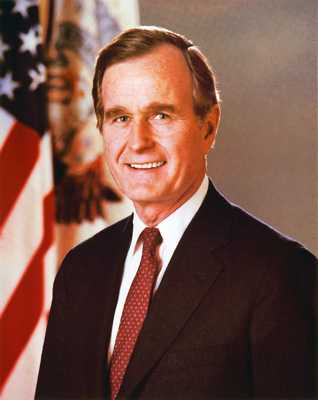
“Enormity” means “extreme evil”, but it’s often used to mean “enormousness”. US President, George HW Bush missed this one when he said after being elected that he “Couldn’t believe the enormity of the situation.” A perfect example of irony (which, in the context I have just used it, is correct).

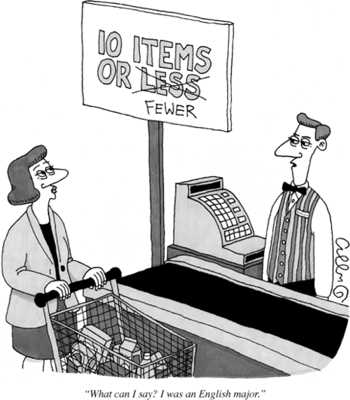
Less is used when comparing quantities that can’t be counted; for example, “I’d like less milk.” If you’re comparing quantities (like bagels, for example) then “fewer” should be used. But you don’t win many competitions with a tie break if you point out that “25 words or less” should actually be “25 words or fewer.” The antonyms “more than” and “greater than” get similarly misused. Programmers will know the comparison operators are referred to as “greater than and less than”; it should really be “greater than and fewer than”.

Chronic is originally a medical term meaning “long term”; it has the same root as “chronometer”. Someone suffering from chronic pain has long term pain. It’s often used to mean “very bad” – in fact “acute” should be used instead. Despite that, it’s easy to find recent examples: “O’Brien: INM in ‘chronic’ state”.

This is such a widely known misused word that examples are less common, as most people know to avoid the term – which should be used to describe something that is actually happening (for example, “He literally danced with joy.”) but should not be used for emphasis (“Steam was literally coming out of his ears.”) This example quotes a, now deceased, reverend gentleman who seemed to rejoice in, frankly, daft opinions, including one about a “literal homosexual steamroller”:

“Panacea” means a cure all; it comes from the same Greek root as “panorama”. It shouldn’t be used to imply a cure for a single thing, and yet here is a newspaper saying: “SOUTH AFRICA: Welfare payments – a panacea for poverty?”

Does “disinterested” mean the same as “uninterested”? No. Here’s an example of misuse: “TomTom Disinterested in Windows Phone 7 Too?”. “Disinterested” means that a party is independent; so a dispute might be settled by a disinterested party. “Uninterested” means the party has no interest. “I asked John if he wanted to go to the cricket, but he was completely uninterested.”

Decimation was a Roman punishment where one in ten men was killed. So when something is decimated, it implies that ten percent of it is destroyed. “Devastate” is almost certainly a better word for most usages and yet: “New York City budget will decimate libraries”.

From the Latin, this means the last in a list of items. But it’s so widely used to indicate the best; a google search for “ultimate phone” gives 307 million hits. I’d argue that the last phone has yet to be made. This is probably the most misused word on the Internet; type “ultimate” into google and thousands of hits come up, pretty much all of them using it as “the best”. However, for a change, this is the ultimate entry in this list.


Web-Stat hit counters
http://www.learn-english-today.com
• lessons + exercises • vocabulary • idioms • proverbs • wordgames • fun • resources • news • books • home •
NEW WORDS IN ENGLISH
Recently-coined words, terms and expressions, with their meaning.
The English language is notoriously fast in adapting to the changing world.
New words enter English from every area of life where they represent
and describe the changes and developments that take place from day to day.
Here are some words and expressions that have been coined in recent years.
Word Meaning
Affluenza
A blend of ‘affluence’ and ‘influenza’.
A social disease resulting from extreme materialism and excessive
consumerism: earning more money and consuming more, which
can lead to overwork, debt, waste, stress, anxiety, etc.
Agritourism
A form of tourism in which tourists stay on farms or in agricultural
villages, and often participate in farm activities.
Alcopop Fruit drinks fortified with alcohol, designed and marketed to appeal
to young people.
Audiophile Person who loves and collects high-quality audio equipment.
Baggravation Blend of the words ‘bag’ and ‘aggravation’.
A feeling of annoyance and frustration at the airport when your
baggage has not arrived but the other passengers’ bags have.
Breadcrumbing A navigation technique which helps users by displaying a list of links
to the pages they have visited when exploring a website
e.g. home >>vocabulary>>transport.
Burkini or Burquini Blend of ‘burqa’ and ‘bikini’
A swimsuit worn by Muslim women which covers the whole body
i.e. the arms to the wrist, the legs to the ankle, with a hood to
cover the hair and neck.
Busking Performing on the streets and other public places, while soliciting
donations.
Busy urban areas will attract street performers (buskers) who sing,
play, juggle, etc
Buzz Excited interest or attention surrounding, for example, a new invention,
a recent event or something that has become fashionable.
Buzzword A new word or expression that is commonly used in specialized
work environments or age-groups, and has become fashionable.
Terms used in advertising can often convert into buzzwords and
become widely used.
Captcha Completely Automated Public Turing Test To Tell Computers and
Humans Apart.
A distorted image of letters and numbers used to ensure that a
response is not generated by a computer, in order to prevent
spamming.
Carjacking Blend of ‘car’ and ‘hijacking’
When a car driver is forced to give up his vehicle or drive to a
destination designated by the attacker.
Chatroom Areas on the internet where people can communicate by
exchanging typed messages.
Chick lit Books, usually featuring female characters, written by women on
contemporary themes and issues that appeal more to women than
to men.
Citizen journalism News collected and reported by ordinary people, especially
through the use of blog software.
Cloud computing A computing service which enables access to a shared pool of
resources (servers, data storage, applications, etc.) over the Internet.
For example, users can access and use tools or applications through
a web browser without having to install them on their computers.
Content farm A website that publishes large amounts of low-quality content, or
content copied from elsewhere, in order to attract visitors and
improve its search-engine rankings.
Copyleft Opposite of copyright.
Whereas copyright imposes restrictions on the distribution of a work
or publication, copyleft eliminates restrictions and allows freedom of
use for all.
Cot potato Very young child who spends a lot of time watching television.
(cot = a baby’s bed)
Couch potato A person who spends a lot of time sitting in front of the television.
Daycation A trip or short vacation which lasts only one day -
daycationers do not stay away overnight.
Decruitment Euphemism for laying-off staff or downsizing a company.
Docusoap Blend of ‘documentary’ and ‘soap’.
(soap opera: sentimental TV serial)
A ‘docusoap’ is a reality television programme in the style of a
documentary.
Dramedy Combination of ‘drama’ and ‘comedy’.
A film, play or TV programme that mixes drama and comedy.
Earworm A tune that keeps repeating itself over and over again in our heads.
E-cruitment Online recruitment of employees, including online submission of
resumes and cover letters.
Elancer A professional person who works from home and provides services on
the internet.
Emoticon A blend of ‘emotion’ and ‘icon’.
A symbol, used in email messages, which is made out of
punctuation marks and resembles a human face.
E-piracy Electronic piracy
Illegal downloading of material found on the internet (films, music, etc.)
E-stalk To stalk (follow) someone using Internet searches and email.
E-waste Electronic material and devices that have been thrown away.
Fashionista Person who dresses according to the latest fashion trends.
Flame war A period during which angry or rude email messages are exchanged.
Flash mob A crowd that gathers in a pre-determined place, performs an action
then disperses very quickly. The mob is not told exactly what to do
until just before the event.
Flexitarian A vegetarian who sometimes eats meat or fish
Freemale A woman who is happy to stay single and independent so that she
can do what she wants when she wants.
Flightmare Blend of ‘flight’ and ‘nightmare’.
Unpleasant air travel experience (lost luggage, missed connections, etc.)
Foodoir A blend of ‘food’ and ‘memoir’.
An account of someone’s life or personal experiences, with a strong
emphasis on food, often including recipes and cookery advice.
Funemployed/
Funemployment A blend of ‘fun’ and ‘unemployed’.
Someone who enjoys not having a job because they have more
time for leisure and fun activities.
Funkinetics A form of energetic step aerobics that mixes exercise and soul music.
Gastropub A pub which, in addition to beer and alcoholic drinks, offers
gastronomic cuisine.
Gastro*****uals A new generation of men who see cooking more as a hobby than
a household chore, and use their cooking skills to impress friends
and potential partners.
Glamping Blend of ‘glamour’ and ‘camping’.
Luxury camping : sleeping in the open but with every comfort
including cooking equipment.
Greycation Going on holiday or vacation with grandparents in order to
reduce the cost.
Guesstimate Blend of ‘guess’ and ‘estimate’.
A rough estimate without any claim of accuracy.
Hacktivist A person who manipulates information on the internet in order
to transmit a message, usually political.
Hoody or hoodie A person, especially a youth, wearing a hooded top.
Hotspot Location in which wireless Internet access is available
for example airports, hotels, train stations, etc.
Infomania Constantly checking and responding to email and text messages.
Infotainment Blend of ‘information’ and ‘entertainment’.
Online services connected to information and leisure activities.
It bag High-priced designer handbag that is the bag “of the moment”, or
a “must-have” item.
It girl A girl who has become a celebrity more through intense media coverage
than through any personal achievements (e.g. Paris Hilton).
Jumbrella Blend of ‘jumbo’ and ‘umbrella’.
Very large umbrella set above tables outdoors at a coffee shop,
pub or restaurant.
Landline A telephone connected to wires in a fixed location as opposed
to a mobile or cell phone.
Locavore A person who only eats food produced locally.
Mailbomb To deliberately try to disrupt another computer system by sending
massive amounts of email to it.
Meritocracy The idea that merit and individual effort determine one’s success
rather than wealth or birth.
Mocktail Non-alcoholic drink that looks like a cocktail.
Nail tat A temporary tattoo applied to the nails.
Netbook Small laptop computer which weighs less than 3 pounds and has
a 7 to 10 inch screen.
Netiquette Blend of ‘network’ and ‘etiquette’.
Set of rules governing appropriate behaviour and courtesy on the
internet.
Netizen Blend of ‘internet’ and ‘citizen’.
A person who spends an excessive amount of time on the internet.
Nevertiree A person who continues to work after they have reached the age
of retirement.
Newbie A new member of any group, community, or activity.
Nonliner Someone who rarely or never uses the Internet, usually because
they cannot access it.
Noogler New Google employee.
Notspot An area where there is slow Internet access or no connection at all.
Noughties The years between 2000 and 2009 which contain a ‘nought’ (zero),
in the same way as other decades are called the ‘thirties’, ‘sixties’,
etc .
Offshorable Something that can be done or produced in another country, especially
at reduced costs.
Optics The way a situation appears to the general public, or the impression
it gives.
Outernet Traditional media (newpapers, magazines, radio, television) as opposed
to the internet.
Overparenting Being excessively protective of one’s children in order to guarantee
their safety and ensure their success in life.
Oversharing Providing too much information on the Internet (credit card details,
personal information, etc.) especially through social network sites.
Overworking class A segment of today’s working population where there is a desire or need
to work long hours.
Password fatigue Being tired of having to remember a large number of passwords for
different electronic devises.
Quintastic A blend of the adjective ‘fantastic’ and the prefix ‘quin’.
An informal way of referring to a person who is aged fifty or over
but remains *****y, smart, energetic and successful, especially
someone famous.
In August 2011 President Barack Obama will become a quintastic.
Recessionista Popular new term for a person who succeeds in dressing stylishly
on a tight budget.
Road rage Aggressive habits often resulting in violence against other drivers.
Robocall Commercial telemarketing call which plays a recorded message.
Sandwich generation A generation of people who care for the needs of their children
as well as those of their own elderly parents.
Screenager A young person or teenager who spends a lot of time in front of
the computer screen.
Sitcom Blend of ‘situation’ and ‘comedy’.
A drama, on television, based on humorous everyday situations.
Slumdog Very poor, underprivileged person who lives in an overcrowded
squalid area of a city called a slum.
Smirt Blend of ‘smoke’ and ‘flirt’
Smoking prohibition laws have led to a new sort of social pastime :
‘smirting’, smokers getting to know each other when outside on
the pavement.
Snail mail The standard system of delivering mail which is very slow in contrast
to electronic mail.
Sofalise/sofalize Stay home and use the internet, phone or other electronic device to
communicate with people (social networking, chatting, tweeting, etc.),
rather than go out and meet them face to face.
Spinnish The language used by spin doctors, spokes-persons, campaign
managers, etc. when trying to present information in a favourable
light.
Staycation A vacation in which you stay at home and relax or visit places
close to where you live.
Textual harassment Sending text messages to mobile phones which insult or abuse
people.
Tombstoning Jumping or diving into water from a dangerously high place such as
a hotel balcony, a cliff, bridge, wall, roof, etc.
Trashion Blend of ‘trash’ and ‘fashion’.
Fashionable items created from old, used and recycled elements.
Trekkie A fan of the TV science fiction series Star Trek.
Tribal marketing Marketing strategy which consists in using the social behaviour of
certain groups (‘tribes’) of consumers (e.g. surfers, rappers) to promote
a product or service. Very often used by clothing and accessory brands.
Tweet People who ‘tweet’ send short messages via the microblogging
service Twitter.
Tweetheart A user of the Twitter service who is very popular or admired, or with
whom other users communicate a lot.
Upskill Teach an employee new or additional skills.
Videophile Person who is very interested in watching videos and making
recordings, and values high-quality results.
Viral marketing Marketing strategy that consists in encouraging people to pass along
information to friends, family and colleagues through e-mail messages,
blogs, video-sharing, etc., so that the marketing message spreads
like a virus.
Vook A combination of video, text, images and social streams in an
electronic book.
Web rage Anger or frustration as a result of difficulties or problems encountered
when using the Internet.
Webinar Presentation or seminar conducted over the web.
Weblish A form of English that is used on the web (use of abbreviations,
acronyms, small letters, absence of punctuation and hyphens etc.)
Also known as : webspeak, netspeak, internetese.
Widget Blend of ‘window’ and ‘gadget’.
A small application or tool that can be installed and executed
within a web page.
Winterval Blend of ‘winter’ and ‘festival’.
A festival that takes place in winter.
Wordle The words of a piece of text arranged into a sort of graphic.
The more frequent a particular word appears in the text, the bigger
its size in the wordle.
(Also called ‘word cloud’ or ‘text cloud’.)
homepage
knowledgeable……………
Wow best list in quite a while. Proud LV is back on track. I knew none of these.
Interesting!
educational.. very good.. more lists from you in the future, ok?!
The manner in which the author put this list together, reminded me of my old English teacher
Comma splice, monstette. Tut-tut.
lol, sorry
Not quite. A comma splice joins two independently grammatical sentences together using a comma but without using “and.” “The manner in which the author put this list together” and “Reminded me of my old English teacher” are not sentences on their own. Monstette’s comment just has an unnecessary comma.
this is why i started coming to listverse not for crap about the academy awards and stuff that jmar666 or whatever that idiots name is puts out
Word nerds. Grammar nazis. There’s more to life than have flame wars over semantics.
Correct grammar can be important. “Literally” is an excellent example. How is one to know when something literally happened if they are unsure if the person speaking literally means “literally”? Luckily, the people who misuse the word sometimes make it obvious they don’t know what it means. “I literally exploded!” is a good example. However, “I literally slapped her!” Did they literally slap, or do they mean the opposite of literally slapped? Yes, some of us get uptight about grammar when it’s not important; however, correct grammar is sometimes essential to proper communication.
I hate it when people use “literally” when there’s no reason to. The word loses its purpose
Yeah me too. My brain literally explodes every time that word is misused.
…ew
My new favorite thing about the show “Parks and Recreation” is Rob Lowe’s character’s frequent misuse of that word. Especially his particular pronunciation, LIT-rilly.
While it may not be the most correct usage, my usual response to incorrect uses of the word “literally” is to ask them “as opposed to figuratively?”
In programming, we can use floating point numbers which we do not count.
Which one is correct – “5 is less than 10″ or “5 is fewer than 10″ ? 5 and 10 are just numbers and need not be counts of any objects.
I believe less is the correct answer.
In the example you are comparing values, not quantities.
Doesn’t even have to be floating point. You can compare strings of characters as long as there is a context for it. Is “abc” fewer or less than “cde”. In fact, what about coordinates on a map? Is over there “less” than over here, or “fewer”?
“less than” is correct, and “fewer than”, in the case of programming is completely wrong.
You should probably say: lower then
“They’re literally hanging from the rafters” -Gorilla Monsoon.
Are you really going to argue with a man who was obviously a master of the English language and all things within the realm of man?
I’ve got to admit that I didn’t know the enormity one. Looks like Im as bad as George Bush
Don’t put yourself down. No-one can be as bad as him.
Hyphenating “no one” is considerably worse than misusing “enormity.”
Thanks for that. You made me smile.
Smiling is considerably better than hyphenating “no one.”
(I think I’ll utter that bit of Confucian insight to some random person in RL just to see what happens).
You should have included penultimate instead of ultimate. You could have placed it #2.
…or he could put ultimate, which is actually misused, as the last item of the list. Including both would leave room for one less mistake anyway.
I see what you did there
One fewer?
Nobody’s going to comment on the fact that the world “Ultimate” is included, used incorrectly, in this very websites logo at the top of the page?
“Litverse Ultimate top 10 lists”
Just the dozen or so people who did so on this very list.
13th
Great list.
You should write a list about misused english phrases as well.
Quite a few of the entries on the list are incorrect. Instant, for example, also means a very short space of time, or without any delay, which is where the list author seems to confuse it with quickly.
Literally does get mixed up with figuratively sometimes, but I think it’s a bit of an obvious one for this sort of list. However the author’s quote uses the term correctly, since it’s being done for exaggerated dramatic effect. It’s like saying “He was so upset, steam was actually coming out of his ears.” Yes we all know the author’s exaggerating and that didn’t really happen, but all of the words are used correctly to express what the author wants.
Ultimate meanwhile only means the best in the sense that it’s the last or final one that will ever have to be made, or will ever achieve its position. When you say a phone is the ultimate phone, that means that it is not only the best phone that has ever been made, but that any phone which comes after it will also not be as good.
I agree, nice corrections. Though the list was entertaining to read, the meaning of words is very fluid and changes with culture, so most of the list was really pedantic. Especially the ones that you mention; I don’t see a flaw in the way that Google have used Instant.
Enormity also means large in magnitude according to the OED.
Granted these are archaic uses, but it seems hypocritical of the author of this list to rely on public use ( which after time separates archaic use from contemporary use) to decry ( with wanton political satire I may add) recovered public use of the original meaning.
Beautifully said, and I agree 100%.
I disagree with you on the point you make about the word “literally.” “Literally,” means, literally, that your account of reality is accurate and not exaggerated in any way.
You couldn’t say, for example “he was so upset that steam was coming out of his ears, and I’m not exaggerating–this really happened.” Unless you’re a comedian (and a bad one) or the person you’re talking about suffers from an extremely rare medical condition, you are misusing (I would say abusing) words.
People do tend to think that the word “literally” can be used to merely emphasize things; they don’t necessarily realize that it actually means “no, I’m speaking seriously, this is how it happened.” Furthermore, misuse of this word, more than that of any other on this list, is progressively rendering the word itself completely useless. Think about it: if the word were properly used, I could say, “That man was literally the meanest person I have ever met,” and the person listening to me would immediately know that the man I was talking about is, indeed, the meanest person I have met in my life, which is quite a title for anyone. In the real world, however, thanks to the widespread misuse of the word, if I make the same remark, the person listening to me would get the idea that the man I’m talking about is a mean person, but he/she would have no idea how mean he really is. He is mean, granted, but not necessarily the meanest person I have met in my life.
And no, if you say that steam was actually coming out of someone’s ears and it didn’t really happen, you are not using the word “actually” correctly. Nowhere in the dictionary does it say that one of the meanings of actually is “almost happening” or anything like that. There are many ways to emphasize or exaggerate without abusing the language. You can say, for example, “Steam was almost coming out of his ears.” This is a wild exaggeration, because there is literally no way steam could come out of one’s ears under any circumstance, but the word “almost” is subjective, so saying so would be exaggerated, but not outright false. And I think your emphasis is quite understandably conveyed.
You’re right about “ultimate,” though.
If you follow that logic, then every time you tell a lie, you’re abusing the language. ‘Steam was literally coming out of his ears’ is hyperbole, which by definition is an obvious over-exaggeration. It’s obvious because it can’t possibly be true, but it’s nevertheless stated as if it were fact. Literally hasn’t been added for emphasis. It’s been added to express the fact that this actually happened, even though we all know it couldn’t possibly have happened.
In the same way when I say that Paul Bunyon was twenty feet tall, I’m not abusing the language, and I’m not misusing the words twenty or tall. I don’t have to qualify it by saying Paul Bunyon was almost twenty feet tall to be speaking proper English.
Over-exaggerate is another falsely used term, as it doesn’t exist. When exaggerating there isn’t anything further, you can exaggerate a little and a lot, but not over-exaggerate.
Over-exaggeration implies that the exaggeration was too much, not how much (such as a little or a lot). F0r instance, I could say that a glass has been overfilled with water without stating how much water was poured into the glass.
Well…
A language (and its conventions) is defined by its users.
In other words, language is shaped by its users in order to fulfill their own communicative needs. And so, a word isn’t misused if it used in accordance to the conventions of the social group to which the speaker and the listener belong. Context is the key.
Just look at anti-languages to see what I mean.
Sorry, but from my point of view you’re approaching the discussion from an uninformed position, just as the author of the list does. Simply put, you don’t seem to grasp that a language which does not evolve is a dead language nor are you aware that written and spoken discourse are two separate entities (one is more lexically dense, whereas the other is more grammatically so), governed by a different set of rules and conventions. “Misusing” literally is not rendering it useless, it is redefining how it is used in a particular context.
And if you say “He really flipped his wig about pedantic hair-splitting nonsense, like the way people use ‘literally.’” Then you’re “abusing” the term literally. And then you’ll truly be the village idiot. But don’t phrase it like that because you’re abusing the word truly and literally murdering our language!
Thank you so much for your last paragraph; I was thinking of a way to express that exact thought and you had already put it so eloquently
@Beth
15TH!!!!!!!!!!!!!!!!!!!!!
my name’s beth and im going to insult someone over the internet for doing nothing
awesome
good list, agree with the mis-sue of the word “chronic” – they pull that ***** all the time over here , its always chronic and 7 times the normal price meanwhile what it actually is , is just regular sub-standard product. *****s.
in the u.s chronic also means good weed…
I’m guilty of so many of these!
Don’t worry you are not alone. But then again this is why we come to listverse in the first place.
Great list… Realy interisting and informative. Hope I remember all these points in the future, and stop missusing them. It does feel like i’m back in highschool, with Mrs Main standing there declaring that everything I say is incorrect… LOL
The author is wrong in saying that the meaning in which we normally use the word “decimate” is a ‘misuse’. True, etymologically ‘to decimate’ means to kill every 10th member of an enemy troupe, but etymology never says the true meaning of a word. It only says how the word was originated.
Today, ‘decimate’ means ‘destroy a large part of something’ and that is the correct meaning of the word.
I think what annoys me about “decimate” is that the meaning is there from the “dec” beginning to the word, and there’s a perfectly good word “devastate” which has the meaning that’s wanted.
Devastate, in Latin, means to cause something to become vast and empty. Which means to completely and utterly destroy leaving nothing behind except an empty void.
It seems like a hyperbole to use this when talking about a few libraries in New York closing down. Perhaps 10% of the libraries WOULD have closed, then what?
Well, then the headline would probably be “Budget cuts will close 1 library in 10!” Your right about “devastate”‘s meaning, but I suspect that’s the meaning the writer meant – although not literally!
You’re* Really?
Slight error in #6: When used in the same context as “chronic pain,” “acute” has the *opposite* meaning of chronic. It means “short term” when referring to disease. So “acute pain” means a short term or sudden onset pain, as opposed to very bad pain. The word “severe” should be used in this context to describe very bad pain.
http://dictionary.reference.com/browse/acute
I stand corrected; I wanted “chronic” in the list because when I was growing up “chronic” was a common teenager’s description of bad or boring things. I remember a review of an Emerson, Lake and Palmer album starting “Chronic has two meanings; very long and very bad, this album fulfills both definitions.”
It was probably on pitchfork
So “acute pain” means a short term or sudden onset pain, as opposed to very bad pain.
My wife can be a pain sometimes. But she’s a cute pain, so I let it slide.
There is no ‘wrong’ in language, only intelligible and unintelligible, or valid and invalid.
Languages evolve. They always have and always will. We shouldn’t be bothered by what words originally meant, but what they mean at the moment. The fact some people think a language should be described by rules that should be strictly adhered to doesn’t change that.
Thumbs Up!
A relevant link:
http://www.smbc-comics.com/index.php?db=comics&id=1981#comic
Excellent point.
Of course that’s true, but I also like to read, or hear, English where the words have been carefully chosen. There was an British Politician (Enoch Powell) who was a clever idiot; he had an almost surreal lack of reality, but he did chose each word with the care of a bomb disposal expert which made him charming to listen to (even if the meaning was nonsense!).
I’m quite ashamed of your left-wing attitudes displayed in that last comment.
I’d imagine Enoch Powell could have written a list of ten words & their meanings & actually get them all correct in the first place. He would most likely have been able to write the very same list in the numerous languages he spoke fluently, whereas you seem to struggle with just the one. Yes, he might not be politically to your taste but that’s no reason to slag him off so. The funny thing is that his rational is now the main priority of the people of Britain, to stop the bleedin’ foreigners from entering the country. They have realised he was right all along! YOU are in the minority now.
“Your” right? this is one of my biggest peeves. It’s “You’re” right. And I think of “decimate” as to kill off a large number” whereas “devastate” is to do alot of damage.
Andrew, “chose” is incorrect. It should be “choose”
Wow, that’s a lot of cognitive dissonance you’ve got going on:
1) “There’s no ‘wrong’ in language”, yet things can be unitelligible or invalid?
If you aren’t communicating effectively, you’re doing it wrong. Plain and simple.
2) We shouldn’t be “bothered” by what words originally meant?
By that logic, words only have meaning through context. This thinking undermines language’s very purpose; We have to agree on the meanings of words in order to accurately convey thoughts. Anything less creates confusion.
Yes, languages evolve. They can also devolve when ignorance goes viral…
…Your response to one is basically agreeing with him.
And yeah, you make a good point on the second response, but as long as the meaning hasn’t literally (mwahahaha) derailed itself, we probably shouldn’t be bothered.
good list!
you should make a list of misused phrases: could care less.
thats a HUGE pet peeve of mine. i always correct people.
Whereabouts are you? I’ve often seen people complain about ‘could care less’, but never actually heard someone say it.
It’s more of an Americanism, the correct phrase is “I couldn’t care less”, which is the phrase you hear most other places. You do hear the incorrect one occasionally in other places though.
Yes, I don’t think I’ve heard “I could care less” in the UK.
I’m in Canada and I usually hear it in TV shows, etc. It literally makes me cringe!
I could care less that you think this usage is incorrect.
*stab stab stab stab stab stab stab stab STAB STAB STAB STAB STAB*
RAAAAAAAAAAAGHHHHHHHHHHRGG!!!!!!!!!!!!!
If you did care less you might not have responded to it at all. But the real question is how much do you care? Neither phrasing really tells anyone on how much they care just that it can’t go any higher or lower. A parent, maybe, couldn’t care less for their kids, because they love them so much it never wavers. At the same time, but far away, a Dr. could care less about a drug that he gives his patients. Because the current success rate is 70%, if more patients die he could care less for the drug that stops chronic pain (they’re old and been in pain for literally 30 years), and stop giving it to them. What those patients were doing 30 years ago this very day I won’t say, but they are some crazy old folks
UGH ME TOO!! Thank you for saying that, I’m glad I’m not the only one who twitches every time I hear someone say “I could care less”. Do people not even think of the meaning of what they’re saying?
Also, I noticed Americans tend to say “you’re so tan” instead of “you’re so tanned”. I suppose it could be correct, if they’re describing the person’s skin colour as tan…but I’m pretty sure they really mean “tanned”, as in suntanned.
Yes, they know what they’re saying. It’s referred to as sarcasm. Both uses of the phrase are valid. One is sarcastic, one is not.
The majority of people who say this aren’t being sarcastic, they’re just idiots.
The one that gets me that is quite common is when somebody uses the phrase “I didn’t tell nobody”, or something similar. “I didn’t tell nobody” means that they told EVERYBODY.
Yeh, no one doesnt like a double negative!
That reminds me of the English teacher saying “There are many examples of double negatives, but no examples of a double positive.” A student called out, “Yeah, right.”
Or Sara Lee.
*somebody, not everybody
Finally a good list!
“Enormity, some people insist, is improperly used to denote large size. They insist on enormousness for this meaning, and would limit enormity to the meaning “great wickedness.” Those who urge such a limitation may not recognize the subtlety with which enormity is actually used. It regularly denotes a considerable departure from the expected or normal . When used to denote large size, either literal or figurative, it usually suggests something so large as to seem overwhelming and may even be used to suggest both great size and deviation from morality . It can also emphasize the momentousness of what has happened or of its consequences .”
Source: http://www.merriam-webster.com/dictionary/enormity
I was just about to quote this: good find!
sometimes i correct people when they use a word incorrectly or some such, but i don’t do it as much because i started to notice i speak in my own way, and so does everyone else. and now i don’t go around acting snobbish and i don’t tell people whether to use “then” or “than”.
Entry 10 is wrong. Most words have more than one definition. One definition of “refute” is “disprove with evidence,” and another is “deny the truth or accuracy of” (Merriam Webster Dictionary, http://www.m-w.com). The Oxford English Dictionary (OED) lists one definition as “refuse or reject.” The OED lists an example dating back to 1513.
Entry 9 is wrong. First of all, it is not “almost universally assumed” that “instant” means “quickly,” because one is an adjective and the other is an adverb. No one says “I ran instant” to mean “I ran quickly.” And it DOES refer to a moment of time, but only as a noun, so that is irrelevant. As an adjective, it can mean “produced with great rapidity or ease” (Merriam Webster Dictionary, entry 5 on http://www.m-w.com). In addition, the OED supports the usage of the word in phrases like “instant coffee” and “instant noodles.”
Entry 8 is wrong. The word “enormity” can also mean “enormousness” (entry 3 on http://www.m-w.com). The OED lists one definition as “hugeness,” giving an example from 1792, 1802, 1830, 1846, and 1891. For example, it lists, “You have no idea of the enormity of my business transactions.”
Entry 7 is wrong. “less bagels” is not wrong; it is merely informal. Of course, many people disagree and are hard-headed about the topic. Read: http://languagelog.ldc.upenn.edu/nll/?p=2819
Entry 6 is wrong. It is not true that “chronic” is “often used to mean ‘very bad.’” Please. No one says “That bagel was chronic.” When people talk about a bad situation and call something chronic, they are saying that it is long-term, or, figuratively speaking, SEEMINGLY long-term, such that it is annoying. The relevant definition from http://www.m-w.com (entry 2a) is “always present or encountered; especially: constantly vexing, weakening, or troubling.” The example given is “chronic petty warfare.” Clearly, there is a negative connotation.
Entry 5 is wrong. The word “literally” has been used figuratively for a long time by reputable writers. The secondary definition listed on http://www.m-w.com is “in effect,” or “virtually.” This means something literally happening may not actually be happening; it may nearly be happening. English evolves, and new definitions and usages arise. Deal with it.
Entry 4 is right, although in 200 years it could feasibly be wrong.
Entry 3 is wrong. According to the Merriam Webster Dictionary (www.m-w.com), “disinterested” means “not interested.” It can also mean something like “unbiased” as you claim. But that’s not the only thing it can mean. This definition is actually the primary definition of the word (listed as #1 on both Merriam Webster and Oxford English Dictionary).
Entry 2 is wrong. “decimate” can mean “reduce drastically in number” or “cause great harm to” (respectively, entries 3a and 3b on http://www.m-w.com). The English language evolves. Words take new definitions over time. The OED supports this definition, too, and gives examples centuries-old.
Entry 1 is wrong. “ultimate” can also mean “the best or most extreme of its kind,” or “utmost” (Merriam Webster). The OED lists one definition as “That is of the greatest or highest degree; of the largest amount, number, etc.”
What a terrible, terrible list. People like you need to stop giving people advice about language. Almost every entry in this list (every entry except #4) is utterly wrong. I find it sad that people listen to advice like this and never bother to try to find things out themselves. The fact is, you don’t need a teacher, because 99.998% of teachers who try to teach you linguistics don’t know what they’re talking about and you can figure things out on your own by using a dictionary and your head.
The use of ‘literally’ by reputable writers doesn’t mean they are correct. By your logic, if a reputable writer switched ‘there’ and ‘their’ for whole work this would then be the accepted rule for the English language.
In regards to Entry 6, people do use ‘chronic’ colloquially to mean severe pain. Simply because you have not heard of this being misused doesn’t mean it isn’t. The definitions you provided support rather than refute (see what I did there) those given in the list.
I agree. Plus, this person talks as if Merriam-Webster were the highest authority in the English language. Other dictionaries do not carry that meaning for the word “literally,” and in fact some (e.g., Random House) adamantly specify that the word “literally” has to be used if it is intended to mean “actually” and “without exaggeration.”
Dictionary.com has this usage note:
Since the early 20th century, literally has been widely used as an intensifier meaning “in effect, virtually,” a sense that contradicts the earlier meaning “actually, without exaggeration”: The senator was literally buried alive in the Iowa primaries. The parties were literally trading horses in an effort to reach a compromise. The use is often criticized; nevertheless, it appears in all but the most carefully edited writing. Although this use of literally irritates some, it probably neither distorts nor enhances the intended meaning of the sentences in which it occurs. The same might often be said of the use of literally in its earlier sense “actually”: The garrison was literally wiped out: no one survived.
So, I hate to break it to you, crazybandit, but just because you say it is OK to use “literally” as an intensifier doesn’t mean the entry on this list is wrong. Some accept it, some do not, therefore it is best to steer clear of the controversial meaning of the word and limit oneself to using it the way everybody accepts it, at least in formal writing. In that sense, the presence of the word in the list is perfectly justified.
Maybe Merriam-Webster isn’t the definitive authority on the English language – but Andrew Pepper isn’t any *more* the definitive authority than Merriam-Webster or the OED is. Normally, by the time a definition is in a dictionary, you can scream all you want, but that definition is going to become correct eventually, and you’re just standing in the way of progress.
As far as the usually followed “Grammar Rules” in the current present go, literal will only ever mean what has been described in above comments. If it is used as an intensifier, it’s mere slang; although Merriam-Webster has thrown slang words and meanings in their dictionaries before, IIRC. So have a few other dictionaries (a few of which had an entry for Pokemon…).
The use by reputable writers of a word for centuries alone doesn’t mean that the definition is correct. You’re right. That’s why I included the dictionary definition. If a word has a particular definition as defined by many reputable dictionaries (e.g., Merriam-Webster, Oxford English) AND the word has been used in reputable writings for centuries, and you take into account the fact that language always evolves, it’s unreasonable to outright say that that usage is wrong without proof. It’s the way of thinking portrayed by things like this list that I’m criticizing, the way people criticize others for using language in a natural way. No professional writer wants to use a word accepted by dictionaries and accepted for centuries by writers and then get criticized for doing so just because someone else wants to be more politically correct or to retain a word’s definition as if there is some intrinsic value to every word that must be protected. New definitions arise over time, the dictionaries catch up, and eventually it becomes socially acceptable to use those definitions. Everything I’ve said is supported by two reputable dictionaries and examples from centuries of edited writing. If you don’t believe these dictionaries or these works of writing are reputable, then name a reputable dictionary that supports your argument.
In “regard” to the word ‘chronic,’ I cannot see what your argument is. My argument is that its definition in dictionaries has a negative connotation. I’m not sure what you mean by “people do use ‘chronic’ colloquially to mean severe pain,’ because “severe pain” is a noun phrase. If you mean to say that “chronic heart disease” should mean only “long-term heart disease” (no connotation) as opposed to “long-term and severe heart disease” (negative), then you wrong, because the advice is not supported by reputable dictionaries (Merriam-Webster, Oxford English Dictionary). Name a reputable dictionary that does not define “chronic” with a negative connotation. I’m giving evidence (the Oxford English Dictionary) to support my argument. You are the one not “refuting” it.
And I don’t see what you mean when you say the definitions I provided support the definitions given in the list, because the definitions given in the list are actually mostly correct. My point is that there are secondary definitions that are correct but that the list rejects. Also, the definitions I gave don’t support the list in any other way. I think it’s pretty clear they directly refute it.
“Instant” is an adjective, too ? What’s the difference with “instantaneously” ? Just asking
I mean “instantaneous”. Sorry.
@Armadillo Look it up in the dictionary.
I don’t even think there IS one.
Lol
Well, of course dictionary’s report how words are used and language is flexible and evolving all the time. Your assertion that no-one says “That bagel was chronic” made me smile; when I was a teenager that’s *exactly* the kind of thing that was used – “chronic” was a very popular word; one guy I was at school with described more or less everything as either “chronic” or “brilliant”.
As I said, this list is more a proofreader’s moan; and the examples I gave are from professional writers or speakers; I would like to think that a professional writer would choose “devastate” over “decimate”.
@andrewtpepper
Your use of “chronic” as a teenager is just slang. Such use appears rarely in carefully edited writing. The example you gave with O’Brien’s use of the word is not that problematic. The definition I gave from M-W (“always present or encountered; especially: constantly vexing, weakening, or troubling”) supports O’Brien’s use. He said the company is in an “extremely chronic financial situation,” suggesting that the situation is always there (it’s hard to get rid of) and is constantly weakening to the company. The OED supports this definition as well. Sure, there are better words that O’Brien could’ve picked, but where is the support for your argument? His use was natural; he thought of the word, he had heard it being used that way before, and it is possible he saw it in the dictionary, and so he used it. Your criticism is natural as well, but unfounded.
And every dictionary I can think of supports the definition of “decimate” that doesn’t have to do with one-tenth of something. The root of the word supports the primary definition, but that doesn’t mean there hasn’t arisen a secondary definition since the word was first used. (In fact, there are more than two definitions.)
“dictionary’s” = grocer’s apostrophe! (improper pluralization)
“no-one” – why the hyphen?
OK, I’m done. There’s a chronic bagel with my name on it…
Just curious, what makes you better than 99.998% of teachers?
@Dawnchaser
I am reasonable. I consulted two good dictionaries and explained my way of thinking. In my experience, English teachers aren’t reasonable. They just give you definitions and rules to abide by.
nice.
Nice to see your criticism of the list. The most annoying example for me might be “decimate,” because it’s always brought up by people parading their education.
One simple problem with insisting on the original meaning of “decimate” is that if you grow that pedantical, you can almost never use the word. Suppose some horrid plague kills 9 percent of your town.
Onlooker: “This town was decimated by the disease!”
Word-cop (wincing): “Not at all. The death toll is below 10 percent.”
Then the epidemic worsens. Finally 11 percent of the town is dead.
Onlooker: “Man, we really were decimated!”
Word-cop (wearily): “Ouch! It can’t be decimation any more now that the death toll has exceeded 10 percent.”
Why on earth would we need one word for exactly the situation in which one-tenth of a group was killed and no word for other percentages?
Would 11% be approximately ‘noniated’?
Agreed. This is literally the worst list of “facts” I’ve seen on the internet (using the pedantic meaning of literally).
However, you gave the author too much credit by saying #4 was right. Panacea is used in practice for a solution to solve all problems related to a particular issue. OED gives the example “the panacea for all corporate ills.” The usage mocked here, “a panacea for poverty,” is also correct. “Climate change panacea” is also correct usage. If it could only be used for something that cured everything (including climate change, cancer and heartache) it would only be a useful word for fiction, and rarely then.
“Less” as in “less bagels” or “10 items or less” is not just informal, it’s completely correct. Merriam-Webster: “constituting a more limited number or amount “. And as Wiktionary points out: “In typical usage this distinction is absent, and less has been widely understood and commonly used as a synonym to fewer since it first appeared in Old English”
Re “literally,” crazybandit you’re right. Webster’s and OED include the figurative meaning, with the OED adding: “is not acceptable in formal contexts, though it is widespread”. I still don’t like it, and I won’t start using it this way myself, but I won’t jump on others for it.
Unfortunately, this writer has achieved exactly what they were paid for, which was increasing traffic, including from my non-native speaker friends who sent me this, whose lives have been made just that bit harder by this misinformation. At least we’ll know better next time than to click on a link to listverse.
Crazybandit, thank you for checking the facts, unlike andrewtpepper – who I hope is ashamed by the enormity of his offense.
Hear Hear!
some of these words do also mean what people “incorrectly” use them as
Great list. Makes me realize once again how little I understand the English language I use on a daily basis.
One of my pet hates is people misusing the words ‘osmosis’ and ‘diffusion’. To be honest though neither of them up that often.
this is great
Many of these I knew, but some I didn’t. Quite interesting to know the exact usage of each. However, as some pointed out words are fluid. They have a tendency to change or have several meanings. Instant is one such from the list.
Cool list today.
Heres a little addition to #5
http://theoatmeal.com/comics/literally
You sir, are the exact opposite of ultimate.
Would the opposite of an ultimate be a primate?
I won’t get into it, because crazybandit did a good job, but other than the “literally” entry, just about all of these words are not misused. Languages are like living, breathing things; they change over time. These may be the ORIGINAL meanings of words, but they are not being misused.
Well, I beg to differ; if I was proofreading a document, these are the kind of words that would make me pause at least. And the examples I gave were from professional writers or public speakers who, you’d like to think, understand the meanings of the words they use.
Yes, languages change over time. Normally it takes generations. The interweb has makes ignorance viral…
If none of these are valid examples for you, what WOULD constitute the misuse of a word?
Words are tools. They have specific meanings and usages. The fact that they change doesn’t make ignorant misuse evolution.
Most of these terms are losing their real meaning by being misappropriated as synonyms.
Extinction is a more apt metaphor for what’s happening to these “living, breathing things”.
LISTVERSE
Ultimate Top 10 Lists.
(as seen in the head banner).
Great spot!
darn…I should have read the comments before I posted LOL…
I thought this a pretty good list – maybe could have been titled 10 Words and What They Actually Mean – of course we use them to mean other things now.
I do have to whole heartedly agree with chronic being on this list; it means long-term, not horrible. Although it can be horrible – ask anyone with chronic arthritis – it doesn’t have to be. Personally, of course, I’m quite fond of the current definition of Chronic….
ps – your example of panacea is weak – there are many causes and types of poverty – a panacea would tackle all forms eh?
Still, interesting offering; enormity was a new one for me. I’ve had it wrong for years.
Good effort – I’d say the penultimate – we had a grammar/usage list a couple years ago….
The “chronic” example was there because when I was a teenager, “chronic” was one of the most common words used to describe, bad or boring things.
Most of your readership is too young to know this.
Meow!
Chronic = Weed is what I was going for. Geez.
hahaha…
Yet another debunkings list which was itself debunked in the comments; to leave the reader even more confused. Of course we’re talking semantics again here, and what is right for one seems inappropriate for someone else. On the surface I found the list ‘quite’ interesting (quite as in ‘a little bit’ but not ‘very’) but the more I read the less interested I became. The definitions are far too short, and fail to back up the listers claims substantially or definitively, and sometimes even confuses the subject.
For example, in list item #4 it states: ‘Panacea’ means a cure all; “Welfare payments – a panacea for poverty?” Is this not correct? Could welfare payments not be used as a means to ‘cure all’ poverty? That is – if all those in poverty subscribed to the welfare state. I’m confused, and I really shouldn’t be – otherwise what is the point to all this?
Yet I did eventually learn something from this particular listverse experience: “There is no ‘wrong’ in language, only intelligible and unintelligible… .The fact some people think a language should be described by rules that should be strictly adhered to doesn’t change that.” (Armin Tamzarian, 2011)
I did struggle a little for an example for Panacea. As luck would have it, a better one has popped up:
http://www.eco-business.com/news/natural-gas-is-n…
Can’t forget the word “technically” which has been abused way too often to even mean anything anymore!
I refute the enormity of the instant education you are trying to provide. I can think of 10 lists or less that have literally given me chronic headaches just from reading them… this one wasn’t one of them. This is the ultimate list as it has decimated the boredom I had towards this site in recent weeks. I believe this may be the panacea which stops me from being disinterested in listverse…
Ok, now that I have managed to misuse every single one of the words I would like to say that this is literally the best list this site has had for some time! Well done sir!
I salute you!
This is the ultimate Listverse list, and if not a panacea, it’s still a great way to refute complaints the site has a chronic problem with poor quality recently. My head literally exploded each time I read an entry and recognized the enormity of this problem. Our language is being decimated, and so many people are disinterested!
And to think Andrew made the point instantly with 10 items or less…
To be honest most of the mistakes here don’t do any harm.
Yes, I agree – it’s really harmless tutting. Although, newspapers that complain about falling educational standards but then uses “refutes” when they actually mean “rebuts” or “denies” are on pretty shaky ground.
Your way of thinking which has spewed out bad work like this list is partly responsible for falling educational standards. Instead of teaching kids to consult dictionaries and in addition develop good judgment when it comes to communication, you are bashing good, natural writing on frivolous topics (i.e., phantom semantics) and outlining rules that seem to require strict memorization (bad) rather than loose and reasonable judgment (good).
If you were to cover the whole English language and extend your work (this list), there would be 999,999,999,999,999 rules. On the other hand, if students were to listen to actually good advice, they would communicate better and not have to spend much time and effort doing so (takes 15 seconds to consult a dictionary, and 1 second to trust one’s own judgment, rather than follow conflicting advice while being paranoid about “proofreaders” who politically cringe at historically accepted definitions). They would be less paranoid about making “mistakes” that “proofreaders” warn you to avoid, and they would ultimately be more confident in their writing. It is not just “harmless tutting.” It’s harmful.
It’s not harmless tutting – it’s misinformation. 10 out of 10 wrong (see above).
I confess I share your dislike of using “literally” figuratively, but the OED allows it – so yes, your list is 100% wrong.
The fewer/less example is a personal peeve of mine.
Well, I’m not sure “ultimate” is misused so much as opposed to people using the secondary definition more often than the primary. Websters dictionary does have “Best or most extreme of its kind” as one of the definitions.
Same thing with decimate.
Good list though
I can’t believe this guy has the gall to refute (hehe) the ancient “greater than, less than” terminology of mathematics. Numbers are not always discrete entities. For example, there are irrational numbers (like pi) that cannot be truly counted. There are even imaginary numbers, as any high school math student will remind you. “Greater than, less than” language fits perfectly with mathematics.
For the rest, like others have stated, etymology does not equal current definition/usage. Language is fluid, ever evolving. Grammar Nazis, IMO, are intellectually insecure.
Agreed. If you’re talking numbers, “less” is perfectly acceptable. In fact, “fewer” would be wrong in that context (5 is less than 10, not fewer than). However, when referring to actual items (e.g., bagels) I agree with the list: “5 bagels is five fewer than 10.”
I was referring to your chastisement (oh, no, did I use this word right?) of computer programmers, who, as far as I know, work in numbers, not bagels.
“Chastising” I think.
http://www.thefreedictionary.com/chastisement
Well there you have it.
That bothered me as well. In math (or programming), numbers are used as objects, not quantities. Three is less than five, plain and simple.
As a “bonus word” suggestion, I nominate “disrespect,” now commonly used in (American) English as a verb: “I killed him because he disrespected me.”
See: http://en.wiktionary.org/wiki/Talk:disrespect
One can “show disrespect,” or “behave disrespectfully,” but cannot “disrespect.”
What the heck are you talking about? “Disrespect” can be used as a verb, just as “respect” can. It’s the second entry in MW.
Disrespect actually IS a transitive verb, but was not commonly used in the past-tense until recently–just within the past ten years or so. Because of this, it is jarring to many people who were taught to use it as a noun.
Hmm, this has given me an idea for a submission. Will check the T&C first, though. You do accept submissions, right?
Actually, scrub that. I love this site but not the T&C…
wow, great list!
I’m suprised I didn’t see affect/effect on here. I hate it when people misuse the words literally and disinterested. They mean uninterested. I always end up wanting to quote Inigo Montoyo. “You keep saying that word! I do not think it means what you think it means.”
I have always considered “disinterest” as a synonym to “unbiased”. Have I been using it incorrectly?
I see many Englishmen and Women who have missed their morning tea. Stop thinking that we Americans “ruined” your language. American English is no better or worse than European or Australian English, only different. In fact, if you really want to get down to it, the language isn’t really yours. It was brought to your tiny island by the Germanic Anglo-Saxons not all that long ago.
To quote from somewhere: ‘English is a language invented by Norman men-at-arms attempting to seduce Saxon barmaids’
I think disinterested and unbiased mean pretty much the same thing.
If you want to get picky, my understanding is that a person would be unbiased /because/ they are disinterested.
i.e. the person is not associated with the arguing parties, and therefore he/she is unbiased.
I could be wrong though.
I don’t know if anybody already said this and I didn’t check the rest of the words but the entry about enormity didn’t sound right to me, and for good reason. Look it up in the dictionary . . . it can indeed mean large:
e·nor·mi·ty
[ih-nawr-mi-tee] Show IPA
–noun, plural -ties
1.
outrageous or heinous character; atrociousness: the enormity of war crimes.
2.
something outrageous or heinous, as an offense: The bombing of the defenseless population was an enormity beyond belief.
3.
greatness of size, scope, extent, or influence; immensity: The enormity of such an act of generosity is staggering.
Well, yes it is the third meaning, but if someone submitted a speech which contained the Bush quote, I’d certainly mention the first meaning and suggest an alternative.
I can’t do a reply because the words Click to Cancel Reply appear on top of the Add Comments box and *sigh* when I click, I cancel. But with regard to the phrase mentioned earlier…
When people say they COULDN’T care less, it’s not only a deeply insulting dismissal of something that might be really important to someone else, it’s nearly impossible to figure out, out of all the thousands of things you really don’t care about, which is the one you care about least. So “I couldn’t care less,” shows the speaker is socially inept and intellectually challenged.
“I could care less,” carries the unspoken connotation,”…but not much.” It’s a little kinder, a little gentler and a great deal more honest.
So if you have a brain and a heart, or either one, NEVER say, “I couldn’t care less.” Use the more decent, “I could care less.”
To be disinterested is similar to being dissociated. It just represents a sort of disconnect. Context clues in a lot of cases can make it seem like it means unbiased though.
Some thoughts:
1. Please don’t kill language.
2. Back up your facts with quoted definitions, otherwise people -who care and actually give this a thought- won’t believe you.
3. Etymological meaning doesn’t mean current meaning, a word rarely means the same it meant over 2000 years ago and from another language…
4. You manage to make a lot of people like your list, yay for you!
Thanks; the list was partly prompted by someone asking me to add “The Ultimate Dining Experience” to a website; that made me think of the condemned prisoner’s last meal!
Isn’t it ironic that Listverse’s tag line is “Ultimate Top 10 Lists”…..
I think you can get away with using “ultimate” as a noun, meaning the best, greatest and most extreme of its kind.
Great list. Let’s keep quality lists coming out please Listverse? How about another Top 10 creepiest places
One day, there will be a list pertinent to the subject without interjection of politics. Unless the list is about politics.
Can you also explain why George HW Bush Is “extreme evil” I realize it was a tongue-in-cheek political comment but come on. It’s just getting a little old.
That wasn’t my comment; it was added by the site editors. I first heard of the quote from the national treasure that is Bill Bryson; in Bush’s defence, he had just spent six months working very hard and (probably) sleeping very little and had then just won an election, so perhaps a slip of meaning is forgiveable.
What about gay ? I hear loads of things described as gay which are completely a*****ual, like cars and buildings etc.
“Gay” is like “chronic” from my teenage years; practically everything seemed to be described as “chronic”.
in my language “a fute” means “to *****” (but not in the literary way, literary it’s “a regula”) so anyways I guess “refute” (which means “to ***** again”) it’s used by us mainly to laugh at it xD.