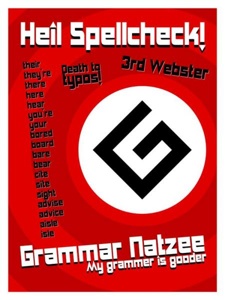
Top 10 Errors in English that Aren’t Errors
Published on April 3, 2008 - 169 Comments
In 1762, Bishop Robert Lowth did a grave disservice to the English language when he published his Short Introduction to English Grammar. Rather than basing his grammatical rules in the usage of the best educated speakers and writers of English, he arbitrarily chose to base them on the Latin grammatical system. The result is that many modern usages in English, particularly an alarming number of rules of normative usage and Standard Written English, are based upon those false origins.
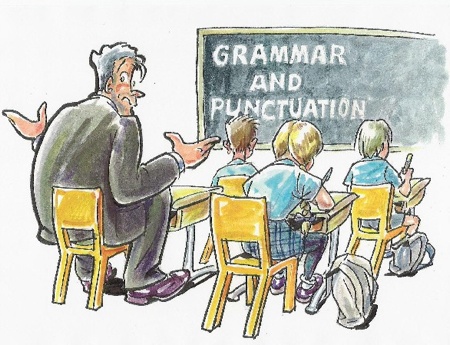
These very rules continue to plague us to this day as they are still used as the foundation of many modern school English curriculums. And so, with this list, I hope to finally put an end to many of these foolish rules. [Did you see what I did?]
The “tween” portion of “between” is a reference to the number 2, but the Oxford English Dictionary says this: “In all senses, between has, from its earliest appearance, been extended to more than two.” Many pedants try to enforce the use of “among” when speaking of groups larger than two. Even the pickiest speaker does not naturally say, “A treaty has been negotiated among England, France, and Germany.”
Because ’til looks like an abbreviation for “until”, some people believe that this word should always be spelt ’til (some don’t object to leaving off the apostrophe). However, “till” has been in regular use in English for over 800 years, longer than ’til. It is completely correct English to say “till”.
Some people have the strange belief that you must “persuade” someone to “convince” them, but you cannot “convince” a person. In fact, persuade is a synonym (means the same thing) for convince - and this usage goes back to the 16th century. It can mean both to attempt to convince, and to succeed in convincing. It is not common anymore to say things like “I am persuaded that you are an idiot” - though this is also correct English.

While it is admittedly logical and traditional to make the distinction between these two words, but phrases such as “part of a healthy breakfast” have become so common nowadays that they can not be considered wrong (except by pedants). It is also interesting to note that in English, adjectives connected to a sensation in the viewer (such as happy) are often transferred to the object or event they are viewing, for example: “a happy coincidence” or “a gloomy landscape”.
For most Americans, the natural thing to say is “Climb down off of [pronounced “offa”] that horse, Tex, with your hands in the air”; but many U.K. authorities urge that the “of” should be omitted as redundant. Where British English reigns you may want to omit the “of” as superfluous, but common usage in the U.S. has rendered “off of” so standard as to generally pass unnoticed, though some American authorities also discourage it in formal writing. But if “onto” makes sense, so does “off of.” However, “off of” meaning “from” in phrases like “borrow five dollars off of Clarice” is definitely nonstandard.
It is also quite common in New Zealand to use “off of” as well - presumably as a result of the English being spoken in the Empire at the time of New Zealand’s founding.
Some people insist that since “none” is derived from “no one” it should always be singular: “none of us is having dessert.” However, in standard usage, the word is most often treated as a plural. “None of us are having dessert” is perfectly fine. I spent many days debating this point with my Ancient Greek tutor via email quotations of its use as a plural (my tutor believed it to be singular only). Neither of us could convince the other but I firmly stand by my belief that it can be used as both plural and singular. εστω!
There are actually many instances in which the conservative usage is to refer to a person using “that” rather than “who”: “All the politicians that were at the party later denied even knowing the host”. This phrase is actually more traditional than “politicians who”. It appears that this issue has sprung mostly from the politically correct idea that it is demeaning to refer to a person as “that” rather than “who”. In some sentences it is clearly better to use “that”: “She is the only person I know of that prefers whipped cream on her cereal.” And in the following case, it would be ridiculous to use “that” for “who”: “Who was it that said, ‘A woman without a man is like a fish without a bicycle’?”
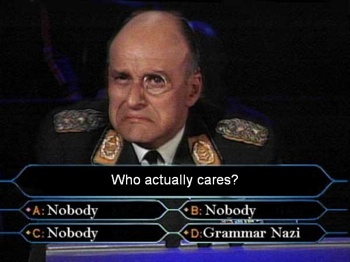
It offends those who wish to confine English usage in a logical straitjacket that writers often begin sentences with “and” or “but.” True, one should be aware that many such sentences would be improved by becoming clauses in compound sentences; but there are many effective and traditional uses for beginning sentences in this way. One example is the reply to a previous assertion in a dialogue: “But, my dear Watson, the criminal obviously wore expensive boots or he would not have taken such pains to scrape them clean.” It would be wise to make it a rule to consider whether your conjunction would sound more natural in the previous sentence or whether it would lose its emphasis by being demoted from its place at the start of a new sentence.
If you want to keep the crusty old-timers happy, try to avoid ending written sentences (and clauses) with prepositions, such as to, with, from, at, and in. Instead of writing “The topics we want to write on,” where the preposition on ends the clause, consider “The topics on which we want to write.” Prepositions should usually go before (pre-position) the words they modify.
On the other hand, if a sentence is more graceful with a final preposition, leave it that way. For instance, “He gave the public what it longed for” is clear and idiomatic, even though it ends with a preposition; “He gave the public that for which it longed” avoids the problem but doesn’t look like English. A sentence becomes unnecessarily obscure when it is filled with “from whoms” and “with whiches”.
The famous witticism usually attributed to Winston Churchill makes the point well: “This is the sort of English up with which I will not put.”
For the hyper-critical, “to boldly go where no man has gone before” should be “to go boldly…” It is good to be aware that inserting one or more words between “to” and a verb is not strictly speaking an error, and is often more expressive and graceful than moving the intervening words elsewhere; but so many people are offended by split infinitives that it is probably better to avoid them except when the alternatives sound strained and awkward.
There are some very obvious times that the split infinitive is far superior:
Murders are expected to more than double next year. (split infinitive)
Murders are expected more than to double next year. (intact infinitive)
However, you could say: “Murders are expected to increase by more than double next year” - but there is absolutely nothing wrong with the split infinitive example above.
Source: Common Errors in English Usage
Related Lists10 Images of Irony10 Common English Language Errors Top 10 Errors in Science Fiction Movies 25 English Language Oddities |
SubscriptionsLike this article? Subscribe to the RSS feed to keep 'em coming, or subscribe via email: |
If you find this site helpful, please leave a donation so you can enjoy the spirit of giving too.
Email This Post


1. BHO - April 3rd, 2008 at 8:01 am
Im sure loads of people will find this interesting.. this all went way over my head tho…..
2. Callie - April 3rd, 2008 at 8:02 am
I was an english major in school and I thought I had grammar down. Some of these ended up surprising me, though. Thank’s jfrater!
3. cparker - April 3rd, 2008 at 8:02 am
so horrible with grammar, they all look right to me. thanks for the lesson but i will still use the wrong phrases.
4. Callie - April 3rd, 2008 at 8:03 am
apparently I’m not good. That was supposed to be thanks…not thank’s….wow
5. Randall - April 3rd, 2008 at 8:05 am
Don’t tell any of this shit to William Safire… he’ll blow a gasket.
But frankly I agree with the list. Good grammar is one thing. I expect it and respect it. Flawless grammar, on the other hand, is…. almost creepy.
This is a list which I heartily approve of. (Breaking rules is fun, too).
6. Simons - April 3rd, 2008 at 8:07 am
LOL at the Grammar Nazi! Nice list, were you an english major in college? I think you should do an official “Ebonics language lesson” list =D
7. Cheeshygirl - April 3rd, 2008 at 8:11 am
Aha, grammar! One of my favorite subjects. Thank you for educating the masses. I’ve argued many times with instructors over grammar “rules” that were outdated and ridiculous. Awesome list!
8. bucslim - April 3rd, 2008 at 8:14 am
Ain’t ‘ain’t’ a word?
9. miller - April 3rd, 2008 at 8:19 am
Prime examples of why the english language is ridiculous.
10. Jen - April 3rd, 2008 at 8:27 am
I’ve been watching a lot of Judge Judy recently on youtube, and one thing I’ve noticed is the startlingly prevalent usage of a bastardized past perfect when simple past would work just fine.
For instance: I had went, he had sad, she had came.
They love the word had. And pretty much every single litigant on the show has spoken like that.
11. DanOhh - April 3rd, 2008 at 8:32 am
One of my “pet peevs” is double negatives. I’m not someone who is in great command of the english lang. BUT, when I hear someone use a double negative there is a “ping” in the back of my head and I have to correct that person. i.e. “We don’t got no…” (PING)Grammar Nazi.
12. jfrater - April 3rd, 2008 at 8:36 am
DanOhh: I hate double negatives too.
Jen: “had had” is okay in many cases as it is different from just “had” on its own, but I definitely don’t like the examples you cited - that would irk me a lot!
13. DiscHuker - April 3rd, 2008 at 8:41 am
i wonder what the grammar nazis of old would think about text message english. roflmao, u l33t 84574RD
14. courtney - April 3rd, 2008 at 8:41 am
“Be careful what you wish for…” Is that phrase considered a grammatical error? Also, could someone explain to me when it’s appropriate to use “who” and “whom”?
‘K bye.
15. Joss - April 3rd, 2008 at 8:44 am
Hooray for this list! I can’t wait to snottily say, “Well, ListVerse told me…” when someone corrects my grammar.
16. DiscHuker - April 3rd, 2008 at 8:44 am
in the southern US we say “fixin to” meaning i am about to do something. I am fixin to go the store. does anyone know the origins of this phrase? i can’t begin to guess what this evolved from.
17. copperdragon - April 3rd, 2008 at 8:46 am
the pictures were hilarious!
“I ain’t not gonna disagree with where you’re at.”
Who uses whom anymore?
What about using “goes” to indicate “says” or “said”.
i.e. (in valleygirl twang) “So then he goes ‘Mulholland Drive is dangerous at night.’ and I go ‘Not if you drive a Porsche.’”
18. islanderbst - April 3rd, 2008 at 8:48 am
Thanks J; one of my friends whom is a grammar nazi, so now I have new ways to her sense of grammar offend.
19. jfrater - April 3rd, 2008 at 8:50 am
courtney: I don’t see anything wrong with “be careful what you wish for” - it is certainly a very common phrase which is reason enough to consider it now a part of English.
As for who and whom - the technical terms are that who is the nominative and whom is the accusative. The easy way to see this:
The Dog [nominative] bit the man [accusative]
Therefore, Who bit whom?
Whom is the thing that something is done to, “who” is the thing doing it.
Another famous example: “For whom the bell tolls”
What is doing the thing? The bell - it is tolling - therefore it is the nominative. You could also look at it like this:
The bell [nominative] tolls for whom [accusative]? It [the bell - nom] tolls for John [acc]
This is a difficult concept in English because we only use these cases in pronouns now. In the old days you might have had something like this (and this is still the case in many languages):
Let us say that “um” is the ending we use for the nominative, and “us” is the ending we use for the accusative:
Dogum bites manus (this would mean “The dog bites the man”)
Manus bites dogum (this STILL means “the dog bites the man - because the endings tell us what the doer is and to whom it is being done)
Dogus bites manum (this would mean “the man bites the dog”)
In Lain and Greek, this is the case always - and it makes it very easy to write poetry because the endings are all the same and word order ceases to be important.
Phew! That was complicated!
20. Sidereus - April 3rd, 2008 at 8:51 am
Good list, and I’m sure there are many more to be found in the English language. Even though the “old timers” and “grammar nazis” try to restrict the language, we cannot help but acknowledge the fact that English is a live and thus changing language with new rules and exceptions born all the time. Good use of language basically comes down to three principles:
1) It is understood by the reader or listener.
2) It conveys precisely what it means to convey.
3) It is elegant and pleasing to read or hear.
21. Randall - April 3rd, 2008 at 8:52 am
copperdragon:
“Who uses whom anymore?”
It’s funny… sometimes you gotta use words like “whom,” particularly in writing, when it’s correct, but even in speech, because “who” just doesn’t *sound* right… you’re compelled to say “whom.” But what’s funny about it is, with me, at least–I’m forced to make a face when I use “whom,” or put a little arch inflection on it, as if to say, “how ironic that I am using this antiquated word form, because grammar demands it.” And yet, as I say… sometimes “who” just doesn’t cut it.
“goes” is less offensive to the ear than peppering a sentence with “like.”
“So then he, like, goes, ‘Muholland Drive is, like, dangerous at night.” And I like, go, “Not, like, if you drive a Porsche.”
22. T - April 3rd, 2008 at 8:55 am
why god…why?
23. SlickWilly - April 3rd, 2008 at 8:57 am
This is way too much for a thursday morning work hangover.
24. Mom424 - April 3rd, 2008 at 9:06 am
My grammar skills are not too shabby. The problem most people have is that they do not listen to what they are writing. The rules are important, but pacing more so. The rules always take a back seat to flow. Read aloud if you cannot do it in your head.
And folks my pet peeve; lose/loose
lose; to miss from ones possession, to suffer defeat
loose; free from restraint, not rigidly attached
please….
25. steve - April 3rd, 2008 at 9:08 am
I heard the Churchill (attributed) quote as “this is the type of pedantry up with which I will not put”, which makes rather more sense.
26. PeteFloyd - April 3rd, 2008 at 9:19 am
Lame.
27. stevenh - April 3rd, 2008 at 9:21 am
RE double negatives - English is NOT arithmetic.
I say: “In (spoken) English it is very possible that 2 positives make a negative.”
You disagree saying: “Yeah, right!”
28. stevenh - April 3rd, 2008 at 9:26 am
Pet Peeves:
your in place of you’re - I often see this in these comments.
“…to try and do…” / “…try to do…” - (1) no good / (2) good - there is (usually) only one action.
29. CRE - April 3rd, 2008 at 9:30 am
Thanks, ListVerse, for helping dumb down the world another notch. If one’s writing is clear, and sounds well, then the rules are not always that important, although, if it is well writen, and clear, chances are that the rules were followed. THe ending with prepositions thing is the worst. It makes the speaker sound less intelligent in most cases in which it is commited. Sometimes it can sound alright, but typically the statement can sound more eloquent if proper grammar is followed. Even “please turn off the light” sounds better than “please turn the light off”. The worst, however, are people who use superfluous prepositions (i.e. “this is where I’m getting off at” or “where do you live at”). I thought the most notable exception from this list was contractions, though. I’ve been brought up to never use contractions, and to always use the full version of the words. THis breeds proper communication, though. How often have you found yourself unable to tell whether someone is saying “can” or “can’t”, when saying “cannot” removes the ambiguity fro the statement. Double negatives can be acceptable also (such as “I will not be dissuaded”). Finally, the one that real gets me anymore is “irregardless”. That is as much of a word as “ain’t”.
30. SlickWilly - April 3rd, 2008 at 9:32 am
I don’t believe “I will not be dissuaded” counts as a double negative, because the meaning of that statement is not analgous to “I will be persuaded.”
31. Lizim - April 3rd, 2008 at 9:35 am
Jfrater,
Damn you and this list! Just when I thought you could not be any more intellectually attractive you appeal to the tiny little “Grammar Nazi” that lives inside of me.
Personally, ending sentences with prepositions makes my blood boil. Growing up in Chicago it was hard to avoid.
“I’m going to the store. Do you want to come with?”
With who?
32. SlickWilly - April 3rd, 2008 at 9:42 am
Jfrater: I order you to cease and desist. All the women on this site swoon over your “intellectual” wit and “roguish” good looks and you’re constant cockblockery, intentional or otherwise, is simply an aggression that will not stand. You’re presence here makes it infinately harder for lowly dorks like myself to score some digital poon.
Whatever, this place is a fucking sausage fest anyway.
33. christopherborne - April 3rd, 2008 at 9:47 am
I was always under the impression that “none” could be singular or plural depending on the prepositional phrase following it (or is understood), e.g. “None of the students like The Great Gatsby.” versus “None of the cottage cheese is contaminated.”.
34. Lizim - April 3rd, 2008 at 9:52 am
Slick,
My husband is more of a “cockblocker” than jfrater seeing as how I know him, love him, and respect him. (not that I don’t respect you jfrater, just in a different way.)
Congrats to you, however, for looking for “digital poon” on a smart website, rather than just paying $39.95 a month for porn.
35. troyfamu - April 3rd, 2008 at 9:54 am
JFrater…great list.
Most grammar errors in the south have nothing to do with ignorance of the rules. They are a result of laziness in the speaker compounded with years of hearing something the “wrong” way. I don’t care how someone talks in a typical conversation, but one can still be chided for having lax grammar in the business world.
36. Lizim - April 3rd, 2008 at 10:04 am
He CRE,
“I’ve been brought up to never use contractions, and to always use full words.”
Please just look at that sentence.
37. ryanh - April 3rd, 2008 at 10:08 am
When writing, I use a rule that splits prepositions into two groups to determine whether I can end a sentence with one. I leave the preposition at the end of idiomatic phrases like “put up with,” or “come down on.” Otherwise, I tend to put them before the verb.
38. Lucky - April 3rd, 2008 at 10:09 am
I hate to actually admit it, but I am a total grammar nazi. I’m constantly correcting people’s grammar, so much so that I kind of annoy myself. lol. Words matter, dang it!
39. torn and frayed - April 3rd, 2008 at 10:14 am
Lizim
Shouldn’t that be “with whom”?
40. Lizim - April 3rd, 2008 at 10:17 am
You caught me!
41. Cedestra - April 3rd, 2008 at 10:20 am
29. *Douche Alert!*
32. ::sigh:: Jamie, have my babies… No, wait! What am I saying?
42. seamas - April 3rd, 2008 at 10:24 am
Interesting.
One fundamental point though : english grammar is not regulated by laws, academies, or other means.
English grammar is “regulated” by usage. Mirroring English laws basis in common law.
(…seen the London Daily Telegraphs’ april fools on a secretive unit to police the language ? [It is] Funny.)
What is acceptable in New York may not be acceptable in London, Toronto, Christchurch, Nairobi or Glasgow, but is still english. And understood.
This is one of reasons why we ain’t not divided by a common language.
Innit ?
/Scots
//have a really terrible Cockney accent
///steve is right about the Churchill quote
43. DiscHuker - April 3rd, 2008 at 10:24 am
lizim: i meant to mention it on another list, but i forgot which one it was revealed on…
thank you and your husband for his service for our country.
44. Rebel - April 3rd, 2008 at 10:26 am
Were murders to “increase by more than double”, it would mean that they had more than trebled. In order to represent the equivalent amount to “expected to more than double”, one would have to say “increase to more than double”.
45. SlickWilly - April 3rd, 2008 at 10:29 am
Lizim: Well, I kind of have to cruise for the digital poonani on these websites. All my credit cards are maxed out. When it comes to porn, the gap between more and enough never closes. *sigh*
46. Rebel - April 3rd, 2008 at 10:31 am
As for prepositions at the end of a sentence, if my daughter were to stop me on the stairs to tell me to bring a different book for her bedtime story but I continued upstairs and brought the one I already had, she might say the following, with 6 prepositions at the end:
What did you bring that book I didn’t want to be read to out of on up for?
47. ReporterChick - April 3rd, 2008 at 10:34 am
My biggest pet peeve is when people say “We was” or “them stuff”. I can’t stand that.
48. Lizim - April 3rd, 2008 at 10:35 am
Disk,
Thanks! He’s not in Iraq, thank god. He does anti-piracy and drug ops. You would not believe the crazy things that people do to try to smuggle drugs and goods in and out of the US.
49. t - April 3rd, 2008 at 10:36 am
to CRE:
If you talked to me using perfect grammar I would laugh and think you were a total weiner.
50. Lizim - April 3rd, 2008 at 10:41 am
Rebel: At least you read to your kids! 6 at the end of one sentence that has to be some kind of record!
51. t - April 3rd, 2008 at 10:46 am
I cringe when people say, “I seen it,” instead of saw.
52. xdarkhorsex - April 3rd, 2008 at 10:50 am
I ain’t never did done knew mosta these there rules. I always did thunk my grammer was ok until de day she keeled over and was done dead
53. Egg - April 3rd, 2008 at 10:50 am
HAH! My grammar is horrible. I wonder if things are equally complex in other languages?
54. Randy - April 3rd, 2008 at 10:54 am
CRE: “How often have you found yourself unable to tell whether someone is saying “can” or “can’t”, when saying “cannot” removes the ambiguity fro the statement.”
The above quoted sentence is a run-on question. “How often have you found…” is a question and should therefore end with a question mark (?). Let me proof your question/statement in this way: “How often have you found yourself unable to tell whether someone is saying ‘can’ or ‘can’t’? Saying ‘cannot’ removes the ambiguity fro[m] the statement.”
As you can see, the corrected version is much better. You also forgot your “m” at the end of from.
jfrater: Great list!
55. bucslim - April 3rd, 2008 at 10:59 am
If you’re looking for perps here, look no further than your local newscast. Shure, Iv’e misspelt and missewezed werdz beefour, but those idiots positively destroy grammar and usage on a daily basis.
Reason? Well they’ve pass through our hallowed halls of Journalism school. Having been through it myself I must say the emphasis wasn’t on writing or speaking well, it was making sure the anchor had his hair properly shellacked. The females worried more about the twinkle in their blue eyes more than reading the copy let alone writing it. The sports dude was more concerned with spraying out the condensed local version of ‘ESPNese,’ and the weather guy was buzzing from his last bong hit.
Dunno if it’s that way in other English speaking places but Americans have always had a ‘who gives a fuck you know what I mean’ attitude about grammar and speaking correctly. Probably attributable to some of the other schlock on TV - Jethro Bodine from Beverly Hillbillies and Cooter from the Dukes of Hazzard come to mind. . . .
56. xdarkhorsex - April 3rd, 2008 at 11:02 am
heh heh you said cooter
57. zionred - April 3rd, 2008 at 11:05 am
you should have included the pronunciation of “often”
58. Yogi Barrister - April 3rd, 2008 at 11:12 am
Some pretentious ass on another website asked this question about the upcoming Superbowl, “Whom are you rooting for?” I found this to be really annoying, and not because he used a preposition at the end. “For whom are you rooting” would have been even more annoying, although very correct.
I wish the abuse of the word “irony” would have made this list.
BTW Is my eyesight failing, or is Jamie using smaller type?
59. Bob - April 3rd, 2008 at 11:16 am
Here’s a good one: “try and” vs. “try to.” Some folks will tell you the latter is proper and the former improper, but the former usage actually predates the latter.
I think a useful distinction is that between “grammatical rule” and “stylistic rule.” The first is something like making your verb and noun agree. The latter might actually be something like the above distinction, or the “between” vs. “among” question, or any number of the other “errors that aren’t errors” listed above.
In other words, the “errors” may not be things that “break” the language, but they may (they also may not be) jar the ear and ruin style.
60. Che - April 3rd, 2008 at 11:20 am
“try and” and “try to” mean two different things, at least where I come from.
I see your point, though.
61. riley - April 3rd, 2008 at 11:24 am
I have a friend who always thought that the word “maybe” was spelled and pronounced “naby”… yes with an “n.” He was 17 years old when I met him and corrected him and he nearly died. He couldn’t figure out why nobody had ever told him that the word “naby” started with an “m.”
I also have a HUGE pet peeve about people saying “alls” as in “alls you have to is talk to her.” That drives me crazy!!
As well, I HATE it when people say “unthaw” or “dethaw.” To “unthaw” is to “freeze,” therefore you don’t say “I have to unthaw the meat” because that would mean you have to freeze it. It’s like people are getting “thaw” and “defrost” messed up somehow… but does it ever drive me crazy!!
62. stevenh - April 3rd, 2008 at 11:25 am
re post 59, 60 - See Post 28 …
Jamie - this did NOT count as a ‘first post’
63. troyfamu - April 3rd, 2008 at 11:28 am
Yogi Barrister: You are correct…about the font. Which of the following are correct?
1)For whom was this small font selected?
2)Who is this small font for?
3)Whom chose this font; and for who?
64. Lizim - April 3rd, 2008 at 11:30 am
OH! When people pronounce the word ask as axe, it really drives me nuts.
65. CRE - April 3rd, 2008 at 11:30 am
Lizam: I was speaking more in regards to spoken usage of contractions, as inm my example. When writing, I use them out of necessity.
Cedestra: Why am I a douche for advocating proper grammar? I’d rather be branded a douche thanb come across as intellectually deficient (or, at the very least, verbally lazy).
Randy: You’ll have to excuse my lack of diligence in writing a quick post on a forum. I know the proper way to format a sentence, like the one that I did, I was simply not concerned with being perfect on here.
Also, 4 years ago I severed the median nerve in my right wrist, so have little feeling, even after surgery, in any of my right hand, except for my pinky. So yeah, sometimnes I miss letters. That’s also why I use contractions when I write.
t: You can think I’m a weiner all you want. Nobody uses perfect grammar, but I hold myself to a higher standard. Would you call me a weiner because I work out? That is keeping myself physically to a high standard. What about because I read? By reading, I hold myself to a higher intelectual standard, by staying abreast of current events, philosophy, and what have you. DOes that make me a weiner? Incidentally, I teach a college prep class for hgih school students, so I get paid to speak with the best grammar I can muster. It’s a matter of offering the best product (my spoken words) as possble. Would you prefer your child be tutored by someone who speaks well, or someone who soulnds as if they were taught grammar by Jeff Foxworthy?
66. Lizim - April 3rd, 2008 at 11:40 am
Now you leave poor Jeff Foxworthy alone!
67. MzFly - April 3rd, 2008 at 11:41 am
Thanks for this list. I have always struggled with the preposition rule. Sometimes it makes more sense and just flows more naturally to end in that manner. I’m glad to know I’m not completely wrong.
68. MzFly - April 3rd, 2008 at 11:50 am
Talking about confusing pronunciations; I had a friend once ask me, “Is there a different spelling for the (pronounced THEE) and the (pronounced THU)?” We were in High School at the time and it took me a moment to realize she was talking about the same word.
Some people are more likely to pronounce it with a hard e and some are more likely to soften in. I tend to lean toward a softer pronunciation.
69. Tobias - April 3rd, 2008 at 11:51 am
What really pisses me off is when people say “Is” twice. You might not have noticed it yet, but once you’ve heard about it, you realize that absolutely everybody says it. Watch a Presidential debate and you’ll hear “The problem is is that we don’t have…”. And the most annoying thing is everybody knows it’s wrong, it’s just an unconcious habit, hell, even I do it sometimes.
70. Lewis_RATM - April 3rd, 2008 at 12:07 pm
I hate when people say ‘I before E, except, after C’. There are so many exceptions!’weird’ ‘Their’, it’s just stupid!
71. otay - April 3rd, 2008 at 12:07 pm
Here’s the one that really gets my goat!
“I have more hair then you” …… improper usage of then and than. They are not interchangeable.
72. MW - April 3rd, 2008 at 12:11 pm
The rule about not ending sentences in a preposition has always bothered me a bit. Not because I commonly do it, but there are a few instances in which I feel that one HAS to do it for the sentence to make sense.
Example:
“Where is the cat?” - “The cat is over THERE.”
Sure, you could say “the cat is lying on the sofa.” But to be required to is a bit ridiculous.
Also, what is the rule for verbs that end in propositions such as “to throw up” or “to go above and beyond”? I can’t very well think of any alternatives to “I have thrown up.”
And is a sentence such as “The ball traveled upwards.” correct?
73. Idreno - April 3rd, 2008 at 12:13 pm
Someone above mentioned double negatives and I have a very humourous example to cite.
When I was in school, I remember that one of the students got into a verbal fight with one of the female security guards. The student eventually called the guard a very upsetting name to which she replied:
“Oh no you didn’t! Oh no you ain’t never not did nothing, uh-uh!!”
To this day, I believe this is the greatest example of double negatives that exists in English. It still makes me laugh my head off!
74. Doug - April 3rd, 2008 at 12:18 pm
over here in England, ’till’ is a word for what you call a cash register. you need to write ’til to avoid confusion, see
75. Lizim - April 3rd, 2008 at 12:21 pm
MW how about “I have vomited”? Or “He went above and beyond what was required”.
76. otay - April 3rd, 2008 at 12:28 pm
MW: “I have hurled” lol
77. otay - April 3rd, 2008 at 12:31 pm
To whom it may concern: I have regurgitated that in which i had previously ingested.
78. SlickWilly - April 3rd, 2008 at 12:35 pm
Doug: “Till” is a very common word across the pond in the states as well. I worked in retail and food services industries for many years and the most common word for your drawer is your “till” or your “bank.”
79. otay - April 3rd, 2008 at 12:58 pm
This is a little off subject, but something i find interesting. Americans (i am American) spell many words differently than the British. Examples: Colour, color; neighbour, neighbor; flavour, flavor. Does anyone know why this is, and when it happened? Obviously it was the Americans that decided that the “u” was not needed and discarded it in their spelling.
80. Csimmons - April 3rd, 2008 at 1:11 pm
Oh great, I get back from school to find a list on english?!?
81. Randall - April 3rd, 2008 at 1:14 pm
otay:
There’s quite an interesting story behind this.
Believe it or not, after the Revolution, when the nation was in its infancy, there was a move on to solidify the break with England SO forcefully that people were even recommending a change in the official language (which of course was crazy–and we still don’t have an “official language”). Anything the break with the motherland.
Well, as part and parcel of this, certain wise brains in the dictionary/linguistics business decided they could do *something* to set us apart. Now remember, even at this late a date, spelling was not quite as consistent or set in stone as it is today. The spelling of names and words was varied and could change from document to document. So this wasn’t such a crazy plan. We’d set *American* spellings for common words, and show the Brits a thing or two about our independence.
So, the francophone spelling for many words were changed (that this did more to dis the French than the English no one seemed to notice). Hence, color for colour, flavor for flavour. Lexicographers like Daniel Webster worked hard to get these spellings standardized and generally accepted and used (his was the first American dictionary) and here we are today.
82. Randall - April 3rd, 2008 at 1:19 pm
otay:
In addition, if you look into it, you’ll find that many “American” words were “frozen” in place–i.e., they remain unchanged from the 18th century, whereas in the intervening time, the Brits dropped them and found new words. And so slowly the languages grew *slightly* apart.
If I recall, “truck” is an example of this. It originally referred, of course, not to the things we see today on the highway, but to any sort of dolly-like cart as well as large wagons. (or waggons as the spelling might put it back then). This term was also used in Britain up to the 17th century… but as time wore on, and technology advanced, in Britain the term became “lorry,” whereas in the US it remained “truck.” When the internal combustion engine was invented and what we’d today consider “trucks” went on the road, the two different terms became set for the same vehicle–in the two separate countries.
83. ArcticBanana - April 3rd, 2008 at 1:22 pm
I loved this list, but I must say that it seems that you deem certain words/phrases to be correct grammar solely on the basis that they are used in everyday language… Just because a majority of the population phrases something a certain way doesn’t mean it is grammatically correct… Just putting that out there
84. Csimmons - April 3rd, 2008 at 1:32 pm
umm…quick question, why’s the comment print small?
85. Csimmons - April 3rd, 2008 at 1:36 pm
Hold on, isn’t the name of the list incorrect, shouldn’t it be “Top 10 english misconceptions” or something.
86. Callie - April 3rd, 2008 at 1:41 pm
I don’t know if anyone is still reading these, but there’s a pretty simple trick for who and whom that (of course) has a few exceptions but its pretty steadfast:
If the phrase you’re trying to use can be answered in question from with “him/her”, use Whom
If the answer is he/she, use who.
EX: 1
To Whom It May Concern
Who does it concern?
It concerns HER
Therefore, use whom
EX: 2
Who will be at the party?
SHE will be at the party
Therefore, use who.
Hope that helped…god I’m such a dork
87. Grammar nazi - April 3rd, 2008 at 2:01 pm
nothing wrong with nazis..
88. Kevin - April 3rd, 2008 at 2:24 pm
The actual Churchill quote was: “That is the type of arrant pedantry up with which I will not put.”
89. otay - April 3rd, 2008 at 2:29 pm
Randall - Thank you for the interesting answer.
A couple years ago, a girlfriend from Australia spent a month here in the States with me. I quickly learned that “boot” and “bonnet” were not articles of clothing.
90. jfrater - April 3rd, 2008 at 2:33 pm
Kevin: in fact no - he did not say that:
Source: http://alt-usage-english.org/e.....repos.html
What I gave above is the closest to the original quote (not Churchill’s but the first description of the quote) - no one knows EXACTLY what he wrote - but the first time someone quoted him as saying it, they used the version I included above.
91. Nelia - April 3rd, 2008 at 2:46 pm
Things that piss me off -
Double negative
double negatives that are being taught to children in public (I heard “I ain’t getting you nothing!” in a toy store once, and I’ve never forgotten it).
On accident - my fiance says this, drives me nuts.
And my mother was the ultimate grammar Nazi, so I can honestly say that I use “who” and “whom” properly. She also hated when one of us would say something along the lines of, “Mike and me are going out.” I can hear her now, “What would you say if Mike was not going? Me is going out? I think not!”
I’ll be teaching English as a second language soon, I’d better brush up on my obscure grammar. Thank goodness for Listverse, otherwise I would have screwed those poor Czech bastards right up!
CRE - Sitting down will be SO much easier once you remove the stick. I promise.
92. Catriona - April 3rd, 2008 at 3:02 pm
Another difference between America and NZ/Aust is the use of ‘z’ instead of ’s’ familiarise, summarise etc.
I really hate people saying ‘are yous coming too,’ makes me cringe…it’s very common here in NZ.
Also people who think ’specific’ is said ‘pacific’
I know I sometimes get ‘borrow’ versus ‘lend’ wrong often and still get corrected by my mother for it
93. Catriona - April 3rd, 2008 at 3:04 pm
oops very bad sentence…I know I sometimes get ‘borrow’ versus ‘lend’ wrong and still get corrected by my mother.
94. BrotherMan - April 3rd, 2008 at 3:07 pm
#72 MW: How about “I have just vomited?”
Great list, Jamie! I only knew of #2 and #6 so it is great to see that I am not completely ignorant on some of this stuff.
95. BrotherMan - April 3rd, 2008 at 3:09 pm
I recall a list that was similar to this WAY back during the olden days of The List Universe. It was a list about grammatical pet peeves or something of the sort.
96. jfrater - April 3rd, 2008 at 3:24 pm
Brotherman: you are right - it was 10 common English language errors.
97. jfrater - April 3rd, 2008 at 3:36 pm
Catriona: you are right on the “yous” thing - but the interesting thing about it is that it is an attempt to restore something we used to have (but dropped for some reason) - which is “ye” and “thou”
Ye is plural or formal (like French vous)
Thou was singular or familiar (like French tu)
The “thou” form fell out of use and we are left with confusion when addressing hoi polloi - so some people in a naturally evolving attempt to differentiate say “yous”. I have not seen any other example of a word falling out of use and naturally being restored in later generations.
You is the oblique/objective version of ye incidentally. So one would have said “Ye bit the dog” or “The dog bit you”.
The funny thing is that most people think of “thou” in the sense of phrases like “holier than thou” and consider it formal, when in fact it was informal - to a point of often being used as an insult.
You may find this interesting: http://en.wikipedia.org/wiki/T-V_distinction
The T-V distinction is a term that refers to second person pronouns relating to politeness or formality.
98. Scott - April 3rd, 2008 at 3:44 pm
I found this list very interesting.
99. Earnest Iconoclast - April 3rd, 2008 at 4:04 pm
English is a Germanic language, not a Romance language like some grammarians tried to make it. Germanic languages have no problem ending sentences with prepositions.
“Walk right in!”
“What are you standing on?” - “On what are you standing?” is really awkward and NOT correct.
etc…
A lot of our spelling is messed up because regulators tried to force Germanic words into Romance spellings.
CRE, the rule is usually that one should avoid the use of contractions in formal writing. Speech is generally considered more casual and allows for more relaxed rules. For someone who claims to hold himself to a higher standard, you sure make a lot of mistakes in your typing…
100. jfrater - April 3rd, 2008 at 4:08 pm
Earnest: I think it is a combination of both romance and germanic - but generally speaking it is considered better English to abhor romantic terms and use the germanic equivalent whenever possible.
101. Catriona - April 3rd, 2008 at 4:16 pm
jfrater: oh, and I thought it was just children who didn’t know better and hadn’t been corrected by their parents
102. jfrater - April 3rd, 2008 at 4:32 pm
Catriona: haha it is, smart arse
I was just pointing out that their ignorance at least stems from a need in English to restore the plural second person! I hate it as much as you do! Let’s start a campaign to bring back “thou”!
103. Catriona - April 3rd, 2008 at 4:43 pm
Somehow can’t see the NZ kids using ‘thou’ can you?
104. SarahJ - April 3rd, 2008 at 5:09 pm
What about, “I want them apples please?”.
105. Jane - April 3rd, 2008 at 5:12 pm
Hey CRE:
“Alright” is not a real word. It’s a bastardization of “all right”. I’m sorry for this, but if you go on about being “Captain Perfect Grammar” you can also expect to be corrected by 400 Listverse readers.
106. stevenh - April 3rd, 2008 at 5:35 pm
Hey Jamie:
I think that I’ll have to move to NZ as well…retire there…
If the company I work for only knew how much time I’ve spent on LV in the past 24 hours they would fire my sorry ass…
107. J. Coustark. - April 3rd, 2008 at 5:45 pm
Catriona. I don’t think it’s a matter of not being corrected by their parents that is the problem. A lot of the parents don’t know any better themselves and couldn’t care less.
108. macabresoren - April 3rd, 2008 at 5:48 pm
As usual, I’m ignoring all the other comments because I find these nitpicking debates to be a waste of time… But I love this list. Grammar is one of the only things I’m good at (though I don’t always express it so well over the Internet), and I’m proud to say I knew the correct usages of nearly all of these, and that I agree with your opinions on when it’s okay to use the “incorrect” versions.
Great list.
109. Raisa - April 3rd, 2008 at 5:58 pm
Some people insist that since “none” is derived from “no one”.
Wrong– it’s derived from “not one”.
110. J. Coustark. - April 3rd, 2008 at 6:29 pm
SarahJ. can you wait until next year, I’ll have a full crop by then.
111. Csimmons - April 3rd, 2008 at 7:04 pm
stevenh: You think you’re on there a lot? I am on here during class through my phone! Of course I don’t comment, I just read lists.
112. knav3 - April 3rd, 2008 at 7:13 pm
sorry, i didnt read all the comments and i dont mean to be a dick, but number 5 is wrong, because youre not talking about none, you’re talking about us, so us is plural, therefore you would have to use are, because us is plural, maybe that sentence is a bad example. The subject of the sentence is us, therefore it would be plural, or else you wouldnt be able to use US or none, then the sentence would be, “i wont have dessert, neither will anybody else.”
that would be closer, but the sentence with “is,” is wrong. sorry.
113. SarahJ - April 3rd, 2008 at 8:29 pm
J.Coustark. Thankyou I can wait until then.
114. Raisa - April 3rd, 2008 at 8:44 pm
knav3 — #5 is not wrong. The word “none” is not synonymous, and does not refer to, “us” or any plural group. Historically, the word “none” originated as a shortened version of “not one”. Accordingly, in any sentences that uses the word “none”, the phrase “not one” can /always/ (if the sentence is correct) be used interchangeably. This is because when you use the word “none”, the subject of the sentence is the “one” referred to in “not one”.
For instance: “None of us is going to the meeting.”
This is correct because, as I’m sure I’ve made clear, “none” is synonymous to “not one”. You can test whether the sentence is correct by switching the two. “Not one of us is going meeting” is still correct. If you were to say “None of us are going” that would be incorrect, as you certainly can’t say that “Not one of us are going.” (”One” is the operative word– it’s the subject, and it’s singular.)
As a side note, none cannot possibly refer to “us”– “us” cannot be the subject of a sentence. It’s a pronoun. I don’t even need to point out that “Us are happy” is incorrect.
115. goof_ball - April 3rd, 2008 at 8:47 pm
Stupid grammar! No one really cares about grammar and English. I don’t understand why you have to learn this in school.
116. Exluddit - April 3rd, 2008 at 9:30 pm
Once in a while I encounter a person here in the US who is learning English. Very often they are baffled by the grammar and oddball colloquialisms that they encounter. My advise to them is to learn the “hard and fast” grammar rules, but understand that they exist only so that they can be broken.
117. CRE - April 3rd, 2008 at 10:21 pm
Earnest: go read my posts again, particularly that one about being disabled. I suck at typing, especially on my laptop, which I am stuck with until I get a new power supply for my desktop. That said, my formal writing is beyond reproach, I just don’t have the time or desire to have someone edit my posts to a forum before I submit them. Contractions in formal writing are unprofessional. In casual writing, they are not a problem. Verbal communication is a diffent story altogether. Try working around heavy equipment sometime, where the need for clear communication is paramount, and you will see why I have developed a tendency not to use cotractions when I speak (although I also have not said that they are grammatically incorrect, I simply do not personally use them).
Jane: alright is a perfectly acceptable word, whose use goes back to at least 1893. If you want to correct me, make sure you are correct yourself. Makes you look less pretentious.
118. CRE - April 3rd, 2008 at 10:23 pm
And I will save all of you who cannot comprehend the meaning of “I do not claim to have perfect grammar” the trouble of pointing out that yes, I realize that the last sentence of my last post was a fragment. It is ok, though. Last time I stepped out of my boat, I stil sunk (though I’m working on the whole walking on water bit even right now).
119. funbutfunctional - April 3rd, 2008 at 10:35 pm
I always enjoy this kind of thing. I teach English as a foreign language so i have to be aware of how I apeak and write.
If you’ve enjoyed this list I would recommend ‘Troublesome Words’ by Bill Bryson. Lots of good examples of grammar rules, mistakes and examples of getting them amusingly wrong.
120. funbutfunctional - April 3rd, 2008 at 10:39 pm
*speak and write. Sometimes I’m not very good at it….
121. DJ - April 3rd, 2008 at 10:50 pm
goof_ball, I have a supervisor that feels the same way. He pisses me off with his grammar. He likes to say or write things that are wrong just because he knows it pisses me off.
To me, the bad grammar in the assorted notes that are posted around my workplace is not something that is funny, it’s unprofessional. There is a place for proper grammar, and this is most certainly that place.
My big pet peeve outside of that? People that use a ‘t’ instead of ‘ed’ for words in the past tense. Oh, sure, I know this was taught as the norm at one time, but haven’t we moved beyond it yet?
122. Sunshine - April 4th, 2008 at 12:59 am
In South Africa we use English spelling. Words like colour. Please could someone let me know if this type of spelling is considered correct in America?
123. jfrater - April 4th, 2008 at 1:06 am
Whoever it was asking about the or/our spelling differences in US/UK English, you might find this interesting:
http://en.wikipedia.org/wiki/A.....our.2C_-or
It is rather too long for me to boil down here as it all happened over a long period if time
124. Catriona - April 4th, 2008 at 2:41 am
J.Coustark. Yes you are right, thank goodness for the parents who correct our grammer and encourage us to use dictionaries
125. astraya - April 4th, 2008 at 3:44 am
I am teaching English in Korea. EVERY DAY I am struck by the rules-within-rules-except-when-there-are-exceptions of English grammar. I have said on many occasions something like “The purpose of language is communication. If you can communicate clearly using bad grammar, go ahead and do it, but your best chance of being understand by the greatest number of people is to use correct grammar”. That said, there have been hundreds of times I have had to take the line of least grammatical resistance, in order for the lesson not to get bogged down.
Comments on the original 10, but not on the comments.
#7 I found out only recently that “healthful” is actually an English word and not Konglish (Korean English). Know that I know that it is actually an English word, I will never use it anyway.
#6 “Off of” is also used in South Australia, which was settled at the same time as NZ. They also used “Where do you live to?” which used to drive me crazy!
#2 “Put up with” is one “concept”. The sentence could be rendered “This is the sort of English which I will not tolerate”.
“You all” is fairly common, but I cringe. One of my colleagues recently said “who all”. She had noticed fast food bags in the staff room, and said to our Korean colleagues “Who all’s been to (fast food outlet)?”. More than one bag = more than one “who”????
If there are any grammatical errors in this, please don’t point them out. I’ve had a long day with Korean high school students.
126. jfrater - April 4th, 2008 at 3:54 am
atraya: I hear “who all” quite often - not from the Brits, but from kiwis and interaction with Americans on the internet. It is a very weird phrase. On another note - I had a holiday in Korea once and loved it - what a great country. I will definitely go back sometime!
127. Danielle - April 4th, 2008 at 4:18 am
Loved this list.
I live in Australia, and whilst I think it’s possible people would make the #4 mistake (”who”/”that”) I don’t think I’ve ever heard it. Maybe we speak better English than you do over there?? Haha, I’m just kidding.
The folks over in NZ never use archaic English, so don’t worry.
128. Sunshine - April 4th, 2008 at 6:42 am
Thank you,
In South Africa we say two very incorrect things. The first is we say ‘aswell’.. I am coming aswell.. translated means I will also be coming. The second is when we say ‘just now’.. I will be there just now.. it means a little later. Other English speakers find this very strange.
129. Randall - April 4th, 2008 at 6:44 am
“who all” isn’t necessarily an example of flat-out “bad grammar,” though–anymore than “y’all”… these are in fact regional “dialect-isms.” This is the beauty of English–it has a flexibility and weirdness that allows it to be in flux, changing and sucking in influences from other languages all the time–not just words, but styles of speech, cadences…. hence the sing-song sound of Southern American speech, Creole, Cajun, etc.
Atraya: my sympathies, though, trying to teach this stuff to non-English speakers. It’s amazing that people get it as well as they do.
130. jfrater - April 4th, 2008 at 6:48 am
Sunshine: I agree that the “just now” thing is very weird. I do think that “as well” is actually perfectly fine English and is found in other English speaking nations as well
NOTE: As well is ALWAYS spelt as two words 
131. NoPunyNerd - April 4th, 2008 at 7:22 am
Who all, you all (almost always contracted as y’all) and what all are commonly used in Texas. No, not by everyone, but by many. Examples: Who all’s going to the barbecue? Are all of y’all going? What all are you bringing? (Yes, people do say all of y’all sometimes.)
Sunshine: The spelling of colour is considered foreign rather than incorrect in the US. We use “as well” in the US to mean “also” just as you did in your example.
Question for the grammar aces: Can someone please explain the difference between sprang and sprung in plain English? Either I’m confused about its proper use, or the word sprang is disappearing from the US vocabulary. The same goes for shrank and shrunk. “The dog sprung from his bed.” “The sweater shrunk in the wash.” Wrong, right?
132. NoPunyNerd - April 4th, 2008 at 8:14 am
Question for the grammar aces: Can someone please explain the difference between sprang and sprung in plain English? Either I’m confused about its proper use, or the word sprang is disappearing from the US vocabulary. The same goes for shrank and shrunk. “The dog sprung from his bed.” “The sweater shrunk in the wash.” Wrong, right?
133. jfrater - April 4th, 2008 at 8:28 am
NoPunyNerd: Sprang is the past tense, sprung is the past participle (requiring the use of an extra verb) - the following two sentences are both correct:
She sprang to help the sick man.
The flowers have sprung up in the garden.
And - many thanks to Disney for abusing “to shrink” - the following is correct:
Honey, I shrank the kids (the movie is WRONGLY titled Honey, I shrunk the kids)
Also correct is:
I have shrunk the kids, or also acceptable (and nicer in my mind) is Honey, I have shrunken the kids.
Hope that clears it up
134. NoPunyNerd - April 4th, 2008 at 11:46 am
Thanks, Jamie … that’s exactly what I thought. Unfortunately, on this side of the pond, shrunk and sprung are used in most instances. It drives me crazy every time I hear it — including on CNN, National Public Radio, network news, Congress, you name it! I feel compelled to say, sometimes aloud, “No, it shrank,” or, “No, it sprang.” I suppose that drives those around me crazy.
135. Dan - April 4th, 2008 at 3:24 pm
reminds me of a point my friend brought up a while back.
all words in the english language can be categorised into Verb, adverb, adjective, noun etc.
But the word ‘very’ when used in certain context does not, such as ‘This very heart’ (shakespeare) in what context is the word there?
136. astraya - April 4th, 2008 at 4:52 pm
Randall: I didn’t mean to imply that “who all” is bad grammar. I just “described” that a colleague had said it. What amazes me about English grammar is that we learn most of it, at least intuitively, by the time we are 5. During my primary school years, the education department phased out grammar and I got none from then on. Any grammar I know is self-taught.
jfrater: I’ve had a ball teaching English in Korea, though high school students are a whole lot noisier and a whole lot less conversational than language academy students. At the high school I don’t have any English-speaking colleagues, so will probably contribute more to Listverse discussions to keep sane.
I’ve got half a mind to submit a list about Korea, but I’m not sure exactly what. “Top 10 English mistakes made by Korean students of English” might have limited appeal.
My last comments (hopefully):
In any “real” language (eg not Esperanto) the language came/comes first, then the grammar was/is formulated to describe it.
Grammar changes all the time. Just about everything we now accept as “good” grammar started off as someone’s “shock-horror-the-end-of-civilisation-as-we-know-it”.
For every “if you say this you will sound like an uneducated yokel” there is an equal and opposite “if you say this you will sound like a pretentious wanker”.
137. Phender_Bender - April 4th, 2008 at 8:13 pm
Uhh… Good list? I consider myself sort of a grammar-nazi when speaking (even though English is my second language). Still anything relating to grammar puts me to sleep.
138. Crimanon - April 5th, 2008 at 2:41 am
I’ve caught my fair share of people harassing me about my tenses. Language can only evolve by being used in different ways. I type the way I speak. I even make it a point in the lists to put proper notes in. Even when you don’t see it right off, there is still a way that it is read. Hence, my capital letters in the middle of a sentence and my constant mish-mash of past/present/future verbage (see new word, you know what I’m saying and that’s all I care about). Evolution of language, a far cry from Esperanto. But, hey, what are you going to?
139. Killerbees - April 5th, 2008 at 7:03 am
I work with many intelligent people, but I hear the following waaay too often:
1. If you have any questions, please contact myself or Larry.
2. There’s two jelly donuts left on my desk.
3. We should have went to the lab already.
140. BrotherMan - April 5th, 2008 at 1:16 pm
#96 jfrater:
I get it…you smart ass
141. Octavian - April 5th, 2008 at 2:51 pm
Your example “Murders are expected to increase by more than double next year” does not contain a split infinitive. The infinitive used is “to increase.” “Double” functions as a noun, I think.
However “by more than double” would technically suggest something above tripling, as an increase of double an amount leaves triple said amount.
142. EXE - April 5th, 2008 at 5:05 pm
Octavian– no, double was a verb there. You just copied the sentence wrong– you took it to be ‘Murders are expected to increase by more than double…’– the actual sentence was ‘Murders are expected to more than double…’
And what’s the deal with passives? Why are passive sentences wrong? If they are wrong, why does the passive voice exist? I think that passives are not necessarily wrong; I think that in many cases the active voice sounds better than the passive, but that if one wishes to use the passive then hats off to them. I think that people should realize, however, the differences between the two, expecially if you’re planning to take a language– in my Latin class, we cannot translate a verb as passive if it is active.
143. Octavian - April 5th, 2008 at 5:15 pm
I did not “take it to be” anything–I pressed control and v, which is a command to copy exact sentences, not what anyone thinks he or she read. I was talking about the example that follows “However, you could say…”
I have nothing against passives, but they often add clumsiness.
144. EXE - April 5th, 2008 at 5:21 pm
Sorry; I thought that you were copying the original example as opposed to what you actually were copying.
145. Diogenes - April 5th, 2008 at 6:40 pm
a can full of Words
worms for the soil
lexicon of slang
manure for the mind
nutrients and salvation
146. shaunism - April 6th, 2008 at 3:27 am
I think splitting infinitives is totally valid in English - we should embrace this versatility in our language.
Re: Persuade versus convince: I believe this is a case where the meanings of the words have evolved; I would never use convince as would persuade.
147. Earnest Iconoclast - April 6th, 2008 at 8:47 pm
English has a 2nd person plural… y’all.
Passive voice is bad because it usually obscures who or what did the thing. It also implies that something “just happened” instead of being done. For example “Mistakes were made.” Um.. . okay, WHO made the mistakes? Or when a kid comes in and says, “The window was broken.” when he really means that HE broke the window. Saying “I broke the window.” shows who did it while the passive kind of implies that it just happened.
This is a great quote about English: “English doesn’t borrow from other languages. English follows other languages down dark alleys, knocks them over, and goes through their pockets for loose grammar.”
Verbing weirds language. I love that you can use nouns as verbs, verbs as nouns, etc… in English.
148. Me, Myself and I - April 7th, 2008 at 1:02 pm
Did you know that English is apparently, one of the hardest languages to learn.
Like, “where” and “wear”
“read”, “reed”, “read”
“led”, “lead”, “lead”
etc…
But, if its so difficult, why do so many people learn it as a second language? They learn it is Frace, Sweden, and I dont know where else, Germany I think, in some schools.
149. Me, Myself and I - April 7th, 2008 at 1:04 pm
“in France”, not “is France”
Sorry
150. Crimanon - April 7th, 2008 at 1:07 pm
Me, Myself and Do I really have to type this every time?: Try Icelandic.
151. Octavian - April 7th, 2008 at 5:09 pm
Try Chinese.
152. Crimanon - April 7th, 2008 at 5:45 pm
Mandarin even!
153. shaunism - April 8th, 2008 at 1:26 am
Mandarin’s grammar is easy; it’s the sounds that are hard.
When I read “The Power of Babel” I learned about a language in Africa that has 16 “genders”; and have you ever seen what poor Irish people go through trying to learn Irish Gaelic?
My friends who’ve learned English as a second language have told me the hardest things are prolific idioms and exceptions, spelling and phrasal verbs. I imagine the first two are common in any language as a foreign one.
154. PennGos - April 9th, 2008 at 11:09 am
I guess I am a Grammar Nazi, because I prefer to twist awkwardly my written and spoken English to better conform to accepted grammatical standards. I am saddened and appalled by the lack of attention paid to these important rules and the general erosion of English. We are become our own Idiocracy.
155. JayArr - April 9th, 2008 at 1:13 pm
Wow! I find this banter intriguing, to say the least! My buddy just directed me to this site today, and I suspect I’ll become a regular reader… time permitting.
Not sure if anyone has mentioned the VERY common misuse of the word ‘impact’ in media today, but OH BOY is that one of my major brain boilers!
156. shaunism - April 10th, 2008 at 10:03 am
PennGos: In the time of Caesar, the upper crust lamented that the Latin spoken by the underclass was so debased that it wasn’t even Latin anymore. At every point in time, we bemoan the degradation of our languages. We have to maintain standards, definitely, but also realise languages evolve. This is especially true, I think, as a language acquires more and more foreign speakers, as they will tend towards rules when they don’t know the exceptions (’I goed to the store’ vs ‘I went to the store’). We must embrace change, while not letting it get too sloppy; a very hard balance to find!
157. Aoede - May 4th, 2008 at 7:35 pm
4: It’s only ridiculous in that case because “who” is not being used as a link, it’s being used as a subject.
158. Crimanon - May 8th, 2008 at 2:41 am
Who is this kid?
159. jfrater - May 8th, 2008 at 3:40 am
fadi is from Pakistan - his comment has been deleted. The others are from Milton-Keynes in the UK - their comments have been deleted and the IP banned. I am guessing their teacher just used this list as a resource and they decided to come on later for some fun. Why is it always English children that make the most noise here?
160. Crimanon - May 8th, 2008 at 3:47 am
Don’t ask me, I’m just a screwed up Yank.
161. Frank - May 14th, 2008 at 4:28 pm
My pet peeves: People telling other people how they ought to talk. Judging a person’s intelligence based on their adherence to standard grammar. Etc.
162. Mark - May 23rd, 2008 at 3:37 am
“It is also quite common in New Zealand to use “off of” as well”
- ‘also’ = ‘as well’
163. Tempyra - June 18th, 2008 at 9:29 am
Interesting that you say “off of” is in common use in New Zealand. It’s not something I ever really noticed in 20 years of living there. What I did notice though, was people saying, “should of” and, “would of” instead of, “should have” and, “would have.”
One thing I have often wondered about is when someone says or writes, “that that”? Is it better to use one or two ‘that’s? E.g. “This is the house that that man was talking about.”
I prefer to use the double that, especially when you’re speaking the phrase and gesturing towards the person or thing you’re talking about. And I have always been told that what you write should be consistent with how you would speak the sentence (assuming perfect conversational skills of course!). Plus, to me, it just seems more elegant and balanced to write/say, “that that.”
Am I wrong?
164. shaunism - June 19th, 2008 at 6:35 am
Tempyra: I think “that that” is OK in some cases - in your example, though, I think you could say “This is the house which that man was talking about” if you want to be clear or more varied, or simply “This is the house that man was talking about” is fine.
I don’t think people are actually saying “should of” and “would of” - they are saying “should’ve” and “would’ve” - they just might not know it when they write it.
Cheers,
Shaun
165. Tempyra - June 21st, 2008 at 5:41 am
Oh I’ve heard people say “should of” and “would of” clearly, but it’s often indistinct. It is something I’ve seen people actually right though!
166. Tempyra - June 21st, 2008 at 5:58 am
Argggh… “write” not “right”. Stupid brain… it’s a homonym!