This is a list of dragons that you may not have heard of before. Iâm not including the famous Welsh Red Dragon, the English one (a.k.a. the wyvern), or the various Chinese dragons (the Loong) because most people know about these through watching films such as Dragonheart, Draco, Reign of Fire, Dragon Slayer and Mulan. Instead, this list briefly details the origin, appearance, and history of some more obscure dragons. To maintain the balance of Good and Evil Iâve chosen both Eastern and Western dragons; dragons are generally perceived as being benevolent in the East but as evil destructive creatures that symbolize the Devil in the West. In no particular order:
Naga is a wingless type of Indian dragon found in Hindu and Buddhist culture. Although the word Naga is often ambiguous the Mahabharata (an epic Sanskrit poem that is an important Hindu text) tells us that the Naga possess the traits of both snakes and humans. In Hinduism, the Naga are portrayed in similar fashion to the Chinese family of dragons, being natural spirits that are associated with water sources but can also be European-style guardians of immense treasure. Naga are also found in Buddhist tradition – as polycephalous (multi-headed) serpents that can magically transforms themselves into human shape. Like the Naga of Hindu legend, the Buddhist version prefers watery dwellings. They particularly like to eat frogs and drink milk.
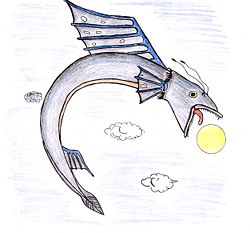
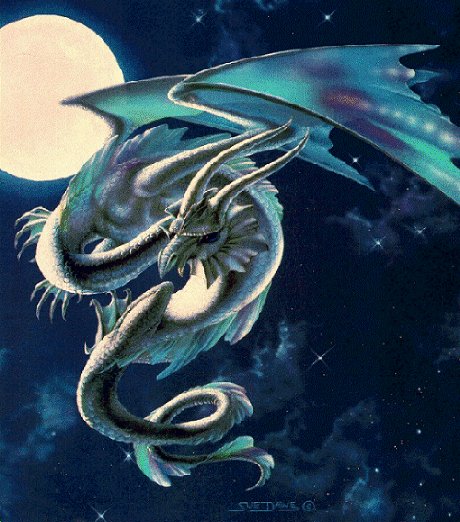
The Bakunawa is actually a deity that was represented as a serpentine dragon, according to Filipino mythology. He has two sets of wings, whiskers, a red tongue, and a mouth âthe size of a lake.â The Filipinos once thought that the Bakunawa lived in the sea at a time when the world had seven moons and that the dragons, being fascinated by their light, would rise out of the sky into the sky and consume the moons. Thus, the dragons were the cause of eclipses. To prevent the world from becoming dark the people would run out of their homes, taking their pots and pans, to make the most noise they could in order to scare the Bakunawa so they would stop eating the moons and give them the moonlight back. Interestingly, the name of the dragons, Bakunawa, can be translated as âmoon eaterâ or âman eater,â the latter being atypical of Asian dragons.
The YilbegĂ€n is more closely related to the Turkish and Slavic dragons of Europe than those of Eastern Asia; consequently it is portrayed as man-eating and ogre-like rather than gentle and kind, despite its Asian home. This reptilian dragon is depicted in the mythology of two ethnic groups living in Siberia â the Turkic peoples and the Siberian Tatars â as a polycephalous monster. In some legends the YilbegĂ€n takes the form of a winged dragon or serpentine creature but in others he is a leviathan who rides an ox with 99 horns.
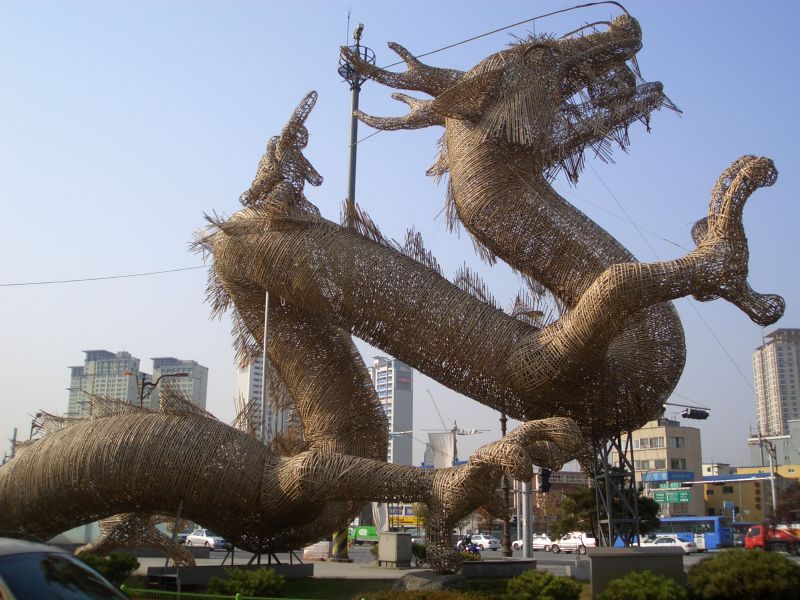
The Korean dragons are derived from the Chinese ones, are given very similar cultural status, and look much the same. Where the Chinese dragon has five toes and the Japanese three, the Korean has four â the dragons are said to have lost toes as they moved south. The Korean dragon has a long beard and no wings. Like other Asian dragons, the Korean variety was supposed to be peaceful and kind creatures that were strongly associated with water and agriculture. They are mostly said to live in watery places such as rivers, ponds, lakes, and oceans. Korean dragons differ from others in that history records them as being sentient and capable of understanding concepts like devotion, gratitude, and kindness.
Before a Korean dragon is a dragon it can be a creature called an imoogi. Depending on which account you read, imoogi are immature dragons that must live for 1000 years before becoming a dragon or, alternatively, cursed, hornless beings that are unable to become fully-fledged dragons.
The NĂðhöggr is a one-of-a-kind dragon that exists within Norse legend. It lives below a giant ash tree, the Yggdrasil or World Tree, which binds the nine worlds of Norse mythology together. NĂðhöggr is usually translated as meaning Malice Striker (sometimes as Striker in the Dark) and lives up to his name as he viciously gnaws at the root of the World Tree that keeps him trapped above Hvergelmir, a seething cauldron, in Hel (the Nordic Hel is roughly equivalent to the English Hell). If NĂðhöggr chews his way through the root of the World Tree it heralds the arrival of Ragnarök and the subsequent destruction of the world. The serpent-like NĂðhöggr is described in the poem VöluspĂĄ as one who âsucks on the corpses of the dead.â
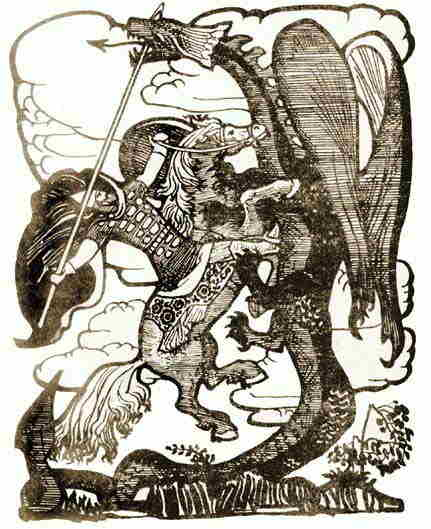
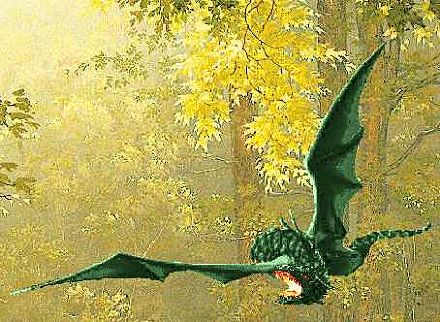
The Zmaj comes from the Slavic country Slovenia and has much in common with other Slavic dragons â three heads that may grow back if decapitated, green scaly skin, and fire-spitting abilities. Its name, Zmaj, is a masculine version of the word for snake, which is usually feminine. The Zmaj can also be called by a much older name of murky origin, Pozoj. Slovenic dragons are generally similar in disposition to other European dragons and are featured in Christian stories of St. George as well as pre-Christian stories in which they are tricked into eating sulphur-containing gifts and thus defeated. The dragon of Ljubljana is a notable exception â it once protected the capital city and is depicted on its coat of arms.
The Chuvash dragons come from Chuvashia, in the center of the European part of Russia. These dragons are the typical European winged fire-breathing sorts but with the ability to shapeshift from dragon to human (and vice versa). The ancestral people of the Chuvashians, who live there today, were Bulgars and told the tale of how when they founded the town of Bilar they came upon a large snake. The snake, which the Bulgars decided to kill, pleaded for peace and was given wings by Allah â which is how the dragon came to fly. Like the YilbegĂ€n, the Chuvash dragons can be polycephalous. The most famous Chuvash dragon, though, is one called Veri Celen (literally, âfire snakeâ in Chuvash) who was able to take human form in order to visit men and women in the night and sleep with them. [Image: tower said to be the home of a chuvash dragon]
The Cuélebre is the Spanish variety of dragon, specifically, from the regions of Asturias and Cantabria. Serpentine, winged and with colorful scales, the Cuélebre are immortal and obsessed with pretty, shiny objects. They hoard treasure and fairy-like blonde nymphs. The legend relating how the Cuélebre originated goes like this:
A beautiful but vain young woman disbelieves her familyâs warnings against combing her hair as she admires her reflection in a pool of water. Unfortunately, a powerful water nymph living in the pool observes as she neglects her tasks in favor of this activity. Once the girl ruffles the surface of the water, as one of her hairs drops in, the nymph takes the opportunity to teach her a lesson. The nymph curses the girl; she grows huge, her hair is replaced by crests and her skin by scales, and she sprouts wings. In true fairytale fashion the maiden can only be returned to her original state by meeting a knight âwho is so brave that he is not afraid of you and has a heart so pure that he finds you beautiful.â The CuĂ©lebre hides in a cave by the sea and waits…
Contributor: Tempyra


goof_ball:
#4: English phonetic pronunciation is “Nidhogg”
#2: The tower in the picture is where the dragon lives.
all: Since the unicorns created them.
yeah, why is there no picture of the Chuvash?
HV
Just as an interesting aside to Samsung’s point – while dragons don’t exist (including taniwhas), a council in NZ forced some public works to stop a development because it was claimed that they were upsetting a taniwha (dragon-like creature) that lived in a nearby river. Insane!
goof_ball: it is pronounced nith-er-grr (th like the “th” in father) – I might be wrong on the “ggr” bit – but I think the double g means you pronounce the “er” in front of it slightly faster than you would if it was a single g. The weird letter is called “eth” and was part of the English alphabet too for many years (in Old English) – for example, beowulf in Old English:
HwĂŠt! We Gardena in geardagum,
ĂŸeodcyninga, ĂŸrym gefrunon,
hu ða ĂŠĂŸelingas ellen fremedon.
Oft Scyld Scefing sceaĂŸena ĂŸreatum,
no picture of the chuvash as I couldn’t find one.
dang! they’re very elusive
I feel better informed now.
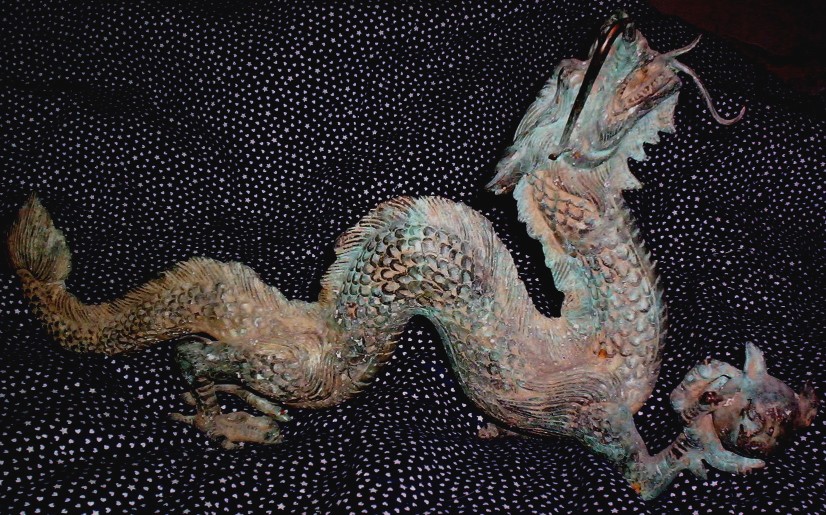
I may just get an image of The NĂðhöggr in #4 painted on black velvet.
Now , where did I put my blacklight?
SlickWilly: I saw that dragon special too, but it was on at an odd hour, on spanish tv…And I don’t understand spanish and only watch spanish tv at odd hours. Thanks, know I know I wasn’t trippin.
Number 5 – This sculpture (for the want of a better word) sits on a traffic island on the main road just south of Seoul CBD. It is HUGE! and almost impossible to photograph convincingly, being hemmed in by 8 lanes of traffic. Any photo taken from far enough back to get the whole thing n frame runs the risk of having traffic in the foreground. Any photo taken from close enough to avoid the traffic doesn’t fit in the frame. In either case, there are medium-rise office and apartment buildings in the background.
None of my students has ever mentioned this dragon.
The Old English letter ‘eth’ was used interchangeably with the ‘thorn’ (like a ‘p’ with the line continued upwards) to represent the two “th” sounds (“this” (voiced) and “thick” (unvoiced)). I can’t figure out whether the voiced or unvoiced “th” is easier to say in the middle of all that. Perhaps the voiced sound, as all the other consonants are voiced.
As these letters fell out of use, the ‘eth’ became confused for ‘y’, so “the” became written as “ye”, as in “Ye Olde …”.
(I consulted the Cambridge Encyclopedia of the English Language while writing this!)
astraya: thanks for that very interesting addition.
MPW: indeed they are
jfrater: We may be misleading ourselves, each other and everyone else by talking about the English pronunciation of these letters in the context of a discussion about a Scandanavian dragon. Pronunciation varied from country to country.
You got the benefit of time zones in posting your phonetic comment before I could.
would lake monsters be considered a type of dragon?
probably not but I’ll ask anyway
astraya: my pronunciation guide is for the Icelandic language pronunciation – I only added the bit about English as an aside. If you follow my pronunciation you should pronounce it correctly in Icelandic
In Icelandic, thorn and eth are pronounced in the same way as they were in Old English.
As another aside, the o-diaeresis is the same as is found in the name of the singer Bjork – which means her name is pronounced “byerk” not “byork”
MPW: I think it would depend on what the monster looked like. I guess you might say that the Loch Ness Monster has the appearance of a dragon (without the fire-breathing bit).
what about champ from lake Champlain:)
No offense, but the picture for No.8. That’s not Naga I knew. Just looking at it you can tell the picture is obviously a Chinese dragon. Naga looks like these.
http://www.raingod.com/angus/Gallery/Photos/Asia/Thailand/images/PhanomRungNaga01.jpg
http://std.cpc.ku.ac.th/delta/deltacp/free/naga.gif
http://content.answers.com/main/content/wp/en/thumb/2/25/280px-NagaPhnomPenh.jpg
http://cdnblogs.thingsasian.com/tablogs/resources/lar/naga3.jpg
Hi y’all. This is gonna sound weird but here goes. I think that whenever something is found all over the world regardless of distance, language, etc. there must be some truth. This is why I believe in, not just dragons or water monsters or whatever, but ghosts. Among other things (shape-shifters, vampires, and the like). Every culture world- wide has stories. There must be a common thread.
HM
Dragons, shmagons! They don’t exist. Whether they ever existed can be argued.
However, many have made a point on how such diverse cultures and places seem to have similar dragon related myths. Thats the only thing I find interesting.
In ancient Mexico there was the Xiuhcoatl. Coatl is “serpent” in Nahuatl, the language used by Aztecs. However, if you see representations of the Xiuhcoatl you will see that they had claws, and looked like dragons.
i know i’ll probably cop a couple of bad comments about this down the track, but anyway, in Australia we have aboriginal mythology (aboriginals call it the “Dreamtime” – too much LSD if you ask me) they have an ancient serpent that goes by the name “Womanbi” also known as the “Rainbow Serpent”.
there are a lot of variations to the story between tribes, but the one common theme in those stories is that the serpent created all the water ways (Lakes, rivers, ponds) and all the mountain ranges in Australia.
Now, i know it’s regarded as a serpent, but all the depictions of it in all the ancient aboriginal rock paintings show it with a crest and horns, it basically looked like a lot of the wingless dragons i have seen over the years.
Tempyra – Great list, Great subject, keep em coming.
CRSN – I was thinking about mentioning Australian Aboriginal legends. Details vary from tribe to tribe, mainly according to the climate: monsoonal in the north, dry in the inland.
According the fount-of-all-knowledge-pedia, there was a “Wonambi naracoortensis, a large snake of the now extinct megafauna of Australia”.
See http://en.wikipedia.org/wiki/Rainbow_serpent
astraya – yeah, i was kinda on the verge of not putting it in myself, but at the same time, i have had to do reaserch for study and for a thesis in aboriginal mythology (australian native history) and most of the aboriginal elders i’ve been in contact with consider it to be a serpent aswell as a dragon, but also, it took them some time to come to that conclusion, i just thought our island needed a mention.
Hi CSRN and astraya, whereabouts in Oz are you from? I’m in Brisbane (it’s raining atm YAY!). I thought about looking into the Aboriginal myths but I wasn’t sure how anything from them would fit into the East vs. West comparison.
Same with the taniwha and the Xiuhcoatl mentioned by AUR above.
Trin – I made an assumption about the name of the zmaj based on this sentence from Wikipedia.org:
“In Slavic mythology, the word zmey and its cognates zmiy, zmaj, zmej and ĆŒmij are used to describe a dragon. Most of these words are masculine forms of the Slavic word for “snake”, which is normally feminine (like Russian zmeya).”
(http://en.wikipedia.org/wiki/Slavic_dragon)
The Slovenian language must be an exception? And is there a specific name for a Slovenian dragon or are they called different names in each legend? E.g. Neville the Zmaj battles St. George? (I just made that up!)
Thanks for correcting my mistake
Tempyra – I’m originally from the northern beaches in NSW and Byron Bay, plus lived in Nimbin and worked in Uki in NSW for 5 years,. but unfortunatly i’m living in Perth, W.A.
Do you travel down to the Tweed valley much? buetiful place, wouldnt mind buying some land there.
also, you may see that i burnt you in the comment section on the Heavy Metal list, sorry, if i had known you were an aussie i would of backed off.
anyway, got to go, catch you on the other side of the web.
Ooh I didn’t even know I commented there??
Where is the Tweed Valley? I probably haven’t been there. Byron Bay is awesome, lucky you got to live there!
I’ve been to Nimbin for 10 minutes; it was a weird experience.
Have a nice evening CSRN
I moved around Australia a lot, first with my family and then by myself. I ended up in Sydney. I’ve been to Perth, Brisbane and the Gold Coast, among many others. I’m now in Korea teaching English.
If you drew a line down the middle of the page and put “dragons” on one side and “serpents” on the other, the the Rainbow Serpent would be on the other side. In a generalist forum like this, though, I don’t think we have to worry too much about categorical distinctions. The Rainbow Serpent shares many of the same archetypal features as the dragons in the list.
I’m at work flipping through a catalog and what do I see? A bronze dragon turtle. The description says, “Behind his tough armored shell and snarling toothy grin, this legendary figure from Chinese folklore embodies the strenght, courage, and unstoppable power of the dragon as well as the longevity and tenacity of the turtle.” Never heard of a dragon turtle, but it reminded me of your list. Now I want one.
“They hoard treasure and fairy-like blonde nymphs.”
You say that like it’s a bad thing…
Why do different cultures have dragon myths?
I read an interesting theory in an evolution book called Before the Dawn.
It noted that the earliest primates to leave the trees and walk upright would have been vulnerable to attacks by snakes, large cats, and birds of prey. These primates (our ancestors) would have developed instinctual fears of these animals and their characteristics. Obviously, mix a bird of prey, a snake, and a large cat you’d have yourself a dragon. As language developed, these instincts would have morphed into stories and legends.
I think this makes more sense than the cosmic anomaly theory mentioned above. But hey, anything is possible.
I’ve never heard of the Bakunawa and I’m from the Philippines. Weird.
CRSN & Astraya – Seeing as how you mentioned that the rainbow serpent and the megafauna watersnake seemed to share links, I’ll also put my off topic theory forward.
Around the time of the megafauna (20,000 years ago or more?) there was diprotodontids a rhinoceros sized ancestor of the modern day wombat.
Now, the diprotodontids used to exist around billabongs and watered areas like that.
Aboriginal culture have legends of the Bunyip, a large shaggy creature that lived in billabongs and waterways. I used to think it was more along the lines of big foot but was told that it resembled more a massive shaggy beast than anything else..
Coincidence? Imagine that! over 20,000 of oral history!
Number 4 is sweet!
And woohoo! I’ve heard of one of them, Nagas! I know about them because of this fantasy series I used to read; they were a whole group of people who could change from snake to human, but were most comfortable as snakes with the upper body of a human.
=]
Sweet list.
Anderi – the Bunyip (with out looking at that *****ty wikipedia, because i was bought up with these stories) is actually made up from several different animals and their body parts i.e kangaroo, koala, tassy tiger (extinct), but, as astraya and tempyra and i mentioned before in ealier posts, the tribal dream time stories vary widley between tribes, there is usaully one common theme among the stories, but that usaully happened from inter-tribal contact and sharing of knowledge.
it is in know way related to the stories of yettis or big foots, the main common theme within the bunyip stories is it has a disusting stink you could smell when it was near and it never got over 5 foot tall.
CRSN – Wow! So much knowledge of the culture. Thanks for setting me straight.
I have the feeling that I gaffed in front of someone with first hand knowledge?
You understand that I’m just city bred!
Anderi – I’m from the city aswell, i guess its just different education programs, i went to Catholic schools when i was young, and it was kind of a normal subject for us.
also i have to deal ith the aboriginal culture on a day to day basis, and being a white guy doesnt really get you in the good books until you understand their culture, a lot of the elders these day are so depressed seeing the next generation going down the path of distruction that the elders have fought so heavily to stop and provide a better future, the new generation is so different to the old days when Eddie Marbo was around that it seems to be a totally different culture/race.
I’m actually from the Philippines and I didn’t know about the Bakunawa until now.
Oh, and this is my first post here, though I’ve been visiting for a couple of months now. So…. hello to all!
*wave, wave*
CRSN: I read somewhere (but can’t find the source, dammit, which means I read it in some doctors waiting room), recently, that there had been a possible sighting of a small group of tassy tigers.
Any truth to that, or just wishful thinking?
I love dragons, thanks for another great list.
I have heard about 1,4,7,8 but the rest i didnt know.
Segue – Nah, if there was a sighting of a Tassy Tiger it would be plastered all over the news, i think the last so called sighting was in 2003 in Victoria (i might be wrong)
And Australia is a pretty magical place in it self, we dont have a lot of the ***** that goes on in other countries, and at least we can give our Prime Minister ***** on the side line without some kind of secret service prick dragging you away and violating your rights to free speech, tust me, if we had Bush running our country, i think we would have shot him by now out of sheer embarassement.
No. 1 is wrong. naga is simply spelled “NAG” which means a snake. the snake that changes its shape to human form is known as a “Ichadhari Nag” which changes its form on will. a snake has to survive for 100 years before turnin into a achidari nag
****
#100. CRSN
….Australia is a pretty magical place in it self
****
Australia *is* magical. I cherish my childhood memories dearly! Even the silly little ones like when, at 4, I would be sent by one of my Uncles (who was an off-track book-maker) to the local pub, with his pail, for a few pints…or running across a blue-tongued lizard on the sidewalk where the shops were and everyone going apesh*t until it went down a storm drain ,or something like that, in the street. Ayers Rock, which I was sure was the gate to heaven. Driving trough the the Bush and seeing the Roo’s, with their graceful leaps, keeping time.
The eucalyptus forests (eucalyptus are still my favorite tree), gum nuts, looris, parrots, koalas all just there to be seen…though I suppose not so much ant more.
****
….trust me, if we had Bush running our country, i think we would have shot him by now out of sheer embarassement.
****
so far, it would seem, the only presidents to be assassinated in office are the ones doing, or attempting to do, some good.
BTW, I read an article online, re: statements by your PM and the immigrants who refuse to learn English, and who deplore the posting of the flag or a multitude of other basic Australian ways of life in the classroom.
I applaud him!
I am of Polish desent and i was wandering where are the Dragons from Poland ? Come on folks the jokes will be too easy but letum go .
Seague – cheers, a like minded person like myself, if people dont like the rock us aussies live on and cant adhere to the basic requirements of living in australia, doesnt matter what religion, we’re very open minded, they can ***** off.
they could probably go to New Zealand, Jfrater put a list up boasting about how great and liberal NZ is, well they can go there, more space for me.
Cool list! I haven’t heard of any of these except the Naga.
==
Polycephalous. Now I have to think of how to integrate this word into everyday.
==
The NĂðhöggr picture is awesome!
CRSN- Any country who can play Australian Rules Rugby is *OKAY* by me.
My Uncles all played. My youngest, a daughter (5’4″115 lbs, a musician, a intelligent woman who has 2 BFA’s and a plethora of minors) plays Rugby Union…someone has to keep up the family tradition.
NRL much funner-er.
We also know of the Chinese Red, the Welsh Green, the Swedish snoutback, and the other one (which escapes me at this second) are from Harry Potter 5.
I’d heard of Nydhoggur before… probably because I’m from Iceland and grew up reading the stories of Norse Mythology!
V.
Well anyone who has read Harry Potter will know the Naga.
The female Naga is the Nagini, or the name of Voldemorts snake.
He is known to milk it and use its venom to rebuild his physical body before book 4.
the illustration for number 1 is pretty interesting. i would like to see it in higher resolution if that is possible.
I am a Filipino and have seen lots of pictures of bakunawa on books/comics or drawings. It’s a giant winged-dragon, the biggest of all. I’ve seen it on TV, it’s like a big, long fish. It flies across the skies and eats the moon..Man! It’s so scary! .
A greedy person is also called Bakunawa.greedy politician etc….(figurative zoomorphism)
where did you got that bakunawa picture?
yeah those corrupt politicians are also called bakunawa…
when i was a kid my grandma always tells to go inside when its already late at night I
might be eaten by a “BAKUNAWA”
Cool list! I’ve actually heard about four of these. But if the Zmaj is the same thing with the creature we have here in Romania (zmeu, plural zmei), it’s not exactly a dragon, but an evil character that varies between a sort of troll and a dragon, or even a human form. But maybe theirs is different
Awesome list! Was very happy to see Korean dragons on there, I have one tattooed on my leg! People usually assume it’s Chinese until I either explain it or they notice the Korean symbol next to it! It was loads of fun researching them before I got the tattoo done.
I’m gonna go ahead and make an observation on #4. His name is actually NĂðhöggur, the u being rather important in the pronounciation, it just wasn’t written in the time of writing things on calfskin in order to save time (and skin).
In Icelandic you would pronounce it Neeth-hugg-ur (as has been pointed out, the th is a sound similar to the one in thorn, though slightly softer). And, since Icelandic has been the most isolated of all the Nordic languages for the past, oh, thousand years, it’s probably the most reliable source of pronounciation for all these things.
Yes, we rule. Give us money now.
I have more things on the guy. I’m just too sleepy now…
aww, no wyvern?
whoa! that is awsome! unbelieveable!
What about the Piasa Dragon? No one ever remembers him…
While informative this isn’t actually a list of dragon types. Nagas are not considered dragons, they are half snake(normally cobra), half human and are considered holy by that connection. NĂðhöggr by contrast is a dragon, but it is the name given to the Norse dragon who lives among the roots of Yggdrasil(the world tree) and constantly gnaws at them.
I’d also like to point out that it’s the Korean Yong dragon that has three toes, where as the Japanese Ryu has four, and the Chinese Lung has five.
I’ll admit however not knowing much about numbers 7,6,3 & 2, the rest I have either read extensively on or have at least heard of them.
There is no mentions of the dragons found on the walls of the Hanging Garden of Babylon