This is a list of 10 more common English errors. This list follows our previous popular list of Top 10 Common English Errors. Hopefully a few of these will help to fix one or two mistakes that we all make from time to time.
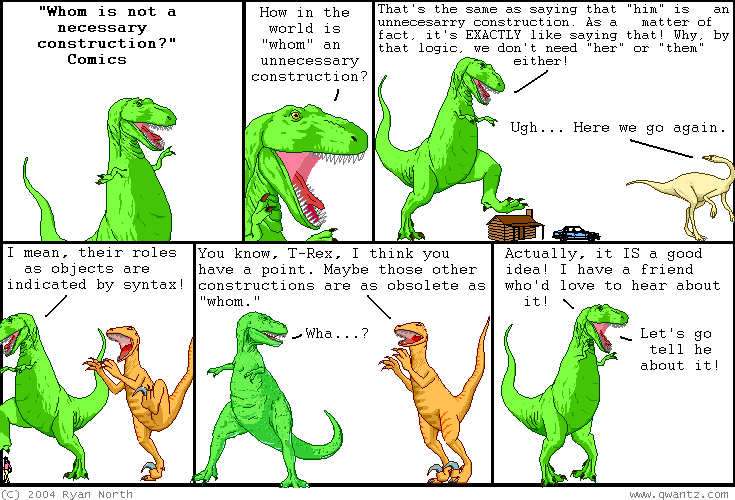
This particular error has become so common that it is beginning to look like the word “whom” may vanish entirely from the English language. The reason for this is that so many people have no idea what the difference is. The difference is a simple one: who “does” the action, and whom has the action “done” to them. We use this difference in other words – “I” and “me” for example. “who” is the equivalent of “I”, and “whom” is the equivalent of “me”. The technical term for this difference is noun case – “who” is the nominative case, and “whom” is the accusative. Here is an example of correct usage:
Who is going to kill Bob? (I am going to kill Bob)
Bob is going to be killed by whom? (Bob is going to be killed by me)
English does not use cases as much as it used to. Many other language do use cases frequently, such as German, Latin, Greek, etc. [Image Source - click for a larger view]
On the previous list of errors I included Irony as a bonus – it deserves its own place and a fully description so here it is. There are four types of irony (none of which resemble remotely anything in Alanis Morissette’s song:
I. Verbal irony
This is when the speaker says one thing but means another (often contrary) thing. The most well known type of verbal irony is sarcasm. For example: “He is as funny as cancer”.
II. Tragic irony
Tragic irony occurs only in fiction. It is when the words or actions of a character contradict the real situation with the full knowledge of the spectators. For example: In Romeo and Juliet, Romeo mistakenly believes that Juliet has killed herself, so he poisons himself. Juliet awakens to find Romeo dead so she kills herself with his knife.
III. Dramatic Irony
In drama, this type of irony is when the spectator is given a piece of information that one or more of the characters are unaware of. For example: in Pygmalion, we know that Eliza is a prostitute, but the Higgins family don’t.
IV. Situational Irony
Situational irony is when there is a difference between the expected result and the actual result. Take for example this account of the attempted assassination of Ronald Regan: “As aides rushed to push Reagan into his car, the bullet ricocheted off the [bullet-proof] car, then hit the President in the chest, grazed a rib and lodged in his lung, just inches from his heart.” The bullet proof car – intended to protect the president, nearly caused his death by deflecting the bullet.
You may want to check out our list of 10 images of irony.

These two words are commonly confused – probably due in part to the fact that both words have more than one meaning. I will explain clearly the main difference and just briefly mention the other (rare) meanings:
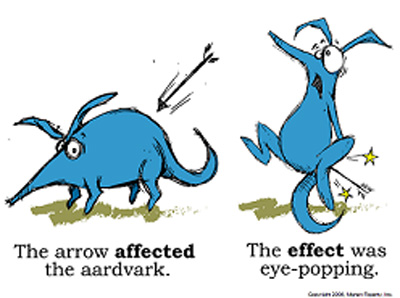
Affect (a-FECT): this is usually a verb (doing word) and the form most commonly confused with “effect”. It means “to influence” or “to cause a change”. For example: John’s protest affected great change in the farming industry (John’s protest caused change to happen).
Effect (e-FECT): this is usually a noun (thing) and it refers to the “end result” or the impact something has on someone or something. For example, “the cocaine had a numbing effect”, or “her smile had a strange effect on me”.
For those who are curious, affect (AFF-ect) means “emotion” but this meaning is used almost exclusively by psychiatrists. And just to further confuse the whole thing, “effect” can also mean “to create” – which is probably the reason that many people confuse it with affect (a-FECT). For example: “I am trying to effect a new council in the city”.
But wait, there’s more: something can “take effect“, but it cannot “take affect“.
Confused? No wonder. Here is a simple way to remember the basic rule:
If it’s something you’re going to do, use “affect.” If it’s something you’ve already done, use “effect.”
Lay: To put something or someone down: “lay your head on the pillow”. Lay needs a direct object to act upon – in the example here the object is “your head”.
Lie: To rest in a horizontal position or to be located somewhere: “If you are tired, lie down”, “New Zealand lies in the Pacific Ocean”. Lie does not need a direct object to act upon – therefore it would be wrong to say “if you are tired, lie yourself down”.
This is seen quite often these days and some people claim that it is acceptable English, but it is not. Do not do it. Here is an example of the offending phrase:
“I wish she would have kissed me”
To correct this grievous error, you need to say: “I wish she had kissed me”.
The reason this is wrong is that “wished” suggests something contrary to reality, and adding “would have” which is also a statement of contrariness, is excessive and unnecessary.
Of course, “would have” is perfectly acceptable in the following sentence: “I would have given a donation if I agreed with the party’s politics.”
The most common problem here is the use of “myself”. Take this sentence: “If you have any questions, ask Jane or myself”. This is wrong. To see how obviously wrong it is, just take Jane out: “If you have any questions, ask myself”. It seems that many people think that “myself” is like an intensified version of “me”. So how do we use “myself” correctly?
“Myself” is only used when “I” has already been used. For example: “I washed myself” or “I put half of the cake away for myself.” This is the only time it is ever used. The same rules apply for “herself” and “himself”.
The difference between “I” and “me” is the same as that shown in item 10 above. “I” is the “doer” and “me” is the “done to”. For example:
I paid the tax department.
The tax department paid me.
Things get a bit more confusing when you add a second person, but the rule is exactly the same:
Jim and I paid our taxes.
The tax department gave refunds to Jim and me.
The difference between less and fewer is that one is used in reference to “number” – things you can count, and the other in reference to “amount” – things measured in bulk. For example, you can’t count sand, so if we want to empty a hole filled with sand, we say “we need less sand in that hole” – but if we want to empty a hole filled with eggs, we say “we need fewer eggs in that hole”. There are other words that follow the same rule:
“A great quantity of sand” – “A great number of eggs”
“We should remove a little sand” – “We should remove a few eggs”
“There is too much sand” – “There are too many eggs”
If you eat too many ice-creams, people might think you have eaten too much dessert.
We commonly see this error crop up with regards to people: “We need less people on this team” – this should actually be “we need fewer people on this team”.
Measurements of time and money ignore this rule, therefore we say: “I have less than 5 dollars” and “It takes less than 2 hours to get to Paris”.
This is wrong. It is a very common error and an appalling one at that! The correct form is “different from”. In British common use, many people say “different to” but that is still technically bad form and most UK style guides reject it. Let us look at each option:
Wrong: “Pink is different than blue” (common use in the US)
Wrong: “Pink is different to blue” (common use in the UK)
Questionable: “John is different than he was before his accident. (this can be phrased better – but because “different” is followed by a full clause, some accept it.)
Right: “Pink is different from blue”.
First of all, “anyways” is not an English word – in fact, I am not aware of it being a word in any language at all. You should never say “anyways”. The word most often crops up in sentences such as this: “John was an idiot anyways!” The correct word to use is “anyway”.
Secondly, anyway is different from any way – both are acceptable but have different uses:
“I didn’t like him anyway”, and: “is there any way to stop the marriage?”
I am sure no one will disagree with this entry being number 1 on the list – it is extremely common nowadays to see these words interchanged – sometimes with hilarious consequences but usually not. Let us look at each word separately:
They’re: The apostrophe is used here to replace a missing letter – the letter ‘a’. “They’re” means “they are” – it only mean “they are”, and can never mean anything else. So if you want to say that someone is happy, you say “they’re happy”. Remember, the apostrophe stands for a missing letter.
Their: This means “belongs to them” – it only means “belong to them” and nothing else. The confusion that has arisen over this word is no doubt related to the fact the an apostrophe is often used to denote possession – such as “John’s dog” – but when we are talking about “them” possessing something, we don’t use the apostrophe.
There: Everything else falls in to this category. “There is a happy man”, “Over there!”, “There aren’t many people at the party”.
Here is a little tip for remembering:
Their – “Their” has “heir” in it – an heir ultimately possesses items left to them in a will.
There – “There” has “here” in it – this can remind you that it refers to a place.


I am forever vehemently correcting the “would/should ofs” around me. Everyone thinks I’m nuts!
Jtradke,
Following your logic we end up with a curious and interesting situation which is clearly, some would say shamefully, demonstrated throughout LV. Those whose native tongue is not English are carefully taught the difference between who and whom, less and fewer. They understand the distinctions and use them accordingly. One therefore finds dr Lecter, a Croatian gentleman, posting a far higher and more comprehensible standard of English than many here whose native tongue is English.
There were much lumps of sugar in my tea.
Many sugar fell in my tea.
I want fewer sugar in my tea.
Many haste fewer speed.
I would like less lumps of sugar in my tea.
I would like fewer lumps of sugar in my tea.
In fact the distinctions between these terms and the reason for their existence is made clear enough in all but the last couplet. That is the common *grey area*. Whereas the intention is unlikely to misunderstood, and will only mark out your grammatical ability, there is a slight hint that *less lumps* might mean smaller lumps rather than a lesser number of lumps. There are also occasions when to use *less*
instead of *fewer* works better, even when the latter is grammatically correct. A good user probably tends to develops an instinct and an ear.
The broad overall distinction is clear.
If you are talking about individual objects making up a group: fewer, more and many.
If a homogeneous mass: less, more and much.
At the end of the day, it amounts to little more than the semantic equivalent of dressing smartly or running around with shoelaces undone and buttons undone. Some take a pride in looking sloppy. Fine.
Heroajax, (120),
Nearly went off the air for a long time, perhaps until next week even. Glad I picked you up. Sure:
Readers Digest Association Inc. ‘The Right Word at the Right Time’ A Guide to the English Language and how to use it. John Ellison Kahn (ed.). First ed. (mine), 1985. 688 pps.
Bought U.K. 1989 for 14.95 sterling.
Chock full of common sense. An update of Fowler, but much more. It was recommended to me by a friend who writes horticultural literature for a living, and whose wife is a compiler of all kinds of book idices (or indexes!). He also introduced me to computing at a critical time: I was contributing to an encyclopaedia. It saved my bacon.
Heroajax, I have no issue with mere discussion of grammar. I did not “bash on” you, or anyone else here. I, for one, did not tell anyone to “shut up”, like some obtuse misanthrope who gets defensive at the slightest criticism. Nor did I “bash on” either of the aforementioned style manuals; I just pointed out that even they do not fancy themselves purveyors of Law, as you appear to.
Anyhow, if you’d like to play the “Appeal to Authority” game, how about the opinions and evidence from some real, live academic linguists? http://languagelog.ldc.upenn.edu/nll/?p=465
First of all, I found an ERROR in the list!
In the irony item, you put:
“For example: in Pygmalion, we know that Eliza is a prostitute, but the Higgins’s family don’t.”
Wrong! “family” is used as a singular noun, so it should be “the Higgins’ family doesn’t”! Mass nouns, baby!
Second, do you have something against Alanis Morissette? Her song is called “Ironic”, not “Irony”, so while the situations she describes (e.g. “Meeting the man of your dreams/And then meeting his beautiful wife”) are not irony, they’re definitely ironic! (I would say “situationally ironic” from what the list says, but I’m not sure.)
@109,110 Heroajax : Thanks H (if you are fine by me using that) , eventually thats what I wanted to point out but you put it in better words
PS. I love lists like this one. Isn’t it obvious?
Thanks!
Why isn’t the difference between well and good on this list? “How does Harry perform in math?” “Harry is good at math…..Harry does math well.”
@77 Jackie: Looks like we’re both right. Just looked up wikipedia, and it says “This is now often considered nonstandard although it was originally essentially the norm (even in formal writing).”
Great list. I have noticed that a lot of younger people (in New Zealand)use ‘bet’ instead of ‘beat’. (I bet him in a race).Is this common in other countries? I also hate the reply ‘Good’ to the question ‘How are you?’.
@124 Jtradke. Sigh, I’m not sure why you’re persisting when I’m only trying to help. Here goes:
Directly from the back cover of my 2000 edition of The Associated Press Stylebook: “this edition contains over 5,000 entries laying out the AP’s rules on grammer, spelling, puncutaion and usage. It gives journalists the references they need to write about the world today: correct names of countries and organizations, internet language and search tecnhiques, langauge to avoid and common trademarks.”
Although I do not personally own a copy of the Chicago Manual of Style. I have used several editions in the past and it says the same thing. All of your English teachers used either manual to instruct you in correct grammatical English.
You might possibly make the argument, that one is a Journalism style and the other is a Novela style, but definitely for all the above rules and for rules of punctuation, they agree completely.
Additionally, I also busted out my Random-House Webster’s New College Dictionary Deluxe Edition. Which after the last “z” entry has … that’s right, a “guide for writers,” Which has … that’s right, all the rules of the English Language we’ve been discussing. EVERY SINGLE ONE!
Those three I listed above are THE authorities in English. So, as far as your “appeal to authority.” Ummm, ya. You definitely need to learn to do some research. Are you honestly trying to cite an internet web site as a bastion of authority? Do you know who set that site up? Where are the webmaster’s credintials? Where are the author’s credentials? What references are they using? Based on my admittedly quick read of the site, seems like it’s mostly opinion. It could be typed out by apes for all we know. Talk to any one of your teachers/professors and ask them what they think about using any internet web sites as a specific, expert reference. They’ll laugh you out of their office. Do web sites sometimes have good and interesting information. Absolutely! Are they a good source of expert information? Not so much in most cases.
I’m sorry. It’s clear you don’t like it, but this is the world we live in. You can choose to be precise in your communication or not. It’s up to you. I can’t change it. I’m simply offering you the opportunity to learn and grow and not to be thought less of because of poor grammar. When you get into the professional business world, this type of nitpicking thing matters … unfortunately. Many good ideas are lost due to poor writing and speaking. It sucks, but it’s true. Anon summed it up perfectly in #122. You can look sloppy or not.
BTW, make sure you place all punctuation within the quote marks.
*Credentials* gaaaa. I hate it when I type too fast.
I always puke in my mouth when people mix up your and you’re.
People who screw up “there, their, and they’re” bother me so very badly. It looks so wrong, and I can’t understand how they do it. It’s SO. FREAKING. ANNOYING.
Rawr.
I agree that most of these errors make me mad. However, language is dynamic and constantly changing. Some of these, such as the “different than,” may be accepted soon because of their common usage.
#67 got it backwards: “Farther” refers to distance and “further” is figurative. You travel farther but pursue a topic further.
#125: I believe “family” is singular in the USA and plural in the UK (same with “company” and similar).
My own peeve: I wish I would have known. No — I wish I HAD known. The overuse of “would have” (or “would of”) is infuriating! “If I would have known, I wouldn’t have gone.” Incorrect. If I HAD known, I wouldn’t have gone. Why do we not teach English in schools anymore?
Eliza Doolittle is not a prostitute. She sells flowers for a living. Her father is initially suspicious about why she has moved into the home of Professor Higgins (who, by the way, has no family), but he soon realizes that Higgins’ intentions are honorable. The title character of “Mrs. Warren’s Profession” (another play by the same author) is a prostitute.
Time to pontificate. Random thoughts:
1) There are no “rules”! In every language, the people started speaking first, followed by grammarians, style-guide writers and teachers trying to make work for themselves. The three books Heroajax mentions are not “rule books”; they are two “style guides” and a “dictionary”.
2) For every “say this and you’ll sound like an ignorant yokel” there is an equal and opposite “say this and you’ll sound like a pretentious *****”.
3) For every appeal to authority there is an equal and opposite rejection of that authority and appeal to another authority. I reject any authority which says “math”, “gotten”, “-ize” and “-or”.
4) Language changes. English used to be a highly formal, inflected language. Now it isn’t. Once there was a singular and plural “you”, and a subject case and object case “you”. Now there isn’t. The first person to (mis)use “you” in the modern way probably had scorn heaped on it/them/he/she.
5) Does this mean that anything goes? No. I’ve often said to my students “Language is about communication. If you can communicate using limited vocabulary and poor grammar, then go right ahead. But” (and this is important) “the best way to communicate most clearly with the most number of people is to use standard meanings, grammars and styles”.
At the level I am working (vocational high school in Korea) the mistakes that students make are far more basic than any of these items, and are things that no native speaker over the age of 3 would say. Last week students wrote sentences such as “Mr (my surname) is English teacher” and “Lee Yeong Ae is a actress”.
One third-year student has been coming to my desk at lunch-time and lesson breaks for some extra help. Having learned English for at least 5 1/2 years (through middle and high schools) she still does not understand “a” and “an”. She said “What does it mean?” I said “It doesn’t mean anything. It’s just a word we use with nouns.” I explained about “an” before a vowel and “a” before a consonant. She came back the next day with “an umbrella” and “a university student”. I explained that it is the sound that matters and not the letter. She came back the day after that and said that her language academy teacher had said “an university student”. I said “You’re language academy teacher is WRONG!!!!” and appealed to the authority of Berlitz and Microsoft Word.
As well as the internal inconsistencies of English, any student of English as a second language is going to be influenced by its own language. Korean doesn’t have “a”, “an” or “the”, “he” or “she” (or any other personal pronouns) so Korean students of English struggle with these basic things. Korean has a system of case markers which resemble Latin more than English. I can’t understand them, but in modern Korean they are falling out of use anyway. No doubt Korean stylists fulminate against that. Korean has a number of constructions that are mainly used when speaking, and others that are mainly used when writing.
A lot depends on context. No-one is going to say to its mate in the pub “Whom did you shag last night?” or even “Who did you shag last night?”, but approximately “Whodja shag last night?”. Would we really say “With whom did you make love last night?”
The best grammar is often invisible. One style guide I have (at school, so I can’t quote directly) gives the example (something like):
“Two boys were playing with a frog, and it died. To the boys, this was just part of the game, but to the frog, it was real”. (Plato, sometime BC.)
Concise, elegant, saying exactly what needs to be said and no more. Maybe I need to do that.
‘Enry ‘Iggins ‘as a mother, if she counts as “family”.
@ Astraya. I completely agree with everything you said. Except point 1. There are rules. You can choose to follow them or not. The books I cited actually are the rule books for English. They just happen to be named “stylebooks.” Again, you can choose to use them or not.
Remember to keep all punctuation within your quotes.
Great points.
Heroajax: I’ll concede half a point. When I said “There are no rules”, I was thinking something like “official laws which have official consequences if you break them”. There are no official laws in English. We do not have an academy. Even if we had one (like the French), we’d probably keep saying and writing the same things anyway, like they do) . Korean now has a law governing transliteration into English, and no-one follows that.
I’ve just checked two more-or-less randomly chosen dictionaries. One defines a rule as “an established regulation or guide for conduct, procedure, usage, etc.”. English doesn’t have regulations, but it does has guides. Another says “an official or accepted principle or order which guides behaviour, says how things are to be done, etc.”. Again, official, no; accepted, yes, so half a concession. (Yes, the second dictionary is British, “behaviour”.)
Punctuation usage varies. British usage (which Australians generally follow) generally puts the punctuation mark inside the quotation marks when that punctuation mark is part of the quotation, such as the quotation from Plato in my previous post (the full stop should be inside, sorry!), but outside when the punctuation mark is not part of the quotation.
I’ve thought about making a list of differences between UK and USA English usages, but am daunted by the size of the topic. Somehow we manage to communicate. Sometimes I think that the differences are, in fact, exaggerated.
“The books I cited actually are the rule books for English. They just happen to be named “stylebooks.”"
Heroajax – the publications to which you refer are assuredly not “rule books for English”, and they do not themselves claim to be. They detail the preferred or required editorial style of an organisation/publisher, etc.
Whilst by their very nature such style guides might be expected to propound correct or proper grammatical usage or convention irrespective of their intended readership, their purpose is to detail “house” preferences, largely in the interest of affording editorial consistency.
Whilst, for the US, at least, the AP and (more particularly) the Chicago style guides have deservedly gained currency as de facto “authorities” to written (American) English, there are numerous publications of at least equal standing to these guides elsewhere. A few well-known British examples :
The Oxford Style Manual;
The Times Style and Usage Guide; and
The Economist Style Guide.
You missed a fifth meaning of the word “Irony” (n) containing or having the attributes of iron.
I meant (a) of course :S
@141 Astraya. Okay. Half-point conceeded on my part as well. I was making the assumption (yes, my fault) that we were not speaking of “laws” for English with punishment consequences other than social ones.
@Kiwiboi. I will grant there are others out there. The ones you cited are also excellent references. I was also simply taking it for granted pretty much everyone here knew there is a difference between British and American written English. I’ll even grant you the “editing preferences” part as well. However, even you admit they are the de facto authorities. For American English if you do not choose either one of those (which are essentially the de facto standard here) there are very few other objective references out there and certainly none so widely accepted. IMO, it’s simply easier to tell people who want/need to learn proper grammar to pick AP or Chicago and be done with it. Even if someone picks another American reference (which are junk, imo), most/all the rules agree anyway.
What I don’t want to do is open the door and allow people to think they can do what they want. The burden of clarity is on the part of the writer and not the reader.
can’t believe “your” and “you’re” isn’t on here! people always butcher that it drives me nuts!
Grammer error in the irony section: “the Higgins’s family don’t.” Because “family” is singular, wouldn’t it be “doesn’t”? Also, is the second ‘s’ necessary? Higgins’
Funny how I already knew all this, and I’ve been studying English only for about 7 years. I know quite a few people who have English as their first language and don’t have the same linguistic skills as me. But I do have the Northern European accent and I probably won’t ever get rid of it
Like I already posted, in the UK, “family” and other collective nouns are treated as plurals.
they’re/their/there mistakes make me cringe!
Like I already posted, in the UK, “family” and other collective nouns are treated as plurals.
Quaker – “Family” is singular; the correct usage is “doesn’t”.
If you want to treat “family” as plural then you must expand the collective noun, per : “the members of the family don’t”.
I’m in the UK, by the way, and have never heard of the absurd treatment of collective nouns to which you refer…
Language is defined by it’s use. Not your English teacher.
The language evolves, words usages evolve over time. If you can’t keep up, then you might as well end it now, because this is a battle that you are destined to lose.
Language, particularly English, is a dynamic, ever growing, ever changing, living art. As with any art, you simply can’t know how to break the rules, if you don’t first *know* the rules.
Every great writer, of the English language, was a master of the language, and every one of them has, at times, broken the rules of which they held such mastery to create lines of breathtaking beauty, or unabashedly naughty and hilarious puns.
As long as English is a dynamic language, it will continue to be the most useful language on earth.
interesting
I fail to see how you could possible mix up they’re/there/their. You’re taught the difference in first grade!!
I always wondered about backward/backwards and forward/forwards. Are you supposed to include the s?
@sammysunset. No “s” for those two words. See my comment #55.
I think your list needs the often-missed the distinction between “can not” and “cannot”. I see this error made by my teaching colleagues (and, of course, my students).
I always wondered about backward/backwards and forward/forwards. Are you supposed to include the s?
sammysunset – when used as an adverb you may generally use either of “backward” or “backwards” (although it seems that, in the US, the ‘s’ tends more often to be omitted). Drop the ‘s’ when using “backward/s” as an adjective.
I guess the same applies to “forward/forwards”, but “forwards” seems rarely used today.
I think your list needs the often-missed the distinction between “can not” and “cannot”
Jim – can you give an example? I was taught to use “cannot” except when “not” forms another part of the sentence (eg. “she cannot dance” / “she can not only dance, but can sing”).
I note, though (from a quick perusal of a few US grammar websites), that American usage of can not/cannot might be more prescriptive than British. Is this the case?
Oh, don’t forget the notorious “resulting to”.
A quick interjection during a snatched work break.
Kew considers the species is valid.
The Royal Botanical Gardens at Kew considers …
Kew keep on giving me good information.
Botanists at Kew keep on …
Arsenal think they’re the best.
Arsenal players/fans think …
Everyone else says Arsenal isn’t the best.
Everyone else says the Arsenal Football Club isn’t …
The shorter, first versions of all these are in acceptable useage. Although the institution and the club are strictly singular, the full sense as conveyed by the longer, lower versions is implicit in every case. It would perhaps be more careful to provide the longer versions, but in these and most similar cases it’s surely hardly necessary.
By the way, I think I would be correct in assuming the following:
Someone above noted that language was spoken before its *rules* came about. That rather suggests the rules were imposed afterwards. I would prefer to suggest that the rules are actually an anlysis and explanation of the inevitable logic of use. Anyone who sees a single object and a number of objects, or speaks of themselves and other people will inevitably be obliged to diferentiate, and a whole load of semantic consequences will cascade in the wake of that differentiation.
You don’t need to learn rules to speak in everyday language because it is ingrained by the neccessity of collective understanding and communication (I believe we are *hard-wired* at birth ready to communicate by signals and speech). However, once the *****ysis exists, it is then possible to add further sophisticed layers rapidly in an informed and focussed way. I don’t need to know anything about aerodynamics to make a paper aeroplane. I fold to a known pattern and it flies or not. I improve by trial and error, hitting aerodynamic nicities by intelligent observation and chance: serendipity. However, that won’t get me to design an F16. Art and the rules of perspective are another example.
As a major parallel, people started counting and were probably very efficient at practical mathematics before the subject was looked at and broken down in an abstract way. Only following that, however, was it possible to advance gradually to the applied heights which have led to our modern technology and the pure heights of our present understanding of the universe.
Okay, so during the irony section, isn’t it ironic that the author made an agreement error “the Higgins family don’t”. The family doesn’t, not the Higgins’ don’t. Lol, irony!
Great list. One that really irritates me is the use of ‘of’ and ‘off’. Since starting my admin job, I’ve come to realise that there are only a handful of people who know how to correctly use these words. Also, I find people tend to mix up the words ‘wary’ and ‘weary’ for some reason. Drives me mad!
I think your you’re should be on this list too, along with to too two 2
165. vix
One that really irritates me is the use of ‘of’ and ‘off’.
****
Excuse me? You’re joking, right?
If, by some bizarre chance you aren’t joking, can you give an example of how these two totally unalike words can be misused, please? Truly, my brain just went into park with this one.
I was surprised not to see the “your” and “you’re” mistake on this list.
Anon: you might be referring to my statement “In every language, the people started speaking first, followed by grammarians, style-guide writers and teachers trying to make work for themselves.” This was mostly-flippant. If I’d been phrasing myself seriously, I would have said something like you did – “I would prefer to suggest that the rules are actually an anlysis and explanation of the inevitable logic of use”. I fully agree with that. Grammar and “rules” arose sort of like “I understood what you just said – let’s agree that that’s what we say when we mean that”, and “I didn’t understand what you just said – let’s figure out what weren’t going to say in the future to avoid misunderstanding”.
I just thought of an illustration. Two hunters are confronting a big cat (see, I’ve got big cats on my mind now). One says “Me run”. That probably means “I’m going to run away. See you back at the campfire if you survive”. With a bit of re-emphasis, it might be “Me, run” ie “I can handle this one on my own. See you back at the campfire with a chunk of big cat t-bone for you”.
In one state of Australia (and in many other parts of the English speaking world), many people say “off of” where standard usage is “off”: “I got off of the bus at the town hall”. The song “Can’t take my eyes off of you” really ANNOYS ME!!!!
astraya,
Point taken. Actually I posted without knowing who had put out the idea. Had I checked out your name first, I’d probably have swallowed my tongue, or whatever is the equivalent for the keyboard (probably the *Enter* key!)
There must be space for a dictionary or encyclopaedia of *Standard Abusage* (go on, tell me one exists!) such as your *off of* as in: “Gerroffof my back willyers!”
I’m happy to have remembered one of my own particular favourites to share:
*Nucular*. I’d like to have had a quid for each time I’ve heard it: even as broadcast during street interviews. I don’t know whether it’s curiously Brit or has a wider currency. The other strange thing: I’ve only ever hear it uttered by CND *nucular disarmers*.
@129 Sandeep, oh ok where on wikipedia do you find grammar stuff like that?
Anon: George Dubya is famous for his (mis)pronunciation of “nucular”. Anyways (sic), some mispronunciations become standard: hand-kerchief, cup-board, sauce-pan.
170. Anon
*Nucular*. I’d like to have had a quid for each time I’ve heard it: even as broadcast during street interviews. I don’t know whether it’s curiously Brit or has a wider currency.
****
What!?!?!? You’ve never heard George Bush, our almost ex-President, trying to say nuclear? Nucular, every time. 8 years of nucular.
Now, Sarah Palin, running for vice-President with McCain, says nucular, too.
I was beginning to think it was a Republican vice.
@171 Jackie: http://en.wikipedia.org/wiki/%27s
From #8
For example: John’s protest affected great change in the farming industry
If it’s something you’re going to do, use “affect.” If it’s something you’ve already done, use “effect.”
Is it just me or are these statements contradictory?
My real hates regarding misuse of English are “my bad” and “so”as “I’m so into Led Zeppelin” or even worse”I’m so totally into Led Zeppelin”
Cheers
Lee
I wish you are my English teacher. You’re so darn funny!
anyway…
“Prayer” has 2 different pronunciations, “prer”- the words used to talk to God; “preyur”- one who prays.
I can’t understand why people would confuse their, they’re, and there. It’s too easy to be confused.
The one that has been bugging me lately is “further” and “farther” … most notably, the narrator on Mythbusters uses them wrong and it bugs me to no end!!! >_
astraya and segue, (172), (173),
In fact, almost without exception, I’ve been listening to Spanish translations of world news for about the last dozen or so years. Before that I had little time for TV and mostly read newspapers. When we go back the UK or Europe we’re buzzing around like bluebottles and have to make an effort to watch anything, as well as being dependent on our hosts or family.
This has deprived of the unique pleasure of *Republican newspeak*. I’m sure the inventive neologisms of GW feature in the grossly irreverent ‘Private Eye’, (where he is – or was – the Revd. Dubya, by the way). But then I only get short runs of that when in UK. Out here there is something called ‘The Clinic’, which was born, together with its title, when Pinochet made his miraculous escape from detention in England and subsequent even more miraculous recovery from death’s door when arriving back in Chile on the ‘plane. But ‘The Clinic’ is like pot compared to crack. So I suffer withdrawal symptoms. Trivium: ‘Private Eye’ is mentioned as favourite reading by Stephen Hawking in ‘A Brief History of Time’.
My pick-up on *nucular* comes from the 70s and 80s as a personal thing.
167. segue
unfortunately I am not joking with the misuse of the words ‘of’ and ‘off’. I work in conjunction with the purchasing dept of my company, and numerous times a day I have to deal with invoices and orders on which someone has ordered (eg) ’2 off the cylindrical valves…’ No amount of explaining this mistake to people makes any difference and so I’ve just given up
what about the “definitely” error? it’s very common :p
http://www.d-e-f-i-n-i-t-e-l-y.com/