What child doesn’t love nursery rhymes? It is this love which has allowed so many of these tales to survive hundreds of years. While many nursery rhymes are innocent stories, some contain morals and others have sinister or political underlying meanings. This list looks at ten popular nursery rhymes and their origins (or speculated origins).
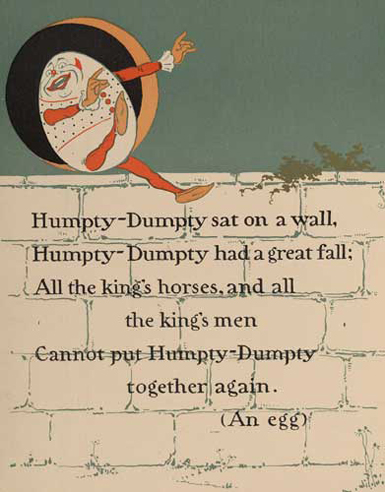
Humpty Dumpty was first printed in 1810. At the time, a humpty dumpty was a clumsy person, so the nursery rhyme was meant as a riddle. It doesn’t actually state that Humpty Dumpty is an egg, so the aim of the reader is to guess what he really is. Of course there is not a person who knows the tale these days that doesn’t know he is an egg. There is speculation that the nursery rhyme had an underlying meaning – in which Humpty Dumpty represents King Richard III of England and the wall his horse. Others have suggested that it refers to the downfall of Cardinal Wolsey at the hand of King Henry VIII.
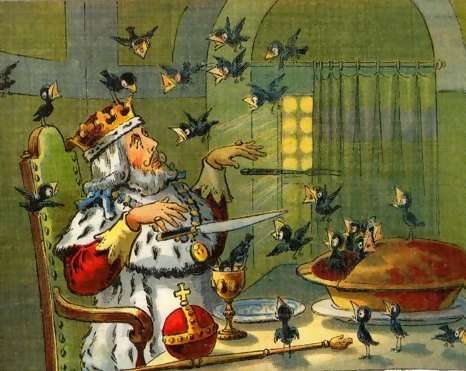
Sing a song of sixpence dates back to at least the eighteenth century. In the original, the tale ends with a blackbird pecking off the nose of the maid in the garden; in the mid-nineteenth century this was sanitized with the addition of a final verse in which a doctor sews it back on. While interpretations vary wildly, the four and twenty blackbirds are most likely simply a reference to a common practice in the sixteenth-century in which large pies were baked then filled with live birds which would escape when the pie was cut. This stems from the fact that a meal was meant not just as nourishment, but entertainment.
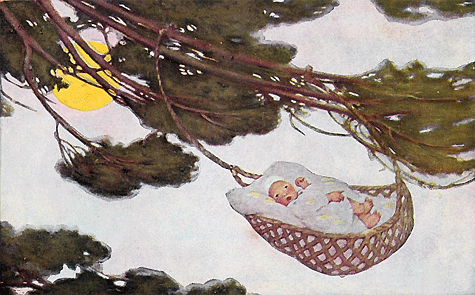
Originally titled ‘Hushabye Baby’, this nursery rhyme was said to be the first poem written on American soil. Although there is no evidence as to when the lyrics were written, it may date from the seventeenth century and have been written by an English immigrant who observed the way native-American women rocked their babies in birch-bark cradles, which were suspended from the branches of trees, allowing the wind to rock the baby to sleep. An alternative interpretation states that the baby is the son of King James II of England, who was widely believed to be someone else’s child smuggled into the birthing room in order to provide a Catholic heir for James. In this interpretation, the cradle represents the Stuart monarchy.
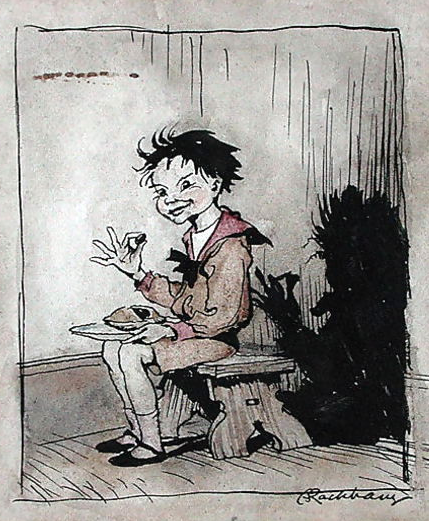
The first recorded version of Little Jack Horner comes from the eighteenth-century but it is most likely to have be known since the seventeenth. In the nineteenth century the story began to gain currency that the rhyme is actually about Thomas Horner, who steward to Richard Whiting, the last abbot of Glastonbury Abbey before the dissolution of the monasteries under Henry VIII of England. The story is reported that, prior to the abbey’s destruction, the abbot sent Horner to London with a huge Christmas pie which had the deeds to a dozen manors hidden within it and that during the journey Horner opened the pie and extracted the deeds of the manor of Mells in Somerset. It is further suggested that, since the manor properties included lead mines in the Mendip Hills, the plum is a pun on the Latin plumbum, for lead. The current owners of Mells Manor have stated that they doubt this interpretation.
The earliest record of this rhyme is in a manuscript of around 1805, which contains only the first verse. There are references to a children’s game called “Bo-Peep”, from the sixteenth century, including one in Shakespeare’s King Lear (Act I Scene iv), but little evidence that the rhyme existed. The additional verses are first recorded in the earliest printed version in a version of Gammer Gurton’s Garland or The Nursery Parnassus in 1810, making this one of the most modern nursery rhymes on the list.
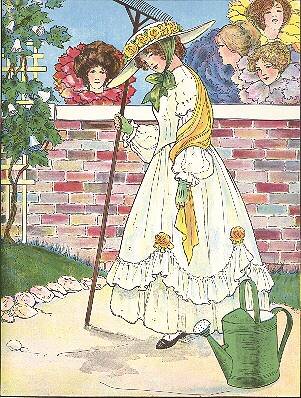
Mary, Mary, Quite Contrary has been seen as having religious and historical significance, but its origins and meaning are disputed as is often the case. The most common interpretation identifies “Mary” with Mary I of England. The “How does your garden grow?” may make mocking reference to her womb and the fact that she gave birth to no heirs, or to the common idea that England had become a Catholic vassal or “branch” of Spain and the Habsburgs, or may even be a punning reference to her chief minister, Stephen Gardiner (“gardener”). “Quite contrary” could be a reference to her attempt to reverse ecclesiastical changes made by her father Henry VIII and her brother Edward VI. The “pretty maids all in a row” could be a reference to miscarriages or her execution of Lady Jane Grey. Capitalizing on the Queen’s portrayal by Whig historians as “Bloody Mary”, the “silver bells and cockle shells” could be colloquialisms for instruments of torture.
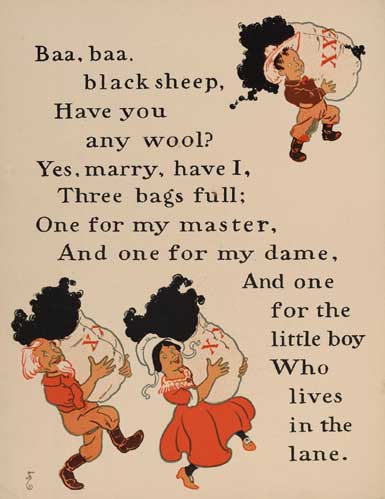
Baa, Baa, Black Sheep is an eighteenth century nursery rhyme sung to the same tune as Twinkle, Twinkle, Little Star. It is possible that this rhyme is a description of the medieval ‘Great’ or ‘Old Custom’ wool tax of 1275, which survived until the fifteenth century. Contrary to some commentaries, this tax did not involve the collection of one third to the king, and one third to the church, but a less punitive sum of 6s 8d to the Crown per sack, about 5 per cent of the value. In the 1980s the theory was advanced that it made reference to slavery, but most scholars disagree.
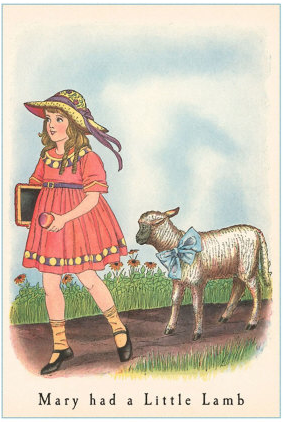
The nursery rhyme was first published as an original poem by Sarah Josepha Hale on May 24, 1830, and was inspired by an actual incident. As a girl, Mary Sawyer (later Mrs. Mary Tyler) kept a pet lamb, which she took to school one day at the suggestion of her brother. A commotion naturally ensued. Mary recalled:
“Visiting school that morning was a young man by the name of John Roulstone, a nephew of the Reverend Lemuel Capen, who was then settled in Sterling. It was the custom then for students to prepare for college with ministers, and for this purpose Mr. Roulstone was studying with his uncle. The young man was very much pleased with the incident of the lamb; and the next day he rode across the fields on horseback to the little old schoolhouse and handed me a slip of paper which had written upon it the three original stanzas of the poem…”
“London Bridge Is Falling Down is a well-known traditional nursery rhyme and singing game, which is found in different versions all over the world. One theory of origin is that the rhyme relates to supposed destruction of London Bridge by Olaf II of Norway in 1014 (or 1009). Another postulates that the rhyme refers to the practice of burying children alive in the foundations of the bridge – though there is no evidence to support this. The fair lady referred to could be Matilda of Scotland who was responsible for the building of a series of London bridges, or Eleanor of Provence who had custody of the bridge income from 1269 to 1281.
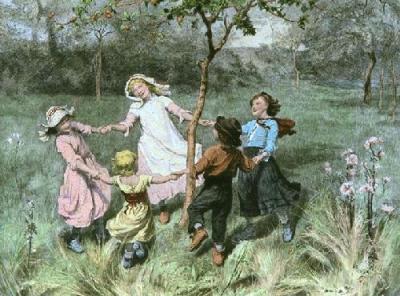
Ring a Ring o’ Roses first appeared in print in 1881 but it was being sung from at least the 1790s. Most people consider the nursery rhyme to be making reference to the Great Plague of London in 1665 but this view did not appear until after World War II. Furthermore, the symptoms don’t describe the plague particularly well, and the words upon which the plague interpretation is based don’t even exist in the earliest forms of the rhyme. The earliest form recorded is:
Ring around the rosy,
A pocket full of posies;
ashes, ashes
we all fall down!
Despite the fact that it is extremely unlikely to refer to the plague, the concept is so deeply set in the modern English speaker’s psyche that it is unlikely to fade in the future.
This article is licensed under the GFDL because it contains quotations from Wikipedia.


humpty dumpty was actualy a cannon! i love listverse but you really do need to do a little more research. And yes scrumpy its a very english list but then its hardly suprising….
That’s just one of many theories and no more credible than any other.
I thought number One did refer to the plague
the pocket full of posies refers to something like when someone had the plague, they were given posies
Actually it refers to the belief that smelling nice things would keep away illness, plague doctor masks are shaped like birds to keep away evil spirits that cause illness and they would have flowers or other aromatic things in the beaks.
I don’t know where they’re getting the idea that it’s so unlikely that it refers to the plague but it seems more than likely to me.
too English!
puff the magic dragon should be on here, i think it had references to drug abuse..
by the way: listvers is great!
That “Ring a Ring o’ Roses” poem always creeps me out. :/
some i never heard of =P
surprised how political these nursery rhymes actually are 0_0
dude they’re just for babies, give them a break!
list suggestion:
10 ways to get into discussions
10 ways to obtain gossip information
I hate it when people refer to a list as too english or too american, unfortunately everyone in the world does not live on one gigantic, happy island so not everybody can be pleased, it’s an absolutely ridiculous thing to complain about…
ANYWAY, fab list, knew ring of roses would be number one, I always thought that sing a song of sixpence had soemthing to do with pirates?
by the way scrumpy, I have noted the sarcasm, but you know for a fact there will be a complaint very soon!
I tried singing “Mary had a little lamb” to the tune of “Twinkle twinkle little star”. It doesn’t work, unfortunately. They’re two wholly disparate melodies.
Coincidentally, “Twinkle twinkle little star” and “The alphabet song” share the same melody.
@scrumpy (1): don’t go there!
@sacha (2): I think puff is a modern story – so doesn’t really suit the list – but I do love it and will try to include it on another list in future
@calm_incense (3): me too – and I think it is a combination of the plague misconception and the fact that it was used in a ghoulish episode of sapphire and steel
@ross (4): it wasn’t a cannon that interpretation comes from a modern satirical extra verse from a british paper in the late 20th century. You really do need to do a little more research.
@Harry (8): Read the list again – it is baa baa black sheep that shares the tune of twinkle little star
Not the part of the tune that says "one for my master" or the last part of the tune that says "and one for the little boy who lives down the lane". The notes of the song are slightly different there. The song that has the exact same tune as twinkle, twinkle little star is the alphabet song. Did you know that it was Mozart that created the tune to both twinkle twinle little star and the alphabet song when he was 3 or 4 years old? That has nothing to do with what I said before but I think it's an interesting fact
Great list. Guess we will never really know where these rhymes come from.
@Jordan (6): that’s a myth invented by snopes to show that we must always question sources – I think it is mentioned elsewhere on the site which may be where you have heard it
Great list. I guess we will never know where these rhymes originated from. However, the hypostasis is an interesting read.
Check the origins of “See-Saw, Marjorie Daw”. Another children’s classic, though minor, was developed by workmen to supply a rhythm to their labors. Though, in it’s time, a “Marjorie Daw” was a prostitute!
@Eire (14): thanks – and I agree! I love the mystery surrounding these very basic tales
@loop (17): ugh the image! That makes a lot of sense – thanks for mentioning it
Rather eclectic lists this past week.
Good reading. Thanks to all contributors.
There’s a story in Es***** that Humpty Dumpty was the name of a cannon on Colchester Castle that was pulled off the wall and broken during the Civil War; all the King’s Horses would have referred to the Royalist side – not a certain story though!
Also from Colchester, “Old King Cole” was said to have come from Colchester.
@Matt1234 (20): thanks
@Eire (16):
Speak for yourself! I plan to travel in time! I’ll find out the origins of all these nursery rhymes when I do and I’ll get back to you!
Wasn’t there another list on listverse that stated that the “Ring a Ring o’ Roses” was about the plague?
Another list should be the origins of fairytales. I heard that Snow White is a medaphore for Cocaine and the Seven Dwarfs are the side effects.
Hurray, one of my favorite lists (I like reading fairy tales and nursey rhymes).
I’ve actually heard of three of these (Bridge, Ring, and Mary Contrary). If I remember right, Disney did some shorts about London Bridge and Mary Mary, but in it, they referred to the fire on London Bridge instead.
I’ll have to see if they have any clips of it floating somewhere on the internet…
@Diamond_Dragon (23): Never! But if so I will edit it
@Eire (24): we have that – search the old lists. I think it was top gruesome fairy tale origins
I don’t mind that the list was “English”… I live on the internet, I have a great understanding for the fact that people come from different backgrounds and have different cultural backdrops.
That being said I do mind that this list does not have the rhymes printed out, nor does it link to the rhymes in question. That I believe shows a very poor understanding of the international nature of the internet as well as the international background of the visitors of this site. I didn’t grow up with these, and only a few of them have become internationally famous enough through pop culture for me to even have heard of them.
So please… post as many american and english lists as you want. I love to learn about other cultures. But do provide background links for those not inclined to spend half an hour googling things to try and understand your articles.
Us Brits are grim really…
Read the very first recorded versions of some of the fairy tales as well. Snow White and Cinderella for sure. They're rather grim and disturbing as well. The versions from Germany are disturbing that is; not necessarily you Brits as well. As I read some person mention once while I was researching the origins of fairy tales, "those versions tend to continue on past the 'happily ever after' part". I'm not trying to insult anyone out there who is from Germany of course.
Too Chinese, I couldn’t read it.
@Frank (28): I considered that but presumed most were sufficiently well known not to require it. I am in bed now so will fill in the gaps in the morning
Well according to my history teacher, Ring a Ring o’ Roses is actually from the Black Plague where the people would carry around flowers ( ie. posies ) because everyone smelled bad and they thought that one of the causes could have been because of the stench. But in the end they all die ( ie. all fall down ).
Isn’t the origin of Rock-a-bye Baby by the daughter of Davy Crockett? Or was I fooled and deceived by modern education in college classes for “Legends and Folk Tales”?
I vaguely heard of Humpty Dumpty.
Thanks to KORN I have heard London Bridge is Falling Down and thanks to 2001 I have heard Mary Had a Little Lamb
way more interesting than i thought it would be. i never once considered the origin stories behind them.
Harry @ #8: Twinkle and ABC and Baa Baa Black Sheep (as well as countless other kids’ songs by (ugh) Raffi et al) do all have the same tune: an 18th-century French tune called “Ah! vous dirai-je, Maman?” (Loosely translated as: “Ah! should I tell you, Mama?”).
Mozart riffed on this tune, so people always think he composed it. But non, non.
Some stupid Wednesday morning trivia for ya…
I'm sorry about what I wrote in reply to someone else's comment then. I had never heard before now that he wasn't the one who originally composed it but I now take what you say into account as well.
Little Boy Blue… he needed the money! OH!
Couldn’t resist.
And yes, this list is too Jewish.
Good job Jamie!
@apepper (21): The English composer Richard Rodney Bennett wrote a children’s opera called “All the King’s Men” about that (supposed) incident. I once owned a vocal score but don’t now. For no particular reason, I don’t believe that that’s the origin of the verse.
“Frank
August 19th, 2009 at 4:10 am
I don’t mind that the list was “English”… I live on the internet, I have a great understanding for the fact that people come from different backgrounds and have different cultural backdrops.
That being said I do mind that this list does not have the rhymes printed out, nor does it link to the rhymes in question. That I believe shows a very poor understanding of the international nature of the internet as well as the international background of the visitors of this site. I didn’t grow up with these, and only a few of them have become internationally famous enough through pop culture for me to even have heard of them.
So please… post as many american and english lists as you want. I love to learn about other cultures. But do provide background links for those not inclined to spend half an hour googling things to try and understand your articles.”
Er, this is a free website? I read this website everyday during my lunchbreak – it’s a great way to spent 15 minutes, and I find most of the content to be really interesting. But if I didn’t then I wouldn’t write and compain about it. Comments like that really ***** me off. The guys running this website do a really good job, who are you to tell them them to provide links for you. If you can’t be inclined to spend 30 minutes googling them, then why should they do it for you?
Jeez, kingoflondon, lighten up. Frank made a suggestion to add links since he is unfamiliar with all these nursery rhymes. His post didn't sound like *****ing at all to me; on the contrary, it sounded much more civil and polite than your response.
Love the list, Jamie! Of course now I got Ba Ba Black Sheept stuck in my head…so thanks!
On a side note, I like the speculation on Mary, Mary, Quite Contrary being Mary I. Sounds like it would fit.
@damien_karras (38): Dang it! You beat me to it!
I’ve become saddened by how many people, of all ages, are almost completely unfamiliar with nursery rhymes. Perhaps it’s because, due to necessity, small children spend less time at home and more in nurseries, daycare, pre-K, and such? Anyway, they seem to be slipping slowly away. I remember being infuriated a few years back when some doofus on Who Wants to be a Millionaire crapped out in one of the first rounds by not being able to recall how many bags of wool Black Sheep had. Sheesh.
Wooooooo… that ring around the rosy song does creep me out a bit.
Ring a Ring o’ Roses does indeed refer tot he plague. The common belief of the time was that the disease was carried through the air, in the bad odors that emanated from the sores of the victims. The cure? A small pouch, or pocket, full of flowers, or posies, was carried around by anyone in the cities who could afford it, and they would hold it over their nostrils and mouth when the were around town. “Ashes” refers to the color of the boils that appeared on ones flesh whilst suffering from the plague.
Awesome list. I cant add any criticism right now though. Maybe I’ll think of something later.
Well, Ring a Ring o’ Roses is indeed about the plague (or some other commonly terminal illness), though it was not about the great plague. When the song was finally published in 1881, it was made clear that that particular song has been sung by children for well over seven centuries. This would mean that it would have been written sometime in the 12th century A.D. at the absolute latest.
About Sing a Song of Six Pence, I’ve always read that it was a recruiting song for pirates written by Blackbeard himself. Of course, this could be incorrect, meanings are always misconstrued with time.
hey, JFrater, at the bottom of the list, it says something about the licensing of this list along with a link.
when i click on the link, i get this:
Oops, something is missing…
We don’t seem to be able to find what you are looking for. How about we let Google have a try at finding it instead?
The standard nursery rhyme for Ring a ring o’ Rosies is not ‘ashes ashes’.
It’s ‘atishoo, atishoo, we all fall down’ as in sneezing, a plague symptom very near the end of the cycle.
Why do you continue to pose as an historian Frater?
Your latest list:
HUMPTY DUMPTY – - – wrong – Humpty was a cannon on the WALLS of Colchester during the Civil Wars – Humpty fell and the walls were breached and “all the kings men” couldn’t prevent the fall of Colchester to Government (Roundhead) forces
SING A SONG OF SIXPENCE – - – wrong – The rye which COST sixpence was used to lure songbirds for the amusement of courtly ladies and gents – blackbirds (and occasionally songbirds in the flocks were then caught and cooked in pies – the ‘live’ birdsprobably refers to a prank at court
ROCK-A-BYE-BABY – - – half-and-half – it was written in America but included stanzas (mostly forgotten and/or discarded from the Mother Country – notably; stanza #2 – Hush a Bye Baby; Your cradle is green
Father’s a nobleman, Mother’s a Queen
Sally’s a Lady who wears a gold ring
Johnny’s a drummer who drums for the king
That “Father’s a nobleman and Mother’s a Queen” indicates mother has been unfaithfull and that the child is illegitemate(possibly even court-sanctioned) to cover Father’s sterility; many believe that the “mother” was Anne Boleyn and the father was a noble of Henry VIII court – attempting to conceive a male ‘heir’ – something Catherine could not.
LITTLE JACK HORNER – - – Yay – one right
LITTLE BO PEEP – - – wrong – Bo Peep is in fact a name derived from the words bleat and sheep (part-onomatopoieic). The rhyme itself was a ‘cautionary tale’
MARY MARY QUITE CONTRARY – - – wrong – it WAS Mary I (Mary Tudor/Bloody Mary) but – the rest is wrong: The garden refers to the graveyards Mary filled with executed Protestants (10-15,000 plus) while the maids were one of several devices so-named for the purpose of beheading or torture/maiming
BAA BAA BLACK SHEEP – wrong – this one has NOTHING to do with a wool tax. It was an onomatopoeic teaching rhyme – nothing more!
MARY HAD A LITTLE LAMB: possibly correct: that’s two! Though there have also been trafitions that Mary refers to the Virgin and the Lamb is, of course Jesus and that Sara Hale either rewrote an older rhyme due to her esperience, unwittingly aped one she had known as a child or simply plagiarised a traditional poem/rhyme as there are older, 16th Century rhymes of a similar nature which mention Mary and a Lamb but no school
LONDON BRIDGE – Correct
RING o’ ROSES – Incorrect: allow me to quote from the Traditional Ballads and Rhymes text in my musical history library.
“The lyrics to this nursery rhyme has its origins as a children’s ring game. The period in history dates back to the great plague of London in 1665 (bubonic plague). The symptoms of the plague included a raised red rash on the skin (Ring a ring o’ rosies) and violent sneezing (Atishoo, Atishoo) A pouch of sweet smelling herbs or posies were carried due to the belief that the disease was transmitted by bad smells”
2 out of 10 Epic Fail!
Try researching through traditional music fora and sites as well as musical history texts before you post a list – especially one this bad – you usually manage to bugger up a couple of “facts” in every historical post; but you really outdiud yourself this time.
BTW sites like “The Mudcat Cafe” are exemplary when it comes to thius stuff as they number not only ordianry everyday ‘muso’s’ in their ranks but several musical/traditional music academics and authors (respected ones) as well: at last count (the moderator is a regular correspondent and, dare I say, friend,) there were over a dozen history / music and musical history university lecturers from around the globe among the members
i read somewhere that the rhyme ‘jack and jill went up a hill’ is based on ancient norse legend to do with the fountain of youth..?
The “Ring of Rosie” referred to the red-rose colored swellings that appeared on a persons skin when they became infected with the plague.
The “Pocket full of Posies” were the flowers carried in a vain attempt to ward off the plague.
Hey there. Hope the Sun is shining where you live? This list is the perfect antidote to the rife naysaying of late – truely because no one knows, or could gain evidence to prove beyond reasonable doubt, the origins of these rhymes. Even though I found the descriptions pretty vague, it did provoke further research.
My two cents: Ring a Ring o’ Roses vs The Plague – The rhyme implies they used to put a ring of roses on the doors of plague victims, while they actually used to paint a cross on the doors. There were nosegays (sweet smelling pouches) – also known as posies – at the time, however, sneezing was not a symptom of the onset, nor the final stages, of the black death. From the original rhyme ‘Ring around the rosy’ could mean that it was written to depect the decorative Maypole dance which celebrated May Day or Midsummer in many parts Europe and early America. Wreaths of flowers were often hung on doors at this time, which were then burned on the midsummer bonfires. This was also the start of the heyfever season – which lasted until the crops ‘came down’ in the Autumn.
This is pure speculation! – but it isn’t often I get the chance to play on the LV anymore.
Awesome list! I had no idea Humpty-Dumpty was originally meant to be a riddle.
Sing a Song of Six-Pence is interesting. I remember crying everytime I heard it as a kid because I thought the king was eating the birds alive. I just read a book where, at a political feast, they baked the pie and put shallow cuts on the top. They then loaded turtles into the bottom, so when the pie was placed in front of the guest, they break the crust themselves.
Oh, Shagrat #50, some of your comments don’t prove the list info “wrong,” they just supplement it, which is quite interesting info; thanks.
The seven dwarfs didn’t have names and personalities, per my own research, until the Disney cartoon in 1939, so I doubt that the old version was about cocaine and its side effects.
#1 Ring a Ring o’ Roses didn’t really explain where it might really have come from, it just dispelled the original believed origin. I was curious to find out what it really meant.
Yeah, “Ring a Ring O’Roses” is definitely about the plague. I’ve seen much evidence to support it in my history classes.
Never Ever Trust Wikipedia! Lesson 101….
You did not state the origins of the rhymes only speculations of the origins. The list should be named possible origins of nursery rhymes. Origins are about facts not speculations. The origins of how people made it to the Americas are speculation not proven fact. Just because something is believed by most people does not mean it is true. Other than those gripes it was a good list.
Yeah, #1 did not actually explain the origins of Ring a Ring O’Roses. I’m pretty sure Ring a Ring a Ring O’Roses was about the plague
This was quite a dodgy list to read:(