What child doesn’t love nursery rhymes? It is this love which has allowed so many of these tales to survive hundreds of years. While many nursery rhymes are innocent stories, some contain morals and others have sinister or political underlying meanings. This list looks at ten popular nursery rhymes and their origins (or speculated origins).
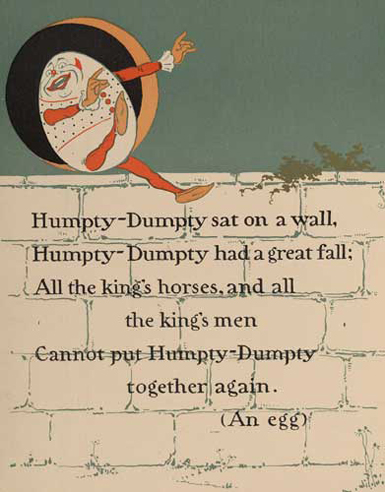
Humpty Dumpty was first printed in 1810. At the time, a humpty dumpty was a clumsy person, so the nursery rhyme was meant as a riddle. It doesn’t actually state that Humpty Dumpty is an egg, so the aim of the reader is to guess what he really is. Of course there is not a person who knows the tale these days that doesn’t know he is an egg. There is speculation that the nursery rhyme had an underlying meaning – in which Humpty Dumpty represents King Richard III of England and the wall his horse. Others have suggested that it refers to the downfall of Cardinal Wolsey at the hand of King Henry VIII.
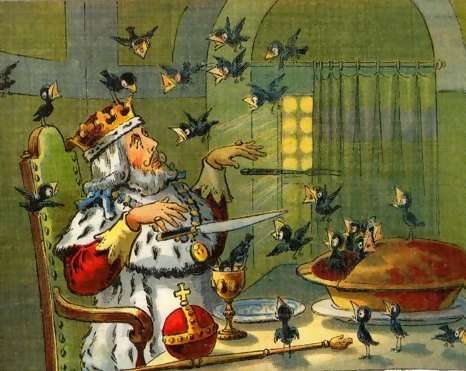
Sing a song of sixpence dates back to at least the eighteenth century. In the original, the tale ends with a blackbird pecking off the nose of the maid in the garden; in the mid-nineteenth century this was sanitized with the addition of a final verse in which a doctor sews it back on. While interpretations vary wildly, the four and twenty blackbirds are most likely simply a reference to a common practice in the sixteenth-century in which large pies were baked then filled with live birds which would escape when the pie was cut. This stems from the fact that a meal was meant not just as nourishment, but entertainment.
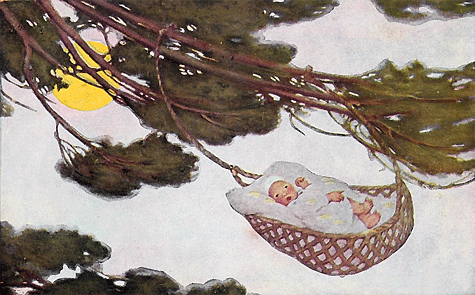
Originally titled ‘Hushabye Baby’, this nursery rhyme was said to be the first poem written on American soil. Although there is no evidence as to when the lyrics were written, it may date from the seventeenth century and have been written by an English immigrant who observed the way native-American women rocked their babies in birch-bark cradles, which were suspended from the branches of trees, allowing the wind to rock the baby to sleep. An alternative interpretation states that the baby is the son of King James II of England, who was widely believed to be someone else’s child smuggled into the birthing room in order to provide a Catholic heir for James. In this interpretation, the cradle represents the Stuart monarchy.
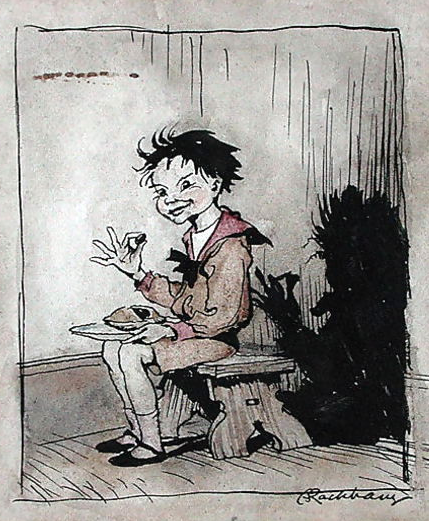
The first recorded version of Little Jack Horner comes from the eighteenth-century but it is most likely to have be known since the seventeenth. In the nineteenth century the story began to gain currency that the rhyme is actually about Thomas Horner, who steward to Richard Whiting, the last abbot of Glastonbury Abbey before the dissolution of the monasteries under Henry VIII of England. The story is reported that, prior to the abbey’s destruction, the abbot sent Horner to London with a huge Christmas pie which had the deeds to a dozen manors hidden within it and that during the journey Horner opened the pie and extracted the deeds of the manor of Mells in Somerset. It is further suggested that, since the manor properties included lead mines in the Mendip Hills, the plum is a pun on the Latin plumbum, for lead. The current owners of Mells Manor have stated that they doubt this interpretation.
The earliest record of this rhyme is in a manuscript of around 1805, which contains only the first verse. There are references to a children’s game called “Bo-Peep”, from the sixteenth century, including one in Shakespeare’s King Lear (Act I Scene iv), but little evidence that the rhyme existed. The additional verses are first recorded in the earliest printed version in a version of Gammer Gurton’s Garland or The Nursery Parnassus in 1810, making this one of the most modern nursery rhymes on the list.
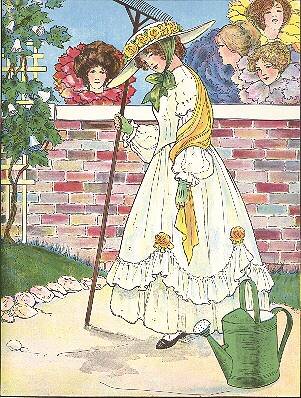
Mary, Mary, Quite Contrary has been seen as having religious and historical significance, but its origins and meaning are disputed as is often the case. The most common interpretation identifies “Mary” with Mary I of England. The “How does your garden grow?” may make mocking reference to her womb and the fact that she gave birth to no heirs, or to the common idea that England had become a Catholic vassal or “branch” of Spain and the Habsburgs, or may even be a punning reference to her chief minister, Stephen Gardiner (“gardener”). “Quite contrary” could be a reference to her attempt to reverse ecclesiastical changes made by her father Henry VIII and her brother Edward VI. The “pretty maids all in a row” could be a reference to miscarriages or her execution of Lady Jane Grey. Capitalizing on the Queen’s portrayal by Whig historians as “Bloody Mary”, the “silver bells and cockle shells” could be colloquialisms for instruments of torture.
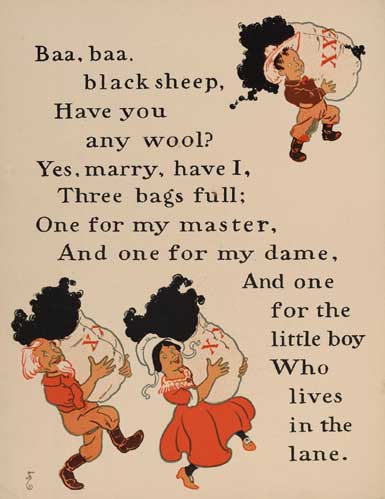
Baa, Baa, Black Sheep is an eighteenth century nursery rhyme sung to the same tune as Twinkle, Twinkle, Little Star. It is possible that this rhyme is a description of the medieval ‘Great’ or ‘Old Custom’ wool tax of 1275, which survived until the fifteenth century. Contrary to some commentaries, this tax did not involve the collection of one third to the king, and one third to the church, but a less punitive sum of 6s 8d to the Crown per sack, about 5 per cent of the value. In the 1980s the theory was advanced that it made reference to slavery, but most scholars disagree.
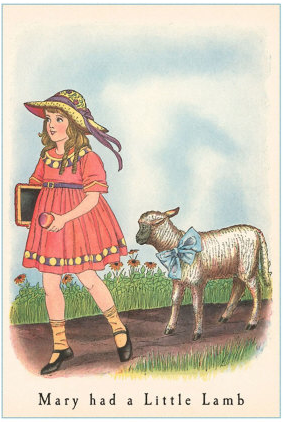
The nursery rhyme was first published as an original poem by Sarah Josepha Hale on May 24, 1830, and was inspired by an actual incident. As a girl, Mary Sawyer (later Mrs. Mary Tyler) kept a pet lamb, which she took to school one day at the suggestion of her brother. A commotion naturally ensued. Mary recalled:
“Visiting school that morning was a young man by the name of John Roulstone, a nephew of the Reverend Lemuel Capen, who was then settled in Sterling. It was the custom then for students to prepare for college with ministers, and for this purpose Mr. Roulstone was studying with his uncle. The young man was very much pleased with the incident of the lamb; and the next day he rode across the fields on horseback to the little old schoolhouse and handed me a slip of paper which had written upon it the three original stanzas of the poem…”
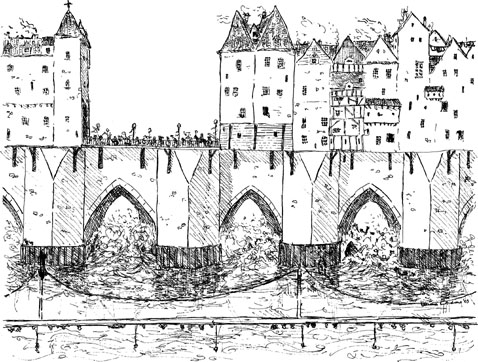
“London Bridge Is Falling Down is a well-known traditional nursery rhyme and singing game, which is found in different versions all over the world. One theory of origin is that the rhyme relates to supposed destruction of London Bridge by Olaf II of Norway in 1014 (or 1009). Another postulates that the rhyme refers to the practice of burying children alive in the foundations of the bridge – though there is no evidence to support this. The fair lady referred to could be Matilda of Scotland who was responsible for the building of a series of London bridges, or Eleanor of Provence who had custody of the bridge income from 1269 to 1281.
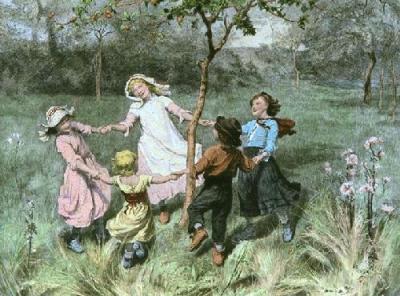
Ring a Ring o’ Roses first appeared in print in 1881 but it was being sung from at least the 1790s. Most people consider the nursery rhyme to be making reference to the Great Plague of London in 1665 but this view did not appear until after World War II. Furthermore, the symptoms don’t describe the plague particularly well, and the words upon which the plague interpretation is based don’t even exist in the earliest forms of the rhyme. The earliest form recorded is:
Ring around the rosy,
A pocket full of posies;
ashes, ashes
we all fall down!
Despite the fact that it is extremely unlikely to refer to the plague, the concept is so deeply set in the modern English speaker’s psyche that it is unlikely to fade in the future.
This article is licensed under the GFDL because it contains quotations from Wikipedia.


@notorioustgb (114): Thank you for that very supportive comment. I appreciate it
Yeah, I knew all these nursery rhymes.
For the person that said “Puff the Magic Dragon” should have been on the list, it isn’t a nursery ryhme, it was a folk song sung by Peter, Paul and Marry. Btw even though people think it is about drugs, the singers say it isn’t. People can put their on meaning to things and change a meaning to something new with pure ‘gossip’. These nursery rhymes have been around for so long I wonder if anyone can really give the “original” meaning of why it was written. Unless you have the original manuscript we’ll probably never really know.
That little Jack Horner picture is creepy!
The hero in this fairy story is an ugly goblin.
u no wat in my whole lyf of kindergarden i din recite a single rhyms…my mom ws freakd out at me. the rhyms r bad omen..
Actually, Humpty Dumpty was a bombard (precurser to cast cannons), the largest in England at the time. As the city was going to be assaulted it was fired and it blew up as bombards are wont to do.
When bombards let go, they shatter, very similar to an egg which is where the egg *****ogy probably started. And no, all the King’s men nor his horses (which would have pulled it in and out of place) could put it back together again.
Jack and Jill went up the hill the both had a buck and a quarter. Jill came down with two fifty.
That *****ing slut !
There was an old woman who lived in shoe,she had so many children her uterus fell out. WHOA !
saber25 u are so wrong! the rhyme was around CENTURIES before then. Also I presume you know that there were no Nazis in WW1. Total idiot.
I thought humpty dumpty was a cannon that fell off a wall, then all the kings men (and horses) couldn’t repair it.
I don’t think Baa,Baa Black Sheep is sung to the same tune as Twinkle, Twinkle Little Star (although it may have originally). The second line Have you any wool? is sung a lot faster than the Twinkle second line. At least it is in Australia.
mary mary quite contrary always sounded a bit *****ual to me.
Those pictures actually made me feel nostalgic. Some of the pictures (I still remember) were on my kindergarten text books. I used to live in a different world when i looked at those pictures…
Thank you so much for posting those pics!!!!!!!!!!
No.1 “Too English” ? What do you mean too English?
Finally its not too American! lol
Thank you so much jfrater. My daughter is eight months old, and I sing nursery rhymes to her all day long. I’ve always wondered where these came from!
wqertghj
I am searching for the full poem …
Monday’s child is…
Tuesday’s child is ….
for the full week
Can only remember “Thursday’s child is full of woe”
@Homsi (137): I am searching for the full poem…
You must not be trying very hard, because it took me all of two seconds to find it. And no, I’m not going to print it here for you.
Who would want to eat a pie filled with bird guano?
I wonder if in the future people will look at Dr. Seuss’s rhymes and tie them with death, war and political unrest?
Good question on the Dr. Seuss. I love the way everything must be *****yzed and de-crypted to find its hidden underlying meaning. Sometimes a rose is just a rose.
As for the list, who cares if its not 100% correct. It makes for light reading and for those ‘proving’ the correct facts, in 20 years those facts will be urban legend too. Of course unless the citation is the original authors explanation isn’t it all speculation.
Love lists of things…mood lighteners and gawd nose sum peepel take thingz weight two sea ree us.
@Diamond_Dragon (23):
@Eire (16):
Speak for yourself! I plan to travel in time! I’ll find out the origins of all these nursery rhymes when I do and I’ll get back to you!
Diamond_Dragon…You sure you ain’t been puffin’ on a magic dragon?
I think ring around the roses was a bit different. From what i’ve heard the last line is “We all fall dead.” Creepy huh? Anyways thats what I think.
I am looking for 10 nursery rhymes for this thing im doing with my course (CACHE) its to do with lookin after children. but i needed 10 nursery rhymes to do with autumn and a quote for it ! so this wasnt much help to me but if any1 has suggestions of 10 nursery rhymes and a quote for each email me on hot-n_lush@hotmail.co.uk thanks
i think its kinda creepy i saw a vid on the tube it was like a horror flick of these possessed evil psycho children killing people and they would always sing the song.it was pretty demented. it reminded me of children of the corn. who comes up with these things? possessed singing 6-yr olds ripping peoples heads off? wtf?
There’s a rhyme in Spanish called “pisi pisi gaña.
” I don’t know how popular it is outside of Costa Rica, but here it is frecuently sung by kids, in a game tha consists in pinching each other’s fingers. I’ve tried to find some info on it’s background, as the lyrics are quite puzzling:
“Pisi pisi gaña (this seems to be nonsense)
playing in the cabin (not sure if this says cabaña -cabin- or cadaña, which i don’t know what it means(
with which hand is it played?
with the cut one.
Who cut it?
the king and the queen
where are the king and the queen?
they’re drinking the water
who drunk the water?
the hens drank the water
where are then hens?
they’re gone to lay the eggs
what happened to the eggs?
the father (priest) ate them
what happened to the father?
he’s preaching the mass
what happened to the mass?
it’s turned into ashes!”
I think it’s pretty enigmatic and a little creepy. Kings cutting off ppl’s hands? royalty drinking from the poultry’s water? A curch burning down?
I understand that many would think the list a little to English but England and europe are much older Cultures than say America as we Know it.
Most on the list came about prior or at the same time as the contanant was discovered.(I prefer to think of everyone as from the same place,EARTH so why does it matter)And unless thier creators left behind some sort of diary or codex we’ll never trully figure it out, Personaly i think they and fairy tales are made for moral teachings to young ones.
It is my understanding that there is a lot of debate over the origin of “Sing a Song of Six Pence”–it has to do with Shakespeare, Black Beard, etc. I’ve never heard of baking live birds.
Ring a Ring o’ Roses does refer to the black plague. i forgot what ring around the rosy meant but pocket full of posies represents the idea at the time that a pocket full of a plant nicknamed “posie” would fend off the plague. Then the,” Ashes Ashes we all fall down.” means that they burnt the dead bodies when they died and after so long they couldn’t burn all the dead bodies so they just through them on a pile.
Yay! I know my stuff. Oh! and Mary, Mary, Quite Contrary is about a torturer and the “silver bells and cockle shells” are instruments of torture. It does most likely refer to Bloody Mary.
Isn’t pretty maids all in a row for Mary Mary Quite Contrary about the fact that she had a lot of still born girls and buried them all in a long row of graves? And cockleshells something to do with her husband , Prince Phillip, being with other woman?
Oh and I thought Humpty Dumpty was meant to be a great Cannon that fell off the castle wall during some kind of war? :S
Isn’t Humpty Dumpty a cannon that fell of the castle wall in some great war or something?
And with Mary Mary Quite Contrary I heard that “pretty maids all in a row” meant that Mary I had a lot of stillborn baby girls that she buried in a long row of graves. It’s a cruel rhyme that one. And Ring a Ring a Rosies has always creeped me out (well since like… I don’t know, year 3?). After watching some kind of Live Horror thing with a little orphan ghost singing Ring a Ring a Rosies on the landing. Creepy. But to think that we sang these as a child, is just horrific, especially Ring a Ring a Rosies. *shudders*
Wow! Very interesting post again, Mr. JFratter =P Although i do think i will be sending you my medical bill because of all these sleepless nights! Greats posts, keep it up.
Humpty Dumpty was a cannon!
And also, I always knew ring a rose as going “Atishoo! Atishoo! We all fall down!”
BTW I’m British
Having the first name of Mary, I HATE #5 and #3. My responses for #5 is either “It doesn’t grow cuz I *****ed on it”, or “…silver bells and cute guys all in a row”. For #3, I ask if the person teasing me would like the leftovers!
Ring around the rosy IS actually about the Plague.
The RING was actually a rash people would get on their skin when they got deathly sick.
Pocketful of posies refers to the fact that people would carry flowers around in their pockets because the smell of dead bodies was overwhelming. Then of courses, ashes, ashes, we all fall down is refering to all the bodies being burned in massive graves because so many were dying.
Thats all
I hate #3 and #5…it's my first name. When people ask me about my lamb, I ask if they'd like the leftovers. When #5 is brought out, I'll say either, "It doesn't grow because I *****ed on it", or I'll change the pretty maids line to "Cute guys all in a row".
Oh my god!!! The first idea of ring a roses came in after the first world war and the song dates from 1790s whereas the plague happened over a hundred years earlier.
Let me get this straight- about 80% of the people on here think the plague happens and then magically 100 or so years later someone decides to write a poem about it and then around 200 years later (this is assumption) the ghost of the person who wrote it flies down from the sky in order to tell someone what the poem was about, and in doing so explains he wrote the poem after another ghost flew down from the sky to tell him about the plague.
Sorry, I may have gone a little bit crazy after reading two pages of comments about how this poem relates to the plague when it doesn't make any sense for it to do so. Aaaaaaaaaaarrrrrrrrgggggggghhhhh!!!!!!
But it DOES make sense, they’re just incorrect about the time the rhyme began.
Besides, you read two pages of comments. Did anyone say it was ghosts? Or did they just say they got the time wrong?
If you knew anything about what went on during the plague you wouldn’t be arguing as it makes PERFECT sense.
Do some actual research before you take an article like this at face value.
definitely English
ring around the rosie- boils
pocket full of poises- you need to smell good somehow (if you had the plague it was thought you smelled bad)
ashes ashes- cremation
we all fall down- everybody is dieing on the streets
Ring Around The Rosie is about the the Black Death or Bubonic Plague. The rhyme actually started in the late 1400's. Ring around the rosies means that when you had the diease, you would have round, red cirlces on your body. Pocket full of posies means that people thought that they would catch the disease from the smeel, because it really stunck back then because we didnt have toilets. Ashes, Ashes means that the corpses of the people that died from the disease would get burned. We All Fall Down means that everyone with the disease would die.
I’m also pretty sure Humpty Dumpty was a cannon, nothing to do with an extra verse but a cannon was shot of St Marys Wall during the civil war and the town was eventually lost because of this.
I’m also pretty sure Humpty Dumpty was a cannon, nothing to do with an extra verse but a cannon was shot off St Marys Wall during the civil war and the town was eventually lost because of this.
Iam convinced that Ring a Ring of Roses described the great plague in the 15 hundreds.Symptems of the Bubonic plague was a pink ring like rash that turned black, sneezing as well. The posy refers to the fact that in those days a small bag of flowers and herbs were carried around the neck to ward off disease. These posies were also carried in a pocket. During the great Black Death plague 20,000 people died in England. Whole villages were wiped out. Gravesend is a town where it is thought that open pits were dug to bury the victims of this disease.
wow i never even thot bout n e of ths, tiil my sons girl fren,out of tha blew, brot up history teacher n nursery ryhmes she told me that humpty dumpty was a cannon n ring around tha roise was about a plague well i look it up and i end up here, this is very interesting i thank ill hang out for awhile
Actually for ring around the rosy, it does make sense, it was about the bubonic plague, and people believed it was caused by bad smell(it was actually trading with Asia), so they kept pockets full of flowers, hence pocket full of posies, it says ashes because they burned the dead bodies, and the we all fall down part, was them dieing
humpty dumpty sat on a wall humpty dumty had only one ball all the kings horses and all the kings men use to f that one nuted bastard again and again….ooow lol…
“Mary, Mary Quite Contrary” does refer to catholic Mary I, however, the “silver bells” refer to the Catholic Church (a bell is rung during the communion service, I think to represent when the bread, or host, is transformed into the body of Christ) and the “cockle shells” refer to the catholic practice of pilgrimage, as cockle shells were the symbol of a pilgrimage to Santiago de Compostela in Portugal, a great pilgrimage site of the Middle Ages, dedicated to the apostle St.James. I also understood that the “pretty maids all in a row” referred to protestants burnt at the stake, who were often women, although I’m not sure of that one.
Song of Sixpence came from the Medevial times. A pie was baked, then live tethered birds were inserted. When the pie was opened, the birds flew out. This was made not to eat, but for the amusement and amazement of the viewers. It was typically the finale to a feast!
Number One is flawed as even the earliest form of the song pointed out still bears strong resemblance to the practices during the plague.
I really don’t know how it can be seen as “unlikely” when if you knew what happened during those times it makes a lot of sense.
Where are all the works of Mister Andrew Clay. You folks dropped the ball on this one.
i believe that “ring a ring o’ roses” is reffering to the plague.
Ring around the rosy- this is talking about the ring that would appear around the red spot on a person’s skin when they would contract the plague
A pocket full of posies- people would keep posies (a type of flower) in their pockets becase with all the dead people everywhere it smelled very bad in the streets and so people would reach into their pocket to smell a posie
ashes, ashes- the people who died of the plague were burned to ashes so the disease wouldn’t spread as much
we all fall down!- this verse is refferring to everyone dying of the plague
i have heard that adults would teach this to their children to retaliate against the king without being killed for treason or something
Why the rhyme “Twinkle Twinkle Little Star” is not in top 10 list
As a Capen, my grandpa has told me the story of Mary had a little lamb for years. It’s nice to see it confirmed.
i believe ‘pop! goes the weasel’ would have been a good addition to this list
Are you looking for a Cricut cartridge that you can use on daily basis for just about any project? If so, check out the Don Juan Cricut Cartridge- 7 Tips You Can Use…cricut