
 Humans
Humans
Humans  Travel
 10 Best Hiking Trails in America with Breathtaking Views
 Weird Stuff
 The 10 Weirdest Materials That Can Be Used to Make Paper
 Crime
Crime The 10 Most Infamous Gangs in History
 Miscellaneous
 Ten Groundbreaking Tattoos with Fascinating Backstories
 Our World
 10 Green Practices That Actually Make a Difference
 Humans
 Ten Historic Men Who Deserve Way More Credit Than They Got
 Movies and TV
 The 10 Most Heartwarming Moments in Pixar Films
 Travel
 Top 10 Religious Architectural Marvels
 Creepy
 10 Haunted Places in Alabama
Humans Ten Journalists Who Got Caught Faking the News
Travel 10 Best Hiking Trails in America with Breathtaking Views
Weird Stuff The 10 Weirdest Materials That Can Be Used to Make Paper
Who's Behind Listverse?

Jamie Frater
Head Editor
Jamie founded Listverse due to an insatiable desire to share fascinating, obscure, and bizarre facts. He has been a guest speaker on numerous national radio and television stations and is a five time published author.
More About Us
Crime The 10 Most Infamous Gangs in History
Miscellaneous Ten Groundbreaking Tattoos with Fascinating Backstories
Our World 10 Green Practices That Actually Make a Difference
Humans Ten Historic Men Who Deserve Way More Credit Than They Got
Movies and TV The 10 Most Heartwarming Moments in Pixar Films
Travel Top 10 Religious Architectural Marvels
Creepy 10 Haunted Places in Alabama
Top 10 Unbelievable Miniatures
There was once an excellent collection of miniatures displayed in a Southern California themepark (not Disneyland) that was known as Mott’s Miniatures. Sadly, that marvelous collection has been auctioned out to others and all that remains is a poor substitute, by way of photos, on the Mott’s website. The readers at ListVerse have a hunger for the odd and unusual, yet there is no list here that covers the subject of miniatures. This list is a salute to the world of the tiny, both man-made and those that nature has seen fit to create.
10
Seashells in the sand
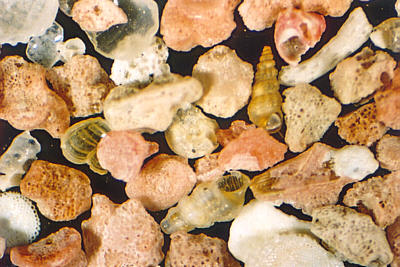
Not to be confused with microscopic plankton and diatoms, these are indeed fully formed seashells on a minuscule scale. A great many gem and mineral societies world-wide have divisions devoted to the study and worship of these tiny homes that can be found in sand samples from around the world. And remember that impossibly tiny as these shells are, the original inhabitants were even smaller, as they had to fit within. There is no evidence, so far, of any species of hermit crab that may have used these microshells as a borrowed home.
9
Nano-motors
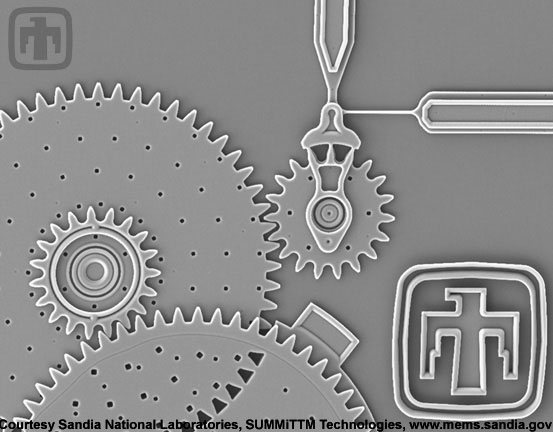
Nanotechnology, nanorobotics, nanomachines. An ever expanding field of science and technology expected to revolutionize the world as we know it. The simplest, (though hardly simple), of nano machines are being constructed for biological study to better understand the mechanics of the cell, and all it’s natural capabilities. The hope is that humans may be able to replicate some of these functions, towards the better health of mankind in the future. Science envisions great strides in the fields of molecular biology, medicine, chemistry, physics, and nanocomputers through the development of these microscopic motors. Many of these machines are as small as 1/2 the width of a human hair and others are so small several hundred would fit in the space of the period at the end of this sentence.
8
Smallest Bible
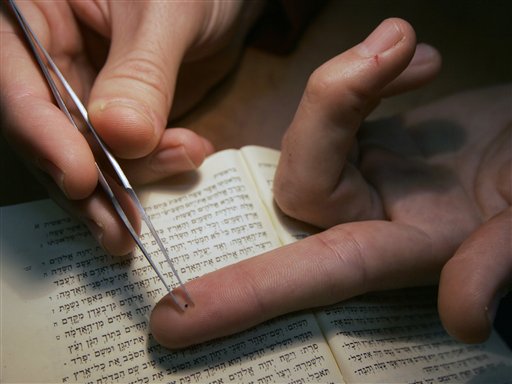
In 2007 nanotechnology was pushed to another extreme when Technion inscribed the entire Hebrew text of the Jewish Bible onto a space less than half the size of a grain of sugar. The team etched the 300,000 words of the Bible onto a tiny silicone surface less than .5 mm square by blasting the silicone with gallium ions.
The previous smallest, known, copy of the Bible measured 2.8 x 3.4 x 1 centimeters (1.1 x 1.3 x 0.4 inches), weighing 11.75 grams (0.4 ounces) and containing 1,514 pages, according to Guinness World Records spokeswoman Amarilis Espinoza. The tiny text, obtained by an Indian professor in November, 2001, is believed to have originated in Australia.
7
Insect powered aircraft
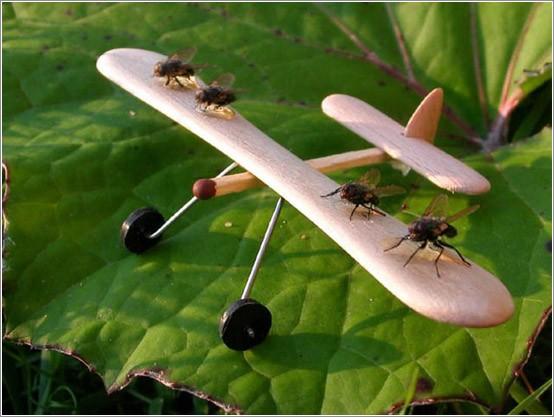
There are ancients stone tablets from the city of Ur that observe the natural flying power of the common housefly. The ancient Egyptians mused about how the housefly’s powers may provide insight to the Pharaoh’s journey into the Afterlife. Even the great Nikola Tesla had a curiosity about insect power, as excerpted here.
“His sixteen-bug-power motor was, likewise, not an unqualified success. This was a light contrivance made of splinters forming a windmill, with a spindle and pulley attached to live June bugs. When the glued insects beat their wings, as they did desperately, the bug-power engine prepared to take off. This line of research was forever abandoned however when a young friend dropped by who fancied the taste of June bugs. Noticing a jarful standing near, he began cramming them into his mouth. The youthful inventor threw up.” Adopted from “Tesla: Man out of time”, by Margaret Cheney, 1981.
Dr. Richard Brewer is given credit with manufacturing the first prototype fly powered airplane in 1949, constructed of balsa wood and the cellophane from a pack of Lucky Strike cigarettes. Reportedly Dr. Brewers prototype plane was delivered to the Smithsonian Institute’s National Air and Space Museum during the 1960’s. Insect powered aircraft have become quite a well followed hobby with many websites devoted to blueprints and instructions to construct miniature planes that utilize houseflies or flying beetles as their motors.
6
Mini-bees
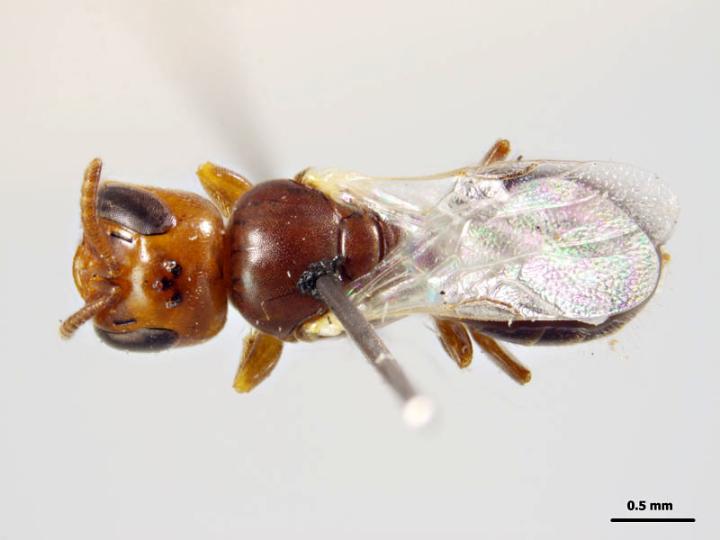
Called Quasihesma, these minutely small bees come from Cape York in Queensland. Known as the smallest species of bee, these little guys are only 2mm long. That’s approximately the size of the head of a pin. They come from the family Colletidae, and are often referred to collectively as plasterer bees, due to the method of smoothing the walls of their nest cells with secretions applied with their mouthparts; these secretions dry into a cellophane-like lining. Another distinction of this group of bees is that they are solitary bees. Although they have been known to build nest in groups, they do not manufacture hives.
5
Matchsticks
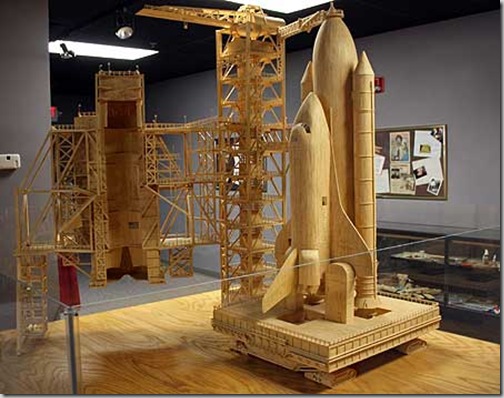
One of the many “humble” art mediums, matchsticks have been used to create a cavalcade of various structures and masterpieces. Commonly referred to as folkart, matchstick miniatures have also been classed as another form of “prisonart”, although the creators of such hardly need to have served time behind bars. The amount of art developed in this medium is immense, with artists each having their own vision of what they would like to produce, whether it be stick carvings, match head sculptures, or homages to the engineering feats of mankind from every culture and civilization, created from minute lumber, one stick at a time.
Interesting trivia: The origin of matchsticks can well be dated back to 3500 BC. The Egyptians developed a small pinewood stick with a coating of a combustible sulfur mixture.
4
That’s the pits
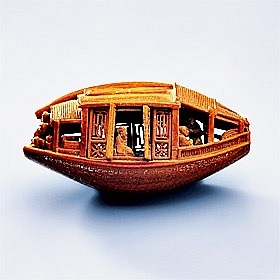
What to do with those pesky pits that we find in our everyday foods. For centuries those pits from peaches, plums, cherries and olives have been thrown away with the garbage. But for quite of few folks with the ache to create, and with an extremely steady hand, those very pits are the “core” of their calling. The inspiration for this list, Mott’s Miniature’s had quite a “large” collection of pit carvings that can be viewed at their website. The American artist Bob Shamey has been featured by Ripley’s Believe It or Not not just once, but twice, for his carvings. At the National Palace Museum in Taiwan there is an olive pit carving of a tiny boat, with working shutters and facial expressions on all eight passengers.
3
Checkmate!
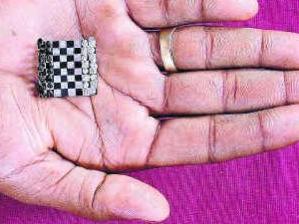
Guinness World Record for the smallest handmade chess set was awarded in 2006, and goes to M. Manikandan of Srivilliputtur, Tamil Nadu, India. His incredible creation has a chess board only 24 mm square. As for the playing pieces themselves, the largest piece is 10 mm high and the smallest is half that at 5 mm. A further search for mini chess sets revealed a beautiful solid gold set for sale on E-bay that also measured 24 x 24 mm. The owner has used slightly over 6 grams of 22 carat gold for which he is seeking 100,000 rupees. Though that may sound like a king’s ransom, converted into US dollars, the amount comes down to a less staggering $2,175, or 1560 Euros.
2
Rice
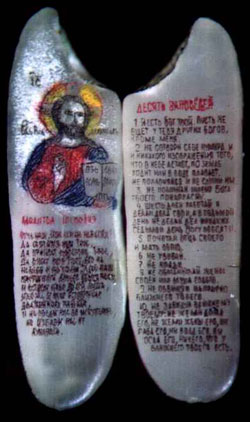
Long considered a symbol of wealth and prosperity throughout the Asian world, rice has always held a position of high esteem and respect, not to mention being a daily staple food source around the world. It’s only natural that respect for this most humble of grains would evolve into it’s own field of art. Rice writing originated in ancient Turkey and India, and one of the oldest known examples of this art is housed to this day in the Topkapi Palace in Istanbul. To have a grain of rice with your name written on it is still thought to be quite a lucky charm, so many companies have made a small fortune by providing such services. Most of these tiny art pieces are suspended in small glass vials filled with mineral oil, to help magnify the writing on the minuscule grain.
1
Through the eye of a needle
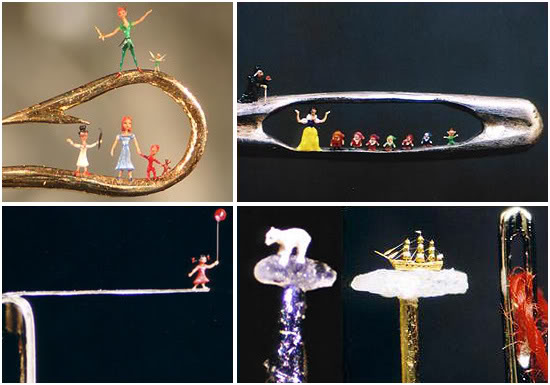
The pinnacle of handmade miniatures would have to be sculptures that are smaller than the eye of a needle. The hands down master of the art currently is Willard Wigan MBE. An artist who started his career at only 5 years old when he decided to start building homes for ants, he has continued to impress the world with his micro creations, the artist is often referred to as the “Eighth Wonder of the World”. Wigan works primarily through the night, as even traffic noise from outside can destroy a piece he is working on. Using micro tools on a microscopic work field, he must control not only his pulse rate, but his breathing, as he has inhaled a few of his masterpieces, due to a poorly timed inhale.
+
The World’s Smallest Snake
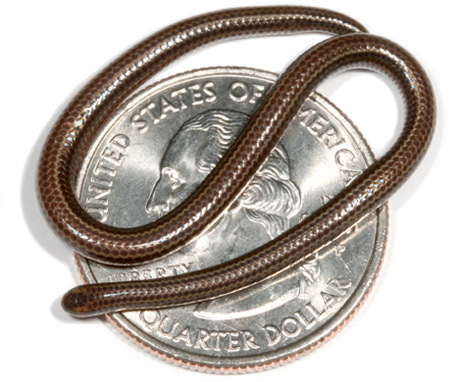
The Barbados Thread Snake was recently discovered in 2008. Recognized as the world’s smallest snake, the tiny reptile will only reach a maximum size of 10 cm long. (about 4 inches.), and are reported to be “as thin as spaghetti”. Due to it’s extreme tininess, females only lay one egg, which hatches out at half the size of the adult. A larger clutch of eggs would produce such small offspring that it would be near impossible for the snakelings to find sustenance.
More Great Lists
 Top 10 Unbelievable Types Of Illusions And Hallucinations
 10 Unbelievable Times Royalty Went Undercover
 10 Unbelievable Things That Have Required A Doctor's…
 10 Unbelievable Cases Of Self-Amputation For Survival
 10 Twisted And Unbelievable Facts About The Happy…
 10 Prescription Drugs With Unbelievable Side Effects
 10 Unbelievable Facts About Cowboy Bob
 10 Rude-Sounding British Places With Unbelievable…
 10 More Bizarre Units Of Measurement That Are Unbelievable
fact checked by
brunobanana
More Great Lists