The UK is currently undergoing its election process so it seemed appropriate that this list ought to be published now. The British parliamentary system is an interesting one and many other countries base their system on it. Hopefully this list will leave us all with a better understanding of that system.
Or to be more accurate, there is no single document setting out how the country should be governed. The UK is one of only a handful of nations without a written constitution (the others being Israel, New Zealand and San Marino), it instead relies on a huge number of separate laws and traditions which evolved over hundreds of years.
A surprising number of features central to the British political system are nothing more than convention. There is no constitutional requirement for there to be a Prime Minister for example, it is simply a role that has developed over time.
The lack of a concrete constitution is likely to become a serious political debate in the near future as the Liberal Democrat party has begun campaigning for constitutional reform.
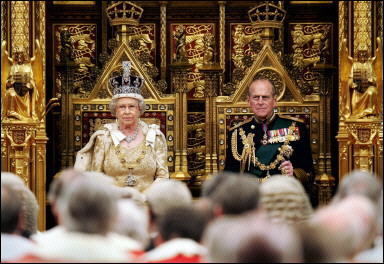
Before a bill can become law, The Queen must give her approval or ‘royal assent’. She still has the power to grant [accept], withhold [refuse] or reserve [postpone] the royal assent of any bill from Parliament.
In reality, no monarch has refused a bill passed by Parliament since 1708 so it is assumed that that The Queen will grant assent to any Parliamentary bill presented to her.
The number of votes a party gets and the number of seats they win in Parliament rarely show any relationship. Voters pick a candidate for their local area and the person with the most votes wins the seat. If a candidate wins with 60% of the vote, the other 40% of votes are discounted.
A simple system, but in a nation with three major parties, it can throw up some anomalies which has lead some of the public to question how representative the voting system is. Those discounted votes soon mount up and can lead to results such as the 2005 election where the Labour Party got only 37% of the vote but 55% of the seats and the Liberal Democrats got 22% of the vote but only 9% of the seats.
The voting system does however tend to produce a clear overall winner which leads us on to…
British citizens have no say in who becomes PM – the best they can do is vote for their party’s MP and hope. As you might expect from a system built on ancient conventions, the process of deciding who becomes PM is far from straight forward. After the results of the General Election have been announced, the leader of the party with an overall majority (ie. with more MPs than all of the other parties put together) goes to Buckingham Palace and asks the Queen for permission to form a government. Luckily for them, there is another convention that the Queen will never say no to the leader of the biggest party.
The system is not very democratic in fact in most elections less than 40% of the people have voted for the largest party. Some parties allow their MPs to choose the party leader – not
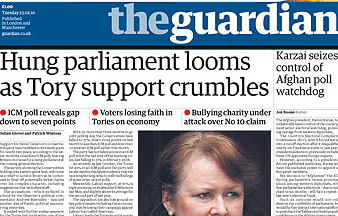
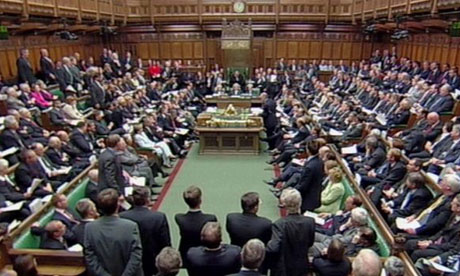
The voting system usually makes sure the winning party has a strong overall majority, but occasionally the votes don’t produce a clear winner. These ‘hung parliaments’ force the parties with a sizable share of the seats to make deals, sometimes two of them agree to work together until the next election.
If none of the parties can work together to form an overall majority, the convention is that the previous PM stays in office. This means there is the possibility that Labour may come third in the 2010 election, but Britain will still have a Labour Prime Minister!
There is no fixed amount of time between elections. The law states that a government must have an election at least every five years, but an election can be called at any point within that time. The Queen has ultimate power over the dissolution of Parliament, but convention allows the Prime Minister to choose when this should be.
When the PM decides the time is right to have an election, they the Queen and ask her to dissolve Parliament. This often proves advantageous to the Government who usually wait until they are ahead in popularity before putting the vote to the public.
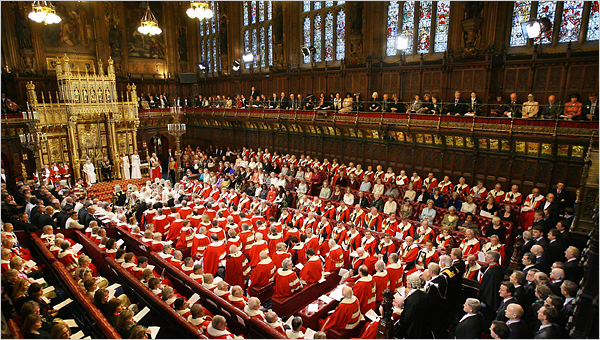
The MPs sitting in the House of Commons are not the only politicians in Parliament, although you could be forgiven for thinking so. Parliament also has an upper chamber of ‘Lords Temporal’ appointed by The Queen on recommendation of the Government and 26 prominent Bishops of the Anglican Church.
All bills successfully passed through Parliament are debated and ratified by the House of Lords. The Lords can and do reject bills, but the ultimate power lies with the House of Commons who can invoke the ‘Parliament Acts 1911 and 1949’ to pass the bill regardless. This has only happened seven times since 1911, most recently in 2004 to ban hunting with dogs.
As the upper chamber is unelected and ultimately powerless against the House of Commons, there have been calls for change from some MPs who favour an elected second house similar to Congress in the USA.
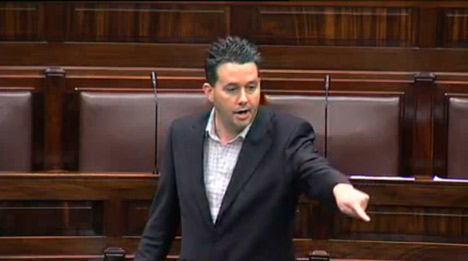
When in session, MPs are forbidden from using language that might ‘offend the dignity’ of Parliament. This commonly covers swearing, personal insults and, most seriously, accusing an MP of being dishonest. Many words have been deemed unparliamentary by House Speakers over time including ‘coward’, ‘guttersnipe’, ‘hooligan’, ‘liar’, ‘traitor’ and ‘git’.
Many MPs have perfected the art of insult whilst avoiding reprimand from the House Speaker and enjoy mocking their rivals with stock phrases such as being ‘economical with the truth’ when lying or ‘unusually fatigued’ when drunk.
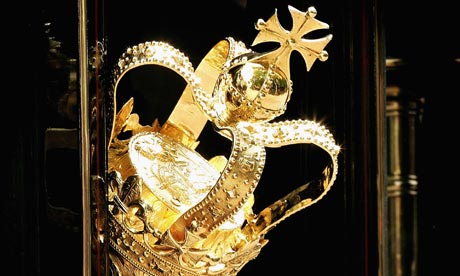
The Mace of the House of Commons is an ornate golden staff which rests in the centre of the chamber when Parliament is in session. The staff represents the authority of The Queen and must be present in the chamber for the meeting of the house to be legal.
The mace has seen its fair share of action over the decades being thrown, snatched and even wrestled from MPs protesting at Parliament’s decisions. In 2009 Labour MP John McDonnell was suspended for picking up the staff and disrupting a debate on the expansion of Heathrow Airport, London.
The House of Commons makes use of an old and rather eccentric method of voting. After the vote has been announced by the Speaker of the House, the MPs present are given eight minutes to move in to one of two rooms – the ‘aye’ or the ‘no’ room. When the time is up the doors are locked and the MPs line up to be counted.
Secretaries of State and even the PM vote on important matters and can often be seen scrambling for the correct room amongst the others. Despite looking ridiculous, the voting system provides an excellent opportunity for MPs to meet and talk with the PM and the rest of the Government.


Interesting list- am british and even I didn’t know about some of these…
Appropriate list! My favourite “un-Parliamentary” story is that MPs aren’t allowed to sit if they are drunk; the Speaker asked one MP if he was drunk and the MP replied he was “half-drunk”. The Speaker said “that is the same as being drunk” and barred him from the chamber.
When the former PM, Harold Wilson heard this story, he said the MP should have claimed he was “half-sober”.
Brilliant, I’m also British and a couple of these were unknown to me, #1 definately so.
It’s also a fact that although a perfectly true party, the BNP are not allowed to march or broadcast for votes, which in my opinion is very un-democratic.
Yet a fact I’m eternally glad of.
How very fascist of you. I despise the BNP but think it’s a disgrace they can’t broadcast like the rest for votes.
good list… the Brits and their traditions and the eccentricities…
British mumbo jumbo !!!!
“These ‘hung parliaments’ force the parties with a sizable share of the seats to make deals, sometimes two of them agree to work together until the next election.”
Ooh, i never knew that, so THATS why the Conservatives are so afraid of a hung parliment – because Labour and the Lib Dems will inevitably work together in that situation. Labour are already telling people to vote tactically for the Lib Dems in certain areas, and Clegg is talking about a coalition between the two quite alot, even if he does change his mind on it every 5 seconds.
Then again, I live in an area where the Tory candidate could just put up a poster of his own arse and still win by a landslide, so there’s not alot I can do
well you should probs know that this is wrong and can form a hung goverment if they want to this means they don't have to make a deal but will have less power
and I now realize that a lot of this BS mumbo-jumbo was passed on to a lot of the colonies, India included.
Excellent list, and very appropriate, if a little short.
A list of “10 British Parliamentary Scandals” or something along those lines would be brilliant…
@Blondie [6]: They aren’t? Then why was there a BNP election broadcast on the 26th of April? On the BBC, no less.
oh God, not a list about the bloody British Parliament! I cannot stand politicans! They knock me sick. The Iraq War, Afghanistan War, lying to people, the expenses scandal, spending OUR money on Tudor toilet seats, manure and that Duckhouse which is UNbelievable and last week “Bigotgate.” These people sicken me.
i m in love wit a brit n he has no idea..
@mechrabbit
i did have a glance at the list before commenting and i said that ‘maybe’ i’ll read the list jokingly. It was 12.30 pm when i checked LV and that’s about the time i get on the net. So i usually read the lists within 1hour they are posted.
well i loved that list. I think i didn’t know much about the british, so it was quite interesting. Coincidentally, Yesterday we had elections in my country (mauritius) and today i am watching the counting of votes live on tv! The election system that is used in my country is very similar to that of the british except that there is a best loser system that decides for 10 more seats (the best loser system is based on number of votes and ethnicity).
could someone tell me more about the authority of the queen and its limitations.
@Blondie [6]: I saw a BNP Party Political Broadcast on the BBC the other day so I don’t see how this is true.
#9 royal assent isnt odd at all. In fact i believe most countries have this system. The president (for example) has to co-sign(give his grant) the maw for it to become valid. So that happens almost everywhere i think. In a republic that wouldnt be so odd since in most republics people choose their president by a direct vot so people dont see that as very odd.
#7 again that is not odd. In many republics (e.g. France) people dont get to choose their PM. He is named by the party “who won” and the president has to accept it. (or he may not but thats quite rare)
#6 that would probably seem odd only to an american or to someone who has a bi partisan system. In countries where more than 2 parties exist its quite often to have co-allitions (especially if the voting system is representative- the number of votes is equal to the number of seats in the parlament). E.g. Germany i think but i cant recall the parties exactly or france where nowadays the ecologists seem to be getting closer to the socialists.(personally i think a multi partisan system is better than a bi :-p one. You may have situations of coallitions but atleast you avoid having such a rift among the population)
I enjoyed #3- remembered that guy that called obama a liar in congres and the papers all getting agitated. Imagine if he would have said:” mister obama you are economical with the truth”. Hell yeah. Its a recession. And #2. Do they play find the easter mace?
THIS LIST IS TOO ENGLISH!!!! LOL:)
@Smithdogg [12]:
I honestly had no idea, thanks for correcting me about that. I’m sure about their general publicity etc though, in my area although the can leaflet, they’re not even on the voting ballots.
Smithdogg says “A list of top ten British Parliamentary scandals would be brilliant..” Top ten? You`d need a top hundred! Seriously, Akashtorturedmind asks about authority of The Queen-she doesn`t have any, the Monarch lost all authority in the Glorius Revolution of 1688. The way things have been over the past year, I wish the Monarchy HADN`T. Did you know that America`s Law, is based on our old law? The America “Bill of Rights,” is based on The English Bill of Rights, of 1689. In it “Cruel and Unusual Punishment,” banning torture, is there, and America copied it. Shame Bush never read it eh?
@Akashtorturedmind [15]:
perhaps next time you could read the list and then actually comment on it- first! is not about the list or indeed anything that anyone cares about (other than yourself evidently) nor is it anything to be proud of.
I still find the idea of the politicians scrambling around trying to get into the right room amusing. Its a shame that when they’re all neatly lined up someone doesn’t take the opportunity to shoot the worst of them… :p
Nice list.
Good list. Being from Canada I recognize a lot of these (the Mace, and how the PM is designated to name two). Since we’re a former British colony our system is ripped straight from the British system, with some slight differences. We also have something like the house of lords but we call it the Senate. It’s also an unelected body and appointments are for life, the members are appointed by the PM and needless to say the potential for abuse is huge, the PM could pack the senate with former party members and folks who can do him favours. They also ratify laws but I’ve never heard of them failing to do what Parliament wants. There have been calls over the years to have them change the system so that senators are elected instead of appointed. We also have something similar to a “Hung Parliament” but we call it a “Minority Government”, the difference being that even though the other parties combined (we have a total of four sitting in our Parliament!) may outnumber the other party in seats, the party that wins the most as a whole gets to form the next government with the leader as PM. This is good in a way since the governing party tries very hard to impress the voters before the next election and generally tries to do good things (cutting taxes, etc) in hopes that the next time around they’ll win a majority.
@Smithdogg: That scandal list would be amazing! Not that this list isn’t!
I found this very interesting, and also slightly frustrating to me, being a brit who sees no point to the monarchy (it’s all just tradition, isn’t it?). I hope every Brit on here has voted!
)
As long as the BNP don’t get power, it’s all good!
Oddities of the US Congress:
You may only be President or a Congressman in modern times if you are from a privileged background and tremendously wealthy. If you are poor you don’t count.
There will only ever be two parties that may rule the country: Democrat and Republican. You may not form other parties.
You may defraud the people of the US and take the Presidency despite having fewer votes. The money oriented “justice” system will support you in this.
Once elected President, you are not required to acknowledge international treaties, laws, human rights or cultures.
When President you may have ***** with your staff.
To be President or a Congressman you must denounce Evolution. You are required to prove that you are a fundamentalist Christian.
You must demonstrate that the Middle East and all other forms of governance are evil and sub human. You must perpetuate this.
Odd yet common mathematical calculations handed out to new members of the US Congress:
The value of 100 black/brown/yellow people = .5 American.
$1,000,000 + being white = you may do as you please, please disregard the law or buy your way through it.
1 ton of American waste / “supporting economic growth” = 0 tons of waste.
Enjoy, hope you guys learned something.
Whoever gets in power should ban Piers Morgan from appearing on tv
Ever thought of standing for election? You may just become PM with that manifesto!
This list is interesting to me. I have a question, though: “…it instead relies on a huge number of separate laws and traditions which evolved over hundreds of years.”
Are the ‘traditions’ considered law? Or is it that they’ve been tradition for so long no one really questions it any more?
Hey, y’all.
I don’t find this list to be anywhere on the odd side, personally, because my island was once under British rule and our laws are still somewhat similar to theirs.
Item number 7 is a huge difference, though! What an eye opener! The posters in the picture of number 5 were interesting.
As for item number 3, I think Asian Parliament is generally much more raunchy and crass (and violent) than that of British Parliament. They just insult and taunt in a more civilized manner.
LottieB, thanks for this list! Informative.
@hehe [23]:
I’ve been in the US all my life, and have probably more criticisms than most. That being said, I was enjoying this list and the comments until you popped up – no thanks for throwing a turd in the punchbowl….
Is a British election always held on a weekday? Does this disadvantage Labour supporters? Elections are always held on a Saturday in Australia, but I don’t know whether that’s law or tradition.
Because Australia’s parliamentary system is derived from Britain’s, because I am generally interested in British history and because I used to work for a publishing company, there was nothing surprising about most of this.
From what I am aware, there is no convention or law that dictates which day of the week an election is to be held on.
Traditionally, British elections are held on a Thursday. I've heard this was due to workers collecting their wages on the Friday, and then drunk over the weekend. It's been at least 70 years since a UK election was held on a day other than a Thursday.
Is it true judges wear powdered wigs? (I love that)
@astraya [28]: Yes, it’s always on a weekday, but polling starts at 7am and doesn’t close until 10pm. Anyone that can’t get to a polling station can apply for a postal vote.
I didn’t find this odd at all. Some of them were new to me, but very interesting. The “scrambling for the correct room” had me giggling.
Neat list, LottieB.
I wish you would have spelled out MP before you started using it throughout the entire article for those of us across the pond! I had to look it up, but the list is very interesting and so different from what we know here in the US!
Has anyone got an I agree With Nick! T-shirt? There nice and colourful.
Haha at No.2
Reminds me of…
OBJECTION!
In Australia, we only have two main political parties/factions. It tends to polarise everything except the politicians always vote with the party, so it essentially removes all debate in the process. Such an inefficient system indeed..
Some are new to me very interesting list
Thanks
I’m not old enough to vote, but most people, including myself, that are my age (16-17) seem to be supporting lib dem. I hope one of the partys lowers the age to vote down to sixteen but education is my main concern, the conservitives will only let people that are highly qualified be teachers but in my experiance it doesn’t really matter about there qualifications, just there charisma, the best teacher I had was an amarican he had to look at the text books a lot but he made the lessons fun and explained everything very clearly – I ended up getting an A in science. My biology teacher I have for A-level obviusly knows a lot but I never understand a word she is saying!
your charismatic teachers obviously never showed you how to spell,bring the right to vote age down even further it would be fun seeing cheryl cole or mika as pm
I find this list too British-centric.
Uh, I mean, nice list.
@bluesman87 [15]: Aahhhhh You beat me to it! I was just about to comment on the list being “too American”, (you know, just to be a smart@$$)…
When I saw the title of this list I thought it would be boring, but I ended up being educated on some topics that I’ve always wondered about! (and, honestly, isn’t that what Listverse is all about?)
Many thanks to LottieB for an informative list on a boring Thursday in Florida!
I didn’t realize how much Canada still follows with British Parliamentary rule.
The Governor General gives Royal Assent in the Queen’s name.
We have many political parties – the Conservatives, the Liberals, the Bloc Québécois, The New Democratic Party currently being those represented in the House of Commons. As such, percent of voters doesn’t reflect number of seats.
We can’t vote directly for the Prime Minister, just for our MP.
With so many parties, we frequently have “Minority Governments” which are similar to Hung Parliaments. As such, the PM has to carefully consider before introducing a new law or bill, because the rest of the House will frequently ban together and call a vote of non-confidence if the current PM makes a move they don’t like, causing an election to be called.
An election is called every five years, but we usually don’t wait that long to have one. Also, unlike the States but like Britain, we can elect the same person over and over again.
As @Don said, we have a Senate instead of a House of Lords, but it performs in a similar manner.
I sure there’s more I’m forgetting. Still, very interesting list!
Number five, is of course a direct result of the fact that the British was too much p*****s to follow the example the frog-eaters set in 1789, and behead the king.
Number 8 is one of the downfalls of first past the post. In Canada’s last election the Bloc Quebecois received 10% of the popular vote and won 49 seats, while the NDP received 18.2% of the popular vote and only won 37 seats. I think Canada should get a system of mixed member proportional representation.
Fuddle Duddle.
@Armadillotron [17]: the Monarch did not loose all authority after the Glorious Revolution/ Bill of Rights 1688, their autority was just RESTRICTED so parliament had more power than the King/Queen…but by no means meant the Monarch had NO power at all. many revisionist historians agree that it was not a revolution, but a REACTION…the MPs were not asserting new powers or Rights, just re-asserting one that were already there but had been abused or ignored by the previous monarch. the most radical change in the Bill of Rights was that no Catholic could ever be Ruler of Britain again.
@Scratch (41) LOL!! Any of us who grew up here can never forget Mr. Trudeau. How about the Trudeau salute?
I was honestly not expecting to enjoy this list so it was pleasnt surprise… I´m giggling imagining parliament members scrambling into the correct room…
Plus “economical with the truth”… I think I´m going to use that!
Interesting list.
I myself have just been down to my polling station to cast my vote!
Is it wrong that this list makes me proud to be English?
@Amber [46]: You should be very proud of your parliaments’s originality!
@astraya [28]: in Canada elections are held on weekdays but the Elections Act legally requires employers to allow employees time off to cast their ballot:
“All employees who are qualified electors…are entitled to three consecutive hours on polling day for the purpose of casting their ballots. If an employee’s hours of work do not allow him or her three consecutive hours to vote, the employer must allow him or her sufficient time off to allow three consecutive hours for that purpose.
For example, if an employee lives in an electoral district in which the hours for voting are 9:30 a.m. to 9:30 p.m., and the employee’s hours of work are 11:00 a.m. to 7:00 p.m., the employee’s hours of work will not allow three consecutive hours for voting. The employer might allow the employee to arrive late (at 12:30 p.m.), to leave early (at 6:30 p.m.), or provide the employee three hours off at some other point during the work day in order to allow the employee the opportunity to exercise the right to vote.”
that politican at number 3 is irish
This is so cool. I love the fact that people just respect tradition instead of trying to overthrow it at every turn. I feel like Americans (please don’t get too offend. I am a proud American myself) never want to relying on old things. I mean, we have the constitution, but that’s always under debate, and people are always trying to keep moving forward and onward and upward and whatnot. I guess I’m just jealous of the fact that England is like 15x older than America.
It seemed strange to me that these are described as “Oddities” as I’m familiar with all of them and they seem normal to me. On reflection, I concede that they are very different from most of the Western world. Strangely, they do work quite well.
BTW re the usual comments that “this list is too… (insert name of country)”, the person who described it as too English seems to have forgotten it applies to Scotland, Northern Ireland and God’s own country of Wales!
IS that Raisin Brahms classical music ceral ad for real?
@gw1pcd [51]: That’s what I was going to say!
But then again, Scotland does have it’s on Parliment, but they don’t have total control =P
Good List!
Very interesting list! As several have said before me, most of these are very familiar to me because we have a copy-cat system here in Canada. I think we raise hands here to vote on something, though. If our politicians had to scramble into rooms, I might like them more.
It’s probably already been said but the politician in the picture for #3 is from Ireland. He most certainly has nothing to do with the British Parliament
Number 9 is wrong I belive,, the queen doesn’t need to give the royal asscent its jsut a convetion alothugh odd. Other that its a relaly good list which will help in my A level politics studies.
@Don [43]:
lol. Yeah, he was quite a character from what I hear and read.
@sochej [54]:
Yeah, in Canadian Parliament the speaker actually does a voice vote – first asking for the ayes and then the nays and then just judging between the two based on volume. If it seems close, the members can ask for a recorded vote, and then they just stand up and say aye or nay as they are called by name.
Sadly, number 6 would never happen here in America.
I’m absolutely hypnotized when Parliament is in action. I try to catch it on TV whenever I have a chance…
Here’s a clip where Cameron DESTROYS Brown in debate:
I voted this morning. To be honest I didn’t vote with a great enthusiasm. My current MP Peter Robinson has been embroiled in a ***** scandal ( his wife, also an MP had an affair with a 19 year old ( she’s 60! ) and a financial scandal YET he’s almost guaranteed to be re elected! The nonsense that is Northern Ireland politics!